




Abstract
Objectives
The objective of this study was to learn about owner experiences of chronic kidney disease (CKD), focusing on use of therapeutic renal diets (TRDs) and intestinal phosphate binders (IPBs).
Methods
An online survey was promoted to UK-based cat owners.
Results
In total, 859 owners participated. Most cats (n = 620; 72.18%) had two or more clinical signs at the time of their CKD diagnosis. Most common were polydipsia (n = 462; 53.78%) and weight loss (n = 426; 49.59%). In 94 cats (10.94%) CKD was only diagnosed as a result of wellness screening. In total, 371 participants (43.19%) reported that their cat’s blood pressure had been measured; 100 of these (26.95% of those where blood pressure had been measured) subsequently received anti-hypertensive medication. In total, 90.80% of all participating owners had received a recommendation to feed a TRD. Five hundred and seventy-one owners (66.47%) reported that they were feeding a TRD as a component of their cat’s diet. The most common reason for not feeding a TRD was that the cat did not like it (n = 123; 59.13%). Where a veterinary recommendation to feed a TRD had been received, 564 owners (72.31%) reported feeding a TRD as a component of their cat’s diet vs seven owners (7.04%) who had not received a veterinary recommendation to feed a TRD. IPBs had been recommended to 321 owners (37.81%) and for 72 owners (8.38%) the recommendation came from a source other than a veterinary professional. Where used, IPBs were commonly added to a TRD (n = 136; 49.28%) and were generally accepted within 4 weeks (n = 178; 73.86%).
Conclusions and relevance
Awareness of TRDs was high but much lower for IPBs. A veterinary recommendation to feed a TRD was associated with higher compliance.
Introduction
Chronic kidney disease (CKD) is one of the most common conditions affecting elderly cats and is estimated to affect more than 30% of cats over 10 years of age. 1 Common historical findings compatible with CKD include weight loss, polydipsia, polyuria, poor appetite and vomiting.1–3 CKD is typically diagnosed on the basis of an increased serum creatinine in combination with inappropriately low urine specific gravity, evidence that these changes are sustained (for several weeks or months) and a clinical history compatible with CKD. 4 Systolic blood pressure assessment is recommended in all cats where CKD is suspected or diagnosed. 4
A small number of publications have reported survey data from owners of cats with CKD, including assessment of quality of life, 5 diet and medication practices,6,7 and awareness and experience of lily toxicity. 8 Owner surveys offer a unique possibility of understanding the ‘end-user’ experience of caring for a cat with CKD.
Clinical studies have reported that feeding a specially designed phosphate-restricted therapeutic renal diet (TRD) is associated with increased survival times for feline CKD patients.9–11 In four research studies, between 46% and 94% of patients with CKD were reported to accept a TRD as a component of their management.9,10,12,13 A recent survey of US owners of cats with CKD reported that 51% of those questioned were feeding a TRD as a component of their cat’s diet. 7 Previous pet owner surveys have indicated compliance to a therapeutic diet could be as low as 12–21%.6,14 Poor compliance may relate to cat and/or owner factors such as nausea related to uraemia and owner reluctance to change the diet for financial or other reasons. Oral phosphate binders can be a useful adjunct to a TRD or used with standard commercial cat food in situations where cat or owner compliance to a TRD is poor.4,9,12
The current study was designed with the aim of understanding more about the experiences of UK owners of cats with CKD and, specifically, their awareness and use of TRDs and intestinal phosphate binders (IPBs).
Materials and methods
A survey was devised to collect data from owners of cats with CKD. The survey contained 35 questions. The questions took a variety of forms, including selecting a single option from a dropdown menu (eg, the cat’s age), ticking checklists (eg, what clinical signs their cat was showing), selecting single options from a number of choices (eg, what International Renal Interest Society [IRIS] stage is your cat?) and entering information in ‘free text’ form. Five questions required an answer only in ‘free-text’ form (eg, the cat’s name); 14 questions allowed owners to enter free text in addition to the answer they gave using the dropdown menu or checklist selections. See the supplementary material for the questionnaire.
Participants were recruited via electronic invitations sent to the Vet Professionals (www.vetprofessionals.com) database of cat owners (around 2000 members) from August 2011 to January 2015, notifications on the Vet Professionals website and postings on the Vet Professionals Facebook page. The country of residence is not known for all members but where recorded is UK (79%) and USA (13%), with smaller numbers from Australia and Europe. One hundred UK veterinary clinics were recruited to assist in promotion of the survey and were supplied with flyers to hand out to clients who owned a cat with CKD. Press releases were made to UK veterinary and owner publications and posted on veterinary and owner CKD forums. Any owner of a cat with CKD was eligible to complete the survey with a maximum of one survey per household, completing the survey for the first eligible cat when listed by name alphabetically.
Data collected from the online questionnaires was collated and stored using FormSite (Vroman Systems) before downloading in a Microsoft Excel spreadsheet for analysis. Descriptive statistical analysis was performed on the data. Free-text owner statements were assessed individually and grouped according to similarity of their contents, as appropriate.
Results
A total of 859 unique questionnaires were received between 3 August 2011 and 22 June 2015. Questionnaires took a median of 8.5 mins to complete (range 2.6 mins to 23.7 h). Two hundred and sixteen (25.15%) questionnaires were received in 2011; 345 (40.16%) in 2012; 162 (18.86%) in 2013; 82 (9.55%) in 2014; and 54 (6.29%) in 2015. Seven hundred and sixty-two (88.71%) respondents told us where they had heard about the survey, with 421 (55.25%) coming as a result of emails and Facebook postings from Vet Professionals or direct visits to the author’s website; 98 (12.86%) came via a recommendation from their veterinary clinic; 88 (11.55%) came via postings on CKD owner forums; 64 (8.40%) as a result of ‘word of mouth’ from friends; and the remainder came as a result of press releases in a variety of vet and owner publications and referrals from other websites and Facebook pages (n = 91; 11.94%).
The cats ranged in age from 1 year to more than 20 years, with a mean age (where known) of 13 years and 4 months.
Six hundred and seventy-six of the cats (78.70%) were non-pedigree short- or longhaired cats and 183 (21.30%) were purebred cats. Participants were asked approximately how long ago their cat had been diagnosed with CKD. The range reported was from 0 days (‘today’) to 11 years. The average time since diagnosis was 14.9 months; 541 (62.98%) of the cats had been diagnosed within 12 months of the owner completing the questionnaire.
In 94 cats (10.94%), CKD was solely diagnosed as a result of a ‘wellness’ screening test and no clinical signs of illness were apparent to the owner. In a further 145 cats (16.88%) only one clinical sign was reported. In the remaining 620 cats (72.18%), two or more clinical signs were reported (Table 1). Overall, increased thirst (n = 462; 53.78%) and weight loss (n = 426; 49.59%) were the most frequently reported clinical signs.
Clinical signs reported at the time of diagnosis for all 859 cats

CKD = chronic kidney disease
Five hundred and twenty-two participants (60.77%) stated that both blood and urine tests had been performed in their cat in order to make a diagnosis of CKD. In 312 cases (36.32%), blood tests alone were performed; in 10 cases (1.16%) only urine tests were reported to have been performed. In 15 cases (1.75%), the option ‘I don’t know’ was selected. One hundred and seventy-six participants (20.49%) had been told about the IRIS staging system by their veterinarian and/or veterinary nurse/technician, whereas the majority (n = 582; 67.75%) had not or could not remember (n = 101; 11.76%). In total, 308 participants (35.86%) knew what IRIS stage their cat was currently in and this was reported as stage 1 (n = 34 cats; 3.96%), stage 2 (n = 113 cats; 13.15%), stage 3 (n = 97 cats; 11.29%) and stage 4 (n = 64 cats; 7.45%). The remaining 551 participants (64.14%) did not know what IRIS stage their cat was in. Three hundred and seventy-one participants (43.19%) reported that their cat’s blood pressure had been measured. The remaining participants mainly reported that blood pressure had not been measured (n = 311; 36.20%) with a smaller number (n = 177; 20.61%) not being able to remember. One hundred and thirty of the 371 cats (35.04%) where blood pressure had been measured were reported to have high readings, blood pressure was normal in 211 cats (58.67%), low in four cats (1.08%) and unknown in 26 cats (7.01%). In those cats where a high blood pressure was reported, 100 (76.92%) were prescribed anti-hypertensive medication, representing 26.95% of those cats where blood pressure was assessed. Sixty-three of these ‘hypertensive’ cats (63.00%) were receiving amlodipine alone; 18 (18.00%) were receiving benazepril alone; eight (8.00%) receiving amlodipine and benazepril in combination; and the remainder receiving alternative/unknown agents or a combinations of agents (n = 11; 11.00%).
More than 90% of the owners (n = 780 cats; 90.8%) recalled receiving a recommendation from their veterinarian or veterinary nurse/technician to feed a TRD. Seventy-one owners (8.27%) said that this recommendation had not been made to them and a further eight owners (0.93%) were unable to remember. Of those recommended a renal diet, 563 (72.18%) recall being told that a TRD was phosphate-restricted, 159 (20.38%) had not been told this by their veterinary professional and a further 58 (7.44%) were unable to remember.
All study participants were asked how much TRD they were currently feeding their cat. In total, 571 owners (66.47%) reported that they were feeding a TRD as a component of their cat’s diet. Of the 780 owners who had received a recommendation to feed a TRD, a higher percentage were reported to be feeding a TRD as a component of their cat’s diet (n = 564; 72.31%). Three hundred and thirty-eight (43.33%) of these owners stated that approximately 75–100% of what their cat ate was a TRD; 124 owners (15.90%) stated that approximately 50–74% of what their cat ate was a TRD; 102 (13.08%) stated that less than half of what their cat was eating was a TRD; 208 (26.67%) reported that their cat was not eating any TRD; and eight owners (1.03%) did not answer this question. For the 71 owners where no veterinary recommendation had been received to feed a TRD, 65 (91.55%) were feeding no TRD to their cat, five owners (7.04%) were feeding some TRD and one owner (1.41%) did not answer this question. Eight owners were unable to remember whether or not a recommendation had been made to feed a TRD. Of these, six were not feeding any TRD, while two were feeding some TRD to their cat with CKD.
In total, 279 owners (32.48%) stated that their cat was not receiving any TRD. Two hundred and eight of these owners (74.55%) had received a recommendation from their veterinary professional to feed a TRD, 65 owners (23.30%) had not and six (2.15%) could not remember whether or not they had received a recommendation. Reasons for not eating a TRD are summarised in Tables 2 and 3.
Owners not feeding a therapeutic renal diet (TRD) as a component of their cat’s diet were asked why this was the case. The table shows their reasons, grouped according to whether or not a TRD had been recommended by their veterinary professional

Data are n (% of applicable cats)
Grouped ‘free-text’ comments entered by owners as ‘other’ reasons for not feeding a therapeutic renal diet (TRD)

Data are n (%)
CKD = chronic kidney disease
Participants were asked whether anyone had recommended an IPB for their cat. Eight hundred and forty-nine of the owners participating in the survey answered this question, with 321 (37.81%) answering yes, 499 (58.78%) answering no and 29 (3.42%) not remembering. The recommendation to use an IPB was most commonly made by a veterinarian (n = 233; 73.50%), with veterinary nurses accounting for a small number of recommendations (n = 12, 3.74%). In 72 owners (22.71%) a recommendation to use an IPB was made but not by a veterinarian or nurse – this primarily comprised websites and internet forums with ‘Tanya’s comprehensive guide to feline chronic kidney disease’ website and forum cited by 16 owners (5.05%). 15 Three hundred and eighty-four of the 385 owners feeding less than half of their cat’s diet as a TRD answered this question. Of these owners, a slightly higher number (n = 158; 41.15%) had received a recommendation to use an IPB in their cat, 212 (55.21%) had not and 14 (3.64%) could not remember.
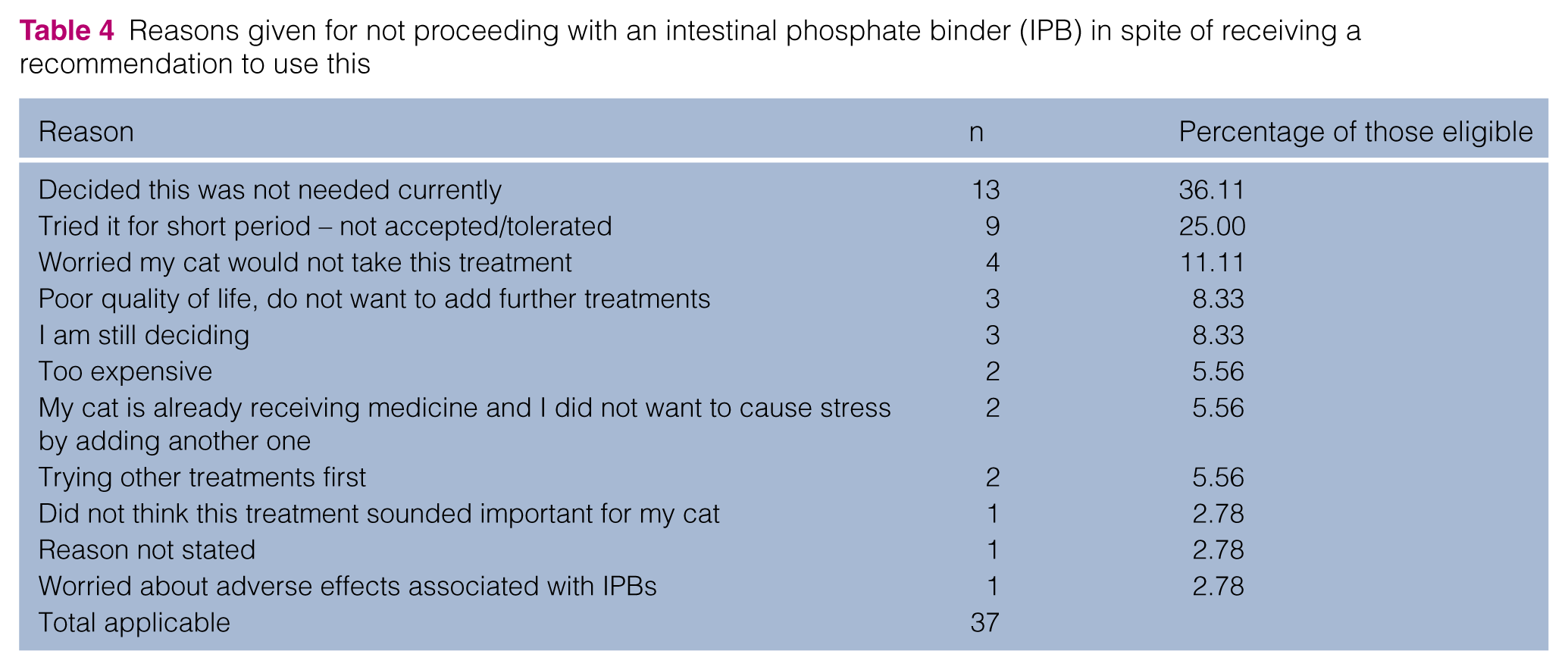
Thirty-six owners (11.21%) chose not to proceed with IPB treatment in spite of the recommendation. A number of options were offered as reasons for not proceeding (Table 4). The most common reasons for not proceeding were deciding that the treatment was not currently needed (n = 13; 36.11%) or having tried an IPB for a short period and given up (n = 9; 25.00%). Two hundred and seventy-six owners (85.98%) proceeding with IPB treatment stated which binder they chose/was chosen for their cat (Table 5). Twelve cats (3.74%) were reported to be receiving two different binders. One hundred and thirty-six owners (49.28%) proceeding with IPB treatment were adding this to a TRD. Sixty-two owners (22.46%) stated that they were not using the IPB with a renal diet, five owners (1.81%) did not answer this question and the remaining 73 (26.45%) selected ‘other’ in answer to the question whether they were using an IPB in addition to a TRD. The majority of these owners stated that they added binder to the non-renal food, while also separately offering their cat some TRD.
Reasons given for not proceeding with an intestinal phosphate binder (IPB) in spite of receiving a recommendation to use this
Owners were asked which intestinal phosphate binder (IPB) they or their veterinary clinic had chosen to use. Answers shown for the 321 owners that had received a recommendation to use an IPB

Two hundred and forty-one owners provided further information on how they were currently administering the IPB to their cat. Most (n = 148; 61.41%) were mixing the IPB with their cat’s food two or more times per day, 42 (17.43%) were mixing the IPB with their cat’s food once a day, 22 owners (9.13%) were administering the IPB orally to their cat close to mealtimes two or more times per day and eight (3.32%) were administering the IPB orally to their cat close to a mealtime once a day. Other answers included administering once a day with timing unrelated to mealtimes (n = 7; 2.90%), administering orally two or more times per day with timing unrelated to mealtimes (n = 3; 1.24%). A small number (n = 11; 4.56%) were using alternative strategies, including administering on treats, only using when the phosphate content of the meal was above 0.7% dry matter, and not using it every day. These same 241 owners also provided information on the ease of acceptance of an IPB in their cat. One hundred and forty-nine (61.83%) reported that it took less than 7 days to persuade their cat to accept the treatment, 29 (12.03%) reported that it took between 1 and 4 weeks to gain acceptance by their cat, eight (3.32%) reported that it had taken more than 4 weeks but they had succeeded in gaining acceptance from their cat and 32 (13.28%) reported that they were still struggling to persuade their cat to accept the IPB. Twenty-three owners (9.54%) recorded ‘other’ comments, which included that they felt it was too early to say, they were administering the IPB via a feeding tube or gel cap, and that their success of acceptance either varied from day to day or with certain binders. Owners were asked to suggest tips for assisting acceptance of an IPB in their cat. Most popular were to mix the binder with a small amount of tasty food (n = 34) and to start at a low dose and increase this gradually (n = 21).
Two hundred and seventy owners that had tried IPB in their cat answered the question ‘Will you continue using a phosphate binder once you have finished your current supply’, with most answering yes (n = 211; 78.15%). One owner (0.37%) answered ‘definitely not’, 25 owners (9.26%) were not sure and 33 (12.22%) stated that they had already stopped giving their cat an IPB. The 59 owners selecting ‘definitely not’, ‘not sure’ or ‘I’ve already stopped using a phosphate binder’ indicated the factors that were influencing or had influenced this decision (Table 6). Most common was difficulty getting the treatment into their cat (n = 28; 41.79%).
Factors that were influencing or had influenced an owner’s decision to consider stopping use of an intestinal phosphate binder (IPB) in their cat

Six hundred and eight owners who had never received a recommendation to use an IPB in their cat were provided with a brief explanation of what these aimed to achieve and when they were indicated before asking if, knowing this, they would be interested in trying an IPB in their cat. The overwhelming majority of owners (n = 520; 85.53%) answered yes, while 88 (14.47%) answered no. Where given, reasons for answering ‘no’ (free text) for around one-third of respondents (n = 28; 32.94%) were that their cat’s phosphate levels were currently normal. Other reasons for not wishing to try an IPB included worries that the cat would not accept a binder added to their food (n = 11; 12.94%), that the cat was currently doing well and therefore they did not want to add additional medications (n = 10; 11.76%), that this medication had not been recommended by their veterinarian (n = 9; 10.59%), that they wished to know more about IPBs before making a decision (n = 9; 10.59%) or that it was too late in the course of their cat’s illness for them to be expected to benefit from an additional treatment (n = 6; 7.06%). Several comments highlighted the value the owner put on their veterinarian’s recommendations – for example: ‘I would use this if my vet recommended it’, ‘I need my vet to recommend this’ and ‘I follow what my vet tells me’.
Discussion
This is the first UK-based large-scale survey that has been carried out to report owner experiences of diagnosis and management of feline CKD and the only owner survey that reports in detail measures being taken to achieve phosphate restriction.
The most common clinical signs noted by owners were of polydipsia and weight loss (53.78% and 49.59% of cats, respectively), similar to previous reported studies.1–3 In 94 cats (10.94%) the diagnosis of CKD had been made solely as a consequence of a wellness evaluation indicating that ‘wellcat’ checks are being promoted. Lifestage-appropriate health screening has been advocated by feline specialists and veterinary associations such as the American Association of Feline Practitioners for many years. 16 While it was informative to collate owner recollections regarding how their cat’s diagnosis of CKD had been made, results may not be completely trustworthy owing to the time that had passed between diagnosis and completion of the questionnaire. In 318 cases (37.02%), the questionnaire had been completed more than 1 year following the cat’s diagnosis of CKD.
In this study, blood pressure was reportedly assessed in only 371 (43.19%) of the cats with anti-hypertensive treatment prescribed in 26.95% of these (100 cats). Previous studies have reported up to 65% of CKD patients having systemic hypertension. 17 Two studies based in first-opinion clinics, likely to be a better reflection of the prevalence in the general population, reported 19–40% of their CKD patients having concurrent systemic hypertension, similar to this owner survey.18,19
The overwhelming majority of owners participating in this study had received a recommendation to feed a TRD (n = 780; 90.80%), which indicates that veterinary awareness of the value of feeding a therapeutic diet for this condition is well recognised. This study also indicated a benefit in compliance when a veterinary recommendation was made. Overall, 571 owners (66.47%) were feeding some TRD – a figure higher than has been reported in other owner surveys.6,7,14 When separated according to whether the owner had received a veterinary recommendation to feed a TRD, the impact of the veterinary recommendation became clear: 72.31% of owners that had received a recommendation to feed a TRD were feeding this as a component of their cat’s diet compared with only 7.04% of those where no recommendation had been received.
Awareness of IPBs was relatively low in this study, with 321 owners (37.81%) owners having received a recommendation to use one of these. Interestingly, this is a higher proportion than that stated in the 2015 study by Markovich et al, 7 which reported that 22% of US-based owners of cats with CKD surveyed were using an IPB in their cat. Both surveys were hosted online and promoted in similar ways, so it is not clear why these results are so different. It is possible that the results may reflect some differences between UK- and US-based cat owners and/or the promotion and/or availability of IPBs. In the current study, awareness of IPBs was slightly greater in those owners feeding less than half of their cat’s diet as a TRD (n = 158; 41.15% of this group) meaning that almost 60% of owners feeding little or no TRD were not providing a phosphate-restricted regime for their cat. Approximately one-fifth of owners using an IPB (n = 72; 22.71%), made the decision to consider using an IPB based on their own reading and research rather than receiving a recommendation from a veterinary professional.
Most owners using an IPB were using either lanthanum carbonate (Renalzin; Bayer Animal Health) or a calcium carbonate and chitosan combination (Ipakitine; Vétoquinol) and the majority reported that their cat accepted this treatment within 4 weeks of initiating therapy (n = 178; 73.86% of those using an IPB). However, difficulty getting the treatment into their cat was the most common factor cited as being important in those owners that had experienced difficulty in gaining acceptance in their cat (n = 28; 41.79%). Improvements in palatability and ease of administration would be helpful as would education on how IPBs should be administered since some owners were administering an IPB at times unrelated to mealtimes.
The value of veterinary support and recommendation for dietary changes and use of binders was evident in some of the ‘free-text’ comments made, underlining the importance of veterinary discussion with owners. Awareness of this finding and of the higher compliance rates to a TRD for those owners that had received a veterinary recommendation may assist clinicians in achieving ‘gold-standard’ care. For example, improved compliance to diagnostic and assessment recommendations such as laboratory tests and systolic blood pressure measurement may be achieved by ensuring that pet owners are aware of these recommendations. With time and support it is to be hoped that all azotaemic CKD patients will receive appropriate phosphate-restriction – ideally through feeding a TRD – as currently recommended.4,20 IPBs are indicated in situations where a TRD is not or cannot be used and in cases where use of a TRD is not sufficient to control serum phosphate levels according to the IRIS recommendations.4,20
It is important to note that the owners completing this survey probably do not represent the ‘average’ cat owner and that this study does have limitations. Our database selects for cat owners with online access who have performed an online search and previously found our website. Many of these owners are likely to have read widely on the subject of CKD prior to completing the questionnaire. This study was time-consuming and required a high degree of dedication from participants. The questionnaire relied on the owner remembering details of their cat’s diagnosis and management, which may have biased some of the results recorded. In addition, social acceptability bias may have influenced some of the results, with owners selecting the answers they felt most ‘correct’. The survey participants are likely to represent the most dedicated cat owners, which is likely to have impacted many of the results. For example, compliance to a TRD is likely to be lower in the general population of UK cat owners.
Conclusions
This study has revealed how powerful the recommendation of a veterinarian can be in achieving compliance to a suggested treatment. Compliance to a TRD was much greater in cats with owners who had received a veterinary recommendation to use this food, whereas very few of the owners that had not received this recommendation were feeding their cat with CKD a TRD. Utilisation of this finding may assist clinicians in achieving optimal management of CKD and other illnesses.
While a recommendation to feed a TRD is commonly made, many cats are not completely compliant to this dietary change and may benefit from the addition of an IPB. The results of this study suggest that IPBs are not commonly recommended in spite of their potential value in providing phosphate restriction to cats with CKD. 4
Supplemental Material
Supplementary Material
Vet Professionals renal questionnaire
Footnotes
Acknowledgements
I would like to thank my colleague Kim Cockburn for her assistance in promoting this study to UK cat owners.
Supplementary material
Vet Professionals renal questionnaire.
Conflict of interest
The author is sole shareholder and an employee of Vet Professionals, which provided support for hosting and promoting this study.
Funding
This study was supported by sponsorship from Bayer Animal Health in 2011 and 2012.
References
Supplementary Material
Please find the following supplemental material available below.
For Open Access articles published under a Creative Commons License, all supplemental material carries the same license as the article it is associated with.
For non-Open Access articles published, all supplemental material carries a non-exclusive license, and permission requests for re-use of supplemental material or any part of supplemental material shall be sent directly to the copyright owner as specified in the copyright notice associated with the article.
