



Abstract
Objectives
Chronic kidney disease (CKD) is a significant disease in cats. Identifying risk and protective factors may help to prevent this significant disease.
Methods
An age-matched case-control study was performed to determine the risk factors in cats with naturally occurring CKD. Twenty-nine clinically normal cats aged ⩾5 years and 101 cats with naturally occurring CKD were studied. Risk factors were determined by interviewing cat owners from the Small Animal Hospital, Faculty of Veterinary Science, Chulalongkorn University, and veterinary hospitals in the Bangkok Metropolitan area, through questionnaires completed between June 2004 and November 2014. Univariable and multivariable analyses were performed using two independent proportional test methods and logistic regression analysis with backward elimination.
Results
Male sex (odd ratios [OR] 2.80, 95% confidence interval [CI] 1.02–8.87; P = 0.02), tap water (OR 3.43, 95% CI 1.08–11.45; P = 0.03) and an outdoor lifestyle (OR 3.77, 95% CI 1.03–17.99; P = 0.04) were associated with an increased risk for CKD. Commercial dry cat food (OR 0.06, 95% CI 0.02–0.17; P = 0.00), filtered water (OR 0.13, 95% CI 0.03–0.52; P = 0.01) and an indoor lifestyle (OR 0.28, 95% CI 0.07–0.98; P = 0.02) were associated with a decreased risk. Logistic regression analysis using backward elimination demonstrated that cats fed commercial dry cat food (OR 0.042, 95% CI 0.01–0.17; P = 0.00) had a decreased risk for CKD compared with cats on other types of diet.
Conclusions and relevance
Multivariable analysis found only feeding commercial dry cat food to be significant, suggesting that commercial dry cat food may be a potential protective factor for CKD in cats.
Introduction
Chronic kidney disease (CKD) is commonly found in older cats.1–3 It is defined as an irreversible decline in renal function of >50% of the glomerular filtration rate (GFR) of at least 3 months’ duration. 4 CKD causes a reduction in renal clearance and disruption to acid–base, fluid volume and electrolyte homeostasis. 4 The prevalence of feline kidney disease has been reported as 1.9% in the general cat population in the USA and as 20% in cats presented at animal hospitals in Australia.5,6 In Thailand, feline CKD was found in 0.6% of cats presented at a small animal hospital. 7 Common clinical signs of CKD in cats include polyuria, polydipsia, dehydration, weight loss, pale mucous membranes and small kidneys. 4 The major aetiology of feline CKD is still unknown. The major histopathological change in feline CKD is tubulointerstitial nephritis.4,8 Breed has also been found to be one of the predisposing factors for CKD.7,9 Maine Coon, Abyssinian, Siamese, Russian Blue and Burmese cats are the most prevalent breeds with CKD. 9
Although there have been previous studies of risk factors in feline CKD,10,11 many risk factors remain to be investigated. Siamese and Siamese mixed-breed cats are commonly found with CKD in Thailand. 7 The objective of the present study was to determine the risk factors in cats with naturally occurring CKD.
Materials and methods
Data were collected from the Small Animal Hospital, Faculty of Veterinary Science, Chulalongkorn University, and veterinary hospitals in the Bangkok Metropolitan area between June 2004 and November 2014. Owners of cats were interviewed regarding the age, sex, breed, weight, types of food fed, water sources and lifestyle of the cats. The owners were asked the same questions whether their cats were included as cases or controls. Cats with CKD and age-matched clinically normal cats were included in the study.
Case and control selection
Cats with naturally occurring CKD were cats of ⩾5 or more years of age with clinical signs including weight loss, polyuria, polydipsia, poor body condition, dehydration, non-regenerative anaemia with blood urea nitrogen (BUN) >35 mg/dl, creatinine >1.6 mg/dl and urine specific gravity (USG) <1.030. CKD cats had to have two or three of the criteria (increased BUN, creatinine and USG <1.030). CKD cats were excluded if they had history of lower urinary tract disease, tumour or calculi in the kidney and/or other severe diseases, including diabetes mellitus, lymphoma and heart failure. The clinically normal client-owned, age-matched cats were cats of ⩾5 years of age with normal physical examination performed by the veterinarian on duty, with BUN <35 mg/dl, creatinine <1.6 mg/dl and USG ⩾1.030. The protocol was approved by the Ethic Committee for Human and/or Animal Experimentation, Faculty of Veterinary Science, Chulalongkorn University.
Statistical analysis
Epi Info version 3.5.3 was used to determine the associations between risk factors and naturally occurring CKD in cats. Age and body weight data are presented as mean ± SEM. Means of age and body weight between groups were compared using the Student’s t-test. Relative frequencies were used to describe the breed, sex and age of cats that developed CKD. Univariable and multivariable analysis were performed. Univariable analysis of categorical data was performed to identify the association between CKD and the variable. Fisher’s exact test was used to test variables associated with CKD when expected frequencies were <5. Pearson’s χ2 was used in cases of large expected frequencies. Multivariable analysis using logistic regression analysis with backward elimination was used to identify variables with potential risk for CKD. Only significant variables identified in the univariable analysis were evaluated in the multivariable model. The Mantel–Haenszel test was used to calculate the odds ratios (OR) and 95% confidence interval (CI). The OR was considered significant by 95% CIs that do not include a value of 1.0. A P value <0.05 was considered significant.
Results
In total, 130 cats were included in the study. There were 29 clinically normal, client-owned, age-matched cats and 101 cats with naturally occurring CKD. Clinically normal, client-owned, age-matched cats and CKD cats were presented to the Small Animal Hospital, Faculty of Veterinary Science, Chulalongkorn University, and at veterinary hospitals in the Bangkok Metropolitan area. The age of the clinically normal, age-matched cats was 9.09 ± 0.59 years and that of the CKD cats was 9.02 ± 0.37 years (P = 0.93). The body weight of CKD cats (4.31 ± 0.18 kg) was similar to that of the clinically normal cats (4.52 ± 0.20 kg) (P = 0.53). BUN, creatinine and USG levels of the CKD cats were 96.87 ± 8.49 mg/dl, 5.01 ± 0.40 mg/dl and 1.016 ± 0.001, respectively. CKD cats were divided into three CKD groups, according to the staging system of the International Renal Interest Society: stage II (mild renal azotaemia; n = 42), stage III (moderated renal azotaemia; n = 28) and stage IV (severe renal azotaemia; n = 31). Of the clinically normal cats, five (17.2%) were male, eight (27.6%) were male castrated, nine (31.0%) were female and seven (24.1%) were female spayed. Of the CKD cats 37 (37.0%) were male, 21 (21%) were male castrated, 30 (30%) were female and 12 (12.0%) were female spayed (Table 1). There was a statistical difference in sex between the two groups.
Signalment of age-matched data of cats presented at the Small Animal Hospital, Faculty of Veterinary Science, Chulalongkorn University (CU), and veterinary hospitals (Private) in the Bangkok Metropolitan area, Thailand, between 2004 and 2014

Data are n (%)
n = 101
P <0.05 when compared between the clinically normal age-matched cats and the cats with chronic kidney disease
OR = odds ratio; CI = confidence interval
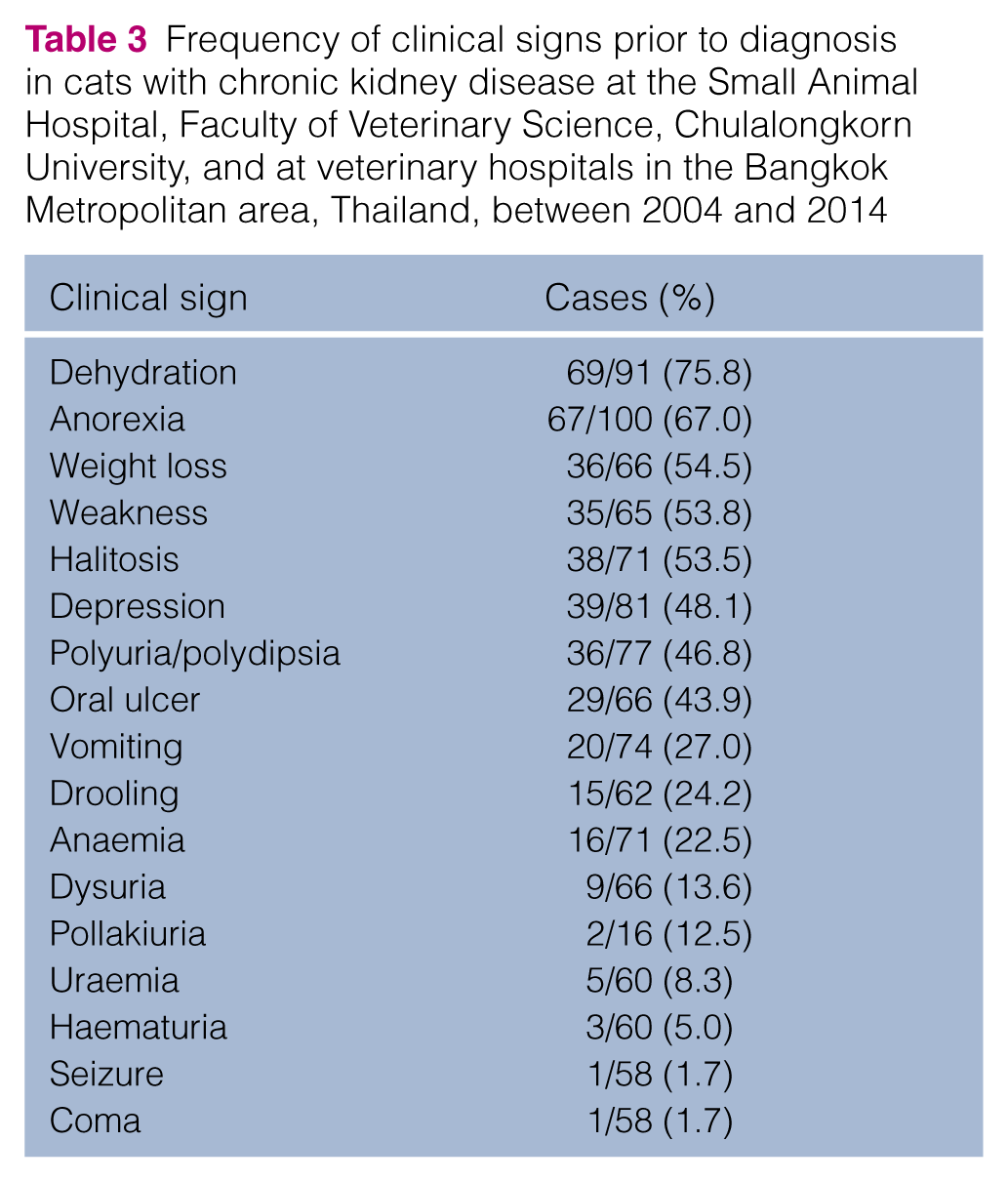
Most CKD cats were allowed to roam freely outdoors (43.4%) (Table 2). According to the clinical signs, CKD cats suffered from dehydration (75.8%), anorexia (67.0%), weight loss (54.5%), weakness (53.8%), halitosis (53.5%), depression (48.1%), polyuria and polydipsia (46.8%), oral ulcer (43.9%), vomiting (27.0%), drooling (24.2%), anaemia (22.5%), dysuria (13.6%) pollakiuria (12.5%), uraemia (8.3%), haematuria (5.0%), convulsion (1.7%) and coma (1.7%) (Table 3).
Information on type of diet, homemade food, flavour, frequency of feeding, water source, water frequency and lifestyle of age-matched data of cats presented at the Small Animal Hospital, Faculty of Veterinary Science, Chulalongkorn University, and veterinary hospitals in the Bangkok Metropolitan area, Thailand, between 2004 and 2014

Data are n (%)
P <0.01 when compared between the clinically normal age-matched cats and the cats with chronic kidney disease (CKD)
P <0.05 when compared between the clinically normal age-matched cats and the CKD cats
OR = odds ratio; CI = confidence interval
Frequency of clinical signs prior to diagnosis in cats with chronic kidney disease at the Small Animal Hospital, Faculty of Veterinary Science, Chulalongkorn University, and at veterinary hospitals in the Bangkok Metropolitan area, Thailand, between 2004 and 2014
When data were analysed using univariable analysis, male cats were associated with an increased OR for CKD when compared with other types of sex (OR 2.80, 95% CI 1.02–8.87; P = 0.02) (Table 1). Cats that were fed commercial dry food were associated with a decreased OR for CKD when compared with other types of food (OR 0.06, 95% CI 0.02–0.17; P = 0.00) (Table 2). Filtered water was associated with a decreased risk (OR 0.13, 95% CI 0.03–0.52; P = 0.01), whereas tap water was associated with an increased risk for CKD (OR 3.43, 95% CI 1.08–11.45; P = 0.03). Cats that roamed freely outdoors had a 3.77 times higher risk for CKD than cats living in other environments (OR 3.77, 95% CI 1.03–17.99; P = 0.04). On the contrary, cats with an indoor lifestyle had 0.28 times the risk for CKD (OR 0.28, 95% CI 0.07–0.98; P = 0.02) (Table 2).
From multivariable analysis using logistic regression with backward elimination, the present study demonstrates that cats fed with commercial dry food had a lower risk for CKD than cats that consumed other types of diets (OR 0.042, 95% CI 0.01–0.17; P = 0.00) (Table 4).
Logistic regression analysis (backward) of multivariables, including commercial dry food, male cats, filter water, tap water, freely outdoor and freely indoor in age-matched cats with chronic kidney disease at the Small Animal Hospital, Faculty of Veterinary Science, Chulalongkorn University, and at veterinary hospitals in the Bangkok Metropolitan area, Thailand, between 2004 and 2014

P <0.01 when compared between the clinically normal age-matched cats and the CKD cats
OR = odds ratio; CI = confidence interval
Discussion
All clinically normal cats and cats with CKD were matched on age because ageing may be an important confounding factor. The ageing process may be one of the factors causing CKD in cats. The mean ± SEM age of CKD cats (9.02 ± 0.37 years) was similar to that of previous studies.1,3,12,13 One study reported that CKD cats in Thailand were approximately 6 years old, 7 which is lower than reported in most previous studies.1,3,12,13 It is possible that there were differences in study design and population included in this study. Ageing has been found to be associated with decreased renal function in human beings. 14 This may be the result of progressive tubular deletion and peritubular interstitial fibrosis, which have been reported in older cats. 12 Of the CKD cats included in this study, 46.5% were reported to have polyuria and polydipsia, which is in agreement with previous reports.3,10
The present study demonstrated that male entire cats were associated with an increased risk of CKD when compared with other types of sex. The association between a cat’s sex and CKD was also reported in a previous study in Australia, which suggested that male cats develop CKD earlier than female cats. 13 Membranous nephropathy was commonly found in male cats; feline immunodeficiency virus (FIV)-associated nephropathy was more common in male entire cats. The reason for this may be explained by one study in rats, which indicated that 17β-oestradiol can protect female rats from hypertension, which causes renal disease progression by inhibiting superoxide production. 15 In people, it was found that women have protection from developing end-stage renal disease, a supporting the role of sex in CKD. 16
The present study also found that cats fed with commercial dry food were associated with a decreased risk for CKD. Hughes et al found that a high-fibre diet, which was low in protein and low in phosphate, decreased the risk of chronic kidney disease in cats. 11 The same trend was reported by Harte et al in 1994 – that a lower-protein diet can slow the rate of clinical signs of progression in CKD cats. 17 Cats with CKD that were given proteinand phosphorus-restricted diets demonstrated longer survival times than the unrestricted group. 18 Cats with spontaneous CKD fed a renal diet had significantly lower serum creatinine and higher blood bicarbonate concentrations than did the maintenance diet group. 19 In this study, a commercial dry cat diet may have lower protein and phosphorous contents.
Our results also demonstrated that drinking tap water was associated with an increased risk of CKD; filtered water lowered the risk of CKD. There were no previous reports on the association between water sources and CKD in cats. However, studies in cats with feline lower urinary tract disease (FLUTD) found that there were no associations between FLUTD and water sources.20,21 A study of people found that drinking water containing >2.0 mg/l fluoride can cause kidney damage in children. 22 Tap water may have higher fluoride than other water sources, which may cause kidney disease in cats. Fluoride causes apoptosis in rat renal tubule cells via activation of Bax expression and Bcl-2 suppression. 23 Rabbit kidneys in chronic fluoride intoxication showed increasing amounts of cloudy swellings, degeneration of tubular epithelia, tissue necrosis, extensive vacuolisation in renal tubules, hypertrophy and atrophy of glomeruli, exudation, interstitial oedema and interstitial nephritis. 24
In this study, cats that roamed the outdoors freely were associated with an increased risk of CKD when compared with other environments. The life span of outdoor cats in the USA was lower than that of indoor cats. 25 Indoor cats were associated with a decreased risk. Outdoor cats have more chance of being exposed to toxins or infectious diseases that may cause CKD. Toxins and infectious diseases such as pesticides, FIV and feline infectious peritonitis (FIP) have been associated with CKD in cats. A US study reported that CKD in cats was associated with roaming freely outdoors (ie, from hunting behaviour). 10 Outdoor cats could contract many infectious diseases and transmit them between cats: FIV, feline leukaemia virus and FIP. Previous studies in many countries found an association between infectious diseases and CKD in cats.26–28 FIV infection has been found to be the potential cause for CKD.26,27 A histological examination of renal tissues of cats experimentally and naturally infected with FIV showed renal changes, including glomerulonephritis, tubular changes and interstitial lesions. 27 According to the results of renal biopsies, pyogranulomatous nephritis was the cause of CKD in cats, secondary to FIP. 1 Other infectious diseases such as leptospirosis may be associated with CKD in cats. 28
From logistic regression analysis using backwards elimination, cats fed with commercial dry food had a lower risk of CKD than cats fed with other types of diets. As we only used the significant univariate variables in our model, the effect of other variables not included were not evaluated. However, one previous study reported no significant association between type of food and life span of CKD cats. 10 Maintaining good body fluids is very important in cats with CKD. Cats with CKD are encouraged to have more water, in order to conserve water. It is possible that dry commercial cat food may stimulate thirst and increase cats’ water consumption, and also protein and phosphorous content.
Conclusions
Feeding dry commercial diet was the only significant factor for CKD found from the multivariable model. We propose that commercial dry cat food may be a potential protective factor against CKD in cats. Further investig-ation is needed to deduce the role of dry commercial cat food in cats with naturally occurring CKD.
Footnotes
Conflict of interest
The authors declared no potential conflicts of interest with respect to the research, authorship, and/or publication of this article.
Funding
This study was supported by a grant from the Graduate School, Chulalongkorn University.