



Abstract
Global importance:
The two feline retroviruses, feline immunodeficiency virus (FIV) and feline leukaemia virus (FeLV), are global and widespread, but differ in their potential to cause disease.
Viral infection – FIV:
FIV, a lentivirus that shares many properties with human immunodeficiency virus (HIV), can cause an acquired immune deficiency syndrome, which predisposes cats to other infections, stomatitis, neurological disorders and tumours. Although secondary infections are common, specific opportunistic infections or acquired immunodeficiency virus-defining infections, such as those that occur with HIV, are not commonly reported in FIV-infected cats. In most naturally infected cats, FIV does not cause a severe clinical syndrome; with appropriate care, FIV-infected cats can live many years before succumbing to conditions unrelated to their FIV infection. Thus, overall survival time is not necessarily shorter than in uninfected cats, and quality of life is usually high over many years or lifelong.
Viral infection – FeLV:
FeLV, an oncornavirus, is more pathogenic than FIV. Historically, it was considered to account for more disease-related deaths and clinical syndromes in cats than any other infectious agent. Recently, the prevalence and importance of FeLV have been decreasing, mainly because of testing and eradication programmes and the use of FeLV vaccines. Progressive FeLV infection can cause tumours, bone marrow suppression and immunosuppression, as well as neurological and other disorders, and leads to a decrease in life expectancy. However, with appropriate care, many FeLV-infected cats can also live several years with a good quality of life.
Practical relevance:
A decision regarding treatment or euthanasia should never be based solely on the presence or absence of a retrovirus infection. Antiviral chemotherapy is of increasing interest in veterinary medicine, but is still not used commonly.
Evidence base:
This article reviews the current literature on antiviral chemotherapy in retrovirus-infected cats, focusing on drugs that are currently available on the market and, thus, could potentially be used in cats.

Retroviral infections and the indication for antiviral chemotherapy
Feline leukaemia virus (FeLV) and feline immunodeficiency virus (FIV) are among the most common infectious agents of cats.1 –5 Retroviral tests diagnose only infection, and not clinical disease,1,2 and cats infected with FeLV or FIV can live for many years.6,7 Therefore, a decision regarding treatment or euthanasia should never be based solely on the presence of a retrovirus infection. 8 FIV- and FeLV-infected cats suffer from the same diseases that occur in cats free of retrovirus infections and, as such, the clinical signs in an individual cat might not be related to retrovirus infection at all.9,10
The retrovirus status of all cats should be known (Figure 1). 8 If a cat is diagnosed with a retrovirus infection in a multi-cat household, all cats in that household need to be tested to determine their retrovirus status. 8 If positive and negative cats are identified in the same household, the owner must be informed of the potential risk to uninfected cats and be advised that the best method of avoiding spread is to isolate the infected cat(s) and prevent them from interacting with housemates. 8 The risk of transmission, however, is not very high for either infection.3 –5

This cat with dual FIV and FeLV infection is in the high risk group of cats with outdoor access and a history of fighting
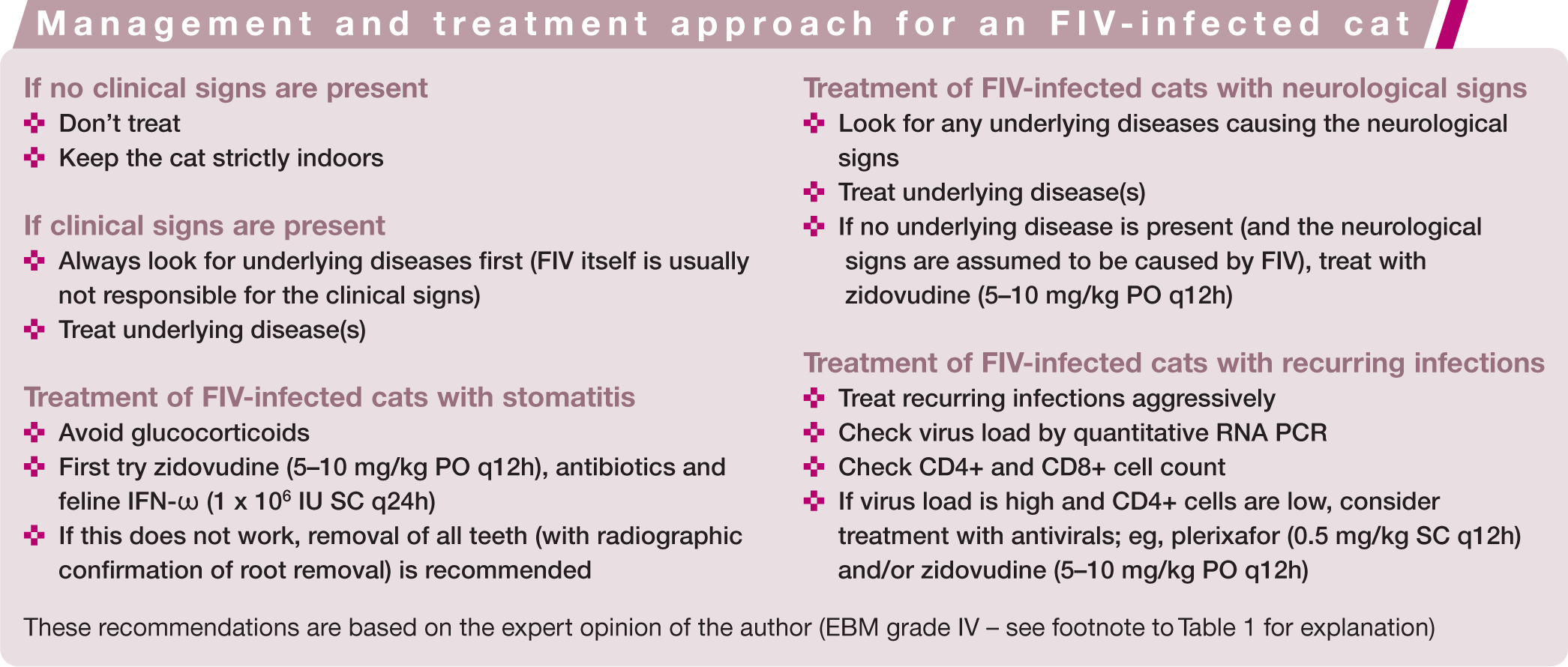
Retrovirus-infected cats need special management and care, and provided they receive this can live for many years in good health. Most retrovirus-infected cats are well managed with symptomatic therapy.3 –5 Specific treatment recommendations for individual cats are summarised in the boxes on page 926. Immune modulators are commonly used in retrovirus-infected cats. Results of uncontrolled studies sometimes suggest dramatic clinical improvement with these compounds, but these effects are usually not observed in properly designed trials, and clear evidence of efficacy is lacking. 4
Antiviral chemotherapy is only indicated in exceptional cases of FIV and FeLV infection, due to lack of proven efficacy of many antivirals and also their toxicity. 4 An update on published treatment studies is provided in this review, focusing on those drugs that are available on the market and, thus, could potentially be used in cats.

Classification of antiviral drugs
Most antivirals used in cats are licensed for humans and are specifically intended for treatment of human immunodeficiency virus (HIV) infection. Some of these drugs can be used to treat FIV infection because most enzymes of FIV and HIV have similar sensitivities to a range of inhibitors. Many drugs, such as nucleoside analogues, are less effective against FeLV, 4 as FeLV is not as closely related to HIV.
Antiviral compounds interfere with the viral replication cycle and can be grouped into different classes depending on the specific step at which they exert their activity.11 –13 These drug classes are summarised in Table 1.
Treatment options (antiviral drugs) for retrovirus-infected cats, with EBM grading of available efficacy data

FIV = feline immunodeficiency virus; FeLV = feline leukaemia virus; ND = not determined; SC = subcutaneous; PO = oral
EBM grades used according to the European Advisory Board on Cat Diseases (ABCD):
I = Best evidence, comprising data obtained from properly designed, randomised, controlled clinical trials in the target species (cats)
II = Data obtained from properly designed, randomised, controlled studies in the target species (cats) with spontaneous disease in an experimental setting
III = Data based on non-randomised clinical trials, multiple case series, other experimental studies, and dramatic results from uncontrolled studies
IV = Expert opinion, case reports, studies in other species, pathophysiological justification
The most common antiretroviral drugs interfere with reverse transcription by inhibiting the retroviral enzyme reverse transcriptase (RT). Three classes of these RT inhibitors can be distinguished: nucleoside analogues (the most widely used antiviral compounds); nucleotide analogue RT inhibitors; and non-nucleoside RT inhibitors. 12 The last are usually highly selective for HIV and, thus, not useful in veterinary medicine.14,15 Drugs with a broader spectrum inhibit other viral enzymes, such as DNA or RNA polymerases, and thus interfere with virus genome replication or inhibit proteinases that are important for the splitting of precursor proteins during viral assembly. Other classes of drugs target viral entry by binding to specific receptors that the virus uses for adsorption; by acting as fusion inhibitors, preventing conformational changes by the virus necessary for the fusion process; or by interfering with viral uncoating.4,11 These various mechanisms of action are illustrated below.

Nucleoside analogue reverse transcriptase inhibitors
Nucleoside analogues are similar molecules to the ‘true’ nucleosides; equally, they have to be phosphorylated intracellularly to become active compounds. Because of their structural similarities, they can bind to the active centre of enzymes (eg, RT, other polymerases) and block enzyme activity. Many of these analogues are also integrated into elongating DNA or RNA strands, but because of small differences in molecular structure, this leads to chain termination or non-functional nucleic acids.12,16,17 Nucleoside analogues are accepted as false substrates not only by viral enzymes, but also by cellular enzymes, which largely accounts for their toxicity. 18
Zidovudine
Zidovudine (3′-azido-2′,3′-dideoxythymidine, AZT) was first synthesised in the 1960s 19 as a potential anticancer drug. In 1985 it was shown to be effective against HIV, 20 and 2 years later it was the first drug to be approved for the treatment of HIV infection. 21
Zidovudine not only inhibits RT, but also cellular polymerases, and this leads to bone marrow suppression. Thus, regular blood cell counts are necessary during zidovudine treatment because non-regenerative anaemia is a common side effect. 22 A complete blood count should be performed weekly for the first month. If values are stable after the first 4 weeks, a monthly recheck is recommended. Cats with bone marrow suppression should not be treated with zidovudine. A study in which FIV-infected cats were treated with zidovudine for 2 years has shown that the drug is well tolerated in most cats. 23 Haematocrit can decline within 3 weeks of initiating treatment to approximately 60% of baseline levels, but recovers in most cases, even without discontinuation of treatment. If the haematocrit drops below 20%, discontinuation is recommended, and anaemia usually resolves within a few days. 23 Other side effects in cats, including vomiting or anorexia, are rare.

Severe stomatitis due to FIV infection. The nucleoside reverse transcriptase inhibitor, zidovudine, has a proven (EBM grade 1) effect on stomatitis in FIV-infected cats

Stavudine
Stavudine (2′,3′-didehydro-2′,3′-dideoxythymidine, d4T) is another drug with efficacy against HIV,48 –51 and was approved for treatment of HIV infection in 1994.
Didanosine
Didanosine (2′,3′-dideoxyinosine, ddI) is also used to treat HIV infection in humans. It was shown to be active against HIV in 1986, 53 and was the second drug to be approved for treatment of HIV infection. It has been marketed since 1991. 12
Zalcitabine
Zalcitabine (2′,3′-dideoxycytidine, ddC) was previously used to treat HIV infection in humans. 56 It was shown to be active against HIV in 1986, 53 and was approved by the US Food and Drug Administration in 1992. However, it ceased being marketed in 2006. Due to its toxicity, zalcitabine should not be used at concentrations over 5 mg/kg/h by continuous infusion in feline patients. 57
Lamivudine
Lamivudine (2R,cis-4-amino-l-[2-hydroxymethyl-1,3-oxathiolan-5-yl]-[1H]-pyrimidin-2-one, 3TC) is also an approved anti-HIV drug.
Nucleotide analogue reverse transcriptase inhibitors
Nucleotide analogue RT inhibitors interact with the catalytic site of the RT and are incorporated into the elongating proviral DNA strand, subsequently causing strand termination.12,15 They compete with the natural nucleotides and thus function as competitive substrate inhibitors. In these respects they are similar to nucleoside RT inhibitors. However, in contrast to nucleoside RT inhibitors, nucleotide RT inhibitors contain a phosphate group and therefore need only two intracellular phosphorylation steps to be converted into their active forms. 12 This circumvents the first (and often rate-limiting) phosphorylation step.15,60
Adefovir
Adefovir (2-[6-amino-9H-purin-9-yl]-ethoxy-methyl-phosphonic acid, PMEA) is active against herpesviruses, hepadnaviruses (hepatitis B) and retroviruses. 61 Adefovir is not licensed as an HIV drug, but is currently approved to treat chronic hepatitis B in an orally available form (bis-POM PMEA).
Adefovir belongs to the acyclic nucleoside phosphonates, in which the alkyl side chain of purines and pyrimidines is linked to a modified phosphate moiety and a C-P phosphonate linkage replaces the normal O5′-P phosphate linkage. 60 This phosphonate bond is non-hydrolysable, which makes it more difficult to cleave off these compounds once they have been incorporated at the 3′-terminal end of the elongating proviral DNA strand. 12
Tenofovir
The antiviral spectrum of tenofovir (2R-1-[6-amino-9H-purin-9-yl]-propan-2-yl-oxy-methyl-phosphonic acid, PMPA) is narrower than that of adefovir, in that it does not extend to herpesviruses, but is confined to hepadnaviruses and retroviruses. 61 Tenofovir is currently the only nucleotide RT inhibitor approved for the treatment of HIV infection; it is marketed as the prodrug tenofovir disoproxil fumarate. 60 Since it was licensed in 2001, it has become one of the most commonly used drugs in HIV therapy.12,17
Non-nucleoside reverse transcriptase inhibitors
Most of the non-nucleoside RT inhibitors are highly specific for HIV. Unlike nucleoside and nucleotide RT inhibitors, which bind to the catalytic site of RT, non-nucleoside RT inhibitors interact with an allosteric site of the enzyme 12 and are not incorporated into the proviral DNA strand. 15 They are classified as non-competitive inhibitors of RT and do not require intracellular activation to inhibit the enzyme.15,16
Non-nucleoside RT inhibitors are a group of structurally diverse compounds that all bind a single site in the HIV RT enzyme. 72 The interaction with the allosteric site, which is located in close proximity to the catalytic site, leads to a number of conformational changes within the RT.72,73 Among other effects, these changes cause a decrease in the interaction between the DNA primer and the polymerase domain of the enzyme and, thus, interfere with virus replication.72,73
The classical non-nucleoside RT inhibitors are not active against FIV and FeLV; however, there is one old drug, suramin, that can be classified as a non-nucleoside RT inhibitor and has been used in veterinary medicine.
Suramin
Suramin (1-[3-benzamido-4-methylbenzamido]naphthalene-4,6,8-trisulfonic acid sym-3′-urea sodium salt), a sulfated naphthylamine and trypan red derivative, is one of the oldest known antimicrobial agents. It is used as a antitrypanosomal agent as well as for the treatment of some (eg, prostatic) tumours. 74 It also has an inhibitory effect on the RT activity of retroviruses and has been used in patients with HIV infection. 75 Suramin inhibits RT by interacting with the template–primer binding site of the enzyme. It competitively binds to the primer binding site and inhibits the template–primer binding that is necessary for DNA prolongation; thus, suramin can be classified as a non-nucleoside RT inhibitor. 76
Suramin is associated with a significant number of severe side effects in humans: nausea and anaphylactic shock as immediate reactions during administration; peripheral neuritis leading to palmar–plantar hyperaesthesia, photophobia, skin reactions, agranulocytosis, haemolytic anaemia and destruction of the adrenal cortex as later side effects.74,75,77 –79 Severe side effects have to be expected in cats as well.
Nucleotide synthesis inhibitors
Nucleotide synthesis inhibitors interfere with DNA and RNA synthesis, but not by mimicking nucleosides. They usually have a broad spectrum of activity, but also marked toxicity. Foscarnet and ribavirin have been used in veterinary medicine.
Foscarnet
Foscarnet (phosphonoformic acid, PFA) has a wide spectrum of activity against DNA and RNA viruses, including retroviruses. Foscarnet interferes with exchange of pyrophosphate from deoxynucleoside triphosphate during viral replication by binding to a site on RT or DNA polymerase. 82 This drug has only a short effect; after treatment is stopped, viral replication is reactivated. Foscarnet is mostly administered IV by continuous infusion because of its short half-life, a property that has also been demonstrated in cats. 83 Oral application is possible but can cause irritation of mucous membranes and oral bleeding.
Foscarnet has many side effects in humans as well as in cats, such as nephrotoxicity and myelosuppression. It is also toxic to epithelial cells and mucous membranes, and gastrointestinal side effects and ulcerations of genital epithelium can occur. In addition, it chelates cations, such that hypocalcaemia, hypomagnesaemia and hypokalaemia can develop.84,85
Ribavirin
Ribavirin (1-[β-D-ribofuranosyl]-1H-1,2,4-triazole-3-carboxamide, RTCA) has marked in vitro antiviral activity against a variety of DNA and RNA viruses. 87 Ribavirin has multiple effects on virus replication, such as allowing DNA synthesis to occur, but preventing triphosphate synthesis by inhibiting the enzyme inosine monophosphate dehydrogenase (essential for synthesis of nucleotides); it thus prevents nucleotide production. 87
Systemic application of ribavirin is limited because of side effects. 88 Side effects in cats in several studies (even using low doses) have included haemolysis, which develops as a result of sequestration of the drug in erythrocytes.89,90 In addition, there is a dose-related toxic effect on bone marrow, primarily on megakaryocytes (resulting in thrombocytopenia and haemorrhage) and erythroid precursors (resulting in non-regenerative anaemia). With prolonged treatment or higher doses, the drug suppresses production of neutrophilic granulocytes. Liver toxicity occurs too. An attempt to decrease the toxicity of ribavirin by incorporating it into lecithin-containing liposomes and giving it at lower doses was not successful. 91
Receptor homologues/antagonists
Receptor homologues/antagonists either bind to the virus or to the cellular receptor and thereby inhibit binding of the virus to the cell surface. Most of these drugs are highly selective for HIV and not useful for veterinary medicine. An exception are the bicyclams (eg, plerixafor), which can be used in cats with FIV infection because of similarity between HIV and FIV with respect to chemokine receptor usage.92,93 Chemokine receptors belong to a group of seven transmembrane proteins in which signal transmission is afforded through rapid influx of calcium into the cell. They are essential co-receptors for HIV and FIV in the infection of CD4+ lymphocytes. 94 CXCR4 is the major receptor for FIV infection, but other receptors also have been shown to mediate viral binding. 95 By binding to CXCR4, bicyclams prevent interaction of CXCR4 with other ligands, thereby inhibiting the entry of HIV or FIV into the cell.96 –98
Plerixafor
Plerixafor (1,1′-[1,4-phenylenbismethylene]-bis[1,4,8,11-tetraazacyclotetradecane]-octachloride dehydrate, AMD3100) is the prototype compound among the bicyclams. It is not on the market as an anti-HIV drug, but is used in humans for stem cell mobilisation. 99 Plerixafor is administered to cats at a dose of 0.5 mg/kg SC q12h. Magnesium and calcium levels should be monitored regularly during treatment. 68
Integrase inhibitors
The enzyme integrase catalyses strand transfer (3′-end joining), which inserts both viral DNA ends into a host cell chromosome. The high degree of conservation of integrase-active sites across many retroviruses suggests that FIV and FeLV can be sensitive to integrase inhibitors. 101 The mechanism of action of these drugs is inhibition of integration of the proviral DNA that is produced by reverse transcription of the viral RNA genome. 71
Raltegravir
Raltegravir is used in humans as an anti-HIV compound.
Interferons
Interferons (IFNs) are polypeptide molecules with a variety of biological functions. 104 They play an important role in mediating antiviral and antigrowth responses and in modulating the immune response. 105 They can be divided into two major types – type I and type II IFNs – both of which show antiviral properties. Type I IFNs, including IFN-α, IFN-β and IFN-ω, are produced by virus-infected cells.104,106 Type II IFN, consisting of only IFN-γ, is produced by activated T lymphocytes and natural killer cells in response to their recognition of virus-infected cells. 107
IFNs act in an autocrine or paracrine fashion, 108 inducing an antiviral state in non-infected cells. IFNs bind to specific cell surface receptors and result in the transcription of IFN-stimulated genes. The products of these genes are proteins with potent antiviral properties which interfere with various stages of viral replication. 108 Several studies suggest that retroviral protein synthesis is not affected by IFNs and conclude that the antiviral activity of IFNs is related to interference with later stages of the viral replication cycle, such as virion assembly and release.104,109 Interferons also trigger virus-infected cells to undergo apoptosis by activating the expression of genes that contribute to the process of programmed cell death.107,109 Thereby IFNs prevent the spread of virus from infected cells and aid in the clearance of virus infection. 107
Human IFNs have been manufactured by recombinant DNA technology and are available commercially. Recombinant feline IFN-ω is on the market in Japan, Australia and European countries, licensed for use in cats and dogs.
Human interferon-α
Recombinant human interferon-α (IFN-α) has antiviral and immunomodulatory activity, and is active against many DNA and RNA viruses. 108 There are two common treatment regimens for use of IFN-α in cats: SC injection of high doses (1 x 10⁴ to 1 x 10⁶ IU/kg q24h) or oral application of low doses (1–50 IU/kg q24h). When given parenterally to cats, human IFN-α becomes ineffective after 3–7 weeks due to the development of neutralising antibodies that limit its activity. 46
IFN-α can be given orally for a longer period as no antibodies will develop during oral treatment, and it has been used in this manner to treat FIV and FeLV infections. However, given orally, IFN-α is inactivated by gastric acid and destroyed by trypsin and other proteolytic enzymes in the duodenum. 110 Thus, direct antiviral effects are unlikely after oral application, but it still seems to have immunomodulatory activity. After oral application, IFN-α can bind to mucosal receptors in the oral cavity, stimulating the local lymphoid tissue. This leads to cytokine release on lymphatic cells in the oral or pharyngeal area, triggering a cascade of immunological responses that finally act systemically.111 –113
Use of low dose oral IFN-α in sick cats naturally infected with FIV (50 IU/kg on the oral mucosa q24h for 7 days on alternating weeks for 6 months, followed by a 2 month break, and then repetition of the 6 month treatment) resulted in improvement of clinical signs in a placebo-controlled, double-blind study. 115
Low dose oral IFN-α was used in a placebo-controlled study in experimentally induced FeLV infection; 0.5 IU/cat (eight cats) or 5 IU/cat (five cats) was given (following experimental challenge) on 7 consecutive days on alternate weeks for a period of 1 month. 111 No difference was found in the development of viraemia between groups; however, treated cats had significantly fewer clinical signs and longer survival times when compared with the placebo group (with a better response in the cats given 0.5 IU/cat) (EBM grade II). 111 Several uncontrolled field studies have also reported a beneficial response in cats when treated with low dose oral IFN-α,116,117 but they only included a limited number of cats and the findings are impossible to interpret without control groups (EBM grade III). In a larger study, the outcome of 69 FeLV-infected cats with clinical signs that were treated with low dose oral IFN-α (30 IU/kg for 7 consecutive days on a 1 week on/1 week off schedule) was compared with historical controls; significantly longer survival times were reported in the treated cats (EBM grade III). 117 In a placebo-controlled study, treatment of sick client-owned FeLV-infected cats with low dose oral IFN-α (30 IU/cat for 7 consecutive days on a 1 week on/1 week off schedule) did not result in a significant difference in FeLV status, survival time, clinical or haematological parameters, or owners’ subjective impression when compared with a placebo group. Thus, this controlled study was not able to demonstrate efficacy (EBM grade I). 118
Feline interferon-ω
Feline interferon-ω (IFN-ω), the corresponding feline interferon, is licensed as a veterinary medicine in Japan, Australia and European countries. Feline IFN-ω is a recombinant product that is produced by baculoviruses containing the feline sequence for this IFN that replicate in silkworms after infection. Results of studies investigating the efficacy of feline IFN-ω against FIV and FeLV are summarised in the box on page 935.
Future priorities
Unfortunately, the level of efficacy of antiviral chemotherapy is often poor and the duration of treatments used in clinical trials is often inappropriate for infections with such long clinical courses. Additionally, the degree of generalisability between experimental infections in cats kept under laboratory conditions and pet cats infected with field strains is unknown. Therefore, it is very important that more well-designed double-blind, placebo-controlled trials using antivirals in naturally retrovirus-infected cats are undertaken to allow judgement on treatment efficacy and side effects of different antiviral compounds.

Footnotes
Funding
The author received no financial support for the research, authorship and/or publication of this article.
Conflict of interest
The author declared no potential conflicts of interest with respect to the research, authorship, and/or publication of this article.