




Abstract
Overview:
In cats, the most serious of adverse effects following vaccination is the occurrence of invasive sarcomas (mostly fibrosarcomas): so-called ‘feline injection-site sarcomas’ (FISSs). These develop at sites of previous vaccination or injection. They have characteristics that are distinct from those of fibrosarcomas in other areas and behave more aggressively. The rate of metastasis ranges from 10–28%.
Pathogenesis:
The pathogenesis of these sarcomas is not yet definitively explained. However, chronic inflammatory reactions are considered the trigger for subsequent malignant transformation. Injections of long-acting drugs (such as glucocorticoids, and others) have been associated with sarcoma formation. Adjuvanted vaccines induce intense local inflammation and seem therefore to be particularly linked to the development of FISS. The risk is lower for modified-live and recombinant vaccines, but no vaccine is risk-free.
Treatment and prevention:
Aggressive, radical excision is required to avoid tumour recurrence. The prognosis improves if additional radiotherapy and/or immunotherapy (such as recombinant feline IL-2) are used. For prevention, administration of any irritating substance should be avoided. Vaccination should be performed as often as necessary, but as infrequently as possible. Non-adjuvanted, modified-live or recombinant vaccines should be selected in preference to adjuvanted vaccines. Injections should be given at sites at which surgery would likely lead to a complete cure; the interscapular region should generally be avoided. Post-vaccination monitoring should be performed.
Introduction
Recently, vaccination of cats has received scientific and public attention linked to the supposition that a range of rare adverse effects can arise following vaccination. In cats, the most serious of these adverse consequences is the occurrence of invasive sarcomas (mostly fibrosarcomas), so-called ‘feline injection-site sarcomas’ (FISSs), that can develop within the skin at sites of previous vaccination. Despite extensive research on the pathogenesis of these sarcomas, there is no definitive causal relationship that explains their occurrence and the direct link to vaccination. The most accepted hypothesis suggests that a chronic inflammatory reaction at the site of injection provides a trigger for subsequent malignant transformation.
Epidemiology and characterisation
In 1991, an increased incidence of tumours in cats that developed at injection sites was first reported in the United States. 1 This observation was connected to an increased use of rabies and feline leukaemia virus (FeLV) vaccinations.2,3 As a consequence, these tumours were first called feline ‘vaccine-associated sarcomas’. However, the subsequent finding that other, non-vaccinal injectables can also cause this type of tumour has led to reclassification of these neoplasms as ‘feline injection-site sarcomas’ (FISSs). These tumours seem to be unique to cats, 4 although comparable tumours have been reported in ferrets 5 and very occasionally in dogs. 6
FISSs occur at sites typically used for vaccination and injections, such as the interscapular region (Figure 1), the lateral thoracic or abdominal wall, the lumbar region, and the area of the semimembranosus and semitendinosus muscles. FISSs are most commonly located in the subcutis, but also can occur intramuscularly.7,8

(a–c) Cats with feline injection-site sarcoma. Courtesy of Johannes Hirschberger, Ludwig Maximilians University, Munich, Germany
FISSs can occur as early as 4 months and up to 3 years after an injection. They are characterised by invasive local growth in the subcutis, often with spread along fascial planes. 9 Most FISSs are fibrosarcomas, 10 but other malignancies, such as osteosarcomas, 11 chondrosarcomas, 7 rhabdomyosarcomas, 7 malignant fibrous histiocytomas,7,11 and myofibroblastic sarcomas 8 have also been described.
FISSs have histological characteristics that are distinct from those of fibrosarcomas in other areas. Typically there is perivascular infiltration of lymphocytes and macrophages at the tumour periphery, a central area of necrosis, inflammation and local infiltration of tumour cells (Figure 2).10,12 FISSs behave more aggressively than sarcomas at other sites. 13 The rate of metastasis ranges from 10–28%.14,15 The lung is the most common site of metastasis, followed by regional lymph nodes and abdominal organs, such as the kidney, spleen, intestine and liver.16,17

Histological sections of a 2 cm diameter mass removed from the lateral thorax of a 13-year-old domestic shorthair cat. A similar interscapular mass had been removed from this cat 2 months previously. (a) A focus of lymphoplasmacytic inflammation is contained within the surrounding sarcoma. (b) Higher magnification of the neoplastic tissue reveals a pleomorphic population of neoplastic spindle cells with occasional giant nuclei and irregular mitotic activity (arrow). Haematoxylin and eosin stain. Courtesy of Michael Day, School of Veterinary Sciences, University of Bristol, UK
In the past 20 years, an epidemiological association has been demonstrated between vaccination and the later development of FISS.3,13,18 –21 The incidence of FISS has been estimated at 1–4 in every 10,000 vaccinated cats in the USA,22,23 and the ratio of injection-site to non-injection-site sarcomas increased from 0.5 in 1989 to 4.3 in 1994. 10 In one study in the USA, reported rates of reaction were 0.3 FISSs per 10,000 vaccinations and 11.8 postvaccinal inflammatory reactions per 10,000 vaccinations in cats. 22 If inflammatory reactions are a necessary prelude to FISS, then these rates suggest that 1 in 35–40 inflammatory reactions develop into FISS. In the UK, the incidence of FISSs seems to be relatively low (incidence risk of FISS per year was estimated to be 1 per 16,000–50,000 cats registered by practices, 1 per 10,000–20,000 cat consultations, and 1 per 5000–12,500 vaccination visits). 24 One reason for the low rate might be that rabies vaccination is not a routine procedure for cats in the UK. One study in Canada investigated the annual prevalence of feline postvaccinal sarcomas among 11,609 feline skin mass submissions from 1992 to 2010 and revealed no decrease in disease prevalence or increase in age of affected cats in response to change in vaccination formulation or recommended changes in feline vaccination protocols. 25
Pathogenesis
Despite extensive research, there is no definitive proof of the pathogenesis of FISS. The most widely accepted hypothesis suggests that a chronic inflammatory reaction at the site of an injection acts as a trigger for subsequent malignant transformation. Adjuvanted vaccines seem to be particularly linked to the development of FISS due to the more intense local inflammation associated with such products. This idea is supported by frequent identification of adjuvants in histological or ultrastructural investigations of these sarcomas.12,18
Many data suggest an association between vaccination and FISS in cats. Aluminium, a vaccine adjuvant, has been found in biopsy samples of FISS. 26 In most inactivated vaccines, an adjuvant is added to enhance the inflammation at the site of injection, which is intended and necessary when applying a killed agent in order to trigger the necessary immune response. However, this inflammation might potentially lead to malignant transformation. Traces of adjuvants can be seen in the inflammatory reaction, specifically accumulated within macrophages or multinucleate giant cells, and later in histological sections of FISS in the transformed fibroblast. 18 Intracellular crystalline particulate material was found in an ultrastructural study in 5 of 20 FISSs investigated, and in one of the five cases was identified as aluminium-based. 12 Although no specific vaccine or adjuvant has been incriminated, 27 local irritation from adjuvant is thought to stimulate mainly fibroblasts to the point that malignant transformation occurs.
At first, only rabies and FeLV vaccines were identified as risk factors,3,13,23 but subsequently other vaccines, including vaccines against feline panleukopenia virus (FPV), feline herpesvirus-1 (FHV-1) and feline calicivirus (FCV), were also found to be involved in the development of FISS in some cases.13,23,28 –30 In addition to vaccines, injections such as long-acting glucocorticoids, penicillin, lufenuron,27,31,32 cisplatin 33 and meloxicam 34 have been associated with sarcoma formation. One study found that the frequency of administration of long-acting glucocorticoid injections (dexamethasone, methylprednisolone and triamcinolone) was significantly higher in cats with FISS in the interscapular region than in control cats. 35 Fibrosarcomas were also reported at the site of a deep, non-absorbable suture in one cat; 36 around a surgical swab in the abdomen of one cat; 37 adjacent to the site of microchip implantation in two cats;38,39 and associated with a subcutaneous fluid port device.38,39 This suggests that all inflammatory reactions, theoretically, have the potential to lead to the development of FISS by triggering uncontrolled proliferation of fibroblasts and myofibroblasts, which, in some cases, results in malignant transformation.
Although many causes of inflammation are associated with FISS development, the risk seems to be higher for vaccines compared with other injections; among vaccines, the risk seems to be higher when adjuvanted vaccines are used. Srivastav et al 35 compared associations between vaccine types and other injectable drugs with the development of FISS in a case-control study of 181 cats with soft tissue sarcomas (cases), 96 cats with tumours at non-vaccine regions (control group 1), and 159 cats with basal cell tumours (control group 2). There was a significant association between the administration of various types of vaccines and other injectable products (eg, long-acting corticosteroids) and FISS development. Of 192 cats with sarcoma, 101 had vaccinations at the site of tumour development during the preceding 3 years, and 23 had received other injections. 35 This study also showed that adjuvanted inactivated vaccines were significantly more commonly associated with FISS development than other vaccines; of 35 vaccinated cats with sarcoma on the hindlimb, 25 cats had received adjuvanted vaccines, seven cats had received modified-live virus (MLV) vaccines (FPV, FHV-1 and FCV), and only one cat had received a recombinant vaccine. These findings also indicated that no vaccines are risk-free. 35

The mechanism by which the inflammatory reaction causes tumour formation is not fully understood. Growth factors promote proliferation, can induce malignant transformation, and also can be involved in the regulation of angiogenesis. Overexpression of growth factors and oncogene activation have been demonstrated in cats with FISS and are suspected to play a role in tumour development.40 –42
As vaccination against FeLV is associated with a higher risk of FISS, some studies looked at a possible role of FeLV and its mutant feline sarcoma virus (FeSV) in the development of FISS, but could not detect either FeLV or FeSV in the tumours. 43 Furthermore, no other viruses, including feline immunodeficiency virus, feline foamy virus, polyomaviruses or papillomaviruses were detected in tumour tissues.44 –47 No evidence has been found to implicate replication or expression of endogenous retroviruses in FISS formation.45,46
The observation that not all cats develop FISS after vaccination suggests that there might be a genetic predisposition. It has been suggested that there is a higher incidence of FISS in siblings of affected cats, and that some cats tend to develop more than one FISS. Alterations with unknown relevance such as hyperploidy, 48 translocations 49 and triploidy 50 of oncogene and tumour suppressor loci have been found on extra chromosomes and monosomic chromosomes in affected cats. Mutations have been identified in the tumour suppressor gene p53, which is implicated in cancer initiation and progression in sarcoma tissue of cats with FISS.51 –55 A case-control study (50 domestic shorthair cats with a confirmed diagnosis of FISS and 100 disease-free matched controls) investigating a possible association between polymorphisms in the genomic sequence of the feline p53 gene and a predisposition to FISS, found a strong association between FISS and the presence of specific nucleotides at two of the polymorphic sites. 56 However, another study, conducted in Munich, Germany, could not reproduce these findings and observed no association with the polymorphisms described. 57
Management
Appropriate treatment should first include staging and careful planning of the surgery, because aggressive, radical excision is crucial to avoid tumour recurrence. The prognosis improves if, in addition to radical surgery, adjunctive treatments such as radiotherapy or immunotherapy are used. Preoperatively, (contrast-enhanced) computed tomography (CT) or magnetic resonance imaging (MRI) should be obtained for staging, and to determine the extent of the tumour and the size of the radiation field required to maximise the chance of a successful outcome.
58
It was shown that the actual size of tumours determined by CT could be twice that estimated at physical examination.59,60 Surgeons should attempt to achieve complete, en bloc, surgical tumour resection with at least 3 cm (ideally, 5 cm) margins
61
[
Preoperative or postoperative radiation therapy significantly decreases recurrence rates and prolongs remission times,16,63,65 while the benefit of chemotherapy is not proven as large prospective randomised controlled trials are lacking. One non-randomised study found no significant difference between control cats (surgery alone) and cats treated with surgery and doxorubicin [
Additional immunotherapy appears to be promising.68
–70 Results of prospective randomised controlled studies of cytokine gene transfer techniques for adjuvant-immunological treatment of FISS showed reduced recurrence rates. In cats receiving gene therapy by the peritumoural administration of histo-incompatible Vero cells expressing human interleukin-2 (hIL-2) in addition to surgery and radiation therapy, only 5/16 (31%) had FISS recurrence, while 11/16 control cats (69%) that had surgery and radiation therapy, but no immunotherapy, had FISS recurrence within 16 months [

Prevention
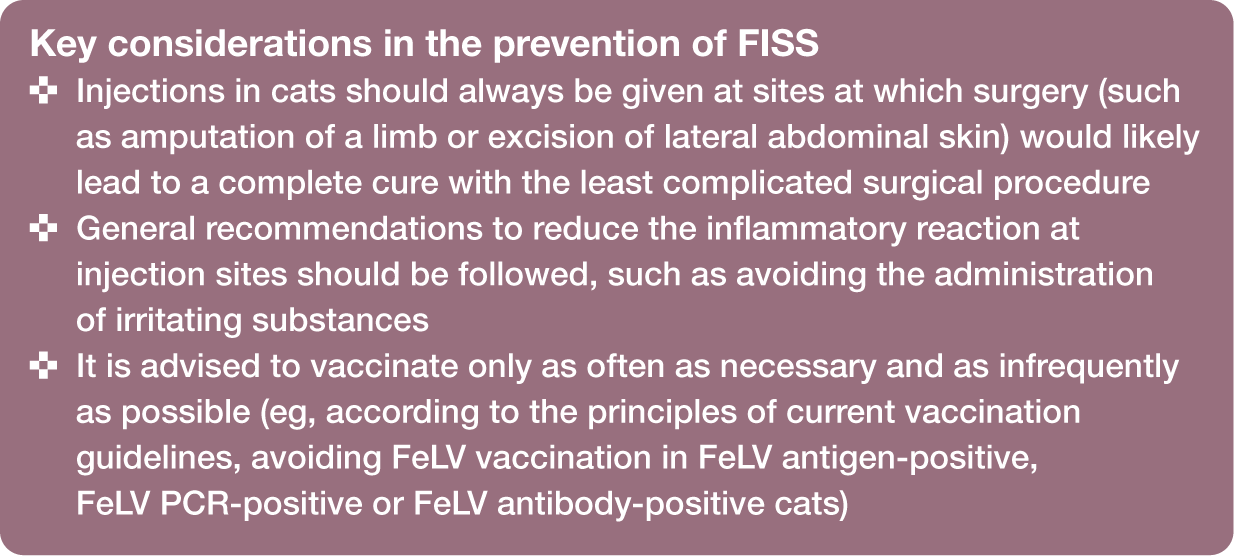
Prevention consists of three general considerations:
Choice of injection site
In general, injecting distally in a leg aids, where necessary, in the subsequent treatment of sarcoma by amputation of the leg (because these tumours are very difficult to excise completely and often recur after resection). 20 Administration of vaccines (or other injections) between the scapulae is generally contraindicated because tumour resection is almost impossible in this location.
To assess the acceptance of the recommendations of the Vaccine-Associated Feline Sarcoma Task Force (VAFSTF), published in 1996, a study involving 392 cats with FISSs compared the anatomical locations of tumours between cases with FISS diagnosed before and after publication of these recommendations.
72
The proportions of FISS significantly decreased in the interscapular (53% to 40%) and right and left thoracic (10% to 4% and 9% to 1%, respectively) regions, whereas the proportions of FISS significantly increased in the right thoracic limb (1% to 10%) and the combined regions of the right pelvic limb with the right lateral aspect of the abdomen (13% to 25%) and the left pelvic limb with the left lateral aspect of the abdomen (11% to 14%). Thus, while veterinarians are complying with vaccination recommendations to some extent, a high proportion of tumours still developed in the interscapular region. There was also an increase in lateral abdominal FISSs, which could be attributable to aberrant placement of injections intended for the pelvic limbs. It remains the case that only administration of vaccines as distally as possible on a limb allows for complete surgical margins if limb amputation is required [
Unfortunately, there is still insufficient clinical information to enable evidence-based vaccine site recommendations. The majority of safety and efficacy data comes from licensing studies in which vaccines are administered subcutaneously in the interscapular region (which should not be used for any injection in the clinical setting). Current research indicates that radical surgical resection of injection-site sarcomas including margins of at least 3 cm, but preferably 5 cm [
Based on these expert opinions, the AAFP now recommends in its new guidelines,
62
consistent with the earlier (2006) guidelines,
75
that vaccines against FPV, FHV-1 and FCV should be administered below the right elbow; FeLV vaccines should be administered below the left stifle; and rabies vaccines should be administered below the right stifle.
62
So far, vaccination in the tail has not been considered a practical option. However, a recent pilot study demonstrated that vaccination in the tail was well tolerated and that tail-vaccinated cats developed an antibody response comparable to that observed following injection of the vaccine distally in the leg [
Alternative recommendations are made by the Vaccination Guidelines Group (VGG) of the World Small Animal Veterinary Association, which recognises the practical difficulties often faced by veterinarians attempting vaccination into limbs or the tail. The advice of the VGG is that a preferred site for vaccine delivery (and surgical resection of a FISS that might arise) is the skin over the lateral abdomen. This is a procedure that appears well tolerated in the majority of cats.
As a general recommendation, recording the sites of injections in the patient’s medical records is important. In addition, post-vaccination monitoring plays a vital role (see box).
Recommendations for reducing inflammatory reactions
In terms of preventing inflammatory reactions at injection sites, there are a few recommendations to follow. Cats should receive as few subcutaneous injections as possible. Intramuscular injections in cats should be avoided because intramuscular tumours develop with a similar frequency, but are more difficult to detect early. Whenever feasible, cats should receive drugs orally or intravenously. The subcutaneous injection of long-acting irritating substances (such as long-acting glucocorticoids) should be avoided.
One study examined potential risk factors when administering vaccines 27 and few factors were associated with the development of FISS. It was observed that the size of the needle and the syringe, the velocity of injection, and whether manual pressure was applied after injection or not, played no role. In contrast, the temperature of the vaccine made a significant difference, with cold vaccines being associated with a higher risk of FISS development than vaccines at room temperature. 27 Thus, vaccines should be taken out of the refrigerator about 15 minutes before injection, but not much longer, to avoid reduction in vaccinal efficacy.

If available, intranasal or oral vaccines would be preferable over injectable vaccines in cats. However, in most countries only injectable vaccines are available. Therefore, vaccines are preferred that cause the least subcutaneous inflammatory reaction. Vaccines without adjuvants should be used rather than adjuvant-containing vaccines, which means that MLV or recombinant vaccines (eg, canarypox-vectored vaccine) without adjuvant are preferred over inactivated vaccines with adjuvants.
It has been shown that recombinant canarypox-vectored vaccines cause less inflammation at the injection site. This was demonstrated in rats,
77
and in a study in cats, in which the typical granulomatous inflammation did not develop at the injection site when using these particular vaccines.
78
An extensive study investigating the subcutaneous tissue response following administration of a single dose of multi-component vaccines confirmed these findings.
79
Three groups of 15 cats were injected with one of three vaccines or saline as a negative control; cats in group A received a non-adjuvanted recombinant canarypox-vectored FeLV vaccine; cats in group B received an FeLV vaccine with a lipid-based adjuvant; and cats in group C were vaccinated with an FeLV vaccine adjuvanted with an alum-Quil A mixture. On days 7, 21 and 62 post-vaccination, significantly less inflammation was associated with administration of the non-adjuvanted recombinant canarypox-vectored vaccine. The inflammation was most severe in the cats receiving the aluminium-based adjuvant. Cats receiving adjuvanted vaccines had evidence of residual adjuvant material accumulated within macrophages even at 62 days post-vaccination.
79
In a case-control study investigating associations between vaccine types and development of FISS, adjuvanted inactivated vaccines were significantly more commonly associated with sarcoma development than other vaccines; of 35 vaccinated cats with sarcoma on the hindlimb, 25 cats had received adjuvanted vaccines, seven cats had received MLV vaccines (FPV, FHV-1 and FCV), while only one cat had received a recombinant canarypox-vectored vaccine [
Vaccination schedules
Finally, to prevent development of FISS, cats should be vaccinated no more than necessary. Therefore, long vaccination intervals should be applied in adult animals; vaccines (such as rabies vaccines and FPV vaccines) that are licensed for 3 year or even 4 year boosters should be preferred; no FeLV or rabies vaccinations should be administered to indoor-only cats; and immune cats should not be vaccinated (eg, if antibodies are detected). This confirms the necessity of individual vaccination schedules.
Key Points
Vaccination of cats provides essential protection and should not be stopped because of the risk of feline injection-site sarcoma (FISS).
Vaccines are not the only injectable medical products associated with FISS.
An individual vaccination schedule is important. Cats should be vaccinated no more than necessary, in accordance with current guidelines.
Appropriate sites for injection should be selected. The interscapular region should generally be avoided. Vaccines should be injected at a site from which a mass can easily be surgically removed, such as distally on a leg or in the skin of the lateral abdomen.
Vaccines should be brought to room temperature prior to administration, but should not be kept unrefrigerated for hours.
Whenever possible, subcutaneous, rather than intramuscular, injection should be performed.
The preference is for: non-adjuvanted vaccines over those containing adjuvant; modified-live vaccines or recombinant vaccines over inactivated vaccines; and vaccines with a long duration of immunity.
Post-vaccination monitoring should be performed. Any lump at the site of injection that is still present 3 months after vaccination, that is larger than 2 cm in diameter, or that it is increasing in size 1 month after vaccination should be surgically removed.
Footnotes
Funding
The authors received no specific grant from any funding agency in the public, commercial or not-for-profit sectors for the preparation of this article. The ABCd is supported by Merial, but is a scientifically independent body and its members receive no stipends from Merial.
Conflict of interest
The authors do not have any potential conflicts of interest to declare.