




Abstract
Overview:
Regardless of whether a pathogen is viral, bacterial, parasitic, fungal or an emerging unknown, the mainstay of infectious disease control is hygiene, and the cornerstone of good hygiene is effective disinfection.
Challenges and current choices:
Certain pathogens present a challenge to kill effectively: parvovirus, protozoal oocysts, mycobacteria, bacterial spores and prions resist most disinfectants but can be eliminated through heat, especially steam, which will kill protozoal oocysts. Heat is the safest and most effective disinfectant, but cannot be universally applied. Temperatures in washing machines and dishwashers should be at least 60°C to eliminate pathogenic spores and resistant viruses. Enveloped viruses are susceptible to most disinfectants; of the non-enveloped viruses, parvovirus is recognised as being the most difficult to eradicate. Sodium hypochlorite is recommended for many applications: cleaning of floors, laundry, food preparation surfaces and utensils. Skin scrubs and rubs containing alcohols are more effective than those containing chlorhexidine, and less subject to contamination.
Disinfectants to avoid:
Deficiency of the enzyme UDP-glucuronosyl transferase renders the cat susceptible to the toxic effects of phenol-based disinfectants (including many essential oils), so these should be avoided in feline environments. Quaternary ammonium compounds (eg, benzalkonium chloride) are also probably best avoided.
The future:
Veterinary disinfection approaches in the future may include use of ultraviolet radiation and, increasingly, silver.
Introduction
Infectious disease is a major challenge for the domestic cat (Felis catus). In nature, a solitary creature, the cat has been forced, by domestication, to live sometimes in unnaturally dense populations (eg, shelters or breeding households), which results in exposure to unnaturally high doses of pathogens at a time when stress may already be compromising the cat’s immune system and ability to deal with it. Hygienic routines and disinfection are the method of choice for eliminating meticillin-resistant Staphylococcus aureus (MRSA) or virulent systemic feline calicivirus (VS-FCV) from premises, and are especially important in situations where there is an emerging, or unknown, contagion, and neither vaccination nor specific testing are available.
There are three priorities when choosing disinfectants for use around the cat: the first, obviously, is efficacy. The second is safety for the cat: the idiosyncrasies of the feline metabolism render the cat especially sensitive to many things that are perfectly safe for other species, such as phenol-based disinfectants. The third, which is outwith the scope of this article but also very important, is safety for humans; especially in veterinary hospitals and shelters, where exposure is likely to be a daily occurrence and long term. Cleaning chemicals have been associated with airway irritation, asthma, contact dermatitis and even, with prolonged exposure, neoplasia. The strongest airway irritants in cleaning products are bleach (sodium hypochlorite), which releases chlorine gas, hydrochloric acid and alkaline agents (ammonia and sodium hydroxide), which are commonly combined. 1 Cleaning agents are divided into sensitisers (amine compounds, quaternary ammonium compounds [QACs], scents containing terpenes, isothiazolinones, formaldehyde) and irritants (chlorine, ammonia, hydrochloric acid, monochloramine, sodium hydroxide, QACs). 1

Different pathogens require different approaches for effective disinfection; thus recommendation of a single disinfectant for all purposes is not possible. In addition, there is no single solution for all applications: for example, steam cleaning, which is necessary to eliminate protozoal oocysts from a premises, 2 is not feasibly applied to the hands of a veterinary surgeon or the skin of a cat. Although hand hygiene (Figure 1) has been recognised as the most important tool in nosocomial infection control since Semmelweis observed its immense effect on the incidence of childbed fever in 1847 (cited in Kampf and Kramer 3 ), obtaining compliance remains a challenge over 150 years on.4,5 Apparently people are more willing to use a hand rub than to wash their hands in water. 3

Hand sanitisers are located by all of the doors of the University of Bern Veterinary Hospital, Switzerland. Courtesy of Dr Diane D Addie
For each class of pathogen, certain members have been identified as the most difficult to kill; for example, of the viruses, parvovirus is the most resistant – thus, if a disinfectant kills parvovirus, it is likely to kill most other viruses as well. There are many publications reporting on the virucidal activity of disinfectants against feline calicivirus (FCV), as this pathogen is often used as a surrogate for human norovirus, 6 which is difficult to grow in cell culture. Details of any special disinfection requirements for a particular feline pathogen are given in the respective ABCD guidelines.
By contrast, some organisms will die outside the host without any intervention (eg, feline leukaemia virus, feline herpesvirus). Survival times outside the host are presented elsewhere.7,8
These disinfection guidelines are intended for the general veterinary practitioner. Special areas, such as the disinfection of blood for transfusion, bone marrow/organs for transplant, and specialised equipment, such as endoscopes, will not be covered. For a review of endoscope disinfection, see Greene et al. 9
Definition and principles of disinfection
Disinfection is a potent means of reducing the number of pathogens on a surface: it minimises the risk of infection for animals and humans that come into contact with that surface. Disinfection does not result in sterility, which can be achieved by other methods, and only for very confined surfaces (eg, on instruments) or liquids (eg, infusion solutions).
Disinfection is always non-specific: it does not inactivate specific pathogens. A good disinfectant will kill most of the bacteria on a surface, including the pathogenic ones. Therefore, it is important that a disinfectant is capable of substantially reducing the bacterial burden on a surface; this is defined in most test protocols as a reduction in the number of infectious organisms by at least 4 log10.
Disinfection can be achieved by various methods: bacteria, viruses and other pathogens can be damaged and inactivated by physical treatment (which is basically heat and radiation) and also by chemical means. The latter is the most common approach to disinfection and can be applied to virtually all surfaces.
Physical disinfection
Heat and steam
Heat is by far the most broad-spectrum method of disinfection. Moist heat is more effective than dry heat, especially under pressure. When used correctly, steam under pressure (ie, autoclaves) is also the most efficient means of achieving sterility. 9 Steam cleaners are widely available and can be used on soft furnishings (eg, carpet), as well as floors and work surfaces.
In veterinary hospitals, shelters and the home, heat can be used in dishwashers, washing machines and incinerators to inactivate infective agents. Introduction of a dishwasher was one of the measures that ended an outbreak of MRSA in a human neonatal hospital. 10 Household dishwashers modified to achieve a temperature of 71°C were even proposed as a substitute for autoclaving in smaller surgeries. 11 However, care must be taken that the dishwasher itself does not become a source of cross-contamination. 12 Sterilisation efficacy is dependent on the duration of exposure of the pathogen to heat, and on whether or not a chemical disinfectant is also used.
Human safety needs to be considered. Zoonotic infections may be indirectly transmitted to laundry workers; albeit from a human source (ie, not zoonotic in this particular example), there is a report of Salmonella being transmitted to laundry workers. 13 One heavily contaminated item can contaminate an entire laundry load, as viruses can be transferred from contaminated to uncontaminated laundry during washing.14,15 It has been demonstrated that Cryptosporidium species oocysts can attach to fabrics during machine washing. 16 In a human hospital, a nosocomial outbreak of Microsporum canis infection was linked to laundry contamination. 17
The temperature needed for decontamination depends on the duration of the wash cycle and the detergent type. 15 For mycotic contaminants, Ossowski and Duchmann 18 found that reliable decontamination was achieved by laundering at 60°C, regardless of the textiles and detergents used. Nims and Plavsic report that 60°C (or higher) is the optimal temperature for inactivating FCV. 19 Temperatures of 56°C and above will kill 99% of Giardia cysts. 20 Addition of sodium hypochlorite with detergent significantly reduced the numbers of viruses in laundry, 14 and the addition of activated oxygen bleach increased efficacy against a number of bacteria. 15 However, parvovirus can resist temperatures of 80°C for at least an hour. 21
Microbial size is an important determinant in the fabric attachment–detachment process during the machine washing cycle, with larger microorganisms showing greater transference to, and retention on, fabric swatches than smaller ones. Transfer efficiencies are higher for cotton towelling than for other fabric types, both before and after the washing machine spin cycle, indicating that it is not only the properties of the microorganism that influence transfer efficiency but also the properties of the fabric. 16 Moriello recommends two washings and stresses the importance of not overloading washing machines to be rid of M canis spores. 22 It should also be borne in mind that the lint trap may harbour contaminants. 22
Ultraviolet-C radiation
Ultraviolet light radiation in the C range (UV-C; typically 254 nm) and B range (UV-B; 280–320 nm) has been investigated for disinfecting water, food preparation surfaces 19 and hospital rooms. UV-C-emitting devices were shown to significantly reduce the bioburden of important pathogens (Clostridium difficile and vancomycin-resistant enterococci, though not Acinetobacter) in real-world settings such as hospital rooms. 23
Parvoviruses and circoviruses appear to be more susceptible to UV-C inactivation than are the caliciviruses. 19
Chemical disinfection
Both pure active substances and commercial disinfectants can be used for efficient disinfection, provided they are applied at an effective microbicidal concentration. Commercially available products usually contain a combination of various active substances. Side effects are minimised but, above all, they are efficacy tested and the microbicidal concentration is determined by an independent body.
In Europe, chemical disinfectants are considered as biocides and need to be licensed. The licensing procedure is complex and expensive (see box below), and will inevitably lead to a substantially reduced supply of available products in the future. It will, therefore, become even more important to choose the right disinfectant for a given purpose.
In veterinary practice, cleaning and disinfection of the surfaces (floors, walls, tables, etc) in various areas of the clinic has to be performed on a regular basis, up to several times a day (Figure 2). In both the veterinary clinic and shelter setting, special attention has to be given to the use of products with proven efficacy against a broad spectrum of microorganisms and viruses, which are safe for use with animals (and used in compliance with local regulations).

(a) The cleaner at the University of Barcelona Veterinary Hospital, Spain, works all through the day (and not just before opening time, as in so many hospitals). This spotless hospital prioritises hygiene over appearance. (b) Rounded corners where floor meets wall in this veterinary hospital consulting room in Stromsholm, Sweden, facilitate floor cleaning. Images courtesy of Dr Diane D Addie

Alcohol
Rubbing alcohol (USP)/surgical spirit (BP) is used primarily for topical application, especially following a chlorhexidine- or iodine-based scrub prior to surgery, or is applied immediately after a dog or cat bite (it stings, but is remarkably effective in preventing bacterial infection sequelae). It is prepared from a special denatured alcohol solution and contains approximately 70% v/v of pure, concentrated ethanol (ethyl alcohol) or isopropyl alcohol (isopropanol). Individual manufacturers can use their own ‘formulation standards’ in which the ethanol content usually ranges from 70–99% v/v. It is colourless. Instruments (eg, thermometers) may be disinfected by immersion in alcohol-based solutions: contamination of such solutions has rarely been reported. 24
Alcohols have a non-specific mode of action, consisting mainly of disrupting the cell membrane or virus envelope, as well as denaturation and coagulation of proteins. Cells are lysed, and the cellular metabolism disrupted. 3 In terms of bactericidal activity, the following ranking has been generally established: n-propanol > isopropanol > ethanol. Bactericidal activity is higher at 30–40°C than at 20–30°C. In terms of virucidal activity, ethanol is superior to the propanols. 3 In one study, alcohols, and particularly ethanol, exhibited poor activity against all non-enveloped viruses. 25 In another, parvovirus resisted exposure to alcohol for 5 mins. 26 Taken orally, concentrated alcohols are lethal.
Park et al 27 evaluated seven hand sanitisers containing various active ingredients, such as ethanol, triclosan and chlorhexidine, and compared their virucidal efficacy against FCV and a norovirus faecal extract. Based on the results of a quantitative suspension test, only one ethanol-based product (72% ethanol, pH 2.9) and one triclosan-based product (0.1% triclosan, pH 3.0) reduced the infectivity of FCV (by ⩾3.4 log units). FCV is susceptible to low pH.
Chlorine releasers
Sodium hypochlorite
Sodium hypochlorite (bleach) has been used as a disinfectant for more than 100 years. It has many of the properties of an ideal disinfectant (see box), 28 and is relatively safe around cats, which is why sodium hypochlorite-based disinfectants are widely used, both in the veterinary surgery and in the home. Rapid inactivation on contact with matter means that items must be first cleaned before they can be effectively disinfected using sodium hypochlorite.
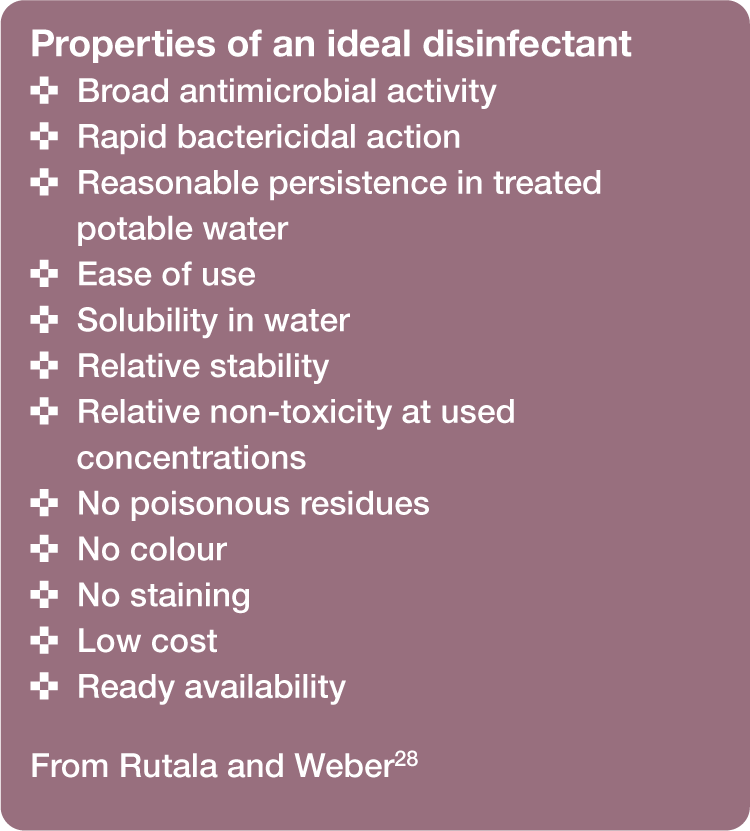
The efficacy of sodium hypochlorite in cleaning and disinfection processes depends on the concentration of available chlorine and the pH of the solution. Hypochlorous acid (HOCl) is a weak acid and dissociates to the hypochlorite ion (OCl−) and proton (H+), depending on the solution pH. It is generally believed that HOCl is the active compound in the germicidal action, whereas the concentration of OCl− is a key factor determining the cleaning efficiency. This implies that the optimal pH for the germicidal activity of sodium hypochlorite differs from that for its cleaning activity. 29 Activity is reduced in the presence of heavy metal ions, biofilms, organic material, low temperature, low pH or UV radiation. 28
Hypochlorites are lethal to most microbes, although viruses and vegetative bacteria are more susceptible than endospore-forming bacteria, fungi and protozoa. Clinical uses in healthcare facilities include hyperchlorination of potable water to prevent Legionella species colonisation, chlorination of water distribution systems used in haemodialysis centres, cleaning of environmental surfaces, disinfection of laundry, local use to decontaminate blood spills, disinfection of equipment, decontamination of medical waste prior to disposal and dental therapy. Despite the increasing availability of other disinfectants, disinfectants based on hypochlorites continue to find wide use in hospitals. 28
Household bleach (0.0314%, 0.0933% and 0.670% sodium hypochlorite, pH 8.36–10.14) produced a >5 log reduction in Listeria monocytogenes, Escherichia coli O157:H7 and Salmonella typhimurium pathogens after 1 min at 25°C. 30
Oxidising agents
Hydrogen peroxide
Hydrogen peroxide is often flushed directly into contaminated or infected wounds where its effervescent action and increased oxygenation retard anaerobic bacteria. It should not be used on closed wounds because of the risk of embolism. 9 It is also used as a disinfectant for nebuliser and anaesthetic equipment. 9 Hydrogen peroxide is not very stable and dissociates into H2O and O2.
After 1 min at 25°C, 3% hydrogen peroxide (pH 2.75) achieved a >5 log reduction in both S typhimurium and E coli O157:H7 burdens. Compared with 1 min at 25°C, greater reductions in L monocytogenes (P <0.05) were obtained after 10 mins of hydrogen peroxide treatment at an initial temperature of 55°C. 30
Potassium peroxymonosulfate
Potassium peroxymonosulfate is an oxidising disinfectant that is usually combined with a surfactant and inorganic buffer in commercially available preparations.9 It is highly bactericidal and virucidal, even against parvovirus (when exposed for 10 mins). 9 However, there is concern that it can corrode surfaces.
Potassium peroxymonosulfate has been shown to significantly reduce FCV titres.19,31
Peracetic acid
Peracetic acid (peroxyacetic acid or PAA) is an organic compound with the formula CH3CO3H; it is generated in situ by some laundry detergents. It is a weaker acid than acetic acid, and is always sold in solution with acetic acid and hydrogen peroxide to maintain the stability of the peracid. It is corrosive due to the acetic acid; however, additives in some commercial products reduce this side effect.
Faecal indicator bacteria (Enterococcus faecium), virus indicator (male-specific [F+] coliphages [coliphages]), and protozoa disinfection surrogate (Bacillus subtilis spores [spores]) were tested by Park et al. 32 Scanning electron microscopy revealed that peracetic acid targets the external layers of spores. Concentrations of 5 ppm (contact time: 5 mins), 50 ppm (10 mins) and 3000 ppm (5 mins) were needed to achieve a 3 log reduction of E faecium, coliphages and spores, respectively.
Peracetic acid concentrations as low as 0.0025% were effective in decreasing Salmonella species artificially applied to chicken carcases, while concentrations of 0.02% were effective in decreasing Campylobacter species numbers, extending the shelf-life of the carcases to 15 days. 33
Pruss et al 34 studied the antimicrobial efficacy of a peracetic acid–ethanol sterilisation (PES) procedure in allogenic avital bone transplants against three enveloped viruses (human immunodeficiency virus type 2, Aujeszky’s disease virus, bovine virus diarrhoea virus) and three non-enveloped viruses (hepatitis A virus, poliovirus, porcine parvovirus). PES led to a reduction in virus titres of more than 4 log10. Only hepatitis A virus showed a reduction below 4 log10 (2.87) with residual infectivity. For Staphylococcus aureus, E faecium, Pseudomonas aeruginosa, B subtilis (including spores), Clostridium sporogenes, Mycobacterium terrae, Candida albicans and Aspergillus niger, a titre reduction below the detection level (5 log10) was achieved after an incubation time of 2 h.
Aldehydes
Chlorhexidine
Chlorhexidine gluconate is widely used as a patient/surgeon skin scrub, and for hand hygiene (both wet washing and rubs). Its antimicrobial activity occurs more slowly than that of alcohols. Both chlorhexidine and povidone–iodine cause an immediate reduction in bacteria; however, the reduction when using chlorhexidine is more dramatic. Unlike chlorhexidine, povidone–iodine shows a lack of cumulative and residual activity. 35
Resistance to chlorhexidine has been described.36,37 Also, multiple nosocomial outbreaks have been linked to contaminated chlorhexidine. 24 Most reports have been traced to the use of contaminated water to prepare diluted preparations and/or the practice of reusing bottles to dispense chlorhexidine without adequate disinfection. Although most outbreaks have occurred with solutions containing less than 2% chlorhexidine, an outbreak has been reported with solutions of 2–4% chlorhexidine. 24
Chlorhexidine was shown to be ineffective against FCV. 27
Jarral et al conclude their review of 593 papers thus: ‘[T]here is no evidence suggesting the use of chlorhexidine during hand scrub reduces surgical site infections, which perhaps explains why guidelines from the World Health Organization, the Centers for Disease Control and Prevention and the Association for Perioperative Practice do not recommend one specific antimicrobial over another for hand scrub.’ 35
Iodine/iodophors
Iodine has broad-spectrum activity against gram-positive and gram-negative bacteria, fungi, protozoa and, to some extent, viruses.9,24 Destruction of bacterial spores requires moist contact for more than 15 mins. 9 Iodine is widely used as a preoperative scrub on patients’ skin. It has a synergistic effect when combined with alcohol and, since it is only slightly soluble in water, it tends to be dissolved in alcohol.
Iodophors are less irritating to skin than iodine compounds, 24 and are non-staining.
Iodine surgical scrub was effective in killing MRSA 38 and parvovirus. 21
Quaternary ammonium compounds/ benzalkonium chloride
The QACs are chemicals that alter the surface tension of an organism and are classed as cationic detergents. They are used for disinfection but are inactivated by organic material, soap and hard water. They are fungicidal, bactericidal and virucidal against some enveloped viruses at medium concentrations, but there is no evidence that they are effective against parvovirus. 9 Benzalkonium chloride was unable to eradicate a mature Salmonella biofilm (though reduced an immature one). 39 Scorza and Lappin 40 claimed that the compound Roccal (Winthrop Laboratories, New York) was effective at inactivating Giardia cysts.
Bacterial adaptation to QACs is documented. Worryingly, exposure to gradually increasing concentrations of this type of disinfectant results in reduced susceptibility not only to the QACs themselves but also to antibiotics, as well as cross-resistance to phenicol compounds (florfenicol and chloramphenicol) in 90% of E coli strains. 41 Extensive use of QACs at subinhibitory concentrations may lead to the emergence of antibiotic-resistant bacteria and may represent a public health risk. 41
Household products
Sodium bicarbonate
The advantages of sodium bicarbonate over the available chemical disinfectants for food contact surfaces are its safety, ready availability and low cost. Sodium bicarbonate at concentrations of 5% and above was found to be the most effective, with 4 log10 (99.99%) reduction in FCV titres on food contact surfaces with a contact time of 1 min. Virucidal efficacy was enhanced when sodium bicarbonate was used in combination with aldehydes or hydrogen peroxide. 42 However, sodium bicarbonate was shown to be ineffective against L monocytogenes, E coli O157:H7 and S typhimurium, even after 10 mins at 55°C. 30 Therefore, since bacterial reduction is important in the disinfection of food contact surfaces, it is preferable to use a cat-safe disinfectant (eg, sodium hypochlorite) and thoroughly wash it off (preferably with very hot [>60°C] water).
Acetic acid (household vinegar)
Cheap and readily available, household vinegar (2.5% and 5% acetic acid) can be used for cleaning as well as for cooking. After 1 min at room temperature (25°C) undiluted vinegar (pH 2.58) reduced S typhimurium numbers by over 5 log units; and at a starting temperature of 55°C, exposed for 10 mins, it significantly reduced L monocytogenes numbers. 30 However, acetic acid fumes make it fairly unpleasant to work with and it is unlikely that it would be chosen in practice over a commercially available disinfectant.
Citric acid (lemon juice)
A 5% solution of citric acid reduced L monocytogenes numbers after 10 mins at an initial temperature of 55°C. 30 However, little is known about the general disinfectant properties of citric acid.
Essential oils
Essential oils have been shown to have some effect against M canis in vitro and in vivo. 43 A mixture composed of 5% Origanum vulgare, 5% Rosmarinus officinalis and 2% Thymus serpillum, in sweet almond oil, was administered to seven infected, symptomatic cats: four of the seven cats recovered. 43 Vázquez-Sánchez et al 44 evaluated the potential of 19 essential oils in removing the foodborne pathogen S aureus from food-processing facilities: thyme oil was the most effective. Thosar et al 45 evaluated five essential oils against four common human oral pathogens (S aureus, Enterococcus faecalis, E coli and C albicans); eugenol oil (oil of cloves), peppermint oil and tea tree oil exhibited significant inhibitory effects. 45
However, the antimicrobial activity of essential oils is due to a number of small terpenoids and phenol compounds; 45 since these are toxic to cats, essential oils should only ever be used under supervision of a qualified veterinary surgeon. Essential oil toxicity has been reported (see Table 1, page 601).46 –48
Reported toxicity in cats associated with disinfectant use
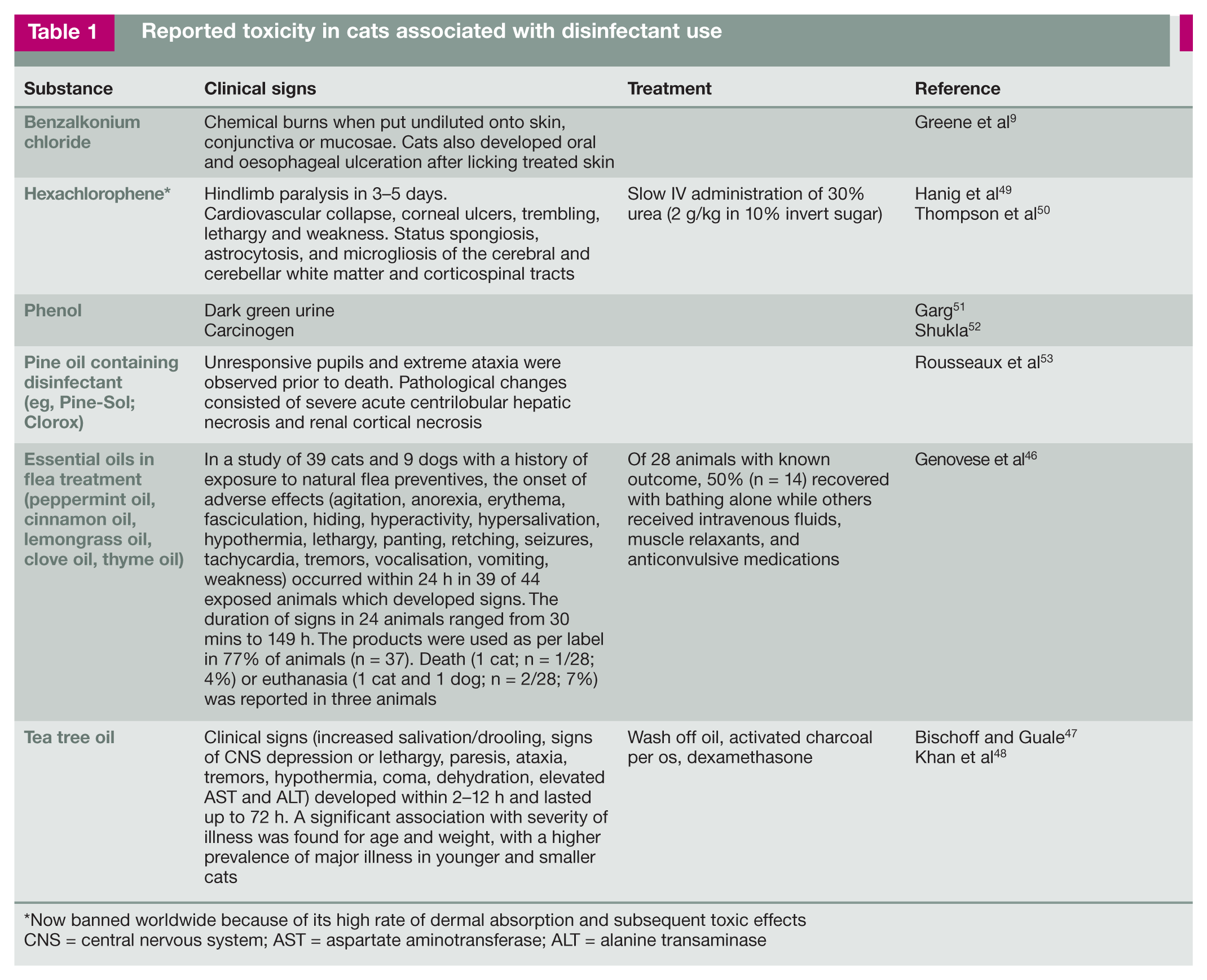
Now banned worldwide because of its high rate of dermal absorption and subsequent toxic effects
CNS = central nervous system; AST = aspartate aminotransferase; ALT = alanine transaminase
Silver compounds
Silver has been used for centuries for making cutlery and dishes, based on an innate understanding of its antimicrobial action. The antibacterial, antifungal and antiviral activities of silver have generated a lot of interest in recent years. A wide variety of applications of silver has recently emerged for consumer products, ranging from disinfecting medical devices, textiles, cosmetics and home appliances to water treatment. The antimicrobial action of silver or silver compounds is proportional to the bioactive silver ion (Ag+) released and its availability to interact with bacterial or fungal cell membranes. Silver metal and inorganic silver compounds ionise in the presence of water, body fluids or tissue exudates. The silver ion is biologically active and readily interacts with proteins, amino acid residues, free anions and receptors on mammalian and eukaryotic cell membranes. Bacterial (and probably fungal) sensitivity to silver is genetically determined and relates to the level of intracellular silver uptake and its ability to interact with and irreversibly denature key enzyme systems. 54
Recent advances in nanotechnology have enabled the production of pure silver as nanoparticles, which are more efficient than silver ions. This has paved the way for new strategies for using pure silver against a wide array of pathogens – particularly multiresistant pathogens, which are hard to treat with available antibiotics. 55 It is believed that the silver nanoparticles are able to interact with disulphide bonds of the glycoprotein/protein contents of microorganisms such as viruses, bacteria and fungi. 55 Silver nanoparticles are attractive because they are non-toxic at low concentrations and have broad-spectrum antibacterial action against at least 12 species of bacteria including multiresistant MRSA, multidrug-resistant P aeruginosa, ampicillin-resistant E coli O157:H7 and erythromycin- resistant Streptococcus pyogenes. 55

There is a growing trend for developing food-packaging materials with antimicrobial properties. Martínez-Abad et al 56 incorporated silver ions into polylactic acid (PLA) films. The films demonstrated strong antimicrobial efficacy against Salmonella enterica and FCV in vitro, with increasing effects at higher silver concentrations. In vivo, antimicrobial activity was very much dependent on the food type and temperature: in lettuce samples incubated at 4°C for 6 days, 4 log colony forming units of Salmonella were inactivated using the films and no infectious FCV was reported. On paprika samples, no antiviral effect was seen on FCV infectivity and films showed less antibacterial activity on Salmonella.
Advances in biotechnology have enabled incorporation of ionisable silver into fabrics for clinical use to reduce the risk of nosocomial infections and for personal hygiene. 54 Although veterinary use of silver has not yet taken off, in 2012, Woods et al 57 reported the use of a combination of nanocrystalline silver dressing and subatmospheric pressure therapy to treat a resistant wound infection, following tumour removal and radiation therapy, in a difficult-to-manage surgical site in a cat.
Chemical disinfectants against parasites
In Europe there is no uniform protocol for efficacy testing of chemical disinfectants against parasitic infections. The only guideline available is from the German Veterinary Medical Society (DVG), with the test organisms being oocysts of the coccidia species Eimeria tenella and eggs of the nematode Ascaris suum. The specific context for this testing is the disinfection of large animal housing. The disinfectants that pass this test are exclusively products based on cresols and phenols – substances that are considered highly toxic for cats. Products based on other active substances, such as aldehydes and peracetic acid, have not been tested against these agents or have been shown not to be efficacious (U Truyen, personal communication).
Antiparasitic disinfection in cat husbandry has, therefore, to rely on thorough cleaning and, whenever possible, steam cleaning to minimise the number of infectious parasites.
Summary
Table 2 presents a summary of the disinfectants discussed in these guidelines. The unique metabolism of cats requires that extra caution is taken when using disinfectants around them.
Summary of disinfectants and their potential for use in the feline environment (continued on page 602)

This table lists disinfectants used in veterinary practices, catteries, shelters and around the home, showing the most notoriously difficult to eradicate pathogens as sentinels for efficacy
For a detailed examination of the uses of bleach, see table 93-1 in Greene et al. 9 FCV = feline calicivirus
Key Points
Disinfectants should be chosen on the basis of efficacy, safety for cats and safety for human users.
Cats are susceptible to phenol-based disinfectants, including certain essential oils.
Heat, especially moist heat, is the safest and most effective disinfectant. Temperatures in washing machines and dishwashers should be at least 60°C to eliminate pathogenic spores and resistant viruses.
Alcohols, and particularly ethanol, are excellent against bacteria but have poor activity against non-enveloped viruses.
Bleach is effective and relatively safe, but its activity is reduced by the presence of heavy metal ions, biofilms, organic material, low temperature, low pH or UV radiation.
Enveloped viruses are susceptible to most disinfectants; of the non-enveloped viruses, parvovirus is universally recognised as being the most difficult to eradicate.
Skin scrubs and rubs containing alcohols are more effective than those containing chlorhexidine, and less subject to contamination.
Quaternary ammonium compounds (eg, benzalkonium chloride) are not recommended.
The future of veterinary disinfection may include ultraviolet radiation and more use of silver.
Footnotes
Funding
The authors received no specific grant from any funding agency in the public, commercial or not-for-profit sectors for the preparation of this article. The ABCD is supported by Merial, but is a scientifically independent body and its members receive no stipends from Merial.
Conflict of interest
The authors do not have any potential conflicts of interest to declare.