




Abstract
Objectives
The aims of the study were to recognise if there is any auditory sensory stimuli processing in cats under general anaesthesia, and to evaluate changes in respiratory rate (RR) and pupillary diameter (PD) in anaesthetised patients exposed to different music genres, while relating this to the depth of anaesthesia.
Methods
A sample of 12 cats submitted for elective ovariohysterectomy was exposed to 2 min excerpts of three different music genres (classical [CM], pop [PM] and heavy metal [HM]) at three points during surgery (T1 = coeliotomy; T2 = ligature placement and transection of the ovarian pedicle; T3 = ligature placement and transection of the uterine body). A multiparametric medical monitor was used to measure the RR, and a digital calliper was used for PD measurement. Music was delivered through headphones, which fully covered the patient’s ears. P values <0.05 were considered to be statistically significant.
Results
Statistically significant differences between stimuli conditions for all surgical points were obtained for RR (T1, P = 0.03; T2, P = 0.00; T3, P = 0.00) and for PD (T1, P = 0.03; T2, P = 0.04; T3, P = 0.00). Most individuals exhibited lower values for RR and PD when exposed to CM, intermediate values to PM and higher values to HM.
Conclusions and relevance
The results suggest that cats under general anaesthesia are likely to perform auditory sensory stimuli processing. The exposure to music induces RR and PD variations modulated by the genre of music and is associated with autonomic nervous system activity. The use of music in the surgical theatre may contribute to allowing a reduced anaesthetic dose, minimising undesirable side effects and thus promoting patient safety.
Introduction
In cognitive science, music is one of the most intriguing and eccentric components of human culture, being apparently universal. 1 In a non-consensual way, music can be defined as the art of organising sound in a temporal dimension according to such properties as melody, harmony, rhythm and tone in order to produce a continuous, unified and evocative composition.2,3 Regardless of its definition, it is widely accepted that music has different physiological and psychological effects on the individual.4–16
Sound waves correspond to longitudinal vibrations of molecules present in the external environment, characterised by alternate phases of compression and rarefaction. 17 These waves are captured by the pinna and travel along the external auditory canal to the tympanic membrane, causing its vibration; the displacement of this membrane leads to the sequential oscillation of the middle ear ossicles, with consequent stimulation of the oval window.18,19 This causes the displacement of perilymphatic vestibular fluid, creating pressure waves that travel through the liquid medium of the vestibular scale and the tympanic scale, as the two scales communicate with each other, and are transmitted to the basilar membrane. The oscillation of the basilar membrane leads to distortion of the stereocilia, with consequent changes in their membrane potential and neurotransmitter release to afferent bipolar neurons, 20 which carry the nerve impulses to the spiral ganglion. 19 Subsequently, the spiral ganglion axons leave the inner ear through the internal acoustic meatus and establish synapses in the cochlear nucleus of the medulla oblongata (Figure 1). 21 From this point on, the auditory information is passed over several other processing centres, such as the superior olivary complex, the lateral lemniscus, the inferior colliculus and the medial geniculate body, culminating in the auditory cortex (Figure 2). 23

The auditory pathway – from the source of sound waves through the external ear to information transmission in the cochlear nucleus (adapted from Patestas and Gartner 18 )
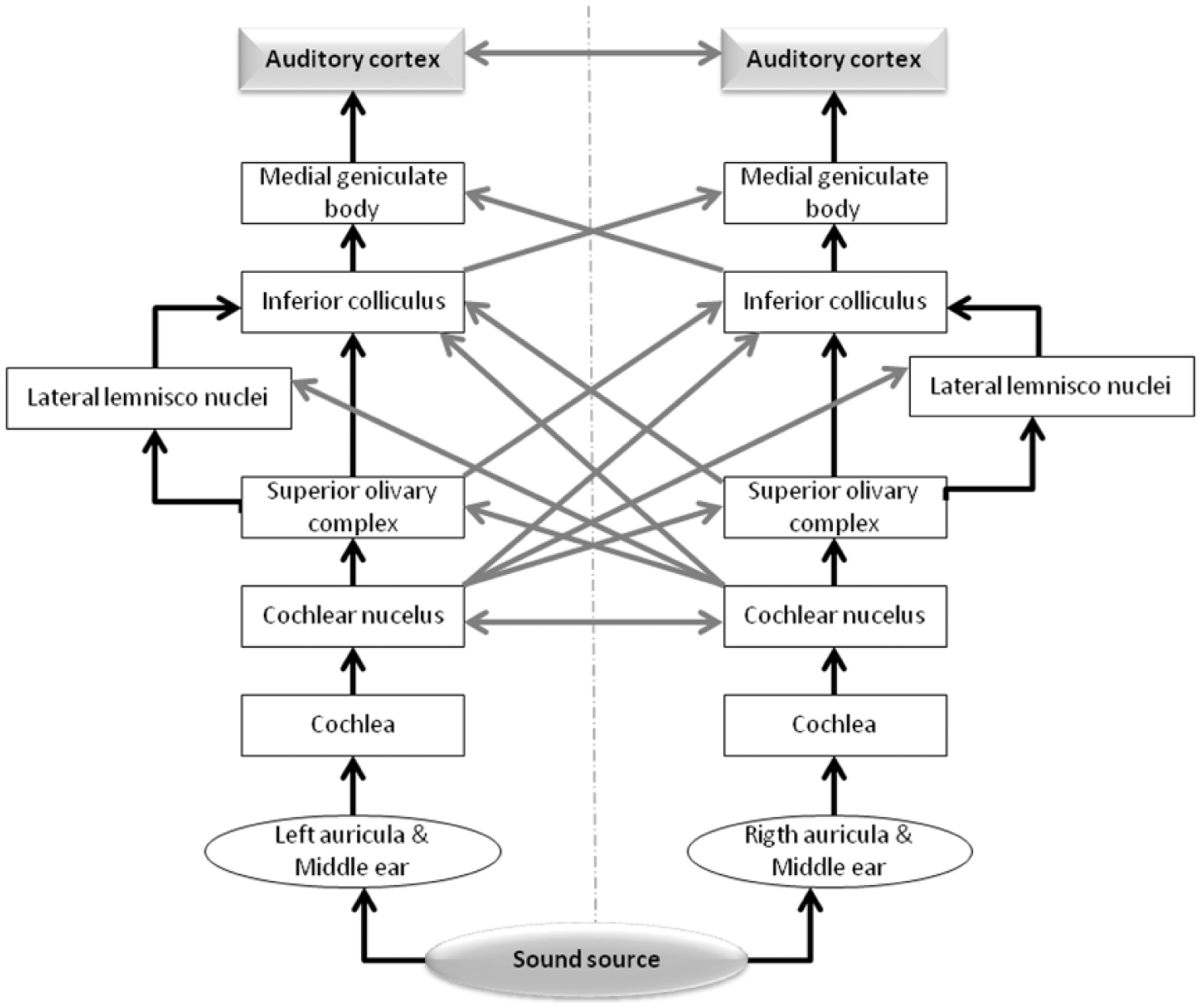
Major ascending auditory pathways (adapted from Mountain 22 )
In non-human animal species, music appears to be a useful tool in terms of welfare, leading to a decrease in stress and anxiety.24–27 In a surgical context, there is evidence that pre-, intra- or postoperative exposure to musical stimuli is beneficial for the patient, leading to a reduction of perceived pain, anxiety and stress, as well as to a decrease in anaesthetic and analgesic requirements.28–41 Several studies in children have reported these findings, and according to the study of Hatem et al, 33 music can even modulate the vital signs in the perioperative period. This is particularly important in children, owing to their frequent non-cooperative nature in a surgery/anaesthesia context. The effects of music on pain reduction are explained by the gate control theory of pain, with music acting to modulate the painful stimuli. Brain imaging studies have shown activity in the auditory pathway, auditory cortex and limbic system in response to music and its ability to reduce stress neurohormonal markers, heart rate, blood pressure and ventilation, especially music with a slow rhythm.10,42 The addition of non-pharmacological agents such as music is assumed to be very important in medical and surgical scenarios.
Clinical assessment of the depth of anaesthesia may be achieved by measuring the respiratory rate (RR) in spontaneously breathing subjects, and the pupillary diameter (PD).16,43–45 We aimed to investigate whether there is any auditory sensory stimuli processing in cats under general anaesthesia, and to evaluate changes in RR and PD in cats exposed to different music genres, relating this to the depth of anaesthesia.
Materials and methods
The study was conducted on a sample of 12 female cats, of domestic breed, with an average age of 9 months (range 6–12 months) and an average body weight of 3.0 kg (range 2.4–3.6 kg), submitted for elective ovariohysterectomy surgery. All individuals were of apparent good health, with no signs of neurological or hearing disorders – conditions that might interfere with the legitimacy of the results. All females with signs of oestrus and with ocular pathology not allowing the collection of accurate data concerning PD were excluded from the sample. For the study, permission from the ethical committee and signed consent forms from the owners were obtained.
After achieving an adequate and stable anaesthetic plane, repeated measurements of RR and PD were undertaken at three different surgical times (T1 = coeliotomy; T2 = ligature placement and transection of the ovarian pedicle; T3 = ligature placement and transection of the uterine body). For each of these surgical time points, patients were first assessed in a silent scenario as a self-control (CT) and then exposed to three different genres of music: classical music (CM), ‘Adagio For Strings (Opus 11)’ by Samuel Barber; pop music (PM), ‘Torn’ by Natalie Imbruglia; and heavy metal (HM), ‘Thunderstruck’ by AC/DC. Musical stimulation was performed for 2 mins for each genre.
The study design for T1 was division of the linea alba into four segments, to be incised under CT and different musical genres; for T2 the study design involved one ovary being surgically worked on under CT and one genre of music, and the other ovary under the remaining two genres. A total of 8 mins was spent on the task. The order of music exposure was not always the same, and data records were blind for the sequence of music presented for each patient (three different sequences were considered, eg, A, B, C). Music was delivered via headphones that fully covered the patient’s ears. An MP3 player set to deliver <80 decibels (measured and confirmed using the Benetech Digital LCD Sound Noise Level Meter device) was used at a loudness level of 4 (out of a maximum of 12) in all patients. Two recordings were made for each genre for each of the studied parameters, and only the arithmetic mean was considered for statistical analysis. The surgical procedure was performed by the same surgeon, using the same surgical technique, and data collection was executed by the same operator, with recourse to a multiparametric monitor (NT MP1000; Mekics Corporation). PD was evaluated by direct measurement using a digital calliper (SXG-model 110, Dongguan Hust Tony Instruments Co) always in the right eye.
All patients were catheterised via the cephalic vein after topical application of bupivacaine gel 5%, and received a continuous intravenous fluid therapy with saline (5 ml/kg/h NaCl 0.9%). Ketamine (7.5 mg/kg IM) with dexmedetomidine (0.08 mg/kg IM) was used for anaesthetic induction, and isoflurane for the maintenance of anaesthesia. A presurgical protocol with amoxicillin + clavulanic acid (8.75 mg/kg IM), meloxicam (0.3 mg/kg SC), atropine (0.02 mg/kg SC) and buprenorphine (0.02 mg/kg IM) was used for all patients. The action of dexmedetomidine was reversed at the end of the surgical procedure with atipamezole (10 IU/patient IM). Statistical analysis was performed with Microsoft Excel and IBM SPSS Statistics. Shapiro–Wilk, repeated measures ANOVA, and Friedman and Wilcoxon signed-rank were used, and P <0.05 was considered to be significant.
Results
We recorded the RR and PD values throughout the study; the results are shown in Tables 1–5. Most individuals exhibited lower RR values when exposed to CM, intermediate RR values to PM and higher RR values to HM at all surgical time points. The Shapiro–Wilk test supports the normality of the obtained data for all stimuli conditions, with the exception of HM at T1 (P = 0.04), which was considered irrelevant given the strength of repeated measures ANOVA; CT at T2 (P = 0.028); and CT (P = 0.033), PM (P = 0.006) and HM (P = 0.014) at T3. ANOVA results for T1, and Friedman’s test results for T2 and T3 exhibited differences in RR between genres, and CT was statistically significant for all three surgical time points (T1, P = 0.03; T2, P = 0.00; and T3, P = 0.00). The results of pairwise comparisons between genres, performed with the post-hoc Bonferroni test for T1 and the Wilcoxon signed-rank test (with Bonferroni correction) for T2 and T3, were statistically significantly different between the following pairs: HM/CM at T1 (P = 0.00), HM/PM at T2 (P = 0.00), HM/CM at T2 (P = 0.00), CM/CT at T3 (P = 0.01) and HM/PM at T3 (P = 0.00) (Figure 3).
Descriptive statistics of the respiratory rates (RR) and pupil diameters (PD), according to music genre and surgical time point. All patients received atropine before the surgical time points and therefore a discrete mydriasis was always expected for all individuals

Data mean (x̄) and dispersion (SD) measures obtained in a 95% confidence interval, presenting the minimum (min) and maximum (max) values at the three surgical time points considered
The physiological respiratory rate range data from Reece 46 (Copyright 2004 by Cornell University)
The physiological pupil diameter range data from Wilkie and Latimer 47
St = statistics; Phys = physiological values; CT = control; T1 = coeliotomy; T2 = ligature placement and transection of the ovarian pedicle; T3 = ligature placement and transection of the uterine body; PM = pop music; CM = classical music; HM = heavy metal
Shapiro–Wilk test results for respiratory rate (RR) and pupillary diameter (PD) organised according to music genre and surgical time point

Values in bold indicate statistical significance
T1 = coeliotomy; T2 = ligature placement and transection of the ovarian pedicle; T3 = ligature placement and transection of the uterine body
Repeated measures ANOVA and Friedman’s test results for respiratory rate (RR) and pupillary diameter (PD), according to surgical time point

Values in bold indicate statistical significance
T1 = coeliotomy; T2 = ligature placement and transection of the ovarian pedicle; T3 = ligature placement and transection of the uterine body
Descriptive statistics of respiratory rate (RR), according to music genre and surgical time point
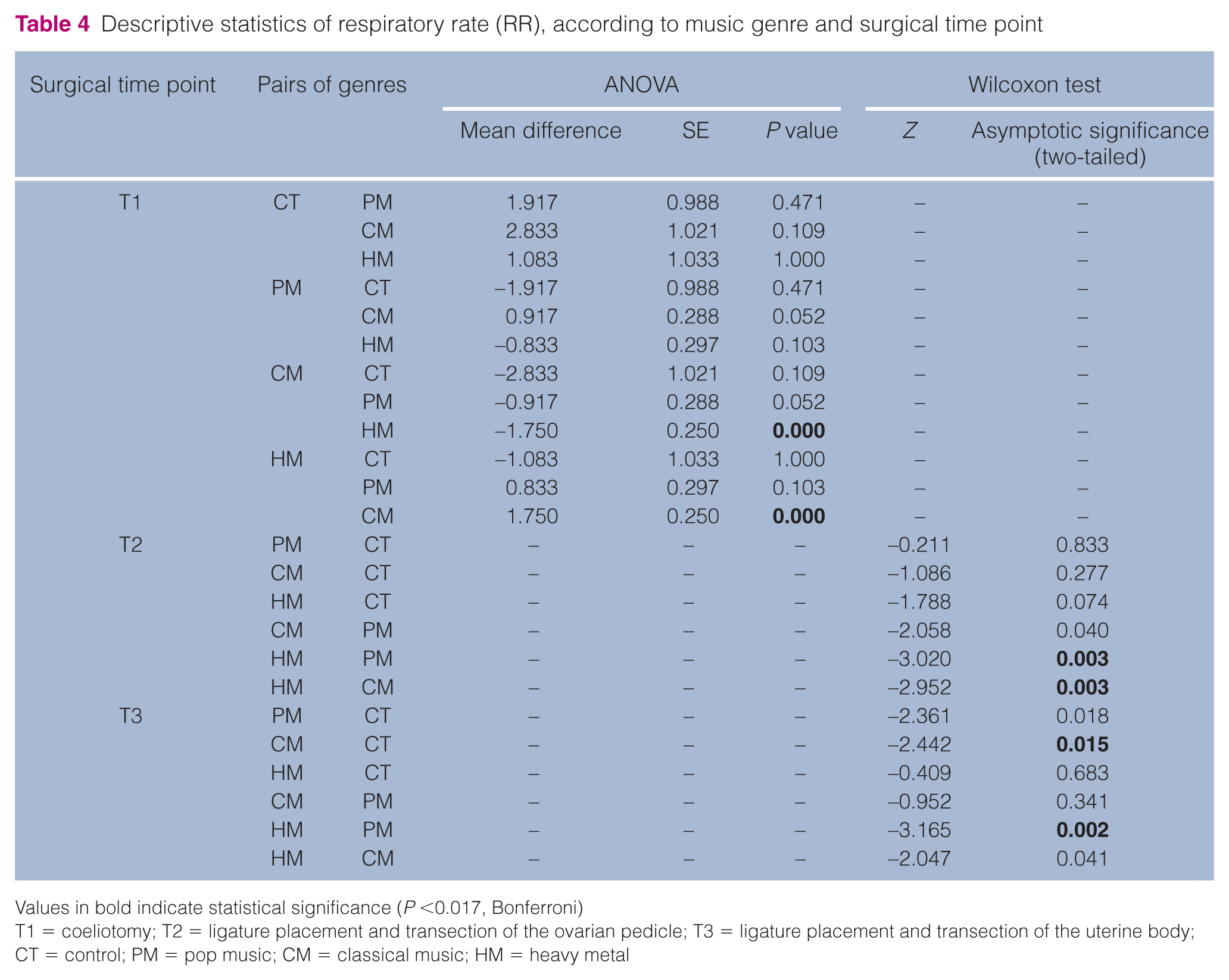
Values in bold indicate statistical significance (P <0.017, Bonferroni)
T1 = coeliotomy; T2 = ligature placement and transection of the ovarian pedicle; T3 = ligature placement and transection of the uterine body; CT = control; PM = pop music; CM = classical music; HM = heavy metal
Descriptive statistics of pupillary diameter (PD), according to music genre and surgical time point

Values in bold indicate statistical significance (P <0.017, Bonferroni)
T1 = coeliotomy; T2 = ligature placement and transection of the ovarian pedicle; T3 = ligature placement and transection of the uterine body; CT = control; PM = pop music; CM = classical music; HM = heavy metal
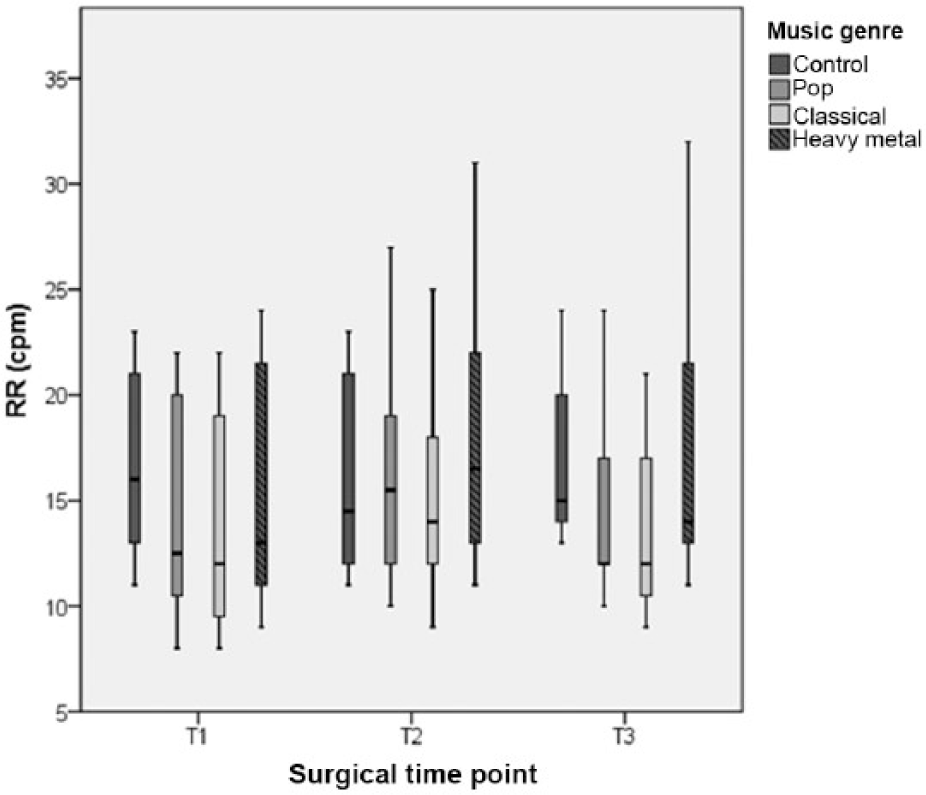
Mean respiratory rate (RR) according to the music genre and surgical time points considered
For PD, at all surgical time points, a higher percentage of individuals manifested lower PD values when exposed to CM, intermediate values to PM and higher values to HM. The Shapiro–Wilk normality test suggests the normality of the collected data, with the exception of CM at T1, the significance value of which was slightly lower than the established threshold (P = 0.04) and for CT in T2 (P = 0.03). The application of the repeated measures ANOVA test led to statistically significant differences being obtained between stimuli conditions for all surgical time points (T1, P = 0.03; T2, P = 0.04; T3, P = 0.00). In terms of pairwise comparisons, statistically significant differences were observed between the following pairs: PM/HM at T1 (P = 0.00); HM/PM at T2 (P = 0.00); HM/CM at T2 (P = 0.00); and at T3 for CT/PM (P = 0.00), CT/CM (P = 0.00), CT/HM (P = 0.002), PM/HM (P = 0.000) and CM/HM (P = 0.000) (Figure 4).

Mean pupillary diameter (PD) according to the music genre and surgical time points considered
Discussion
The autonomic nervous system (ANS) is involved in the control of vegetative functions, which include the respiratory and heart rates, body temperature, and pupil constriction and dilation. In human medicine, the concept that general anaesthesia leads to complete alienation towards external events is rejected by many published studies that support the existence of auditory stimuli processing in patients under general anaesthesia.48–50 Studies on humans concluded that music influences ANS activity differently, depending not only on the sex of the individual, but also on the rhythmic structure to which the patient is exposed.10,51–54 The measures of the anaesthetic effect represent normal physiological responses, which can be quantified, and these are used in clinical practice as possible clinical measures of the depth of anaesthesia. The RR in spontaneously breathing subjects and PD are examples of this.43–45
Our results support these observations for both parameters studied, as the recorded variations showed similar trends over all the considered surgical time points (T1, T2 and T3) in the individuals. In fact, recorded variations in RR and PD can be assumed to be a consequence of the exposure to distinct music genres, with the majority of the patients presenting lower mean RR and PD values when exposed to CM, intermediate values to PM and higher values to HM. By recording these variations it is possible to conclude that, even under general anaesthesia, cats are able to process and differentiate auditory stimuli, and that different rhythms or genres can influence these two physiological parameters, which are under ANS control.16,55,56 The study results reveal a relationship between the different music genres and the clinical signs of anaesthesia depth in the surgical patients as exhibited by the RR and PD variations.
General anaesthetics are potent activity depressants of the ANS, affecting upregulation of cardiac and respiratory functions, and therefore presenting a relatively narrow margin of safety with a borderline between therapeutic, toxic or even lethal doses. 57 Almost all anaesthetic drugs cause a dose-dependent reduction in RR and/or tidal volume, reflecting the patient’s depressed ventilatory function, which is why RR is a good indicator of anaesthesia depth. Considering the side effects of anaesthetics on respiration, it is important to search for new approaches to the anaesthetised patient, with the aim of reducing the anaesthetic dose.
Music can influence RR through the activity of the parasympathetic nervous system, 58 decreasing tissue oxygen consumption. 59 In our study, RR data recording was started only after the patients achieved a stable level of anaesthesia. Patient exposure to different musical genres was the newly introduced stimulus; therefore, we think that the registered variations in RR may be derived from the processed musical stimulus at all surgical time points considered (T1, P = 0.034; T2, P = 0.000; and T3, P = 0.001). According to our results, patients under the same surgical stimulus and hearing CM presented a lower RR (8 cycles per min [cpm]), and those hearing HM presented the highest values (32 cpm). Moreover, the lowest dispersion of data was obtained with CM (12 cpm) and the highest with HM (21 cpm), both in T3. The results are in accordance with the studies of Kogan et al conducted in dogs, 26 where it was concluded that CM can be associated with a more relaxed state, and HM with higher stress and anxiety.
PD measurement is also used as an indicator of the depth of anaesthesia. 60 In cats, the pupil occupies an area that varies between approximately 120 mm2 and <1 mm2, corresponding to a range of values at least 10-fold greater than those displayed by humans. 61 PD adjustment is achieved by the smooth muscle activity of the iris, 62 which, when stimulated by the parasympathetic ANS, promotes contraction, decreasing PD (miosis); in contrast, the sympathetic ANS causes an increase in PD (mydriasis).55,63 All patients received atropine before surgery and therefore a discrete mydriasis was always expected for all individuals. Nevertheless, it was possible to record some variations in PD in all patients at all surgical time points under the influence of different musical genres, revealing statistically significant differences between stimuli conditions for all surgical time points (T1, P = 0.033; T2, P = 0.041; and T3, P = 0.000). According to our results, most of the patients showed greater PD at all surgical time points as a result of exposure to HM, which is related to an increase in sympathetic activity, indicating a more stressful situation. This is in contrast to their exposure to CM and PM, where the miosis values were greater and therefore associated with an increase of the parasympathetic activity.
Conclusions
The results of this study suggest that cats under general anaesthesia are likely to perform auditory sensory stimuli processing, and that this stimulation induces changes in two physiological parameters that are under the control of the ANS, RR and PD, depending on the music genre to which a patient is exposed. This work has implications for the anaesthetic and surgical environments of cats. Use of certain music genres in the surgical theatre may contribute to a decrease in the anaesthetic dose required, reducing undesirable side effects of anaesthetic agents and thus promoting patient safety.
Footnotes
Acknowledgements
We thank CIISA, the Interdisciplinary Centre of Research in Animal Health, Faculty of Veterinary Medicine of Lisbon, University of Lisbon, Portugal; and the Anjos of Assis Veterinary Medicine Center, Barreiro, Portugal.
Conflict of interest
The authors do not have any potential conflicts of interest to declare.
Funding
This research received no specific grant from any funding agency in the public, commercial or not-for-profit sectors.