



Abstract

AAFP
Lights, camera, action: AAFP to be featured on Discovery Channel
The AAFP has been hard at work promoting cat owner education about the importance of routine veterinary visits - and our efforts have paid off! The AAFP and the Cat Friendly Practice (CFP) program will be highlighted in a television episode of ‘Innovations with Ed Begley Jr’, premiering on Discovery Channel. Innovations is an award-winning television series hosted by actor, director and environmentalist, Ed Begley Jr.

This segment will allow the AAFP to reach millions of viewers with our feline wellness messages and build awareness of the CFP program.
The segment will specifically cover:
The importance of routine veterinary care for cats
Reducing stress associated with the visit
The value of feline veterinary exams
How CFPs can benefit cats and cat owners
Dr Susan Little, AAFP President, is interviewed for the Innovations segment

Matt Cohen, cat owner, explains why he brings his cat for routine check-ups
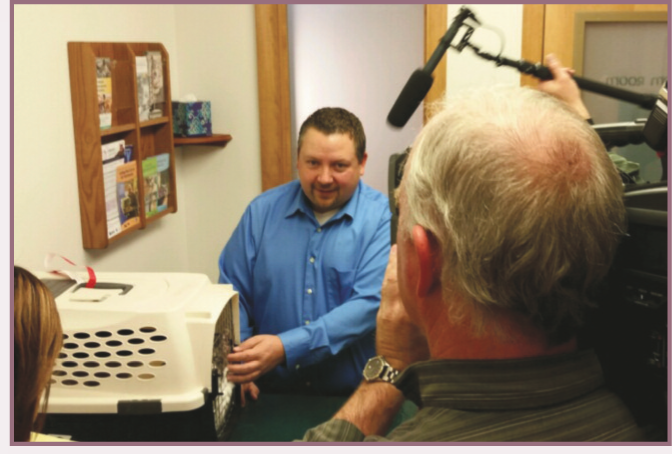
Dr Apryl Steele, AAFP Board Member, discusses the benefits of visiting a Cat Friendly Practice

New guidelines summarise advances in pain management
The AAFP and the American Animal Hospital Association (AAHA) have reviewed and updated the 2007 AAHA/AAFP Pain Management Guidelines in the light of advances in pain management for companion animals. The 2015 Guidelines include a review of this new knowledge. They appear on pages 251-272 of this issue of JFMS and can also be accessed via


iCatCare
‘How-to’ video library
International Cat Care, the parent charity of ISFM, has produced a series of 16 videos to help practices demonstrate to cat owners how to carry out a range of procedures. The videos are each just a couple of minutes long and are designed to offer simple advice for achieving success with some common procedures.


ISFM
CFC resources
Further materials about the Cat Friendly Clinic (CFC) programme are now available on the iCatCare website. For veterinarians, more information can be found about the CFC criteria, such as how to make the reception area more cat friendly, staff training, hospitalisation facilities, and the handling of cats and cat clients.
A gallery of over 40 annotated pictures provides inspiration and solutions for making the waiting room or reception area more cat friendly


Cat owners are also now being catered to, with downloadable leaflets, information about what to expect from a CFC and the facility to provide feedback about their CFC.
To access the new information, visit: www.catfriendlyclinic.org
Award
Clare Rusbridge and Julia Palm have received the 2014 Federation of European Companion Animal Veterinary Associations (FECAVA) awards for best original and best reprint paper, respectively. The awards were presented during the opening ceremony of the 20th FECAVA congress, in Munich in November 2014. From left to right, Monique Megens (FECAVA president), Karin de Lange (Editor of the European Journal of Companion Animal Practice), Julia Palm and Clare Rusbridge. Courtesy of VetiPrax MEDIA 2014/Heep


JFMS
Groundbreaking reviews now free to all
Funding from a foundation with the wellbeing of companion animals at its heart - Maddie’s Fund - has allowed two recent JFMS reviews to be made open access. ‘Feline dermatophytosis: steps for investigation of a suspected shelter outbreak’, by Sandra Newbury and Karen Moriello, and ‘Feline dermatophytosis: aspects pertinent to disease management in single and multiple cat situations’, by Karen Moriello, both published in May 2014, are now freely available to all.

‘As the readers know, dermatophytosis is the most common infectious and contagious skin disease of cats. Although it is self-limiting and non-life threatening, the potential human health risks makes it an important disease in shelters and rescue. The ‘Steps’ article was the result of over a 10 year partnership between us working in the field (SN) and in the laboratory (KM). It articulates a systematic, practical response to outbreaks that guides veterinarians working with shelters through a process that may at first seem impossible to manage. Having access to this systematic plan may be the difference between a shelter being willing to respond constructively rather than giving up when faced with an outbreak. Perhaps even more importantly, the article is a reminder that further investigation, instead of panic, saves lives when faced with a possible outbreak. The ‘Updates’ article introduces a new way of thinking about clinical signs relative to overall health and the CCATS plan (confine, clean, assess, topical therapy and systemic therapy).’
Dr Karen Moriello and Dr Sandra Newbury
‘Dr Moriello’s and Dr Newbury’s research is very important to saving lives for all cats. Their work is revolutionizing not only how we treat ringworm in shelters and foster homes, but has also clarified the misunderstandings in how to diagnose, treat and control ringworm during suspected outbreaks. Maddie’s Fund is pleased to provide the funding to allow open access for this groundbreaking research, as getting the correct information out to all veterinary professionals is critical to saving lives. This work is in alignment with our mission to revolutionize the status and wellbeing of companion animals.’
Dr Laurie Peek, Director of Veterinary Programs, Maddie’s Fund

Book review
Cat sense
If, like me, you love feline medicine and, as a result, you have felt the need to know more about cats, not only as patients but as living beings, then this book should be next on your list to read.
All of us are interested in cats and their medicine or we would not be reading this journal, and much less this page you have now in front of you, right? However, correct me if I’m wrong, but our training in physiology, pathology and therapy is far greater than our general knowledge about the cat itself, its origins and how these origins modified its domestication. Not only that, but how domestication changed the cat to the one we have sleeping on our lap every night while we are relaxing after a hard day of feline clinical pathology.
And this is precisely what this book explores.
The discussion is divided into four broad themes:
Cats in the wild to modern house cats. From different domestication attempts during prehistory to the cat in hatcheries of Egyptian temples, the author pinpoints differences in the domestication of dogs and cats.
How the cat’s brain works. Although, as mammals, our human brains share similar anatomical features to the cat’s brain, there are several notable differences. For example, the five basic senses are not equally important for cats and humans. These, and the social differences lead so often to quite different interpretations of the world around us.
The cat’s social skills. The cat was originally, shall we say, an ‘asocial’ animal. Domestication has allowed some cats to live together in some circumstances without too much distress and discomfort. This section explores these circumstances and how they are evolving; helping cats to adapt to our new style of life.
The cat’s place, present and future. Various questions are posed to the reader, such as: a) whether the cat should or should not live completely indoors; and, if fully adapted to an indoor existence, whether this carries some disadvantages; b) if tolerant behaviour towards people is at least partly inherited, how would cats be in the future if we neutered all ‘good’ house cats? Will this mean that in the near future most cats will be procured from breeders? And, if so, will this spell the impoverishment of genetic diversity?; and c) how we can help in the coexistence of protectionist cat associations and groups that protect the diversity of wild or semi-wild ecosystems around us.
 Feline-specific content
 Practice resource
 Value for money
 Overall reviewer rating

This small, yet great book is ideal to learn about or remind yourself what a cat is, how a cat works and why. But don’t be misled, it contains a huge quantity of science and experience, written in an easy way that avoids tiring and boring chapters. Thanks to that, this book could satisfy the needs of general practitioners, students and interested owners. The author, John Bradshaw, has an incredible method to show you the path, bringing you knowledge and concepts in a very didactic way, assuming that his readers will not all be expert behaviourists.
In summary, this is an easy book to read in terms of both language and content.
It is structured in a logical way, and takes the reader on a journey to show how the cat sees our world - or, better still, how the cat perceives the world that it shares with us. This is a relevant and interesting exercise given the importance of the cat in our modern society, both as owners and as veterinarians.
Acred Med Fel AVEPA
ESAVS Fel Med & Surg
Master Fel Med
John Bradshaw. Penguin Books,
London, 2013. Paperback,
336 pages. Price £8.99,
ISBN 9780241960455