




Abstract
Objective
To assess the medium- to long-term functional outcome of cats after femoral head and neck excision (FHNE) using an owner-completed questionnaire.
Methods
Cats that had FHNE and were free of other orthopaedic or medical conditions that could affect their mobility, other than the studied coxofemoral joint(s), were included. A specific owner-completed questionnaire was used at a minimum of 4 months postoperatively. The questionnaire assessed the ability of the cats to perform normal feline activities, change of demeanour or behaviour, the necessity for long-term analgesia and the time taken to resume normal activities.
Results
Eighteen cats had undergone uni- or bilateral FHNE and met the inclusion criteria. All but one cat could perform normal feline activities without or with slight difficulty at follow-up. The aforementioned cat had notable, persistent difficulty in climbing. The majority of the cats took between 1 and 2 months to resume normal activity. No change in demeanour or behaviour was noted in any of the cats and none of the cats required long-term analgesia.
Conclusions and relevance
Based on the owner-completed questionnaire, cats have good-to-excellent medium- to long-term functional outcome after adequately performed FHNE.
Introduction
Femoral head and neck excision (FHNE) arthroplasty was first described in 1926 by Gathone Robert Girdlestone for the treatment and drainage of septic coxofemoral joints affected by tuberculosis. 1 The procedure was adopted in dogs a few decades later for the treatment of coxofemoral joint arthropathy, such as chronic osteoarthritis and coxofemoral luxations. 2
FHNE is a salvage procedure performed to alleviate pain associated with a diseased or injured coxofemoral joint.3,4 In cats, FHNEs have been reported for the management of femoral head and neck fractures, including femoral capital physeal fractures, coxofemoral luxations, acetabular fractures and osteoarthritis.3,5–8 The clinical outcomes for FHNEs in cats have been reported to be satisfactory-to-good in some studies,3,6,8 but inconsistent in another study owing to concern over dorsal displacement of the affected femur. 9
Total hip replacement (THR), another salvage procedure, has been recommended by some authors for the treatment of coxofemoral joint arthropathy in cats over FHNE.3,10–12 This recommendation stemmed from concerns about poor gait analysis results in dogs after FHNEs, the reduced range of motion in the affected joints, the presence of muscle atrophy and the resulting ‘functional shortening’ of the limb after FHNEs.3,9 This recommendation in cats has to be viewed cautiously as long-term functional outcome comparison between the two procedures in cats is lacking. In addition, differences in the rate and severity of the complications associated with each procedure, and the difference in cost between the two procedures should be taken into consideration. The importance of evaluating the quality of life from the owner’s daily observation after a procedure, in addition to the changes in objective measurements, should not be overlooked. 13
Cats appear to be less demonstrative of pain when compared with dogs and the assessment of pain in the feline patient can be difficult. 14 As a result, the evaluation of lifestyle changes, such as willingness to jump, has been recommended for the assessment of lameness in cats. 14 One study has shown that assessment using an owner-completed outcome measure questionnaire was comparable with objective measures in detecting lifestyle and mobility changes. 15 In addition, an owner-completed questionnaire has been shown to be a practical alternative to objective assessment for functional outcome in cats after carpal and tarsal arthrodesis and after surgical stabilisation of sacroiliac luxations.16–18
The objective of this study was to evaluate the medium- to long-term functional outcome in cats after FHNE using an owner-completed questionnaire.
Materials and methods
Data
Clinical records of all cats that underwent FHNE at two university teaching hospitals and three private practices between 2000 and 2013 were reviewed. Cats with orthopaedic diseases/injuries in addition to the studied coxo-femoral joints (such as contralateral femoral fracture) or medical conditions that might affect mobility were excluded from the study. One exception to this was pubic/ischial fracture; cats with pubic and/or ischial fractures only, in addition to the injuries of studied coxofemoral joints, were included. These cats were included in the study as, in our opinion, the pubic and ischial fractures were unlikely to affect the result of the outcome assessment in this study.
Postoperative radiographs were evaluated by a board-certified orthopaedic surgeon (IC) to determine adequacy of the excision of the femoral head and neck. For the purpose of this study, an inadequate FHNE was defined as an incomplete excision of the femoral neck with bone spur at the ostectomy site. Cats with inadequate excision were excluded from the study and, as a result, the functional outcome of these cats was not determined. Cats were also excluded from the study if the owner-completed questionnaire was not obtained (n = 3).
The questionnaire to be completed by the owners was adapted from previous studies on feline joint diseases (see Table 1 in Supplementary material).16,17 Questionnaires were sent to each of the owners to assess the medium- (>4 months and <12 months) to long-term outcome (>12 months) of the cats after FHNE. A minimum period of 4 months was required between the surgery and the completion of the questionnaire. A minimum follow-up period of 4 months was chosen as, from anecdotal experience, cats would have returned to their ‘normal activities’ by this stage. If a cat had bilateral FHNE performed as staged procedures, the age of the cat at the time of the second surgery was used and the follow-up period was recorded as the period between the second surgery and the completion of the questionnaire
The owner-completed questionnaire examined the ability of the cats to perform normal feline activities during the immediate postoperative period and at the time of medium- to long-term follow-up (at the time of questionnaire completion) using a simple, descriptive, discontinuous scoring system (see Table 1 in Supplementary material) – disability score (DS) of individual activity. Score 0 indicates that the cat is able to perform the activity without difficulty; score 1 represents a slight and occasional difficulty in performing this activity; score 2 represents a slight but frequent difficulty in performing the activity; score 3 represents an important and permanent difficulty in performing the activity; and score 4, the highest score, represents an inability to perform the activity. The average disability score (ADS) for each cat was defined as the average of the DSs for all the activities (seven activities). An excellent outcome was defined as having an ADS of ≤0.50; these cats did not have or had slight and occasional difficulty in performing normal feline activities. A good outcome was defined as having an ADS between (and inclusive of) 0.51 and 1.0; these cats had a slight but frequent difficulty in performing normal activities. Cats that had an ADS between (and inclusive of) 1.01 and 1.50 were considered to have a satisfactory functional outcome. Cats that had an ADS of >1.51 were considered to have a poor functional outcome. The mean of the ADSs of all the cats was termed as the overall disability score (ODS) for FHNE, in line with a previous study. 16 The questionnaire also assessed for a change of demeanour or behaviour, the necessity of long-term analgesia and the time taken to resume normal activities. In the questions enquiring about lifestyle changes, owners were asked to assess the outcomes as dichotomous variables (yes or no).
Surgery
The FHNE was performed as previously described. 19 In brief, the patient was positioned in lateral recumbency with the affected site facing upwards. The caudolateral abdomen, the caudal lumbar region, the base of the tail and the affected limb from the level of coxofemoral joint to distal tibia were aseptically prepared for surgery.
A craniolateral approach to the affected coxofemoral joint was performed. A skin incision was made from just dorsal to the dorsal border of the ilium to the proximal third of the cranial border of the femur, centring at the greater trochanter. The fascia was incised along the skin incision to expose the underlying muscles around the coxofemoral joint. The middle gluteal muscle was identified and separated along the intermuscular septum from the deep gluteal muscle. A tenotomy was performed at the insertion of the deep gluteal muscle, leaving enough portion of tendon at the insertion site for suturing. The middle and deep gluteal muscles were retracted caudoproximally and the articularis coxae covering the joint capsule was visualised. An incision was made in a cranioproximal to caudodistal direction (along the axis of the femoral neck) on the joint capsule, transecting the overlying articularis coxae. Approximately the cranial third to half of the origin of vastus lateralis was elevated from the femoral neck. The femoral head was luxated by severing the round ligament. The femoral head and neck were then exposed by the placement of a Hohmann retractor caudal to the femoral head and by applying lateral and external rotational forces on the distal femur, lifting the femoral head from the acetabulum. Care was taken during the placement of the retractor to avoid entrapment of the sciatic nerve, which wraps around the caudodorsal aspects of the acetabulum, deep gluteal muscle and the greater trochanter.
After the femoral head and neck were exposed, an ostectomy of the femoral head and neck was performed using an oscillating saw. The ostectomy was made along a line connecting the mid-trochanteric fossa proximally to just proximal to the lesser trochanter distally. The ostectomy site was then palpated for any sharp and irregular edges, which were smoothed using a bone rasp. The surgical site was lavaged with saline before routine closure. The incised joint capsule was not sutured closed. The deep gluteal muscle was sutured to the tendon of insertion with a mattress suture pattern and the elevated vastus lateralis was sutured to the cranial edge of the superficial gluteal muscle. The fascia was closed in layers and skin sutures or skin staples were applied.
All cats received postoperative opioid analgesia (up to 24–72 h postoperatively) and non-steroidal anti-inflammatory medications. The duration of the opioid analgesia used depended on the level of analgesia required in each individual case. Different drugs were used at the discretion of the primary surgeon. All cats were discharged home with instructions on early promotion of activity and joint movement.
Postoperative assessment
A ventrodorsal view of the pelvis centred over the extended coxofemoral joints was taken to assess the adequacy of the excision postoperatively. Complete excision of the femoral neck with no bone spur at the ostectomy site was considered adequate.
Results
Background
Thirty-nine cats were evaluated and 18 (46%) were included in the study. Cats were excluded if the owners were not contactable (n = 14), the owner-completed questionnaire was not returned (n = 3), owners were reluctant to participate in the study as the cat had died from a condition unrelated to the affected coxofemoral joint (n = 2) or the FHNE was deemed inadequate (n = 2). Of the included cats, there were six female and 12 male cats. The breeds included in the study were domestic shorthair (n = 9), Maine Coon (n = 3), British Shorthair (n = 3), Tonkinese (n = 1), Ragdoll (n = 1) and Bengal (n = 1). The mean age at surgery was 20 months (SD = 15.5 months). Sex, breed, age at time of surgery, injury or injuries, and the follow-up period were recorded (Table 1). Ten cats had femoral capital physeal fractures, two cats had femoral neck fractures, two cats had coxofemoral joint luxations, one cat had coxofemoral joint luxation and an acetabular fracture in the same joint, one cat had femoral neck and acetabular fractures in the same joint, one cat had severe osteoarthritis in the joint from a previous trauma and one cat had a metaphyseal osteopathy (Table 1). One of the cats with coxofemoral joint luxations also had an acetabular fracture in the same joint and FHNE was performed as the treatment of the injuries in this joint. Six cats had bilateral FHNE performed; three of these were performed in a single session.
Age, breed, injury or injuries, and follow-up period of the cats
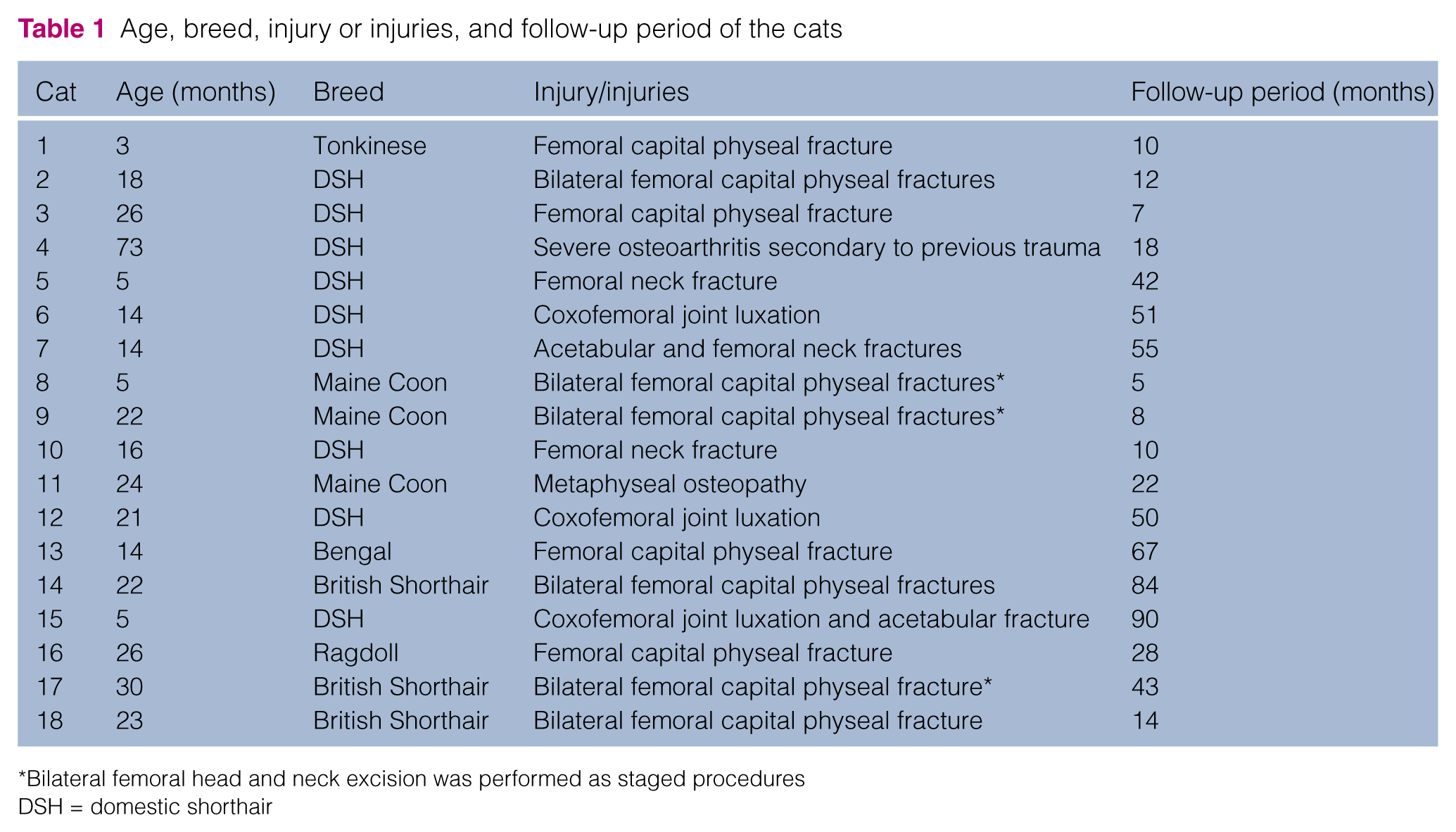
Bilateral femoral head and neck excision was performed as staged procedures
DSH = domestic shorthair
Complications
No intra- or postoperative complications were reported in any of the procedures. Revision surgery was not required in any patient.
Follow-up
Eighteen (86%) of the 21 owner-completed questionnaires were returned. The mean follow-up period was 34 months (SD = 27 months).
One section of the questionnaire (the DS) could not be evaluated in one cat (cat 15) owing to invalid entries (boxes were ticked instead of scores being assigned). The entries for the rest for the questionnaire for this cat (such as the time taken for recovery) were included in the study. Twelve cats (12/17 valid entries; 71%) had an ADS of <0.5 and were considered to have an excellent medium- to long-term functional outcome (Table 2). Five cats (5/17; 29%) had an ADS between (and inclusive of) 0.5 and 1.0; these cats were considered to have a good medium- to long-term functional outcome. At follow-up, the median DSs for running, climbing, jumping down, walking, playing and grooming were 0; the median DS for jumping up was 1. The DS for each cat is available in Table 2 of the Supplementary material. The ADS for each cat is listed in Table 2. The ODS for FHNE was 0.28 (best score = 0, worst score = 4).
Disability scores of the cats at follow-up

The scoring entries were not valid for this cat
FHNE = femoral head and neck excision
Seven cats had reduced height of jump at follow-up (Table 3); three of these cats (cats 2, 10 and 17) had bilateral FHNE performed. Eleven (61%) of the 18 cats took between 1 and 2 months to resume normal activities postoperatively. According to the owners, two cats (cats 4 and 16) did not resume normal activities after the surgery. These two cats were less active in their day-to-day routines, but when performing the assessed activities, they only had slight difficulty in climbing and jumping up and down. They did not have any difficulty in performing other activities. None of the cats required analgesia at the time of follow-up. Change of demeanour (eg, increased aggression, seeking seclusion, resentment of handling) was not noted in any of the cats at the time of follow-up. Owners of 15 (83%) of the 18 cats were willing to bring the cats back for a veterinary examination if required.
Presence of reduced height of jump and recovery period before resumption of normal activity after femoral head and neck excision

1: never gone back to normal, there is a degree of disability; 2: <1 month; 3: between 1 and 2 months; 4: >2 months
Y = yes; N = no
Discussion
This study showed that the medium- to long-term functional outcome of cats after adequately performed uni- or bilateral FHNE was good to excellent based on an owner-completed questionnaire assessment, which was consistent with the findings of previous studies.3,6,8
According to our study, the ODS for FHNE compared favourably with that of carpal arthrodesis (medium- to long-term ODS 0.81) and dorsal pantarsal arthrodesis in cats (medium-term ODS 0.44; long-term ODS 0.04).16,18 All but four cats were able to run, climb, jump, walk, play and groom normally without or with only slight intermittent difficulties. Three of the four aforementioned cats had slight but frequent difficulties in climbing and jumping up. One of these cats had bilateral FHNE (cat 2). The fourth cat (cat 10) had slight but frequent difficulty in jumping up and had permanent difficulty in climbing. It was unclear as to why this cat had a particularly high DS in these activities as this cat only suffered a unilateral femoral neck fracture and it was also a relatively young cat (16 months old at the time of injury and 26 months old at the time of follow-up). The difficulties noted in these four cats could be secondary to reduced joint mobility and altered joint mechanics after FHNE, residual pain or discomfort associated with the FHNE, concurrent underlying orthopaedic disease, such as osteoarthritis, or inadequate femoral neck excision that was not detected on the postoperative radiographs.
The majority of the cats in this study took between 1 and 2 months to resume normal activities. This lag in recovery time was required for the pseudoarthrosis of the joint to form and for the gradual recovery of joint motion and muscle mass. Two cats did not resume normal activities. However, these two cats were assessed to have a good-to-excellent functional outcome as they only had slight and occasional difficulties in climbing and jumping, and were able to perform other assessed activities without difficulty. It was unclear why these cats did not resume normal activities and why the cats were showing particular difficulty in these two activities. However, we speculate that the lack of bone–bone contact of a normal coxofemoral joint after FHNE resulted in weaker propulsion in the hind-limbs for these activities. Despite this speculation, it is vital to remember that the lack of bone–bone contact plays an important role in the successful outcome after FHNE.
Seven cats had reduced height of jump. The large proportion of cats having reduced height of jump in this study was similar to a previous study assessing functional outcome of cats after partial or pancarpal arthrodesis. 16 The underlying reason for this was unclear but we speculated that the reduced height of jump was a more sensitive way to detect subtle difficulty in jumping. None of the cats required long-term analgesia and there was no obvious change in demeanour and behaviour. These findings, in addition to the ADS, were consistent with a good-to-excellent medium- to long-term functional outcome and indicate a good quality of life. It is crucial to remember that functional outcome after FHNE is heavily influenced by the adequacy of the ostectomy as inadequate ostectomy will impinge on joint function and result in chronic lameness.3,4
Femoral capital physeal fracture was the most common indication for FHNE in cats in this study. This was a reflection of the fact that the majority of the cats with traumatic coxofemoral joint injuries had other concurrent orthopaedic conditions, such as sacroiliac luxation, and were excluded from the study. In our opinion, primary surgical stabilisation should be considered before deciding on a salvage procedure of the coxofemoral joints, such as FHNE and THR. The most commonly performed surgical stabilisation for femoral capital physeal fractures is with the use of multiple Kirschner wires.20,21 However, reduced bone stock and chronicity of the injuries may preclude the possibility of primary stabilisation. In these cases, a salvage procedure, such as a FHNE, should be considered to eliminate the pain associated with the condition and to improve joint mobility and function.
Some of the reported changes in objective outcome assessment in cats after FHNEs are caudodorsal mal-position of the femur, shortening of the limb, muscle atrophy, reduced range of motion and pain on passive movement.3,9 The clinical significance of the malposition of the femur after FHNE is not clear. 9 In a large retrospective study of FHNE in dogs and cats, all the cats that were returned for physical examination between 4 and 6 weeks after FHNE had moderate muscle atrophy and a variable degree of reduced range of motion in the affected joint. 3 Despite this, all of the assessed cats were reported to be using the affected limb at the time of assessment, with minimal or no obvious lameness. 3 In our study, no further veterinary reassessment was performed to evaluate the long-term changes in the muscle mass and the range of motion as the studied cats were not returned for examination at the time of follow-up.
Micro-THRs have been reported in a limited number of cats for the treatment of femoral capital physeal fractures, coxofemoral luxation and as revision surgeries after unsuccessful FHNEs.4,9–12,22 Good-to-excellent clinical outcomes were reported in most of the cats in these studies. Despite this, recurrent lameness has been reported in cats after micro-THR. 4 Some of the reported complications of micro- and nano-THRs are luxation of the coxofemoral joint (10–20%), penetration of medial acetabular cortical wall (62%), penetration or fissuring of the femoral cortex (4–18%), post-THR medial patellar luxation needing surgical correction (6–12%), delayed postoperative femoral fracture (3%), acetabular cup loosening, sciatic neurapraxia (1%) and distal femoral medullary canal infarction.4,11,12,22–24 Some of these complications necessitated additional surgeries for the resolution. According to one study, 18% of micro-THR joints required additional surgeries as a consequence of intra- and postoperative complications. 11 Unmanageable or catastrophic complications of micro-THRs have also been reported at a rate of 9–12%; most of these patients required explantations or revision surgeries.11,22 During the explantations or the revision surgeries, some of these coxofemoral joints would have to be converted to FHNE. 11
The intra- and postoperative complication rates for micro- and nano-THRs are not insignificant. These may have significant financial and emotional implications for owners, as well as increased morbidity for the patients. In contrast, no revision surgery was required for any of the procedures in this study and there were no intra- or postoperative complications in any of the cats. Postoperative care after micro-THR in cats commonly consisted of 1–2 days of hospitalisation and cage confinement for 6 weeks.10,11 This is in contrast to the postoperative care in cats after FHNEs, where cage confinement is minimal, and early mobility and ambulation are encouraged.
Studies comparing the complications and long-term functional outcome of THR and FHNE in cats are lacking. One study examining the objective and subjective outcomes in cats after micro-THRs and FHNEs found that all the objective outcome measurements (thigh circumference, angles of hip flexion and extension, and dorsal displacement of the femur) were similar between the THR and FHNE groups when the non-surgical limb was used as a control, except for the dorsal displacement of the femur, which was only reported in the FHNE group. 9 The significance of the dorsal displacement of the femur in cats is currently not clear. 9 It is noteworthy that measurements such as thigh circumference or joint angles have poor intra- and inter-observer correlation, and that measurement of these parameters under sedation will alter the results.25,26
Some authors have strongly recommended micro-THR over FHNE in cats.10–12 Although we acknowledge that THR in cats is an important advancement in feline orthopaedics, one should not overlook the risk of severe complications associated with this, and one should carefully weigh up the risks vs the potential benefits. Veterinary surgeons should be cautioned against choosing a treatment option based on the technical or intellectual challenge and the appeal of performing a novel technique. 27 Another factor to take into account when considering THRs in smaller patients is that smaller dogs and cats tend to live longer than larger dogs; the longevity of the micro-THR in cats, especially when performed at a young age, has not been examined. 22
The main limitations of this study are the number of cats studied, its retrospective nature and the lack of veterinary examination as part of the follow-up. The small number of recruited cases is a reflection of the fact that many of the cats had other concurrent orthopaedic injuries secondary to trauma, as well as the fact that a portion of the suitable candidates were treated with surgical reduction and stabilisation. Inclusion of patients with other orthopaedic injuries will bias the results as they have the potential to alter the lifestyle and the mobility in these cats.
Owing to the retrospective nature of the study, important information, such as pre- and postoperative pain scores, was not recorded in all cases. In addition, the retrospective nature of the study also precluded the standardisation of the postoperative care and treatment protocol.
Veterinarians may notice subtle lameness from thorough veterinary examination, which may be overlooked by the owners. The slight difficulty in jumping and climbing in some of the cats might be due to some degree of pain that was overlooked by the owner and hence the requirement for long-term analgesia was underestimated. Veterinary examination was not conducted in our follow-up assessment owing to concern of stress exerted on the patients during these trips to the practice and the potential reluctance of owners to bring their cats in for the examination. In place of a veterinary examination, we employed owner-completed questionnaires to assess the medium- to long-term functional outcome. Owner-completed questionnaires can guide owners to evaluate their cats’ mobility and their ability to perform normal feline activities, especially those that are affected by pain associated with degenerative joint disease, such as jumping, running, climbing and reduced height of jump. 28 A well designed owner-completed questionnaire has been shown to yield comparable results to objective measures in assessing orthopaedic pain in cats. 15
Conclusions
FHNE is a salvage procedure that results in good functional outcome in cats. Salvage procedures, such as FHNE and THR, are viable alternatives if primary surgical treatment of the coxofemoral joint arthropathy is not an option, either owing to patient factors, such as lack of bone stock for placement of implants, and/or client factors, such as financial constraint (primary surgical repair vs FHNE) or the inability to restrict the patient’s activity level. When choosing the type of salvage procedure, surgeons should carefully and critically weigh up the benefits against the potential risks. Factors such as the type and severity of complications associated with a procedure, long-term functional outcome and quality of life of the patient, and financial impact associated with the procedure should be taken into consideration. A prospective study comparing FHNE and THR using objective analysis tools, such as force plate analysis, will be useful to guide us in which salvage procedure is more appropriate in cats.
Supplemental Material
Table 1
Owner-specific questionnaire
Supplemental Material
Table 2
The disability scores of the cats based on the owner specific questionnaire
Footnotes
Supplementary material
Conflict of interest
The authors do not have any potential conflicts of interest to declare.
Funding
This research received no specific grant from any funding agency in the public, commercial or not-for-profit sectors.
References
Supplementary Material
Please find the following supplemental material available below.
For Open Access articles published under a Creative Commons License, all supplemental material carries the same license as the article it is associated with.
For non-Open Access articles published, all supplemental material carries a non-exclusive license, and permission requests for re-use of supplemental material or any part of supplemental material shall be sent directly to the copyright owner as specified in the copyright notice associated with the article.
