



Abstract
AAFP
Coming on leaps and bounds: Cat Friendly Practice program in the USA
The AAFP’s Cat Friendly Practice (CFP) program has been making great strides in the North American feline veterinary community. Currently, over 1500 practices have started the program and over 640 practices have been designated a CFP!

The AAFP has been hard at work creating informational materials, resources and programs that benefit both veterinary team members and cat owners. Here’s a brief update on some recent CFP initiatives.

Videos for cat owners
The AAFP has launched three educational videos for cat owners on how CFPs can help their cats and why routine veterinary care is so important. The series offers an insight into how CFPs are able to provide the high quality of care while showing owners a commitment to address the distinct health needs and special considerations of feline patients. The videos can be used by your own practice as the topic of a social media post about routine veterinary care for cats, as well as used as an education tool for new clients stressing the importance of yearly visits.

Year of the AdvoCat
We are in the midst of the Year of the AdvoCat, which is an initiative for 2014 to promote the CFP program to veterinary practices and cat owners. For the CFP program, practices must assess their clinics with a comprehensive checklist, and the AAFP has found that some members have not finished this process to become a CFP. In an effort to mitigate any hurdles, the AAFP is putting together CFP Peer AdvoCats who will be an additional resource and support to members as they navigate the CFP process.
2014 AAFP Conference
The focus of the AAFP’s annual conference this month is Feline Gastroenterology and Endocrinology. The program will additionally include a CFP panel of veterinary professionals who will share their personal experiences of going through the CFP program and provide some tips. There will also be a CFP booth in the exhibit hall where you can stop by and ask questions or get further information. For more information on the conference, visit: www.catvets.com/education.
New resources to accompany house-soiling guidelines
The AAFP and ISFM Guidelines for Diagnosing and Solving House-Soiling Behavior in Cats, which have also been endorsed by the American Animal Hospital Association (AAHA), were published in the July issue of JFMS.


Riga stages the ISFM Congress


Speakers and science
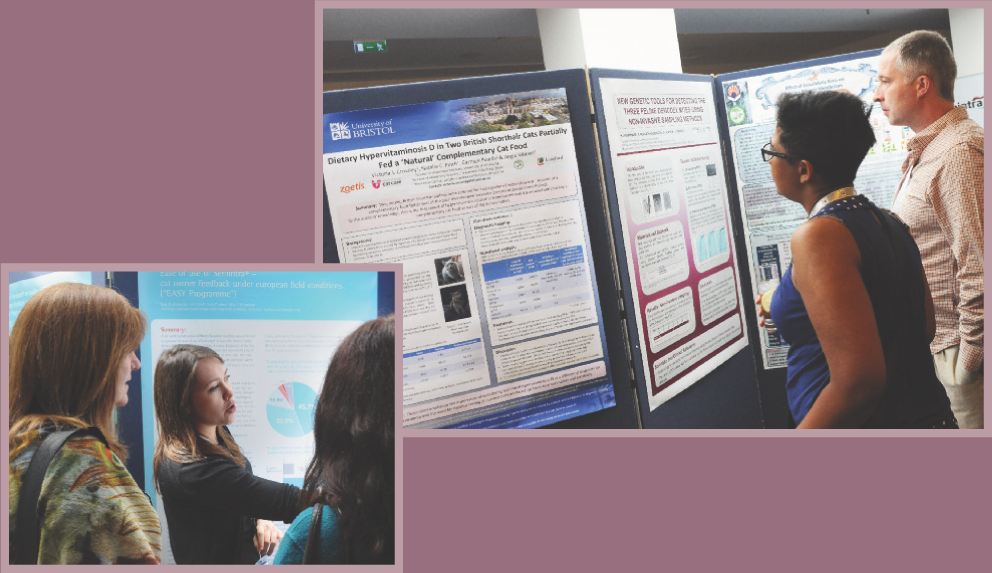
Keynote speakers, Laurent Garosi (right) and Tony Buffington (far right) delivered a memorable series of presentations and also a masterclass each, allowing some of the themes and ideas to be developed in a more intimate setting. With his stunning visual aids and engaging presentational style, Dr Garosi succeeded in making the neurological examination of the cat accessible and demystifying a set of clinical presentations often considered akin to a ‘scary movie’! Professor Buffington focused on evidence-based veterinary medicine, environmental enrichment and Pandora syndrome, providing some fresh perspectives and fascinating insights into some everyday issues for feline practitioners
The 2014 ISFM/Hill’s Award for Outstanding Contributions to Feline Medicine was presented during the Congress to Professor Tony Buffington, who is pictured wtih Andy Sparkes, Veterinary Director of ISFM, Claire Bessant, Chief Executive of ISFM, and Petra Viziova, of Hill’s

Congress speakers also included Rita Gonçalves (above), who gave four well-received neurology lectures, and John Williams (right), who injected surgery into the proceedings with two presentations and a masterclass

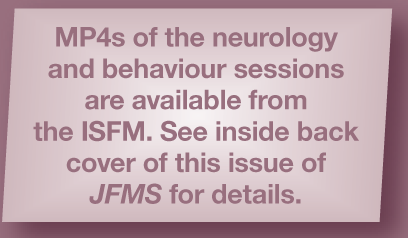
The poster session has established itself as a popular element at the ISFM Congress. Abstracts of the posters appear on pages 764–769 of this issue of JFMS
The poster session has established itself as a popular element at the ISFM Congress. Abstracts of the posters appear on pages 764–769 of this issue of JFMS

The European Advisory Board on Cat Diseases (ABCD)/Merial Young Scientist Awards 2014 were presented during the Congress. The recipients were Katarzyna Zabielska (left), who was presented with the basic research award, and Katja Silbermayr (right), who was presented with the clinical research award. They are pictured with Dr Jean-Christophe Thibault of Merial (left) and Professor Marian Horzinek, chairman of the ABCD board (right). Abstracts of the research which earned them their respective awards appear on pages 768–769 of this issue of JFMS

Among the delegates were many regular ISFM Congress attendees, as well as those attending a European Congress for the first time from Russia, Lebanon, Lithuania and Thailand

Behaviour and welfare
The benefits, challenges and solutions connected with cats and humans living together were explored during the pre-Congress CEVA/ISFM behaviour and welfare symposium. Among the speakers were Daniela Ramos (above left), who discussed her studies in São Paulo on behaviour and stress levels in single versus multi-cat households, and Elly Hiby (above right), who gave an introduction to non-surgical reproduction control in cat populations. Fertility control will be one of the themes of the 2015 ISFM Congress and the subject of a forthcoming special issue of JFMS
Congress partners’ CPD
Integrated into the Congress programme were symposia sponsored by (clockwise from left): Bayer (caring for cats); Hill’s (FLUTD – what’s new?); Boehringer Ingelheim (compliance – more than giving medication); and Merial (cat parasitosis)

Social and chat
The ISFM Congress has an enviable reputation for being one of the friendliest meetings in the veterinary calendar and, as ever, this year there were ample opportunities for social and chat during coffee and lunch breaks, and evening receptions. There were also abundant opportunities to talk one-to-one with speakers, and with exhibitors in the Congress exhibition hall. This year’s Hollywood-themed party night attracted a number of stars of stage and screen!

(left) The ISFM Academy of Feline Practitioners was officially launched during the Congress and members (those who have successfully achieved the MANZCVS qualification) met to enjoy a meal kindly supported by Agria


JFMS
Social media impact and download data
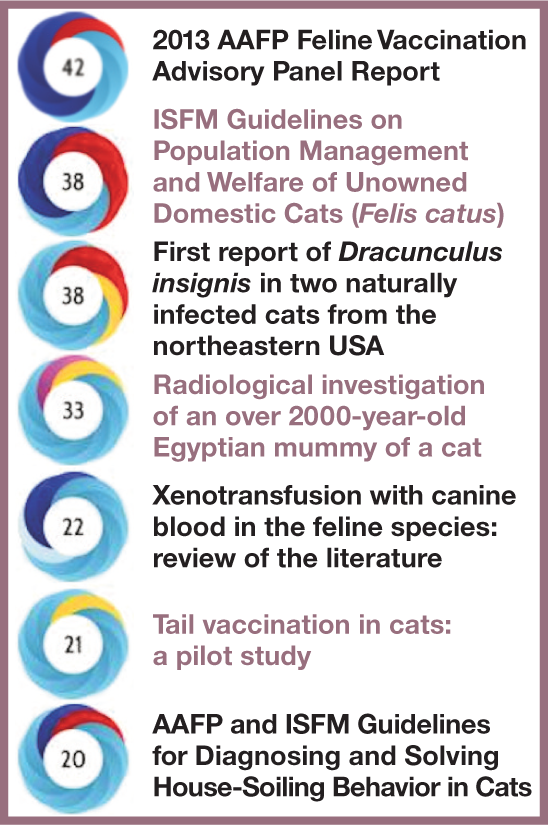
The top seven Journal of Feline Medicine and Surgery articles according to their presence on social media in the 6 months to July 2014 are shown on the right. The article level metric scores, or so-called altmetrics, show the impact the articles have achieved and the colours of the ‘doughnuts’ represent the activity of different forms of social media (pink = Google+; dark blue = Facebook; light blue = Twitter; red = website/media; yellow = blogging). The recently published House-Soiling Behavior Guidelines (JFMS 2014; 16: 579–598) have already made a strong impact.
Below are the current top downloading institutions. The recent addition of the National Taiwan University Library to the list indicates our increasing Asian presence.
Current as of mid-July 2014
Top downloading institutions of 2014 to date


JSFM
Japan joins ISFM’s network of National Partners
The Japanese Society of Feline Medicine (JSFM), a new National Partner of ISFM, held its inaugural meeting and seminar at the end of June, attended by 200 delegates.
Charter members of the JSFM board include Director Dr Takuo Ishida (pictured), Academic Advisors Professor Ryohei Nishimura and Professor Hajime Tsujimoto, both from the University of Tokyo, and Executive Director Dr Satoshi Higashiyama, a general practitioner and practice member of ISFM, as well as several other academics and practitioners.
Left to right: Director Dr Takuo Ishida; attendees at the interactive seminar; and the seminar handout

Despite a pattern of increasing numbers of household cats and declining numbers of dogs, it is reported that cats visit the vet less frequently than dogs in Japan. JSFM feels there are common misconceptions among cat owners concerning feline veterinary care; they have had previous negative experiences when visiting the vet with their cat and are therefore more concerned about taking their pet than are dog owners.
To move feline medicine forward, JSFM, with support from Royal Canin, is holding seminars and conferences to provide an opportunity for vets and vet nurses to learn about feline medicine. There will also be events where owners too can learn about cats.
ISFM has launched its Cat Friendly Clinic (CFC) programme in Japan in partnership with Royal Canin and this has already attracted a great deal of interest. To date four clinics have achieved gold CFC status and one has achieved silver CFC status.
Feline advocates
In conversation: Mark Peterson

Continuing her series of interviews with key figures in feline medicine, Nicolette Joosting, of the Vancouver Feline Hospital, Canada, talks to Dr Mark Peterson, a distinguished speaker at this month’s AAFP conference whose name is synonymous with feline hyperthyroidism.
While at veterinary school, I wasn’t taught too much specifically about cats, but I certainly did see many cat owners who cared tremendously for their indoor cats. I adopted two Siamese cats during my time in school. These cats taught me a lot about having indoor cats (rather than barn cats). I also learned that the Siamese breed could be very loud!
During my internship and residency at The Animal Medical Center (AMC) in 1976, I was surprised to find that over half of our caseload was cats. I learned tons about them in my first 2 years of training at the AMC. Then feline hyperthyroidism changed my life – as far as I know, I was the first veterinarian to document hyperthyroidism in cats (1979) and the first to treat hyperthyroid cats with radioiodine (1980). I soon became a certified cat ‘expert’. That extended to being the first to document a number of ‘new’ diseases in cats, including acromegaly, hypoparathyroidism, insulinoma and feline Addison’s disease. I didn’t make any of these discoveries alone – collaboration is a very important part of any research discovery. The best thing about it is that the longer I work with cats the more I continue to learn from them.
Before retiring (and I am not thinking of that yet!), I’d like to simply finish the many clinical research studies we are doing and get all of the data written up and published. The problem, of course, is that clinical research is a never-ending journey, and once you learn one thing, many new questions arise. The hardest aspect of my job is lack of enough time to get everything done that I’d like to accomplish. Clinical research and writing research papers take a lot of time!
In addition, learn all you can about feline nutrition, but realize that the best place to learn may not necessarily be from the cat food industry. Finally, keep an open mind and don’t be afraid to try new ways to make cat visits, treatment or hospitalization better for the cat and the owner.
Clinical research simply is a logical means to figure out the answer to a clinical problem. Once I identify a question/clinical problem to which I do not know the answer – and this happens almost every week – I work on a protocol to study it. In most cases, of course, it’s best to work on smaller problems (how many hyperthyroid cats have urinary tract infections?) rather than major ones (what is the cause of hyperthyroidism?).
For some cats, I will softly sing to them while holding the touch. I’m not sure if it matters which song you sing, as long as it’s slow and soft – I generally sing an old German drinking song that my grandmother taught me over 50 years ago!
And why do both of my cats have Earl as their second name? Well, my full name is Mark E Peterson, so you can probably guess what my middle name is! My father Earl, the dairy farmer, might be turning over in his grave, or he might be very proud...