




Abstract
The timing of physeal closure is dependent upon many factors, including gonadal steroids, and previous studies have shown that early neutering delays physeal closure. Pelvic and femoral radiographs of 808 cats were analysed and physes at the greater trochanter, proximal femur, distal femur and proximal tibia were recorded as being open or closed. Date of birth, gender, neuter status and breed of cases were recorded. Each physis was analysed individually at a specific age. The number of male entire (ME), male neutered (MN), female entire (FE), female neutered (FN), pedigree and non-pedigree cases at each of these ages was recorded. The number of cases that were open or closed at each stated age were compared between the neutered and entire, the female and male, and the pedigree and non-pedigree groups using a Fischer’s exact test, with P <0.05 being considered significant. Seven hundred and eighty-three radiographs were included: 359 MN, 95 ME, 237 FN and 92 FE. Ninety-six cats were pedigree and 687 were non-pedigree. A statistically significant effect was shown with physes closing later in MN than in ME cats for the greater trochanter (P = 0.0037), distal femur (P = 0.0205) and tibial tuberosity (P = 0.0003). No effect was shown for the proximal tibial or proximal femoral physes, nor for any physis when comparing FE with FN cats. No statistically significant effect of breed or sex was noted. Physeal closure will occur later in MN cats than in ME cats for the greater trochanteric, distal femoral and tibial tuberosity physes, and the potential clinical consequences of this should be evaluated further.
Introduction
Growth of the long bones of limbs occurs by two biological processes: intramembranous ossification producing increases in width and endochondral ossification producing increases in length. 1 The epiphyseal plate, which is responsible for growth in bone length, 2 is composed of hyaline cartilage and appears as a radiolucent line between the epiphysis and metaphysis on radiographs of young animals. 3
Closure of the physis is dependent upon many factors, including species, anatomic site, hormonal influences and diet.4–15 The hormonal determinants of physeal closure include growth hormone, insulin, insulin-like growth factor, thyroid hormone, oestrogens and androgens. 1 It has been suggested that growth plate closure coincides with sexual maturity. 1 However, in cats, primates, cows and humans physeal closure times vary, with some closing pre-puberty and others post-puberty.1,16 It has been proposed that physes that close pre-puberty may close in response to lower levels of gonadal steroids, or, alternatively, in response to some other, as yet undefined signal, while physes that close post-puberty are more dependent upon gonadal steroids for signalling. 1 Both androgens and oestrogen accelerate physeal closure by allowing calcium deposition at the physes.1,17 However, this effect is much more dose-dependent for oestrogens than androgens. 17
Cats have been shown to reach puberty between the age of 8.5 and 10 months,18,19 with weight20,21 and season 22 being determining factors. Physes in cats have been demonstrated as closing between 4 and 9 months, with the majority being closed by 9 months of age. 23 However open physes in entire cats have been reported in animals up to the age of 24 months. 24 Previous studies have demonstrated delayed physeal closure subsequent to early neutering owing to the effects of gonadal steroids.1,17 It is generally accepted that the reaction of the normal physis is likely to be gender-specific, 1 and that physeal closure in castrated males is delayed when compared with that in entire males. 17 However, results in the literature vary regarding whether females are equally affected and which particular physes are affected.1,17,25
The physis is a weak link in the immature skeleton being prone to failure during trauma, 26 and this leads to potential concerns that later closure could lead to a higher incidence of fractures involving the physis.27,28 Epiphyseal separation at the distal femur has been noted to occur in adult cats and the conclusion was made that a line of weakness must still have been present in order for this to occur. 29
The proximal femoral physis has been recorded as closing at approximately 9 months of age,24,28 but as traumatic fractures along this plane are frequently encountered in older cats this is considered suggestive of delayed physeal closure. 30 Non-traumatic fractures of the femoral head have also been reported,31,32 and while little is known about the pathological processes involved in this condition, delayed closure of the physis may be a contributory factor. 28 Physeal fractures in other locations have also been reported in cats that are considerably older than would be expected based on reported physeal closure times.24,27
Attitudes to early neutering vary, but in animal shelters where neutering is being used as a method of population control, it has become normal practice to neuter dogs before the age of 6 months and cats at less than 4 months of age. 33 The traditional recommended age of neutering is approximately 6 months in cats, prior to the average age of puberty, and this was the protocol in the majority of the practices involved in this study. There exists concern regarding the possibility that animals neutered pre-pubertally may be more vulnerable to fractures affecting the physis for a longer period of time than entire cats. 17 The purpose of this study was to expand the existing data base regarding normal times of physeal closure in cats and the effect of neutering on physeal closure, particularly with regard to the physes of the proximal pelvic limb where injuries are common.28,31,34 Our hypothesis was that both male and female neutered cats would have open physes at a later age than sexually entire cats. This effect was expected to be particularly pronounced at the femoral capital physis.
Materials and methods
Pelvic and femoral radiographs of cats were analysed from one referral and two primary care centres. Hospital files were searched using terms ‘cat femur’ and ‘cat pelvis’ to locate appropriate cases. Date of birth, gender, neuter status and breed of each cat were recorded. Domestic shorthair, domestic longhair or cross-breed were classified as non-pedigree; all other breeds were considered pedigree and recorded by breed. Radiographs were disregarded if the radiograph was poorly exposed, compromising assessment of the physes, or if the radiograph involved a fracture or fracture repair of the area of interest. Physeal plates of the greater trochanter, proximal femur and distal femur were recorded as being ‘closed’ or ‘open’. During the study it was found that the proximal tibia was also invariably included on the radiographs being evaluated and therefore the status of the proximal tibial physis and tibial tuberosity physis was also recorded. The physis was recorded as closed if a radiolucent line at the level of the physis could not be observed. 1
Analysis was performed separately for each physis. The population of cats was divided and grouped into male entire, male neutered, female entire, female neutered, pedigree and non-pedigree categories, and organised into ascending age order. For each physis, male entire cats were compared with male neutered cats and female entire cats were compared with female neutered. Entire males were also compared with entire females and neutered males to neutered females. In addition, pedigree cats were compared with non-pedigree cats, regardless of gender and neuter status. A specific age was chosen at which to analyse each physis, which was based upon previously published literature. 24 The ages chosen were as follows: greater trochanter at 7 months, proximal femur at 9 months, distal femur at 13 months, proximal tibia at 9 months and tibial tuberosity at 17 months.
For direct comparison it was necessary to have cats at the specified age in each category; owing to an absence of cats aged 17 months, the age used for comparison for the tibial tuberosity physis was amended to 18 months. Similarly, there was an absence of cats aged 7 months in the pedigree category for the greater trochanteric physis; therefore, the age for comparison for these particular categories was amended to 8 months.
The number of cases at each of these ages was counted separately for male entire, male neutered, female entire, female neutered, pedigree and non-pedigree. The number of open and closed physes at these particular ages for each physis was recorded. If physes were closed before the stated ages, they were assumed to be closed at the stated ages. If the physes were recorded as open at a later age than was being evaluated, they were assumed to be open at the stated age for each physis.
Statistical analysis
For all physes the number of cases that were open or closed at each stated age were compared between two groups. The male entire group was compared with the male neutered group, the female entire group with the female neutered group, the entire male with the entire female group, the neutered male with the neutered female group and the pedigree group with the non-pedigree group using a Fischer’s exact test. A P-value <0.05 was considered significant.
Results
A total of 808 radiographs was reviewed. Twenty-five cases were rejected either because of poor radiographic quality complicating assessment of the physes or owing to the presence of a fracture. Therefore, 783 sets of radiographs were included. Out of these, 359 cats were male neutered, 95 male entire, 237 female neutered and 92 female entire. Pedigree cats accounted for 96 cases, while 687 were classified as non-pedigree. The age of the cats ranged from 1 month to 20 years; therefore, although a large total sample was evaluated, the sample size at each of the specified ages was smaller.
As has been documented in earlier studies, 1 islands of cartilage sometimes prevented complete radiographic physeal closure and this complicated assessment of the physis as open or closed. In these cases physeal closure was not considered complete until there was complete disappearance of the radiolucent line with these islands no longer being visible. This assessment is in line with that used previously. 1
Greater trochanteric physeal closure
Thirty cases were identified aged 7 months where the greater trochanteric physis was radiographically evident: five male entire, 10 male neutered, nine female entire and six female neutered. The proportion of cases for each category where the physis remained open is shown in Table 1. Male neutered cats had later growth plate closure times than entire male cats (P <0.05) (Figure 1). Female entire cats did not differ in time to closure compared with female neutered cats (P >0.05) (Figure 2). The latest recorded open growth plate for this set of data was 13 months for a male neutered cat, 7 months for a male entire cat, 9 months for a female neutered cat and 12 months for a female entire cat. There was no significant difference when comparing entire males with entire females (P >0.05) or neutered males with neutered females (P >0.05).
Number of cats with open or closed physes at specified ages according to sex and neuter status

ME = male entire; MN = male neutered; FE = female entire; FN = female neutered

Comparison between the percentage of male entire cats and male neutered cats with closure of the greater trochanteric growth plate at 7 months (P = 0.0037)

Comparison between the percentage of female entire and female neutered cats with closure of the greater trochanteric growth plate at 7 months (P = 1.00)
Proximal femoral physeal closure
Fifty-three cases were identified aged 9 months where the proximal femoral physis was radiographically evident: seven male entire cats, 27 male neutered cats, six female entire cats and 13 female neutered cats. The proportion of cases for each category where the physis remained open is shown in Table 1. There was no statistically significant difference between the time of growth plate closure for the proximal femur when comparing neutered cats of either gender with sexually intact cats (P >0.05), as seen in Figures 3 and 4. However, the latest recorded open proximal femoral growth plate was 20 months for a neutered male, whereas the latest recorded open proximal femoral growth plate for an entire male was at 12 months. For the female cats, the latest recorded open proximal femoral growth plate was 24 months for the neutered female and 12 months for the entire female. There was no significant difference when comparing entire males with entire females (P >0.05) or neutered males with neutered females (P >0.05).

Comparison between the percentage of male entire and male neutered cats with closure of the proximal femoral growth plate at 9 months of age (P = 0.6228)

Comparison between the percentage of female entire and female neutered cats with closure of the proximal femoral growth plate at 9 months of age (P = 0.3331)
Distal femoral physeal closure
Seventy-one cases were identified aged 13 months where the distal femoral physis was radiographically evident: nine male entire cats, 33 male neutered cats, 12 female entire cats and 17 female neutered cats. The proportion of cases for each category where the physis remained open is shown in Table 1. Male neutered cats had statistically significantly later closure of the distal femoral growth plate than male entire cats (P <0.05) (Figure 5). Female neutered cats did not differ significantly in time of closure compared with female entire cats (P >0.05) (Figure 6). The latest recorded open distal femoral growth plate in the male neutered group was 24 months, compared with 15 months in male entire cats. In the female group the latest open distal femoral growth plate for entire cats and neutered cats was 25 months and 24 months, respectively. There was no significant difference when comparing entire males with entire females (P >0.05) or neutered males with neutered females (P >0.05).

Comparison between the percentage of male entire and male neutered cats with closure of the distal femoral growth plate at 13 months of age (P = 0.0205)

Comparison between the percentage of female entire and female neutered cats with closure of the distal femoral growth plate at 13 months of age (P = 0.2635)
Proximal tibial physeal closure
One hundred and seven cases were identified aged 9 months where the proximal tibial physis was radiographically evident: 12 male entire cats, 51 male neutered cats, 16 female entire cats and 28 female neutered cats. The proportion of cases for each category where the physis remained open is shown in Table 1. Male entire cats and male neutered cats showed no statistically significant difference for age of physeal closure (P >0.05) (Figure 7). This was similarly true for the female categories (P >0.05) (Figure 8). The latest recorded open proximal tibial growth plate was 24 months for male neutered cats and 15 months for male entire cats. The latest recorded open proximal tibial growth plate for female entire cats was 25 months; it was 24 months for female neutered cats. There was no significant difference when comparing entire males with entire females (P >0.05) or neutered males with neutered females (P >0.05).
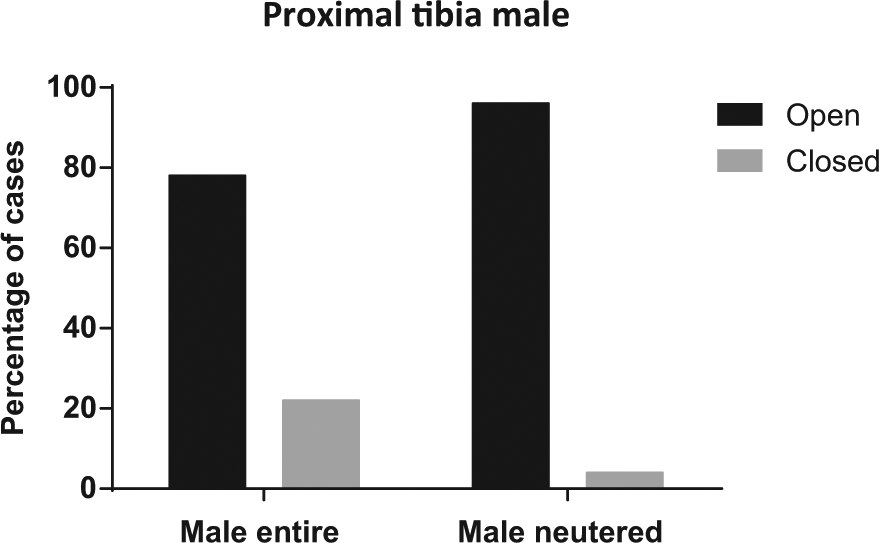
Comparison between the percentage of male entire and male neutered cats with closure of the proximal tibial growth plate at 9 months of age (P = 0.1455)

Comparison between the percentage of female entire and female neutered cats with closure of the proximal tibial growth plate at 9 months of age (P = 0.5406)
Tibial tuberosity physeal closure
Sixty-eight cases were identified aged 18 months where the tibial tuberosity physis was radiographically evident: 12 male entire cats, 31 male neutered cats, 14 female entire cats and 11 female neutered cats. The number of cases for each category where the physis remained open is shown in Table 1. Male neutered cats demonstrated statistically significantly later closure of the tibial tuberosity growth plate than male entire cats (P <0.05) (Figure 9). Female cats showed no difference (P >0.05) (Figure 10). The last recorded open tibial tuberosity growth plate was 36 months for both the male entire and male neutered groups. The latest open tibial tuberosity growth plates for the female neutered group and the female entire group were 30 months and 36 months, respectively. There was no significant difference when comparing entire males with entire females (P >0.05) or neutered males with neutered females (P >0.05).

Comparison between the percentage of male entire and male neutered cats with closure of the tibial tuberosity growth plate at 18 months of age (P = 0.0003)
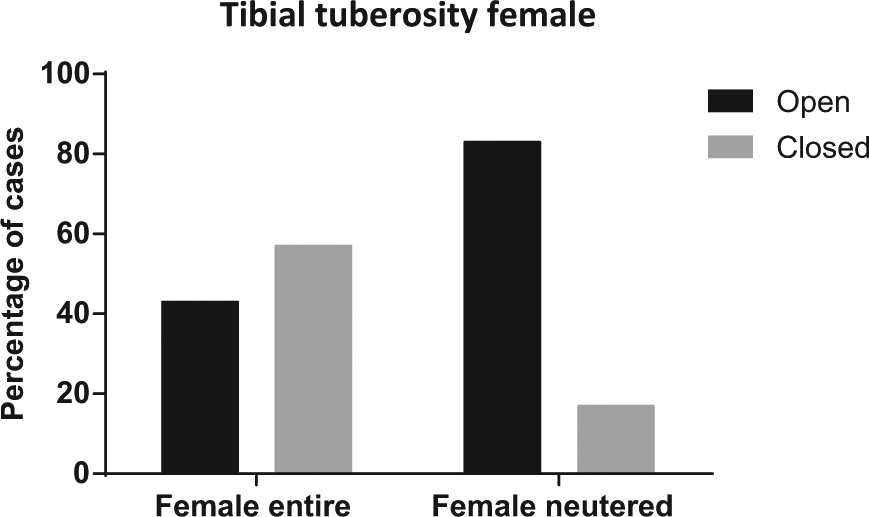
Comparison between the percentage of female entire and female neutered cats with closure of the tibial tuberosity growth plate at 18 months of age (P = 0.0511)
Pedigree compared to non-pedigree
On comparison of pedigree and non-pedigree cats there was found to be no significant difference (P >0.05) between the times of growth plate closure at any physis analysed. The latest open physis for the pedigree group of cats was recorded at 36 months for the tibial tuberosity. The last open growth plate for the non-pedigree group of cats was also recorded at 36 months for the tibial tuberosity.
Discussion
The original hypothesis that initiated the study expected to establish that neutered cats of both genders would demonstrate physeal closure at an age later than that of their entire counterparts, with the prevalent differences occurring in the male neutered compared to male entire categories. The results of this study confirmed this hypothesis only in male cats, not female cats, and only in select physes. A significant delay in closure for neutered male cats compared with entire male cats was demonstrated for the greater trochanteric physis, distal femoral physis and tibial tuberosity physis.
For female cats, no significant findings at any physis were demonstrated. In a previous study, delayed closure of the distal radial physis was demonstrated in cats that had been neutered both pre- and post-puberty 1 compared with entire female cats. Our study is the first exclusively investigating a large number of pelvic limb physes and evaluating them individually, and appears to contradict previous work. While the previous study was prospective in comparison with our retrospective study, only six animals per group were investigated, so the numbers we report are larger. In addition our study evaluated five physes in comparison with the one evaluated in the previous work. Three major groups of physes have been identified that close at, or about, the same time, 24 with those in the first group closing between 4 and 7 months, those in the middle group between 8 and 14 months, and those in the latest group between 14 and 20 months. It has been proposed that those that close pre-puberty may be less affected by the age of neutering than those closing post-puberty. 1 The distal radial physis is in the latest group of physes to close. Out of the physes evaluated in our study, two were in the middle group (greater trochanter and proximal femur) and three in the latest group (distal femur, proximal tibia and tibial tuberosity). While it could be argued that the lack of significant difference in closure time for the proximal femoral physis could be because it closes in the middle group and is possibly influenced by lower levels of gonadal steroids or by alternative signals, this would seem unlikely as the greater trochanteric physis typically closes prior to the proximal femoral physis, and this was affected by neutering. It is also possible that individual physes respond to other signals in addition to withdrawal of gonadal steroids, which may vary with location and would explain the difference between the results reported here and those reported previously. However, this is purely supposition and requires further study.
It has been demonstrated in previous studies that castration does delay physeal closure.17,25 May et al 17 evaluated the proximal humeral, distal femoral and proximal tibial physes, but grouped them together rather than evaluating each separately. Their study reported that these physes all closed later in neutered males, which partially supports the findings in our study as the distal femoral physis was found to remain open significantly later in male neutered cats. However, our study did not demonstrate a significant difference in the proximal tibial group. The differences between our study and the previous work may be owing to the effect of grouping the physes together in the previous study, which may have made a lack of effect at one particular physis more difficult to identify.
The tibial tuberosity physis was found to be open much later than expected in some cats. It has been stated previously that this apophysis should fuse to the cranial edge of the proximal epiphysis between 36 and 44 weeks of age, 24 with radiographic fusion being complete between 50 and 76 weeks of age. In our study, in both the male neutered and male entire cats, the last open physis was recorded at 36 months. In the female neutered and entire cats, the tibial tuberosity physis was recorded as open at 30 and 36 months, respectively. This persistence of open growth plates in all the groups of cat should be noted. This may be relevant in cases requiring surgery in this area, for example, in cases of patellar luxation requiring realignment of the quadriceps mechanism.
Unexpectedly, there was no significant difference between male neutered cats and male entire cats when comparing the proximal femoral physis; however, the latest recorded open physis for a neutered male was at 20 months of age compared with 12 months for an entire male. This could be a type two error. As it has been demonstrated in previous studies that male cats, aged between 12 and 42 months, are prone to femoral head fractures involving the physis,28,30,35 it would be interesting to determine if a larger sample size would demonstrate a significant difference between the two groups. It would also be interesting to assess the influence of weight on this result, which it was not possible to do in this study.
Little data are available that determine an ideal age of neutering. 36 While it is generally accepted that neutering delays physeal closure times in male cats, there is a paucity of data on the effect of neutering on individual physes, which may demonstrate different results, as noted in this study. This study partially supports previous work indicating that neutering affects physeal closure times of selected physes in males, but the clinical significance of this in terms of physeal fracture remain unclear. One study has demonstrated that there is no significant correlation between the age of neutering and the incidence of long bone fractures, 37 suggesting that even though the physes appear to be open for longer, this has limited clinical relevance. Root et al 1 also demonstrated that the predisposition to Salter Harris fractures was no different in cats neutered at 7 weeks or 7 months. Other studies, however, have demonstrated clinical significance in the delay of physeal closure, 28 and traumatic fracture of the proximal humeral, distal radial, distal femoral and distal tibial growth plates have been demonstrated in neutered male cats at an age later than expected. 27 Following the results from this study, further investigation to assess the potential clinical significance of delayed physeal closure is warranted.
Limitations
The retrospective nature of the study introduces potential sources of error, particularly with regard to the potential for reporting inaccuracies. The date of birth of the cat was provided by the owner and inaccuracies here may have altered the calculated age of the patient and therefore the results. Unfortunately, if the cat was recorded as neutered, it was not possible to obtain details of what age the cat had been neutered. Therefore the effect of early neutering could not be assessed in this study, simply the effect of neutering in general.
There was no standardisation in radiographic positioning and protocol. As the radiographs were taken at a particular point in time, it was not possible to determine at what exact age each physis had closed or was going to close. It was just determined whether the physes were closed or open at that specific point in time (of the radiograph being taken). In order to determine when a physis closed for a particular cat serial radiographs of each cat would need to taken and this was not possible for this retrospective study.
Some studies have suggested that overweight cats are more likely to have delayed physeal closure. Unfortunately, it was not possible to obtain sufficient numbers of accurate weights to enable evaluation of this hypothesis. When a weight was recorded, this was the most recent weight for the patient, which may or may not have been the weight at the time of radiography. For this reason weights were not recorded and the effect of weight on physeal closure was not evaluated.
The sample size was relatively small at the specified ages, even though a large total sample had been evaluated. No open physes were evident in cats over the age of 36 months and therefore a large amount of data was disregarded for the direct comparison at each specified age.
Conclusions
The data presented here support the hypothesis that physeal closure will occur later in neutered male cats than male entire cats for the greater trochanteric, distal femoral and tibial tuberosity growth plates, and the potential clinical consequences of this should be evaluated further. A larger sample size or a large prospective study may overcome some of the limitations described above and may show significant differences at more physes.
Footnotes
Acknowledgements
We would like to acknowledge Mieghan Mhairi Bruce for her assistance with the statistical analysis.
Funding
This research received no grant from any funding agency in the public, commercial or not-for-profit sectors.
Conflict of interest
The authors do not have any potential conflicts of interest to declare.