




Abstract
Overview:
Papillomaviruses are epitheliotropic and cause cutaneous lesions in man and several animal species, including cats.
Infection:
Cats most likely become infected through lesions or abrasions of the skin. Species-specific viruses have been detected but human and bovine related sequences have also been found, suggesting cross-species transmission.
Clinical signs:
In cats, papillomaviruses are associated with four different skin lesions: hyperkeratotic plaques, which can progress into Bowenoid in situ carcinomas (BISCs) and further to invasive squamous cell carcinomas (ISCCs); cutaneous fibropapillomas or feline sarcoids; and cutaneous papillomas. However, papillomaviruses have also been found in normal skin.
Diagnosis:
Papillomavirus-induced skin lesions can be diagnosed by demonstration of papillomavirus antigen in biopsies of skin lesions, or detection of papillomavirus-like particles by electron microscopy and papillomavirus DNA by polymerase chain reaction (PCR).
Treatment:
Spontaneous regression might be expected. In cases of ISCC, complete excision should be considered if possible.
Virus
Papillomaviruses are small viruses containing circular double-stranded DNA and belonging to the family Papillomaviridae, which contains 30 genera.
Epidemiology
Papillomaviruses have been detected in several animal species and in man as a cause of cutaneous lesions. 1 In each host different papillomavirus types exist, which is also true for cats. 2 The viruses tend to be species-specific, but sequences related to bovine and human papillomaviruses have been found in cats, suggesting cross-species transmission.3,4 Papillomavirus infection has also been detected in other felids including the Florida panther subspecies of cougar (Puma concolor coryi), bobcat (Lynx rufus), Asian lion (Panthera leo persica), snow leopard (Panthera uncia) and clouded leopard (Neofelis nebulosa). 5
Pathogenesis
Papillomaviruses are epitheliotropic; infections usually occur through lesions or abrasions of the skin. Initially, the basal cells of the stratum germinativum are infected, which leads to hyperplasia and delayed maturation of cells in the stratum spinosum and granulosum. In the basal cells only early gene expression occurs, whereas viral protein synthesis and virion assembly occurs in terminally differentiated cells of the stratum spinosum and, more specifically, the stratum granulosum. Virus is present in the differentiated keratinised cells and is shed with exfoliated cells of the stratum corneum.
Papillomaviruses are commonly found in normal skin of different animals, including the cat; 6 this makes definitive proof of a causal relationship between the presence of papillomavirus sequences and skin lesions difficult.

Clinical signs
In cats, papillomaviruses have been associated with different skin lesions.
First,
Second, viral plaques can progress into
Third,
Fourth, papillomaviruses have been associated with
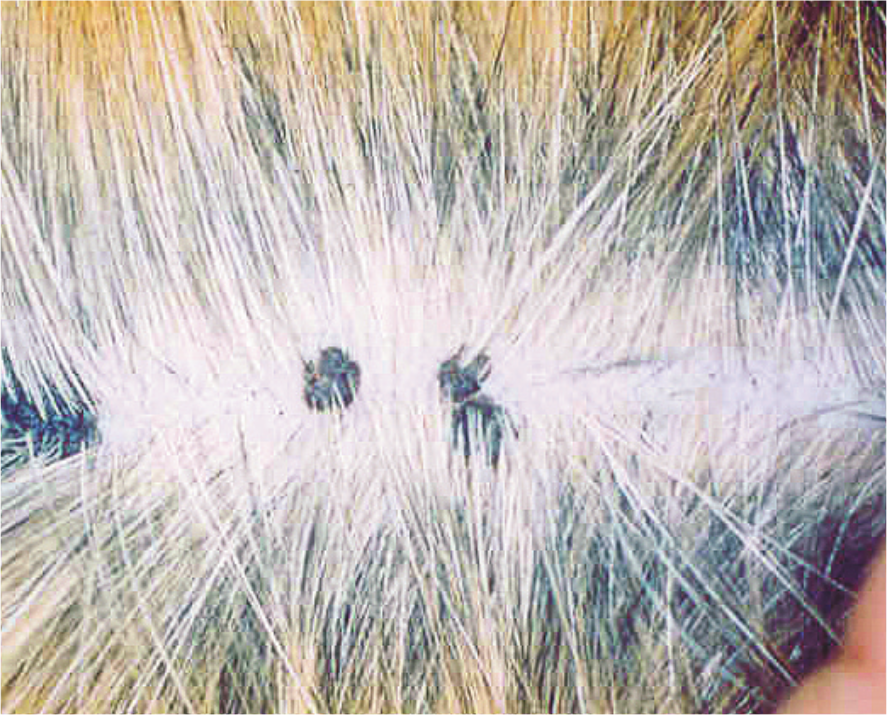
Pigmented flat cutaneous papillomas. Courtesy of Herman Egberink, PhD thesis, Utrecht

A case of sarcoid in a patient presented at the Utrecht Companion Animal Clinic; diagnosis was verified histologically, but the viral etiology was not established. Courtesy of Y Schlotter, Companion Animal Clinic, Veterinary Faculty, Utrecht University
Diagnosis
A biopsy from a skin lesion can be taken for histopathological examination and immunohistochemical staining of papillomavirus group-specific antigens. By electron microscopy, intranuclear papillomavirus-like particles might be demonstrated in keratinised cells. Also PCR can be used to demonstrate papillomavirus DNA in the lesions and for identification of the viral strain by further sequencing. However, the presence of papillomavirus DNA in normal skin of cats makes interpretation of positive PCR results of skin lesions difficult [
Disease management
No specific treatment is known. In immunocompetent cats, spontaneous regression can be expected, as is also seen in dogs, but it may take a long time, up to several months [

There are no vaccines available for papillomatosis in cats.
Footnotes
Key Points
Funding
The authors received no specific grant from any funding agency in the public, commercial or not-for-profit sectors for the preparation of this article. The ABCD is supported by Merial, but is a scientifically independent body.
Conflict of interest
The authors do not have any potential conflicts of interest to declare.