



Abstract
Practical relevance:
Squamous cell carcinoma (SCC) is a tumour that commonly involves the skin or oral cavity and is, therefore, an important differential diagnosis for any cutaneous lesion(s), especially any non-healing scabbing lesions on the eyelids, nasal planum or ears of light-coloured cats.
Clinical challenges:
Superficial lesions of the nasal planum, discrete small eyelid lesions and lesions on the tips of pinnae are relatively easily treated, but higher stage lesions are more challenging to manage and may compromise the cosmetic appearance of the cat.
Audience:
This review article is aimed at all veterinary practitioners that see cats.
Evidence base:
The review summarises the peer-reviewed literature relating to our understanding of feline cutaneous SCC. Unfortunately, the literature is limited and in need of updating in areas.
Squamous cell carcinoma
Squamous cell carcinoma (SCC) is a malignant tumour arising from squamous epithelium. Squamous epithelium forms most of the skin, lines the oral cavity and oesophagus, and forms the nail beds and foot pads. SCC accounts for 15% of feline skin tumours and the vast majority of feline oral malignant tumours, but primary SCC of cats’ digits is less common. As with most cancer, this is a disease of older cats, with the median age affected being 10–12 years old. The behaviour of SCC varies according to site. The underlying cause of SCC also varies and is site related. Treatment options depend on the stage of the primary tumour.
This review focuses on cutaneous SCC and, in particular, solar-induced forms of the disease. Oral and digital SCC are outwith the scope of the present article, although oral SCC has previously been reviewed in this journal. 1
Aetiology of cutaneous disease
The cause of most cutaneous SCC is chronic exposure to ultraviolet (UV) light; specifically it is thought to be related to exposure to UVB radiation. Tumours of this aetiology are seen almost exclusively on the head, with white cats or coloured cats with white areas being at greatest risk. 2 Fur is a physical barrier to UV radiation so these SCCs arise on sparsely haired, non-pigmented areas such as the ears, eyelids, nasal planum and temporal areas. Cats of any breeding and either sex can be affected but long-haired breeds are more protected as they have better hair cover, and breeds like the Siamese are naturally protected by the distribution of their markings. In humans, it has been suggested that UV light and human beta papillomaviruses may act together to cause cutaneous SCC, but the evidence is contradictory.3,4 Some authorities have extended this theory to the solar-induced feline SCC, but the evidence is not compelling. 5
About 10% of SCC of the skin presents in a different way. It appears on the body of cats of any colour as multiple superficial lesions and is referred to as Bowenoid carcinoma, Bowen’s carcinoma or multicentric squamous cell carcinoma in situ. This presentation and its treatment is discussed on page 406.
Presentation
Most cats with solar-induced SCC present with lesions noticed by their owners. The lesions often appear as reddened, non-healing scabby craters and classically the owner perceives any lesion on the cat’s nasal planum as a non-healing cat scratch. The whole head of a susceptible cat is exposed to the same UV damage over the same length of time; thus it is not unusual to see pre-cancerous (actinic) changes and SCC in the same area of skin at the same time (Figure 1).

This cat had areas biopsied as actinic change, carcinoma in situ and stage T1 squamous cell carcinoma (SCC) distributed over his nose and temporal areas
Ears often show obvious actinic change, thickening and curling at the edges before becoming scabbed and undergoing erosion at the edge of the pinna as normal tissue is lost and the disease progresses from actinic keratosis through carcinoma in situ to SCC (Figure 2). Cats can present with concurrent lesions on their pinnae, nasal planum and eyelids.

Pinna of a domestic shorthair cat showing thickening at the edge and scabbing, consistent with early actinic changes
Diagnosis and clinical staging
Diagnosis is best achieved by biopsy – either a punch biopsy or an excisional or incisional biopsy using a scapel. Most lesions are too superficial or inflamed to enable a reliable diagnosis through fine needle aspiration. There are often multiple abnormal areas so, ideally, multiple areas should be sampled as some areas will be dysplastic whereas others will be overt SCC. It is sensible to put samples into separate pots to ensure the more aggressive lesions are correctly identified.


Feline skin stained by immunohistochemistry for MCM7 (the brown-staining cells) and counterstained with eosin. MCM7 is a marker of dividing cells. These brown-staining cells are forming the basal layer of the skin
World Health Organization staging system 6

Feline cutaneous SCCs are relatively slow to metastasise. If they do they are reported to spread to the draining lymph nodes and the lungs. Therefore, complete staging (see box on page 402) would involve fine needle aspiration of draining lymph nodes and chest radio graphs.
Therapeutic decision making
The treatment options available for solar-induced SCC depend largely on the site affected on the cat’s head and how extensive the lesion is, but may also vary according to the geographic location of the reader. For completeness, all published treatments are reviewed below.
As the tumour is unlikely to metastasise the decision for complete staging should involve a discussion with the owner centred on the proposed treatment and its effect on the cat. A client may be more enthusiastic to pursue the added expense of staging if it might influence the decision to embark on a treatment plan that is expensive, time consuming, could have an impact on quality of life or is cosmetically challenging.
In one older multimodality study, cats with lesions on the pinna alone had longer survival times (799 days) than cats with nasal planum lesions alone (675 days). Cats with lesions on both the nasal planum and pinnae had the shortest survival times (530 days). In this study the range in survival times was nearly 2000 days. 7 In reality, if a cat is a suitable candidate for surgery then it can very often be cured. 8
Surgical treatment
Surgical excision is the most successful way of treating lesions of the pinnae and eyelids, and also the most successful way of treating invasive (stage T3 or T4) SCC of the nasal planum. The major limitation of surgery is the cosmetic outcome. Most clients seem to accept the loss of their cat’s pinnae but find the complete removal of the nasal planum more challenging, regardless of the fact that the cat itself usually has an improved quality of life after the removal of the ulcerative, irritating and probably painful lesion.
Excision of eyelid SCC presents the problem of maintaining functionality after the surgical procedure. For complete excision a 4–5 mm clear margin is required, which in many cases means the full eyelid. The whole of the bottom eyelid can be replaced with lip as a rotational graft to fill the deficit and cats do well functionally with this technique. In two studies, cats with clean margins were disease free for over 12 months.8,9 Replacing the whole upper lid is more complex but blepharoplasties can be used to repair such defects.
Pinnectomy with a clean margin results in long survival times. This surgery is a relatively straightforward procedure. Removal of the macroscopic lesion with a recommended 1 cm margin should be the aim, and the cartilage should be trimmed so that the opposing skin edges can be sewn together with the cartilage edge hidden, to facilitate healing. Frequently cats need to have both pinnae removed. 10
Similarly, removal of lesions of the nasal planum with a tumour-free margin results very often in a good outcome (Figure 4). For stage Tis and T1 lesions surgical treatment can sometimes be successful without recourse to nasal planectomy but for T3 and T4 staged lesions a nasal planectomy is usually the only way to achieve the margin required. It is recommended that a minimum lateral margin of 5 mm is taken from the visible lesion. 10

Nasal planectomy. Intraoperative views (a,b) and appearance several weeks after surgery (c). Images courtesy of Jane Ladlow
The skin should be sutured to the remaining nasal mucosa; a purse string closure of the defect should be avoided as this is linked to stenosis. The fact that the scar will contract should be taken into account when the surgery is performed. 10 Nasal stenosis can be managed but the outcome is more guarded. Cats sometimes are inappetent for a few days after surgery and can sneeze more postoperatively.

Cryosurgery
Cryosurgery is an option for superficial (stage T1 and T2) tumours. For lesions on the pinnae and nasal planum, this treatment option gave a median disease-free interval of 254 days in 11 cats. 7 In another study, 102 cats were treated with cryotherapy. The median remission time was 26.7 months overall, 11 with ear and eyelid lesions responding most successfully to treatment. The major limitation of cryosurgery is that the margins cannot be assessed, so recurrence is a problem. In the latter study, 17/102 cats experienced recurrence at a median of 6.6 months after treatment. 11
Radiotherapy
Teletherapy
Orthovoltage, megavoltage and proton beam irradiation have been used for nasal planum SCC, again with tumours staged as T1 responding better than those at T3 or T4. For example, 85% of cats bearing a stage T1 tumour were alive 1 year after treatment with orthovoltage radiotherapy in comparison with 45.5% of those with T3 tumours. 12 Various protocols have been used but the outcomes remain very similar. The advantage of external beam radiotherapy is that it is less cosmetically challenging, but it involves several anaesthetics and is associated with a higher recurrence rate compared with surgery.
Brachytherapy
Beta radiation can be used successfully for superficial SCC lesions (3 mm or less in depth) and has the major advantages of being sparing of the local normal tissue and also repeatable. It is delivered under a light general anaesthetic to keep the cat still. An ophthalmic applicator designed for use in humans is touched to the lesion for a certain length of time to deliver the prescribed dose of radiation (Figure 5). The end of the applicator is 8 mm in diameter and impregnated with strontium-90. In two published studies involving treatment of the nasal planum using slightly different protocols, the results were similar with 13/15 cats and 43/49 cats achieving complete remission for a median of 692 days and 1071 days, respectively.13,14 In the larger study, 33% of cats developed new SCC lesions outside the radiation field, which is not unexpected given that the whole of the nasal planum would have been exposed to the causal factor.
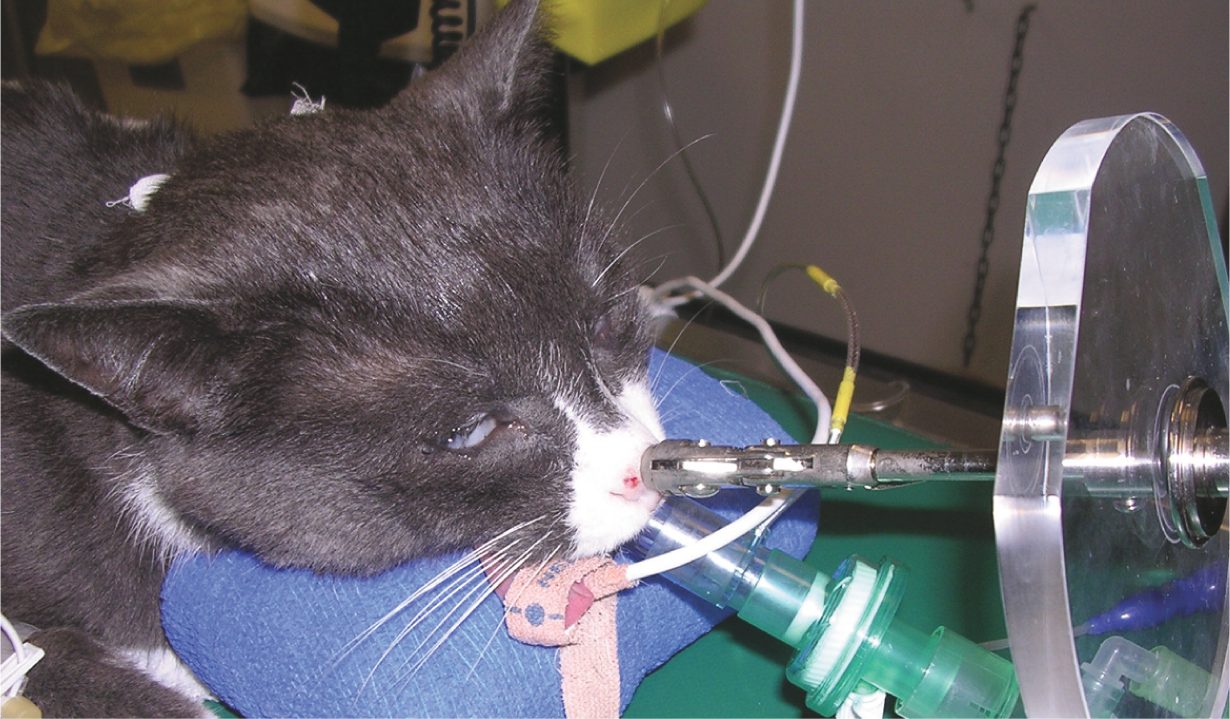
Application of strontium-90 plesiotherapy. Note that the cat has previously had one lesion treated (to the left of the applicator)
This treatment approach can also be used successfully for eyelid SCC.
Photodynamic therapy
Another option for superficial lesions of the nasal planum is photodynamic therapy (PDT). With this technique a photosensitiser is administered and taken up preferentially by the tumour cells. In some studies an intravenous photosensitiser has been used and in others it is applied topically as a cream to the lesion. Shining light of a specific wavelength over the lesion results in the formation of oxygen radicals, which cause the death of the tumour cells while sparing the normal tissue and giving good cosmetic results. The limitation of the technique is the depth to which either the photosensitiser or the light source can penetrate and the relatively high recurrence rate, although the technique can be safely repeated.
In one study using a topical photosensitiser, 85% of cats went into complete remission but 51% experienced recurrence in a median time of 157 days. 15 In other studies using intravenous photosensitisers the initial response rate was 49% and 100%, respectively, with 61% and 75% 1 year ‘overall tumour control’ reported. 16 Interestingly, people treated with PDT report that it is painful and in one study it was noted that the heart rate of cats went up despite anaesthesia and analgesia when the light was applied to the lesion. 16
Medical management
Cytotoxics
There are few data to support the use of cytotoxic drugs for the treatment of cutaneous SCC. In a cohort of 23 cats with nasal planum SCC, a carboplatin sesame seed oil emulsion was injected intralesionally. Seventy-three per cent of the cats experienced a complete response and 55% of the cats were progression free at 1 year. 17 Great care should be taken to avoid contamination of staff with the cytotoxic agent if this approach is contemplated. Mitoxan trone given by the conventional intravenous route resulted in a response in 4/32 cats treated. 18
A small cohort of cats bearing more advanced (one stage T2, two stage T3 and three stage T4) tumours of the nasal planum were treated with intra lesional carboplatin and orthovoltage radiotherapy. All six exhibited a complete response for a range of 52–549 days. 19

Electrochemotherapy has been used in nine cats utilising intralesional bleomycin; 7/9 of the cats responded. 20
COX-2 inhibitors
Cyclooxygenase-2 (COX-2) is an inducible enzyme that is involved in the production of prostaglandins that modulate pathological events such as inflammation, wound healing, and has a role in the development of several types of cancer. It can be identified in cutaneous feline SCC immunohistochemically, although its role has yet to be clearly elucidated. 21 It is overexpressed in sunlight-induced SCC in humans 22 and human actinic keratosis is treated with COX-2 inhibitors. 23 Thus, there may be a role for COX-2 inhibitors over and above the control of inflammation and pain associated with these lesions, but more studies need to be done in this area to understand this potential application more fully.
Prevention
Ideally, cats at high risk of cutaneous SCC should avoid sunlight at the height of the day, which may be feasible for those that receive their dose of carcinogen through sunbathing from inside the house. UV light-blocking film is readily available and easily applied to windows. For cats that spend time outdoors, sunblock can be applied to the ears (various sunscreen products are available for pets). Application may be easy in cats that will tolerate being stroked until the sunblock has soaked in (to avoid ingestion), but is more challenging in less relaxed cats. Sunblock is impossible to administer to the nasal planum without it being licked off.
Tattooing has not been shown to decrease the incidence of SCC. 24
Key Points
Solar-induced SCC needs to be identified promptly to allow the best chance of cure. This is particularly true of SCC of the eyelid and nasal planum where treatment options, and cosmetic and functional outcome, are dependent on the stage of the tumour at diagnosis. With prompt diagnosis this tumour can be treated very successfully.
The outcome for Bowenoid carcinoma can be variable. Sometimes the condition can be cured; other cases may require long-term management as new lesions occur.
Case notes
Pertinent history
Fred had spent the first 7 years of his life in Spain before his owners moved to the UK. He had a history of SCC of both ear tips, which had been removed following his arrival in the UK, with tumour-free margins.
Physical examination
On presentation, the biopsied area was noted on the left side of the dorsal aspect of the nasal planum, with an additional thickened area of about 2 mm adjacent to it. Submandibular lymph nodes were not palpably enlarged and the rest of the clinical examination was unremarkable. Staging (fine needle aspiration of the lymph nodes and chest radiographs) was offered to the client, but was refused on grounds of cost.
Superficial but extensive nasal planum lesions, similar to those Fred presented with, in a 10-year-old domestic shorthair cat

Clinical decision making
Strontium-90 plesiotherapy, a radiation treatment using a beta emitter which penetrates very superficial tissues, was suggested as the most appropriate therapy on the grounds that the procedure is short and relatively non-invasive, and the risk of metastasis from the SCC was very low. Although curative in 80% of cases when given as a single dose, 14 it can be repeated if necessary. Alternatively, surgical excision could have been used successfully but, in this case, it was felt that strontium offered the best chance of a good cosmetic outcome with a low risk of recurrence.
Treatment
Routine haematology and biochemistry testing was performed prior to anaesthesia and was unremarkable. Fred was anaesthetised and strontium-90 treatment was administered to the affected area, at a single large dose of 100 Gy.
Typical appearance of a nasal planum 6 weeks after being treated with strontium plesiotherapy

Fred was discharged with a Buster collar, as the treated area usually becomes pruritic. A scab developed 2–3 days after treatment and came off a few weeks later, revealing a shiny pink area of skin beneath.
Follow-up and outcome
Four months later the owners reported a new, very similar lesion outside the treatment field, dorsolateral to the left nostril. This area had scabbed but had not caused irritation or dysfunction and, overall, they were very happy with Fred’s quality of life.
Fred was returned to the clinic for re-evaluation, which revealed a superficial scabbed lesion in the location described above, although Fred had managed to scratch his nose in between his owners contacting the clinic and his arrival at the hospital. The lesion was consistent grossly with SCC. In general the rest of the examination findings were unchanged; however, serum biochemistry revealed mildly elevated creatinine (214 µmol/l; reference interval 70–212 µmol/l), with normal range urea.
Fred at his second presentation at the clinic. Note the bilateral pinnectomy

A decision was made to repeat the plesiotherapy and, following fluid therapy and induction of anaesthesia, strontium-90 was applied in a single field to the affected area, at a similar dose to previously. Fred was again sent home with a Buster collar and, at the time of writing, had been in complete remission for 4 months.
Footnotes
Funding
The author received no specific grant from any funding agency in the public, commercial or not-for-profit sectors for the preparation of this article.
Conflict of interest
The author does not have any potential conflicts of interest to declare.