



Abstract
Fluctuations in iodine concentration in food have been suggested as one risk factor for the development of feline hyperthyroidism, an epidemic disease first described in 1979. Three international studies have examined iodine concentrations of commercial cat foods. The iodine concentration of 112 commercial cat foods from across the USA was measured, and the daily iodine intake by hypothetical 4.5 kg adult cats or 1.4 kg kittens calculated in this descriptive epidemiologic study to examine differences in feline iodine intake due to (i) geographical source of foods, (ii) packaging type, (iii) brand-to-brand variation, (iv) form of iodine supplementation, (v) types and numbers of seafood ingredients and (vi) kitten and ‘therapeutic’ diets. Dramatic variation among canned foods (resulting in ingestion of approximately 49–9639 μg iodine/day) suggests that the disparity in iodine concentrations may lead to development of nodular hyperplasia and, later, clinical hyperthyroidism, if cats consume diets that are at first iodine-deficient and later contain excessive iodine. Manufacturers are encouraged to ensure adequate iodine supplementation across all products and areas of the USA.
Introduction
Feline hyperthyroidism (FH) was originally described in five cats in 1979 at a New York veterinary specialty practice 1 and, thereafter, was described in case reports and case series across the country and around the world.2–6 Since these initial reports, FH has reached epidemic proportions. 7 FH is now considered the most common endocrinopathy in older cats. 8 FH is similar to toxic nodular goiter (TNG) in humans, appearing at an older age, with clinical signs (weight loss with polyphagia, polyuria/polydipsia, tachycardia, agitation, unkempt appearance and a nodular goiter) and treatment options (methimazole, radioactive iodine or surgery).2,9,10 Risk factors for nodular goiter in humans include increasing age, female sex, iodine deficiency and exposure to endocrine- disrupting compounds that interfere with iodine uptake.11–13 In the USA, iodine deficiency goiter among humans in the early years of the last century was prevalent in the upper Midwest compared with either coast, and outbreaks of iodine-induced hyperthyroidism occurred in the upper Midwest following iodine supplementation. 14 The etiology of FH is unclear, but is considered, based on case-control studies, to be multifactorial, including increasing age, female sex, no specific breed, diets consisting of at least 50% canned food, and several environmental factors, such as exposure to fertilizers and increasing frequency of carpet cleaning, suggesting an effect by endocrine disruptors.7,15–20 Recommendations for feline iodine intake changed in 1978 20 from minimum iodine concentrations of approximately 100 μg iodine/day based on feeding studies, often for kittens,21–26 to minimum iodine concentrations expressed in units of iodine/kg of dry diet.27–29 In 2006, these recommendations were revised yet again so that a 4 kg cat would consume 87.5 μg iodine/day based on a diet of 350 μg iodine/1000 kcal metabolizable energy. 30 It has been suggested that this recommendation may still be insufficient for the long-term health of cats. 20
The iodine concentration of commercial cat foods has been measured in several international studies between 1986 and 2002.31–33 The findings revealed wide variation in iodine concentrations, particularly among commercial canned cat foods (Table 1). Feeding trials with varying iodine concentrations have demonstrated little or no change in thyroid function tests (Table 2). Because excess iodine has been hypothesized to be one cause of feline TNG, we investigated through a descriptive epidemiologic study whether there are differences in feline iodine intake due to (i) geographical source of foods across the USA, (ii) type of packaging, (iii) brand-to-brand variation, (iv) form of iodine supplementation, (v) types and numbers of seafood ingredients and (vi) kitten and ‘therapeutic’ diets.
Measurement of iodine in commercial cat foods (prior studies)
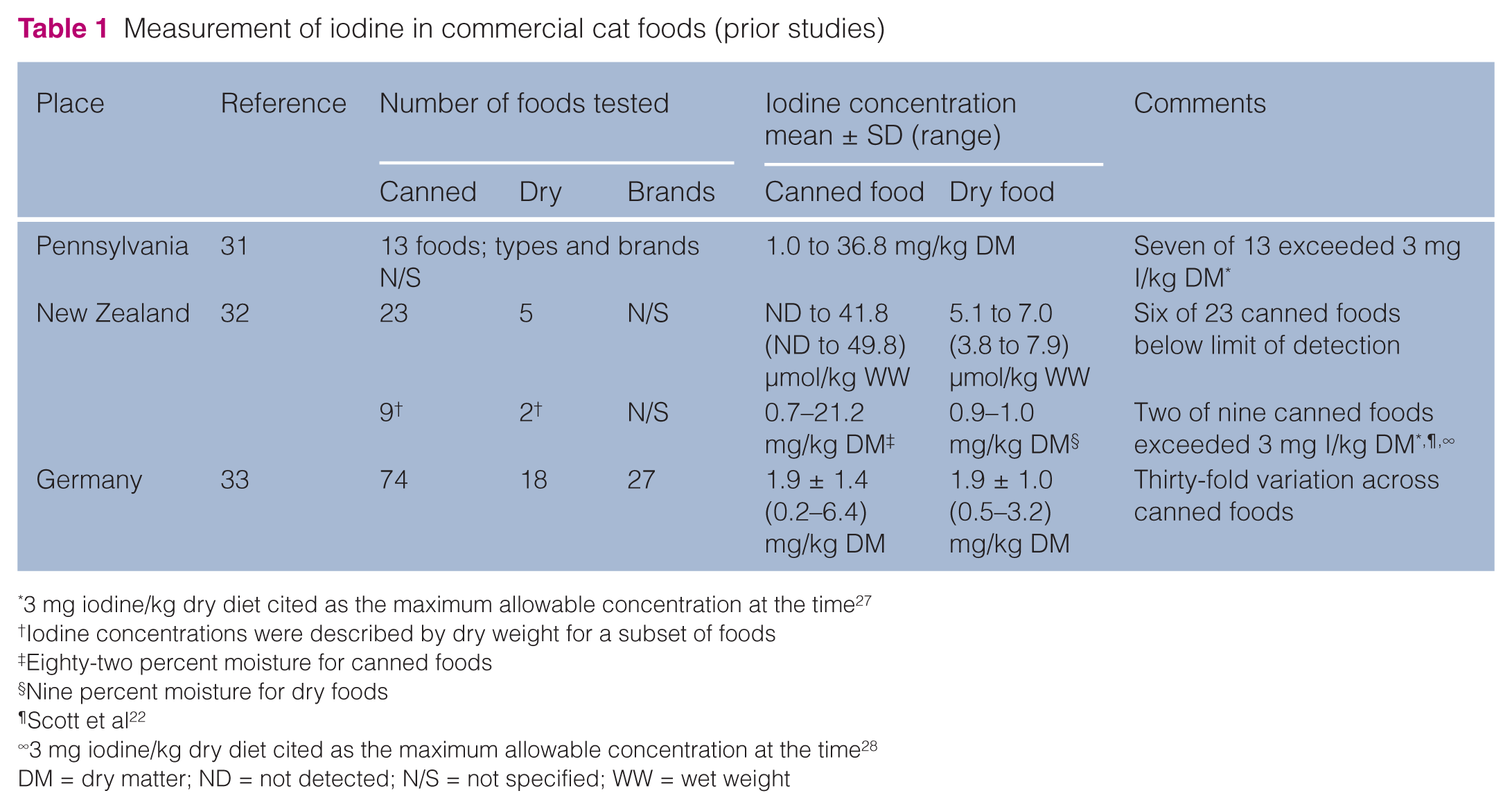
3 mg iodine/kg dry diet cited as the maximum allowable concentration at the time 27
Iodine concentrations were described by dry weight for a subset of foods
Eighty-two percent moisture for canned foods
Nine percent moisture for dry foods
Scott et al 22
3 mg iodine/kg dry diet cited as the maximum allowable concentration at the time 28
DM = dry matter; ND = not detected; N/S = not specified; WW = wet weight
Feeding trials of cats using diets with varying iodine concentrations (prior studies)
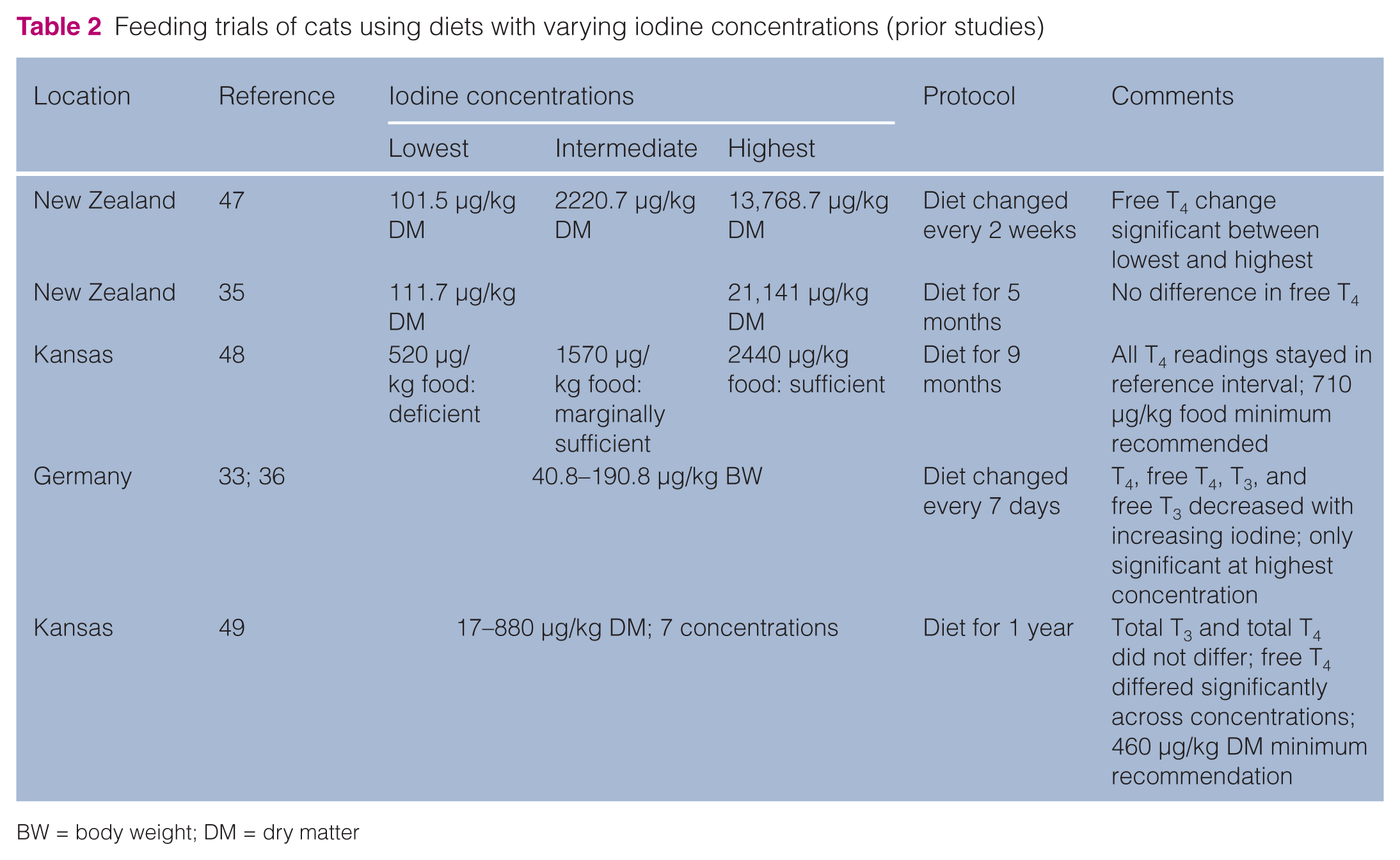
BW = body weight; DM = dry matter
Material and methods
Cat foods were purchased between November 2008 and March 2009 from pet supply stores and supermarkets in northern California, central Florida and northwestern Indiana. An attempt was made to obtain samples from all three regions of nationally-marketed commercial adult cat and kitten foods, and those marketed as adjuncts to medical treatment (‘therapeutic’ diets). Containers were inspected for unique lot numbers from each region. Foods were assigned numbers and, on opening, samples were retrieved and placed in plastic vials marked with their assigned numbers. The vials were shipped overnight to Boston Medical Center, Boston, MA, USA in a foam-lined shipping box for laboratory measurement of iodine concentration. Iodine concentration was measured by the Sandell–Kolthoff colorimetric reaction following digestion with chloric acid 34 and was reported in micrograms of iodine per gram of food; the lower detection limit was 0.1 μg/g. Using label statements of moisture content, iodine intake on a dry matter basis (I-DM) was calculated. Using label statements of feeding instructions, or manufacturers’ websites in the case of ‘therapeutic’ diets, iodine concentration on a daily basis of food consumption (Daily-I) was calculated for a hypothetical 4.5 kg cat or 1.4 kg kitten. Seafood ingredients and their order by weight were obtained from food labels. Iodine supplementation information was likewise obtained from food labels. Because iodine concentrations were not normally distributed, these were compared using medians and Kruskal–Wallis tests for non-normally distributed data, and presented as median (range) values. A P-value <0.05 was considered significant.
Results
Cat foods
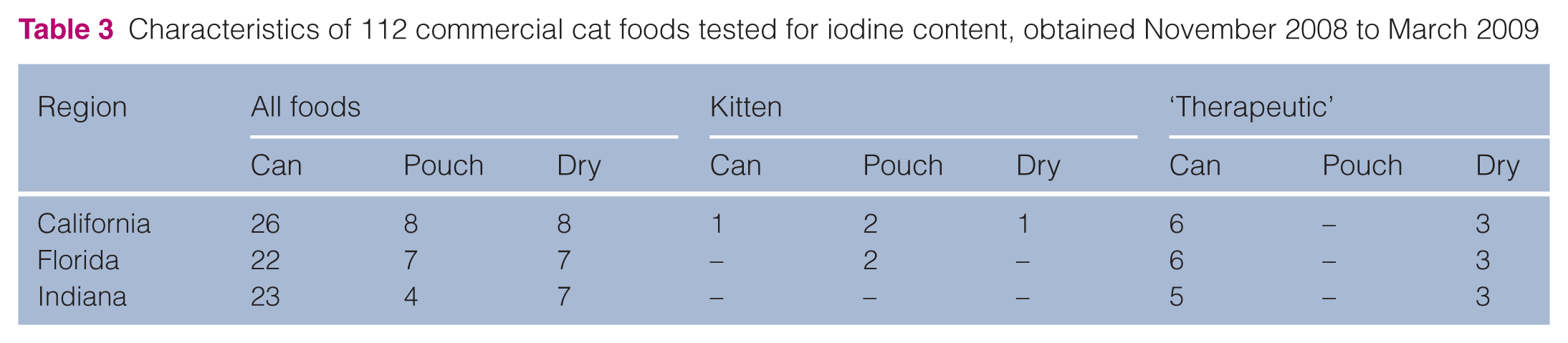
Samples of 112 cat foods were tested. These were 71 canned foods, including one kitten food, and six ‘therapeutic’ foods; 19 pouched foods, including two kitten foods; and 22 dry foods, of which one was labeled for kittens and three were ‘therapeutic’ foods. Not every brand, variety and form of food was available from the three regions. The distribution of foods from the three regions by packaging type is shown in Table 3 and the names of the tested foods and states of purchase appear in Supplementary data. Even though few samples were from ‘therapeutic’ or kitten diets, they were included in evaluations of I-DM and Daily-I intake for packaging type, regions, iodine supplementation and seafood ingredients.
Characteristics of 112 commercial cat foods tested for iodine content, obtained November 2008 to March 2009
Iodine concentrations by packaging and geographic region
The median I-DM for the sampled foods was 3500 μg/kg DM (range 200–154,550 μg/kg DM) corresponding to a calculated Daily-I intake of 179.0 μg/day (range 11.6–9639.3 μg/day). Ninety-six of 112 (85.7%) sampled foods had a calculated Daily-I intake ≥ 100 μg/day. Both median I-DM and median Daily-I intake differed across packaging types (P <0.01) (Table 4). Likewise, both measures of iodine concentration differed within Florida (P = 0.04) and median I-DM differed within Indiana across packaging types (P = 0.02) (Table 4). While no statistically significant differences in iodine concentration were found across regions, the greatest variation was among canned foods (Table 4). A dry food from California had the lowest Daily-I intake, 11.6 μg/day, while a canned food from Florida had the highest Daily-I intake, 9639.3 μg/day.
Iodine concentrations on a dry-matter basis (I-DM) and daily intakes (Daily-I) for a hypothetical 4.5 kg cat or 1.4 kg kitten among commercial cat foods obtained from three regions, November 2008 and March 2009

P <0.01 across packaging types
P = 0.04 across packaging types
P = 0.02 across packaging types
Iodine concentrations by brands
The sampled foods consisted of eight brands and two supermarket varieties. For one national brand, only one sample was available; several samples were available for other brands and are thus the basis for this analysis. Both I-DM and Daily-I intake differed across brands (P < 0.01). Daily-I varied within seven brands, with the smallest variation, 2.3-fold (median 204.3; range 109.5–257.6 μg/day) and greatest variation, 337-fold (median 339.9; range 11.6–3914.8 μg/day). I-DM varied similarly within brands. One brand of canned foods, with 17 samples and eight varieties, varied 83-fold in I-DM and Daily-I intake. Four of seven nationwide brands had minimum Daily-I intake <100 μg/day. The Daily-I intake for one brand was <100 μg/day (median 66.7; range 26.9–91.9 μg/day); these samples were from three varieties of pouched food.
Among foods from at least two of the three regions, a 13.3-fold variation was the largest measured, and occurred in one brand and variety of dry food. The Daily-I intake ranged from 11.6 μg/day in the sample from California to 154.9 μg/day in the Florida sample. The smallest variation, 1.04-fold, was measured in one ‘therapeutic’ dry food marketed for obesity management.
Iodine concentrations by iodine supplementation
Forms of iodine supplementation listed explicitly as part of commercial cat food labels were calcium iodate (45/112, 40.2%), potassium iodide (52/112, 46.4%) and iodized salt (30/112, 26.8%) (Table 5). Iodized salt was an ingredient in 30 foods that contained calcium iodate. ‘Salt’ was also listed as an ingredient in 71/112 (63.4%) foods, with no indication of its iodine status. All three foods supplemented only with potassium iodide had Daily-I intake ≥100 μg/day; these were samples of one brand of dry food from all three regions. Median I-DM and Daily-I intake varied across foods with iodine supplementation and/or salt (P <0.01 for both statistics). Six of 112 (5.3%) foods tested did not have explicit iodine supplementation, including five ‘therapeutic’ canned foods from all three regions and one pouched food from California. Daily-I intake differed between foods with and without explicit iodine or salt supplementation in their ingredient lists (P <0.01).
Iodine concentrations on a dry-matter basis (I-DM) and daily intakes (Daily-I) for a hypothetical 4.5 kg cat or 1.4 kg kitten among commercial cat foods obtained from three states, November 2008 and March 2009

P <0.01 across packaging types
P = 0.01 across packaging types
P <0.01 between foods with and without iodine supplement listed in ingredients
Iodine concentrations by seafood content
Fish listed as ingredients in 76 tested cat foods included cod, ‘fish’, fish broth, fish meal, fish oil, herring meal, mackerel, ocean whitefish, salmon, salmon broth, sardines, shrimp, trout and tuna. Iodine content was higher in foods with fish ingredients than in those without, though median I-DM and Daily-I intake were not significantly different (P = 0.17 for I-DM; P = 0.31 for Daily-I intake) (Table 6). Median I-DM and Daily-I intake varied across packaging types, but not across regions for foods with and without fish ingredients.
Iodine concentrations on a dry-matter basis (I-DM) and daily intakes (Daily-I) for a hypothetical 4.5 kg cat or 1.4 kg kitten among commercial cat foods obtained from three states, November 2008 and March 2009

P = 0.02 across packaging types
P = 0.01 across packaging types
P < 0.01 across packaging types
Daily-I intake differed across combinations of iodine supplement and seafood presence or absence (P = 0.03). One food contained no listed seafood ingredient and no labeled iodine supplementation; this was one canned ‘therapeutic’ food from Florida providing Daily-I intake of 69.2 μg/day. Five foods with seafood ingredients were not supplemented with iodine, 35 foods contained no fish ingredients and were supplemented with iodine, and 71 foods contained both seafood ingredients and iodine supplementation. Daily-I intake differed across these combinations by packaging type as well (for canned foods, P = 0.01; for pouched foods, P = 0.03).
Iodine concentrations for kittens and adult cats
The median I-DM for six foods marketed for kittens was 5009 μg/kg DM (range 2940–7280 μg/kg DM) corresponding to a calculated Daily-I intake of 220.9 μg/day (range 112.5–308.7 μg/day). The calculated Daily-I intake for all six foods exceeded 100 μg/day.
The median I-DM for 80 non-‘therapeutic’ foods labeled for adult cats was 3644 μg/kg DM (range 200–154,550 μg/kg DM) corresponding to a calculated Daily-I intake of 204.3 μg/day (range 11.6–9639.3 μg/day). Sixty-nine of 80 (86.3%) adult cat foods had a calculated Daily-I intake ≥100 μg/day; 59 (73.7%) adult foods had I-DM ≥3 mg/kg DM. The 11 foods with Daily-I intake <100 μg/day were one dry food and three pouched foods from California; one canned food, one dry food and two pouched foods from Florida; and two canned foods and one pouched food from Indiana. Neither median I-DM nor median Daily-I intake differed between kitten and adult foods.
Iodine concentrations in ‘therapeutic’ diets
Overall, the median I-DM for the foods marketed as adjuncts to treatment was 2613 μg/kg DM (range 840–5000 μg/kg DM) corresponding to a calculated Daily-I intake of 147.8 μg/day (range 49.2–240.6 μg/day). Twenty-one of 26 (80.8%) ‘therapeutic’ foods had a calculated Daily-I intake ≥100 μg/day. Ten of 26 (38.5%) sampled ‘therapeutic’ foods had I-DM ≥3 mg/kg DM. The five foods with Daily-I intake <100 μg/day were one canned product from California, two canned foods and one dry food from Florida, and one canned food from Indiana. These were marketed as adjuncts for heart disease, urinary calculi and renal insufficiency. Both median I-DM and median Daily-I intake differed between adult and ‘therapeutic’ foods (P <0.01).
Discussion
Before 1978, recommendations called for minimum iodine concentrations of 100 μg iodine/day, particularly for kittens.21–26 Revised recommendations in 2006 suggested that a 4 kg cat would consume 87.5 μg iodine/day on a diet of 350 μg iodine/1000 kcal metabolizable energy diet. 30 Sixteen of 112 tested foods in the current study were found to provide <100 μg iodine/day. These were seven canned foods, six pouched foods and three dry foods, and were from all three states; five of these were ‘therapeutic’ diets.
The range of iodine concentrations was widest for canned foods, similar to an earlier report from Germany, 33 though the median calculated Daily-I intake exceeded that for dry and pouched foods. Consumption of canned food has been identified as a risk factor for FH in the majority of epidemiologic reports to date.7,15–19 The variability of iodine concentrations in canned foods may contribute to development of FH; thus, manufacturers must ensure adequate and consistent iodine concentrations in canned foods.
Because cat foods from national brands are likely manufactured in several parts of the country, we evaluated foods from the two coasts and from the Midwest. Iodine concentrations for foods from the coastal states varied more than for foods from Indiana: canned foods in California and Florida had I-DM and estimated Daily-I intake that varied over 100-fold, while I-DM for canned foods from Indiana varied 68-fold. Pouched foods in Indiana had higher estimated median Daily-I intake than in California or Florida. Only dry foods from Indiana had a range of Daily-I intake meeting the early iodine recommendation of ≥100 μg/day.
In 1964, a feline feeding study was reported in which an iodine intake of 5000 μg/day resulted in thyroid nodular hyperplasia. 25 In this study, 2/112 tested foods exceeded this threshold; these were cans of one brand and variety from California and Florida. In 1986, the National Research Council (NRC) recommended a daily upper limit for iodine intake of 5000 μg/day for cats, citing this feeding study.25,28 This NRC upper limit was reported to be 3 mg/kg of dry diet in two earlier studies measuring iodine concentrations in cat foods.31,33 In the present study, 74% of adult, non-‘therapeutic’ cat foods sampled exceeded this concentration. No upper limit has been specified in the most recent NRC guidelines. 30
The results of the present study are similar to, yet more dramatic than, those previously reported in studies of fewer samples of cat foods from the USA, New Zealand and Germany.31–33 We found a nearly 200-fold variation in estimated Daily-I intake among canned foods tested and over 20-fold variations for pouched and dry foods. Regional differences in iodine concentration were found: foods from California varied 472-fold in Daily-I intake, foods from Florida varied 358-fold, and foods from Indiana varied 54-fold. Wide variations were found across packaging types rather than across regions. Dramatic variations were also found within certain brands, the greatest being over 300-fold, although most brands meet the current and former iodine supplement guidelines.
Supplementation of iodine per label ingredients did not guarantee adequate iodine concentrations in the sampled foods; the Daily-I intake provided by some foods was far below 100 μg/day. Except for one brand of dry food from the three regions that would provide Daily-I intake ≥100 μg/day, the presence of seafood did not ensure adequate iodine concentration. Fish oil was the only seafood ingredient in that dry food, and appeared lower than the first five ingredients by weight. Curiously, foods without fish ingredients had median iodine concentrations greater than foods containing fish listed as lower than the fifth ingredient by weight.
The results of this study are of great concern, with a wider variation in iodine concentrations in cat food than described previously. The lower iodine concentrations in the ‘therapeutic’ diets suggest that when trace-element pre-mixes are reformulated for diets to address specific diseases and syndromes, iodine concentrations may not be adequate. The kitten foods appeared to be adequately supplemented. This is important because iodine is vital for the developing cat.21,22
Limitations of this study include testing only one sample of food from each product from each location; the concentration of iodine in the tested samples may not always reflect concentrations in other samples of the same lots of each food. Because iodine as a supplement is part of a trace-element pre-mix, it is possible that a random sampling would not reflect the mean concentration across the product line over time. All products were not available in each location. Calculations of Daily-I intake were based on label feeding instructions; actual owner compliance with these instructions is unknown and actual iodine intake by cats is also unknown. Within certain brands, differences in feeding instructions from one variety to another may be overlooked by owners using package size as a feeding guide. This may lead to potential over- or under-consumption of iodine.
While cats appear to autoregulate thyroid hormone synthesis in the face of variable iodine intake under most circumstances,35,36 feline hyperthyroidism resembles iodine-induced hyperthyroidism in humans. 20 In humans, iodine-induced hyperthyroidism most commonly occurs in patients with nodular goiter who previously ingested diets insufficient in iodine. 37 In conditions of iodine deficiency, and in response to increasing thyroid-stimulating hormone (TSH) concentrations, iodide trapping increases in the thyroid, followed by preferential production of the more biologically active T3 over T4. 38 Chronic stimulation of the thyroid by TSH leads to hypertrophy, nodular hyperplasia and autonomous function; this process takes years to develop.37,39 It is possible that the development of toxic nodular goiter in older cats resembles that which occurs in humans. Iodine-induced hyperthyroidism occurs most frequently in the elderly, who develop a nontoxic nodular goiter over many years, especially in areas of the world where iodine deficiency is endemic. 39 When these patients are given excess iodine, either to treat iodine deficiency or following the administration of iodine-rich radiologic contrast agents, hyperthyroidism may occur,37,40 similar to that observed in elderly cats. Thyrotoxicosis may occur owing to the iodination of iodine-deficient thyroglobulin or as a result of the failure to appropriately decrease the entrance of iodine into the thyroid by suppression of the thyroid sodium/iodide symporter. 40 Mutations in the TSH receptor at numerous sites have been identified in human toxic nodular goiter.41–43 Feline thyroidal adenomas resemble human TNGs histopathologically,44–46 and mutations in the feline TSH receptor similar to some described in human TNG have been reported. 46 To date, published feeding studies with varying iodine concentrations have followed cats for 1 year, at most (Table 2). We speculate that in this disease of older cats, those with thyroid nodules that develop hyperthyroidism may previously have ingested diets insufficient in iodine and were then fed iodine-rich foods. Thus, at least one risk factor for feline hyperthyroidism may be long-term iodine deficiency, similar to the human syndrome. Therefore, it is important to ensure that all foods for cats contain adequate, but not excessive, iodine.
Conclusions
This descriptive epidemiologic study demonstrated that iodine concentrations in commercial cat foods appear to fluctuate dramatically below and above the minimum and maximum recommendations before the epidemic of feline TNG began, and that these variations can be seen across packaging types, brands, iodine supplementation type, seafood ingredients and intended use. The dramatic variation we found among canned foods (resulting in the ingestion of approximately 49 to 9639 μg iodine/day) is more extreme than described previously. This suggests that the disparity in iodine concentrations may lead to development of nodular hyperplasia and, later, clinical hyperthyroidism if cats consume diets that are at first iodine-deficient and later contain excessive iodine, as the human experience has shown. Manufacturers should strive to provide adequately supplemented iodine concentrations that are as uniform as possible across all product lines and regions.
Supplemental Material
Click here for Supplementary Appendix
Table of food sampled by brand and US state
Footnotes
Acknowledgements
Thanks to Drs Lynn Guptill and Julie Levy for sending cat foods from Indiana and Florida; to Ms Desiree Santoso for assistance in examining cat food labels; to Ms Carol Kutsch for assistance with packaging foods for shipment; to Drs William Ford, Gena Kanas, Fionna Mowat and Heather Watson for manuscript review; and to Ms Nadine Russell for assistance with manuscript preparation.
Supplementary data
Table of food sampled by brand and US state
Funding
This research received no grant from any funding agency in the public, commercial, or not-for-profit sectors.
Conflict of interest
The authors do not have any potential conflicts of interest to declare.
This paper was presented in part at the American Thyroid Association 80th Annual Meeting, West Palm Beach, FL, USA September 2009
References
Supplementary Material
Please find the following supplemental material available below.
For Open Access articles published under a Creative Commons License, all supplemental material carries the same license as the article it is associated with.
For non-Open Access articles published, all supplemental material carries a non-exclusive license, and permission requests for re-use of supplemental material or any part of supplemental material shall be sent directly to the copyright owner as specified in the copyright notice associated with the article.
