




Abstract
Endoparasitic infections are common in stray cats. Many of these parasites are responsible for zoonoses, and stray cats can be a source of environmental contamination. The prevalence of parasites in 139 stray colony cats in the city of Milan, northern Italy, was investigated by faecal examination. The overall prevalence of endoparasites was 50.4%, with 11 different parasites found. Parasites with zoonotic potential were detected in 49.6% of cats. Concurrent infections with two or more zoonotic parasites were recorded in 14.3% of cats. Among the parasites found, the most common was Toxocara cati (33.1%; P <0.0001). The other species found by coproscopic examination were: Ancylostoma tubaeformae (7.2%), Isospora species (4.3%), Trichuris vulpis (2.9%), Dipylidium caninum (2.9%), Aelurostrongylus abstrusus (2.9%), Eucoleus aerophilus (syn Capillaria aerophila) (1.4%), Spirometra species (1.4%), Taenia pisiformis (0.7%) and Hymenolepis nana (0.7%). Coproantigen specific for Giardia duodenalis was detected in 2.9% of the samples. Pseudoparasites (eggs of mites) were found in 4.3% of the samples. No sample contained Toxoplasma gondii oocysts, despite the fact that 70 cats tested positive for T gondii-specific IgG antibodies, and none of the diarrhoetic samples tested positive for Cryptosporidium species oocysts. Variables linked to infection were body condition score (BCS), the presence of diarrhoea and infection with G duodenalis. Cats infected with G duodenalis were more likely to have a low BCS (odds ratio (OR) = 11.5, P = 0.02) and diarrhoea (OR = 30.7, P = 0.0007). The results of the present study confirm that endoparasitic infections, most of which have zoonotic potential, are distributed in stray colony cats of Milan.
Introduction
Gastrointestinal parasitism is one of the main causes of morbidity in stray cats.1 –9 Many of these parasites are responsible for zoonoses, and free-roaming stray cats represent a potential source of environmental contamination that can lead to the spread of infection to susceptible animals and, in some cases, humans. Moreover, stray cats maintain a permanent infection pressure upon domestic cats that have access to the outdoors. 10 Cats bury their faeces in soil, which leads to the accumulation of endoparasite larvae, eggs, oocysts and trophozoites in the environment. Burial in the soil is favourable for many parasitic infective stages as it protects them from desiccation. 11
In 2006, Eurispes (Istituto di Studi Politici Economici Sociali) reported that in Italy the number of stray cats was about 2,500,000. 12 In the city of Milan, located in northern Italy, there are more than 500 feline colonies, 13 and these colonies are controlled through a no-kill trap-neuter-return (TNR) programme authorised by National Law number 281 of 14 August 1991, which covers the management of pets and the control of stray cats. 14 Studies have shown that environmental faecalisation in Milan is high, and, to the best of our knowledge, recent surveys have covered only the canine population of Milan. 15
The aim of this coprological study was to investigate the prevalence of endoparasites in stray cats in colonies within the urban areas of Milan. The study also examined correlations between endoparasitic infection and colony of origin, age, gender, body condition score (BCS) and presence of diarrhoea, as well as seropositivity to feline immunodeficiency virus (FIV), feline leukemia virus (FeLV) and Toxoplasma gondii.
Materials and methods
Sampling and data collection
Over a period of 2 years (2008 to 2010), faecal samples were collected from 139 stray cats from urban colonies located in Milan during a TNR programme approved by the local authority of the city council. The information collected on each cat included the location of the colony of origin (ie, in which of the eight municipalities of Milan they were from), age, gender (47 males, 33.8%; 92 female, 66.2%) and breed (all cats were domestic shorthair). Age was estimated by dentition, with 65 cats (46.8%) being characterised as kittens (≤ 6 months), 73 (52.5%) characterised as adults (>6 months) and one cat characterised as age unknown. The BCS was recorded for 129 cats; the median value was 4.2 ± 0.62 (range 2–6). Twelve (9.3%) cats were underweight (BCS = 1–3/9) and 117 (90.7%) were of normal weight (BCS = 4–6/9). 16
All cats were housed individually in cages. Faecal samples (about 10 g from each cat) were collected in separate clean plastic containers directly from the litter tray in each cage. Faecal samples were obtained at the same time during postoperative hospitalisation, and were scored as diarrhoetic or not diarrhoetic based upon the degree of fluidity. 17 Following surgery, cats were hospitalised for 5 days or longer, depending on their health status and were then released at the trapping location.
Serological examination
Blood samples were collected aseptically from from the jugular vein of 100 cats during anaesthesia and placed in serum separator tubes. Following separation, sera were tested for antibodies to FIV (relative to gp40 and p24 FIV antigens) and FeLV p27 antigen using a commercial ELISA kit (Snap FeLV/FIV Combo Plus Test; Idexx Laboratories). Toxoplasma gondii sera IgG antibodies were detected using a commercial indirect fluorescent antibody test kit (Fuller Laboratories, Fullerton, CA, USA). An antibody titre ≥1:64 was considered indicative of T gondii exposure. 18
Parasitological examination
Faecal samples were stored at 5°C and examined within 48 h. Each sample was first examined macroscopically for the presence of adult parasites or tapeworm proglottids. Direct faecal wet mount smears with and without Lugol’s solution were examined microscopically to identify trophozoites. Only diarrhoetic faecal samples were stained with carbol fuchsin for the detection of Cryptosporidium species oocysts. Each sample was then processed by flotation in a sucrose and sodium nitrate solution (360 g of sugar + 540 g of sodium nitrate in 1000 ml of water, specific gravity = 1.35 at 20°C), by sedimentation in water, and using the Baermann technique.
Giardia duodenalis coproantigens were detected using a commercially available quick immunochromatographic test kit (RIDA Quick Giardia; R-Biopharm AG). This kit was validated previously in our laboratory for the detection of Giardia species antigens in feline faecal samples (data not shown). All larvae, eggs and oocysts found were identified according to morphological characteristics under light microscopy. 19 A cat was classified as positive if at least one of these elements was present in its stool sample.
Statistical analysis
Overall prevalence was defined as the percentage of faecal samples positive for any parasitic species, and specific prevalence was defined as the percentage of faecal samples positive for a given parasitic species. Prevalence data were regrouped according to gender (male/female); age (juvenile/adult); presence or absence of diarrhoea; FIV, FeLV and T gondii seropositivity; BCS (poor/good); and the location of the colony of origin (ie which of the eight municipalities in Milan). All statistical calculations were performed with MedCalc software (version 12.1.3). Prevalence data were compared by χ2 analysis and Fisher’s exact test was used to test for associations between positivity for different parasites and independent variables (colony of origin; gender; age; BCS; presence of diarrhoea; FIV, FeLV and T gondii seropositivity). Results were considered significant at P <0.05.
Results
During the study period, a total of 11 different parasites ranging in prevalence from 0.7% to 33.1% were identified among 139 faecal samples collected from stray colony cats in Milan (Table 1). The overall prevalence of endoparasitic infection was 50.4% (70/139). Mixed infections were found in 14.3% (10/70) of the cats that tested positive. Of the positive samples, 62/70 (88.6%) were positive for one species, 8/70 (11.4%) for two and 2/70 (2.9%) for three different species. Parasites with zoonotic potential were detected in samples from 49.6% of the cats.
Prevalence and zoonotic potential of parasites identified by faecal microscopic examination and by Giardia duodenalis quick immunochromatographical coproantigen testing of samples from 139 stray colony cats in Milan, northern Italy
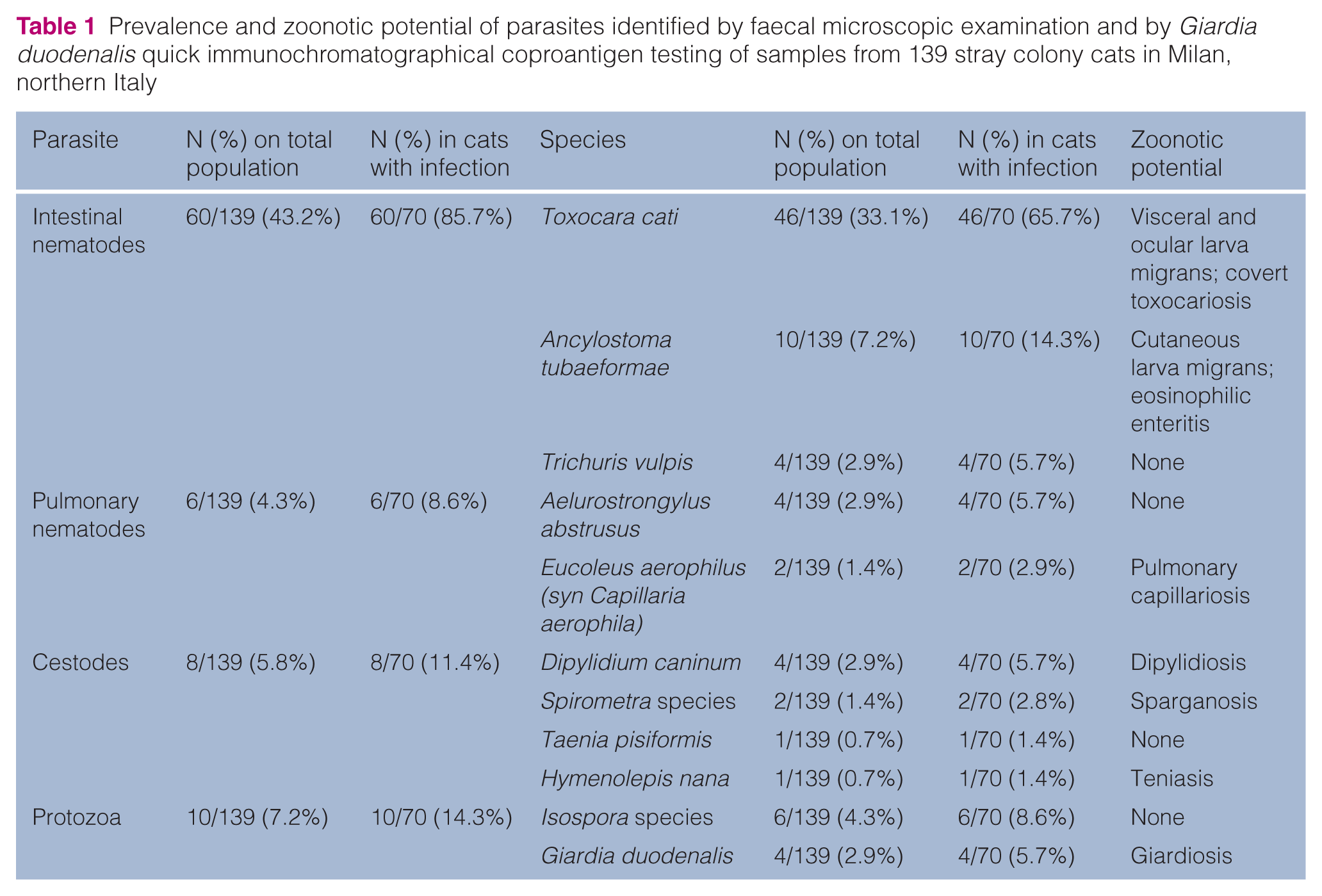
Among the parasites found, the most common was Toxocara cati (46/139; 33.1%, P <0.0001). The remaining species found were Ancylostoma tubaeformae (7.2%), Isospora species (4.3%), Dipylidium caninum (2.9%), Giardia duodenalis (2.9%), Aelurostrongylus abstrusus (2.9%), Trichuris vulpis (2.9%), Eucoleus aerophilus (syn Capillaria aerophila) (1.4%), Spirometra species (1.4%), Taenia pisiformis (0.7%) and Hymenolepis nana (0.7%). Of the 139 cats surveyed, 15 (10.8%) had diarrhoetic faeces. Of the 70 cats positive for endoparasites, six (8.6%) presented diarrhoetic faeces. Pseudoparasites (eggs of mites) were found in three samples (4.3%).
Of the four samples that tested positive in the G duodenalis quick immunochromatographical test, none showed trophozoites or cysts during a microscopic evaluation of fresh faecal smears with and without Lugol’s solution. No sample contained T gondii oocysts. None of the diarrhoetic samples analysed by carbol fuchsin staining tested positive for Cryptosporidium species oocysts.
There was no correlation between colony of origin, gender, or age and the likelihood of infection with any parasite. The only variables linked to infection were BCS, the presence of diarrhoea, and infection with G duodenalis. Cats infected with G duodenalis were more likely to have a low BCS (1–3/9) (odds ratio (OR) = 11.5, P = 0.02) and diarrhoea (OR = 30.8, P = 0.0007).
Five (5%) cats tested positive for FIV antibodies and four cats (4%) tested positive for FeLV antigen. Out of 78 cats tested for T gondii, 17 (21.8%) tested positive. Of the 70 cats positive for endoparasites, 1.4% (1/70) were positive for FIV antibodies, 2.9% (2/70) for FeLV antigen and 15.7% (11/70) for T gondii-specific IgG. However, no association was found between the seroprevalence of FIV, FeLV and T gondii and the prevalence of intestinal parasites.
Discussion
Although numerous studies have examined the worldwide prevalence of intestinal parasites in stray cats, none of the recently published reports involved feline populations in Milan. The number of different parasites (11) registered in our survey was within the range of 6–12 parasites documented in studies conducted elsewhere.1 –6 However, the overall prevalence of 50.4% in this study was higher than that reported in European studies involving stray cats in Spain (32.9%), 3 Portugal (23.1%), 6 Germany (33.6%) 7 and the UK (34.8%). 1 A previous study conducted in central Italy found that the behaviour of stray cats from colonies puts them at risk for endoparasite infection. 9 The high parasitic infection burden of stray cats is not surprising. It is most likely caused by the absence of deworming treatments and permanent exposure to sources of parasitic infections (faeces, waste, paratenic hosts, etc). However, biases could have influenced the prevalence results gathered in our study. The true prevalence may be much higher because when only one faecal sample is collected, prepatent infections and the intermittent shedding of parasite stages may lead to underestimation of the prevalence of parasitic infection. 19 Similarly, a low level of infection may go undetected when samples are evaluated using traditional microscopy methods. 2
Among the parasites found in our survey, T cati, G duodenalis (assemblages A and B), A tubaeformae and E aerophilus (syn Capillaria aerophila) are responsible for important zoonoses. An epidemiological study of human toxocariosis in northern Italy showed a seroprevalence of 4.4% in adult epileptics and 10.6–14.5% among institutionalised mentally retarded patients. 20
Consistent with a number of other studies in Europe, the USA and Australia,3,5 –9 ascarids and, in particular, T cati, were found at a significantly higher rate in our survey (46/139, 33.1%, 65.7% of the total parasites found). These data are important as Toxocara species eggs are environmentally resistant; therefore, when an area is contaminated the potential for infection will persist for months or years. A reported infection rate for feline ascaridiosis in northern Italy based on analysis of 76 faecal samples collected from stray cats in the Veneto region was lower (22.4%) than the rate in our study. 4
In our survey, six cats (4.3%) were infected with pulmonary nematodes. In particular, four (2.9%) cats were infected with A abstrusus and two with E aerophilus (syn Capillaria aerophila) (1.4%). As far as we know, no data are available on the prevalence of A abstrusus in stray colony cats in northern Italy. The available Italian data on stray colony cats are relative to a feline colony from central Italy with suspected lungworm infection and indicate a prevalence of 24.4%, as determined by nested polymerase chain reaction assays. 21 An Italian survey of cats from central and southern Italy, and a microscopic examination reported prevalences of 16% and 18.5%, respectively, with straying and free-ranging behaviour being a risk factor for infection in both studies.22,23 Data obtained from a study of 231 Spanish stray cats showed a prevalence of 1.7%. 3 In Portugal, the prevalence was 17.4% in 97 faecal samples analysed; 24 in Germany a prevalence of 1% was reported based upon an examination of 837 stray cats. 7 Cats infected with A abstrusus contribute to environmental contamination and to infection of the intermediate and paratenic hosts. The organism could then be ingested by other cats that are allowed to roam freely. Data on A abstrusus in stray cats are important and representative of the distribution of this parasite because free-ranging cats have greater exposure to intermediate and paratenic hosts (eg, rodents, frogs, lizards, snakes and birds). In addition, it is important to track A abstrusus infections in stray colony cats managed by TNR programmes as this infection is one of the causes of pulmonary diseases involved in anaesthetic-associated death, ie, death occurring within 24–48 h after anaesthesia administration during spaying–neutering procedures. 25 In the infected cats examined in our survey, no respiratory signs were recorded and all four cats recovered from the anesthesia without problems. However, this infection presents varying clinical outcomes depending on different variables, such as worm burden. We had no quantitative data concerning the parasitic load in the Baermann-positive cats, as we did not calculate the results as number of larvae/g of faeces. For this reason, the absence of respiratory signs and the full recovery from the anaesthesia could have been due to a low grade of infection.
The prevalence of E aerophilus (syn Capillaria aerophila) infection in our study was 1.4%. Despite the low prevalence, this infection is not uncommon in cats. The first report of the occurrence of E aerophilus infection in pets from Italy in 2009 revealed an infection rate of 5.5% in cats. 26
Infection with Giardia species was first found in Italy in 1963, with 5.6% of fresh intestinal smears of samples from 90 necropsied stray cats in Milan testing positive. 27 The prevalence of Giardia species infection in our study (2.9%) was similar to that of the only other reported data for northern Italy, which were obtained from analyses of 76 stray cats from the Veneto region and showed a prevalence of 2.6% as determined by microscopic evaluation. 4 When larger populations of stray cats were investigated using an enzyme-linked immunosorbent assay test, the prevalence reached 15.8%. 28 We only conducted a single coprological examination, a method which has a low sensitivity in detecting chronically infected animals. This bias could have affected our study, leading to an underestimation of the real prevalence of this parasite. As the excretion of Giardia species cysts in infected cats is intermittent over time, 29 at least three faecal samples obtained over a 3–5 day period should be collected and examined in order to improve the diagnostic sensitivity.19,29 Giardia duodenalis can be difficult to detect using conventional microscopy, 30 as was demonstrated in this study. To improve the sensitivity of Giardia species diagnoses in our samples, we used an immunochromatographical antigen detection test (RIDA Quick Giardia; R-Biopharm AG) in addition to microscopy. The immunochromatographical antigen detection test uses monoclonal antibodies directed against specific Giardia species cyst and trophozoite cell wall proteins. The test is both highly sensitive (80.0%) and specific (99.4%) for human faeces compared with microscopy. 31 In our survey, a significant correlation was found between BCS (P = 0.04, OR = 11.5) and infection with G duodenalis. Cats that tested positive had a lower BCS (1–3/9) and were more likely to have diarrhoea (OR = 30.8; P = 0.0007). This result is not surprising, as giardiasis in cats may cause small bowel diarrhoea with accompanying weight loss. 17
No T gondii oocysts were found in the faecal samples we examined in this study, even though 21.8% of 78 cats tested positive for specific T gondii IgG. The absence of detectable oocysts is possible because oocysts are excreted by cats during a short period of time (1–2 weeks) when a primary infection takes place 32 and because by the time most cats become seropositive they have completed the oocyst shedding period. 33
Pseudoparasites (eggs of mites) were found in three samples (4.3%). The copropositivity of one faecal sample for eggs of H nana may have been due to ingestion of an infected rat or mouse by the cat, and thus may represent a pseudo-parasite finding that could lead to a diagnostic error.
The major limitations of this study were (i) the presence of important enteric protozoans, such as Tritrichomonas foetus, was not investigated; (ii) we did not use molecular tools to enhance the sensitivity of the coproscopic exams (eg, for G duodenalis cysts and Cryptosporidium species oocysts and/or for T gondii oocysts); and (iii) we did not provide further epidemiological information on the parasitic infections found (eg, in identifying assemblages of G duodenalis).
Conclusions
Despite the relatively small sample size and the limitations of our survey, the results of the present study confirm that gastrointestinal parasitic infections, most of which have zoonotic potential, are distributed in the stray colony cats of Milan. The most effective procedure for minimising the incidence of infection with most of the parasites we found in this study is regular deworming of the cat population. 34 This procedure would be difficult to implement in practice considering the large number of cat colonies in Milan. However, the effective control of stray cat populations through the TNR programme is reducing the susceptible feline population. Several control strategies that are practical include feeding stray cats with commercial, processed food in order to lessen predation and thus minimise diffusion of parasite infections, such as teniasis and toxoplasmosis, and the covering of children’s sandboxes to lessen faecal contamination by stray cats.34,35 The most widely recognised source of human parasitic infections is the ingestion of contaminated soil. 36 This factor, coupled with the public’s poor understanding of disease transmission and the hazards of pet faeces with respect to transmitting infectious diseases, 5 underscores the importance of education in reducing the incidence of infections with potentially zoonotic parasites. Ultimately, an accurate assessment of prevalence will allow not only for future targeted intervention and management of zoonotic threats, thus promoting a decline in feline intestinal parasitosis and its transmission to other pets and humans, but will also enhance the welfare of stray cats.
Footnotes
Funding
This research received no specific grant from any funding agency in the public, commercial, or not-for-profit sectors.
Conflict of interest
The authors do not have any potential conflicts of interest to declare.