




Abstract
Practical relevance:
Flea allergic dermatitis is one of the most common skin diseases of cats presented for veterinary attention. It is therefore important for the practitioner to be able to design an appropriate flea management plan for their patients.
Clinical challenges:
There is no ‘one size fits all’ flea control programme for cats. Successful flea management requires an understanding of flea biology and knowledge of the mode of action of commercial flea products, of which there is a wide range available. Management of owner expectations can often present a challenge. Cat owners generally attribute a persistence of fleas after the administration of routine flea control to be a reflection of product failure. Owners may also be sceptical that fleas are responsible for the clinical signs of overgrooming in their cat and perceive a lack of response to flea adulticide treatment to be evidence of this fact.
Evidence base:
This article reviews an extensive body of published literature to update some concepts in flea control and discuss how judicious use of traditional and newer flea products can contribute to an integrated flea control strategy for cats.
Fleas! Where to start?
The cat flea, Ctenocephalides felis felis (C felis), is an important ectoparasite of cats. Flea bites cause mechanical irritation, annoyance and pruritus in cats with flea allergic dermatitis (FAD). FAD is a hypersensitive state induced in the host by injection of salivary antigens at the time of feeding. In addition to causing FAD, severe flea infestation can cause anaemia. Fleas can also act as vectors for other parasites including Dipylidium caninum, Bartonella henselae, Rickettsia felis and Haemoplasma species, and in the transmission of feline leukaemia virus.1–5
There is no ‘one size fits all’ flea control programme for cats; the design must take into account the age, lifestyle and allergy status of the cat, presence of other companions in the household, and owner ability and resources.
Despite having a wide range of topical and systemic commercial flea products available, the selection of flea control products can be frustrating for the veterinary practitioner. Cat owners generally attribute a persistence of fleas after the administration of routine flea control to be a reflection of product failure. Owners can also be sceptical that fleas are responsible for the clinical signs of overgrooming in their cat and perceive a lack of response to flea adulticide treatment to be evidence of this fact.
It is important to recognise that there is no ‘one size fits all’ flea control programme for cats. The design must take into account the age and lifestyle of the individual cat, the presence of other companions in the household, the allergy status of the cat, and the ability and resources of the owner. Only by considering these various factors can success be achieved with the implementation of an integrated flea control plan.
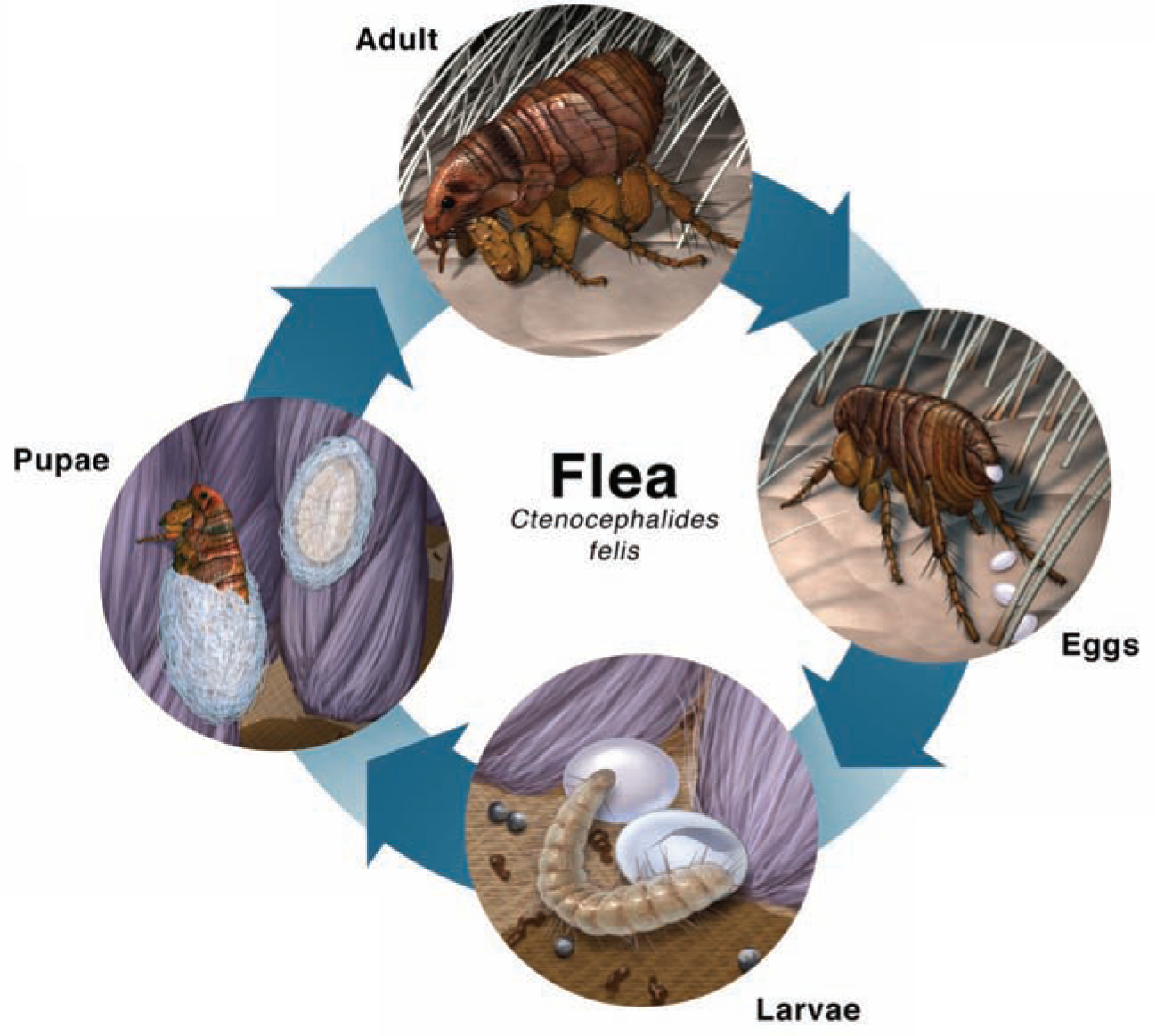
Diagram showing the different flea life stages. Courtesy of Elanco Companion Animal Health

Adult fleas feeding on the skin

Flea faeces turn reddish brown when in contact with water; this is best viewed against a white background

Using flea biology to correct some outdated concepts in flea control
‘A single flea bite is enough to cause FAD’
Traditionally, it was believed that a single flea bite was sufficient to cause the clinical signs of FAD and that total eradication of fleas was essential to ameliorate the signs of the condition. However, adult fleas feed within 5 mins of host contact and, given there is no flea product that can kill all fleas within this time period, it is likely that some flea feeding will always occur prior to flea death. Instead, FAD is likely to be dependent on the degree of hypersensitivity of the host, the total flea burden and the amount of flea antigen injected during flea feeding. Therefore, rapidly reducing the total flea numbers and decreasing flea feeding time are the keys to controlling the clinical signs of FAD.
‘Fleas are contagious’
Flea infestation most commonly results from the emergence of adult fleas from cocoons in the environment, with direct transfer from another infested dog or cat in close proximity only accounting for a very small number of fleas on the patient. Treatment of the environment to remove the source of the fleas is therefore an important aspect of an integrated flea control programme.
‘There are no fleas on my cat; therefore, it cannot have FAD’
Cats may have FAD even if fleas are not evident on visual inspection or flea combing during clinical examination. Cats with FAD remove more fleas by grooming than do non-flea allergic cats, thereby reducing the physical evidence of fleas. 28 Hence, the absence of fleas or flea faeces on a cat does not exclude the diagnosis of FAD.
‘Treat fleas only when you see them’
Most of the flea life stages reside in the environment and only adult fleas on the cat are visible to the owner. A single application of any flea product is unlikely to eliminate all life stages of fleas and consistent application of an appropriate product is more likely to achieve a successful outcome. It is therefore more advisable for owners to prevent flea infestation on their pets, rather than having to treat the consequences of FAD.
Traditional and newer options for flea control
Traditionally, flea control has focused on treatment of indoor and outdoor environments (where egg, larval and pupal stages reside) and the cat (where adult fleas reside). With the newer, more rapid-kill and more persistent insecticides, treating the cat only may be sufficient to control flea infestation. However, this is more likely to be successful in an indoor cat compared with an indoor/outdoor cat, which will have greater exposure to flea life stages present in the environment.
Insect growth regulators
Insect growth regulators interfere with the growth and development of fleas but have no effect on adult fleas. They reduce flea infestation by eliminating environmental life stages and preventing reinfestation. All in-contact animals must therefore be treated.
There is a lag phase of about 8 weeks between commencing treatment with an insect growth regulator and achieving control of adult fleas. Concurrent administration of an adulticide is, therefore, recommended. 29
Insect growth regulators can be divided into two main categories: insect development inhibitors (eg, lufenuron) and juvenile hormone analogues (JHAs) (eg, pyriproxyfen and S-methoprene).
Lufenuron
Lufenuron is a benzoylphenyl-urea that inhibits chitin synthesis, polymerisation and deposition during flea development. 30 Female fleas that ingest lufenuron therefore produce infertile eggs.
Lufenuron is available as a suspension, which is administered monthly at a dose of 30 mg/kg PO with food to enhance absorption (Program 133 mg or 266 mg ampoules; Novartis) or as an injectable preparation administered at a dose of 10 mg/kg SC every 6 months (Program 40 and 80; Novartis). Both formulations are safe to use in kittens from 6 weeks old, as well as in pregnant and lactating queens.
Injectable lufenuron administered at registered dose rates has been shown to produce a 90% decrease in adult flea emergence for 196 days after treatment, 30 while oral lufenuron combined with nitenpyram at 1 mg/kg q48h PO reduced flea populations by approximately 98% within 7 days of administration and for the study duration of 90 days. 31
Juvenile hormone analogues
Juvenile hormones regulate larval DNA transcription and maintain larval information. JHAs are absorbed through the flea cuticle and prevent the activation of genetic switches that determine the sequential development of organs and tissues in immature flea stages;32,33 thus eggs that are subsequently laid do not hatch.
(S)-methoprene is a JHA with both larvicidal and ovicidal activity but no adulticidal activity. 34 Pyriproxyfen is a JHA with activity against flea eggs and other juvenile stages. 33 Prolonged pyriproxyfen exposure may also be adulticidal.33,35 Pyriproxifen is available as a topical 3% endectocide in combination with 22% dinotefuran (Vectra for Cats; Ceva). S-methoprene is available in combination with fipronil (Frontline Plus/Frontline Combo; Merial).
Various studies have been performed to evaluate the efficacy of topical pyriproxyfen treatment in cats. A single topical application at 1 mg/kg prevented 100% of eggs from hatching for 7 weeks, 90% for 8 weeks and 60% for 12 weeks. 36 Another study demonstrated that two topical applications of pyriproxyfen, at 10 mg/kg 3 months apart, in 107 flea-infested cats resulted in 87.5% of the cats achieving zero flea counts after 180 days. 37
Adulticides
Flea products containing adulticides eliminate adult fleas, thereby reducing flea feeding.
Fipronil
Fipronil is a phenylpyrazole, which blocks the action of gamma-aminobutyric acid (GABA), an inhibitory neurotransmitter, at GABA-gated chloride channels in the central nervous system (CNS) and at neuromuscular junctions. 38 This causes disruption of normal nerve function, leading to hyperexcitation, convulsions and paralysis of fleas. When applied topically, fipronil accumulates in the sebaceous glands and epithelial layers and spreads over the body via translocation. 39
Fipronil is available as a 0.25% spray (Frontline Spray 2.5 g/l; Merial, Effipro 2.5 g/l Spray; Virbac) or a topical 10% endectocide (Frontline Top Spot/Frontline Original; Merial, Effipro Spot On; Virbac), and in combination with S-methoprene (Frontline Plus/Frontline Combo; Merial). The spray formulation is registered for topical application at a dose rate of 3–6 ml/kg once every 4 weeks in kittens from 2 days old. The endectocide is registered for topical application at a dose rate of 50 mg/cat once every 4 weeks. Frontline Plus is registered for use in kittens older than 8 weeks of age and is safe in pregnant and lactating queens. Effipro Spot On is registered for use on kittens older than 8 weeks and weighing more than 1 kg. Frontline Top Spot and Effipro Spot On contain a different vehicle to each other, with no apparent difference in efficacy. 40
When applied as 0.29% topical spray, fipronil was reported to have greater than 99.5% efficacy against adult fleas within 48 h and provided greater than 98.2% and 99.5% control of adult fleas and egg production, respectively, for 2 weeks in cats. 41
A single application of fipronil spot-on 50 mg/cat was effective in reducing adult flea burdens by 24.3% and 62.6% at 3 and 8 h post-treatment, respectively, in cats. 42 A separate study reported 97.5% and 97% efficacy in reducing flea populations on 12 dogs and three cats after 7 and 28 days, respectively. 43
Topical fipronil 50 mg/cat applied once a month for three applications resulted in significant reductions in geometric mean flea counts, pruritus score and severity of miliary dermatitis and alopecia in cats. 44
Imidacloprid
Imidacloprid (also nitenpyram and dinotefuran – see below) is a neonicotinoid that binds to nicotinic acetylcholine receptors (nAChRs), resulting in opening of the non-selective cation channels, promoting the influx of extracellular Na+/Ca2+ and efflux of intracellular K+ to disrupt the balance of the membrane potential. 45 The net result is depolarisation of neurons and subsequent insect paralysis. Imidacloprid has high affinity for insect nAChRs and very low affinity for vertebrate nAChRs, which explains the safety aspects of using this product to treat mammals. 46
Imidacloprid is available as a topical 10% insecticide (Advantage; Bayer) and as an endectocide in combination with 1% moxidectin (Advocate/Advantage Multi; Bayer) registered for topical application at a dose rate of 10 mg/kg every 4 weeks. Advantage is safe to use on kittens from 8 weeks old and also can be topically applied to pregnant and lactating cats. Advocate is registered for use in kittens from 9 weeks old.
Imidacloprid is larvicidal and adulticidal, with a rapid onset of action, killing fleas and larvae within 20 mins via direct contact.47,48 According to the manufacturer, the product is distributed over the skin surface and hair coat within 12 h of application and is stored in the water-resistant lipid layer of the skin surface and sebaceous glands, with a residual effect.48,49
A single application of topical imidacloprid was 95.3% and 97.4% effective in reducing flea populations in dogs and cats at 7 and 28 days, respectively. 43 In a separate study, topical imidacloprid was effective in reducing adult flea burdens by 26.9% and 82.8% at 3 and 8 h post-treatment, respectively. 42
Nitenpyram
Nitenpyram is a neonicotinoid that binds to specific nAChRs and interferes with normal nerve transmission in fleas. It is absorbed systemically into the blood of the host and is readily taken up by feeding fleas.
Nitenpyram is available as an oral tablet (Capstar; Novartis) to be administered at a dose rate of 1 mg/kg/day. Capstar is registered for use in kittens from 4 weeks of age and can be used in pregnant and lactating queens. Side effects reported include an increase in scratching, biting, licking and twitching for up to 7 h after administration. 50
Nitenpyram demonstrates a rapid-kill action within 30 mins;42,51 100% efficacy in removing fleas at 3 and 8 h after oral administration; 42 a 100% kill rate after 24 h and 98.6% reduction in adult flea numbers after 2 days. 50 Similarly, flea egg production decreases by 97% during the first 2 days of treatment. 50 Based on these results, nitenpyram dosed at 1 mg/kg PO q24–48 h provides excellent protection against adult fleas for up to 2 days. The main limitation of this drug is the short duration of action and therefore it is best used in circumstances where rapid flea elimination is required or in areas of high flea exposure (eg, within a cattery). It is usually combined with oral or injectable lufenuron for longer term flea control. 52
Selamectin
Selamectin is a synthetic avermectin, derived from doramectin, that acts by opening glutamate-gated chloride channels in the muscle membranes of arthropods, leading to paralysis and death. 53 Selamectin probably has both direct and systemic effects on fleas and is ovicidal, larvicidal and adulticidal.53,54
Selamectin is available as a topical 6% endectocide (Revolution; Pfizer, Stronghold; Pfizer) and is registered for topical application at a dose rate of 6 mg/kg every 4 weeks for kittens and cats older than 6 weeks. Side effects can include gastrointestinal reactions and transient hair loss at the application site. Topical selamectin has been shown to eliminate more than 98% of fleas within 24 h and was highly effective in reducing egg hatching (>92%), larval development (>95%) and emergence of adults (85.6–100%) for 30 days.54,55 Bathing and soaking does not appear to affect the efficacy of the product. 56 The bioavailability of selamectin is reportedly higher in cats than in dogs. 57
Summary of common flea products registered for use in cats

Newer flea products
Dinotefuran
Dinotefuran is a neonicotinoid that binds to specific nAChRs and interferes with normal nerve transmission in fleas. Dinotefuran is available as a topical 22% insecticide in combination with 3% pyriproxyfen (Vectra for Cats; Ceva Animal Health); it is registered at a dose rate of 1000 mg/m2 body surface area applied once a month, and can be used in kittens of 8 weeks and older.
Dinotefuran kills fleas by contact; ingestion of the product by the flea is not necessary. According to the manufacturer’s data, Vectra for Cats reportedly kills fleas as early as 2 h after application, with a greater than 95% reduction in flea numbers by 6 h, and approximately 91–98% reduction in flea numbers for a 30-day period.
Metaflumizone
Metaflumizone is a semicarbazone that blocks voltage-dependent sodium channels, resulting in paralysis and death of insects, with the benefit of having no reported cross-resistance with other chemistries. 58
Metaflumizone is available as a topical 18% endectocide (ProMeris for Cats; Fort Dodge), registered to be applied at a dose rate of 40 mg/kg every 4 weeks in kittens and cats older than 8 weeks of age. A similar flea control product for dogs containing metaflumizone and amitraz (ProMeris Duo; Fort Dodge) has been associated with a contact drug-triggered pemphigus foliaceus. This complication has not been reported in cats.
ProMeris for Cats kills adult fleas with >90% efficacy within 24–48 h of treatment and has been shown to control flea reinfestation for up to 7 weeks. 59 Another study showed that a single application resulted in >99.2% reduction in egg production within 48 h of application and provided 99.7% control of adult fleas within 72 h. There is >99% control of adult fleas for at least 42 days and reduced egg production by >99% for at least 5 weeks. 60
Readers should be aware that, since 2011, ProMeris is no longer available in the USA.
Spinetoram
Spinetoram is a semi-synthetic second-generation derivative of the spinosyns 61 that acts primarily by binding to nAChRs, leading to hyperexcitation of the insect CNS and, in turn, paralysis and death.61,62
Spinetoram is available as a topical 39.6% endectocide (Assurity; Elanco) and is registered for use in kittens of 8 weeks and older. Assurity kills 98–100% of fleas within 12 h of application and continues eliminating fleas for a full month after application.
Spinosad
Spinosad is a mixture of two natural macrocyclic lactones (spinosyn A and spinosyn D) isolated from a soil bacterium. 61 It acts primarily by binding to nAChRs, leading to hyperexcitation of the insect CNS and, in turn, paralysis and death. Additional mechanisms of action include opening of chloride channels in neurons in the insect CNS, resulting in hyperpolarisation. Spinosad also inhibits responses to GABA, suggesting potent effects on function of GABA-gated chloride channels in insect neurons. 63
Comfortis (Elanco) has recently been registered in the USA and Japan for use in cats at a dosage of 50 mg/kg orally monthly. It is safe in cats from 14 weeks of age and weighing more than 2 lb in bodyweight. Published studies in dogs showed that spinosad provides high efficacy (97.2–100%) flea elimination for 30 days.64,65 The speed of kill is rapid, with adulticidal efficacy being 53.7% within 30 mins of administration and 64.2% at 1 h, 81% at 4 h and 100% by 24 h post-treatment.65,66 The efficacy evaluated after weekly flea challenge was approximately 100% during 3 weeks, and 90% on day 39. 65 Flea egg production was also reduced by >99.8% for 30 days. 66
Integrated flea control
The goals of managing flea infestation have traditionally been:
Elimination of existing fleas on the cat;
Elimination of fleas acquired from the environment;
Prevention of subsequent flea reinfestation.
As discussed earlier, the commonly held belief used to be that only a single flea was required to initiate FAD in cats, and that total flea eradication was necessary in order to resolve the associated pruritus and overgrooming. In line with this concept, flea management regimens typically involved intensive on-host flea product application, combined with treatment of the environment. More recently, the concept of a ‘pruritus threshold’ has been introduced, which suggests that cats can tolerate a certain pruritic load without demonstrating clinical signs and that pruritus is only initiated if this threshold level is breached. This concept is supported by the fact that despite the rapid-kill rate of many flea products, no single product is able to prevent fleas from biting and feeding before they succumb to an insecticide. Consequently, reducing rather than eliminating the flea burden may be sufficient to control clinical signs of FAD.
In line with the recent concept of a ‘pruritus threshold’, reducing rather than eliminating the flea burden may be sufficient to control clinical signs due to FAD.
Some studies have suggested that perhaps elimination of fleas and prevention of reproduction can both be achieved at the host level without the requirement for environmental treatment.43,67 Certainly, this could be the case for an indoor cat living in an enclosed environment free from continuous exposure to adult fleas or flea eggs. Indoor/outdoor cats, by contrast, are more likely to be reinfested through emergence of adult fleas from pupae in the environment or direct transfer of adult fleas from other cats. Treatment of the immediate outdoor environment is therefore more important in these cats to reduce the likelihood of reinfestation. In addition, it is recommended that the environment is treated in cases of heavy flea infestation or severe FAD.
A summary of current recommendations for different scenarios is outlined below.
Treating the non-allergic indoor/outdoor cat in a single cat household
The use of an adulticide with larvicidal and ovicidal activity is recommended because of the continuous low-level exposure to fleas. Examples include the application of the endectocides, selamectin, fipronil or imidacloprid, once a month.
Treating the allergic indoor/outdoor cat in a multiple pet household
For maintenance, it is recommended that products that rapidly kill adult fleas are used to reduce flea feeding times. For the allergic cat, examples include nitenpyram, spinosad and dinotefuran. The addition of an insect growth regulator such as lufenuron will further control the juvenile stages of the flea life cycle. It is recommended that all non-allergic cats in the household receive lufenuron.
Treatment of an infested environment
Environmental control of the various stages of the flea life cycle can be achieved by mechanical removal and the direct application of insecticidal powder, mineral insecticides, aerosols, foggers and sprays onto surfaces where eggs, larvae, pupae and emergent adults are located. Vacuuming with a beater-type vacuum can remove about 90% of eggs and 50% of larvae from carpets. 68 Vacuuming also stimulates emergence and therefore continued vacuuming is essential to remove newly hatched adult fleas. The effectiveness of vacuuming decreases with increasing density of carpet, while the use of carpet cleaning equipment and solutions provides inconsistent results. 68
Insecticide resistance
C felis has shown a propensity to develop resistance to insecticides, especially cyclodienes, carbamates, organophosphates and pyrethroids. 69 A field-collected flea isolate (cottontail) was reported to be resistant to lufenuron, with reduced susceptibility to fipronil, and another flea isolate (R6) reportedly had reduced susceptibility to fipronil.41,70 This was hypothesised to be due to a point mutation in the Rdl gene, 71 although a study by Brunet et al, in 2009, refutes this assertion. 72 A large-scale worldwide study in 2011 revealed sustained susceptibility of C felis to imidacloprid. 73
It is important to institute an integrated approach to flea control to delay the development of resistance. Incorrect application of flea products may allow continued reproduction of fleas, resulting in persistent flea infestations and selection for resistant strains.
Most cases of perceived resistance are, however, due to incorrect usage of flea products (eg, underdosing, infrequent application intervals) and poor understanding of flea biology. Failure to treat all in-contact animals, failure to treat environmental infestation during severe flea infestation and genetic variation in susceptibility of flea populations can also lead to the problem of perceived resistance.
Footnotes
Key Points
Case notes
Physical examination
The cat had patchy mid-thoracic to lumbar truncal alopecia. The distribution was highly suspicious for flea allergic dermatitis (FAD).
Differential diagnoses
Diagnostic testing
Examination for adult fleas and flea combing for flea dirt were negative. Multiple superficial and deep skin scrapings were negative for ectoparasites.
Treatment
A therapeutic flea control trial was instituted before pursuing any further diagnostic testing. Nitenpyram PO q24h was considered but the cat would not permit daily oral medications; thus oral spinosad (extra-label use) was selected to be administered every 14 days. By the time of the 4-week and 8-week revisits, the pruritus had resolved and there was evidence of substantial hair regrowth.
The absence of adult fleas or flea dirt does not rule out FAD, as cats can rapidly remove evidence of flea infestation via grooming.
Funding
The authors received no specific grant from any funding agency in the public, commercial or not-for-profit sectors for the preparation of this article.
Conflict of interest
Dr Mandy Burrows acts as a consultant for both Pfizer Animal Health and Elanco, and receives sponsorship from Novartis, Merial and Elanco for continuing education presentations.