



Abstract

Most feline clinicians would agree that many cats vomit hair balls, yet the causes and even significance of this problem are not well understood. Welcome, then, Martha Cannon’s review of hair balls, found in the current issue of JFMS, which eloquently summarises available knowledge about this condition. 1
Writing such a review was undoubtedly a challenge, given the disparity between the prevalence of vomiting hair balls in clinical practice and the dearth of high quality published research on the subject. Indeed, although 46 references are cited, many are opinionated reviews or book chapters, and many of the scientific studies reported are more than 20 years old. Although this information is valuable, it’s a pity that, in the past two decades, the bulk of the veterinary research on this topic is limited to case reports and small case series from referral populations. This is not surprising because most clinical research is undertaken at academic institutions, with referral hospitals. However, in our opinion, more effort should be focused on the common and prevalent diseases seen in primary care. Of course, there are already many examples of such research, including work on chronic kidney disease,2,3 hyperthyroidism, 4 obesity,5–7 and diabetes mellitus. 8 As these studies highlight, this is best undertaken by establishing partnerships between academic institutions and veterinarians in primary care practice.
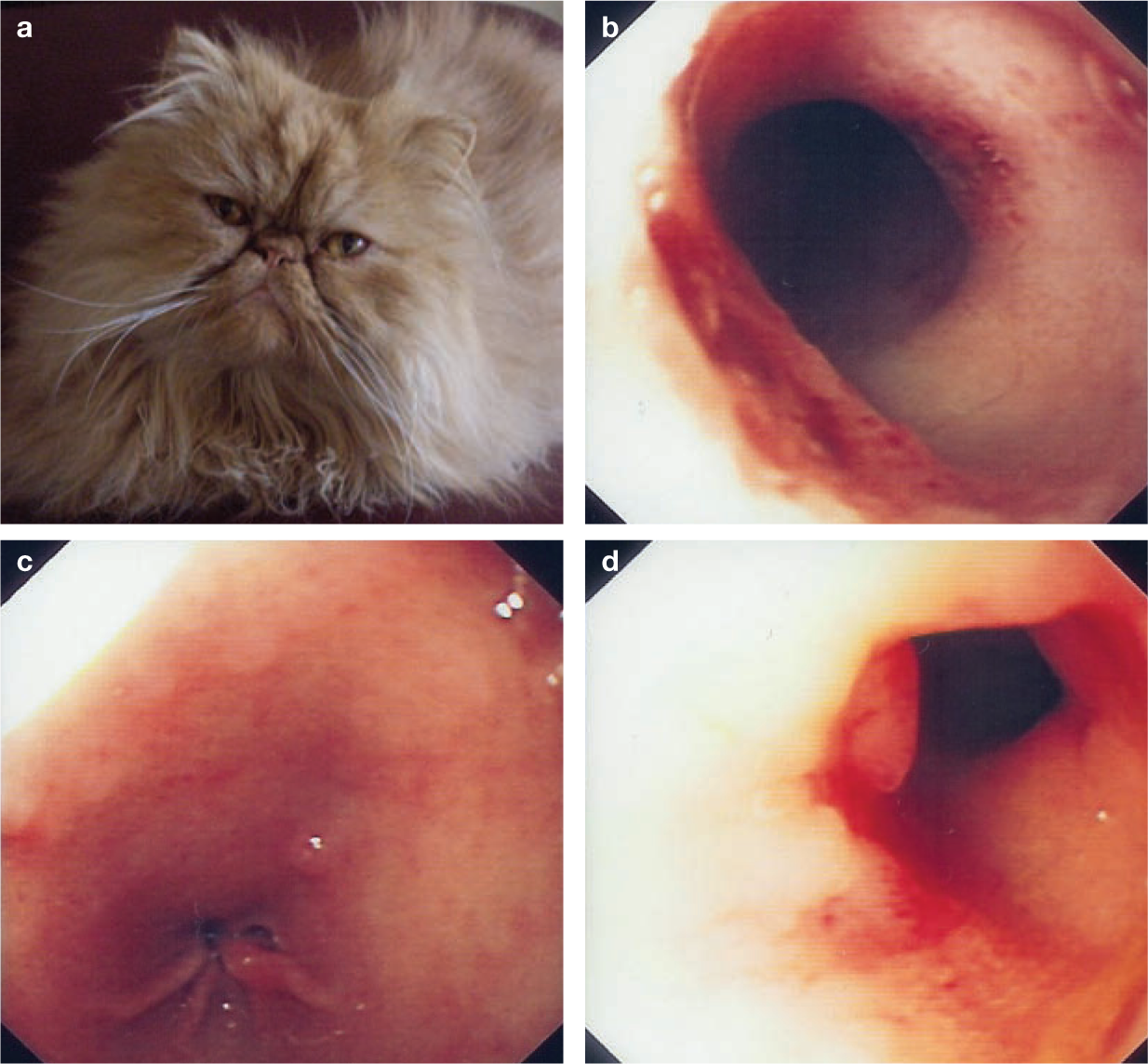
A 9-month-old neutered male Persian cat presenting with a history of persistent hair ball vomition (a). Gastroduodenoscopy revealed fibrous pyloric nodules (b) and proximal duodenal ulceration (c). Spiral organisms, suggestive of Helicobacter species, were identified in gastric biopsies, while mild inflammatory changes were seen in both the stomach and duodenal mucosa. The cat responded well to triple therapy and instigation of a single source, highly digestible protein diet. Gastroduodenoscopy repeated after therapy revealed that the duodenal ulcer had healed, leaving scar tissue (d). Thereafter, the cat remained well longterm, but would relapse every 612 months. Clinical signs were similar each time, and responded well to the same medical management
With that in mind, we are fully supportive of the establishment of the Small Animal Veterinary Surveillance Network (SAVSNET) in the UK, a resource designed to obtain real-time information, after owner consent, from first-opinion practices about diseases of companion animals. 9 Not only will this provide a valuable source of information about the current and future disease status in companion animals, but it again highlights the contribution that primary care practices can make to clinical research.
So, why else is this hair ball review such a fascinating read? The author tackles a key clinical conundrum head-on, namely the fact that hair ball vomition can be either a normal physiological phenomenon or a sign of an underlying gastrointestinal disease. Since the act of grooming occupies a significant proportion of the pet cat’s normal daily activity and involves ingestion of hair, it is not surprising that approximately 10% of healthy cats vomit hair balls. The two of us are all too familiar with this phenomenon, since one of our own cats regularly vomits hair balls, without apparent cause or consequence. If this process is so common, how then can we veterinarians distinguish between normal and abnormal? The answer is again highlighted in the review, namely that we should pay close attention to historical findings, physical examination, or both. Rather than focusing purely on hair ball vomition, changes in the pattern or frequency of vomition and the presence of other clinical signs of possible underlying disease (eg, weight loss, appetite changes) should be taken into account (see case 1).

A 4-year-old male neutered domestic longhair cat (a) with a history of recurrent abdominal pain, pyrexia and a single episode of vomiting. At exploratory coeliotomy, a large dry trichobezoar was identified which was impacting his duodenum (b) and obstructing biliary outflow (c). Concurrent cholangitis (d) and pancreatitis (e,f) were also identified. It was unclear whether the obstructing trichobezoar had caused the triaditis, or had occurred secondarily to dysmotility arising from triaditis. The hepatobiliary disease was treated with appropriate therapy. Over the next 4 years the cat was generally asymptomatic, but suffered from occasional recurrence, often accompanied by hair ball vomition
A further concept that the review highlights is that hair balls can both be caused by, and be the cause of, alimentary tract obstruction or disturbed motility. Indeed, we have ourselves seen cases of hair ball-associated obstruction (see case 2). This is the classic ‘chicken and egg’ dilemma of not knowing what came first, and emphasises the need to investigate thoroughly for associated or underlying disease.
Finally, and most importantly, the review summarises current opinions on therapy for hair ball vomition, with the main strategies including dietary modification and drug therapy. Once again, the scarcity of published literature is evident, most notably the lack of peer-reviewed trials concerning treatment efficacy. We are both strong advocates of evidence-based medicine. While, in the absence of such evidence, clinical judgement should prevail, clinicians should be cautious about reliability of their judgement, and never forget the mantra: ‘First, do no harm.’ The example of risks of lipoid pneumonia after inadvertent inhalation of liquid paraffin is an important reminder of the potential harm associated with drug administration, while dilemmas regarding the use of cisapride highlight the ‘prescribing minefield’ that feline-focused veterinarians often encounter. This emphasises the need for prospective, randomised controlled trials, both to provide objective evidence of efficacy, and information about any adverse events.
Martha Cannon has performed a remarkable feat in summarising the key aspects of a feline enigma that we are all familiar with. We encourage JFMS readers to read her review, and hope that they enjoy it as much as we have.