




Abstract
Cases of feline thelaziosis have seldom been published in the scientific literature. We report the first autochthonous case of feline ocular thelaziosis in Portugal caused by Thelazia callipaeda and suggest that this infestation should be included among differential diagnoses of ocular diseases in cats from this country.
Case Report
Thelazia callipaeda (Spirurida, Thelaziidae) is a nematode parasite found in the conjunctival sac and under the nictitating membrane of dogs, cats, wild carnivores and even human beings.1,2 The presence of these nematodes in the eyes may cause lacrimation, epiphora, conjunctivitis, ocular discharge, keratitis and corneal ulcers. Thelazia callipaeda is transmitted by the fruit fly Phortica variegata (Diptera, Drosophilidae), a non-biting dipteran insect that feeds on the lachrymal secretions of the vertebrate hosts. 3 Adult female worms produce first-stage larvae that are ingested by the vector with the lachrymal secretions and are released as third-stage larvae by the same insects while feeding on the ocular secretions of other receptive hosts. 4
The distribution of T callipaeda, commonly known as ‘oriental eye worm’, was considered for a long time to be confined to the former Soviet republics and Asia. 1 However, in the past decades thelaziosis caused by T callipaeda has been reported in dogs, cats and foxes from northern Italy with an infestation prevalence of up to 60% in some municipalities.5–7 Most recently, autochthonous cases of thelaziosis in both dogs and cats were reported in southwestern France,8,9 Switzerland 10 and Spain,11,12 as well as in dogs from Germany. 13 Additionally, four human cases of T callipaeda infestation have also been reported in Italy and France. 14 Intraspecific genetic characterization of T callipaeda has revealed the existence of several haplotypes in Asia, but only one haplotype (haplotype 1) in Europe, thus suggesting the unique origin of the infestation in this continent. 15
The present report describes a case of ocular thelaziosis due to infestation with T callipaeda in a cat from northeastern Portugal.
In November 2011, a 3-year-old male cat (European breed) from a village in the municipality of Macedo de Cavaleiros, Portugal, was presented for veterinary consultation, with a left eye infra-orbital abscess, a history of chronic conjunctivitis and oedema of the conjunctiva. The cat was sedated in order to clean the wound and, during ophthalmic examination, a few white worms were observed moving over the cornea (Figure 1). Seven worms were collected from the cornea and conjunctival sac with cotton swabs and flushing with saline solution.
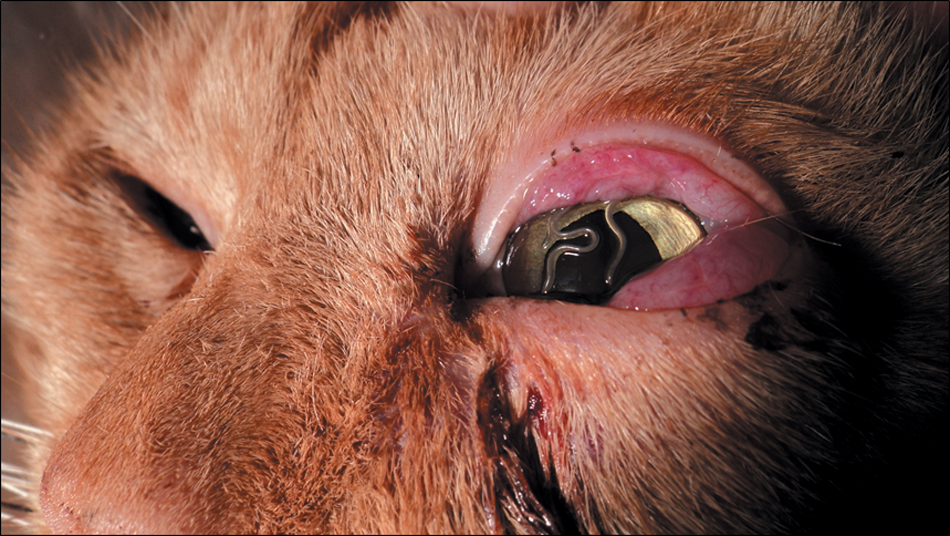
Thelazia callipaeda worms over the cornea and oedema of the conjunctiva
The worms were preserved in 70% ethanol and later were morphologically identified as T callipaeda (five females and two males) according to the morphological keys by Otranto et al. 16 Specific polymerase chain reaction (PCR) amplification of a partial sequence of the mitochondrial cythocrome c oxidase subunit 1 (cox 1) gene 15 and sequence analysis revealed T callipaeda to be haplotype 1 — the one reported previously in cats and other vertebrate hosts in Europe.
The cat was treated with an association of orally-administered milbemycin oxime and praziquantel (Milbemax; Novartis) and it was also given a systemic antimicrobial (cefovecin sodium, Convenia; Pfizer) for the abscess, and gentamicin sulphate and dexamethasone in eye drops (Tiacil Vet; Virbac) for conjunctivitis. Five weeks later the cat had no nematodes on the ocular surface and no ocular signs.
This is the first report of T callipaeda infestation in cats from Portugal. The village from where the case is reported is located at latitude 41.7° N, and is characterized by mountains with valleys and river streams, as well as vegetation represented by chestnuts, pine trees, oaks and cherry trees. That area falls within the predictive geoclimatic model for the suitable habitat of P variegata, the vector of T callipaeda. 17
The first case of feline thelaziosis in a European country was described in Italy (four cats from the province of Turin, from 1997 to 2001) by Otranto et al. 5 Several other reports of ocular thelaziosis in cats were subsequently published from Italy, France and Switzerland,6–10 being lower in number than the cases of canine thelaziosis. In previous studies thelaziosis was diagnosed in five cats compared with 108 dogs positive for T callipaeda 10 and in two other cats compared with 115 positive dogs. 9 In the Piemont area in northern Italy 42 cases of feline thelaziosis were described by Tosco et al, 7 with an infestation prevalence of 8.5%.
The present case is most likely an autochthonous one, as the cat never travelled outside the village. Several hypotheses for the origin of this case could be considered. The first explanation could relate to the fact that canine thelaziosis has already been described in this area. 18 Furthermore, the cat lived in an outdoor environment, thus being at a higher risk of infestation through potential contact with fruit flies. The presence of oak trees and river streams provides a suitable environment for the vector of T callipaeda. 17 In addition, wild animals in the area (eg, foxes, wolves, hares, martens and wild cats) might play an important role in maintaining the infestation and acting as reservoirs of T callipaeda, as for other European countries.19,20 Another hypothesis to explain the occurrence of this parasite is the presence of a large number of emigrants returning for summer holidays, especially in July and August, with their pets, travelling from France, Switzerland, Germany and Spain, where canine thelaziosis is endemic.8,10,11,13
Similarly to dogs, cats infested with T callipaeda may be asymptomatic, thus indicating that a careful examination of all animals, either with ocular signs or not, should be performed in endemic areas. Moreover, owing to the potential public health risk, both veterinary practitioners and medical ophthalmologists should be aware of this disease. Control of thelaziosis is currently based on the removal of adult nematodes directly from the eyes of affected hosts, including cats, and systemic administration of antiparasitic drugs. Regarding treatment, a single dose of a 10% imidacloprid and 1% moxidectin spot-on showed an efficacy of 90% (100%, following a second administration after 2 weeks). 7 In addition, the therapeutic efficacy of milbemycin oxime/praziquantel tablets against T callipaeda was tested in naturally-infested cats resulting in a mean percentage worm count reduction for the treated group of 62.2% and 80.0% on days 7 and 14, respectively (P = 0.0106 and P = 0.0043 compared with a placebo group). 21
The use of a 10% imidacloprid and 2.5% moxidectin spot-on formulation was also effective in the control of dog thelaziosis 5 (90.5%) to 9 (95.2%) days after treatment. 22 Single subcutaneous administration of 1% ivermectin (200 µg/kg body weight) or conjunctival instillation of two drops per eye of an injectable formulation of 1% moxidectin in dogs was shown to be effective.23,24 Finally, the oral administration of milbemycin oxime in dogs, at the recommended dose for the prophylaxis of Dirofilaria immitis (0.5 mg/kg body weight), showed high efficacy percentages against natural infestations with T callipaeda after one or two treatments (1 week apart). 25 Regarding prophylaxis of thelaziosis, the monthly administration of milbemycin oxime, at the same dose as mentioned above, showed 90% efficacy in preventing T callipaeda infestation in dogs. 25 In addition, the single administration of an injectable sustained-release formulation of moxidectin at a dose of 0.17 mg/kg body weight provided full-season (June–January) protection against canine natural infestation by T callipaeda. 26 A prophylactic scheme for cats might follow the regular application of single or combined drugs approved for cats.
Conclusions
The present report provides the first description of feline thelaziosis in Portugal. More clinical and field studies are needed to better understand the epidemiology of T callipaeda in cats and other vertebrate hosts in Portugal, and also that of the vector, P variegata. This finding should alert veterinary practitioners to include thelaziosis in the differential diagnosis of ocular diseases in cats and to also consider chemoprophylaxis for T callipaeda.
Footnotes
Funding
This research received no specific grant from any funding agency in the public, commercial or not-for-profit sectors.
Conflict of interest
The authors have no conflict of interest to declare.