




Abstract
There has been concern that early castration of pedigree kittens may lead to a depletion of gene pools. Web-based questionnaires on early castration were distributed to breeders and cat rescue organisations. One of the reasons that breeders used early castration was to counteract what they considered irresponsible breeding, such as overuse of strains within the breed or production of cross-breeds. Of all pedigree kittens, 45.1% were kept intact while 54.9% were neutered before re-homing. Nineteen (65.5%) of the cat rescue organisations believed that early castration could be beneficial in reducing the number of homeless cats, but only six (20.6%) had applied early castration. Three organisations replied that their veterinarian declined to do early castration and two believed that it was not safe for the kittens. There does not, necessarily, seem to be conflicting interests between keeping genetic variation in pedigree breeds and the possibility of limiting the population of homeless cats.
Introduction
Cat overpopulation leading to homeless cats and animal welfare issues is a problem all over the world. Castration before puberty is the only method to make certain that a cat will not produce a litter, as most non-pedigree cat litters seem to be unplanned.1,2
Although most publications regarding early neutering have focused on the use of early castration in cat rescue organisations, breeders of pedigree cats may also castrate the kitten early, ie, before it moves to a new home. The only effective means that a cat breeder has of preventing a kitten from breeding is to have it neutered before it is re-homed.
Early castration of pedigree cats has caused some concern. There is a fear that routine castration of a large proportion of pedigree kittens at an early age may lead to a depletion of gene pools and therefore an increase in in-breeding and health problems.3–5 In Sweden, this concern is one of the contributing reasons for not recommending castration before the cat is 6 months old unless there are extenuating circumstances. 3 Although the general recommendation in Sweden is to neuter kittens after 6 months of age, some veterinarians perform early castration and some breeders routinely have their kittens neutered before they are re-homed. It has also been stated that cat breeders apply early castration as a means of not sharing their breeding stock with other breeders.
The definition of early castration varies but has been suggested to be castration before 4 months of age. 2 The age when kittens are separated from their mother varies. Some cat clubs have regulations or recommendations that the kitten must be at least 12 weeks old before it can be re-homed.6–8 According to the Swedish animal welfare law, no kitten is allowed to be separated from its mother until it is at least 12 weeks old. For kittens that are to be re-homed when they reach 12 weeks of age or more, there is no need for castration before they are at least 10 weeks old.
The main aim of this study was to evaluate cat breeders’ motives for the application of castration before kittens are re-homed and the potential risk of early neutering for depletion of genetic variation in pedigree breeds. In addition, we wanted to evaluate the usefulness of early castration to cat rescue organisations.
Materials and methods
For the purpose of this study we have defined early castration as castration before a kitten is re-homed.
Questionnaire for breeders applying early castration
A web-based questionnaire was designed to obtain information from cat breeders applying early castration. Email lists of breeders were obtained from cat organisations. It became obvious from online posts in a cat discussion forum that breeders re-posted the link to each other, resulting in the loss of controlled distribution, as had been originally intended. Subsequently, a link to the survey was also published on a cat website to reach as many breeders as possible. It was not possible to direct the questionnaire specifically to breeders applying early castration as there are no registers to identify them.
Respondents were asked to either choose between pre-determined alternatives, answer numerical questions (eg, age of re-homing) or to rate a statement according to the extent of their agreement. In addition, they could add free comments to several of the questions. The questionnaire was available from 17 April to 17 June 2010.
Questionnaire for cat rescue organisations
The questionnaire was sent by email to 102 cat rescue organisations, but could not be delivered to five of these. It was available between 7 September and 30 October 2010. In a reply posted on 10 September, the respondent wrote that the question had not been discussed and therefore it was difficult to reply. On 14 October a message was sent that added an option to reply that the subject had not been discussed.
Results
Breeders applying early castration
Eighty-one responses were received from breeders that applied early castration. Fifteen of the responses were removed from the study — 14 because they had been answered by Danish breeders, which was beyond the aim and inclusion criteria of the study, and one because it was incomplete. Sixty-six responses that could be analysed remained in the study.
Base data on catteries applying early castration
Breeds
A total of 17 breeds were included (Figure 1). Some breeders kept more than one breed. One breeder commented that they applied controlled breeding with other breeds to avoid in-breeding in their Devon Rex cats.

Number of breeders in this study within each breed. One breeder may have more than one breed
Number of cats in the catteries
The mean number of female cats was 3.1 ± 1.8 per breeder and the corresponding figure for male cats was 1.1 ± 1.1. Fifty-six breeders answered the question on the number of adult neutered cats in the cattery; the mean was 1.7 ± 1.4 (Figure 2). In addition, 26 breeders replied that they had 1–13 (median 1.0, mean 2.2 ± 2.5) intact adult cats that were placed with a co-owner.
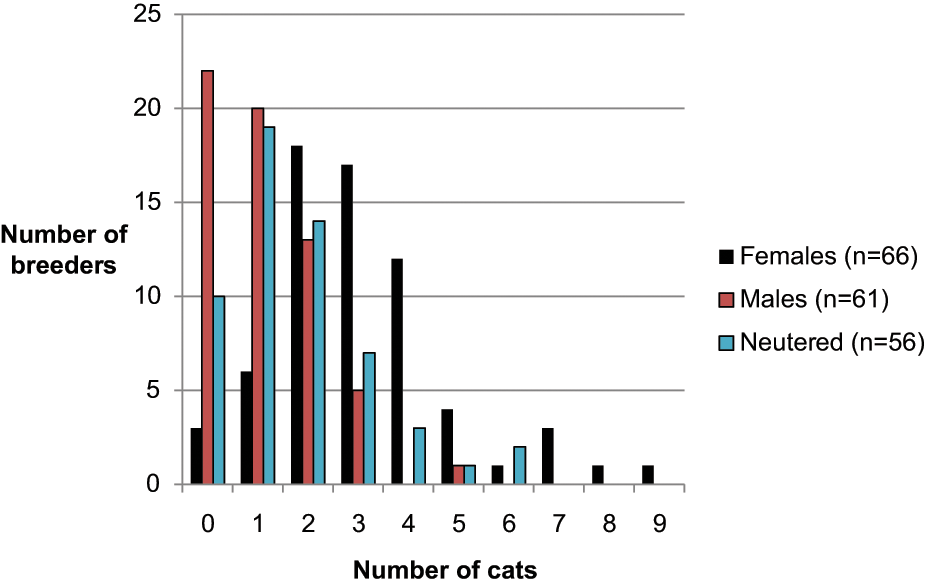
Number of intact males and females, and neutered cats in the catteries (n = number of breeders that replied)
It may seem strange that three breeders did not keep intact females. One of these breeders had, however, a cat placed at a co-owner, one mentioned that the breeding female had recently been spayed and one did not comment, although there was one intact male and four castrated cats at that cattery.
Litters per year
Sixty-five breeders replied on the mean number of litters/year in their cattery. Most of the breeders (66%) had 1–3 litters/year (Figure 3). Several breeders answered that it varied from year to year.
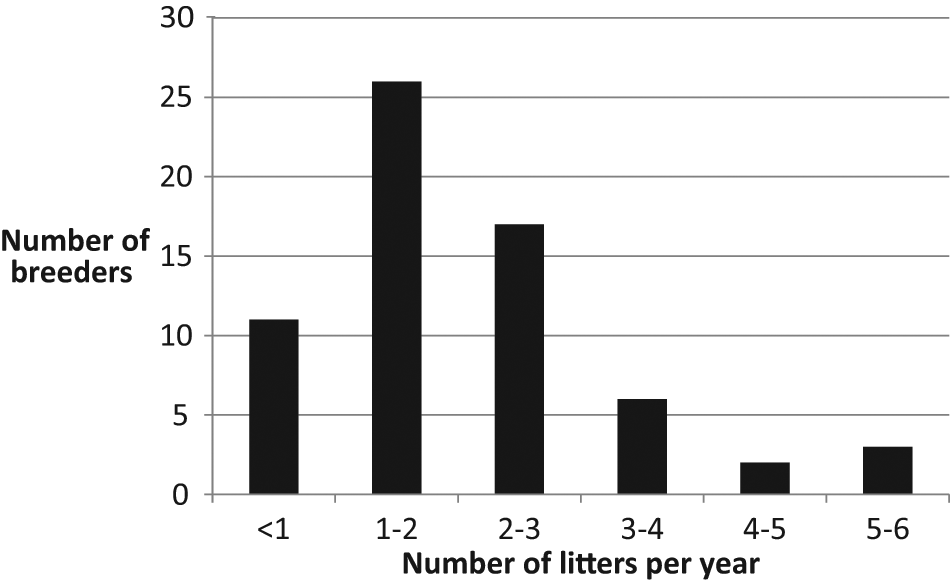
Number of litters per year
Perceived advantages with early castration
The breeders were asked to choose seven of the 15 predetermined alternatives on the perceived advantages of early castration. The perceived advantages were grouped according to three different sections (Table 1). The replies were evenly distributed between the sections, but the single most common answer was the possibility to counteract irresponsible breeding (12.0%).
Perceived advantages with early castration

Perceived disadvantages with early castration
The possible disadvantages that most of the breeders partly agreed on were an increased risk for depleted genetic variation, difficulties in evaluating the breeding potential of a kitten and that buyers might want an intact kitten (Table 2).
Perceived disadvantages with early castration (percentage of replies)

Agree completely = 5; do not agree = 1
In the free comments section, breeders commented that there was no difference on the effect on genetic variation if a kitten was neutered at 12 weeks or 6 months, and that selection of breeding stock was the breeder’s responsibility rather than the buyer’s. One breeder commented that only kittens that were unsuitable for breeding owing to health issues were castrated. Other opinions were that it was not appropriate to keep the cat intact for a long time as a ‘reserve’ and that buyers of pet cats could not function as a ‘reserve plan’.
Other disadvantages that were mentioned in the free comments section, in addition to the multiple choice alternative, were negative reactions from other breeders (n = 4), higher cost for the breeder (n = 3), that buyers might want to have the cats at a younger age (n = 2) and difficulties in choosing the right kittens for breeding (n = 3).
Reasons to apply early castration
The breeders were asked to choose three of the seven pre-determined alternatives on the main reason why they currently applied early castration. There was also a box where they could fill in another reason of their own choice (Figure 4).

Breeders’ reasons for applying early castration. (1) Other, including reduction of behaviour problems, increasing the genetic variation, counteract matador breeding, less surgical stress for young animals. (2) Counteract irresponsible breeding. (3) Health benefits for the kitten. (4) Contact with foreign breeders that have shared their experience of early castration. (5) More active participation in the development of the breed. (6) Reduction of the risk of uncontrolled reproduction. (7) Agreements with other breeders that restricts further breeding with kittens and may include a demand for early castration of kittens. (8) Advantage for the buyer
The breeders were also asked to provide free comments on the reason why they had started to perform early castration (ie, it could be different from the current reason for performing early castration). In the free comments section several breeders mentioned more than one reason why they had started performing early castration.
Thirty-two of the breeders mentioned the possibility of counteracting irresponsible breeding as the main reason for beginning early castration. As examples of irresponsible breeding, they mentioned the production of mixed-breeds, ‘back-yard breeding’, restricted genetic variation caused by overuse of cats, breeding from cats with inherited diseases or from carriers of diseases, or breeding from cats that had not undergone health tests. Nine breeders had started early castration because of contracts and demands from other breeders; six mentioned the health of the kittens as the main reason.
Number of kittens neutered and kept intact
The mean number of kittens kept, or sold neutered or intact is shown in Table 3. A total of 484 (45.1 %) kittens were kept intact, while 589 (54.9%) were neutered. Of the intact kittens, a total of 285 were sold, while 182 intact kittens were sold specifically for breeding. One breeder replied that he/she never let a whole litter be used for breeding. One breeder had sold three intact kittens with an agreement that they would be neutered at the cost of the breeder and not used for breeding. Another breeder had sold four intact kittens in the last litter because there was no local veterinarian who was willing to neuter kittens at that time.
Mean number of kittens that were kept intact, sold neutered or kept as neuters by the breeder. Means ± SD (number of breeders replying)

N/A = not applicable
Age when kittens are neutered and re-homed
Breeders could fill in more than one alternative if the age of castration varied. A total of 95 responses were therefore received. The earliest age that breeders had their kittens neutered was 10–11 weeks (8.4% of responses), with the majority of responses indicated having their kittens neutered at 12–13 weeks (42%) or 14–15 weeks (30.5%).
In the question regarding the age of re-homing, breeders were asked to write the age in a box. Most neutered kittens were re-homed after 14 weeks of age (39/59 breeders that replied). Eight breeders replied that kittens were neutered at 10–11 weeks of age and eight breeders re-homed kittens at 12–13 weeks of age.
Experiences of negative effects
The breeders were asked if they had experienced any negative side effects, such as fractures, oestrus after castration, postoperative complications, overweight, problems related to the urinary tract or problems with disturbed growth. In addition, they could leave a comment about other possible negative effects. Seven breeders (10.6%) reported one negative effect. Four of them had experienced problems with overweight, but three of these commented that it did not differ from traditional castration and one did not leave any further comments. Three breeders reported that cats neutered at an early age showed a lower tendency to overweight than cats neutered at an older age. One breeder that reported disturbed growth commented that that the kittens might have slightly longer legs and two breeders reported surgical complications. One breeder who had experienced surgical complications commented that it had happened once in 18 litters and the other commented that it might have been an allergic reaction to the sutures.
Eight breeders had spontaneously commented that, in their experience, recovery after early castration was quicker and easier for the kitten than after traditional castration.
In the comments section where the breeders were asked if they had experienced any other negative effects, five breeders mentioned that they had experienced negative attitudes from other breeders or veterinarians, and one mentioned that the possibility of keeping a kitten for breeding had become impossible because of pyometra.
Use of contracts
The breeders were asked if they used contracts when they sold kittens for breeding in order to try to evaluate the degree of control they wished to obtain over sold kittens. Fifty-one (77.3%) of the breeders replied that they used contracts. However, it was revealed in the comments that the question had been unclear, as many breeders replied that they used the cat organisation’s standard contract, which does not regulate the use of the kitten. In the comments, however, six breeders specifically mentioned that they wrote contracts that restricted the use of the offspring of the cat. Such restrictions could be that no offspring of the first generation could be sold for breeding, being used only in the buyer’s cattery, restrictions in the number of offspring or that a male could not be used in other catteries. One breeder imposed restrictions depending on the restriction of his/her own cat and wrote that restrictions often applied to two generations in that breed. Five breeders mentioned that the contracts included conditions about health tests before breeding.
Cat rescue organisations
A total of 29 responses were received, together with five messages that the subject had not been discussed, giving a response rate of 35%. The majority of the organisations believed that early castration could be beneficial in reducing the number of homeless cats (65.5%) and that it could be useful for their organisation (75.9%), but only six had applied early castration up to 14 weeks of age (20.6%). Ten of the organisations that did not apply early neutering had discussed this with their veterinarian. One organisation had declined a suggestion of early castration because they felt that the subject had been studied too little in Sweden, while three replied that their veterinarian declined to do early castration. Four of the organisations did not believe that early castration would be an alternative for them. One of these commented that the cat had to finish growing first and one that it was necessary to know more about the physical and behavioural effects of early castration. An organisation that had replied that early castration could reduce the number of homeless cats still replied that it was not an alternative for them because their veterinarian declined early castration and animal hospitals were too expensive. The fourth organisation that did not believe that early castration was an alternative could not see any reason for it and replied that it was no problem to wait until the cats were sexually mature.
Discussion
To our knowledge this is the first evaluation of the application of early castration in pedigree cats. Owing to the nature of the study it was not possible to evaluate the overall effect of early castration on the gene pool in pedigree breeds. That was, however, not the aim of the study. It is likely that the publication of the links on internet sites made it possible to reach more breeders. Early castration is not likely to be very widespread in Sweden owing to the general national recommendations that, in general, cats should not be castrated before the age of 6 months.3,4 Even if we had tried to reach all breeders of pedigree cats in Sweden in an effort to calculate the total percentage of early castrated kittens, it is very likely that breeders applying early castration would have had a much larger tendency to answer as they will have thought more about the issue, thus causing a bias. A smaller sample size with the possibility of telephoning cat owners to increase the compliance rate would most likely have resulted in fewer responses from the group of interest. Although performing early castration is not prohibited, the recommendation of the cats being 6 months old is still followed by most veterinarians, which, of course, is the purpose of having a recommendation. We believe that this study gives an insight into the application of this procedure in pedigree kittens that has not been documented previously.
Reasons to apply early castration differed between breeders, but the possibility of counteracting irresponsible breeding seems to be one of the main reasons. Opinion about what constitutes irresponsible breeding is likely to differ between breeders, but, in the comments left, breeders mentioned the production of cross-breeds, breeding from cats that had not undergone health tests and overuse of certain individuals, thus limiting the gene pool.
This study does not support the statement that breeders of pedigree cats apply early castration to a large extent because they do not want to share their breeding stock. Breeders who applied early castration sold more intact kittens than they kept, although not all of the intact kittens were specifically intended for breeding. Of all the kittens, 45.1% were intact at the time of re-homing and 33.2% of all sold kittens were intact.
The main perceived risk with early castration was, nevertheless, a possible depletion of the gene pool. Some breeders mentioned, however, overuse of individual cats and strains as a cause of gene pool depletion, and as a reason to apply early castration with the aim of increasing genetic variation. It is easy to believe that a reduction in the number of intact cats would automatically lead to a depletion of the gene pool and in-breeding because fewer animals would be used for breeding. This reasoning neglects, however, the fact that not all cats will be used for breeding. Development of animal breeds always involves a selection of the breeding stock and there will, for various reasons, always be individuals that are not suitable for breeding. The market for pedigree kittens is limited and the population of pedigree cats is divided into several breeds, leading to several numerically-small breeds. It is not realistic to believe that there could be an indefinite increase of the number of individuals in each of these breeds. Therefore, it is necessary for breeders to breed responsibly within limited populations. In a small population that is not expected to increase rapidly in size, an increase in in-breeding can be avoided by limiting the number of offspring from each cat that will contribute to the gene pool — as has been shown in dog breeds.9,10 By restricting the use of individual breeding animals and the number of offspring from them that are used for further breeding, more animals can be used for breeding in populations that have limited potential to increase in size. 10 Several breeders in this study expressed a wish to limit the number of offspring with the same genetic background that would be used for breeding. As shown in this study, there is an imbalance between the number of females and males kept intact. A better balance between males and females would further contribute to controlling the degree of in-breeding.
In contrasts to cats, pet dogs in Sweden are more often kept intact. They tend to be kept under control and are not allowed to roam free, which is why the birth of unwanted puppies is not a very large problem — cats often roam free. Dogs kept as pets in such controlled populations can, therefore, sometimes be found to have a breeding value. In contrast, it is more unusual that cats are kept intact after puberty unless they are intended for breeding. Cats that have been used for breeding are often castrated when they are no longer going to be used for this purpose. Intact male cats are not often good pets because of their tendency to mark territories. Queens may develop pyometra and are more likely to develop mammary tumours if they are intact. In addition, the behaviours associated with oestrus may be disturbing. Therefore, it is not realistic to expect that there would be a pool of intact ‘reserve’ cats that can be used for breeding after they have been sold to new owners. As some breeders mentioned in this study, buyers who chose to breed from a cat sold as a pet may not always be willing to breed responsibly, which may include expensive health tests and careful selection of a suitable combination of animals. For various reasons, kittens designated by the breeder to become pets are not always suitable for breeding.
Although early castration, as applied by the breeders in this study, is not likely to increase the risk of in-breeding, this is a risk that has to be considered. If a very large proportion of kittens were to be castrated, and if breeders were to use early castration to avoid competition from other breeders, it is likely that the gene pools would become depleted eventually. Not all kittens that are kept intact for breeding may be suitable for this purpose when they are older. Therefore, it is important that breeders and cat organisations are aware of the risks associated with the depletion of gene pools. Some breeders mentioned, however, that there is no difference in the gene pools between castration at 12 weeks or 6 months of age. Also, buyers who want a pet kitten are likely to want to have their cat castrated before puberty.
Although the limited size of the gene pool is definitely a problem to consider for pedigree cats that are bred in small populations, a recent study suggested that current data do not indicate that Polish pedigree cat populations are threatened by negative effects of in-breeding. 11 Pedigree analyses, such as in the study by Mucha et al, 11 may, however, underestimate in-breeding, as many breeds have been founded by mating closely related cats and there may be gaps in the early generations. As indicated by replies in this study, many breeders do, however, seem to actively avoid close in-breeding. 11 For example, one of the breeders in this study applied controlled out-crossing with other breeds to increase genetic variation in their breed. Although health problems have certainly been identified in pedigree cats, they may not always be caused by in-breeding, but can, in some cases, be caused by a selection for unhealthy conformation. 12 Breeding in small populations and in-breeding are, however, likely to increase the frequency of certain health problems.5,12 One of the breeders had replied that the reason he/she had started with early castration was that kittens sold previously had been used for ‘back-yard’ breeding and that some of these had been shown to be carriers of hypertrophic cardiomyopathy. Selling neutered kittens can thus prevent breeding from cats with harmful genes. Nine of the breeders had commented that they had started early castration because of contracts with other breeders; at least five breeders used contracts that restricted the use of the offspring of the kittens they sold for breeding. This is a practice that limits other breeders’ choices and, to a large extent, reflects a wish to control breeding within the breed. Thus, responsible use of early castration can be a means of improving health by counteracting irresponsible breeding, but, if used unwisely, it may have the opposite effect by reducing the gene pool.
Most of the breeders had their kittens neutered after they had reached 12 weeks of age — an age after which kittens are no longer considered to be in the pediatric period. 2 No kittens were neutered before the age of 10 weeks. Few breeders had experienced any negative side effects of early castration. Four breeders mentioned overweight, but three of these commented that it did not occur more frequently than after traditional castration and cannot, therefore, be considered an effect of early castration as such. Previous studies do not indicate that the risk of overweight is higher after early castration than after castration at a traditional age. 13 Two breeders had experienced surgical complications, but it is unclear if this was caused specifically by early castration as such. Surgical complications will occur in a proportion of cats that are castrated — irrespective of the age — and have not been reported to be higher after early castration than after traditional castration when older. 2 Eight of the breeders had commented spontaneously that they experienced early castration to be easier for the kitten, with a quicker recovery. A quicker recovery time is in accordance with previously published studies. 2
The feral cat population is not an isolated population of cats. Homeless cats may once have been pets, or have descended from pet cats that have been abandoned or that have disappeared from their homes. Although pedigree cats are much less often found in the feral population than non-pedigree cats, cats in the feral population may have pedigree cats in their parentage. According to advertisements on, for example, the internet, it is not unusual for cats in the non-pedigree cat population to be described as mixed breeds with different percentages of pedigree cats in their parentage. Once an intact kitten is sold there is usually nothing the breeder can do to stop further breeding from that kitten.
The poor response rate from cat rescue organisations may be owing to the fact that the issue had not been discussed in all organisations and that these cats do not have one specific owner but are within the custody of an organisation in which opinions may differ. The majority of the cat rescue organisations in this study considered early castration as an alternative that could be used to reduce the number of homeless cats, although only six of them had used it. Three organisations that had discussed early castration with their veterinarian but did not use it replied that their veterinarian declined to do early castration. Two of the organisations that replied that they did not believe early castration would be an alternative for them considered that it was not safe for the kittens. The safety of early castration has been demonstrated in several studies, but it has also been shown that the attitudes toward early castration may be slow to change.2,14 Our results indicate that general recommendations for not neutering cats before the age of 6 months may have negative effects on the application of pre-pubertal castration of shelter cats and may, therefore, counteract efforts to reduce the number of homeless cats.
In conclusion, there was no evidence in this study that early castration of pedigree kittens will inevitably cause a depletion of gene pools. It may even benefit genetic variation if used responsibly. Therefore, there are not conflicting interests, necessarily, between keeping genetic variation in pedigree breeds and the possibility of limiting the population of homeless cats by castrating kittens before they are re-homed.
Footnotes
Acknowledgements
The authors would like to thank Professor Erling Strandberg for advice concerning genetic effects and Jane Morrell for kindly revising the language.
Funding
This research received no specific grant from any funding agency in the public, commercial, or not-for-profit sectors.
Conflict of interest
The authors do not have any potential conflicts of interest to declare.