



Abstract
To investigate the potential transmission of subtype H3 influenza virus to cats, a serological survey was carried out in South Korea. Serum samples (n = 1027) were obtained from 809 pet cats and 218 domesticated cats living in urban colonies (D-cats) from 2008 to 2010, and tested using an influenza anti-nucleoprotein (NP)-specific enzyme-linked immunosorbent assay (ELISA) and the haemagglutination inhibition (HI) test, which was recommended by the World Organization for Animal Health. Anti-influenza virus antibodies were detected in 3.12% and 2.43% of cat sera tested using the NP-specific ELISA and HI test, respectively. Anti-H3 antibodies were also identified when the HI assay was used for influenza virus serotyping. These data may indicate the sporadic transmission of subtype H3 influenza virus from other infected species to cats in South Korea.
Short Communication
Influenza A virus, a member of the genus Orthomyxovirus, is lipid-enveloped and contains a segmented, negative-sense RNA genome. 1 The influenza A virus is a highly infectious respiratory pathogen of birds and mammals, and is capable of efficiently crossing the host barrier to infect all susceptible species. 2
Cats and dogs have been considered to be relatively non-susceptible to influenza viruses.3–6 However, the successful interspecies transmission of the highly pathogenic avian influenza virus (AIV), H5N1, and the pandemic H1N1 influenza to cats and other felids by direct or indirect contact with infected humans and birds has been reported.7–12 Also, interspecies transmission of equine influenza virus H3N8 to domestic dogs was first reported as a novel canine respiratory pathogen in racing greyhounds and shelter dogs in the USA in 2006. 13 Interspecies transmission of AIV H3N2 to dogs in South Korea and South China has also been reported.14,15 In South Korea, the canine influenza virus (CIV) H3N2 is capable of spreading rapidly within dog populations;16,17 the human influenza virus (H3N2) and AIV H3N2 have also been detected in South Korea.18–20 Interestingly, the case of CIV H3N2 infection was recently identified in domestic cats in South Korea. 10 Influenza A virus infection of cats has important implications for both veterinary medicine and public health because companion animals, such as cats, usually reside in close contact with humans. Therefore, the aim of the present study was to detect antibodies to subtype H3 influenza virus in South Korean cats.
Serum samples (n = 1027) were collected from 809 pet and 218 domesticated cats living in urban colonies (D-cats) from across South Korea over a period of 3 years (2008–2010). Sera from pet cats were supplied by iNtRon Biotechnology Company and Neodin Vetlab Company, which specialise in the diagnosis of feline and canine diseases. Serum samples were collected from pet cats in Seoul (n = 250), Gyeonggi (n = 65), Gyeongsang (n = 10), Chungchung (n = 10) and Jeonra (n = 10) in 2008; in Seoul (n = 135), Gyeonggi (n = 55), Gyeongsang (n = 24), Chungchung (n = 31) and Jeonra (n = 21) in 2009; and in Seoul (n = 131) and Gyeonggi (n = 67) in 2010. Of the 809 pet cats, 383 were healthy; the remaining cats had respiratory signs, including fever, sneezing, coughing and rhinorrhoea. The D-cat samples were supplied by three animal rescue shelters located in Gyeonggi (n = 2) and Jeonra (n = 1). The 218 D-cat sera were collected from Gyeonggi (n = 100) in 2009, and from Gyeonggi (n = 92) and Jeonra (n = 26) in 2010. The 1027 serum samples were analysed for influenza virus anti-nucleoprotein (NP) antibody using a competition enzyme-linked immunosorbent assay (ELISA) (Bionote, Gyeonggi). The samples were also analysed using haemagglutination inhibition (HI) and neuraminidase inhibition (NI) tests. The sera were pretreated to destroy non-specific inhibitors before the HI and NI test, as previously described. 21 The HI test was performed in accordance with procedures recommended by the World Organization for Animal Health (OIE). The HI titre was expressed as the reciprocal of the highest serum dilution that completely inhibited the haemagglutination of the 4HA units of the virus. The following antigens were also used for serotyping: H1N1 influenza virus (A/swine/Korea/GC0503/2005) for H1; H3N2 influenza (A/canine/Korea/01/07), H3N2 (A/cheongju/H407/08), H3N2 (A/duck/LPM91/06) and H3N8 (A/Equine2/Miami/1963, ATCC VR-317) influenza virus for H3; H5N3 influenza virus (A/duck/Hongkong/820/1980) for H5; and H9N2 influenza virus (A/Chicken/Korea/01310/2001) for H9. The H3N8 influenza virus (A/Equine2/Miami/1963, American Type Culture Collection (ATCC) VR-317) was purchased from the ATCC. The remaining influenza virus strains were kindly provided by Dr Dae-Sub Song and Young-Ki Choi. H3N2 (A/canine/korea/01/07) and H1N1 influenza viruses (A/swine/Korea/GC0503/2005) were used to detect antibodies to the NI test, as described previously. 22
Antibodies against the influenza virus were detected in 32/1027 serum samples (3.12%) using the NP-based ELISA (Table 1). Of these 32 positive samples, 15 were from healthy pet cats and nine were from pet cats with clinical signs of respiratory disease. However, the clinical status of the eight D-cats was unknown (Table 2). The HI test for the H3N2 influenza virus (A/canine/Korea/01/07) detected anti-canine H3 antibodies in 25/1027(2.43%) cat samples (Table 1). Of these 25 positive samples, 12 were from healthy pet cats, seven were from pet cats with clinical signs of respiratory disease and six were from D-cats. The titres of the positive serum samples ranged from 32 to 128 HI units (Table 2). Two (P09-063 and P10-88) and five (P08-106, P09-074, P10-87, P10-101, F10-72) of the positive samples against anti-canine H3 showed similar titres (from 32 HI to 64HA) against human H3 and avian H3 influenza respectively. These samples were cross-reactive with canine H3, but none cross-reacted with equine H3N8 or other antigens (H1, H5, H9) in the HI test (Table 2). The 32 positive sera identified by the NP-based ELISA were then used in the NI test. Three samples showed titres of 80 (P09-102), 64 (P10-69) and 64 (P10-108) against canine N2, respectively (Table 2). None of the samples reacted with a response for human N1 in the NI test (Table 2).
Seroconversion of influenza virus in pet cats and domesticated cats living in urban colonies (D-cats)
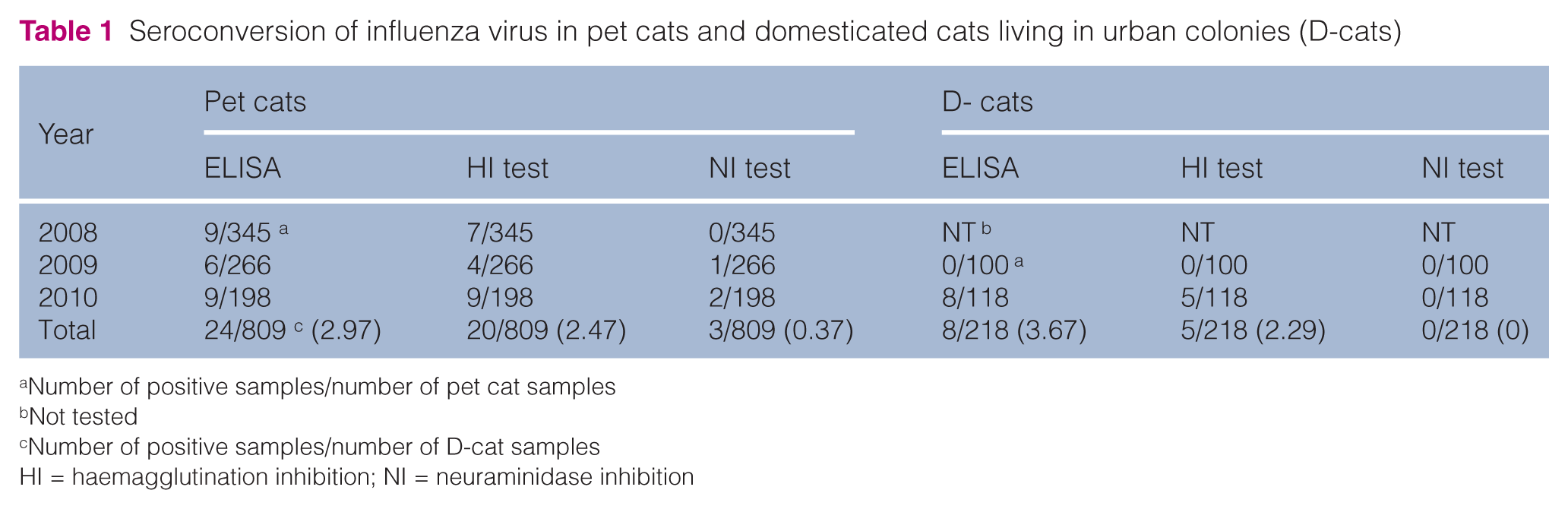
Number of positive samples/number of pet cat samples
Not tested
Number of positive samples/number of D-cat samples
HI = haemagglutination inhibition; NI = neuraminidase inhibition
Haemagglutination inhibition (HI) and neuraminidase inhibition (NI) titres in positive samples measured by nucleoprotein (NP)-ELISA

Respiratory disease
Healthy
Domesticated cats living in urban colonies
The transmission of influenza virus from companion animals to other species is a public health concern because of the possibility that, owing to reassortment, a new virus strain with zoonotic potential could emerge. 12 Dogs and cats are susceptible to natural influenza virus infection by spill-over transmission from avians. Dogs are also susceptible to an equine adaptive virus reservoir. Influenza virus subtype H3 is highly adaptable and can infect both avians and mammals, including humans. 23 In South Korea, CIV H3N2 has been isolated from cats following transmission from dogs, 10 and both human and avian H3N2 influenza viruses circulate in South Korea.18–20 The human H3N2 influenza virus was also transmitted from humans to dogs and cats in Japan. 22
In the USA 0.9% of cats in Iowa were reported to be seropositive for influenza A virus, 24 and 43.5% of cats in Ohio were seropositive for H3N2. 25 In Japanese cats tested, 3.8% were seropositive for subtype H3 influenza A virus. 22 In the present study, 3.12% of Korean cats were identified to be seropositive by NP-based ELISA and 2.43% by the HI test. Korean cats showed low seropositivity compared with other countries. These differences could be the result of the number of cats tested, the areas where the cats were from and the time of sampling conducted in each study. The NP-based ELISA is a better tool for the serological diagnosis of influenza. 16 Experimental monitoring for CIV H3N2 seroconversion showed that the NP-based ELISA detected anti-influenza H3N2 antibodies 2 days earlier than the HI test, which is consistent with the results of a previous study. 16 Seven sera were positive in the NP-based ELISA, but negative in the HI assay, which may suggest early seroconversion against influenza. The seroprevalence of subtype H3 influenza was identified in both pet and D-cats. This indicates that although the seroprevalence of subtype H3 influenza virus in cats is not high, it may circulate countrywide. It may also imply that canine influenza type H3, rather than human and avian influenza type H3, is currently circulating in South Korean cats.
Only three samples (P09-102, P10-69, P10-108) were positive for the canine N2 subtype in the NI test; no antibodies were detected in the other samples. Previous studies show that antibodies against NA are infection permissive, but limit the extent of disease by inhibiting the release of progeny viruses from infected cells.26–28 Thus, serum anti-NA titres show an inverse relationship with the severity of clinical illness, and the quantity and duration of viral shedding in infected persons.29–32 Sera negative for the N1 and N2 subtypes in the NI test may still contain antibodies to other NA subtypes of influenza A virus. Unfortunately, we could not use the NI test for NA subtypes other than N1 and N2 as we did not have enough serum.
Data from the NP-based ELISA and the HI test showed that healthy pet cats presented with slightly more positive sera than pet cats with respiratory disease. This result may be supported by the fact that the subtype H3 influenza A virus manifests with mild-to-moderate signs or persistent subclinical infection in cats.25,33
As dogs and cats are present in many households, animal hospitals and farms, they provide an environment in which exposure to viruses shed by infected animals may be common; thus, cats are open to infection by CIV H3 type, rather than human and avian influenza H3.
Therefore, the infection and transmission of subtype H3 influenza by cats, as major companion animals, needs to be continuously monitored and evaluated across multiple species because of public health concerns regarding the possibility that a new recombinant influenza virus may emerge that can infect cats, dog, humans and chickens.
Footnotes
Acknowledgements
We are grateful to Mr Sung Yub Kim for technical assistance.
Funding
This work was supported by a grant from the animal, Plant and Fisheries Quarantine and Inspection Agency, Ministry for Food, Agriculture, Forestry and Fisheries, South Korea.
Conflict of interest
The authors do not have any potential conflicts of interest to declare.