




Abstract
Peripheral blood smears of 1094 domestic cats were collected and tested by indirect immunofluorescence antibody assay for p27 antigen in cells to study the prevalence and risk factors for feline leukemia virus (FeLV) in the state of Rio de Janeiro. Sex, age, breed, outdoor access, neutering status, type of habitation (household, shelter, veterinary clinics and other places), number of household cats and clinical signs were registered on a form. Among the tested samples, 11.52% were positive. Risk factors for FeLV infection included outdoor access, age range between 1 and 5 years old, and cohabitation with numerous cats.
Short Communication
Feline leukemia virus (FeLV) is a γ-retrovirus associated with several degenerative and proliferative disorders in domestic cats. FeLV is transmitted by close and prolonged contact between healthy cats and virus carriers, primarily by saliva containing virus particles.1,2 Thus, virus dissemination may be favored depending on social behavior, hygiene habits (mutual grooming) and sharing food or water bowls.2–4 Other less common infection sources are tears, transplacental transmission, milk, plasma, urine and feces, as well as the use of contaminated instruments or blood transfusion.3,5
In previous studies, sex, age, neutering status, outdoors access, type of habitation and cohabitation with multiple cats have been identified as risk factors for FeLV infection.6–9 As FeLV transmission is associated with close contact between permanently infected and healthy cats, the incidence of infection is higher in a multi-cat household. 10
Routine diagnosis for FeLV includes enzyme-linked immunosorbent assay (ELISA) and indirect immunofluorescence antibody testing (IFA) for detection of the nucleocapsid protein p27. Screening tests (ELISA and other immunochromatographic assays) detect the presence of free antigen in circulating blood, while IFA tests for the presence of antigen within infected leukocytes and platelets, confirming bone marrow infection.2,11 Most FeLV-positive cats have progressive viremia with continuous shedding of the virus in saliva.2,12 Detection of proviral DNA by polymerase chain reaction (PCR) is indicated in cases of suspected regressive infection, where ELISA and IFA results are negative.1,12,13
In Brazil, only a few FeLV epidemiologic studies have been carried out with small numbers of samples from domestic cats tested by immunochromatographic assays.14,15 The purpose of this study was to determine the FeLV prevalence in a larger number of domestic cats in Rio de Janeiro state, and to analyze the results for significant risk factors for infection.
Peripheral blood samples were obtained by jugular or cephalic venepuncture, or by puncturing the ear tip of 1094 domestic cats examined at veterinary clinics or hospitals, in shelters or in private homes between July 2007 and November 2008 in Rio de Janeiro state. The study was approved by the Ethics Committee of Rio de Janeiro Federal Rural University (UFRRJ) and formal consent was given by all owners.
A questionnaire designed to gather data concerning sex, neutering status, age, breed, type of habitation, outdoor access, number of cats in the household, location and other information about the health and history of the cats was completed by participating veterinarians. Blood smears were sent in duplicate to the Laboratory of Virology and Immunology from Rio de Janeiro Federal Rural University within 7 days of preparation. The IFA assay was performed according to the manufacturers’ standards (Primary Anti-Feline Leukemia Virus Antiserum for IFA and Anti-goat IgG FITC Conjugate; VRMD).
The χ2 test was used to perform the first risk factors analysis. Variables with P values <0.20 were included in a multivariate analysis using logistic regression and odds ratios (OR) (95% confidence interval). All statistics were performed using SPSS software Version 15.0 (IBM).
Of the 1094 cats, 11.52% (126/1094) were IFA-positive for FeLV p27 antigen. Clinical signs of disease were present in 70.63% (89/126) of the positive cats. Based on the univariate analysis, FeLV prevalence was significantly higher in cats aged 1–5 years compared with other age groups (P <0.001). The risk of FeLV infection was also associated with lifestyle, being significantly higher in cats with outdoor access compared with indoor cats (P <0.001) and higher in cats living with 6–15 other cats when compared with cats living alone (P = 0.001). Associations among FeLV infection risk and sex, neutering status, breeds and type of habitation were not detected (Table 1).
Analysis of risk factors for FeLV infection by χ2 analysis (n = 1094)

Unknown, †cattery and street, ‡data showed statistical difference P <0.05
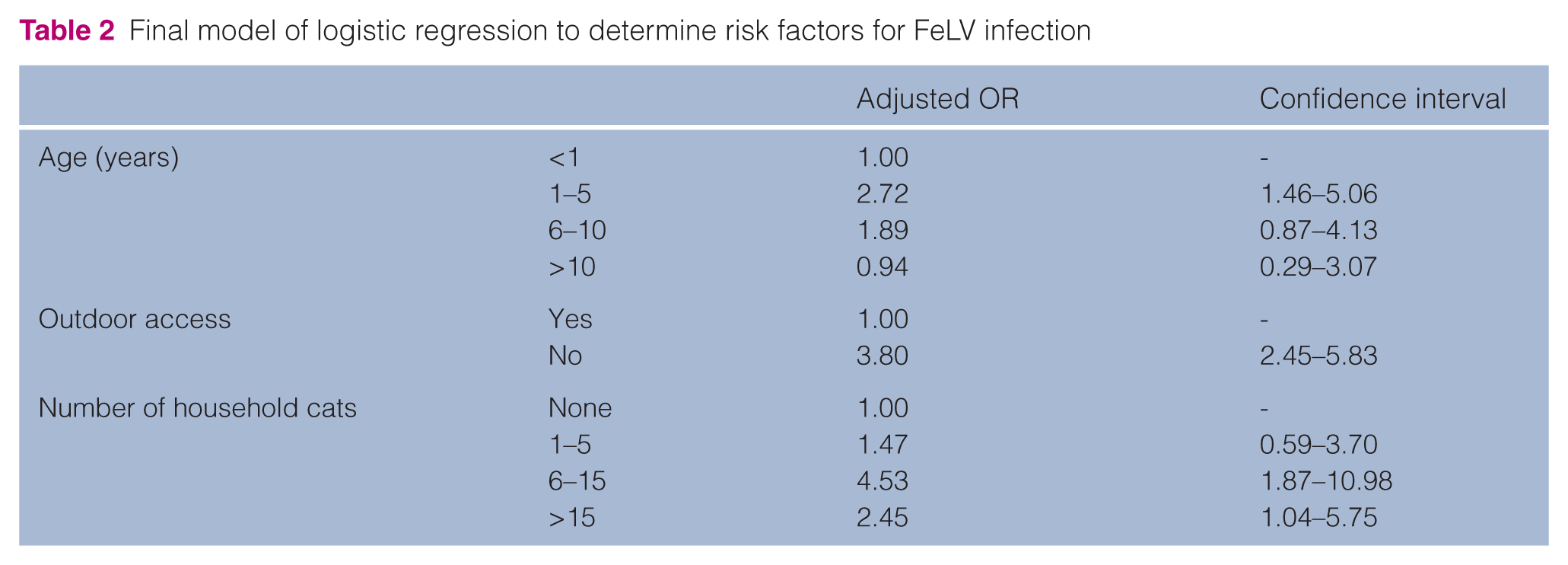
According to multivariate analysis, the risk factors identified for FeLV infection were aged 1–5 years (OR = 2.72), outdoor access (OR = 3.80), cohabitation with 6–15 cats (OR = 4.53) and cohabitation with more than 15 cats (OR = 2.45) (Table 2).
Final model of logistic regression to determine risk factors for FeLV infection
The world’s increasing cat population and its concentration in small groups or colonies has stimulated the growth and persistence of viral infections. Thus, FeLV has become a major feline pathogen, responsible for the most important diseases that can cause prolonged suffering and death.
To our knowledge, this is the first epidemiologic survey of FeLV prevalence conducted by a research laboratory covering several cities in Rio de Janeiro state. Our results showed a FeLV infection prevalence of 11.52% in the sampled cats in Rio de Janeiro state, which was found to be consistent with several epidemiologic studies conducted in different regions of the world. 4,9,16 The sample collection could not be randomized because of practical aspects, such as distance, owner restrictions and the willingness of veterinarians to participate. The high percentage of sick animals tested suggests that unhealthy cats were preferentially selected for testing.
However, the prevalence of FeLV infection can vary.3,6,10,17 For example, in Sydney, Australia, and in Japan, the observed prevalence of infection among healthy cats was 2% 18 and 2.9%, 7 respectively. A high prevalence was observed among sick cats in Madrid, Spain (30.4%), whilst the prevalence among healthy cats was 15.6%. 4 The variations of FeLV prevalence may be related to the number of animals tested, the animals’ state of health and the diagnostic method employed, as well as measures of disease control and prevention for each studied region.
The IFA is the least expensive FeLV assay in many countries, including Brazil. Cats diagnosed by IFA are considered persistently infected because this test detects viral antigen associated with leukocytes and platelets in secondary viremia, when progenitor cells from bone marrow are infected. 19 This can be a measure of progressive infection; however, the outcome for the cats in this study is unknown. Given the potential for false-negative results caused by leukopenia, the number of positive cats may have been underestimated in this group of cats. In addition, cats with regressive infections that resist bone marrow infection may also result in false-negatives when IFA is used as the only measure of infection.2,12
Knowledge of the risk factors involved in this disease is an important aspect for control and prevention. This study showed that FeLV infection was associated with age, outdoor access and cohabitation of multiple cats. Age is often reported as a risk factor for FeLV infection in several epidemiologic studies.4,6 In multivariate analysis, cats aged 1–5 years were more susceptible to infection.
As in previous studies, access to the outdoors is a strong risk factor for FeLV infection because of the increased chance for exposure to infected cats.8,16 Similarly, cats that lived with more than six others in the same household (in the range of 6–10 and more than 15 household cats) were also at greater risk for FeLV infection (OR = 4.53, P <0.001 and OR = 2.45, P <0.001, respectively). In densely populated environments, the spread of FeLV via saliva is the most important form of transmission.3,6
Prophylactic measures for this FeLV infection are based on identification and isolation of infected cats, as well as on vaccination of cats known to be negative for the infection and at high risk of exposure.20,21 In Brazil, an inactivated virus vaccine is available, but its high cost limits usage, mainly in densely populated areas with huge populations of cats.
This study indicates that FeLV infection remains common in Rio de Janeiro with risk factor analysis results that are consistent with most previous epidemiologic studies.8,17,22
Footnotes
Funding
This work was supported by Conselho Nacional de Desenvolvimento Científico e Tecnológico - (CNPq).
Conflict of interest
The authors do not have any potential conflicts of interest to declare.
Accepted: 18 March 2012