



Abstract
Congenital limb deformities are rarely reported in the cat. The macroscopic and radiographic features of aphalangia are described in a 2-month-old male kitten showing a shortened limb that ended, at the level of the carpus, in a stump without digits. A nail was present at the level of the first phalanx and on the palmar surface only two footpads were present. The radiographs showed an absence of phalanges. The first metacarpal and the proximal and distal phalanges of digit 1 were present. The deformed metacarpal bones were reduced in length; the carpal bones were incompletely ossified. This defect is a rare condition in many animal species. To the author’s knowledge, the congenital fore limb deformity described here is the first documented case in a cat.
Case Report
Birth defects are structural or functional congenital malformations arising from errors during fetal development. 1 They can either modify an isolated portion of a body system, the complete system or parts of several systems. 2 Malformations of the extremities have variable manifestations: they range from the lack of a single structure to partial or complete absence of the limbs. 3 Congenital limb deformities have only been rarely reported in the cat.4–9
This report describes the macroscopical and radiographical findings in a kitten referred to the Department of Veterinary Public Health at the Faculty of Veterinary Medicine, Messina, Italy.
The study was performed in a 2-month-old, male kitten, belonging to a colony of strays. The kitten was reported to have been born with a deformed right fore limb. There was no known trauma during birth or the neonatal period. The subject was unable to use the leg. Physical examination revealed a shortened limb that ended, at the level of the carpus, in a stump without digits; a nail was present at the level of the first phalanx and on the palmar surface only two footpads were present. No skin changes were present (Figures 1 and 2).

Frontal view of both forelimbs; the right forelimb is malformed showing the absence of the digits and a single nail
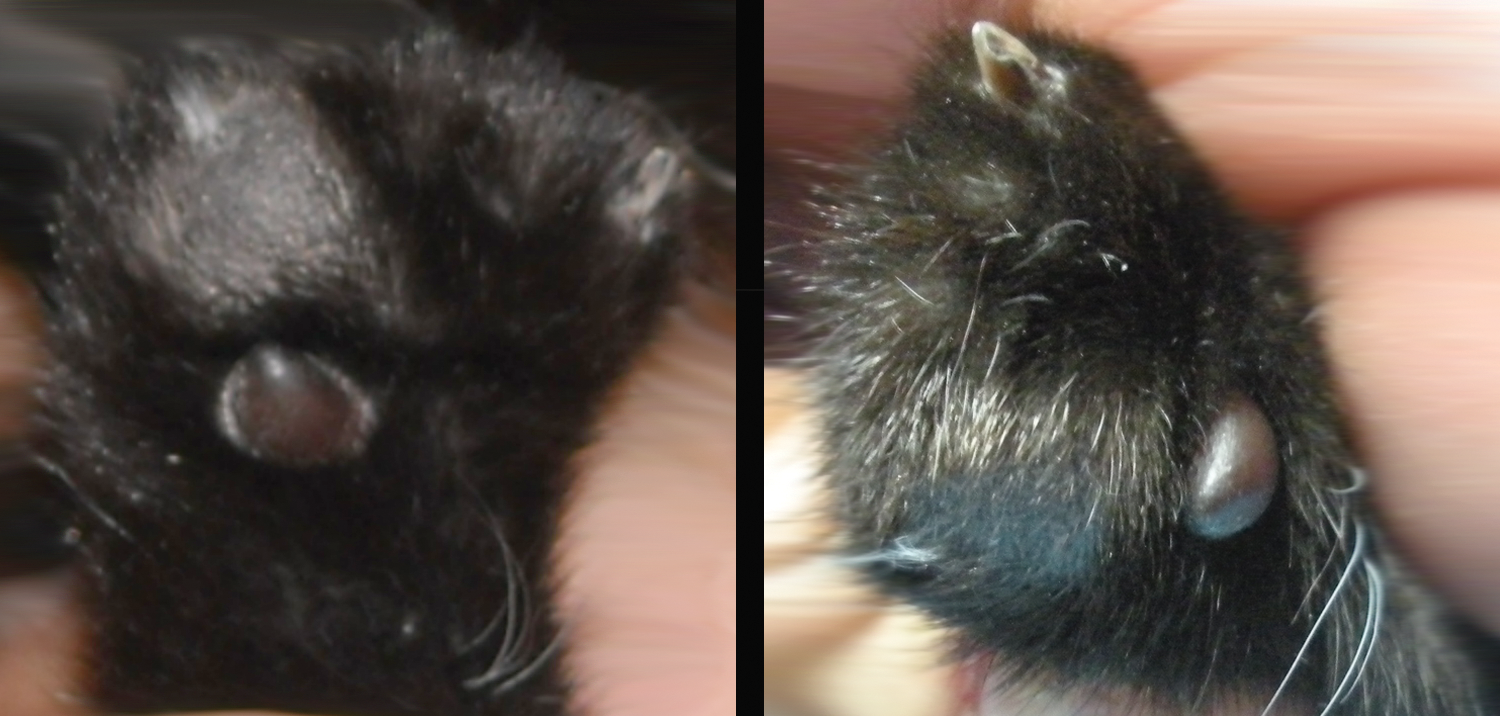
(A, B) Palmar and oblique views of the right fore limb showing absence of the distal segment and of the claws with reduced number of pads
Mediolateral and dorsopalmar view radiographs were made. The radiographs showed an absence of phalanges. The first metacarpal and the proximal and distal phalanges of digit 1 were present. The deformed metacarpal bones were reduced in length; the carpal bones were incompletely ossified consistent with the age of the kitten (Figure 3). On follow-up radiographical examination 4 months later, the carpal bones appeared deformed and radius and ulna were shortened when compared with the contralateral limb (Figure 4). At the time of writing, the kitten was still alive and in good health, but did not use the affected fore limb.

(A) Mediolateral radiograph of the right fore limb malformation (at 2 months): metacarpal bones were shortened, without phalanges and a unique claw. (B) Dorsopalmar radiograph of the same fore limb malformation (at 2 months): carpal bones were rounding, metacarpals shortened and presence of a single nail at the level of the first phalanx (only a hypoplastic or rudimentay first phalanx was seen)

Dorsopalmar radiograph of the fore limbs (at 6 months): carpal bones were subluxated, metacarpal bones were deformed, without phalanges, radium and ulna were shortened in size compared with the contralateral leg; no swelling of soft-tissues was seen. The left fore limb was normal
Embryologically, the primary step in limb development is the rounding up of the somatic mesoderm cells of the hypomere beneath the surface ectoderm, resulting in a limb bud. During development of limb buds, the superficial ectoderm thickens along the distal ridge, or ‘apical ectodermal ridge’. This condition persists until the condensation of the digital mesenchyme. 1 The critical period for limb development in the feline embryo is between day 16 and 28 after fertilisation, when tissues are more prone to external influences. 1 Although little is known of the main mechanisms of congenital limb deformities, several predisposing factors are identified in the literature. 10
Malformations of the extremities, or parts of them, range from absence of a single portion of the normal distal limb to partial or complete absence of the limb. 3 The term hemimelia has been used by several authors when a paraxial limb segment is lacking.1,3 Hemimelia includes several forms, amongst which transverse hemimelia, also called congenital amputation, is characterised by a defect in which there is complete absence of the normal structure across the full width of a limb. In contrast, in paraxial hemimelia only the pre-(cranial) or post-(caudal) axial element of the limb is missing. Terminal hemimelia refers to a partial or complete defect in the distal portion of the limb. 11 Adactyly is commonly used when referring to the peculiarity of the total absence of digits. 1
Moreover, partial adactylia is the absence of one to four digits and their metacarpals or metatarsals, whilst
partial aphalangia is the absence of one or more phalanges from one to four digits. By definition, however, the metacarpals are absent in adactyly, whereas in the kitten in this report, the metacarpals, though not normal in appearance, were preserved. Therefore, the defect in this report represents a partial (as the first digit is present) aphalangia.
In veterinary literature, fore limb adactyly was described in dogs;12–15 adactyly has been described in cows;16,17 Leipold and Macdonald reported a case of adactylia and polydactylia in a Welsh foal; while Leipold et al described adactyly in Southdown lambs.18,19 Barrand and Cornillie described a case of a cat with bilateral hind limb adactyly and a similar condition has been described by Cornillie et al in a brachymelic cat.20,21 Lockwood et al reported two cats with bilateral radial hemimelia, polydactyly and cardiomegaly. 22 Arnbjerg described a case of a kitten with partial hemimelia of tibia 23 and Towle et al reported the clinical and radiographical features of a litter of kittens affected with complex syndactyly. 24
The case reported here shows similarities to that described by Barrand and Cornillie, 20 although the legs involved were hind limbs and authors named this defect adactyly. Causes of digital malformations include genetic defects, administration of chemotherapeutics (tetracycline, griseofulvin, parabendazole, etc), malnutrition (lack of riboflavin), drug intake such as thalidomide or corticosteroids (in chick embryos), transplacental virus infections and x-rays.25–27 Other causes of distal limb absence in young animals include strangulation by restrictive bands, in utero accidents and postnatal traumas. 28
Genetic or environmental teratogens are not probable causes for this anomaly, as these would have had an effect on all limbs or at least on both fore limbs. No information on traumatic events, inbreeding and/or history of diseases were evidenced by the authors and, therefore, the aetiology of the abnormalities in the current case remain unknown.
Although congenital limb deformities in cats have previously been documented, the present case is, to the authors’ knowledge, the first report of feline fore limb partial aphalangia in cat, and represents an addition to the scant literature on this topic.
Footnotes
Acknowledgements
The authors want to thank Professor Eugenio Cianflone for translating this work.
Funding
This research received no specific grant from any funding agency in the public, commercial, or not-for-profit sectors.
Conflict of interest
The authors declare that they have no conflict of interest.