




Abstract
When a police officer commits a criminal offense, they not only violate the very laws they are legally entrusted to uphold, but in doing so, they also violate the public’s trust. In Canada, the importance of public trust is recognized through the criminal offense of “breach of trust by a public officer,” and as an aggravating factor in sentencing. As there is a significant dearth of research on police criminality and on the sentencing of police officers in Canada, we present an empirically grounded examination of 93 sentencing decisions between 1990 and 2024, involving over 100 police officers convicted for breaches of trust. The study sheds light on the nature of police-perpetrated breaches of trust, and on the ways in which courts sentence police-offenders in Canada. Our study underscores that although sentencing is an important element of police accountability, it does little to address the systemic aspects of police criminality.
Introduction
In the early morning hours on December 28, 2016, Michael Theriault, an off-duty Canadian police officer, perpetrated a violent assault on Dafonte Miller, a 19-year-old Black man. Theriault claimed that Miller and his friends were breaking into cars and that it was his intention to disarm and apprehend Miller (Gillis, 2019). During the interaction between the men, Theriault beat Miller so severely with a metal pipe that he permanently blinded Miller in one eye. Theriault was convicted of assault (R v. Theriault, 2020). When sentencing Theriault, the judge noted that because he was a police officer, his conduct constitutes a breach of trust, a fact that increases the severity of sentencing. The judge noted that police officers are held to a higher standard than the ordinary citizen: Simply stated, the police are sworn and duty-bound to serve and protect all members of the community. In order to perform this function, the police are granted a great deal of trust and power. However, this trust and power gives rise to a corresponding duty to uphold the law and values of the community. When a police officer commits a criminal offense, he or she also breaches the community’s trust (R v. Theriault, 2020).
The Ontario Court of Appeal upheld the trial outcome and affirmed the sentencing judge’s finding that as police officer, Theriault was subject to a higher standard compared to the average person, regardless that he was off duty at the time (R v. Theriault, 2021).
When police officers engage in misconduct or commit criminal offenses, they not only violate the very laws they are legally entrusted to uphold, but they also undermine the legitimacy of policing and the wider criminal justice system in the eyes of the public. As a result, it is essential to understand how police accountability systems address police misconduct in general, and how the court system responds when officers are prosecuted and sentenced for committing criminal offenses. As a criminal defendant, police officers present unique challenges for the court process. As noted by the sentencing judge in Theriault, given their role and responsibilities in the criminal justice system, police should be subject to a higher standard, resulting in greater culpability and exemplary sanctions at sentencing (Davids & McMahon, 2014; Nadin-Davis & Sproule, 2024; Ruby et al., 2012; R v. Theriault, 2020). However, given their line of work, police officers as defendants are unlikely to have a criminal record and often have personal histories of community involvement and prior good deeds, aspects that are generally seen as mitigating at sentencing (Puddister & McNabb, 2021; Ruby et al., 2009, 2012). Additionally, a police officer’s status as an agent of the state adds a unique element to sentencing – this status brings the institutional and collective aspects of state responsibility into the courtroom in a manner that is distinct, though shared with military personnel and veterans (Lee, 2013; Loughnan, 2015).
Criminal prosecution and sentencing of police officers can provide significant consequences for police misconduct and criminality, such as loss of employment and criminal sanctions, including incarceration. The sentencing of police officers remains understudied by the existing scholarship, though some suggest that special treatment for officers in sentencing undermines the rule of law (Bedi, 2017; Freeman, 1996; Isfen & Rauxloh, 2017). The limited existing empirical research suggests that while convictions of police officers are rare, sentences will typically increase with the seriousness of offense committed and where victims were unknown to the officer (Boateng et al., 2024; Butera et al., 2024; Dean & Gottschalk, 2011; McNabb & Puddister, 2024; Puddister & McNabb, 2021). Because the sentencing of police officers has not received substantial attention in the existing literature, we have little understanding of how sentencing fits within the wider ecosystem of police accountability in Canada. The qualitative factors that inform judges’ sentencing decisions remain unknown, including the question of whether concerns over public trust, legitimacy, and police oversight animate the sentencing of police officers. More broadly, empirical questions remain about the nature of police criminality in Canada, including the types of offenses that officers are most commonly sentenced for, the characteristics of police-offenders and their victims, and the severity of sanctions ultimately imposed on police officers at sentencing.
In this paper, we analyze criminal sentencing decisions involving breaches of trust committed by Canadian police officers. Breach of trust by a public officer is a specific criminal offense that can be charged against those who work for the public, including police officers. Additionally, in sentencing, judges can consider whether the offender, in committing an offense, breached the public’s trust as an aggravating factor, resulting in a more severe sanction. As there is a significant dearth of research on breach of trust committed by Canadian police officers and on the sentencing of police officers more generally, the aim of this study is to explore the nature of breaches of trust committed by sentenced police officers and to assess how courts approach sentencing in cases involving such convictions. To do this, we conduct an analysis of sentencing decisions in cases where judges specifically indicate an abuse of trust as an aggravating factor on sentencing or when officers were convicted of the criminal offense of “breach of trust.” Our study presents an empirically grounded examination of 93 sentencing decisions involving over 100 police officers as offenders, between 1990 and 2004. The analysis sheds light on the qualitative factors that shape judicial decision-making when sentencing police officers, including relevant principles of sentencing, and the mitigating and aggravating factors unique to police officer offenders. We also document relevant trends relating to police-offenders, including the criminal offenses for which they are convicted and their victims. The objectives of this research are two-fold. First, the goal is to develop a better understanding of the nature of police criminality in Canada, particularly the underexplored phenomenon of breach of trust. And second, this research adds to our understanding of how the Canadian criminal court system responds to police officers as offenders and how sentencing fits within the wider ecosystem of police accountability and oversight.
To achieve these objectives, the paper will first provide an overview of relevant literature, including scholarship on police accountability, and on the prosecution and sentencing of police officers. We will then describe the legal definition of breach of trust in Canada, followed by a description of our methodology and presentation of our data. We conclude by considering what our findings mean for public confidence in policing, the wider administration of justice and the challenges in holding police accountable for breaches of trust through sentencing. We also discuss the role of courts as a mechanism of police accountability and the unique aspects of sentencing police officers as agents of the state. Our findings are situated within a wider discussion of how blame for wrongdoing is attributed more generally. We conclude by considering potential avenues for reform.
Literature Review
Police Accountability
Policing in constitutional democracies is based on consent – citizens authorize the police with additional powers and agree to some limitations on their liberty in exchange for the protection and safety of the community (Tulloch, 2017, p. 24). As agents of the state authorized to use legitimate force (including lethal force) against the public, criminal conduct and violations of the law by police officers presents unique challenges for prosecution and criminal sentencing. As Goldrosen (2025) notes, police officers take on special obligations to the rule of law. Police misconduct is more than a personal wrong, it involves the application of “structural power” of the state which harms the victim and the collective equality and liberty of the community, and thus, punishment for police misconduct must be taken seriously (Goldrosen, 2025, pp. 109–110).
There are generally two explanations as to the causes of police misconduct and criminality – individual or organizational and systemic (Punch, 2003). Individual explanations suggest that police criminality is the fault of an individual bad officer and their personal failings – the “rotten apple” (Boateng et al., 2024; Gottschalk, 2022). Explanations that look to how a department, culture, and the wider system of policing fosters or turns a blind eye to officer misconduct can be labelled as the “rotten barrel” or “rotten orchard” (Boateng et al., 2024; Punch, 2003). The cause of misconduct – whether it be the individual, organization/culture, or a combination of both – speaks to concerns raised by attribution theory, a theoretical framework that attempts to understand how blame and responsibility are assigned (Eberly et al., 2011; Gailey & Lee, 2005). Attribution theory can explain why the wrongdoings of an individual (a police officer) are often separated from an organization (a police department or the system of policing more generally) when assigning blame. Individuals can be blamed or exonerated based on how the organization or collective responds, and organizations like a police department can easily distance itself from the conduct of one or two rogue officers or bad apples (Gottschalk & Benson, 2020). While blame can be ascribed to organizations, individuals are more likely to receive blame because wrongdoing or conflict are often attributed to personal flaws or characteristics rather than considering the organizational or systemic factors (Keaveney, 2008). Individuals are more likely to be blamed by observers because individual wrongdoing is often understood to be a personal choice and one that defies accepted norms of behavior (Keaveney, 2008). Finally, when it comes to police misconduct the official public response and initial narrative will be set by the police department and its leadership rather than individual officers (Gottschalk & Benson, 2020). These findings help to explain why individual officers (the bad apples) are often the target of accountability measures and reform while policing organizations (the barrel) or policing itself (the orchard) are less likely to receive blame or suffer consequences for misconduct.
Although it is easier to blame individual officers for misconduct, more effective and preventative forms of police accountability will take a holistic approach and consider the organizational and systemic factors that serve to perpetuate police violence and misconduct (Harris, 2012; Levine, 2019; Puddister, 2023). These systemic and organizational factors include norms within police organizations, including hyper-masculinity, an ideology that emphasizes violence and the ‘blue wall of silence’ that encourages officers to be complicit in the misdeeds of others and to stymie accountability measures (Jacobi, 2000; McNabb & Puddister, 2024; Purvis & Blanco, 2020). Importantly, while police misconduct and violence are experienced by individuals, the impact is felt across communities and groups (Jacobi, 2000). As Bandes (1999, p. 1278) explains, when police violence is viewed as the product of individual bad apples, instances of police misconduct are seen as anecdotal, isolated, and outliers from the norm. This individual-based framing undermines systemic reform and prevents those responsible for oversight such as prosecutors, courts, or senior officers from appreciating the wider context.
Legal Oversight and Accountability
A police accountability system provides a process by which officers are held responsible for their misdeeds, which in turn, fosters public confidence and legitimacy in policing and the wider criminal justice system (Walker & Archbold, 2020). Methods of police accountability also can promote integrity and trust internally within police units and departments (Archbold, 2021). Canadian police are subject to multiple and overlapping mechanisms of accountability (Martin, 2007; Sossin, 2007). This includes internal oversight, such as the chain of command and professional standards units, and external oversight, which includes civilian oversight bodies. Police are also subject to political oversight though policy and resourcing primarily by police service boards, oversight through media reporting, and the focus here, legal oversight through litigation and the courts (Laming & Valentine, 2022; Roach, 2018; Sossin, 2007).
Legal oversight for the police includes standards of the Constitution and relevant statutes as applied by courts, rulings by the Supreme Court of Canada, civil litigation, and through the criminal prosecution of individual police officers. By determining the admissibility of evidence gathered by the police and applying the standards set in the Constitution and the criminal code, criminal trial courts provide the most routine and regular form of oversight for the police (Martin, 2007). Courts have the authority to scrutinize police conduct against the standards set out in the Canadian Charter of Rights and Freedoms (1982), which provides protection for various legal rights of individuals subject to police investigation, detention, and arrest. The Charter of Rights empowers Canadian courts to remedy violations of legal rights by excluding evidence gathered by the police or by ordering a stay of proceedings, 1 among other remedies (Charter of Rights and Freedoms, 1982, s. 24). In a similar nature, the Supreme Court of Canada sets national standards for police conduct through its interpretation of rights set out in the Constitution (including the Charter of Rights) and through the development of the rules of evidence and various common law doctrines that structure police powers (Burchill et al., 2024; Riddell & Baker, 2018). Canada does not have a doctrine of qualified immunity to shield individual police officers and their conduct from lawsuits, and police are subject to liability under civil law which includes a duty of care for the accused (Hill v. Hamilton-Wentworth Regional Police Services Board, 2007) and victims (Doe v. Metropolitan Toronto (Municipality) Commissioners of Police (Div. Ct.), 1998). Police can be found liable for wrongful death, misuse of force, unlawful arrest, among other legal obligations (Martin, 2007; Scott, 2014). These forms of legal oversight can provide complainants and the criminally accused financial compensation and access to remedies that can serve to denounce or condemn officer behavior; however, they are limited by the fact that they require access to effective legal representation, which may be out of reach for many who lack the necessary financial means to pursue litigation (Puddister & McNabb, 2021).
Prosecution of Police Officers
Another avenue of legal oversight is the prosecution of individual police officers for criminal offenses. Prosecution includes when police violate the criminal law through the course of their duties such as committing assault by using excessive force or committing negligence by failing to intervene – or when police commit criminal offenses in their private lives off duty, like in the Theriault case described in this paper’s introduction (Goldrosen, 2025). Prosecution of police officers is guided by section 25 2 of the Criminal Code of Canada (1985), which authorizes use of force by police provided that they act on reasonable and probable grounds, though the Supreme Court of Canada notes that, “Police actions should not be judged against a standard of perfection. It must be remembered that the police engage in dangerous and demanding work and often have to react quickly to emergencies. Their actions should be judged in light of these exigent circumstances” (R v. Nasogaluak, 2010).
Criminal charges against police officers can result from investigations conducted by internal professional standards units, another police force, or from civilian oversight bodies (Puddister, 2023). During misconduct investigations, Canadian police officers generally maintain 3 the same constitutional rights as any other person, they do not receive enhanced protection as found in some American states that have enacted Law Enforcement Bills of Rights which provide additional protection to police during investigations or interrogations related to misconduct (see Levine & Rushin, 2018).
While prosecution can result in significant consequences for individual police officers, such as incarceration, it is not without limitations. First, prosecutors are often hesitant to take charges to court given the significant challenges that are unique to prosecuting police officers (Levine, 2016a; Panwala, 2003; Walker & Archbold, 2020). Obtaining evidence in a case involving a police officer can be challenging given that much of police work is conducted out of public view (McNabb & Puddister, 2024). When it comes to police shooting cases in particular, Walker and Archbold (2020, p. 50) explain that it is difficult for prosecutors to prove that the officer had criminal intent because police can often claim that there was a credible threat to their life and safety. The officer’s credibility is most relevant in shooting death cases where there are no other witnesses, other than the officer, to attest to the threat or resistance demonstrated by the deceased (Panwala, 2003). Levine’s (2016a) study of police shootings finds that prosecutions only occurred in cases with compelling evidence that contained heinous forms of police brutality.
A second challenge in prosecuting police officers relates to their status as criminal justice insiders, with existing relationships with local prosecutors who may extend preferential treatment or be hesitant to pursue an officer’s prosecution (Jacobi, 2000; Levine, 2016b). Moreover, police officers are experts in criminal conduct, evidence gathering, and are extremely well positioned to protect their rights when dealing with law enforcement (Puddister & McNabb, 2021). Given their status as a criminal justice insider, police officers are often viewed as credible – judges and juries are deferential and hesitant to challenge this credibility (Boateng et al., 2024; Freeman, 1996; Levine, 2016; Walker & Archbold, 2020). The credibility afforded to police officers can be contrasted with the fact that in many police violence cases the victim could have been in the process of committing a criminal offense or was being arrested when the police misconduct occurred (Panwala, 2003; Puddister & McNabb, 2024). Moreover, unlike the typical criminal defendant, police officers are often represented by high-profile specialized defense counsel and have the support of powerful police unions (Puddister & McNabb, 2021).
A third element that makes prosecution of the police challenging is police occupational culture or features of the rotten barrel and rotten orchard which foster loyalty and suspicion of outsiders. Because police work can be dangerous, and some aspects of policing cannot be shared with the public, police officers may prioritize the protection of other officers instead of reporting misconduct or cooperating with oversight investigations, including prosecutions that might arise out of such investigations (Chin & Wells, 1997; Cottler et al., 2014; Maher, 2008; Puddister, 2023).
Although it is difficult to secure a conviction, Colbert (2016) argues that the prosecution and trial of a police officer can serve an important public education function, even if the result only exposes the public to the reality of police brutality and the failings of the system of oversight. The prosecution of police officers is individualized in focus and reactionary (rather than preventative). A successful prosecution can bring substantial individual consequences; however, it cannot address the rotten barrel/orchard, the departmental policy or culture that might have fostered or failed to prevent officer criminality. Prosecution does not satisfy the call for systems of oversight that are holistic, preventative, and address the cultural or organizational aspects of police wrongdoing (Harris, 2012).
Sentencing of Police Officers
There is a rich literature on police oversight and the causes of police criminality, however, less attention is paid to the outcomes when an officer is criminally prosecuted, including the specific sentences imposed by courts. Bedi (2017) argues that police officers should be subject to greater culpability at sentencing compared to non-police officers to foster trust in the police and to provide deterrence. However, in practice, police are not always considered more blameworthy and sentenced more punitively. For example, in police brutality cases, courts routinely depart from sentencing guidelines to sentence more leniently (Freeman, 1996). According to Freeman (1996) these departures undermine equality and fairness under the law, thus weakening the deterrent effect of the law and undercutting the state’s recognition of harm caused to victims. Like the sentencing of military officials and veterans, the sentencing of police officers brings state responsibility into the courtroom in a manner that is distinct from routine prosecutions of individual offenders (Loughnan, 2015). For example, similar to military veterans, it may be relevant in sentencing to consider how prior and legitimate experiences as a police officer impact an officer’s mental health and occurrence of Post-Traumatic Stress Disorder (PTSD), and courts may consider the state’s responsibility for the mental toll of policing on an individual (Lee, 2013). Isfen and Rauxloh (2017) examine the role of police officers as victims and how this victimization is viewed differently in the sentencing regimes of England and Germany. According to the authors, German law rejects any special status for police officers as victims, instead the fact that a victim is a police officer may mitigate the sentence of an offender convicted for resisting law enforcement because these offenders are subject to the power of the state in a manner that makes them uniquely vulnerable (Isfen & Rauxloh, 2017, p. 49). While the focus here is on police officers as perpetrators rather than victims, this consideration of the power of the state and how it might shape criminal sentencing is a shared focus.
In terms of empirical findings regarding the prosecution and sentencing of police officers, Dean and Gottschalk (2011) studied the sentencing of 60 Norwegian police officers and report a relationship between seriousness of police crime and severity of sanction imposed as measured by length of incarceration, with both variables increasing together. In a study of Ontario police officers, Puddister and McNabb (2021) find that most officers are either found not guilty (30%) or have their charges withdrawn by the prosecution (27%). In the rare occurrence that an officer is convicted, the most common sentence imposed is a discharge (either conditional or absolute), 4 the least restrictive sanction available, while incarceration was imposed in approximately one-third of cases (Puddister & McNabb, 2021). Police officers convicted of sexual assault in particular are likely to receive incarceration, though the total number of officers convicted for this offense remains low, and there is an overrepresentation of senior officers in these cases (McNabb & Puddister, 2024, p. 14). A study of sexual misconduct committed by American police officers finds that more serious offenses have higher conviction rates and result in longer sentences and that a majority (85%) of officers are terminated following arrest (Butera et al., 2024). Boateng and colleagues (2024) find a greater chance of conviction for cases that involve child victims and victims previously unknown to the officers. The authors also report that convicted officers with a longer tenure of service had greater odds of being convicted (Boateng et al., 2024). Although Boateng et al. (2024) do not examine the consequences for convicted officers, they suggest that understanding the factors that influence sentencing decisions should be the focus of future research – a task we take up in this paper.
Breach of Trust
The study that follows examines the sentencing of police officers for breach of trust. Sentencing in Canada is based primarily on judicial discretion which is guided by common law principles and specifications set out in the Criminal Code – it lacks the structure of a sentencing commission or formal sentencing guidelines found in other jurisdictions (Puddister, 2021). Case law suggests that when sentencing police officers, courts should apply exemplary sentences because police criminality violates the public’s confidence in the wider justice system and because a police officer will have full knowledge of the wrongfulness of their actions (Nadin-Davis & Sproule, 2024, s.3:37).
Breach of trust is an offense in the Criminal Code of Canada (1985) and is a specific factor to be considered aggravating at sentencing. Section 122 of the Code provides Breach of Trust by a Public Officer, “Every official who, in connection with the duties of their office, commits fraud or a breach of trust, whether or not the fraud or breach of trust would be an offence if it were committed in relation to a private person.” 5 As explained by the Supreme Court of Canada in R v. Boulanger (2006, para. 5), a public official includes any person who holds public office or is “appointed to discharge a public duty,” and it is the latter context which applies to police officers. Breach of trust is worded broadly and captures a wide range of conduct related (but not limited) to corruption, misconduct, neglect of duty, and fraud (Ruby et al., 2012, pp. 1067–68). The purpose of this offense is to recognize the responsibilities of those who are charged with maintaining the public trust and to reflect the public’s expectation that officials will exercise their powers for the benefit of the public. This means that a public officer may be criminally responsible for conduct in a manner that does not apply to private individuals (R v. Boulanger, 2006, para. 52). The offender’s public duty status is relevant for sentencing those convicted under s. 122 because their conduct may undermine institutions of governance and for police officers in particular, the administration of the justice system, and it is this element of the offense that encourages sentencing judges to emphasize general deterrence (Ruby et al., 2012).
Davids and McMahon (2014) note that the broad nature of the breach of trust offense has made it challenging to apply in practice. Instead, prosecutors often prefer to address the specific underlying offense (e.g., fraud, neglect, theft) and to treat the offender’s role in breaching the public trust as an aggravating factor in sentencing. This factor is addressed by the Criminal Code which provides that judges must consider as aggravating at sentencing “evidence that the offender, in committing the offence, abused a position of trust or authority in relation to the victim” (s.718.2(a)(iii)). Unlike the s.122 offense, the sentencing principle “abuse of trust” can apply to both private and public individuals, however, it takes on particular importance when applied to offenses committed by police officers because, “…the integrity of an entire police force is at stake […] The public wants to trust their police force. A breach of trust has a resounding effect” (R v. Nixon, 1991, p. 6). The sentencing principle of abuse of trust is more flexible and can be applied to a wider range of conduct compared to the breach of trust offense in the criminal code.
Ultimately, breach of trust by a public official is an offense that attempts to hold those who work on behalf of the public to a higher standard compared to the average private citizen. When a police officer is prosecuted for breach of trust, this recognizes that the abuse of power to seek personal gain or to target vulnerable individuals must be met with significant consequences (Davids & McMahon, 2014). The public prosecution of officers can provide individual criminal sanctions through sentencing, and it can serve a broader educational function by demonstrating to the public how the police accountability system functions in practice. Understanding how the justice system responds to police misconduct through sentencing can further public legitimacy, encourage reform, and reinforce the rule of law.
Methods and Data
To better understand the nature of police criminality, specifically, breaches of trust, as well as the role of sentencing courts in providing oversight of the police, the study which follows addresses two descriptive research questions: 1. What is the nature of breaches of trust committed by sentenced police officers? 2. How do courts sentence police officers convicted for breaches of trust?
To answer these questions, we analyze Canadian sentencing decisions published between 1990 and 2024, involving police officers who breached the public’s trust. Our study involves two types of cases: sentencing decisions which involve a formal conviction for the criminal offense of “breach of trust by a public officer” under section 122 of the Criminal Code, and cases where officers, although not formally convicted under s. 122, are sentenced for criminal activity which constitutes a breach of the public’s trust. 6 In this latter scenario, judges must explicitly consider the breach of trust as an aggravating factor in sentencing as per section 718.2(a)(iii) of the Criminal Code. 7 Cases were located through CanLII and LawSource, two legal databases which publish reported Canadian court cases. 8 An initial search yielded several cases involving border service officers, military officers, as well as incidents involving retired police officers. These cases were ultimately excluded, as they go beyond the scope of our study. In the end, our dataset includes 93 judicial decisions, involving 104 sentenced officers, and 87 victims. 9 Our study includes trial and superior court cases, with representation across all 13 provinces and territories. 10
Each sentencing decision was coded based on a pre-determined coding scheme that categorized each case based on a variety of descriptive information. Specifically, we systematically collected information relating to the characteristics of the incident and judicial proceedings (i.e., nature of offense(s); level of court; location; guilty plea), characteristics of the police offenders (gender; age; on or off-duty 11 ; police force; rank; years of service; noted disability; any employment discipline); and where applicable, characteristics of the victims involved (gender; race; age; relationship to accused; noted disability).
The second half of our analysis homed in on sentencing. For each case, we recorded which sentencing principles (enshrined in section 718 of the Criminal Code) are emphasized in the decision (denunciation, deterrence, separation, rehabilitation, reparation, responsibility), 12 the nature of the sentence imposed (type of sentence and length), as well as the aggravating and mitigating factors discussed by judges. The coding scheme for this latter part of the analysis was developed abductively, where certain aggravating and mitigating factors were pre-determined, but new factors were added inductively based on a preliminary review of the cases. Certain aggravating and mitigating factors are standard across criminal cases. For instance, pleading guilty and being a first-time offender are routinely treated as mitigating factors in sentencing decisions. These types of factors that are routinely expressed in sentencing decisions were included in our pre-determined codebook. However, factors that are unique to police-offenders were developed inductively, as this is the first study exploring the qualitative factors that judges specifically consider in the sentencing of Canadian police officers and particularly for breaches of trust. Aggravating and mitigating factors required some interpretation on the part of the coder, as the exact language used by judges is not always standard across cases. After a preliminary round of coding and testing for inter-coder reliability, 13 we refined the definitions of some of these factors to ensure consistency and reliability in the coding.
Finally, we complement the quantitative trends derived from the content analysis with qualitative examples from the sentencing decisions. These examples shed light on the ways in which judges engage with questions regarding the nature of police work, public trust, legitimacy, and oversight of police officers.
Results
Characteristics of Offenses
Across the 93 sentencing decisions, 31.7% of police officers (33/104) were formally convicted with “breach of trust by a public officer” under s. 122 of the Criminal Code. For the majority of sentenced officers, breach of trust was exclusively dealt with as an aggravating factor, under section 718.2(a)(iii) of the Criminal Code. Additionally, the majority of officers were sentenced for offenses committed while on duty (84.2%) Although, as seen in the Table below, certain offenses, namely, sexual offenses frequently occurred off duty.
Nature of Offenses in Breach of Trust Cases Involving Canadian Police Officers, 1990–2024 (n = 101 Officers) 14
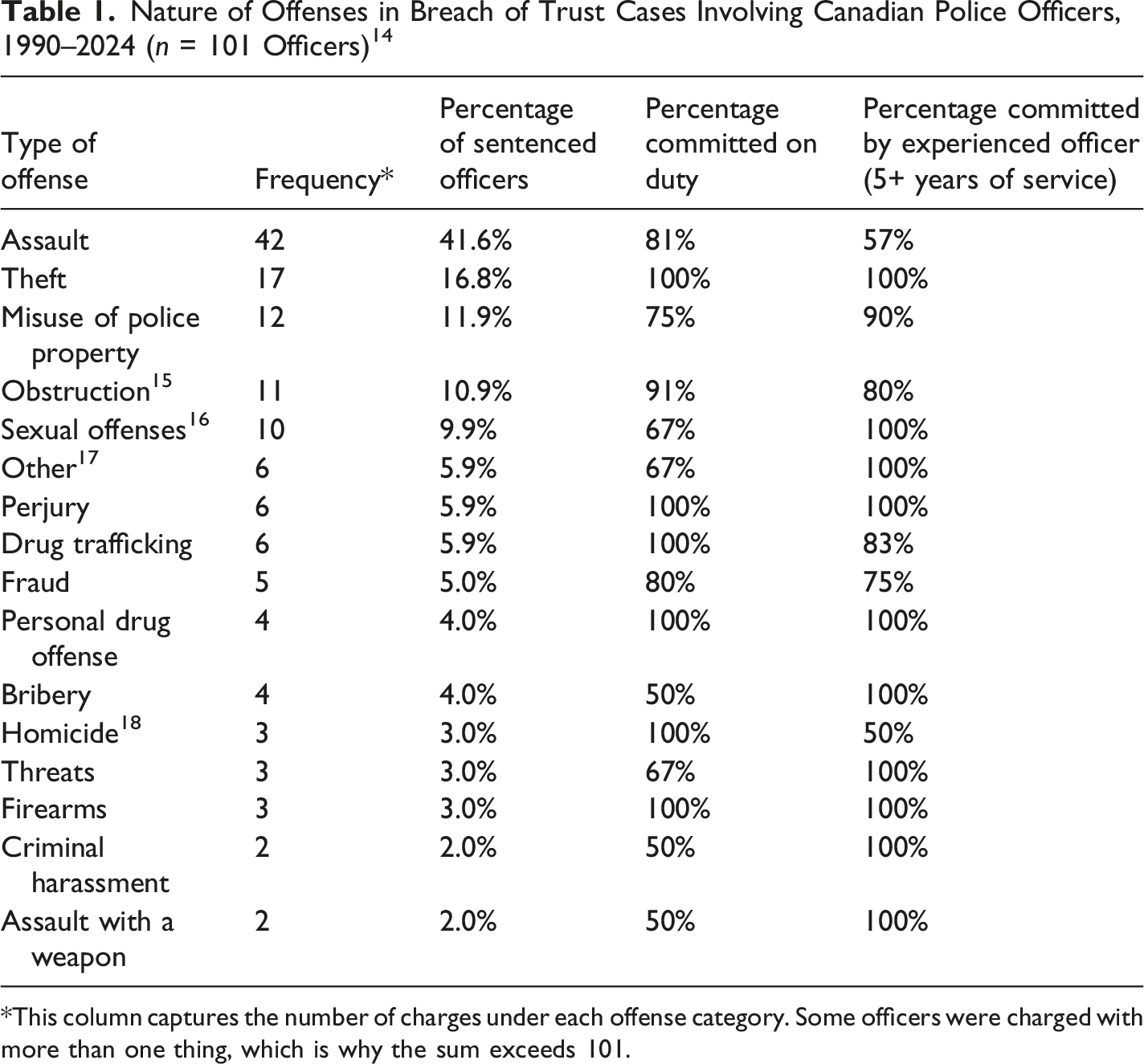
*This column captures the number of charges under each offense category. Some officers were charged with more than one thing, which is why the sum exceeds 101.
Only eight officers (19.05%) were sentenced for assault arising from off-duty conduct. In one case, an off-duty RCMP officer in Alberta, while travelling out of town for his son’s hockey tournament, assaulted his son’s coach in a hotel lobby following a night of drinking (R v Willett, 2017, para. 1). The officer punched the hockey coach in the face, with enough force to knock the man unconscious, and proceeded to kick him while he was down (R v Willett, 2017, para. 8). As a result, the victim suffered a black eye, broken nose, concussion, chipped tooth, among other serious injuries (R v Willett, 2017, para. 33). The incident was caught on security footage (R v Willett, 2017, para. 6) and the attack was deemed by the judge to be unprovoked (R v Willett, 2017, para. 32). The officer ultimately pled guilty, and although it was an off-duty incident, the judge described the perpetrator’s conduct to be a breach of trust, since he was known to be a police officer by the victim and among the hockey community (R v Willett, 2017, para. 32). Citing R v Koopman (1999), the Court further explains why police violence, even when committed off duty, constitutes a breach of the public’s trust: Police officers enjoy a special status in our community. To the extent that they are the people on the front lines with whom the public has contact, they represent the justice system. For a police officer to breach that trust and engage in a violent criminal act, even though off duty, has consequences for the administration of justice which go beyond the actions of the officer on the one night. Put simply, it undermines public confidence in the police and in the end, in the rule of law (R v Willett, 2017, para. 41).
The second most common breach of trust police officers are sentenced for is theft, and all these offenses occurred on duty. Many of these cases involved officers stealing police property, as well as confiscated evidence and proceeds of crime. The nature of these offenses varied significantly from petty theft to highly sophisticated and planned schemes. For instance, with respect to the former, an officer in New Brunswick, while responding to a fire at a local residence, stole 83 dollars and small personal items from the residence owner (R. v. Leblanc, 2003, para. 1). The judge noted that while the belongings and amount of money stolen might seem insignificant, the victim was a “single mother of modest means” who had saved that money to purchase Christmas gifts for her children (R. v. Leblanc, 2003). On the more serious end of the spectrum, in an older case from Nova Scotia (R v. Crowell, 1997), the Chief of Police for the town of Kentville used his position to steal more than $64,000 from various entities including the Town of Kentville and the Atlantic Association of Chiefs of Police. The offender stole money on twenty different occasions and as described by the judge “used his position of authority to plot and scheme against his unsuspecting colleagues and associates” (R v. Crowell, 1997, para. 13).
Following theft, misuse of police property and obstruction of justice were the next most common breaches of trust. Most misuse of police property cases involved improper uses of police databases, which were sometimes used by police offenders to facilitate stalking or other criminal offenses. For instance, an Ontario officer repeatedly accessed police databases to look up a 21-year-old victim over a three-year period. The officer used confidential information from the databases to contact the victim to express romantic feelings (R. v. Ardrey, 2022). Perhaps the most notable case involving obstruction of justice in the dataset involved five police officers in Ontario, who illegally searched an apartment without warrant during a 1998 drug investigation (R. v. Schertzer, 2013). The officers falsified memo book entries (R. v. Schertzer, 2013, para. 5) and lied under oath, 19 to falsely claim that their search occurred only after obtaining a valid warrant. The officers maintained the same fabricated timeline of events throughout the court proceedings. Their conduct and deception ultimately obstructed justice and compromised the heroin trafficking case they were investigating (R. v. Schertzer, 2013, para. 27).
Finally, there were ten cases involving police-perpetrated sexual offenses. Most of these cases involved sexual assault, but there were also incidents involving indecent behavior, viewing child sexual exploitation material, and communication with a minor for a sexual purpose. In many cases, police offenders met their victims through their official duties as police. Indeed, there were several incidents where individuals who called the police for help were subsequently assaulted by a responding officer. In one particularly egregious and recent case, an Ontario woman called the police for help after receiving threatening messages (R. v. Quinn, 2024). One of the responding officers, an officer with 23 years of service, told the complainant that if she felt unsafe travelling back to her apartment, he could escort her—an offer of assistance the victim accepted (R. v. Quinn, 2024, paras. 8–9). Once alone at the victim’s apartment, the officer sexually assaulted the victim, forcing her to perform oral sex, among other acts of violence (R. v. Quinn, 2024, para. 10). As described by the victim in her victim impact statement, the assault made “fear, anxiety and hypervigilance become part of her everyday life,” and meant that “being near a police officer or a police station led her to a panic attack and feeling afraid” (R. v. Quinn, 2024, para. 13). In sentencing the officer to a four-year term of imprisonment, the judge explained how the offender used his status as a police officer to “present himself as the friendly neighborhood police officer who could be trusted” (R. v. Quinn, 2024, para. 27).
Characteristics of Police Offenders and Victims
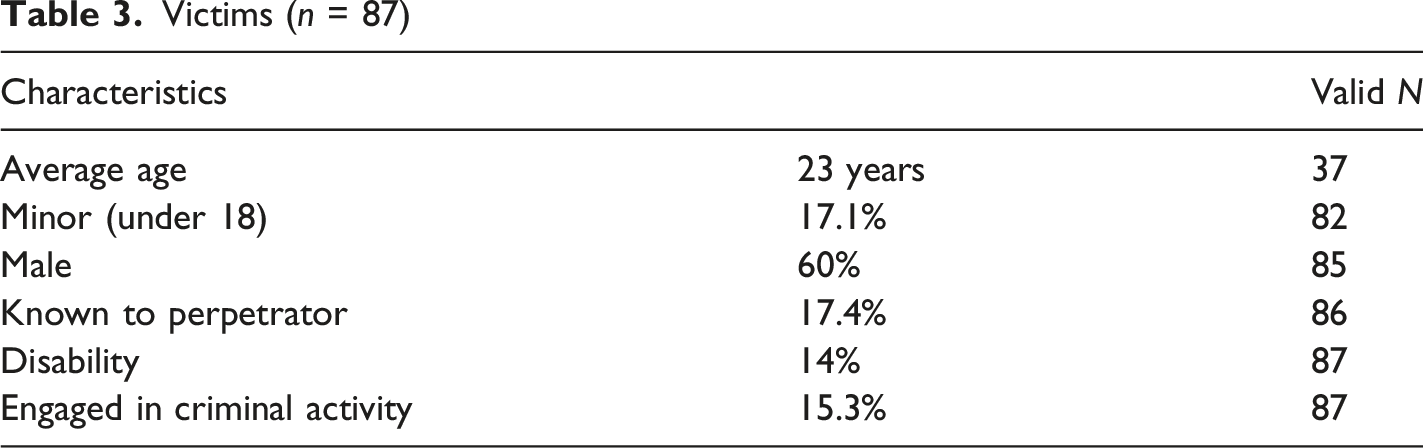
A key element of sentencing requires judges to consider the unique characteristics and circumstances of the offenders before them, as well as the characteristics of the victim(s) which might shed light on the offender’s moral blameworthiness. Therefore, it is worth briefly highlighting the demographic make-up of police offenders and victims across breach of trust cases.
Police Offenders (n = 104)
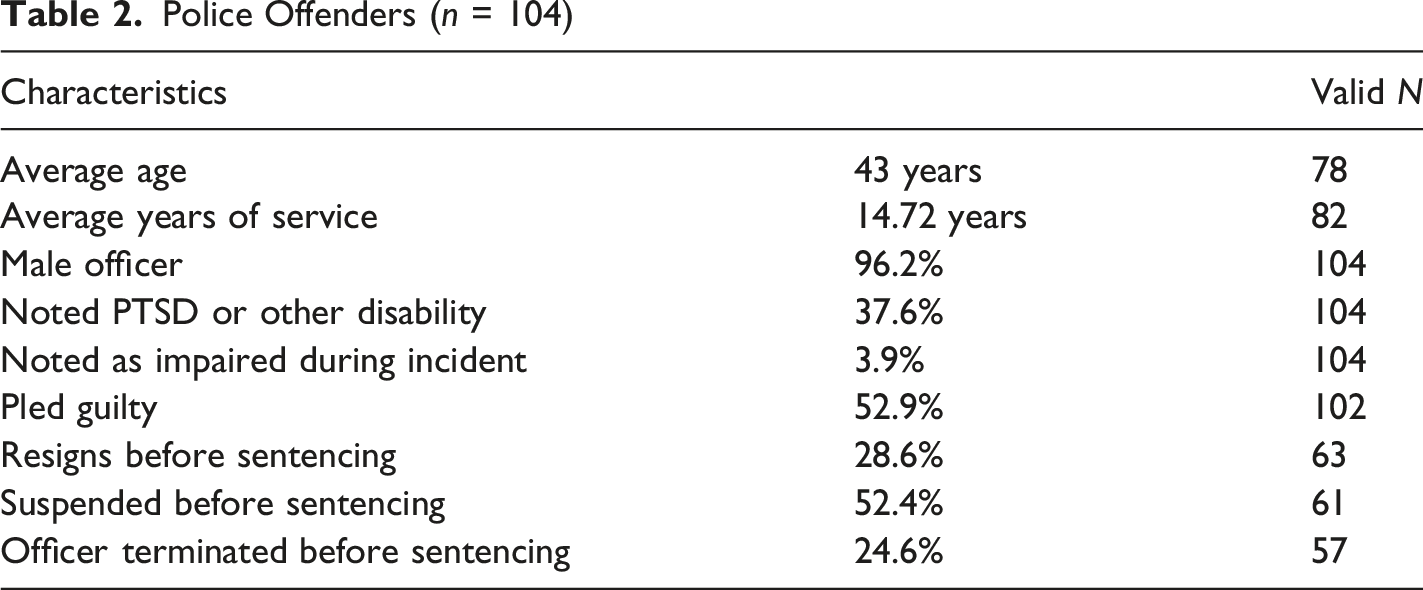
Additionally, more than a third of officers were noted to suffer from PTSD or a different mental health disability, which, as will be discussed below, is commonly treated as a mitigating factor in determining a fit sentence. Approximately half (52.9%) of officers pled guilty, with the remainder of officers opting for a trial. For officers where information was available on employment/disciplinary outcomes, half were suspended (either with or without pay) during the legal proceedings. And a significant proportion of officers either resigned (28.6%) or were terminated before sentencing (24.6%).
Victims (n = 87)
Principles and Objectives of Sentencing
Principles of Sentencing (n = 100 Officers) 20
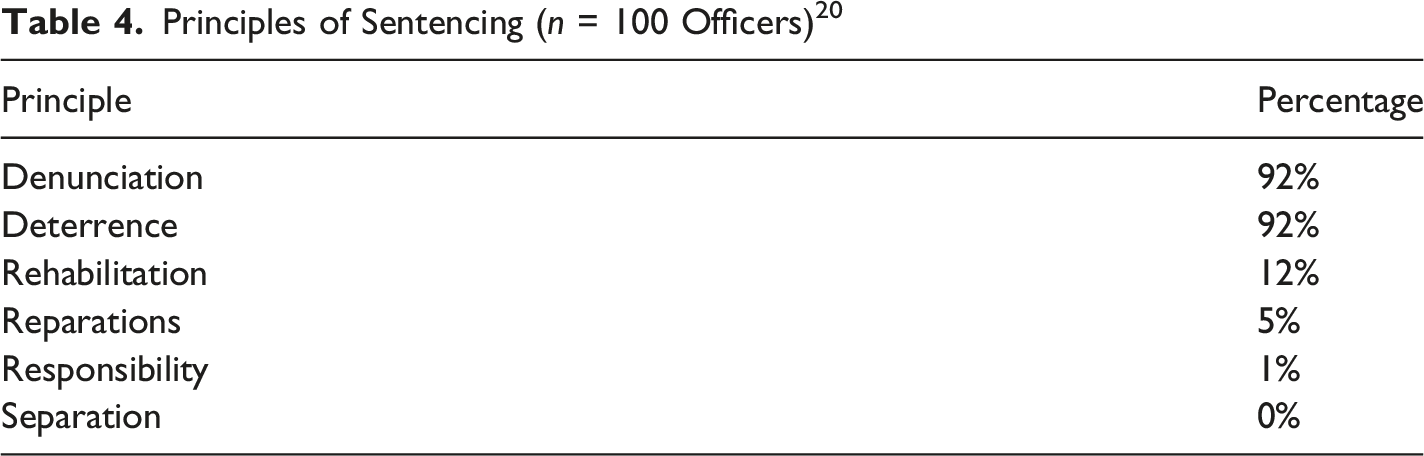
In justifying denunciation and general deterrence, judges often point to the rule of law and the importance of citizens seeing that officers who violate the law face meaningful consequences. For instance, in contextualizing a need for denunciation in R. v. Ryan (J. S. M.) (1999), the sentencing judge wrote: “To put it bluntly, if a person in society sees that an RCMP officer can get away with a crime and not have to pay the price and do the time, as they say, then we send a very negative message to all members of society” (para. 16). Similarly, in R. v. Sood (2019), the judge explained that sentences imposed on police offenders for breaches of trust must “send a message to the public that such abuses of trust and power are dealt with resolutely by courts when police officers who commit such offences are finally called to account” (para. 66). With respect to general deterrence, judges explain that police officers, beyond the offender at hand, must also see the ways in which police criminality can lead to severe criminal sanctions. As the judge in R. v. Crowell (1997) put it, “[the] message [of a serious sanction] is especially important for all other peace officers who may be inclined to abuse their positions of trust. Peace officers serve on the front line of our justice system. Their integrity must be beyond reproach” (para. 23).
Despite the strong emphasis placed on general deterrence and denunciation, judges rarely emphasized specific deterrence when sentencing police officers for breaches of trust. Indeed, across several cases, judges articulated that the conviction, and where relevant, internal discipline or employment consequences, on their own, achieve the goal of specific deterrence (for example: R. v. Browning, 2023; R. v. Gibson, 2003; R. v. Showan, 2022; R. v. Snelgrove, 2021). In other words, judges find that the very act of going through the criminal process as a police offender is enough to deter officers from committing future offenses, lessening the need to emphasize specific deterrence in sentencing. For example, in R. v. Rossignol (1994), an officer pled guilty to assault following an on-duty incident where he entered a young woman’s home in the middle of the night and attempted to kiss her twice without consent. Despite the serious nature of the offense, the judge did not believe specific deterrence was relevant: The court has to consider whether the crime was deliberate or committed on momentary impulse. Here it would appear to me that there was very little planning and deliberation… I think it should be fairly called that, impulsive. I have got to consider the effect of the punishment as a deterrent to the prisoner and others and to what extent it will be effective. [The police offender] does not need much deterrence. He has suffered a great deal since this matter occurred through a suspension with pay until conviction and suspension without pay since. He appears to have learned a very important lesson and is unlikely to reoffend (R. v. Rossignol, 1994, pp. 8–9).
Although the judge characterizes the offense as a simple lapse in the officer’s better judgement—an “impulsive” and “unplanned” crime— the decision goes on to explain that there still remains a need to emphasize general deterrence through the sentence, as “other people in positions of trust… need to be reminded and deterred from ever abusing that trust” (R. v. Rossignol, 1994, p. 9).
As outlined in Table 4, it is relatively rare for courts to emphasize principles of sentencing apart from denunciation and general deterrence. However, the third most emphasized principle is rehabilitation. Most commonly, rehabilitation was emphasized in cases where judges linked the offense at hand to issues of addiction or broader mental health challenges faced by the offender, that are at least in part the result of their work as police officers. To illustrate, in R. v. Spindor (2016), an officer pled guilty to breaching the public’s trust after stealing a small amount of money from a cash jar at his police department (para. 5). The judge outlined two particularly traumatic incidents that the officer was involved in during the course of his career, including a call where the officer found a deceased individual who had taken their own life days earlier (R. v. Spindor, 2016, para. 25), and a call where the officer was attacked with a knife (R. v. Spindor, 2016, para. 27). The judge accepted the expert opinion of a forensic psychologist, that the officer suffered from PTSD, depression, as well as a gambling addiction, as a result of these events (R. v. Spindor, 2016, para. 29). Therefore, the judge concluded that because “the [officer’s] offending behavior was triggered by harm he suffered while serving the community,” a sentence which emphasizes rehabilitation, alongside denunciation and deterrence, was warranted (R. v. Spindor, 2016, para. 62).
Surprisingly, the objective of providing reparations to the victim and/or community was only emphasized in the sentencing decisions of five officers. Four of these cases involved police officers using excessive force and/or engaging in threatening behavior towards members of the public. In one case, R. v. Shipley et al. (2015), two officers used excessive force to arrest a man. The sentencing judge explained that there was a need to provide reparations for the harm done to the community because “the offence occurred in a public place, it was videotaped by the public and ultimately posted on social media” (R. v. Shipley et al., 2015, para. 23). In contrast, responsibility as a principle of sentencing was only emphasized in the case of one officer (R. v. Forcillo, 2016), and there are no cases where separation was emphasized.
Aggravating and Mitigating Factors
Considering this paper’s specific focus on police breaches of trust, it is unsurprising that the most common aggravating factor is evidence that an officer abused their position of trust in the community. This is followed by evidence that an officer abused their position of trust in relation to an identifiable victim. As seen in Table 5, police perpetrated offenses are especially aggravating if the officer caused significant harm to their victim. Although rare across the cases, in R. v. Theriault (2020), the case discussed in the introduction which involved a white, off-duty police officer who brutally assaulted a young Black man, the sentencing judge allowed the submission of two community impact statements. These statements made clear the ripple effects of police violence which go beyond the immediate victim(s). As one of the organizations, the Black Action Defense Community explained in their submission: …this case has caused an outpouring of emotion, anger, outrage, and disbelief amongst members of the Black community… this case has eroded the trust that members of the Black community have towards the police, and has caused members of the community to fear the very police “whom are expected to serve and protect” the community… this case is a further example of the trauma that has been inflicted on the Black community… trauma that will take generations and possibly centuries to heal (R. v. Theriault, 2020, para. 27). Aggravating Factors (n = 101 Officers)
21
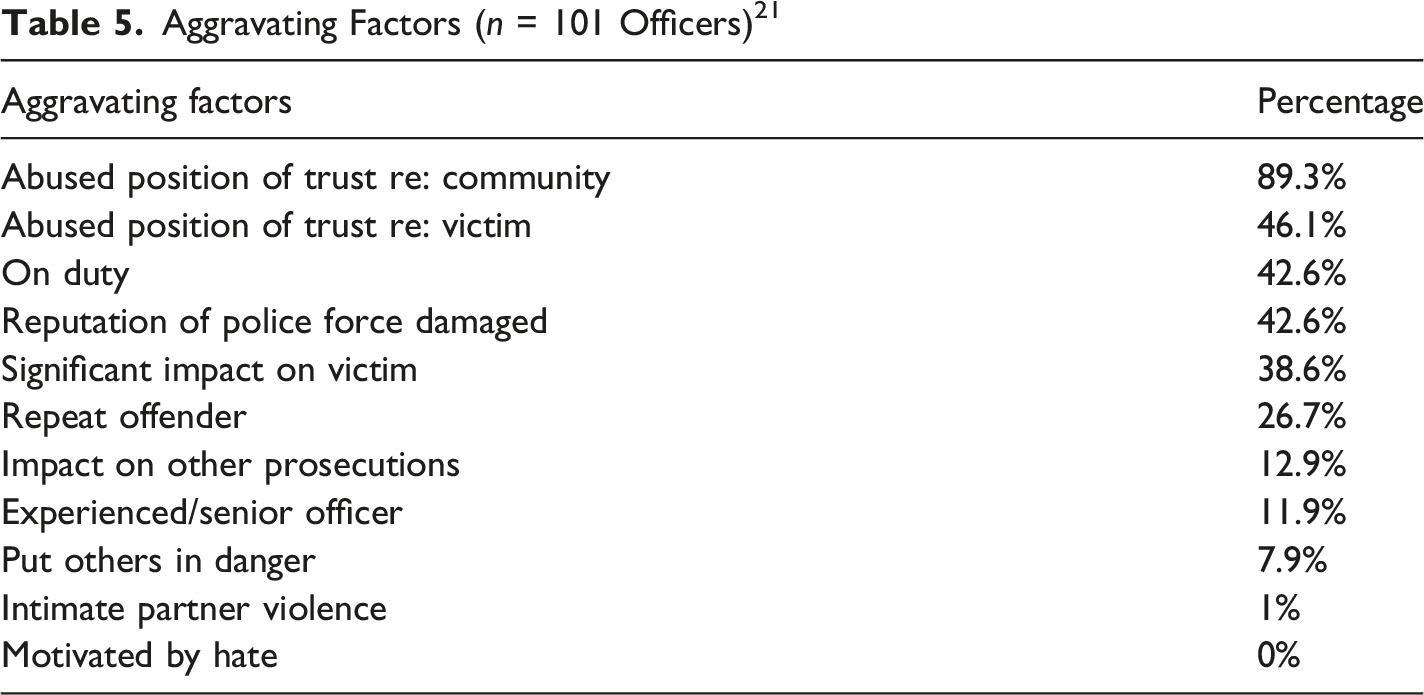
Hand-in-hand with concerns around the erosion of the community’s trust, judges often considered how the breach of trust served to damage the image of the police force—and of policing institutions more generally—which is treated as an aggravating actor. For example, in R. v. Duke (2018), a case involving police theft, the judge wrote: Every day, police officers across this country put on the uniforms of their respective police services, pick up their badges, and report for duty… They often put their lives at risk and do so in order to keep our communities safe. When a police officer commits an offense against the very community he serves… such actions have the potential of tarnishing the reputations of those police officers who continue to uphold their oaths, and who continue to act with integrity and honesty as they execute their duties” (R. v. Duke, 2018, paras. 1–2).
Relatedly, when officers commit offenses while on duty, it is considered by judges to be particularly aggravating. As explained in R. v. Dominelli (2018), breaches of trust committed on duty are especially aggravating for the purposes of sentencing because the powers of police are based upon a social contract. Police are afforded significant powers, including the ability to use lethal force (where warranted), in order to execute their duties, but this is based on the expectation that police will only “exercise those powers with honesty and integrity” (R. v. Dominelli, 2018, para. 25). While on duty, police are visibly acting as agents of the state, and as such, the optics of a police officer committing an offense in uniform can severely undermine the community’s trust in the wider justice system. Judges would often connect the on-duty status of the offense with the importance of emphasizing deterrence and denunciation through a serious sanction. For instance, in R. v. Whitney (2015), a 16-year veteran RCMP officer pled guilty to breach of trust for stealing $650 that he had seized in the course of his duties. In determining that a discharge would be contrary to the public interest, the court stated that “[t]he message must be clearly sent to police officers that when they commit a breach of trust while on duty, that any sentence that is imposed requires that deterrence be paramount to preserve the public faith in the integrity of the justice system” (R. v. Whitney, 2015, para. 96).
It is noteworthy that 26.7% of police officers are noted as repeat offenders by sentencing judges, which is considered an aggravating factor in sentencing. This finding is consistent with previous scholarship on police criminality which finds patterned behavior to be relatively common among police offenders (for example: McNabb & Puddister, 2024). Nonetheless, even in cases involving repeat offenses, judges are still hesitant to label police offenders as having a propensity for crime. For example, in R. v. Zheng (2012), a case involving excessive use of force, the judge acknowledged that the police offender has “three times abused a special trust he was given as a police officer,” but concluded that the officer does not show a “general criminal propensity” or “pose any general risk to the public” (para. 108).
Mitigating Factors (n = 101 Officers)
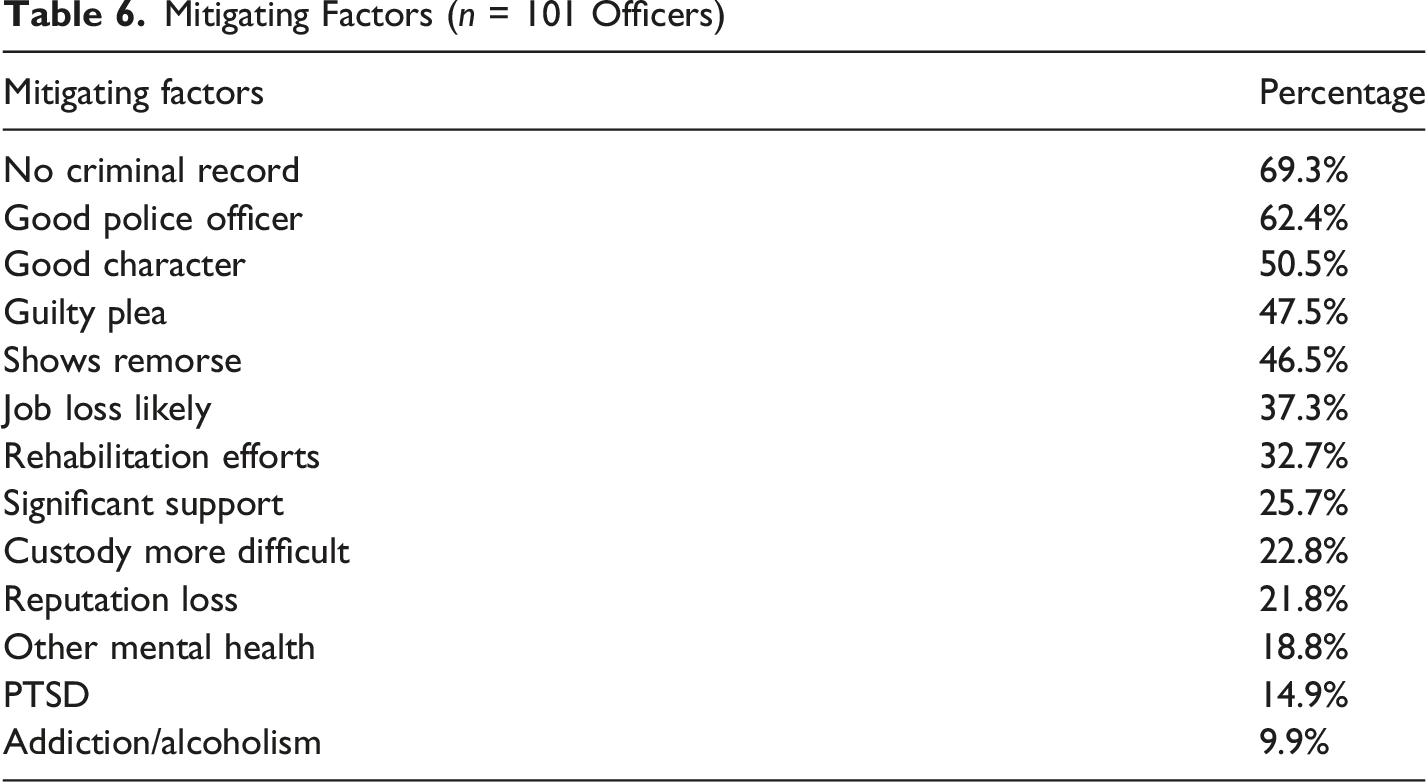
With respect to mitigating factors, among the most emphasized consideration is what can be described as the “good police officer archetype.” (Table 6). This is where judges characterize the offense at hand as a mistake, or a temporary lapse in the officer’s judgement—pointing to the fact that the offender is generally a good police officer. Here judges will make note of all the good the officer has done for the community through their work as a police officer, to justify leniency in sentencing. To illustrate, in an Ontario case, an officer was convicted for illegally accessing police databases to provide confidential information to a known drug dealer (R. v. Kramp, 2014, para. 65). The judge wrote: A total of 12 character letters were provided… These letters all reflect the total shock and surprise their authors experienced when they learned about the charges laid against [the offender] because they were so out of character for her…. [she] loved being a police officer; it was the most important thing in her life prior to being affected by alcohol… policing meant everything to her, and she strived to do her best. The evaluations corroborate what she advised me. She was an excellent police officer, dedicated, hard-working, a “go to” person, dependable, intelligent, self-motivated and a productive team member (R. v. Kramp, 2014, para. 65).
Invocations of the “good officer archetype” were often linked to broader discussions about the nature of police work, where police criminality is framed, at least in part, as resulting from the difficulties of being a police officer. For example, in R. v. Potter (2016), a police officer assaulted a man who was detained in the back of his police vehicle (R. v. Potter, 2016, para. 7), an incident that was captured on video and audio recording (R. v. Potter, 2016, para. 8). Rather than situating the incident within a broader context of police violence, the judge articulated that the evidence was “clear and convincing” that the assault was “out of character” for the officer, and that the incident was triggered by a number of factors related to his work as a police officer, including “the accumulated stress to himself and his family over time, the understaffing of [his] detachment, and resulting emotional and physical exhaustion” (R. v. Potter, 2016, para. 43). This context relating to the conditions of the offender’s work as a police officer was treated as mitigating for the purposes of sentencing.
Much like in the sentencing of non-police officers, the fact that an offender has no previous criminal record, has “good character,” pled guilty, and shows remorse, are all frequently mentioned as mitigating factors in breach of trust cases. It is worth briefly distinguishing between “good character” and the “good officer archetype.” The latter is about the offender’s performance and history as a police officer specifically, whereas the former is about their character as a person. To demonstrate, in a case involving excessive use of force, the judge elaborates how “impressed” he was with the offender’s background (R. v. Gibson, 2003, para. 26), noting how “in addition to his police duties” the offender is a “lay minister with a local church,” and a “father who supports his partner… his three children... and three foster children… who [are] young Native youths that suffer from fetal alcohol syndrome” (R. v. Gibson, 2003, para. 15).
For more than a third of the officers, the fact that they were likely to lose their jobs as police officers was treated as a mitigating circumstance by judges. In a case involving a police officer engaging in conversation of a sexual nature online with a person who represented herself to be under the age of 16, the judge explained how the offender has already suffered, as his “dream career” was over: He aspired to become a Royal Canadian Mounted Police officer since arriving in Canada. As a youth he conducted himself so as not to compromise his chances of being hired by the RCMP. His dream came true when he was hired in 2007 (para. 14)… [the offender] has already suffered significant consequences for his actions. His dream career in policing is over. He was suspended without pay immediately after his arrest causing economic hardship to his family. He remains unemployed, despite efforts to find work. He has been ostracized by work colleagues, friends, and neighbours (R. v. Devic, 2018, para. 21)
More broadly, the ostracization of police offenders was commonly discussed across cases. For 21.8% of officers, judges explicitly discussed reputation loss as a mitigating factor. In doing so, judges would often cite how these cases tend to attract significantly more attention and scrutiny through news and social media reporting, compared to cases involving non-police offenders (for example: R. v. Devic, 2018; R. v. Dominelli, 2018; R. v. Theriault, 2020). As one judge put it, because of how high profile these cases tend to be, police officers have “the most to lose if they are caught. The loss of reputation alone is significant for these people” (R. v. Ardrey, 2022, para. 52). Hand-in-hand with reputation loss, judges would frequently highlight that for police officers sentenced to a term of custody, their time in prison will be more difficult because of their status and identity as a police officer.
The prevalence of mental health disabilities and addiction among police officers was a consideration that loomed large in discussions of mitigating factors. Officers proactively engaging in rehabilitation efforts and having a significant network of support were both factors that were commonly raised as mitigating. Similarly, albeit less frequently, the very fact that an offender suffers from a mental health disorder such as depression, or more specifically, suffers from PTSD or alcoholism and/or addiction, was also considered to be mitigating in sentencing police officers. For example, in sentencing an Ontario police officer for stealing 44 oxycodone pills from an evidence locker, the judge wrote: [the offender] stole the drugs here in order to feed his addiction... It is significant that this addiction arose out of him being prescribed opioids to deal with the pain caused by various injuries. A number of these injuries occurred in the course of [his] work as a police officer (Para 161). His depression and PTSD also arose out of his work as a police officer. His history brings home the fact that police officers often have to deal with numerous traumatic incidents during the course of their careers. In [the offender’s] case he also had to deal with what I can only describe as an appalling degree of harassment by police colleagues (R. v. Murray, 2018, paras. 160–162).
In speaking to the prevalence of trauma and mental health challenges among police officers, judges would discuss a tension raised by the sentencing of police officers. As explained in R. v. Willett (2017), judges are expected to hold police officers to a higher standard by virtue of being police officers. However, “it is the duties and requirements of [policing] that lead to the exposure to traumatic events which results in a mental disorder which in turn leads to or at least contributes to the criminal act” (para. 70). In other words, police officers—by virtue of being police officers— are meant to be sentenced more severely. Yet police officers—by virtue of being police officers— are more likely to suffer traumatic incidents and mental health disabilities, which calls for mitigation in sentencing.
Sentences
Sentences Imposed From Least to Most Punitive (n = 101 Officers) 22
Sentences Imposed Across Type of Offense
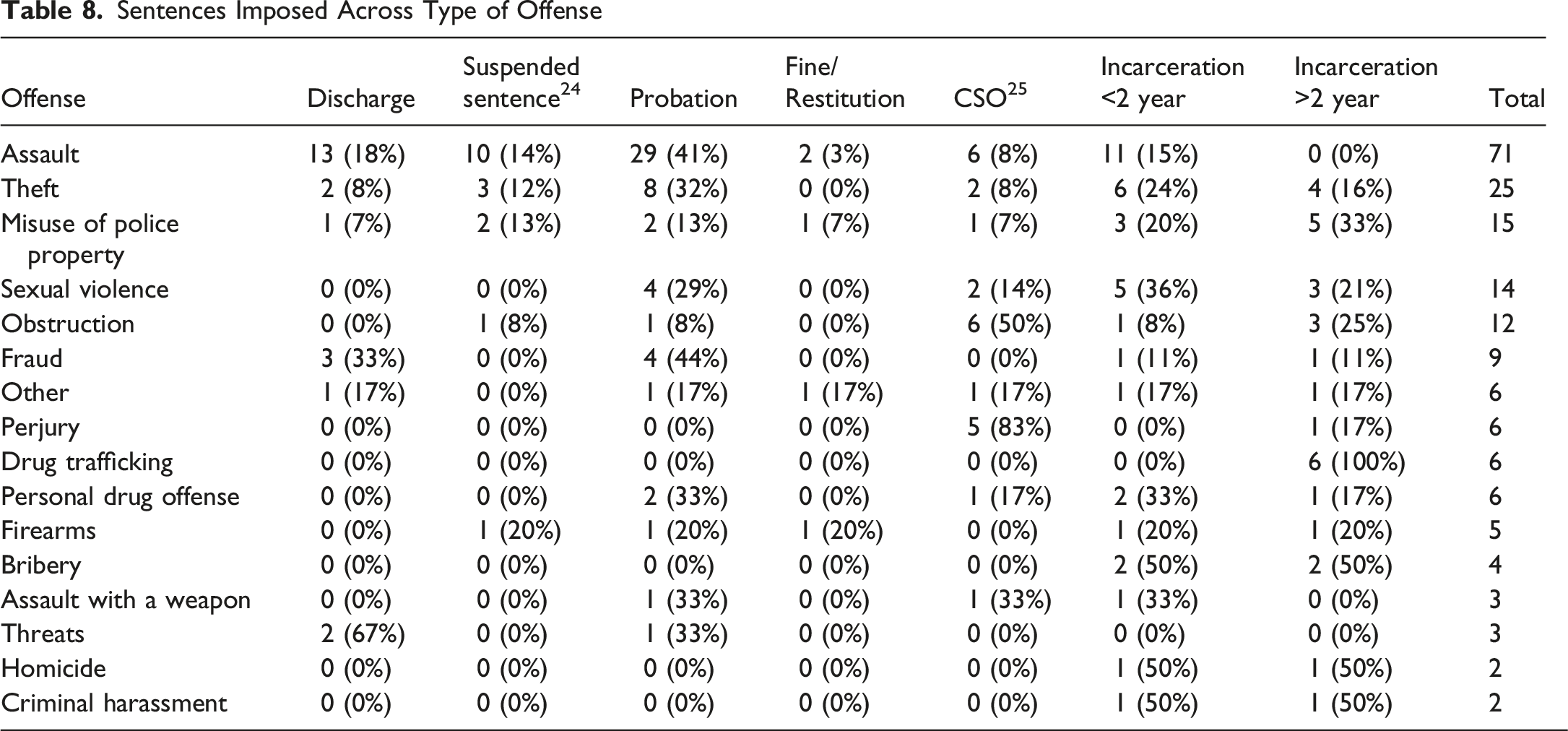
Assault was the least likely offense to result in a term of imprisonment, and this appears to strongly correlate with officer tenure. As highlighted earlier, nearly half of all officers sentenced for assault were on the job for less than five years. Only four of the 18 officers in the dataset who were employed for under five years at the time of their offense were sentenced to a term of imprisonment, and the average length of incarceration was 29 months. In contrast, approximately half of mid-career officers (11/21), those employed as police officers between 5–14 years, were sentenced to a term of incarceration, and typically, for a longer period of time (avg. 53 months imprisonment). Forty percent of the most experienced officers (17/42), individuals who have worked for more than 15 years as police, received a term of imprisonment for an average of 34 months. Although our dataset was too small to establish a statistically significant relationship between type of offense, tenure, and sentencing outcomes, this set of findings reinforces how experience as a police officer can serve to mitigate or aggravate a sentence. Newer officers are perhaps considered less morally blameworthy and thus deserving of leniency in sentencing. By contrast, mid-career officers, because of their experience, are viewed as less deserving of mitigation. And the most experienced officers, can benefit from the “good officer archetype” discussed earlier, the idea that these officers have done enough good for their community over a long period of time, to be deserving of leniency in sentencing.
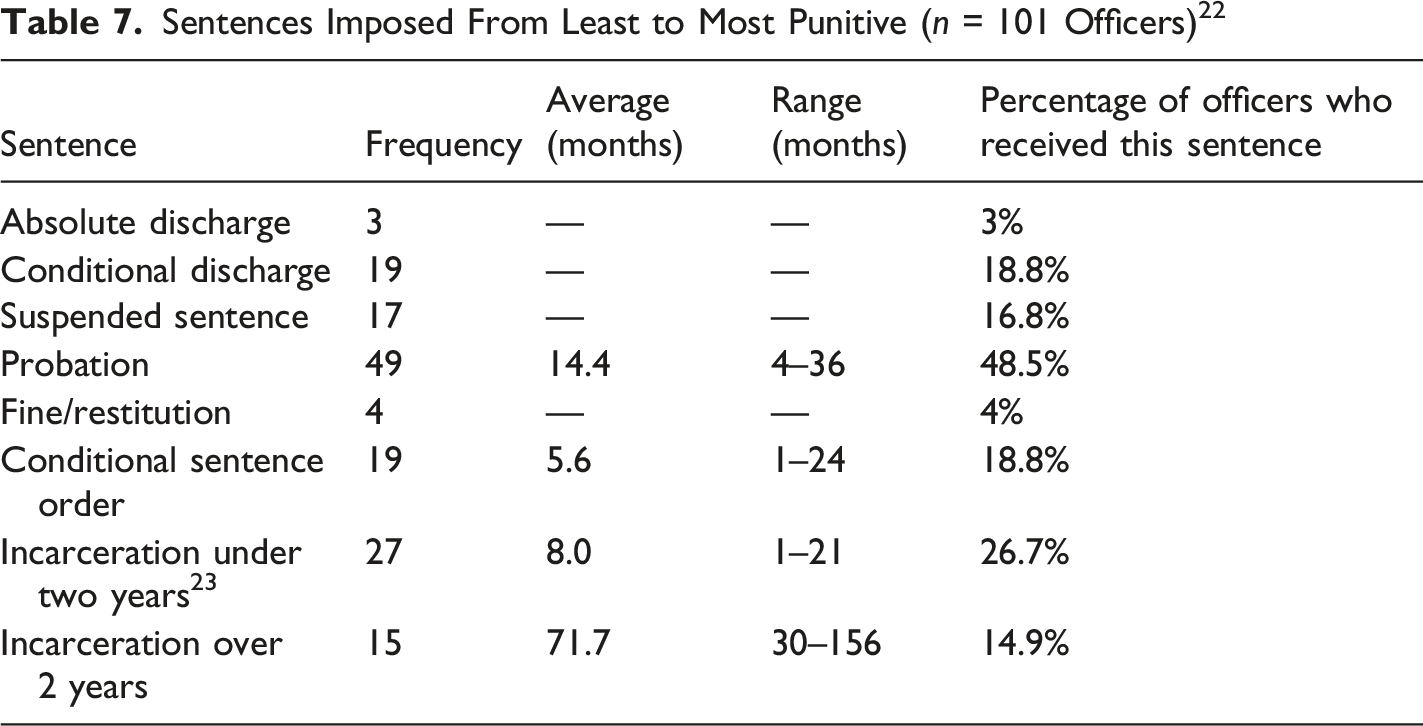
In general, the severity of sentences and frequent imposition of imprisonment reflects the significant weight judges place on denunciation and general deterrence. Judges would frequently cite R. v. Proulx (2000), a decision in which the Supreme Court of Canada explained why conditional sentence orders, compared to incarceration, are typically inappropriate for achieving the principles of denunciation and deterrence. Chief Justice Lamer notes in Proulx: “Where punitive objectives such as denunciation and deterrence are particularly pressing, such as cases in which there are aggravating circumstances, incarceration will generally be the preferable sanction. This may be so notwithstanding the fact that restorative goals might be achieved by a conditional sentence” (R. v. Proulx, 2001, para. 114).
At the same time, judges will frequently impose community sentences (conditional sentence order and/or probation) in lieu of a custodial sentence, drawing attention to the fact that custody tends to be harder for police officers specifically (which, as mentioned earlier, is treated as a mitigating factor in sentencing). For instance, in a case involving five counts of sexual assault, the judge decided that the 18-month term of custody can be served in the community (house arrest), rather than in a correctional institution. The judge explained how: [the offender] has given 30 years of professional life to serving the community… because of that service, he faces extraordinary risks serving a sentence in a custodial institution. He would be an obvious target for some other inmates who do not consider police officers to be their friends… [a community sentence] is significantly preferable to requiring him to spend many of the 18 months in a jail cell, where his life would, in my opinion, be in significant danger (R. v. Kukoly, 2023, para. 26).
As police officers will typically lose their job following a criminal conviction unless sentenced to a discharge, judges are mindful that their sentencing decisions have impacts which go beyond the sanction they impose.
Discussion/Conclusion
This study sought to empirically evaluate the nature of police-perpetrated breaches of trust and the ways in which sentencing judges respond to these offenses. Our study shed light on the qualitative factors that shape the sentencing of police officers, including relevant principles of sentencing, and the mitigating and aggravating factors that are unique to police officer offenders. The findings also revealed previously unknown trends about the characteristics of police-offenders, victims, and police criminality more broadly. This set of findings make an important scholarly contribution because police criminality is an underexplored phenomenon in Canada, despite receiving significant scholarly attention in other similar jurisdictions such as the United States and United Kingdom. To our knowledge, this is also the first empirical study of police-perpetrated breaches of trust that expands beyond a case study analysis. Similarly, the sentencing of Canadian police officers has received little systematic attention in the literature. As such, our study has made an important contribution towards understanding how the criminal court system, and more precisely, the process of sentencing, fits within the wider apparatus of police accountability in Canada.
Our study makes clear that sentencing judges take seriously the privileged position of trust held by Canadian police officers. Only three police officers across the study were sentenced to an absolute discharge, the most lenient sentencing option available in Canada. Instead, terms of imprisonment were among the most common sentences imposed. The seriousness of these sanctions, however, must be balanced against the broader context of prosecuting police officers, beyond sentencing alone. The small body of literature that empirically explores the prosecutorial outcomes of Canadian police officers investigated for criminal offenses suggests that few officers make it to the stage of sentencing. Indeed, investigations into alleged police criminality rarely result in criminal charges. Puddister and McNabb (2024) report the charging rate against Ontario police officers investigated by the Special Investigations Unit, a civilian oversight agency, to be three percent. Internationally, the charging rate of police officers varies from two to ten percent, depending on whether the investigation is conducted internally by a police force, or by an external oversight body (Moss, 2022; Prenzler, 2000). Of the rare cases which result in charges, it is common for charges to be withdrawn prior to trial, and when prosecution proceeds, acquittals are the norm (Puddister & McNabb, 2021). Put simply, although our study shows that sentencing can serve as an important mechanism of police oversight, it is imperative to remember that sentenced police officers only represent the tip of the iceberg—the vast majority of allegations into police criminality will never be scrutinized by the courts (McNabb & Puddister, 2024).
Our narrow focus on sentencing is an inherent limitation of this study as the findings can only speak to those few breaches of trust which make it to the stage of sentencing. As an exploratory study which aimed to produce a descriptive account of how officers are sentenced for breaches of trust, our focus on sentencing decisions was warranted. However, to develop a more representative, generalizable account of breaches of trust committed by police officers, future research should aim to explore these cases at the investigation, charging, and prosecution stages. A broader focus that goes beyond sentencing would more accurately capture trends relating to offenders, victims, and the underlying nature of breaches of trust committed by police officers. This type of an analysis could also shed light on the factors that inform decisions to charge or discipline officers for breaches of trust and would ultimately add to our understanding of the overlapping mechanisms of police oversight which exist in Canada.
Our study’s representativeness is also limited by our approach to data collection; specifically, our tailored and narrow key word search strategy. Future research should expand from our search term approach to allow for a greater number of cases to be analyzed. Increasing the number of cases could also allow for an interesting longitudinal analysis which considers whether and how the nature of discipline associated with breaches of trust has changed over time. For instance, with greater public awareness of the issue of police excessive use of force in the wake of high profile events such as the killing of George Floyd and the subsequent global protests in the summer of 2020, it would be interesting to see whether there is an associated increase in the rate at which officers are charged or prosecuted for breaches of the public’s trust.
Moreover, the seriousness of breach of trust is exemplified in this study by the fact that general deterrence and denunciation are by far the most common sentencing principles that inform the sentencing process. Together, these principles were emphasized in 92% of sentencing decisions, which has led to the emergence of a clear body of case law in Canada which calls for serious sanctions against police offenders. Across the sentencing decisions, judges explain how exemplary sentences are needed to maintain public confidence in policing institutions, as well as the broader criminal justice system, which explains the emphasis on general deterrence – or the notion that sentences should dissuade others in society and especially those in similar positions from engaging in similar conduct. The need for exemplary sentences is in tension with the fact that those who are convicted of breach of trust are often individuals with background factors that courts frequently look to as mitigating, such as having no criminal record (relevant in over 60% of cases in our study) and service to the community (Ruby et al., 2012). The fact that an officer’s seniority and experience appeared to simultaneously aggravate and mitigate sentencing outcomes best speaks to this tension. Experienced officers are expected to “know better” – thus aggravating their sentence, yet at the same time, their history of good deeds in the community as police officers is seen by judges as deserving of leniency. Additionally, in some cases, judges consider the collateral aspects of sentencing relevant to police officers, which can include job losses (over one-third of cases) and impact on one’s reputation or stigma (over 15% of cases). It is these background factors that are common to the sentencing of police officers that helps to explain why specific deterrence – which is the attempt of a court to dissuade the individual offender – is not prioritized by sentencing judges in our study.
Denunciation and general deterrence go together as communicative tools to both police officers and the wider public. Judges emphasize denunciation to send the message to the public that police officers who violate the law face meaningful consequences under the rule of law. In essence, in democratic society, where policing is ultimately based on the consent of the people, law enforcement must use their special powers responsibly and lawfully. And when police officers misuse their profound powers, serious consequences are necessary to maintain the delicate balance of trust between police and the public (Davids & McMahon, 2014). The emphasis on general deterrence when sentencing breach of trust cases also relates to the fact that in committing this offense, offenders have compromised “the basic institutions that protect society” (Ruby et al., 2012, p. 1067). Here we see that Canadian sentencing judges are considering some of the challenges to the rule of law that are posed by police criminality (Freeman, 1996)
The ways in which judges use sentencing as a venue for maintaining public trust in policing and the justice system more broadly, was also on display in discussions of aggravating factors. The most invoked aggravating factor was the fact that officers breached the community’s trust in committing their offense. Particularly while on duty, Canadian police officers are actively working as representatives of the state and are operating on the public’s consent (Tulloch, 2017). Even more, on-duty police are armed with a firearm and afforded the lawful ability to use lethal force against citizens (where warranted). Therefore, on-duty acts of police criminality have a particularly deleterious impact on the public’s confidence in policing. Relatedly, judges frequently cite how police criminality causes reputational damage to police forces—which is seen as an aggravating factor. Sentencing is thus perceived by judges to serve an important remedial function—making right police breaches of trust through the imposition of serious sanctions.
Despite that almost all sentencing decisions contain discussions about the importance of maintaining public confidence in the integrity and fairness of the justice system, it is noteworthy that the offenders’ status as a police officer is treated simultaneously by judges as both an aggravating and mitigating factor. With respect to the latter, we find that judges commonly justify leniency in sentencing based on what we describe as the “good police officer archetype.” Here, judges frame police breaches of trust as mistakes, or temporary lapses in judgement, that run counter to the offender’s history of good deeds as a police officer. These types of discussions, on their own, obscure the systemic dimensions of police criminality and minimize the officer’s responsibility. However, judges would commonly connect the “good police officer archetype” to discussions about the difficulty of police work. This would sometimes take the form of judges explaining how an officer was a “good police officer” up until an important event on the job—such as a particularly traumatic call—which then led the police officer to use drugs or alcohol to cope with the resulting distress. Indeed, 37.6% of police officers were described in the sentencing decisions to suffer from PTSD or another mental health disability, factors which were commonly treated as mitigating their moral culpability.
Although the case law dictates that police officers are meant to be punished severely, sentencing police offenders is complicated by the fact that police officers, in the service of the public, are more likely to experience traumatic events, leading to higher rates of PTSD, among other complications. Judges can consider that officers are exposed to these conditions solely because of their role in maintaining public safety (Isfen & Rauxloh, 2017). The connection made by judges between prior good works and the mental toll of policing are similar to the considerations judges make when sentencing military veterans (Lee, 2013; Loughnan, 2015). In sentencing veterans, courts consider both the contributions made by veterans to society and the mental illness that might be borne by those serving in these roles, or what Lee (2013, p. 287) calls a “gratitude-based discount” and the “mental disturbance discount.” The mental toll of police service on individuals, including a higher prevalence of PTSD is well documented by existing psychological and psychiatric literature (Hartley et al., 2013; Maguen et al., 2009; Rivard et al., 2002), and thus the relevance of mental health and PTSD in sentencing police officers in our study was expected.
Police and those in military service share the role of serving the public, both occupations can be exposed to conditions that can foster higher rates of mental illness, and both are authorized by the state to legitimately use force, including lethal force. Based on these elements, the existing literature on military veterans suggests that sentencing these offenders has the effect of bringing state responsibility into the courtroom in a unique manner (Loughnan, 2015; Olusanya, 2021). Indeed, if some aspects of an offender’s culpability relate to the impact of their role working in service of the state, it suggests the state could implicitly bear some responsibility for those actions. These considerations are also relevant in the sentencing of police officers and explain why police criminality is an affront to the rule of law and impacts the community beyond the specific victims of offenders (Bedi, 2017; Goldrosen, 2025).
The sentencing decisions that linked officers’ struggles with mental health, addiction, and trauma to their experiences working as police officers, draw attention to some of the systemic dimensions of police criminality. For instance, judges would frequently describe how policing is a difficult job that commonly exposes police officers to violence and other difficult scenarios. In this way, judges acknowledge a systemic dimension to police criminality—where police officers are more likely to engage in violence and criminality because of the very nature of police work. However, it was rare for judges to discuss other systemic and institutional aspects of policing, such as an occupational culture influenced by the blue wall of silence and imbued with hypermasculinity (Chin & Wells, 1997; Cottler et al., 2014; Maher, 2008; McNabb & Puddister, 2024).
When sentencing an offender, judges consider personal history, background, and circumstances of the offense. Judges in our study attempted to address the unique nature and wider context of sentencing a police officer by noting the remedial effects of sentencing and by emphasizing general deterrence. However, sentencing as a mechanism of police accountability is limited by its focus on the individual offender. Sentencing decisions rarely address how police misconduct and criminality can be influenced by factors beyond the individual such as a departmental culture that encourages or permits misconduct (Boateng et al., 2024; Gottschalk, 2022; Punch, 2003). Similarly, a sentencing decision cannot undertake a systemic inquiry, nor can it address flawed policies or procedures that may have contributed to police misconduct. Importantly, sentencing individual officers can do little to address the disproportionate rates of police violence experienced by those with mental illness and by Black, Indigenous and other peoples of color (Tracking (In)Justice, 2023; Wortley et al., 2021). Nor can sentencing remedy the disproportionate rates of police perpetrated sexual and gender-based violence experienced by women (Cottler et al., 2014; McNabb & Puddister, 2024).
These limitations highlight how the process of sentencing individuals serves to reinforce the “fundamental attribution bias” noted by attribution theory which refers to when individuals and their own personal failings are blamed and held responsible for wrongdoing, instead of addressing how systemic or organizational factors might have played a role (Gailey & Lee, 2005; Gottschalk & Benson, 2020; Keaveney, 2008). One way to encourage courts to consider the wider context and to address some of the limitations of the largely individualized sentencing process could be through the creation of a specific aggravating factor for when a police officer 26 commits a criminal offense. Creating an officer-specific aggravating factor would build on the principle underlying the offense of breach of trust – that public officers should be held to a higher standard. It would similarly signal to judges to sentence these cases with the appropriate level of severity to repair public trust and legitimacy in all cases where the offender is a police officer. This change to sentencing law would require a simple amendment of the Criminal Code by Parliament.
Prosecuting and sentencing police officers under the public criminal legal system is important for the rule of law, and despite the challenges noted in this article, there should not be a separate legal process and system for police officers. The findings of our study make clear that courts can provide significant consequences in dealing with individual cases, however, if the public and police officers themselves are unaware of how this system of police accountability operates, little can be done beyond individual cases. The principle of open court – the notion that justice must be seen to be done – has relevance here. Increasing public knowledge of the cases where officers are (or are not) held accountable through prosecution and sentencing can allow the public to evaluate this method of oversight, which may help to repair the trust that has been breached between the public and the police when an officer commits a crime. The emphasis on general deterrence by sentencing judges highlights that police officers themselves could benefit from a better understanding of the criminal sanctions that can result for breaching the public’s trust and of the wider consequences for the legitimacy of policing in general. Increasing public and police understanding of the criminal sentencing of police officers could help to address organizational and cultural aspects of policing that foster misconduct and criminality.
When police officers commit crimes, they not only violate the criminal law, but they also violate the trust of the community. Sentencing alone cannot repair the harm caused or prevent future harms from occurring. Sentencing should be viewed as one part of a larger, holistic system of police accountability. Fundamentally, the act of sentencing is an individualized endeavour – courts can consider the rotten apples, but not rotten barrels or orchards.
Footnotes
Acknowledgements
We wish to thank Marg Empke for her helpful research assistance and Matt Hennigar for providing feedback on an earlier draft of this manuscript. We also wish to thank the anonymous reviewers for their valuable feedback as well as Dr. John L. Worrall and the rest of the editorial team at Police Quarterly. Kate also thanks her boss Henry for taking longer naps so she could complete revisions.

Funding
The authors received no financial support for the research, authorship, and/or publication of this article.
Declaration of conflicting interests
The authors declared no potential conflicts of interest with respect to the research, authorship, and/or publication of this article.