



Abstract
This study investigates the effects of hot spots policing on self-initiated officer activity using data from a violent crime reduction strategy implemented in Dallas, TX. A strong body of empirical evidence has demonstrated that violent crime is disproportionately concentrated in very small, specific geographic locations. Hot spots policing leverages crime concentration by focusing police resources in these small, crime-prone areas. While extensive research demonstrates that hot spots policing is effective in reducing crime, critics argue that focused enforcement efforts may lead to increased proactive activities targeting residents. To date, no research has specifically examined the impact on self-initiated officer activities involving citizen interactions within communities exposed to hot spots policing. Moreover, there has been little exploration of the differences between hot spots strategies that use proactive approaches compared with lighter footprint strategies. We address this gap in the literature using a multi-year assessment of the effects of two types of hot spots policing on self-initiated activity. We found differential impacts on self-initiated activity in areas treated with deterrence-based, high visibility (HV) strategies versus those treated with proactive, offender-focused approaches (OF). Hot spots policing had no effect on self-initiated activity in HV treated areas while there were statistically significant increases in four of five measured categories in the OF treated locations. This study highlights the need for law enforcement agencies to adopt tailored approaches specific to crime conditions in different areas. While proactive approaches may be necessary in specific locations, agencies should understand both the crime reduction benefits and potential impacts on local communities.
Introduction
1Hot spots policing is one of the most effective strategies known to help reduce violent crime in small areas of crime concentration in urban settings (Braga et al., 2019; National Research Council, 2004; Weisburd & Telep, 2014). Developed in the mid-90s and repeatedly tested with randomized controlled trials and robust quasi-experimental designs, hot spots policing has become a broadly accepted approach to controlling violent crime in places where it is most likely to occur (Braga et al., 2019; Sherman & Weisburd, 1995). Hot spots policing increases the concentration of police resources at crime-prone locations and leverages the law of crime concentration to deter offenders at places that disproportionately contribute to violence (Weisburd, 2015).
Despite the success of hot spots policing at controlling crime in criminogenic places, some cities have experienced significant negative consequences associated with aggressively proactive police strategies (Geller et al., 2014) focused on high crime areas. The now infamous NYPD stop and frisk strategy in the early 2000s resulted in the initiation of a pattern or practice investigation by the U.S. Department of Justice and a verdict against the NYPD for unconstitutional policing following a bench trial in a U.S. district court (Floyd v. New York, 2013). The strategy was highly controversial and produced a plethora of media stories and scholarly articles for more than ten years (Avdija, 2014; Fagan, 2010; Fagan et al., 2010; Gelman et al., 2007), most of which were critical of the approach because of its disparate impact on communities of color in New York. Police forces in Chicago (ACLU, 2015; Skogan, 2017) and Philadelphia (Hannon, 2020) also have been criticized for aggressive stop and frisk practices that disproportionately impacted persons of color.
Critics of hot spots policing argue that it can damage community trust and police legitimacy and lead residents of targeted neighborhoods to feel they are under siege and over-policed (Bates, 2022; Rinehart Kochel, 2011; Rosenbaum, 2006). Despite these criticisms, most empirical work to date has found no negative impacts on police legitimacy or perceptions of the police associated with hot spots policing (Ratcliffe et al., 2015; Weisburd et al., 2011). However, with minority confidence in the police recently at a near all-time low (Jones, 2021), any police strategy that differentially focuses resources on high crime neighborhoods, many of which may be disproportionately populated with minority residents, will likely draw scrutiny and is appropriately the subject of empirical inquiry into potential disparate impacts, including increases in stops or other enforcement actions.
The current study examines the secondary effects of a hot spots policing strategy on police activity by utilizing data from a city-wide violent crime reduction strategy implemented in Dallas, TX., in May 2021. The central focus of this study is the influence of hot spots policing on police-citizen interactions, which if increased in volume due to a new strategy, may potentially strain relationships between officers and the communities they serve. To date, a considerable amount of the literature focuses on the NYPD stop and frisk strategy and is drawn from New York City (Tillyer et al., 2023); however, police activity is broadly defined here to include traffic stops, routine investigations, and arrests. Using pre- and post-implementation data for a five-year period, the current study seeks to broaden that literature by investigating how police activity varied in high crime areas following the adoption of a hot spots policing strategy. Thus, the current study directly measures the impact of the strategy on police activities beyond violent crime suppression to investigate whether the strategy increased proactive, police-initiated contacts in treated areas compared to those that were not treated. Results of this investigation provide direct empirical evidence regarding the effects of a hot spots policing strategy on police-civilian contacts, and indirectly, how local communities are impacted by a specific policing strategy.
Following this introduction, relevant literature on hot spots policing is reviewed with a specific focus on its potential disparate impacts on the local community. Thereafter, the Dallas hot spots strategy and the current study’s design, data, and analytic methods are described before presenting the findings and results. We conclude with a discussion of whether and how hot spots policing can be implemented equitably while maintaining community trust and police legitimacy.
Overview of Research on Hot Spots Policing
The “law of crime concentration” (Levin et al., 2017; Weisburd, 2015) suggests that a small number of places (about 4–5%) account for about 50% of reported crime incidents and/or calls for service to the police. Since the mid-1990s, researchers have suggested that concentrating police resources at these locations can help reduce crime (Sherman & Weisburd, 1995), and considerable evidence now exists that this routine activities-based strategy (Cohen & Felson, 1979) is effective (Braga et al., 2019; National Research Council, 2004). Hot spots policing has emerged as a popular tactic for deploying patrol and other police resources and has demonstrated its effectiveness in dozens of high-quality research studies (Braga et al., 2019). Treatments tested to date include increases in foot or vehicle patrol, offender-focused apprehension programs, camera monitoring with directed patrol, drug enforcement operations, and problem-oriented policing strategies (Braga et al., 2019; Groff, 2015; Rosenfeld et al., 2014). Braga et al., ‘s 2019 meta-analysis of 62 hot spots studies found that problem-oriented policing strategies were moderately more effective at reducing crime than increasing traditional police activities at hot spots.
Previous research has investigated the effects of different hot spots tactics on crime. The findings provide a robust body of evidence supporting the effectiveness of hot spots policing (Ariel et al., 2016; Carter et al., 2021; Koper et al., 2022; Sorg et al., 2017). Still, limited attention has been given to the nature of officer-citizen interactions within these areas. Groff et al. (2015), for example, compared foot patrol, problem-oriented policing, and offender-focused tactics within experimental and control hot spots and found that only offender-focused tactics had an impact on violent crime. Uchida et al. (2019) also found that offender-focused tactics were effective at reducing crime in targeted hot spots in Los Angeles but only when coupled with enhanced patrols as an additional place-based treatment. Researchers in other settings, though, found that saturation foot patrol alone (Piza & O’Hara, 2014) was effective at reducing overall street violence in a targeted area in Newark, albeit with some evidence of temporal and spatial displacement of robberies to nearby areas.
Fewer studies have explored how these strategies influence direct interactions between officers and community members, yet officer self-initiated activities during hot spots policing deployments likely play a role in shaping public perceptions of police legitimacy and thus of the strategies themselves (Tyler, 1990). For example, saturation patrols or police crackdowns (Sherman, 1990) can be an effective short-term strategy to reduce crime in small, targeted areas, but such strategies often come with cost (Scott, 2003). Place-based strategies that increase police activities in small areas can alienate local residents and make conditions worse (Sherman, 1990). They also can lead to crime displacement (Wood et al., 2004), raise concerns about racial and ethnic profiling (Scott, 2003), and ironically, make residents feel less safe (Hinkle & Weisburd, 2008).
Impact of Hot Spots Policing on Stops and other Proactive Police Contacts
Hot spots policing concentrates police resources in the relatively few places that produce most of the crime in any given city, with the goal of reducing crime through a combination of deterrence, and possibly, incapacitation of high-risk offenders. Does hot spots policing, then, necessarily increase police-initiated stops and related outcomes such as routine investigations or arrests in targeted areas? One early iteration of hot spots policing, the Kansas City gun experiment, assigned overtime officers to an eight by ten block area of Kansas City with a homicide rate 20 times the national average and tasked them with engaging in proactive patrol activities to find and seize illegal guns. Officers spent approximately 1200 person-hours over 176 days initiating a “high volume of contact with the street population,” including issuing over 1000 traffic citations and making 948 traffic stops, 532 pedestrian stops, and more than 600 arrests (Sherman & Rogan, 1995). As a result, gun seizures nearly doubled and gun crime plummeted at a “cost” of significantly increased police-initiated stops of citizens in the area, many of which, in all likelihood, were unproductive. 2
In recent years, the national conversation around strategic policing practices, like hot spots policing, has increasingly focused on the need to balance effective crime control and maintenance of positive community relations. Reform movements have raised concerns about the disproportionate impact of new policing strategies on communities already facing adverse conditions and the possibility that the strategies may hinder police practices that build trust (Brunson & Wade, 2019). Indeed, prior research emphasizes the importance of ensuring that proactive strategies do not alienate communities or exacerbate tensions, particularly in marginalized areas (Brunson & Wade, 2019; Tyler & Huo, 2002). In evaluating hot spots policing, previous studies have largely focused on crime reduction, with less emphasis on community outcomes such as perceptions of police legitimacy (Tyler & Fagan, 2008). While hot spots policing can reduce crime, the increased police presence and proactive tactics could also lead to higher levels of police-citizen contact, while negatively impacting community relations (Hinkle & Weisburd, 2008).
In the early 2000s, the New York City Police Department engaged in an intentional strategy of increasing stops and frisks of pedestrians in an effort to control crime. At bottom, the NYPD stop, question, and frisk (SQF) strategy was executed primarily in crime hot spots (i.e. impact zones) and resulted in a more than four-fold increase in SQFs over a seven-year period (Weisburd et al., 2016). The strategy was highly controversial and ultimately found to be unconstitutional because of its intentional focus on minority neighborhoods and disparate impact on minority citizens (Daniels v. City of New York, 2003; Floyd v. City of New York, 2013).
More contemporary hot spots approaches attempt to avoid the inefficient and alienating tactics of the NYPD SQF strategy while leveraging the crime control benefits of focusing on crime-prone areas and high-risk offenders. Working with criminologists, the LAPD designed a hot spots strategy known as the Los Angeles Strategic Extraction and Restoration (LASER) program that used intelligence to score, surveil, and arrest high-risk offenders from a single LAPD division (Newton). This component of the strategy avoided the generalized targeting of residents for stops, but it still relied on saturation patrols in hot spot corridors that increased the number enforcement outcomes experienced by residents in the targeted areas. Conversely, Corsaro and colleagues (2019) found that merely placing officers in stationary patrol vehicles with their emergency lights activated for 15-minute periods had a violent crime reduction effect in hot spots in Las Vegas. A key remaining question is whether high visibility hot spot tactics like those used in Las Vegas or intelligence-driven, offender-focused strategies like the one employed in Operation LASER can effectively limit indiscriminate stops of residents in targeted hot spots.
The Current Study
While the crime reduction benefits of a hot spots policing strategy are well documented, less well understood are the ancillary impacts on the local community. Given the various manifestations of a hot spots strategy and limited study on unintended consequences, it is not clear if a hot spots strategy can offer crime reduction benefits while minimizing associated costs to police-community relations through heightened proactive police activity. To be clear, our study cannot directly examine police community relations; however, it does measure whether levels of police/citizen contact increase that could be attributed to a new targeted policing strategy. The current study aims to address this gap in the hot spots literature through the following research questions: 1. Do small geographic areas treated with a hot spots strategy experience higher levels of officer-initiated traffic stops compared to areas that received no treatment? 2. Do small geographic areas treated with a hot spots strategy experience higher levels of officer-initiated routine investigations compared to areas that received no treatment? 3. Do small geographic areas treated with a hot spots strategy experience higher levels of arrests compared to areas that received no treatment? 4. Does the hot spot treatment type exert differential impact on the frequency of officer-initiated traffic stops, routine investigations, or arrests?
Data to address these questions resulted from implementation of the Dallas Violent Crime Reduction Plan (hereafter referred to as the Crime Plan), which was created through a partnership between the Dallas Police Department (DPD) and criminologists, implemented by the DPD, and evaluated by independent researchers.
Background
Beginning in late spring 2021, the DPD began implementing an evidence-based, three-prong strategy to reduce violent crime in the city of Dallas (Dallas Police Department, 2021). The Crime Plan is built on the theoretical principles of opportunity theory and grounded in the empirical research on effective violent crime reduction strategies. Hot spots policing is the strategy adopted by the DPD to help lower violent crime in the near-term while providing the DPD and other city stakeholders time to build the partnerships necessary to bring more complex place-based and offender-focused strategies to bear on the problem. In total, the Crime Plan consists of three primary, evidence-based strategies (hot spots policing, place network investigations, focused deterrence) and several secondary strategies purposely sequenced and designed to help reverse a three-year rising trend in violent crime.
The first phase of the Crime Plan, hot spots policing, was designed to immediately target violent crime by modifying the opportunity structure with the introduction of guardianship (i.e., a police officer) in the city’s most violence-prone areas. To identify violent crime hot spots, spatial analyses of recent (past 60 days) and more extended (past one year) trends were used to identify the locations containing the highest concentration of violent crime. Utilizing an existing map layer in Dallas that divides the city into 330’ x 330’ grid squares (101,103 total grids), the hot spots strategy then rotates police resources to the city’s most crime-prone grids every 60–90 days based on recurring crime analysis. As a result, the DPD treats between 50 – 65 grids (.05%) out of the 101,103 grids that comprise the city’s land area. The treated grids represent the 50 – 65 highest crime grids in the city for the period in which they are selected. Together, the treated grids account for roughly 8–10% of the city’s violent crime in any given treatment period.
During treatment, each grid received one of two treatment types: high visibility (HV) or offender focused (OF) treatments. During HV treatments, police officers were deployed to grids identified as hot spots during the hours in which violent crime most often occurred in the past year. Officers were instructed to park their patrol cars within the hot spot grids and remain stationary for 15 minutes with all emergency lights activated. On-duty patrol officers were responsible for conducting HV treatments. Assessments of fidelity revealed that DPD officers achieved an average treatment protocol compliance rate of 75% during treatments periods in the first two years of the study. During OF treatments, specialized crime response teams (CRTs) were deployed to hot spots to focus on high-risk violent offenders. These treatments often involved serving warrants on repeat violent offenders located within or in close proximity to the target grids. The seven patrol division-based CRTs also conducted covert surveillance, developed investigative leads, and worked longer-term cases in the hot spots. Grids were roughly divided in half, so about the same number of grids received each type of treatment within each treatment period. DPD determined which treatment strategy was used for selected hot spots based on the environmental features at those locations. Commercial locations (e.g. convenience stores or strip malls) with good lines of sight typically received the HV treatment while apartment complexes and residential streets often received the OF treatment.
After one-year of Crime Plan implementation, violent crime in Dallas was down about 10% in the targeted hot spots. Moreover, the contribution of the treated hot spots to overall levels of violent crime in the city decreased as the year went along (Smith et al., 2024), suggesting that the hot spots strategy may have impacted city-wide violent crime counts by the end of the year.
Data & Variables
Temporally, this study examines activity across a five-year or 60-month period (January 1, 2018, and December 31, 2022). Hot spot treatments were initiated in Month 42 and continued through Month 60. Spatially, the study area included all 101,103 grids in the city. During the 18-month treatment period, 143 unique grids received treatment with 65 receiving high visibility treatment only, 73 grids receiving offender focused treatment, and five grids receiving both types in separate months.
Difference-in-differences (DiD) modeling (discussed in detail below) was selected as the analytic strategy to address the research questions. To support this analytic strategy, we intersected the city’s 101,103 grids with the 60 months of data observations. This process resulted in the creation of 6,066,180 grid-month cases to which we spatially (i.e., grids) and temporally (i.e., months) assigned all data so that all data of interest were represented in this grid-month structure.
Three data sources were utilized to address the research questions. The dependent variables were measured by analyzing enforcement or investigative activities undertaken by the DPD during the study period; these activity records were supplied by the agency from their internal databases. The key variables of interest measuring activity were a) traffic stops, b) routine investigations, and c) arrests. Traffic stops are defined as any officer-initiated stop and detention of a person operating a vehicle. Routine investigations involved any other self-initiated officer activity for law enforcement-related activities. Excluded from this variable were traffic stops (captured separately), calls for service, off duty security mark-outs, mark-outs associated with hot spots treatments, and administrative matters. 3 The third category of police activity, arrests, were analyzed in multiple categories. Total arrests included both custodial and those in which citizens were released on summons regardless of offense type. A category for violent crime 4 arrests was developed given the focus on violent crime in the hot spots treatment. Finally, a measure of warrant-related arrests was created to measure police activity in all grids, but in particular, activity in offender-focused treatment grids where treatment is aimed at identifying and arresting repeat violent offenders, many of whom have outstanding warrants. All dependent variables (i.e., traffic stops, routine investigations, all arrests, violent crime arrests, and warrant arrests) were measured with a count variable indicating how much activity of each type occurred within each grid-month.
The second data source allowed for the identification of hot spot treatments by grid and by month. Specifically, a dichotomous variable (1 = yes, 0 = no) was associated with each grid-month to indicate if a hot spot treatment was applied to that case. Additionally, dichotomous variables were also created to signify whether the treatment was offender focused (OF) or high visibility (HV). Although it was possible for a grid to have received both treatment types throughout the study period, no grid received both treatment types at the same time. Additionally, the data structure accounted for grids that received both treatments by considering treatment at the month level. For example, if a grid was treated with HV, then treated with OF in a later period, officer activity in that grid, and for that month, would only be counted for the treatment type that it received during that month.
The final data source provided a measure of violent crime. For the purposes of the Crime Plan, violent crime is defined as any of the following offenses: murder, robbery of individuals or businesses, and non-family-related aggravated assault; these offenses were aggregated to the incident level. This process avoided any inflation of crime counts when an incident involved multiple victims. In other words, a violent crime involving multiple offenses and/or victims was counted as one incident. Subsequently, all violent crime incidents were geographically located within one of the 330’ x 330’ foot grids for analytic purposes. Incidents were then totaled across all grids for each month of the study period to produce a count of violent crimes by grid-month.
Analytic Strategy
The primary analytic technique for this study was difference-in-differences (DiD). DiD compares the change in a population during and following treatment to the change in another population that did not experience treatment (Goodman-Bacon, 2021; Wooldridge, 2010). For this study, DiD models compared the change in officer-initiated activity in treated grid-months before and during treatment periods to the change in officer-initiated activity in non-treated grid-months. The regression based DiD approach also allows for the inclusion of control variables in the models. Given the focus of the Crime Plan, we included a measure of violent crime within each grid-month in all models. This step was necessary because the selection of grids for hot spots treatments was based on the highest number of violent crime incidents recorded in the months preceding the treatment. Since grids with higher crime rates were more likely to experience a greater number of stops and arrests, the presence of violent crime may have introduced bias into the models’ results. Controlling for violent crime ensures that the models accurately reflect the impact of the hot spots treatments independent of the crime levels in these areas.
Due to the rarity of police activity across grid-months, especially in treated grids, the difference-in-differences design helps to ensure that control grids with similar characteristics provide a valid comparison for assessing the treatment impact. Our design helps mitigate concerns about regression to the mean by ensuring that treated and control grids are compared evenly with similar baseline characteristics. Two sets of DiD models were estimated. The initial set of models regressed all treatment, only high visibility (HV) treatments, and only offender focused (OF) treatments on traffic stops, routine investigations, all arrests, violent crime arrests, and warrant arrests while controlling for violent crime incidents. It was important to model three different grid-month outcomes (all treated grids, HV grids only, and OF grids only) to identify the potential combined and independent effects of treatment type. These models were estimated using all grid-months (N = 6,066,180). The second set of models mirrored this analytic strategy but only considered grids that recorded at least some police activity during the study period. These models reduced the number of cases analyzed by roughly 50% (N = 3,082,620) and provide an estimation of the relationships in question after eliminating grids with no activity. All models were estimated with Stata version 18.0 and command xtreg with fixed effects.
To examine the validity of our DiD models, we tested the parallel trends assumption. “Parallel trends” assumes that both treated and untreated grids followed similar trajectories prior to the intervention (Angrist & Pischke, 2009). To determine whether our models met this assumption, we regressed the outcome variables on an interaction term between time and the treatment indicator to assess any significant differences in pre-treatment trends between the groups (Amin & Qin, 2024). Across all models, the regression results and visual inspection of the graphs indicated that the parallel trends assumption was satisfied.
Results
Descriptives.
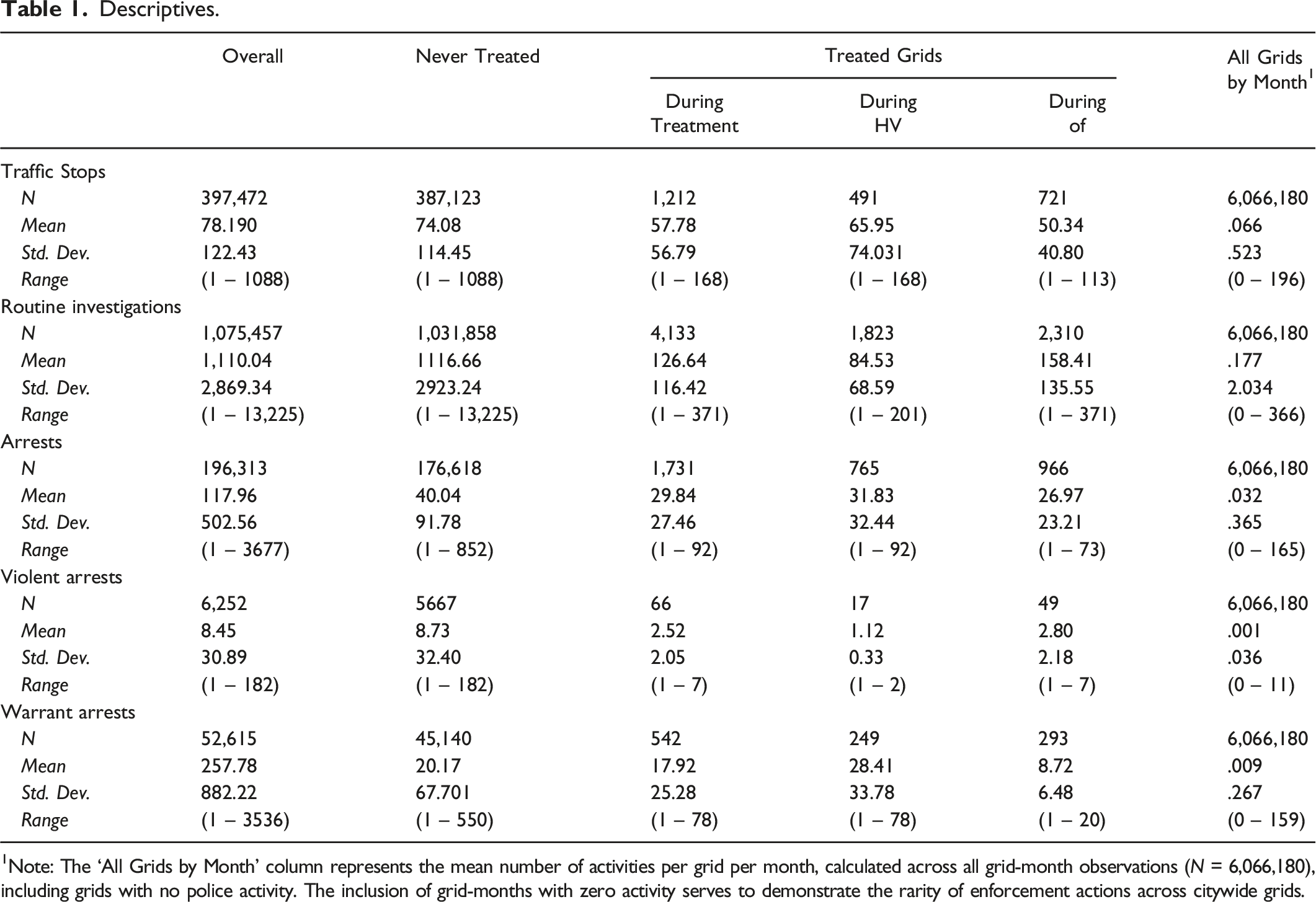
1Note: The ‘All Grids by Month' column represents the mean number of activities per grid per month, calculated across all grid-month observations (N = 6,066,180), including grids with no police activity. The inclusion of grid-months with zero activity serves to demonstrate the rarity of enforcement actions across citywide grids.
DPD officers initiated about 400,000 traffic stops during the 60 months of the study with roughly 78 traffic stops per grid, on average. Of note, there were approximately 1200 traffic stops in treated grids during treatment periods. Approximately 500 occurred in HV treated grids and about 700 took place in OF grids. Slightly more than one million routine investigations occurred during the study period with approximately 4000 occurring in treated grids during treatment. OF grids experienced a higher number of routine investigations (n ≅ 2300) than HV grids (n ≅ 1800). Around 200,00 arrests of any kind occurred across all grids with approximately 1700 in treated grids. There were slightly more than 6200 violent arrests during the study period, and 66 occurred in treated grids. About one-quarter of violent arrests occurred in HV grids (17) compared with 49 in OF grids. Finally, there were about 52,000 warrant arrests during the study period. They were spread roughly equally across HV and OF grids during treatment, although OF grids recorded slightly more warrant arrests (n = 293) than HV grids (n = 249).
DiD was used to estimate multiple models according to the strategy outlined in the previous section. These models compare the change in police activity in treatment hot spots (before and after treatment) to other grids in the city of Dallas while controlling for violent crime incidents. The measures of violent crime used to select treatment grids (incidents of murder, robbery, and non-family-related aggravated assault) were the same measures used as controls in our models. Model 1 includes all grid-months, while Model 2 examines only grid-months that included some police activity. That is, Model 1 includes grids in the city, even those that never experienced a stop or arrest for the entire duration of the study, and Model 2 is limited to grids in which at least one stop or arrest occurred.
Traffic Stops.
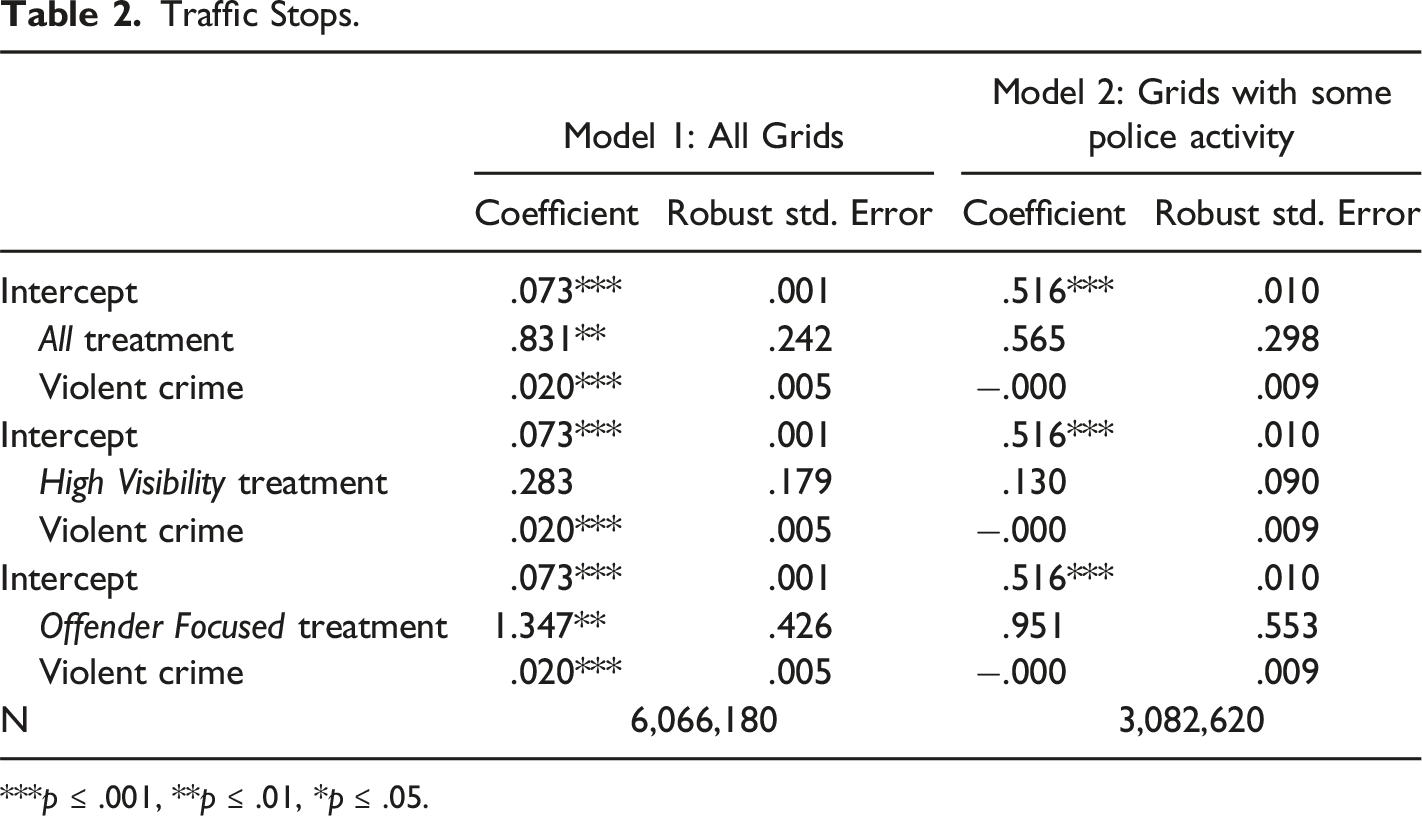
***p ≤ .001, **p ≤ .01, *p ≤ .05.
Routine Investigations.
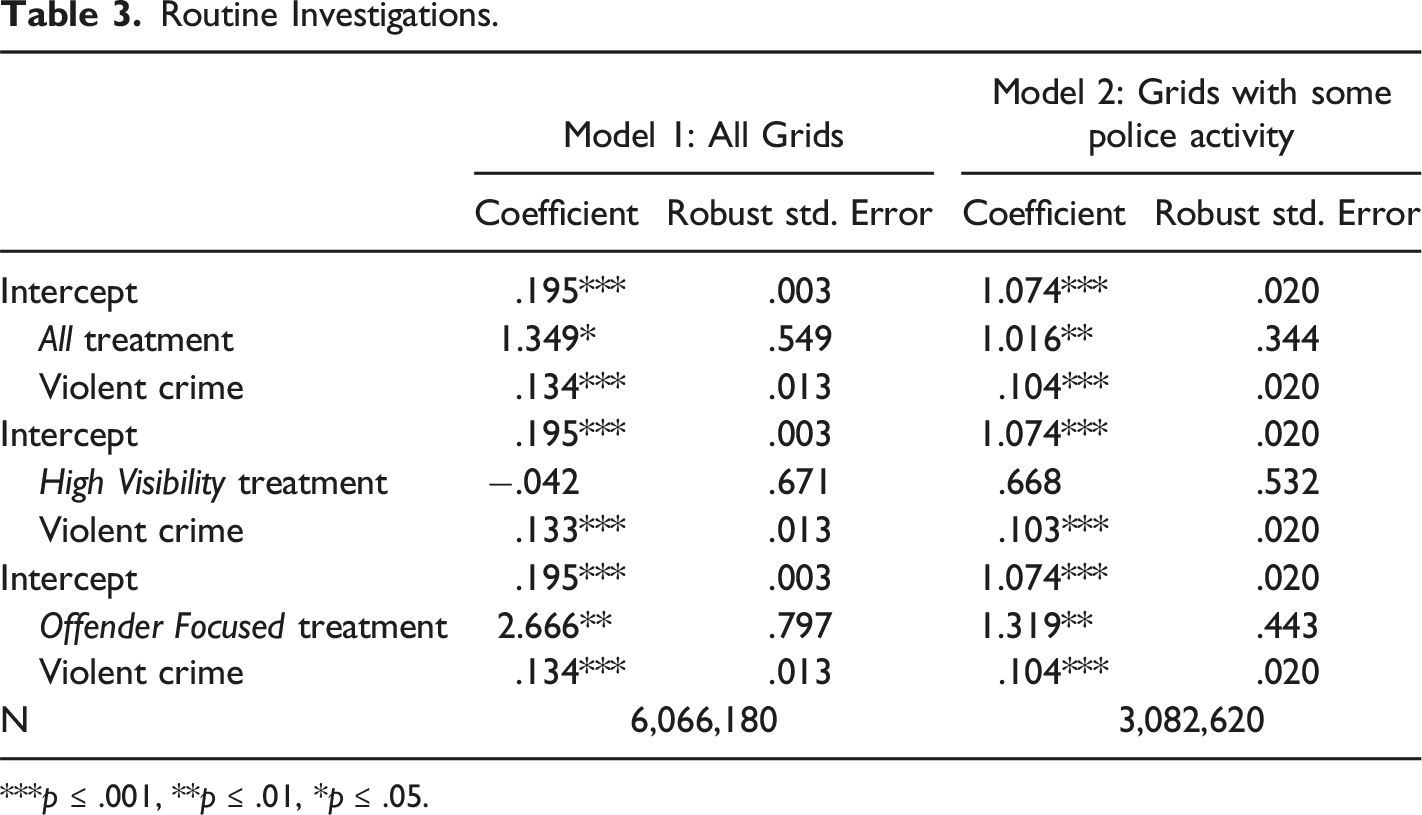
***p ≤ .001, **p ≤ .01, *p ≤ .05.
Arrests.
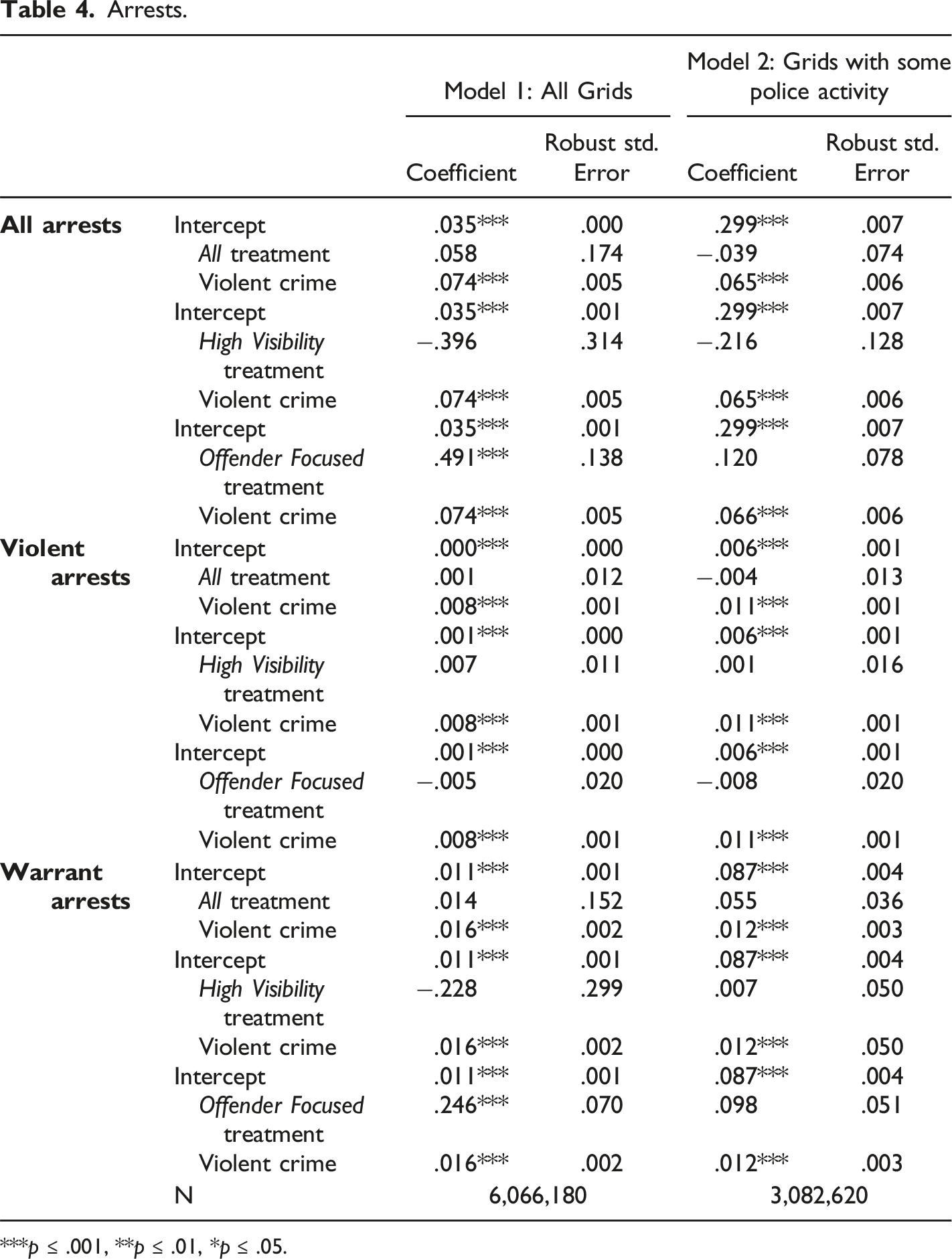
***p ≤ .001, **p ≤ .01, *p ≤ .05.
The second key finding is that the OF treatment type did produce a higher total number of arrests (approximately .5 more arrests per grid-month) and more warrant arrests (approximately .25 more arrests per grid-month). While this finding is only apparent in Model 1, it does suggest that proactive police presence and engagement using an offender-focused strategy yields a slightly higher number of arrests. This is to be expected as these units are purposefully working these geographic areas with an eye toward executing existing warrants, collecting evidence to build cases and making arrests when warranted. Thus, this result is not particularly surprising. One final item to note are some differences in the arrest results between Models 1 and 2. In the case of arrest, the coefficients are primarily in the same direction but with a lower magnitude in Model 2. This suggests that the statistical significance reported in Model 1 may be a product of the sample size. Regardless of statistical significance, however, the trend in findings is consistent and reflective of the conclusions offered here.
Discussion
Compared to the 36 months prior to intervention, May 2018 – April 2021, the Dallas Violent Crime Reduction plan has reduced crime by roughly 15.3% since treatment began in May 2021 (Smith et al., 2023, 2024). At the same time, the number of arrests fell city-wide and in treatment areas by approximately 11% and 14%, respectively. Still, a common question from stakeholders in Dallas remained: Did the Crime Plan increase proactive officer activity, and thus, officer-civilian contacts, in targeted hot spots? Indeed, prior research has found that violent crime disproportionately occurs in disadvantaged, low SES areas of urban cities (Boggess & Hipp, 2010; Sampson & Wilson, 1995; Wilson, 1996). All involved were cognizant of the need to develop an approach that would effectively target hot spots while adhering to the plan’s “light footprint” goals. The intervention needed to focus on sustainable, non-invasive deterrence rather than heavy-handed enforcement. A key goal was to avoid over-policing in at-risk, disadvantaged communities.
The Dallas Crime Plan presented an opportunity to assess the ancillary impacts of a hot spots strategy on police activity and indirectly, its impact on the local community. The analysis revealed that the hot spots treatments increased traffic stops and routine investigations under some treatment conditions but exerted no consistent effect on arrests. The modest increases in traffic stops and routine investigations were a product of the offender focused (OF) hot spots treatment rather than high visibility (HV) treatment and were felt primarily in areas of the city that already experienced some level of proactive police activity.
While total arrests and warrant arrests in OF treatment locations were elevated during treatment, those impacts become non-significant when the sample was limited to grids that experienced some level of proactive police activity. Thus, even areas that routinely saw proactive police activity (e.g. higher crime areas) did not experience elevated levels of arrest during hot spots treatment, a result that held even for the OF treated areas of Dallas.
These results are not unexpected. Officers deployed to HV treatments were asked to remain in or around their vehicles and to be visible and accessible to the public rather than engaging in proactive enforcement activity, unless, of course, an incident occurred that required their intervention. Therefore, it makes sense that officers were not more likely to contact or arrest citizens solely because officers were present in the area. These findings provide evidence that crime reduction is achievable by deterrence-focused policing approaches that increase guardianship in high crime areas without the costs of heavy-handed, zero tolerance enforcement. Conversely, during OF treatments, officers were instructed to apprehend repeat, violent offenders with outstanding warrants and conduct proactive investigations of others engaged in high-risk behavior often associated with violence, such as street-level drug dealing. This work necessarily involved more stops and ultimately more arrests of offenders in the hot spots. For this reason, DPD carefully chose areas where known offenders lived and frequently visited. In sum, police activity was not elevated by deploying the HV strategy, but the OF approach did increase police-civilian contacts in ways that were consistent with the strategy.
Costs and Benefits of Different Hot Spots Tactics
Prior analyses from the Dallas Crime Plan demonstrates that OF treated grids experienced greater crime reductions (Smith et al., 2024) than HV treated grids. On average, OF treatment resulted in a 12.5% reduction in crime compared to 7.9% in HV treated grids. Considered together with the current findings regarding police activity in OF treated grids, these results raise an important policy question. Do the crime reduction benefits derived from the use of OF tactics outweigh the potential negative effects of heightened police-civilian contacts in OF hot spots? In some cities, a less impactful, but still efficacious HV strategy, may be preferrable to reduce potential friction with the community and allow for sustained hot spots treatment. Alternatively, an OF treatment strategy could be further refined in an attempt to reduce “false positive” contacts and improve the targeting of specific individuals associated with violent crime. Indeed, the results here indicate that warrant arrests increased in OF locations as designed, suggesting that the strategy is being deployed with intended precision to ensure minimal ancillary costs in terms of police-civilian contacts.
On one hand, an OF focused approach may be needed for agencies targeting specific problems associated with individuals repeatedly responsible for violent crime in certain areas. Braga and colleagues (2019) support this conclusion as they found that problem-oriented policing strategies were at times more effective than traditional (e.g. high visibility) hot spots policing. On the other hand, HV treatments did not significantly affect the rate of police activity. For some agencies, especially those facing particularly strained relations with the citizens they serve, this may be a more attractive option, even with a slightly decreased effect on crime, as it is a potentially more community-friendly approach to hot spots policing. Indeed, this allows for adoption of a policing strategy that is sensitive to community needs while avoiding the potential for unintended consequences of aggressive law enforcement tactics (Brunson & Miller, 2006; Weisburd et al., 2011). HV treatments, by focusing on visible deterrence rather than direct contact with citizen, offer a pathway to achieving agencies’ crime reduction goals while mitigating potential detriment to community-police relations.
Competing policy goals force cities and their police agencies to balance crime reduction benefits with the potential risks of increased police interactions with citizens. Moreover, research has demonstrated that increased police presence and activity, particularly in minority and disadvantaged neighborhoods, can have a detrimental impact on community trust and perceptions of police legitimacy (Rinehart Kochel, 2011). These findings go beyond police-public relations. They speak to legitimacy of law enforcement, where community trust is paramount for sustainable crime reduction and public safety.
Differential Minority Contacts
A related policy question arises when considering the context of where hot spot policing is often deployed. As noted, the selection of hot spot treatment locations in Dallas was entirely based on levels of violent crime and did not consider the racial, ethnic, or socioeconomic composition of local neighborhoods. The goal was to reduce violent crime in Dallas’ highest crime micro-areas by using light footprint, high visibility tactics and/or narrowly tailored offender focused tactics.
Notwithstanding the success of the strategy in reducing violent crime, a counter-narrative exists that questions whether the crime control benefits derived from the strategy are worth the cost in community trust and police legitimacy that comes from increased police activity in disproportionately poor, minority neighborhoods (Rinehart Kochel, 2011; Rosenbaum, 2006; Weisburd, 2016). Scholars and other police observers have raised these conceptual and theoretical concerns with hot spots policing. In her 2011 article on the unexamined consequences of hot spots policing, Kochel noted that at that time, published research had not critically examined the impact of hot spots policing on public perceptions of police legitimacy and had not seriously grappled with the overlap between hot spots, crime concentration in minority neighborhoods, and the fact that minority citizens tend to be less trustful of the police to begin with. If hot spots policing tactics result in more stops, searches, and/or arrests of minority residents, this can damage legitimacy and set off a chain reaction of adverse consequences in already struggling communities (Rinehart Kochel, 2011; Rosenbaum, 2006).
Despite these concerns, most research to date has found no deleterious effects from hot spots policing on public perceptions of the police, and in fact, the weight of the evidence is that residents of crime hot spots may appreciate the increased focus on crime in their neighborhoods (Chermak, McGarrell, & Weiss; Corsaro et al., 2010, Shaw, 1995; Weisburd & Telep, 2014). For example, experimental evidence from three cities in San Bernadino County, California showed no significant impacts on residents’ fear of crime, perceptions of police legitimacy, or collective efficacy despite an aggressive, order maintenance-style “broken windows” intervention strategy on their blocks (Weisburd et al., 2011).
Finally, the valuable role that police play in disadvantaged, minority neighborhoods is often lost in policy discussions surrounding these areas. While the potential exists for some policing strategies to damage community trust and police legitimacy, our findings also give reason for hope that police can lower crime without harming community relations. While we do not directly measure or report here on community perceptions of the Dallas Crime Plan, hot spots policing can be well-received in communities experiencing elevated levels of crime (Braga et al., 2014). Thus, a chance exists to not only reduce crime but also strengthen community trust and legitimacy in policing. Ultimately, policymakers and law enforcement agencies must consider which strategy works for best for their unique needs. Such consideration should involve discussions surrounding both crime reduction as well as the impact on community.
Hot Spots Policing and Procedural Justice
Recently, Weisburd and colleagues (2022) reported results from a randomized controlled trial on the effects of procedural justice training on hot spots policing outcomes in three cities. These researchers randomly selected 40 high crime street segments in Tucson, AZ, Cambridge, MA, and Houston, TX to receive additional police presence by officers assigned to the experiment (8 in Tucson and Houston; 12 in Cambridge). Prior to the start of the experiment, half the participating officers received 40 hours of intensive training on procedural justice (PJ) while the other half received a half-day training on hot spots policing. Finally, half the hot spots in each city were randomly assigned to the officers trained on procedural justice while the other half were assigned to the control officers. Data came from field observations, police crime, arrest, and calls for service records, and pre-post community surveys that tapped into perceptions of procedural justice, police legitimacy, police harassment, and excessive force.
Although crime increased in both the treatment and control hot spots during the experiment, it increased less (by about 14%) in the procedural justice hot spots than in the control hot spots. The PJ hot spots recorded 60% fewer arrests than the controls, and field observations confirmed small to moderate improvements in procedural justice-related behavior by the trained officers compared to the controls. Interestingly, though, community perceptions of procedural justice and police legitimacy were unchanged between the treatment and control areas, although residents in the PJ hot spots were slightly less likely to report officers harassing people or using excessive force than the control hot spot residents. Key takeaways are that procedural justice training can reduce arrests associated with hot spots policing and potentially lead to less perceived harassment and police violence by the community. Agencies implementing a hot spots policing strategy that includes an OF component may consider training officers in procedural justice as way to help reduce the impact of the tactic on the community.
Our findings contribute to the growing body of evidence that police agencies have the potential to effectively lower violent crime with minimal detriment to community members - and without reputational harm to the agency. Dallas has been engaged in hot spots policing, including offender focused work using specialized crime response teams, for almost three years without scandal and with good crime reduction results. Indeed, prior work demonstrated that hot spots policing has led to double digit decreases in violent crime in treated areas (Smith et al., 2023, 2024), which is unquestionably a public benefit. In the current study, though, we find an increase in police-citizen contacts in OF treatment areas. For policy makers, this finding highlights the complexity of implementing crime reduction strategies that balance effectiveness and impact on community members.
Limitations
The current study is not without limitations. First, due to the way in which pedestrian stops are combined with other officer activity in the routine investigation field, it was not possible to fully parse out activities where citizens were contacted. While administrative functions were excluded, this variable may count incidents in which no citizen was present (e.g., abandoned property) or where an officer marked out of service to assist citizens (e.g., stalled vehicles). Given the low frequency of these activities coupled with the high number of cases, it is unlikely that the inclusion of these situations impacted the results.
The analyses of OF grids revealed significant increases in four of five measured categories. The large increase in warrant arrests provides some evidence that officers were targeting known offenders; however, more research is needed to determine who is being stopped and arrested in offender focused hot spots. It will be important for future studies to provide a more granular examination of officer activities in these areas.
Finally, the current study lacks event-level data on the race or ethnicity of individuals involved in police-citizen encounters. This limitation does not allow for direct examination of impacts on marginalized communities. We hope to incorporate demographic data into future studies to better understand the effects of hot spots policing on different populations.
Conclusion
This study underscores the importance of evaluation in targeted policing strategies. Hot spots policing is a proven and effective crime reduction tool. However, as DPD has demonstrated, it is important for police departments to continuously assess their strategies’ effects on local communities to ensure that citizens are not negatively impacted. Our analyses present nuanced but expected results. We found statistically significant increases in four of five measured categories. Analyses by treatment type revealed significant increases in traffic stops, routine investigations, arrests of any type, and warrant related arrests in OF treated areas. Changes in HV locations were non-significant. The differential impacts of OF and HV treatments on officers’ self-initiated activities are likely due to the proactive nature of the OF approach compared to deterrence-based high visibility (HV) treatments. These findings emphasize the necessity of a tailored approach to hot spots policing and suggest that law enforcement agencies can achieve meaningful crime reduction benefits in the high-crime areas without necessarily increasing contact with citizens. Looking forward, we hope to expand this research to further explore the long-term effects of these strategies on crime rates and community impacts.
Footnotes
Declaration of Conflicting Interests
The author(s) declared no potential conflicts of interest with respect to the research, authorship, and/or publication of this article.
Funding
The author(s) received no financial support for the research, authorship, and/or publication of this article.
