



Abstract
Since procedural justice was proposed, this vein of research has gained much popularity in scholarship, empirical supports, and theoretical advancement. Yet, research on the procedural fairness within police organizations, particularly on the underlying and mediating mechanisms between internal and external procedural justice, remains understudied. Relying on survey data collected from Taiwanese police officers, this study expands the current literature by testing the direct relationships between supervisor, organizational, and social supports and external procedural justice and their indirect connections through supervisor trustworthiness and self-legitimacy. Supervisor and social supports were found to directly boost officers’ commitment to external procedural justice. Perceived organizational support promotes external procedural justice through cultivating officer self-legitimacy. This study concludes by discussing cross-border research and pragmatic implications for police training and management.
Introduction
Drawing upon Tyler’s (1990) procedural justice model, a large number of empirical studies have shown supportive evidence regarding the importance of officers fair treatment given in a respectful manner during police-citizen encounters in improving public trust and perceptions of legitimacy (Donner et al., 2015; Gau, 2011; Jackson et al., 2011; Jonathan-Zamir et al., 2015; Sun et al., 2017). A central theme of the model posits that people who perceive procedural fairness, receive respectful treatments, and trust regulatory authorities’ decision-making process are more inclined to comply with the law and to cooperate with the police because legal authorities are viewed as legitimate institutions (Mazerolle et al., 2013; Sunshine & Tyler, 2003; Tyler, 2017; Tyler & Huo, 2002). Legitimacy is thus the recognition of the right to govern (Coicaud, 2002), or an interactive product of a recognition of the right to govern and of the consent from the governed (Bottoms & Tankebe, 2012). Recent police scholarship has extended procedural justice framework to police organizations by highlighting the importance of fair and just treatment within the organizations in achieving procedural justice on the street (Van Craen, 2016). Nonetheless, research on the procedural fairness within police agencies remain understudied regarding how officers form their commitment to procedural justice or through what mechanisms that internal procedural justice can transfer to external procedural justice.
The present study contributes to this line of research by assessing the direct relationships between organizational and social support and external procedural justice and their indirect connections through supervisor trustworthiness and self-legitimacy. We develop a theoretical model to delineate the associations among these core concepts (see Figure 1). Our study advances the policing literature in several areas. First, we incorporate more exogenous sources into the study of external procedural justice. Although supervisory justice has been considered in past studies on, for example, officers’ job satisfaction (Masal & Vogel, 2016; Paoline & Gau, 2020), the effects of other forms of support, such as organizational and social supports, are less investigated. When officers perceive fair treatments by their organization, they are more likely to identify with the organization because of a sense of organizational support (Bradford et al., 2014), however, whether procedural fairness and organizational support have distinct impacts on officers is understudied. Further, the inclusion of social support into the explanatory model is particularly relevant, as it recognizes the existence of a reciprocal relationship between officers and citizens in molding officers’ occupational attitudes and behavior toward neighborhood residents. How police officers treating the public during encounters is likely to influence people’s perceptions of the police, which in turn shapes their support for the police. Therefore, based on the norm of reciprocity, officers with high social support are more willingly to exercise fair policing toward the public. Hypothesized model.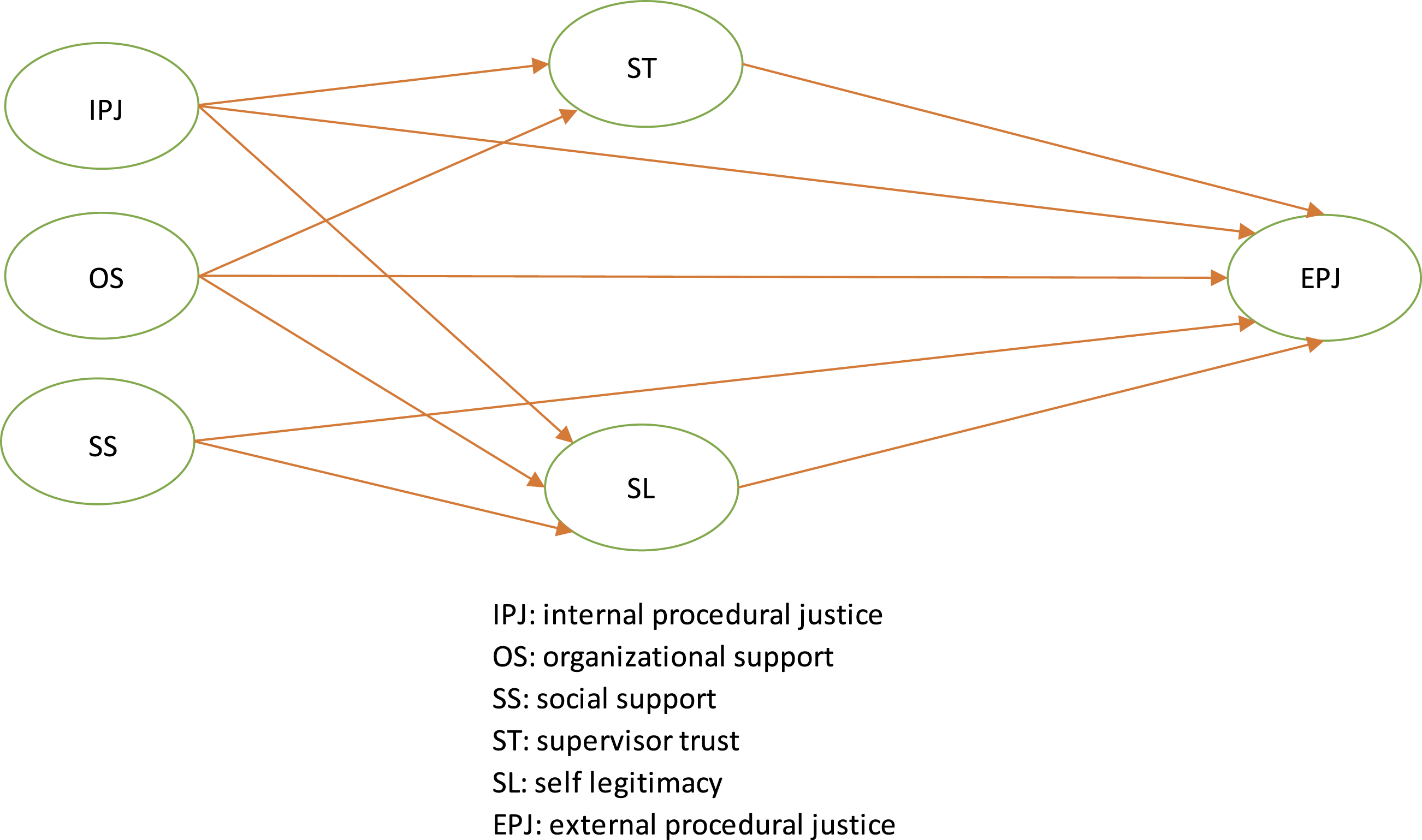
Second, we continue the centrality of legitimacy in the procedural justice scholarship by analyzing the mediating role of supervisor trustworthiness and officer self-legitimacy (e.g., officers’ recognition of their own legitimacy to rule). Recent studies found that officers’ trust in supervisors increased their compliance with agency rules and cooperation with supervisors (Wang et al., 2020). Similarly, officers’ perceived self-legitimacy plays a key role in connecting the social context of policing, both working environment (e.g., fair supervisors and organization) and social supports, to external procedural justice given to citizens (Bradford & Quinton, 2014; Tankebe, 2019). However, previous studies have rarely considered both self-legitimacy and supervisory trust simultaneously in the relationship between internal and external supports that officers received and external procedural justice that rendered to the public. Furthermore, the relative importance of their mediating role could be different across various forms of support (supervisor, organizational, and social), which is seldom assessed in previous studies.
Building on the prior works of procedural justice, the present study tests an expanded conceptual model that links the internal (supervisory) procedural justice and perceived organizational and public support to officers’ commitment to external procedural justice through supervisory trust and self-legitimacy (Van Craen, 2016; Van Craen & Skogan, 2017). Findings of this study reveal whether perceived self-legitimacy and supervisor trustworthiness are instrumental in translating internal procedural justice and organizational and social support to the delivery of procedural justice on the street. The tested theoretical framework and comparative discussions of empirical findings deliver both conceptual and pragmatic implications for improving police-public interactions in other democracies and the authoritarian China that operates under similar cultural traditions but different political systems.
Literature Review
Figure 1 displays the explanatory model, linking internal and external supports to external procedural justice directly and indirectly through supervisor trust and officer self-legitimacy. Therefore, our literature review starts with a review of description of the rationale of the theoretical model supported by a review of the direct and indirect linkages between internal and external supports and external procedural justice. We then briefly introduced recent developments in Taiwan policing, with highlights on the procedural justice literature of the Taiwanese police.
A Conceptual Model of External Procedural Justice
Van Craen (2016, p. 290) proposed a “fair policing from the inside out” model that explains police fair treatment on the street from a multidisciplinary perspective that connects internal procedural justice (e.g., supervisory procedural justice) to external procedural justice (i.e., officer procedural justice) through some psychological mechanisms, such as trust in supervisors and job satisfaction. After Van Craen’s seminal works (e.g., Van Craen, 2016), a growing number of studies have proposed and tested a number of potential mediators that may link internal and external procedural justice, in addition to investigating the direct relationship between the two (e.g., Van Craen & Skogan, 2017; Donner & Olson, 2020; Kutnjak et al., 2019; Sun et al., 2018; Wu et al, 2017). The current study has substantially extended this line of inquiry on two fronts. First, it argues that besides internal procedural justice, there are additional organizational climate factors that may significantly shape officers’ behaviors on the street. Particularly, organizational and social support represents important sources of positive influences on police performance. In the criminological literature, Colvin et al. (2002) formulated an integrated theory of crime that highlights simultaneously the crime-promoting influences of coercion and the crime-preventing influences of social support on crime. We posit that in the area of policing, differential support should also gain its due attention from researchers, recognizing that support from organization (internal support) as well as from family and community (external support) may reduce officer misconduct and encourage police positive behaviors, including fair treatment of citizens on the street. Second, our model incorporates two psychological factors that may potentially explain the effects of internal procedural justice, organizational support, and social support on external procedural justice: supervisory trust and perceived self-legitimacy. The next subsections will further elaborate on the rationales that accentuate organizational and social support as important sources of external procedural justice, and supervisory trust and self-legitimacy as meaningful mediators that link fair treatment and support to external procedural justice.
Fair Treatment and Supports Conducive to External Procedural Justice
Organizational support has long been recognized as vital in promoting desirable attitudes and behavior of employees. Employee’s views of organizational support signal their perceptions that the organization values their contributions and care about their well-being (Eisenberger et al., 1986). Perceived organizational support is manifested in the employee’s perceptions of fairness, supervisor support, and organizational rewards and job conditions (Eisenberger et al., 1986). Organizational support therefore tends to breed such positive psychological and behavioral outcomes as higher organizational commitment, lower occupational stress and burnout, stronger obligation to achieve organizational objectives, and better job performance (Zagenczyk et al., 2021).
For the police to operate effectively in a democracy, the agency’s climates and characteristics must support officers (Goldstein, 1977). Given the fact that a majority of patrol officers have a tendency to handle new situations the way they thought their supervisor would handle them (Johnson, 2008), internal democracy of the police may generate a learning effect that encourages officers to internalize the democratic values (Sklansky, 2008), which, in return, intuitively translates to favorable occupational attitudes and democratic policing on the street. Indeed, studies found that organizational support strengthened police officers’ organizational commitment, job satisfaction, and effectiveness (Boateng & Wu, 2018; Lambert et al., 2017), and shielded officers from occupational burnout and stress (Miller et al., 2017). Organizational support can come in many ways. For example, appropriate training, as a form of favorable job conditions, can enhance officers’ awareness, knowledge, and skills of handling problematic incidents such as domestic violence (Belknap, 1995), potentially fostering their inclinations to treat the public fairly and justly on the street.
Supervisor support represents one of the core indicators of organizational support (Eisenberger et al., 1986), and internal support, appropriate shadowing/coaching, and fair procedure from leaders would shape organizational outcomes and performance (Alexander & Ruderman, 1987; Edmondson, 1999). In the policing literature, supervisor support has been most frequently operationalized through the measure of internal or supervisor procedural justice, signaling supervisors’ fair and just treatments of subordinates. This line of investigation has linked supervisor procedural justice to officers’ attitudes toward external procedural justice, compliance with agency policies, responsiveness to citizen requests, and organizational climates (Bradford et al., 2014; Haas et al., 2015; Kutnjak et al., 2019; Sun et al., 2018; Trinker et al., 2016; Van Craen & Skogan, 2017; Wu et al., 2017). International studies measuring supervisor support using non-procedural justice related items also found positive linkages between supervisor support and job satisfaction, work engagement, and work performance (Jo & Shim, 2015; Kula, 2017).
Besides internal support from the department and supervisors, social support from the public constitutes a potential antecedent of officers’ willingness to treat citizens fairly. To the police, perceived external support from the public implies a direct endorsement from citizens that police are trustworthy to listen to and interact with (Van Craen & Skogan, 2017). Few studies have investigated the connection between social support and external procedural justice, but the results are encouraging. In their research on officers in an English constabulary, Bradford and Quinton (2014) showed that public support is positively associated with officers’ perceived self-legitimacy and the latter is also linked to commitment to procedurally justice policing, suggesting a possible indirect relationship between social support and external procedural justice. Jonathan-Zamir and Harpaz’s (2018) study of the Israel police found that perceived public support is positively related to officers’ support for treating people with procedural justice.
The existing literature suggests that while line officers’ perceived fairness received from police supervisors is connected to their own stronger commitment to procedural justice (or, fair treatments) toward citizen and democratic policing, organizational support and social support from the community are arguably important to officers when respectfully delivering justice on the street. We thus hypothesize that officers’ internal and external supports are directly related to external procedural justice, with greater organizational, supervisor, and social supports linking to a stronger willingness to treat citizens with procedural justice on the street.
The Mediating Role of Supervisor Trust and Self-Legitimacy
Although the police have been described as a quasi-military force, prior studies have consistently associated officers’ self-legitimacy with fair treatments received from their supervisors and practiced within the organization (Nix & Wolfe, 2018). Recent studies conducted in non-Western societies also suggest that the implications of workplace democracy are as important as the relationship between the police and the public (Sun, et al., 2019; Wu, et al., 2017). In other words, supervisory fair and respectful treatments foster managerial legitimacy from officers’ viewpoint (Sun, et al., 2018). In addition, it has been argued that legitimacy is a two-way ongoing dialogue between both sides of power (Bottoms & Tankebe, 2012), and power-holders must persuade themselves that they legitimately hold the power before claiming it over citizens (Bottoms & Tankebe, 2013; Tankebe, 2010, 2014b). Cultivating officers to claim their power is rightful thus is most likely a developmental, dynamic process from the ‘inside-out’ of police organizations (Wu et al., 2017). Specifically, being fairly treated by supervisors, officers are more likely to increase their sense of self-legitimacy (Bradford & Quinton, 2014; Tankebe, 2014b). Self-legitimacy may stem from identification with the police organization and internalization of the police values; when officers feel justly treated by their organization, they identify more strongly with it and consequently establish a firm sense of their own legitimacy (Bradford et al., 2014). Nix and Wolfe (2017) also demonstrate the importance of justice within organization on officers’ sense of self-legitimacy to the extent that it offsets the impact of negative publicity. A lack of self-legitimacy is likely to ultimately diminish police organizational capacity to tackle crime and violence (Kyprianides et al., 2010). Routine activities in which officers engage are thus important to police trainings that help establish a sense of ruler and construct a social identity of legitimate policing (Barker, 2001).
The aspect of self-legitimacy also has important effects on the way officers behave when policing. Officers with a higher level of self-legitimacy are more likely to exercise procedural justice when encountering citizens (Jackson et al., 2012). In their pioneering work, Bradford and Quinton (2014) found that police self-legitimacy predicted officers’ commitments to suspects’ rights in specific and procedural justice police in general in England. Officers with a higher level of self-legitimacy tend to have a stronger commitment to democratic policing by giving fair treatments to citizens (Tankebe, 2019). Self-legitimacy was associated with greater support for treating citizens in a procedurally fair manner (Jonathan-Zamir & Harpaz, 2018), and officers’ self-legitimacy has been argued as the foundation of cultivating and sustaining the legitimacy received from citizens (Sun, et al., 2018). In addition to these positive outcomes, self-legitimacy also reduced the likelihood of officers’ use of force; the more that officers believed in their own legitimacy, the less likely they were to use force. Collectively, recent studies have suggested that self-legitimacy should be embedded in the framework of internal-external procedural justice. Thus, cultivating officers’ self-legitimacy is beneficial when developing police personnel training, including police academies, in-service trainings, and promotional trainings/education.
Another important factor that has been tested in the procedural justice framework is trust in working relations (Hubbell & Chory-Assad, 2005). Built upon the concept of organizational justice including supervisory procedural justice, prior studies have demonstrated that a fair and respectful process to reach decisions would increase trusting relationships between supervisors and subordinates (Colquitt et al., 2001; Crow et al., 2012; Rothstein & Stolle, 2008). Lind and Tyler (1988) have pointed out that subordinates place more weight on the fair process when supervisors unbiasedly consider their voice before making decisions within an organization. Treating subordinates in a respectful and polite manner also demonstrates supervisors’ sincere concerns about organizational members’ welfare and good intentions, especially when the interaction is initiated by themselves, the side with power (Murphy, 2009). In addition, a procedurally fair working environment promotes officers’ commitment to organizational rules and values (Bradford et al., 2014) and breed a sense of trust (Wang et al., 2020). Procedural justice, which comprises fair treatment as well as fair process to reach decisions, promotes members’ voluntary compliance with organizational rules and commitment to authorities’ values. A sense of trust is enhanced, even when the outcome is not favorable to individual members or even entails personal costs (Skogan, 2006). While a sense of internal trust promotes officers’ commitment to procedural justice when interacting with citizens (Tankebe, 2014a), in a large sample of sheriff’s deputies in the USA, Wolfe & Nix (2017) found that supervisor procedural injustice reduces officers’ trust.
Prior studies largely focus on a positive role of internal procedural justice on officers’ self-legitimacy, and less attention has been paid to other impactful factors like social support. Bradford and Quinton (2014) demonstrated that officers committed to agency goals tend to have a greater sense of self-legitimacy. In fact, “the most powerful predictor of officers’ confidence in their own authority is identification with their organization” (Bradford & Quinton, 2014: 1023). Furthermore, in the context of police subculture, it has been argued that officers with strong bonds to their colleagues would have their support on the street, even though sometimes public seems to be unsupportive of the police. Empirical studies have evidenced that peer recognition enhanced officers’ self-legitimacy (Tankebe, 2008, 2019; Tankebe & Meško, 2015); the more that officers felt recognized and accepted by their peers, the greater their sense of self-legitimacy. However, such an argument also raises the concern of “licensed thugs” from a more liberal perspective. Although Tankebe (2014b) soundly pinpoints that legitimation is sideways to their loyalty to colleagues, especially within the subculture of police, the impact of peers on self-legitimacy is sometimes undetectable when a sense of justice within the organization is considered (Nix & Wolfe, 2017).
Based on the reviewed literature, we propose that supervisory procedural justice, police organizational support, and social support increase the trustworthiness of supervisors and self-legitimacy, which subsequently increases officers’ procedurally fair treatment delivered to citizens.
Fair and Just Policing in Democratic Taiwan
Taiwan occupies a geopolitically important position located at the center of the western Pacific Ocean – off China’s southern coast and between Japan and Philippine. Followed by Japan’s half-century colony and 1945 surrender, the Republic of China (ROC), led by Chiang Kai-shek and his political party (Kuomintang or KMT), took over Taiwan. Both Japan and Chiang faced significant resistance from local residents at the beginning of their regimes, and the police and military forces were used to suppress residents’ self-governing actions (e.g., Musha Incident, 228 Massacre). Inherited the legal system of civil law, the role of the police is to enforce laws on behalf of the governing body, and the purpose of policing was to maintain coercive social order, monitor political activists, and maintain the “status quo”, in addition to crime control. Taiwanese literally experienced centuries of authoritarian regimes until 1987 when KMT terminated Martial Law and opened a new page of democracy (Cao et al., 2014). Since then, there is no shortage of large-scale demonstrations and protests, including student-led Wild Lily Movement and Sunflower. The former seeks for fundamental changes regarding how democracy should be practiced, resulting in citizens gaining the right to directly vote the top leader of the island, which subsequently rotated the ruling party in central government.
Democratization is never a non-reversible process (Cao et al., 2016), and, to residents of Taiwan, it is a learning process involving both power-holders and citizens subject to the power; citizens learn to express different political opinions in a justifiable manner and authorities learn to respect the boundary of power authorized by law. Democracy continues to root in Taiwan in 21st century, as the power of the central government continues to peacefully transitions from one party to another via elections in which the police power is not abused. Empirical literature indicates that Taiwanese trust in the police, in both instrumental and expressive senses, to a great extent (Sun et al., 2014). It was once argued that Taiwanese cannot distinguish procedural-based trust (e.g., polite, patient, fair) from outcome-based trust (e.g., crime control, traffic control, emergency) in the police, but later examination revealed that urban residents had a lower level of outcome-based trust than rural counterparts while no difference was found in procedural-based trust (Wang & Sun, 2020). For another example of democratization, student protesters of 2014 Sunflower Movement occupied the congress building (so called Legislative Yuan) for the purpose of opposing the illegitimate passing of the Cross-Strait Service Trade Agreement pushed by the executive branch without due process. Given few confrontational incidents, the police-citizen interactions were relatively respectful (Ho, 2015). In addition, democratization, accompanied with a greater emphasis on human rights, has brought internal challenges (e.g., influences of political representatives and media) to police performance (Sun et al., 2016), while transnational crimes (e.g., telecommunication frauds, ATM hacking, human trafficking, disinformation and online foreign propaganda) require attention from the police (Wang & Hsieh, 2021). Despite Taiwan has become a more diverse and inclusive society (e.g., elected the first female president in Asia), the police have been argued as a self-reinforcing close system – the majority of officers are trained and educated by Taiwan Police College (TPC) for a 2 year college degree or by Central Police University (CPU) for a 4 year bachelor’s degree (Cao et al., 2014). All male Taiwanese citizens are obligated by the law to serve in the military unless medically exempted, but TPC and CPU graduates are exempt from military services. The highly centralized Taiwanese police, from cadet academies and trainings, deployments, to leadership and management, reinforce itself into a closed system. Subsequently, such a closed system can be a double-edged sword that on one hand chocks initiatives and hides potential problems within the police force (Kuo, 2018). On the other hand, shaping a team culture and developing officers’ self-legitimacy is facilitated in such a structural environment (Chen, et al., 2021).
In addition, procedural justice studies have indicated that internal procedural justice is connected to external procedural justice directly and indirectly via job-related satisfaction and strain in Taiwan (Wu, et al., 2017). It has been found that trust in the public domain promotes officer fair treatment of citizens in this democracy (Sun, et al., 2018), and Taiwanese officers’ trust in supervisors increase their compliance with police agency rules and cooperation with supervisors (Wang, et al., 2020). Also, Taiwan and China have often been compared because of their similarities (e.g., language, culture, history) and sharp differences (e.g., political system), and it is interesting to note that people on the democratic side rate a lower level of trust in the criminal justice system than those on the authoritarian side (Hsieh & Boateng, 2015; Wu, 2014). In sum, Taiwanese have practiced democracy to a great extent for close to four decades, and the Taiwanese police have changed from serving an authoritarian regime to serving the public.
Methods
Research Site and Data
Data used in the present study were collected from policemen and policewomen who attended in-service training conducted at the Taiwan Police College (TPC) in mid-2019. This 4-week course recruited line-duty officers who either never received similar training before or had a higher level of seniority among peers. Qualified trainees, who did not have any major incident against them in recent years or were not under probation, came from different local police departments across the state. Under the Ministry of Internal Affairs, the TPC is also responsible for educating line officers and granting associate degrees in Taiwan, but this segment of education is separated from the promotional trainings which this study collected data from.
Before one of the authors, who is also a faculty of TPC, administered the surveys in the classrooms by herself, officers were clearly informed about their voluntary participation in the study, which is explicitly explained not part of their trainings, and they could withdraw from the survey anytime without concerning any consequence. An 86-item survey, including demographics, was written in English and then translated into Chinese. The survey was developed by the researchers of the present study, and the dual-translation process was used to ensure the validity of content and the precision of the translation. Officers as survey participants usually feel that their experience is honorably recognized, and thus they are willing to offer inputs which is believed to help the perspective of their trainings. There were 350 surveys distributed to the trainees, and 332 of them were returned to the researcher on the spot with a response rate of 95%. The high response rate is consistent with prior survey studies adopting similar data collection methods from Taiwan police (e.g., Sun et al., 2019; Wu et al., 2017). After removing few invalid surveys, the sample dropped down to 328. Missing data analysis indicated that very few variables had one or two missing values randomly scattered in the dataset, and final analyzed sample was 318.
The majority of the respondents were male (95%), married (80%), and with some college education (64%). On average, the participating officers had 20 years of police experience, and approximately three-quarters (76%) of the respondents were assigned to non-desk duties. About 9% of the survey participants were veterans. Survey respondents also came from different cities and counties of Taiwan.
Measures
Descriptive Statistics and Reliability Test Results (N = 318).
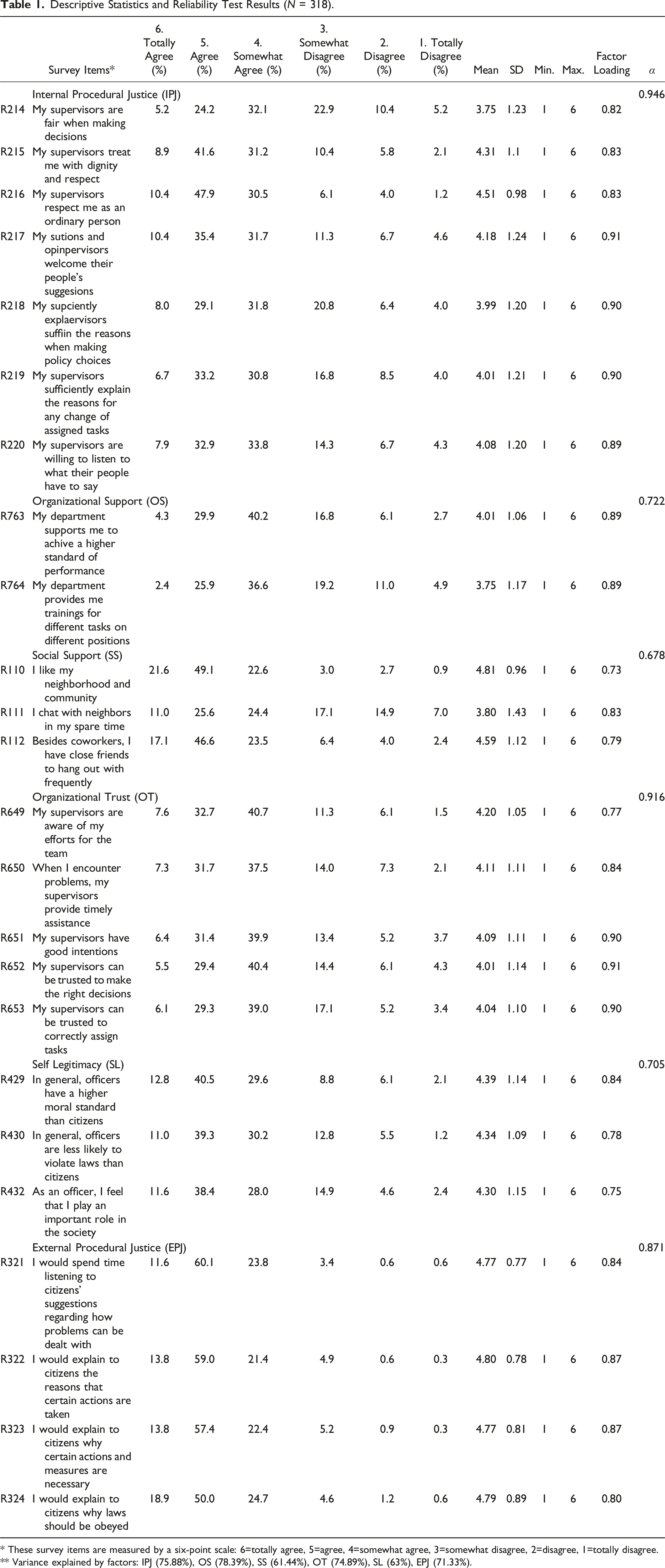
* These survey items are measured by a six-point scale: 6=totally agree, 5=agree, 4=somewhat agree, 3=somewhat disagree, 2=disagree, 1=totally disagree.
** Variance explained by factors: IPJ (75.88%), OS (78.39%), SS (61.44%), OT (74.89%), SL (63%), EPJ (71.33%).
Analysis
Structural Equation Modeling (SEM) was employed to test the mediating roles of self-legitimacy (SL) and supervisory trust (ST) between internal procedural justice (IPJ), organizational support (OS), and social support (SS), and the outcome of external procedural justice (EPJ). As a multivariate analysis technique, SEM assesses multiple causal relationships simultaneously among social constructs, observed and latent, measured by identified indicators. SEM outperforms other statistical techniques by offering statistics on how well a model fits the data and statistically gauging the significance and magnitude of the indirect effects. SEM also assesses the minimum number of causal influences among specified variables and their directions.
Our main objectives are to assess the validity of the theoretical constructs and evaluate the acceptability of the expanded conceptual model of procedural justice in the present study. Data analysis was performed using the statistical software Mplus, and the model fit was assessed by an array of indices: the chi-square measure of overall goodness-of-fit (CHISQ), the comparative fit index (CFI), the Tucker-Lewis index (TLI), root mean square error of approximation (RMSEA), and standardized root mean square residual (SRMR). It is worth noting that a significant chi-square test does not necessarily signal a poor model-data fit, as chi-square is sensitive to large sample sizes. Attention thus should be paid to good-fit criteria of other indices (e.g., CFI and TLI greater than .95, and RMSEA and SRMR smaller than 0.05 indicate good model fit) (Kline, 2005). Upon the confirmation of the hypothesized model, a suggested model generation strategy with the aid of the Modification Index (MI) was adopted to improve the model fit by changing parameter restrictions (Joreskog & Sorbom, 1993). The full information maximum likelihood (FIML) was the iteration method to estimate the parameters of coefficients in the models. This method is reasonably robust to modest violations of the normality assumption, better than the generalized least squares (GLS), another often utilized estimator, that has been documented to have a higher likelihood of negatively biased estimates, especially when the estimate model is not correctly specified (Chou & Bentler, 1995; Finney & DiStefano, 2006).
Results
The final measurement model showed a good fit of the data to the proposed model (CHISQ = 347.554, df = 232, p < .001; CFI = .977; TLI = .973; RMSEA = .04; SRMR = .042), and factor loadings are all statistically significant at the 0.001 level. Table 1 displays the descriptive statistics of all indicators of the latent factors, and indicators were all loaded on their theory-based factors. Based on the modification indices (MI), the error term for ST1 (R649) was specified to be correlated with ST2 (R650) and the error term OT4 (R652) was correlated with OT5 (R653). The error term for IPJ1 (R214) was correlated with IJP2 (R215), and IPJ2 (R215) was correlated with IPJ3 (R216). The error term for SL1 (R429) was correlated with SL2 (R430).
Next, the structural model was estimated testing that the relationships between IPJ and OS, and EPJ are mediated through ST and SL, and the relationship between SS and EPJ is mediated through SL only. The final SEM model shows an adequate fit to the data based on several indexes (CHISQ = 347.933, df = 233, p < .001; CFI = .978; TLI = .973; RMSEA = .039; SRMR = .042).
IPJ – fairly treated by supervisors – has a significantly positive impact on officers’ trust in supervisors (ST) (b = .602, p < .001, SE = .044) and a positive effect on exercising procedural justice when encountering citizens in the community (EPJ) (b = .303, p < .001, SE = .095). However, IPJ and ST do not significantly associate with officers’ self-legitimacy (SL), and ST does not significantly increase EPJ. It was found that perceived organizational support (OS) significantly increases ST (b = .344, p < .001, SE = .051) and self-legitimacy (SL) (b = .431, p < .001, SE = .087), with the latter subsequently increasing officers’ tendency to practice procedural justice when encountering citizens (EPJ) (b = .283, p < .001, SE = .07). The mediating roles of SL explains away the direct impact of OS on EPJ. Finally, perceived social support (SS) significantly increases officers’ commitment to deliver procedural justice (EPJ) (b = .344, p < .001, SE = .076) but not officers’ self-legitimacy (SL).
The proposed model and hypotheses are partially supported by the empirical examination. Specifically, police internal procedural justice increases the trustworthiness of supervisors, as well as officers’ commitment to procedural justice. Both officers’ perceived social support outside the police circle and their self-legitimacy increase officers’ tendency to deliver fair treatment to citizens. In addition, organizational support boosts both supervisory trust and officers’ self-legitimacy. It is surprising that supervisory trust neither increases officers’ procedurally fair treatment delivered to citizens nor enhances officers’ self-legitimacy (Figure 2). Structural equation model.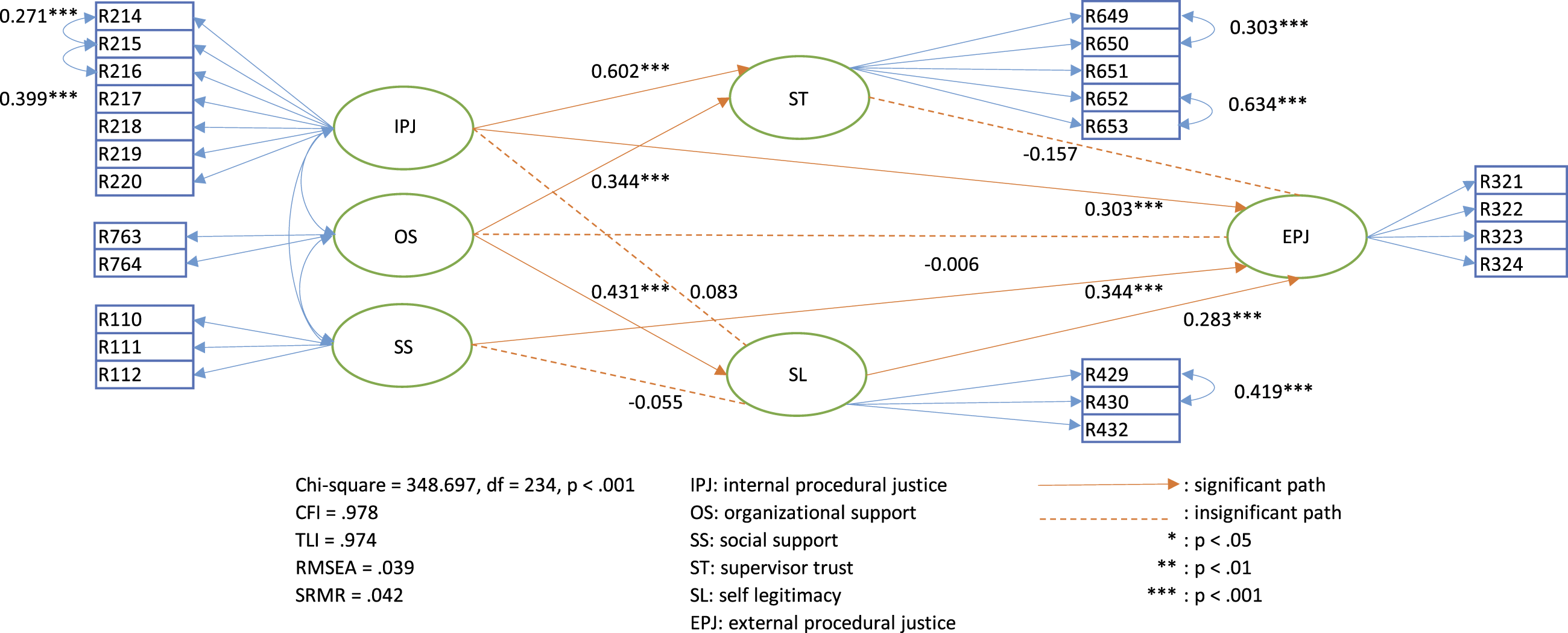
Discussion and Conclusion
The importance of training cannot be overemphasized in many professions. In policing, proper and effective training brings many positive outcomes, such as improving officer performance, reducing agency liability, increasing officer working morale, and mitigating community aversion to the presence of law enforcement. Inadequate or inappropriate training often results in inaccurate assessments of situations and poor decision making, and the consequences can be devastating, or even lethal, especially among first-respondents like the police. Officers’ learning, however, occurs not only in the classroom and on training sites but also through interactions within the police organization. The present study explicitly shows that supervisors’ respectful and justifiable manners, especially in the interactions with subordinate officers (Colquitt et al., 2001), do matter in forming a sense of trust in supervisors, confidence in policing, and commitment to procedural justice policing.
Recent studies suggest that workplace democracy is an effective option for management internal of law enforcement organizations, although the police has been characterized as a top-down hierarchical organization (Wilson & McLaren, 1977), in which rookies are socialized to hold the confidence in their authority as an officer. Appropriate training like procedural justice can reduce officers’ feelings of under-confidence or overly confident. Drawing on the work of the internal-external procedural justice framework, the present study employed survey data collected from Taiwanese officers to expand the framework by evaluating the mediating roles of supervisory trust and self-legitimacy in connecting internal and external procedural justice, and examining the direct and indirect effects of organizational and social support that officers receive in shaping their procedurally fair behaviors on the street. Specifically, we found that the procedural justice that officer received internally boosts their supervisory trust and predisposes them to deliver procedural justice externally. Inconsistent with prior studies (Bradford & Quinton, 2014; Nix & Wolfe, 2018; Sun et al., 2018; Tankebe, 2014b), internal procedural justice does not cultivate officers’ self-legitimacy while organizational supported training is considered, thus its impact on external procedural justice is chiefly direct. The connection between internal and external procedural justice may route through other mechanisms like social learning (Van Craen & Skogan, 2017), and a sense of right-to-govern is likely to be trained.
For various reasons, officers’ recognition of their own legitimacy to rule (or, ‘self-legitimacy’) plays a key role in connecting the social context of policing, both working environment (e.g., fair treatments received from supervisors, organizational support) and social supports, to external procedural justice given to encountered citizens (Bradford & Quinton, 2014; Tankebe, 2019). Self-legitimacy has been elaborated as a continuous dialogue between powerholders and audiences (Bottoms & Tankebe, 2012), with power-holders’ self-legitimacy serving as the foundation of cultivating and sustaining audience legitimacy. An essence of officers’ right to govern comprises their own sense that the role as law enforcer and the demands of citizen compliance are justifiable. Furthermore, officers taking trainings would escalate a sense of organizational support that assures organizational investments in their human capital, which subsequently increase their trust in supervisors and enhance their confidence in governing. For managing purposes, it might be equally important for police organizations to pay attention to applicants and on-duty officers’ attitudes toward procedural justice during the training.
To officers, although good relations with colleagues consistently predict their organizational commitment, support from the community is equally important for both police effectiveness and legitimacy (Coicaud, 2002; Ren et al., 2005). Noticeably, officers who perceive stronger social support tend to have a higher level of willingness to deliver procedural justice. Receiving support from ordinary residents outside of the police enclosed circle is essentially important in democratic policing (Coicaud, 2002), and such support directly promotes officers to respectfully and fairly treat citizens out of good intentions. Support from the civilian community outside of the police group, however, does not have a significant indirect effect on procedural justice through self-legitimacy in the present study. Indeed, while the connection between police self-legitimacy and procedural justice is confirmed, there is no statistical evidence to back a direct effect of perceived social support on officer perception of self-legitimacy. A plausible explanation is that Taiwanese officers seem to rely on legality (the legally prescribed police power), rather than public support, as an important source of power-holders’ legitimacy. The conceptualization of legitimacy forms the western foundation of the rule of law. The Chinese concept of legitimacy has been argued as the rule by law, which is not a dialogue but basically a one-way top-down approach (Cao et al., 2016). In a democratized Chinese society, the Taiwanese police usually build their sense of legitimacy solely on law or legality, while the western concept of democracy continues to influence how ordinary people conceptualize legitimacy and revalidate democratic policing. Whether the model here can be replicated in other Chinese societies, including those that might have been ruled under authorities of “dull compulsion” (Bottoms & Tankebe, 2012), should be empirically tested in future research (Wu et al., 2019). Variables that might be unique to Taiwanese policing, such as sentiment, reason, and law (Martin, 2019), should also be considered in future search.
A sense of justice within police organizations might fully explain the impact of peers on officers’ self-legitimacy (Nix & Wolfe, 2017), but our empirical findings do not support that a sense of supervisory trustworthiness plays a mediating role between organizational support and procedural justice delivery. Instead, perceived support from the police organization helps officers build self-legitimacy which further leads to procedural justice. Legitimation therefore may be sideways to their colleagues’ support within the subculture of police (Tankebe, 2014b).
Our broadened framework of IPJ-EPJ connections and empirical findings offer pragmatic policy implications for legitimation. Developing officers’ self-recognition of the moral validity of power appears to be a missing piece of the puzzle in prior IPJ-EPJ framework, and this study demonstrates that self-legitimacy has an important mediating role that explains the effect of organizational support on officers’ commitment to procedural justice. When officers believe that their departments instrumentally support them, including providing necessary training to improve performance, they are more likely to identify themselves as authority figures, which further contributes to their decision makings being structured in a trained and consistent, and hopefully democratic, manner.
Our empirical evidence demonstrates that daily operations involving supervisor-subordinate fair interactions and organizational supported trainings enhance officers’ trust in supervisors. However, supervisory trustworthiness does not lead to procedural justice policing on the street, and consequently the impact of supervisory trustworthiness is only direct as aforementioned. Meanwhile, organizational support boosts a sense of legitimate power that officers are entitled to, which in turn increases their chances to conduct democratic policing. Therefore, department support is a critical, direct, antecedent of self-legitimacy, as well as a significant, indirect, influencer of officer procedural justice that deserves more research attention. Consequently, it is pivotal for police departments to support line officers in order to achieve higher standards of performance including providing trainings for successful completion of different tasks regardless of job positions.
It is worth reiterating that democratization is never a one-way process (Cao et al., 2016). Thus, we do not mean to claim that the entitlement of power, even through organizationally sponsored training, is concern-free from and will not deviate from the path of democratic policing. Power-holder and audience legitimacy occupy different societal spaces, and thus the two groups, officers and citizens, see things very differently. In a similar vein, to the officers, the introduction of perceived social support from non-governmental groups (e.g., friends, neighbors, family) ensures legitimation, which is cultivated internal of the police, is aligned with social expectations and local needs.
Some limitations of the present study should be addressed to further research. First, because the data were collected from senior line officers who were qualified to receive promotional trainings, the generalizability of the findings may be somewhat limited. Sampled group in this study are seasoned line officers, and the development process might be different from police cadets, especially those in 4-year degree programs at Central Police University. Second, although the statistical model employed has a great capacity to simultaneously consider multiple plausible causal paths, the data were collected in a “snapshot” survey, not in a longitudinal fashion. The time-order of variables thus naturally posts limitations on causal inferences, and future research should consider adopting longitudinal designs. Third, external procedural justice measures intent/willingness not actual treatment of citizens in procedurally just ways. Other types of research design, when feasible, should be considered in future research. Fourth, variables indigenous to Taiwan were not considered in this empirical study. As one of the post-Confucian societies, the value system in Taiwan is different from civil society of the West, even after the contemporary political transformation (Cao et al., 2016). Democratization of policing in such a different cultural context has brought unique challenges (e.g., black gold politics (Chin, 2003)), and future research should develop more indigenous variables specifically to this young democracy (Martin, 2014).
To conclude, the present study suggests that placing self-legitimacy at the center of an on-going process of dialogue within the police organization is a valuable allocation of resources. Legitimacy can be found where police organizations provide trainings to cultivate power-holders’ moral rights to exercise their power. The effects of supervisors’ procedurally fair treatments and officers’ perception of social support received from community can directly reach outside of the police circle and impact officer procedural justice on the street, regardless their effects on trust in supervisors or perception of self-legitimacy. In contrast, the positive influence of organizational support is mainly indirect through enhancing police self-legitimacy. Therefore, supervisory procedural justice, police organization support, and social support should be sufficiently addressed within the organization in the context of democratic policing.
Footnotes
Declaration of Conflicting Interests
The author(s) declared no potential conflicts of interest with respect to the research, authorship, and/or publication of this article.
Funding
The author(s) received no financial support for the research, authorship, and/or publication of this article.
