



Abstract
Class-wide Function-related Intervention Teams (CW-FIT) is a classroom management intervention in which teachers incorporate positive behavior support (PBS) principles by teaching specific classroom expectations and providing feedback on student behavior as part of an interdependent group contingency. Interventions like CW-FIT may be helpful for students with emotional or behavioral disorders (EBD), as such students often struggle to succeed in school. In the present replication study, researchers examined the effects of CW-FIT in a self-contained U.S. elementary EBD classroom. One teacher and her five students with EBD participated. Researchers used an A-B-A-B withdrawal design with maintenance probes to examine changes in students’ on-task behavior, as well as teacher praise and reprimand rates. Results revealed the teacher was able to implement CW-FIT with fidelity with corresponding increases in student on-task behavior and teacher praise, though there was little effect on teacher reprimands. The teacher and the students found CW-FIT to be socially valid. Results suggest CW-FIT can be an effective classroom management intervention in self-contained elementary EBD classrooms.
Students who are at risk for or are classified with EBD often struggle in school both academically and socially (Bowman-Perrott et al., 2023; Wagner et al., 2005). A common feature of EBD is an inability to cultivate or maintain interpersonal relations with others (Individuals With Disabilities Education Act, 2004). Studies have shown that students diagnosed with EBD exhibit lower levels of social skills than both peers who are typical and peers with other disabilities (Wagner et al., 2005). These findings are especially concerning because a successful education is often dependent on learning social and interpersonal skills so students can successfully interact with their teachers and peers (Caldarella et al., 2018). Students classified with EBD also often perform below their grade level and as a result fall further behind their peers both academically and socially (Bowman-Perrott et al., 2023; Wagner et al., 2005). An intervention that may help students with EBD to be more successful in school is Class-wide Function-related Intervention Teams (CW-FIT).
CW-FIT
CW-FIT is a classroom management intervention that incorporates positive behavior support (PBS) principles by teaching specific classroom behavioral expectations during instructional time and providing students specific feedback on their behavior and use of social skills at predetermined timer intervals (Caldarella et al., 2015; Wills et al., 2009). The purpose of CW-FIT is to increase classroom on-task behavior and teacher praise rates and to decrease teacher reprimand rates. A primary component of CW-FIT is its focus on teaching and reinforcing student on-task behavior by implementing an interdependent group contingency (Conklin et al., 2017). If one student in a particular group is off task, then the entire group is considered off task, even if the other members of the group are demonstrating on-task behavior. This motivates all the students in the group to demonstrate appropriate behavior (Bolt et al., 2019). CW-FIT has been shown to be effective in increasing students’ class-wide on-task behavior and teacher praise-to-reprimand ratios in elementary general education classrooms (Caldarella et al., 2015; Conklin et al., 2017; Kamps et al., 2011; Wills et al., 2009, 2021) though more research is needed for students with special education needs.
CW-FIT and the Good Behavior Game (GBG) are both interdependent group contingencies that are similar in their approach but differ in several ways (Wills et al., 2021). In the GBG, the teacher assigns students to one of two teams. If one student on a team misbehaves, then the whole team gets a negative tally. Thus, in the GBG, points are given to teams for inappropriate behaviors, and the team that has the lowest number of points (the fewest number of inappropriate behaviors) is rewarded at the end (Wills et al., 2021). With the GBG, teachers also do not typically tell students how many point infractions they are allowed, which means that students have no way to understand how they are doing. CW-FIT, on the other hand, separates students into three to six teams, depending on the size of the class, and students are awarded points based on their groups’ performance rather than the behavior of other groups. Teachers provide points for appropriate behavior to teams at regular intervals, as well as provide students point updates at these intervals by reminding students of the target behaviors and point goal (Wills et al., 2021). With CW-FIT, teachers are also trained to provide behavior-specific praise and feedback when awarding teams points, while the GBG does not actively work to increase teacher praise rates.
CW-FIT With Special Education Populations
Relatively few studies have examined the effects of CW-FIT in elementary special education classrooms. One study implemented CW-FIT in an elementary resource classroom (Wilson, 2015). In this study, data were collected on two students with an educational classification of autism and one student with an educational classification of emotional disturbance. Both teacher praise statements and classroom on-task behavior were assessed. Results were consistent with other CW-FIT studies and demonstrated increased praise statements upon implementation of CW-FIT. Furthermore, on-task behavior for the students increased by an average of 37.00%.
There have been several studies examining the effects of CW-FIT on students at risk for EBD in general education classrooms (Caldarella et al., 2018; Kamps et al., 2011; Wu et al., 2019). These studies have generally found increased on-task behavior rates from students with EBD, as well as decreases in classroom disruption rates upon implementation of CW-FIT. Caldarella et al. (2018) further concluded that CW-FIT is an appropriate and socially valid tool for elementary school teachers to utilize to help students with EBD.
Only one study has examined CW-FIT in a self-contained elementary special education classroom serving students with EBD (Weeden et al., 2016). Before implementing the intervention, participants demonstrated a wide range of off-task behaviors, such as arguing, out-of-seat, and talking-out behaviors while the teacher was instructing (Weeden et al., 2016). Implementation of CW-FIT resulted in increased class-wide on-task behavior, increased teacher praise behaviors, and decreased teacher reprimand behaviors. These findings demonstrate that CW-FIT was an effective classroom management intervention in this self-contained elementary classroom serving students with EBD.
Need for Replication Studies
Although Weeden et al. (2016) demonstrated positive results, it is also the only study to have examined the effects of CW-FIT in an elementary classroom serving students with EBD. Because of this, studies need to be conducted that implement CW-FIT in additional elementary self-contained EBD classrooms to determine if the results are replicable. Systematic replications of studies in educational research are important because the effectiveness of an intervention can vary widely based on the setting in which it is implemented. Systematic replications are those in which experimental procedures are largely repeated, but some aspects of the original study vary, such as the participants or the settings, to determine whether the results will be generalizable. Through examination in systematic replication studies, the effectiveness of CW-FIT as an intervention can be better evaluated. This is especially true with student populations with or at risk for EBD since such students are greatly affected by the consequences of their behavior both academically and socially (Caldarella et al., 2018; Wagner et al., 2005). Interventions must be tested and replicated to demonstrate their effectiveness with this population.
Study Purpose
The purpose of this study was to conduct a systematic replication of Weeden et al. (2016) and implement CW-FIT in a self-contained EBD classroom. Students are placed in self-contained classrooms when their behavior is so extreme they are unable to remain in their general education classrooms. Weeden et al. (2016) demonstrated the effectiveness of CW-FIT when used in a self-contained special education classroom serving elementary students with EBD. This study aimed to confirm the results of Weeden et al. (2016) by implementing CW-FIT in another self-contained EBD special education classroom, thus adding to the literature. This study addressed the following primary research question: (1) To what degree does the implementation of CW-FIT in a self-contained EBD classroom affect group on-task behavior within the classroom? This study also addressed the following secondary research questions: (2) To what degree does the implementation of CW-FIT affect teacher praise and reprimand rates? (3) To what degree do the participating teacher and the students find CW-FIT to be socially valid? (4) To what degree can an elementary teacher in a self-contained EBD classroom implement CW-FIT with fidelity?
Method
Setting and Participants
This study took place in an elementary school serving students in kindergarten through sixth grade in a suburban area in the Mountain West region of the United States. Data were collected in one self-contained EBD classroom at this elementary school during the second semester of the 2022–2023 school year. The teacher and her classroom were recruited because the first author of this study had previously worked in this classroom as a paraeducator. Two paraeducators also worked in the classroom but did not participate in the study.
The teacher was a White 24-year-old female who had been teaching special education for 2 years and was in her second year of teaching in this self-contained EBD classroom. There was a total of five male students in her class, with one student in third grade and four students in fourth grade. Four of the students were White, and one was Hispanic/Latino and an English language learner. Four of the students had an educational diagnosis of emotional or behavioral disability (as classified under state law), and one student had an educational diagnosis of autism. Each student in the classroom had the same behavior intervention plan, which included a level/reward system, social skills instruction, praise, and a visual schedule and consistent routine. Scheduled breaks and a fidget option for sensory functions were also used for those students who had additional needs. Seclusion and restraint were also used when students were being physically unsafe to themselves or others. Two additional students were placed in this classroom during the study; however, these students were not included as participants, and no data were collected on them.
Dependent Variables and Measures
Researchers were trained to collect class-wide on-task behavior, teacher praise and reprimand, and intervention fidelity data during 20-min in-person observations. Researchers were trained by a university-based CW-FIT coordinator who provided practice video recordings so the researchers could practice observing class-wide on-task behavior and teacher praise and reprimands. When researchers reached 80.00% agreement with the practice video administration, they were able to begin observing in person. Researchers also recorded procedural and intervention fidelity after each observation. Interobserver agreement (IOA) rates for each observation were also recorded. The researchers who conducted observations and collected data were the first author of this paper and the university-based CW-FIT coordinator. During observations, researchers stayed near the back of the classroom so as not to disturb instruction and to have a better view of the whole classroom. Observers did not participate in any of the activities being observed. After the final intervention phase, the teacher and her students were provided with surveys to evaluate the social validity of CW-FIT. The teacher was also given an interview to gather qualitative data on her perceptions of CW-FIT. More details on the dependent variables and measures are provided below.
Class-Wide On-Task Behavior
Class-wide on-task behavior was the primary dependent variable in this study. Class-wide on-task behavior percentages were collected by researchers using a classroom behavior measuring sheet. Observers used momentary time sampling procedures to record class-wide on-task behavior by marking teams as on-task or off-task every 30 s over an observation period of 20 min. The instances of on-task behavior were then added up and divided by the total observations made. This number was then multiplied by 100 to get the percentage of class-wide on-task behavior.
Teams were considered on task if, at the 30-s mark, every student in the group was appropriately working on the assigned or approved activity. This looked like students attending to the material of the appropriate task; making appropriate motor responses, such as writing or looking at the teacher or student speaking; appropriately asking for assistance, such as raising their hand; and waiting appropriately for the teacher to continue with classroom instruction, such as sitting quietly in their seat. Teams were considered off task if, at the 30-s mark, one or more students on a team were not participating in an approved or assigned activity. This included behaviors such as one or more students staring into space, talking out, engaging in disruptive behaviors, or being out of their seat.
Teacher Praise and Reprimands
The secondary dependent variable was the teacher praise and reprimand rates. During each 20-min observation period, observers recorded the frequency of teacher praise and reprimands by marking a tally. These tallies were marked for both individual praise and reprimands and group praise and reprimands. Praise statements included behavior-specific praise, such as, “Good work staying in your seat,” as well as more general praise statements indicating approval of student behavior, such as, “Well done.” Praise statements did not include simply acknowledging correct answers from students, such as saying, “Yes, that’s right.” Reprimand statements were defined as verbal statements indicating disapproval of inappropriate behaviors or were seen as a correction of student behaviors, such as, “You need to sit down,” or “Please raise your hand if you wish to talk.”
Intervention Fidelity
After each observation, researchers rated the teacher on her implementation of CW-FIT using an intervention fidelity form (see Figure 1). This form included nine items rating how well the teacher implemented the components of CW-FIT rated on a scale from 1 (low) to 3 (high). These items included statements such as “Classroom expectations clearly posted” or “Timer used and set at appropriate intervals.” A fidelity percentage was calculated by dividing the total rated points recorded by the observer by the total possible fidelity points and then multiplying the number by 100. After the first three observations during the initial intervention phase, researchers checked to ensure the teacher implemented CW-FIT with at least 80.00% fidelity. After each of these three observations, researchers provided the teacher with the top half of the fidelity sheet to provide feedback on how she was rated. Researchers had planned to provide verbal feedback about how to improve her implementation if fidelity was below 80.00%, but this was not necessary with this teacher.

CW-FIT Treatment Fidelity Checklist.
Results demonstrated the teacher implemented CW-FIT with an average of 97.00% intervention fidelity (SD = 6.62%) in the first intervention phase. During the second intervention phase, the teacher implemented CW-FIT with an average of 98.00% intervention fidelity (SD = 2.03%). During the maintenance phase, the teacher’s intervention fidelity dramatically decreased to an average of 35.00% fidelity (SD = 2.01%). During the maintenance phase, the teacher did not fully implement CW-FIT in her classroom, meaning that she did not separate students into teams, award them points, or give teams rewards for good behavior. However, she did continue to maintain a high praise rate and have her own classroom expectations posted on the wall, which are key components of the CW-FIT intervention.
Social Validity
Social validity data were collected from both the teacher and the students at the end of the study using the same measures that were used in past CW-FIT studies (see, e.g., Caldarella et al., 2015; Wills et al., 2021). Social validity data were collected at the end of the study because this is what has been done in past CW-FIT studies, and thus, as part of the attempt to complete a systematic replication. These measures were chosen to measure the social validity of CW-FIT because the items asked specifically about components of CW-FIT. The teacher completed a 10-item questionnaire about her perceptions of CW-FIT (see Figure 2). This measure included items such as, “I enjoyed being a CW-FIT Intervention Teacher,” and “The timer was manageable for use during instruction.” Researchers also conducted an in-person interview with the teacher about her experience with CW-FIT to obtain more qualitative data about the use of the intervention. Interview questions included, “Which aspect(s) of CW-FIT were most helpful to you?” and “How would you modify the CW-FIT program for future use?” Students were provided with a social validity survey to understand their experiences with CW-FIT. This 6-item questionnaire included two yes or no questions and four open-ended items to gain an understanding of students’ attitudes about the intervention. Items on this measure included, “What do you like about CW-FIT?,” “What didn’t you like about CW-FIT?,” and “Do you think other students should get to use CW-FIT in their classrooms?” This survey was offered to students in both English and Spanish.
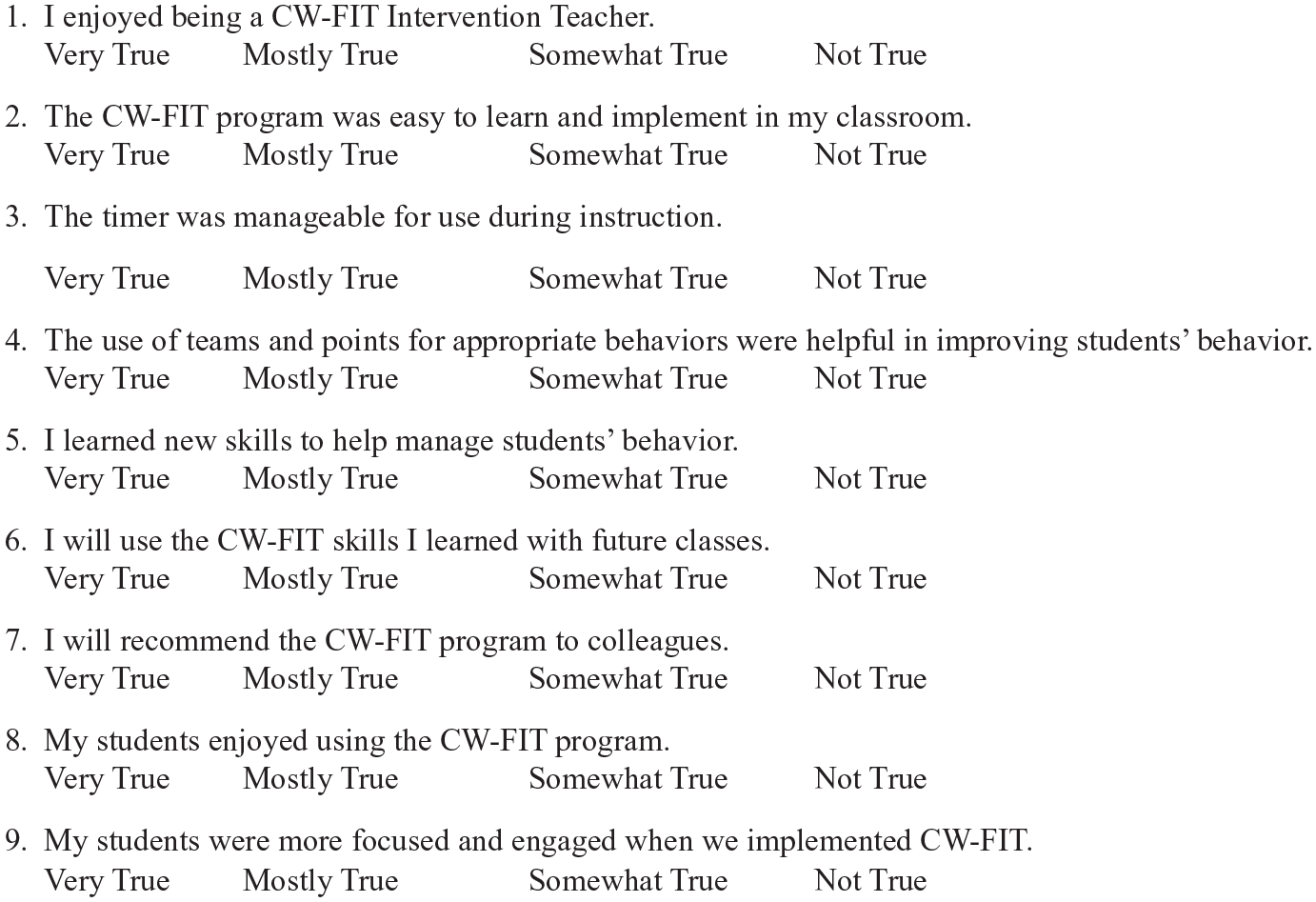
Teacher Social Validity Survey
Interobserver Agreement
Interobserver agreement (IOA) was calculated for 40.00% of the observations for each phase of the study. For class-wide on-task behavior, IOA was calculated by dividing the number of agreed intervals by both observers by the total number of intervals and multiplying that number by 100. As teacher praise and reprimand data were frequency data, IOA percentages were calculated by dividing the number of the lower total count by the higher total count and multiplying that number by 100. The average on-task behavior IOA was 95.93% (SD = 0.02; Range = 92.50–97.50%). The average IOA for individual praise statements was 89.74% (SD = 11.99; Range = 73.33–100%). For group praise statements, the average IOA was 87.50% (SD = 31.73; Range = 0.00–100%). The average individual reprimand IOA was 71.50% (SD =38.88; Range = 0.00–100%). The average IOA for group reprimand statements was 85.00% (SD = 33.75; Range = 0.00–100%). Lastly, the intervention fidelity IOA was 98.89% (SD = 1.79; Range = 96.30–100%).
For group praise statements and individual and group reprimand statements, the range low was 0.00%, which may be explained by a low occurrence of teacher behaviors during some observation sessions. Low-frequency behaviors are likely to be more susceptible to low IOA when the formula is based on lower total count/higher total count x 100. For example, an observation of one reprimand by the first observer and zero reprimands by the second observer would yield 0.00% IOA. This has occurred in some past CW-FIT studies (Wills et al., 2021). Another possible explanation is that there was some disagreement among observers about what constituted a group praise statement or an individual or group reprimand statement, which may have contributed to the range of lows for these variables.
Procedures
Consent
Before beginning the study, researchers met with the teacher and the special education director of the school to go over the expectations of the study. Institutional review board approval was then obtained from the university and school district. Teacher consent forms and parent assent forms were distributed. Parents were given a week to indicate whether they wanted their child to participate in the study. Child assent forms were then distributed to the students in the classroom. All parents and students agreed to participate.
Baseline
Dependent variables were measured for 5 days during baseline conditions. The teacher chose a time of day to implement CW-FIT based on low levels of student on-task behavior, which was in the mornings during math instruction. While baseline data were recorded, business-as-usual instruction in the classroom was conducted by the teacher, which consisted of the students rotating between four math instruction groups. The teacher instructed one of these groups, while also monitoring the other groups, which were led by the two paraeducators.
Training
Once baseline classroom on-task behavior was recorded, the teacher received a 1-hour after-school training on how to implement CW-FIT. Training was completed in the teacher’s classroom. Researchers conducted the training by presenting CW-FIT training slides and explaining the fundamental aspects of how to implement the intervention in the classroom. The researchers checked with the teacher for understanding throughout the training by asking whether she understood how to implement CW-FIT and answering any questions she had. Researchers also provided the teacher with the CW-FIT training slides so she could review them before implementing the intervention in her classroom. As part of the training, the teacher was instructed to implement CW-FIT during her regular classroom instruction. After her first implementation of CW-FIT, she was given feedback by researchers using the intervention fidelity form. This was done to ensure the teacher correctly understood the intervention and was implementing CW-FIT with fidelity before implementing it without researcher feedback. If the teacher did not implement CW-FIT with fidelity during this initial implementation, researchers provided the teacher with specific feedback on those portions of the intervention that she did not implement correctly so she could improve implementation during the intervention phase.
Intervention
The next phase of the study was implementing CW-FIT in the classroom without researcher feedback. The teacher implemented the standard CW-FIT intervention and introduced it to her students as a game. Five data points were collected over 5 days.
Social Skills Lessons
The teacher instructed her students on social skills and classroom behavior expectations. These included lessons on ignoring inappropriate behavior, following directions the first time, and how to get the teacher’s attention. These expectations were displayed on posters which were hung on the wall for everyone in the class to see and included specific steps for the students on how to demonstrate those behaviors in class.
Teams
The teacher divided her class into two teams based on where their desks were situated in the classroom, with two participating students on one team and three on the other. The two new students who were added to the classroom during the study were placed in a group together, so their behavior would be less likely to affect the students participating in the study.
Timer
The teacher was instructed to set a timer for whatever interval she believed would be most beneficial for their students and chose a 5-min interval. The teacher had the discretion to set the timer for longer or shorter intervals, depending on the needs of her students, but chose to maintain the 5-min interval throughout the study.
Goals, Points, and Praise
Before beginning each CW-FIT session, the teacher set a goal regarding how many points each team would need to earn during the class period. This point goal was determined by the total amount of time CW-FIT was played that day. The teacher calculated the number of timer beeps based on the total time CW-FIT was played and then multiplied the number of beeps by 0.80, which resulted in the point goal for the day. For example, if CW-FIT was going to be played for 45 min with a 5-min interval timer, then the goal would be 7 points. When the timer sounded, the teacher scanned the room and awarded points to those teams who were demonstrating the social skills and behavioral expectations they were previously instructed on. The teacher also gave behavior-specific praise to those teams who received points and behavior-specific feedback to those teams who did not receive points so they could improve their behavior. The teacher also had the option to award bonus points and extra praise to teams demonstrating the classroom behavior expectations. All team points were recorded on a point chart which was posted in the classroom.
Reward
Before beginning CW-FIT, the teacher determined with the students what the reward for attaining the point goal would be for that day. When the CW-FIT session ended, the teacher tallied the points each group received. If a team had met the point goal, they would immediately receive the reward that had been determined. The common reward provided was 10 min of video game time.
Withdrawal
The next phase of the study was the withdrawal of the CW-FIT intervention. The teacher discontinued reviewing the classroom social skills and behavioral expectations, took down the social skills posters and point chart, and was instructed to teach as she had during the initial baseline phase. Five points of data were collected over 5 days.
Intervention
During the fourth phase of the study, the teacher implemented CW-FIT as she had during the first intervention phase. Five points of data were collected over 5 days.
Maintenance
A maintenance phase began the week following the end of the second intervention phase. Maintenance probes were collected once per week over 5 weeks. During these maintenance observations, the teacher was able to decide whether she wanted to use CW-FIT. During each of the maintenance observations, the teacher did not implement CW-FIT. However, she did continue to maintain a high praise rate and have classroom expectations posted on the wall, which are key components of CW-FIT.
Research Design
This study was conducted using a single-subject A-B-A-B withdrawal design with maintenance probes. Five data points were collected for each phase. Given the small sample size, data were only collected if at least 80.00% of students were present in the classroom.
Data Analysis
Researchers conducted visual analyses using Maggin et al.’s (2013) protocol by examining changes in level, trend, and variability within and between phases. Maggin et al.’s protocol is based on What Works Clearinghouse standards for single-subject research (Kratochwill et al., 2010). Researchers also used the conservative dual-criterion (CDC) method to strengthen the visual analysis. This method was used to lessen the likelihood of a type I error occurring by setting the trend lines an additional .25 standard deviations in the direction of the expected change (Fisher et al., 2003). With this method, there is evidence of a systematic change between phases if a certain number of points in the intervention phase fall above or below both the mean and the trend lines calculated. Fisher et al. (2003) specify that for the number of data points in this study, for systematic change to be demonstrated, each data point must be above the mean and trend lines for baseline to intervention phases and below the mean and trend lines from intervention to baseline phases. In addition, Swoboda et al. (2010) detailed the procedures for applying the CDC method to A-B-A-B withdrawal designs. Swoboda et al. (2010) also provided the Excel functions to calculate the mean and trend lines for this study. The CDC method was used to draw mean and trend lines on the graphs presented in the results section.
Teacher praise and reprimand rates were analyzed by comparing means and standard deviations of both individual and group praise and reprimands across study phases. Intervention fidelity was analyzed using the fidelity checklists previously described and calculating percentages across phases. Social validity data were analyzed by using descriptive statistics and looking for themes in the responses provided in the satisfaction surveys and interviews. The purpose of the analysis of the qualitative data was to describe how well CW-FIT operated in the classroom, as well as provide context for the effects of the intervention.
Results
Class-Wide On-Task Behavior
The mean percentage of baseline class-wide on-task behavior for the first baseline phase was 33.25% (SD = 11.03%), ranging from 17.50% to 45.00%, with a downward trend and high variability (see Figure 1). During the first intervention phase, class-wide on-task behavior increased sharply, to a mean of 80.00% (SD = 7.03%), ranging from 71.25% to 92.50%, with an upward and stable trend. Upon the removal of CW-FIT, on-task behavior immediately decreased to a mean of 62.00% (SD = 3.71%), ranging from 57.50% to 67.50%, with a slightly downward stable trend. Class-wide on-task behavior rates rose again immediately upon reimplementation of CW-FIT in the final intervention phase to a mean of 81.34% (SD = 5.06%), ranging from 74.36% to 86.25%, with a moderately variable and slightly downward trend. CDC results suggested there was a systematic change between baseline and intervention phases, as data points in each phase exceeded the mean and trend lines calculated (see Figure 3). On-task behavior decreased slightly during the maintenance phase to an average of 76.74% (SD = 7.46%), ranging from 65.00% to 82.50%, but was still significantly above baseline levels and was more variable than all but the first baseline phase.
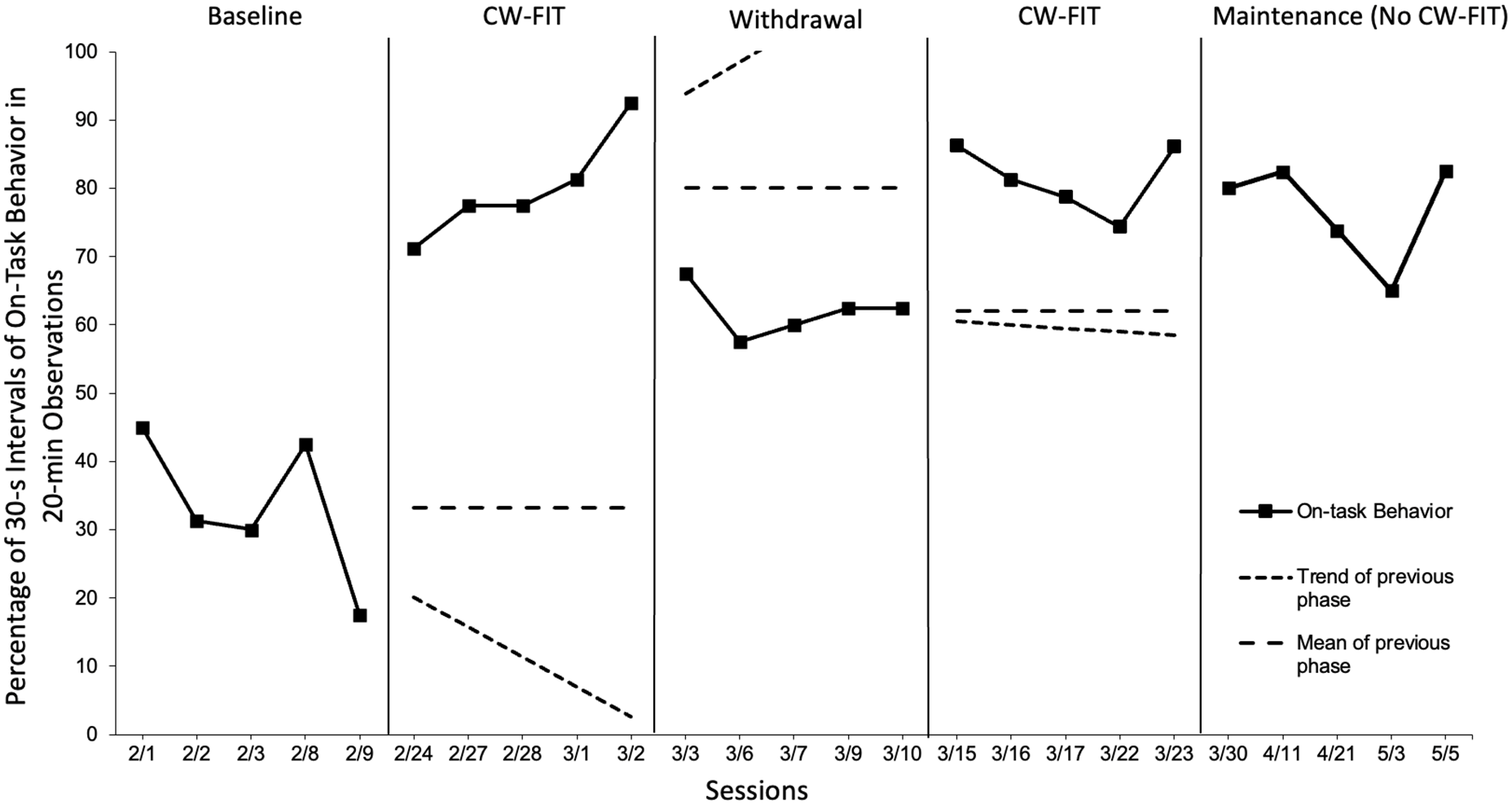
Changes in Class-Wide On-Task Behavior Across Phases With CDC Mean and Trend Lines.
Teacher Praise and Reprimand Rates
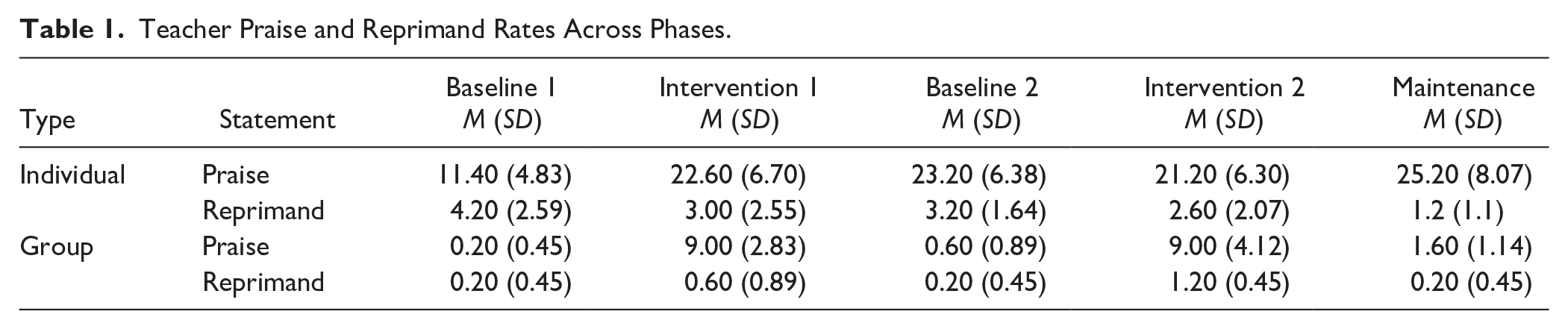
We examined data for both individual and group praise and reprimand statements (see Table 1 for means and standard deviations across phases). Group and individual praise statements significantly increased upon implementation of CW-FIT in the first intervention phase individual teacher praise statements stayed consistent throughout the withdrawal and second intervention phases of the study (see Online Supplemental Figure 1). Group teacher praise statements decreased upon the removal of CW-FIT in the withdrawal phase and increased in the final intervention phase (see Online Supplemental Figure 2). Individual teacher reprimand statements slightly decreased upon implementation of CW-FIT in the first intervention phase, increased slightly during the withdrawal phase, and then slightly decreased upon implementation of CW-FIT during the second intervention (see Online Supplemental Figure 3). Group teacher reprimand statements stayed consistent throughout the study, with a slight increase in the final intervention phase (see Online Supplemental Figure 4). During the maintenance phase, individual teacher praise statements remained high while individual reprimand and group praise and reprimand statements decreased.
Teacher Praise and Reprimand Rates Across Phases.
Social Validity
Teacher
On the social validity survey, the teacher marked very true on statements about how CW-FIT was easy to learn and implement in the classroom, how the timer was manageable for use during instruction, how she planned to use CW-FIT skills with future classes, and how she would recommend CW-FIT to colleagues. The teacher marked mostly true for statements about enjoying being a CW-FIT teacher, how using points for appropriate behaviors helped improve student behavior, how she learned new skills to help manage student behavior, and how her students enjoyed using CW-FIT in the classroom. The teacher marked somewhat true on a statement about how the students were more focused and engaged when CW-FIT was implemented.
During the interview, the teacher said she liked the group contingency aspect of CW-FIT and that it helped manage behavior in her classroom. She also liked how CW-FIT had set visible behavioral goals for the students to reference while playing the CW-FIT game. The teacher also mentioned how much the students in her classroom enjoyed playing the CW-FIT game and how they were sad when she took the posters down. She also liked how the students were involved in choosing their reward. The teacher said she would likely continue to use CW-FIT, particularly when the students come back from breaks from school. One difficulty the teacher mentioned was the addition of two new students to her class while the study was being conducted, as she found it difficult to teach the new students the game while also continuing to implement it for the rest of the students. She would have found it easier if the classroom of students had stayed the same while implementing CW-FIT. When asked how she would modify CW-FIT for future use, the teacher said she would work on stretching out the timer interval. For example, instead of having the timer go off every five min, she would extend the timer interval to 6 min, then 7 min, and so on.
Students
All five participating students completed the student social validity survey. Four of the students responded that they liked CW-FIT, while one responded that they did not like it. When asked what they liked about CW-FIT, three of the students referred to how they liked the reward for getting enough points with CW-FIT (which was usually 10 min of video game time), while the fourth student responded simply that it was fun to play the game. One student answered that they did not like anything about playing CW-FIT. When asked whether other students should get to use CW-FIT in their classrooms, three of the students responded yes and two of the students responded no. When asked why they would or would not recommend CW-FIT to other classrooms, most students said it was fun. One student wrote that they would not recommend CW-FIT because “it is bad, boring,” and they “don’t like it.” When asked what they did not like about CW-FIT, most students wrote “nothing” while one student wrote that they did not like “everything” about CW-FIT. Responses about what else the students wanted to tell researchers about CW-FIT echoed their previous responses: Three students said they loved CW-FIT and being able to play fun games, while two students did not have any additional comments.
Discussion
Findings
Class-Wide On-Task Behavior
Changes in level, trend, and variability suggested that CW-FIT was effective at increasing students’ on-task behavior in the participating classroom. Class-wide on-task behavior increased by an average of 48.09% upon implementation of CW-FIT. This percentage increase is like the results found by Weeden et al. (2016), which demonstrated an average percentage increase of 39.00% in on-task behavior from baseline to intervention when CW-FIT was implemented with similar students. Visual analysis of changes in level, trend, and variability also indicated considerable changes in the expected direction and suggested a functional relation between CW-FIT implementation and improved on-task behavior. The CDC method also indicated a systematic change between phases as none of the data points within phases overlapped with data points from previous phases. These results are like changes seen in other CW-FIT elementary general and special education classroom studies (Caldarella et al., 2015; Conklin et al., 2017; Kamps et al., 2011; Weeden et al., 2016; Wills et al., 2009, 2021; Wilson, 2015).
Class-wide on-task behavior decreased slightly during the maintenance phase but was higher than on-task percentages during the baseline and withdrawal phases. This may be due to possible carry-over effects. While the teacher did not formally implement CW-FIT during the maintenance phase she did maintain a high praise-to-reprimand ratio and had her own classroom expectations posted on the wall, though no other aspects of the intervention were used. These students may have responded more powerfully to receiving specific praise concerning their classroom behavior than to the point system and the group reward. Downs et al. (2019) found that increasing the rate of teacher praise statements resulted in higher rates of on-task behavior of students at risk for EBD, while on-task behavior of peer-comparison students remained consistent. This effect might in part be explained by the small amount of praise students with EBD typically receive from teachers, or by the potentially low number of positive interactions with adults they have, which could make the praise statements these students do receive more effective (Downs et al., 2019). The higher on-task percentages during the maintenance phase of the study may thus be explained by the relatively high individual praise rates which were maintained by the teacher while her reprimand statements were relatively low. Because of these results, future research may consider conducting a component analysis of CW-FIT to see which components of CW-FIT have the most effect on increasing on-task behavior in the classroom, particularly with students with or at risk for EBD.
Teacher Praise
The results of this study suggest that CW-FIT had a positive impact on the teacher’s rate of individual praise statements, as these almost doubled upon implementation of CW-FIT during the first intervention phase. However, throughout the rest of the study phases, individual teacher praise rates remained high, with the maintenance phase having the highest rate of individual praise statements. This may be explained by the training when the researchers instructed the teacher to utilize praise statements during CW-FIT. The teacher appears to have continued to praise her students at high rates even when the full intervention was not being implemented in the classroom. Although results suggest that CW-FIT had a positive impact on the teacher’s praise rates after the first baseline phase, they do not demonstrate a functional relation, since individual praise statements did not decrease during the withdrawal phase of the study.
The results of this study also suggest that CW-FIT had a positive impact on the teacher’s rate of group praise statements. Teacher group praise statements increased more than tenfold from baseline to intervention phases. In the maintenance phase, when the teacher chose not to implement CW-FIT, group praise statements substantially decreased. These data suggest there was a functional relation between CW-FIT and teacher group praise statements, possibly due to the result of the removal of the timer which serves as a reminder for teachers to scan groups and provide them with praise and points for appropriate behavior.
These individual and group praise statement results are somewhat like changes seen in other CW-FIT elementary general and special education classroom studies (Conklin et al., 2017; Kamps et al., 2011; Weeden et al., 2016; Wills et al., 2021; Wilson, 2015). However, it is also difficult to directly compare this study’s individual and group praise statement data to the praise statement results from other studies because other studies examined praise statements collectively, as opposed to examining individual and group praise statements separately. Although individual praise statements did increase upon implementation of CW-FIT like the past studies listed above, these rates did not decrease during the withdrawal or maintenance phases as they did in previous studies. Thus, previous studies demonstrated more of a functional relation than was found in the present study concerning individual praise statements. This study demonstrated that group praise statements substantially increased upon implementation of CW-FIT and decreased upon removal of the intervention and are like the functional relations demonstrated in previous CW-FIT studies (Conklin et al., 2017; Kamps et al., 2011; Weeden et al., 2016; Wills et al., 2021; Wilson, 2015).
Teacher Reprimand
The results of this study also suggest that CW-FIT had a small positive effect on the teacher’s rate of individual reprimand statements. These rates were slightly lower during intervention phases and slightly higher during baseline and withdrawal phases. However, teacher individual reprimand statements were at their lowest rate during the maintenance phase, which is inconsistent considering the small positive effect seen on individual reprimand rates during the intervention phases. These data could be partially explained by carry-over effects from learning and implementing CW-FIT in the classroom, or by the high individual praise rate during the maintenance phase, which may have prevented higher rates of off-task behavior, and thus, the teacher would have less reprimands to her students. Thus, these results suggest that CW-FIT had a small impact on decreasing individual teacher reprimand statements and are like results seen in other studies which have demonstrated either consistent reprimand statements or a small decrease in reprimand statements upon implementation of CW-FIT (Conklin et al., 2017; Kamps et al., 2011; Weeden et al., 2016; Wills et al., 2021).
The results of this study further suggest that CW-FIT slightly increased the teacher’s rate of group reprimand statements. Group teacher reprimand statements remained consistent throughout the study, with slight increases during both intervention phases. The nature of CW-FIT as a group contingency could explain these data. When awarding group points, the teacher sometimes provided corrective feedback in the form of reprimands to groups not following directions. Thus, group reprimand rates were slightly higher during the intervention phases as opposed to the baseline, withdrawal, and maintenance phases. These results appear to indicate that CW-FIT had a small negative impact on the teacher’s rate of group reprimand statements. The group reprimand results do not align with past studies. However, like with teacher praise statements, it is difficult to directly compare this study’s results to other studies because others have examined reprimand statements collectively, as opposed to this study, which examined individual and group reprimand statements separately.
Social Validity
Responses from both the teacher and the students suggest that CW-FIT was perceived as a socially valid intervention in the participating classroom. The teacher had mostly high ratings and positive comments like past studies of CW-FIT in elementary general and special education classroom studies (Caldarella et al., 2015; Conklin et al., 2017; Kamps et al., 2011; Weeden et al., 2016; Wills et al., 2021). It should be noted, however, that although the teacher had overall positive comments about CW-FIT, she did not use the full intervention when maintenance observations were conducted after the second treatment phase. It may be that for this teacher, the social validity of CW-FIT in her classroom is somewhat lower than what was indicated through the social validity questionnaire and interview.
Another factor that might have negatively impacted social validity was the difficulty the teacher reported when implementing CW-FIT when the two new students were added to the classroom. The teacher found it difficult to teach the new students the CW-FIT game while also continuing to implement it for the rest of the students. She reported she would have found it easier if the classroom of students had stayed the same while implementing CW-FIT. It does not appear that other teachers from previous CW-FIT studies have had this difficulty implementing the intervention.
Most of the students reported enjoying CW-FIT. They specifically reported they liked getting a reward for their appropriate classroom behavior, and they thought it was fun. Most of the students also reported that other students should be able to use CW-FIT in their classrooms because it was fun. There was one student who did not enjoy CW-FIT and, when asked specifically what they didn’t like, said they did not like anything about the intervention. It should be noted that this student’s behavior escalated when filling out the social validity survey, which may have influenced the student’s answers. This should not discredit the student’s response, but it should be considered when evaluating the overall social validity of CW-FIT in this classroom. However, based on the overall positive responses from the students, CW-FIT appears to be a socially valid intervention. These results are like student social validity ratings in other CW-FIT elementary general and special education classroom studies (Caldarella et al., 2015; Conklin et al., 2017; Kamps et al., 2011; Weeden et al., 2016; Wills et al., 2021).
Intervention Fidelity
Results showed CW-FIT was implemented with high fidelity with most ratings falling between 96.00% and 100.00%. These results show that a teacher in an elementary self-contained EBD classroom can implement CW-FIT with fidelity. These results are like intervention fidelity ratings reported in other CW-FIT elementary general and special education classroom studies (see, e.g., Caldarella et al., 2015; Weeden et al., 2016; Wills et al., 2021). Intervention fidelity decreased to an average of 35.00% during the maintenance phase because the teacher did not implement the full intervention (such as separating students into teams, awarding them points, or giving teams rewards for good behavior) but instead integrated aspects of the intervention into her instruction, such as keeping a high praise-to-reprimand ratio and having her own classroom expectations posted on the wall.
Limitations and Areas for Future Research
Limitations of this study should be considered when interpreting the results. One limitation is the addition of two other students to the self-contained EBD classroom during the study. Although these students were not included as participants, and no data were collected on them, their presence could have potentially influenced the behavior of the teacher and the students. As the nature of research in applied settings is inherently difficult and unpredictable, future studies could be conducted to determine the best ways to integrate new students into the CW-FIT intervention.
The current study only implemented CW-FIT as a Tier 1 intervention. Future research could examine the effects of adding secondary or more targeted interventions to traditional CW-FIT implementation such as self-management or help cards, to help target those students in self-contained EBD classrooms who do not respond to the intervention by itself (Wills et al., 2009). Such studies would help increase understanding of the effects of CW-FIT on this population of students. Future studies could also conduct a component analysis in self-contained EBD classrooms to see which components of CW-FIT are most effective in these types of classrooms.
Conducting a large-scale study of CW-FIT in multiple EBD classrooms would also make a significant contribution to the literature, though this was not possible in the current study. The students who participated in this study were also all male and in third or fourth grade. Research in additional EBD classrooms and with students from other grade levels would help to further evaluate the external validity of the study findings. Based on the results of the current and past studies, we believe similar results are likely when CW-FIT is implemented in other EBD classrooms, if the intervention is implemented with fidelity. We encourage such additional studies.
Conclusion
The results of this study suggest that CW-FIT was an effective classroom management intervention in a self-contained elementary EBD classroom to help improve student on-task behavior. Results further demonstrate that CW-FIT implementation resulted in increased individual and group praise statements, slightly decreased individual reprimand statements, but increased group reprimand statements. The results also suggest the teacher and most of the students found CW-FIT to be socially valid. The teacher also implemented CW-FIT with fidelity, showing that CW-FIT can be correctly implemented by a teacher of a self-contained elementary EBD classroom. Further studies examining CW-FIT implementation in other self-contained EBD classrooms would help researchers and practitioners more fully understand the intervention’s effects.
Supplemental Material
sj-docx-1-pbi-10.1177_10983007241275695 – Supplemental material for Improving Behavior in a Self-Contained Elementary Classroom for Students With Emotional or Behavioral Disorders: A Study of CW-FIT
Supplemental material, sj-docx-1-pbi-10.1177_10983007241275695 for Improving Behavior in a Self-Contained Elementary Classroom for Students With Emotional or Behavioral Disorders: A Study of CW-FIT by Peyton A. Johnstone, Paul Caldarella, Christian V. Sabey and Howard P. Wills in Journal of Positive Behavior Interventions
Footnotes
Declaration of Conflicting Interests
The author(s) declared no potential conflicts of interest with respect to the research, authorship, and/or publication of this article.
Funding
The author(s) received no financial support for the research, authorship, and/or publication of this article.

References
Supplementary Material
Please find the following supplemental material available below.
For Open Access articles published under a Creative Commons License, all supplemental material carries the same license as the article it is associated with.
For non-Open Access articles published, all supplemental material carries a non-exclusive license, and permission requests for re-use of supplemental material or any part of supplemental material shall be sent directly to the copyright owner as specified in the copyright notice associated with the article.
