




Abstract
Behavior analysts have been working in and with public schools for decades. However, there is a paucity of research related to their work; specifically, their roles and responsibilities and needed support. We conducted a 37-item online survey of 98 nationally certified behavior analysts who work in public schools in a Southeastern state in the United States to gather information about what these professionals do and whether they feel supported to complete their work effectively. The roles and responsibilities of school-based behavior analysts vary but frequently include facilitating professional development opportunities, including coaching, administration and supervision tasks, and supporting programming for both special and general education students with less emphasis on direct services to students. When asked about the types of students with whom they work, behavior analysts shared they work with a variety, including those with and without disabilities. Behavior analysts shared mixed results related to their feelings of support from school districts and their supervisors. We discuss implications for practitioners and future research.
Board certified behavior analysts® (BCBAs®) are specifically trained in the science of behavior and are nationally certified through the Behavior Analyst Certification Board (BACB). The number of BCBAs® in the United States continued to steadily rise with a 5,825% increase since 2010 (Behavior Analyst Certification Board [BACB], 2022b). Nationally, approximately 7%–12.5% of BCBAs® work within education (Association of Professional Behavior Analysts, 2015; BACB, n.d.).
To become a BCBA®, there are several requirements, including a master’s degree, specified behavior analytic coursework, and extensive fieldwork supervised by a BCBA® or BCBA-D® (board certified behavior analyst-doctoral®; BACB, 2022a). Although the BACB recommends choosing the university program based on the focus area and selection of supervisors who can customize the fieldwork to the individual’s area of interest, these are not requirements (BACB, 2022a). However, Brodhead et al. (2018) suggest that behavior analysts should engage in activities falling within their scope of practice (i.e., what they are permitted to do in their profession), and within their scope of competence (i.e., what they have experience to complete). BCBAs® may complete their preservice supervised fieldwork experiences in a variety of settings, including clinical, in-home, community settings, or schools. Bailey and Burch (2010) suggested fieldwork experiences and training are critical components for developing competence in a specified area. Education is one area BCBAs® may practice within their scope of competence (BACB, 2021).
The Individuals with Disabilities Education Improvement Act (IDEA, 2004) mandated public education use behavioral methods to support classroom behaviors. IDEA 2004 also requires using interventions rooted in scientifically based research. Although IDEA does not articulate specific methods for implementing behavioral practices, behavior analytic research has identified several behavioral methods aligned with IDEA, including functional behavior assessments (FBAs), positive behavior interventions and supports (PBIS), whole group and individual behavior interventions, and the prevention of challenging behaviors (e.g., Bloh & Axelrod, 2008; Shepley & Grisham-Brown, 2019; Simonsen & Sugai, 2019). Yet, there is a national shortage of personnel trained to implement behavioral interventions (U.S. Department of Education, 2016).
With such a shortage, teachers have consistently identified challenging behavior as one of the chief issues they have faced over the past two decades (Bushaw & Calderon, 2014; Reinke et al., 2014; Walker et al., 2004). Several studies have reported behavior management and student discipline are some of the top reasons teachers identify for leaving the profession (Bottiani et al., 2019; Hong, 2012; Ingersoll, 2002; Thibodeaux et al., 2015). Teachers new to the field have reported feeling inadequately prepared to address classroom management (Abidin & Robinson, 2002; Evertson & Weinstein, 2006; Melnick & Meister, 2008; Scott et al., 2007). Student behavior has created higher levels of classroom disruptions and has been reported as a primary cause of stress and anxiety for teachers, particularly since COVID-19 (National Center for Education Statistics, 2022; Pressley et al., 2021), and many teachers have expressed a plan to leave their jobs due to challenging student behavior (Kurtz, 2022).
Behavior Analysts in Education
To address behavioral needs, the demand for BCBAs® in schools is increasing and more schools are employing BCBAs® throughout the United States to support students with and without disabilities (e.g., Menendez et al., 2017; Shepley & Grisham-Brown, 2019). Skinner (1968) asserted, “Education is perhaps the most important branch of scientific technology” (p. 19). The field of applied behavior analysis (ABA) is well-documented in developing educational interventions that have been used to improve outcomes for individuals for over 70 years (Carr et al., 2002; Gersten, 1985; Wolery et al., 1992). ABA has been proven effective and reliable for students with and without disabilities for skills such as requesting attention appropriately and following directions (Cammilleri et al., 2008; Tiger & Hanley, 2004). Additionally, when educators implemented PBIS, which is based on ABA, with fidelity, students’ academic achievement increased (Bradshaw et al., 2010; McIntosh et al., 2011). Yet, despite the reported effectiveness of ABA, there is an obvious absence of the adoption and application of ABA in the public school setting (Putnam & Kincaid, 2015).
Roles and Responsibilities of School-Based Behavior Analysts
Board certified behavior analysts frequently are asked to perform roles and responsibilities that include assessment, treatment program development, data analysis, and supervision of personnel (BACB, 2017). These roles and responsibilities may look similar in the public school setting, such as conducting FBAs, developing and implementing behavior intervention plans, or coaching general and/or special education teachers to implement behavior interventions. BCBAs® may also be responsible for training team members to implement interventions, monitor the fidelity of implementation, analyze data on the effect of intervention on student behavior, guide data-based adjustments to the plan, and gradually reduce coaching support (DiGennaro Reed et al., 2018).
In addition to the traditional roles and responsibilities of a BCBA®, those working in the public school setting may also need to perform other context specific duties. Board certified behavior analysts are often responsible for providing professional development opportunities for staff who frequently have little or no knowledge regarding ABA (Mason et al., 2013). BCBAs® are frequently asked to participate in collaborative teams to support systems change, such as PBIS teams (Putnam & Kincaid, 2015). Specialized educational knowledge is essential to working in the public school setting: such as educational law, systems change, or curriculum development, which are not typically taught in behavior analytic coursework (Brodhead et al., 2018; Layden, 2022; Layng et al., 2011).
Effective implementation of ABA in public school systems remains lacking (Putnam & Kincaid, 2015). This disconnect begs the question of how schools can effectively utilize BCBAs®. However, with the paucity of research about their current functioning within schools, it becomes important to learn what roles and responsibilities these professionals are currently engaging in while working in school settings. The current study aimed to address the identified gap in the literature and to provide a more in-depth understanding of the roles and responsibilities of school-based behavior analysts, inclusive of BCBAs®, BCBA-Ds®, and BCaBAs® (board certified assistant behavior analysts® who have limited scope of practice under the supervision of a BCBA® or BCBA-D®). The following research questions guided this study:
Method
Due to limited extant literature available on roles and responsibilities for school-based behavior analysts and the unavailability of a currently existing tool we could find to use, the research team developed the survey using questions that supported the research questions to determine the roles and responsibilities of these professionals.
Survey Development
We developed and distributed a survey to nationally certified school-based behavior analysts in a Southeastern state in the United States. The survey consisted of 37 items about four topics relevant to behavior analysts’ practice: (a) practicing as a nationally certified BCBA®, BCaBA®, or BCBA-D® in public schools (referred to as behavior analyst for brevity); (b) behavior analysts’ roles and responsibilities; (c) available district provided supports; and (d) demographics of the responding behavior analysts. Please see Table 1 for a list of survey items (i.e., questions) and possible responses. Information provided by school-based behavior analysts as part of a statewide project focused on supporting behavior analysts informed survey design. Members of the research team collaboratively drafted initial questions, including four BCBAs® who have worked or currently work in public schools, with two members having survey design and reporting experience. A review panel consisting of other prior participants in the statewide project reviewed initial questions. The review panel consisted of four school-based BCBAs® for content purposes and two higher education faculty members with expertise in survey construction. We gathered feedback by asking these professionals to respond to an e-mail asking them to review the drafted survey and indicate (a) the extent to which each survey item addressed content relevant to the purpose of the study; (b) the appropriateness and relevance of individual survey items; (c) the understandability of the survey items’ wording for intended respondents; and (d) if we missed inclusion of relevant items and if so recommendations for additional items. We also asked the six member professional panel to provide any additional feedback they deemed useful. Based on the panel’s feedback, we revised several items for clarity and added two additional items. After the survey revision, we piloted the drafted survey with 16 additional individuals with expertise in the content and/or survey construction. These individuals included 10 BCBAs® who worked in public schools, 3 higher education faculty with expertise in behavior analysis and survey design, and 3 educators who were not behavior analysts with experience in hiring and/or supervising behavior analysts. Based on this final expert review, we analyzed feedback and revised two items for clarity.
Administered Survey Questions and Possible Responses for Topics Relevant to Behavior Analysts’ Practice.
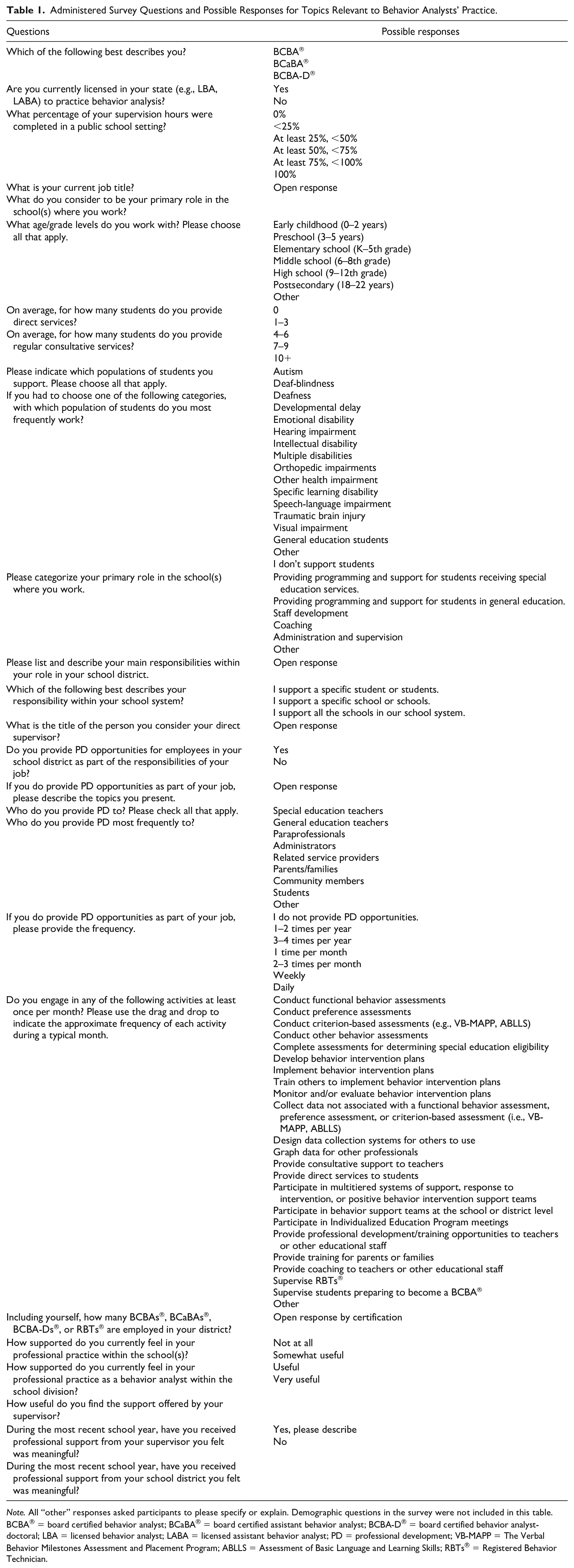
Note. All “other” responses asked participants to please specify or explain. Demographic questions in the survey were not included in this table. BCBA® = board certified behavior analyst; BCaBA® = board certified assistant behavior analyst; BCBA-D® = board certified behavior analyst-doctoral; LBA = licensed behavior analyst; LABA = licensed assistant behavior analyst; PD = professional development; VB-MAPP = The Verbal Behavior Milestones Assessment and Placement Program; ABLLS = Assessment of Basic Language and Learning Skills; RBTs® = Registered Behavior Technician.
The first section of the survey contained 19 questions asking respondents about their experiences of practicing as a behavior analyst in schools. Questions elicited information about certification and licensure type, years of experience as a certified behavior analyst in schools, contract type, job title, primary role, main responsibilities, age/grade level of students served, the provision of direct or consultative services, and types of students served. The second section of eight questions related to the roles and responsibilities of behavior analysts in schools focused on specific activities. These questions asked if the behavior analyst provides professional development activities as part of their job responsibilities and if so, asked them about topics of professional development, who receives the professional development, and the frequency of provision. Questions also asked about specific activities a behavior analyst may engage in and the frequency in which they do so. The third section contained eight questions and focused on support received by the behavior analysts including how supported they felt by their supervisor and school district and what additional supports would be helpful for behavior analysts working in schools. The final section asked behavior analysts six additional demographic questions.
Survey Dissemination
We disseminated the survey to all members of the state-funded network for school-based nationally certified behavior analysts in the Southeastern state using Qualtrics. Eligibility to participate in the survey included the following requirements (a) at least 18 years of age, (b) employed by a public school district in the Southeastern state; and (c) holding current national certification through the BACB as a BCBA®, BCBA-D®, or BCaBA®. We excluded behavior analysts not employed by school districts, but instead contracted by school districts to complete specific tasks. See Table 2 for a summary of behavior analyst certification levels, district location, and the type of supervision completed in public schools. We sent the invitation to participate in the survey by e-mail to 151 eligible, nationally certified behavior analysts between June 2 and July 8, 2022.
Percentage of Behavior Analysts by Self-Reported Certification, District Location, and the Proportion of Preservice Fieldwork Supervision Completed in Public Schools.
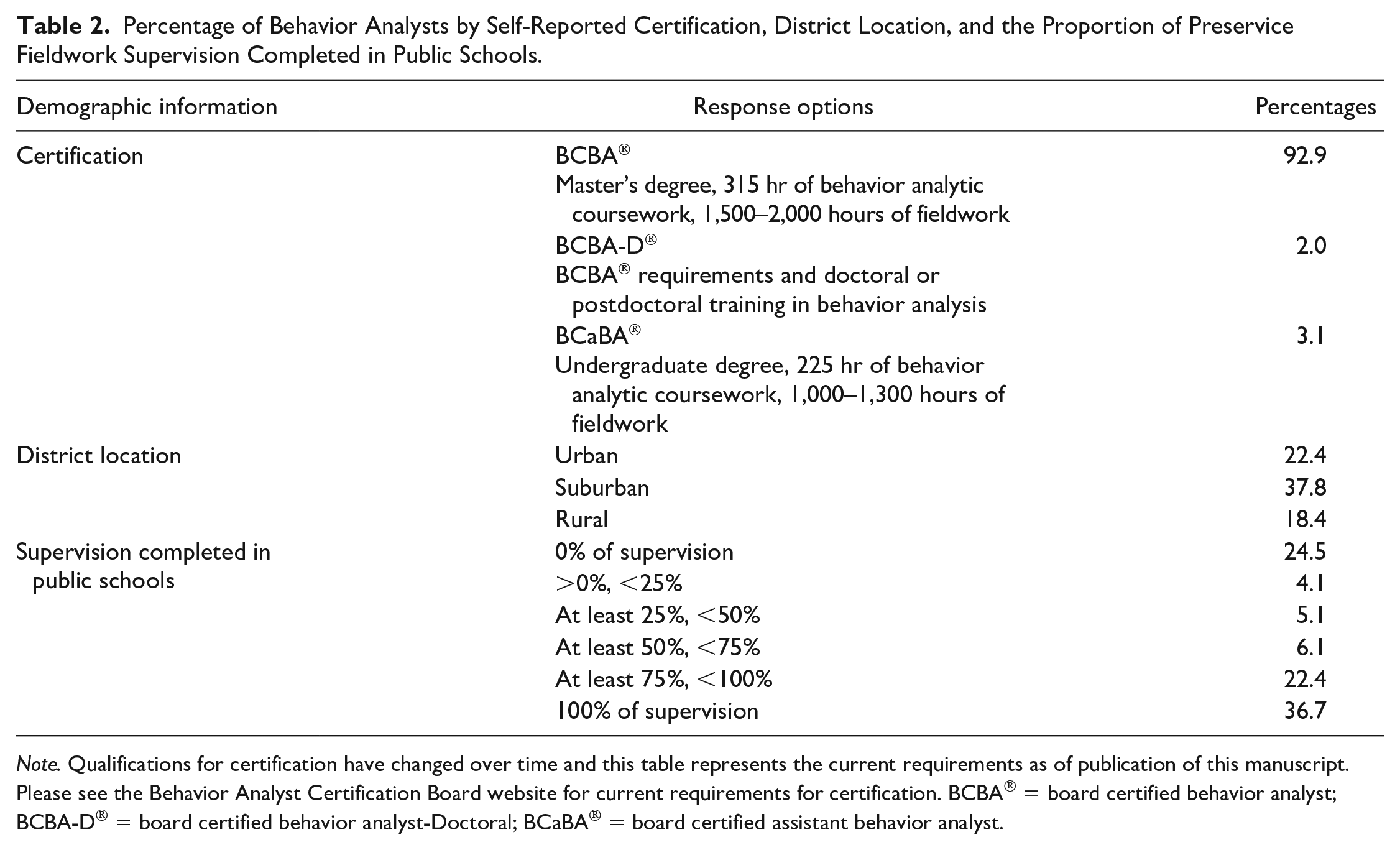
Note. Qualifications for certification have changed over time and this table represents the current requirements as of publication of this manuscript. Please see the Behavior Analyst Certification Board website for current requirements for certification. BCBA® = board certified behavior analyst; BCBA-D® = board certified behavior analyst-Doctoral; BCaBA® = board certified assistant behavior analyst.
Data Analysis
Data were collected through Qualtrics and then downloaded into SPSS for descriptive and correlational analyses. The survey included five open-response items that asked for job titles or specific activities (see Table 1). For the open response items, all responses were gathered into an Excel document and sorted for duplicative responses. The research team noted the frequency of duplicate responses and subsequently identified and set aside duplicated responses for further analysis. The research team then reviewed all remaining responses for common words or phrases such as “director” or “autism.” Items sharing common words or phrases were grouped together within the Excel sheet (e.g., special education director, director of special education, and executive director of special education or ABA coach, behavior coach, and behavior interventionist). From these grouped items, we reported themes using the commonalities seen such as those seen in job titles (e.g., behavior supports and coaching or autism-related supports) or activities including professional development topics (e.g., FBAs, functions of behavior or data collection, data analysis, data-based decision-making). Once the groups were reviewed for themes, the research team titled each group to represent the theme of the categorized items within that group.
Results
Respondents
The survey was completed by 98 behavior analysts, or 64.9% of the total eligible population in the Southeastern state in the United States. Of those behavior analysts surveyed, 92.9% were BCBAs® (n = 91), 2.0% (n = 2) were BCaBAs®, and 3.1% (n = 3) were BCBA-Ds®, and 2.0% (n = 2) did not respond to the question regarding the level of their behavior analyst certification. We only solicited nationally certified behavior analysts to complete the survey; thus, the two individuals who did not respond to the question of which type of behavior analyst were included in the analysis. Because of the low numbers of BCaBAs® and BCBA-Ds®, we grouped all behavior analyst certifications together for our analyses and referred to them as behavior analysts. Approximately 93% of respondents were also licensed as a behavior analyst in the Southeastern state by the State Board of Medicine, the entity overseeing licensure for BCBAs® practicing behavior analysis in this particular state.
Board certified behavior analysts at all certification levels are required to have extensive supervised fieldwork. Currently, this fieldwork is defined as 1,500–2,000 hr depending on the type of supervision experience obtained (BACB, 2022a). Survey responses regarding where the behavior analyst received their precertification supervised fieldwork created a bimodal distribution meaning most either received all (37.1% of responses, n = 36) or none (24.5% of responses, n = 24) of their supervised hours in schools. Please see Table 2 for the full distribution.
Behavior analysts shared the type of district in which they work, including 22.4% (n = 22) in an urban school district, 37.8% (n = 37) in a suburban district, and 18.4% (n = 18) in a rural district. The majority of behavior analysts (79.6%, n = 78) identified as female with 5.1% (n = 5) of members identifying as male. Behavior analysts ranged in age from 22 to 69 years with a mean of 42.4 years and became certified between 2002 and 2022, with a median of 2016. Behavior analysts reported working in schools, on average, for 14.1 years (range = 0–42 years, SD = 8.5 years) and reported having worked as a behavior analyst, on average, for 5.1 years (range = 0–17 years, SD = 3.9 years). Additionally, the majority of the 82 behavior analysts who answered the question (71.4%, n = 70) identified themselves as White, with 4.1% (n = 4) identifying as Black or African-American, 4.1% (n = 4) identified as Asian, and 4.1% (n = 4) identified as other with each of these sharing they identified as more than one ethnicity.
Job Titles
Within public schools, there are not always designated roles for behavior analysts; however, many behavior analysts who work in schools are hired under a different title. For example, individuals with training as school psychologists, who are also certified as behavior analysts, might be hired as school psychologists but use their behavior analysis training as part of their skill set. Behavior analysts reported a variety of job titles. The most common reported group included those who provide behavioral and instructional supports and often coaching to other professionals within the schools, such as teachers or administrators. These professionals (81.7% of responses, n = 76) identified their titles in a variety of ways, including ABA coach, behavior coach, coordinator of specialized behavior support, BCBA®/behavior analyst, behavior interventionist/intervention specialist, or technical assistance provider. Of that group, nine professionals (9.7%) held a specific autism focus and included roles of autism consultant, autism and behavior specialist, and specialized instructional facilitator for autism. The next highest group of professionals included teachers (10.8% of responses, n = 10). Some teachers within a group had a specific behavioral focus (5.4% of responses, n = 5), while others identified as special education teachers (5.4% of responses, n = 5). Administrators (4.3% of responses, n = 4) identified either as principals or directors of special education. School psychologists (3.2% of responses, n = 3) were the smallest reported group.
Student Services and Supports
Behavior analysts can provide support and services at a variety of levels: student-level support, school-level supports, and district-level support. Although 8.2% (n = 8) of behavior analysts shared they support a specific student or students and do not support entire schools, most indicated they support at least one school or even an entire district. Supporting all schools in the district was reported by 28.6% (n = 28) of behavior analysts; 60.2% (n = 59) reported they support at least one or several schools. Behavior analysts who supported more than one school but not an entire district were asked how many schools they supported. Behavior analysts indicated a range of 1–27 schools, with a mean of 14.2 schools and a median of six schools.
Behavior analysts reported their roles and responsibilities with students generally fell into two categories: (a) direct services or (b) consultative services. Most behavior analysts (65.3%, n = 64) reported they do not provide direct services to any students. Of the 33 behavior analysts who did not report providing direct services, 11.2% (n = 11) provide direct services to one to three students; 6.1% (n = 6) provide direct services to four to six students; 2.0% (n = 2) provide direct services to seven to nine students; and 14.3% (n = 14) of behavior analysts indicated responsibility for direct services for 10 or more students. When asked about consultative services to students, 19.4% (n = 19) of behavior analysts reported not providing consultative services to any students. Yet, 57.1% (n = 56) of behavior analysts shared they provided consultative services to 10 or more students, with another 9.2% (n = 9) providing these services to seven to nine students, 6.1% (n = 6) to four to six students, and 5.1% (n = 5) to one to three students. For both areas, averages were solicited, so if intermittent or short-term direct or consultative services had been provided, they may not be reflected in these numbers.
We asked behavior analysts to choose all the age and/or grade levels of students they supported: (a) early childhood (birth–2 years of age), (b) preschool (3–5 years of age), (c) elementary school (K–5th grade), (d) middle school (6th–8th grade), (e) high school (9th–12th grade), (f) postsecondary (18–22 years), or (g) other. Most behavior analysts chose more than one response, frequently working across K–12 grades. The largest number of behavior analysts reported working in elementary school (85.7%, n = 84). Most behavior analysts work with three or more age or grade-level groups (see Table 3).
Percentage of Behavior Analysts Serving Students by Age or Grade and Disability Categories.
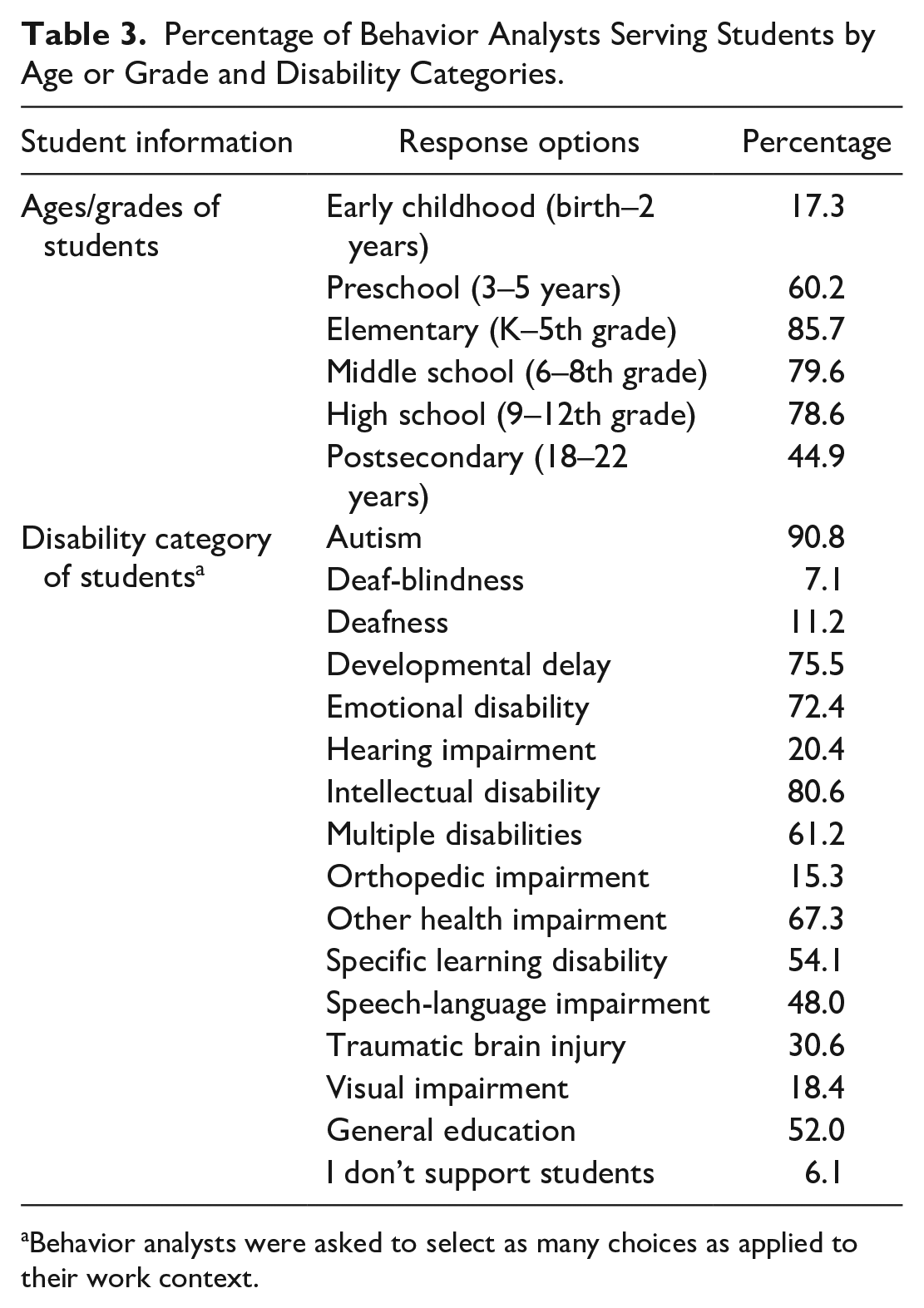
Behavior analysts were asked to select as many choices as applied to their work context.
We asked about the students’ behavior analysts serve based on the federal disability categories for special education eligibility, in addition to general education students, other, and none or “I don’t support students.” When asked to choose the students with whom they work most often, behavior analysts most frequently reported autism (57.1%, n = 56) followed by emotional disturbance (15.3%, n = 15). See Table 3 for all disability categories. However, when behavior analysts were permitted to choose all of the student categories with which they work, most reported working with more than one category of students. Behavior analysts still listed autism as the primary student population they served (90.8%, n = 89). One behavior analyst indicated they served only one group of students. Most (73.5%; n = 72) indicated they served between 3 and 10 categories of students, suggesting ABA services are being spread among students as opposed to being concentrated only with students with autism. Table 3 provides a summary of the percentage of behavior analysts serving students by age or grade and disability categories.
Types of Responsibilities
In addition to student support, we sought to examine their roles more broadly by asking behavior analysts to categorize their work using a mixture of forced and open-choice questions. When given a forced choice, 32.7% (n = 32) of behavior analysts indicated they provide programming and indirect support for students receiving special education services through working with teachers. Additionally, 29.6% (n = 29) indicated a primary role of coaching, 16.3% (n = 16) selected administration and supervision, 8.2% (n = 8) reported staff development, and 3.1% (n = 3) selected providing programming and support for students in general education. See Table 4 for a summary of responses. The open response question asked behavior analysts to list and describe their main responsibilities and allowed them to share their perceived primary role in the schools. Behavior analysts selected building capacity (e.g., training, coaching, consulting) most often as their primary responsibility (46.9%, n = 46 behavior analysts). Other themes included behavior intervention and support, autism programming, administration, compliance, crisis support, positive behavior supports or multitiered systems of support (MTSS), instructional support, and conducting FBAs as their primary roles.
Percentage of Behavior Analysts With Different Roles and Responsibilities in Schools.
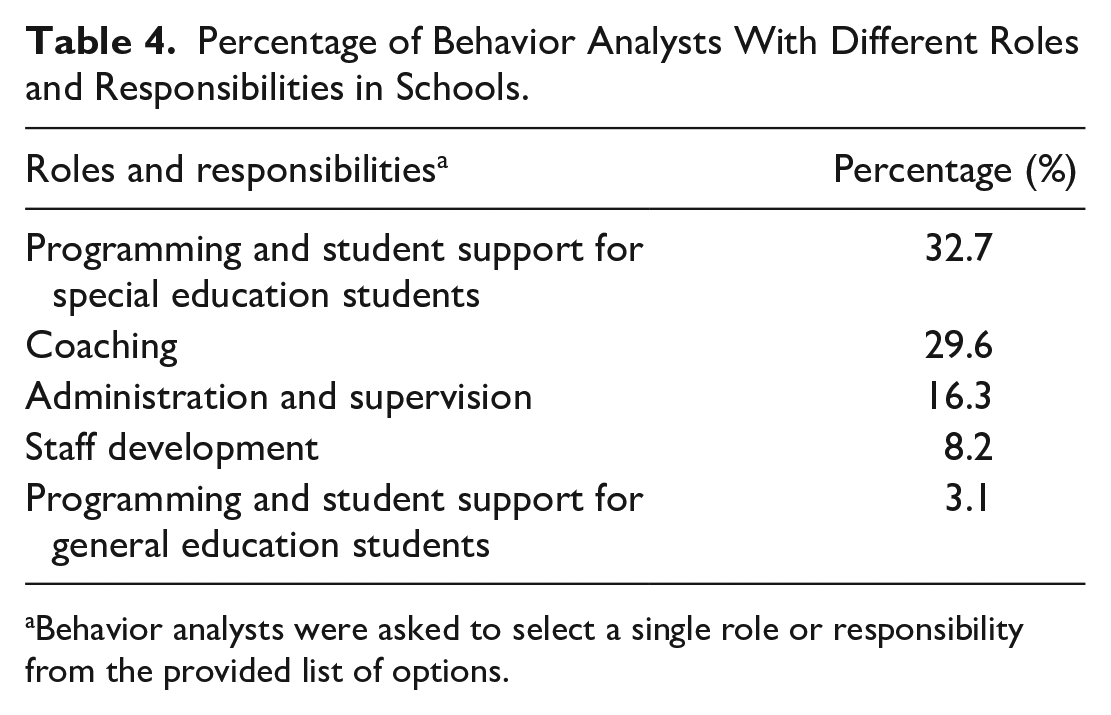
Behavior analysts were asked to select a single role or responsibility from the provided list of options.
Under the category of building capacity, the school-based behavior analysts reported (a) creating and implementing professional development; (b) coaching; (c) consulting; (d) promoting consistent evidence-based practices; (e) setting goals with teachers; (f) aligning their own goals with teacher needs; (g) facilitating professional learning communities; and (h) modeling evidence-based practices. In summary, 82.7% (n = 81) of behavior analysts indicated the provision of professional development as part of their job responsibilities. Although a common job responsibility, behavior analysts reported offering professional development opportunities with varying frequency: 11.2% (n = 11) reported one to two times per year, 27.6% (n = 27) three to four times per year, 23.5% (n = 23) at least once per month, and 6.1% reported weekly professional development offerings. When forced to choose to whom they most frequently provide professional development, behavior analysts reported special education teachers (58.2%, n = 57), general education teachers (9.2%, n = 9), paraprofessionals (8.2%, n = 8), administrators, (3.1%, n = 3), and parents and families (1.0%, n = 1). When given the opportunity to choose all that apply regarding who they provide professional development for, behavior analysts indicated special education teachers (82.7%, n = 81), paraprofessionals (76.5%, n = 75), general education teachers (59.2%, n = 58), administrators (59.2%, n = 58), related services personnel (43.9%, n = 43), parents/families (33.7%, n = 33), community members (11.2%, n = 11), and students (6.1%, n = 6).
When asked the open-ended questions about professional development topics, behavior analysts identified a wide range of topics. The prevalent themes included specific behavior supports (e.g., FBAs, behavior intervention planning, functions of behavior), data (collection, analysis, and decision-making) and progress monitoring, curriculum, and instruction, particularly with a focus on specialized instruction, evidence-based practices (e.g., shaping, reinforcement, antecedent-based interventions). We also identified the overarching themes of classroom management (e.g., basic behavior management, classroom organization), tiered systems of support (including MTSS and PBIS), trauma-informed practices, crisis management, and various crisis intervention programs including restraint and seclusion policies, social/emotional supports, assessment strategies, relationship building, paraprofessional training, autism training (including state-specific requirements for paraprofessionals), communication supports including verbal behavior, self-regulation skills, group contingencies and classwide interventions, Individualized Education Program (IEP) development and developing measurable goals, executive functioning skills, and leadership.
Supervision Structures
Due to the varied titles and roles school-based behavior analysts fulfill, respondents’ reported supervision structure differed. While approximately 60% (n = 58) received at least 75% of their supervision hours within the public schools, another one third (n =33) received less than 50% of their supervision in public schools with 24.5% (n = 24) receiving no supervision within the public schools.
We asked behavior analysts to name the role of their direct supervisor in an open-ended question. We found approximately one-quarter (n =28) of behavior analysts reported being supervised by a director of special education or similar title. Another 18.4% (n = 18) reported being supervised by a coordinator or specialist in special education. The rest of the behavior analysts reported ABA program coordinators, principals/assistant principals, superintendents/assistant superintendents, autism program supervisors/coordinators, behavior intervention services managers, directors of pupil personnel, lead teacher specialists, elementary education specialists, and school psychologist coordinators/supervisors.
We asked behavior analysts how generally well supported they currently felt within their schools on a scale of 1 to 4 with 1 meaning Not at All and 4 meaning Very Supported. Less than one-fifth of behavior analysts (17.3%, n = 17), reported they feel Very Supported, 37.8% (n = 37) reported feeling Supported, 21.4% (n = 21) reported feeling Somewhat Supported, and 7.1% (n = 7) reported Not at All. When asked how supported they felt as a behavior analyst in their school district, the responses changed somewhat. Behavior analysts reported feeling Very Supported at 14.3% (n = 14), Supported at 22.4% (n = 22), Somewhat Supported at 36.7% (n = 36), and Not at All at 10.2% (n = 10). When asked about the usefulness of the support offered by their supervisor: 26.8% indicated it was Very Useful, 22.4% (n = 22), Useful, 28.6% (n = 28), Somewhat Useful, 19.4% (n = 19), and 15.9% Not at All,13.3% (n = 13). In a free response format, we asked behavior analysts which meaningful support their supervisor provided. Responses varied and included support to work through tough cases and legal or regulatory issues as well as providing clear and constructive feedback and suggestions. Behavior analysts shared that their supervisor helped them to learn more about district processes and systems. Several behavior analysts reported their supervisor supported and encouraged attendance at conferences or other specific professional development opportunities for behavior analysts such as attending U.S. Department of Education (DOE)–supported state network events, learning new assessments, or earning continuing education credits elsewhere. Many behavior analysts reported their supervisor’s availability but did not specify their interactions further. Several behavior analysts reported their supervisor was generally supportive and offered support in other areas, but the supervisor did not understand behavior analysis or was unable to support them in the area of behavior analysis.
Not all support is equal and when asked if the school district provided them with meaningful support, the results were split: 53.2% (n = 52) reported no and 46.8% (n = 46) reported yes. When asked what meaningful support districts provided, behavior analysts most often reported districts paying for and/or allowing time to attend professional development opportunities including the Department of Education–supported state network events, behavior analysis conference, or other training events. One person shared the district provided best practices in leadership and one stated they received clear, constructive feedback. The only other answers without the mention of training support included one district hiring more BCBAs®, and one behavior analysts had received additional compensation from the district.
Given the levels of meaningful support reported as available by behavior analysts from their school district and their supervisors, we were interested in the relation between those variables and the amount of time the school-based behavior analysts had been working in a school setting. A Spearman’s rho (rank order correlation) between total years worked in a public school setting and how supported the school-based behavior analysts feel in their professional practice was r = −0.23 (p = .043, n = 79). The longer behavior analysts worked in a school setting, the less supported they felt by the district over time. The correlation between total years worked in a public school setting and the usefulness of support offered by their supervisors was insignificant (r = −.21, p = .06), suggesting that while behavior analysts do not feel supported by their districts, they do feel supported by their direct supervisors. We were also interested in the relation between the length of time as a behavior analyst and these two variables, but we found less variation in the behavior analyst time served compared with the school personnel time served, and neither relations were significant.
Discussion
The results of this survey offer a glance at the roles and responsibilities, professional experiences, and supports of behavior analysts working in public schools and thus contribute to the limited research available about this specific group of professionals. Although the number of BCBAs® working in school districts continues to grow, this survey illuminates the vastly different experiences of behavior analysts in schools. Most school districts hire BCBAs® because of their understanding of behavior and their ability to implement ABA. However, how school districts expect BCBAs® to apply their skills varies. The wide range of job titles alone indicates an apparent lack of clarity and cohesion of expectations and job responsibilities. Furthermore, the number of behavior analysts who reported a lack of support suggests school districts struggle with how to best support these professionals. Perhaps the lack of support can be attributed to educators having limited knowledge not only of ABA but how to apply its principles to improve practices within schools. Additionally, specific to the Southeastern state in this study, given the recency of new guidance for the provision of ABA in schools from this state, school districts may need more time to operationally define their expectations, roles, and responsibilities, and supports for the behavior analysts.
Interestingly, most behavior analysts (65.3%, n = 64) did not report providing direct services to students. Although this may be related to their roles (e.g., special education director), it may also indicate behavior analysts are either promoted to or hired into roles further removed from student service provision. For example, school districts can leverage behavior analysts, expertise to provide professional development about ABA to teachers lacking knowledge or skills (e.g., Mason et al., 2013). Our findings support this utilization of behavior analysts with 82.7% (n = 81) of respondents indicating they provide professional development as part of their job responsibilities. School-based behavior analysts might also be more likely to provide consultative services to the adults working with students. In our findings, 77.6% (n=76) reported providing consultative services to at least one student, with over half of our sample of behavior analysts engaging in consultation for more than 10 students.
Despite the variety of expectations, behavior analysts employed by the school districts shared two commonalities: their primary support for special education and their focus on building capacity. Overall, regardless of the job title, behavior analysts tended to support special education typically by supporting teachers. Behavior analysts primarily reported supporting students with autism; however, they did report working with other student populations. Only a small percentage of behavior analysts supported students and teachers in general education. Thus, an incongruence exists in practice. Both special and general education teachers report difficulties with behavior management (Bushaw & Calderon, 2014; Reinke et al., 2014). PBIS is also designed to address the behavioral support needs of all students (Simonsen & Sugai, 2019). Yet, behavior analysts, the professionals with the expertise to address challenging behavior, seem underutilized in the general education setting. Despite this underutilization, behavior analysts themselves emphasized the need to build capacity and broaden their impact. They reported collaboration with teachers and administrators, serving on committees, and coaching others to help foster understanding of the ABA behavioral principles and improve student outcomes.
Although most behavior analysts received at least three quarters of their preservice fieldwork supervision hours within the public schools, many had received limited or even no prior supervised fieldwork in a public school setting. As such, questions about these behavior analysts’ scope of competence arise. Specifically, if these professionals are not receiving any supervision in the public school setting, are they appropriately qualified to work in public schools, particularly with limited mentorship opportunities? Brodhead and colleagues (2018) emphasized the need for BCBAs® to practice within their scope of competence, in this case, public schools. Addressing scope of competence is also supported by Bailey and Burch’s (2010) discussion of the need for BCBAs® to develop competence through required supervision experiences.
Limitations
Although the results of this survey begin to fill a gap in the literature about behavior analysts in schools, our study does have some limitations. First, generalization is limited, as we restricted our sample to nationally certified behavior analysts employed by public school districts in one Southeastern state in the United States. This study focused on behavior analysts employed by public school districts because district-contracted behavior analysts may have different roles and responsibilities. For example, if a BCBA® is contracted by the school district to complete an assessment or evaluation, these tasks directly affect their roles and responsibilities differently than a BCBA® employed by the district who has a variety of roles and responsibilities. However, the variability amongst the behavior analysts offers an illustration of practices across this one state. This particular Southeastern state directly employs behavior analysts in public school districts; this practice might be uncommon across the United States. Additionally, the state department of Education has issued guidance related to the practice of behavior analysis in schools. Finally, this state has licensure for behavior analysts, which not all states have.
Second, in this survey study, behavior analysts self-reported their roles and responsibilities. The practices behavior analysts engage in may differ from those self-reported. It is also plausible that recency bias affected respondents’ answers on the survey with behavior analysts potentially placing more importance on the most recent events they encountered in schools. We asked behavior analysts about the size of their district, but responses varied too much for us to use the data in the analysis, with many indicating they “did not know.” We did not ask behavior analysts if additional behavior analysts were employed in their district, which may or may not be the case for our respondents. The size of the district and the availability of other behavior analysts may affect caseload comparisons. As evidenced by our findings, certified behavior analysts in school practice in a variety of roles and these roles likely affect the types of activities in which these professionals engage. Additionally, while we asked behavior analysts about perceived support related to practice in a public school, their differing roles may also affect their perceptions regarding available support. Despite limitations, our findings contribute to the literature as a preliminary exploration of this topic suggests several implications for future research and practice.
Implications for Research
Although a great amount of research exists on interventions with students and educators in schools, little research has been published on the BCBAs® working in schools, their roles, professional needs, and their impact on adults and students in the buildings they support. This survey offers only a window into the experiences of behavior analysts in schools in one Southeastern state; thus, future studies can explore the experiences of behavior analysts in other states or at the national level. Furthermore, this survey can inform future inquiries into behavior analysts’ lived experiences and go more in-depth into looking at how behavior analysts engage in their practice and the implications of their work on student outcomes. Additionally, future research should consider whether school-based behavior analysts affect teachers’ perceptions of student behavior, given this is a high cause of teacher attrition (Hong, 2012; Ingersoll, 2002; Thibodeaux et al., 2015).
Most concerning, our study findings suggest school-based behavior analysts in one Southeastern state in the United States feel unsupported in their roles and responsibilities. Future studies can explore how behavior analysts define meaningful professional support and how school districts can provide such support. Additionally, as this survey study relied on self-report, researchers may want to consider other viewpoints about behavior analysts in schools and investigate the perceptions of administrators, teachers, students, and students’ families.
Implications for Practice
This study has important implications for professionals in schools and higher education preparation programs. If schools want to improve behavioral support for all students, those who receive special education services and those who do not, they need to provide meaningful opportunities for behavior analysts to leverage their expertise. BCBAs® can offer a wide range of support for school staff, from designing and delivering professional development to building behavior management skills in others to problem-solving around specific concerns and gathering data. BCBAs® also have expertise in data collection and analysis, which can serve schools well for individual students as well as system-level work. Experience such as this can be learned during supervised fieldwork experiences. Unfortunately, a quarter of the behavior analysts in our sample completed zero hours of supervision in the school setting with another almost 10% completing <50% of their hours in a school setting. With Bailey and Burch (2010) suggesting the essential nature of supervised fieldwork to develop competence and the need to practice within one’s scope of competence (Brodhead et al., 2018); however, BCBAs® may lack readiness to effectively work in school settings without prior fieldwork in school settings supervised by a BCBA®. If BCBAs® choose to work in schools but lack supervised experience in schools, mentorship is essential to broadening their scope of competence.
For schools to utilize the expertise of BCBAs® well, they must have a better understanding of what ABA is and its potential applications in school settings. School staff can foster such understanding by turning to guidance from the U.S. Department of Education and professional organizations, such as NETWORK, and ensuring the roles and responsibilities of BCBA® align with their skills. At the national level, BCBAs® must work to ensure educators understand what ABA is and is not as well as how it can be implemented effectively in the school context. Once hired, BCBAs® must collaborate with school administrators and other district personnel in charge of evaluating them. Together they can develop a thoughtful plan for meaningful utilization of BCBAs® within the school district, so they can remain in the field and provide a meaningful support for teachers, other professionals, students, and families of students.
Conclusion
School-based BCBAs® are not new to education, but little is known about how they function within the public school setting. With approximately 7%–12.5% of BCBAs® in the United States working in schools (Association of Professional Behavior Analysts, 2015; BACB, n.d.), it is important to understand what these professionals are charged to do in their roles to inform preparation programs as well as ensure successful application of ABA to improve student outcomes. Schools can certainly benefit from the knowledge and expertise of BCBAs®, but an effective partnership based on a mutual understanding of what ABA is, what a BCBA® does, and how they can effectively work in schools is required for success.
Footnotes
Declaration of Conflicting Interests
The author(s) declared no potential conflicts of interest with respect to the research, authorship, and/or publication of this article.
Funding
Funding for this project and the development of this article was provided by the Virginia Department of Education (grant no. 876-DOE86625-H027A200107).
