



Abstract
There is a need to provide evidence-based social, emotional, and behavioral interventions for learners at risk for emotional and behavioral problems. Evidence-based interventions for social and emotional success are especially necessary for Black learners with emotional or behavioral problems. In the current study, we used a multiple-baseline design time-lagged across groups (i.e., classrooms) to examine the effects of a culturally adapted version of the Strong Start curriculum plus Check-In/Check-Out on externalizing problem behaviors of 18 first-grade and second-grade Black learners. Results indicate a functional relation between the intervention package and externalizing problem behaviors. Additionally, post-intervention social validity assessment indicates that participating teachers viewed the intervention package as feasible and participating learners reported a positive experience.
Keywords
Schools often fail to provide adequate and preventative social-emotional and behavioral interventions for learners at risk for emotional and behavioral disorders (EBD; Cook et al., 2015). As a result, learners with EBD experience high rates of exclusionary discipline, social isolation, absence, and dropout (National Center for Learning Disabilities, 2020). Black learners are disproportionately represented in the number of learners identified with EBD. To illustrate, Black learners represented almost 23% of the emotional disturbance category outlined by the Individuals with Disabilities Education Act (IDEA)—yet they only made up about 14% of the total school-age population (Office of Special Education Programs [OSEP], 2021). Effective social-emotional and behavioral interventions for Black learners are particularly important given that this race group experiences higher rates of suspension and expulsion than others (Office for Civil Rights, 2021a, 2021b). Furthermore, Black learners are more likely to be exposed to factors (e.g., systematic racism and marginalization, low socioeconomic status [SES], dysfunctional neighborhoods) that place them at risk for EBD and related mental health issues (Graves et al., 2017). At present, there is a limited research base addressing social-emotional and behavioral interventions adapted to the unique backgrounds and needs of Black learners. Across student populations, though, social and emotional learning (SEL) and behavioral monitoring are two converging, prevention-oriented movements for learners with social-emotional and behavioral needs.
Recent federal guidance has encouraged schools to teach and support social-emotional competencies as a way to promote overall student wellness and improve educational outcomes (U.S. Department of Education, 2021). SEL instruction provides a framework for teaching social-emotional skills and strengthening protective factors, including those skills and behaviors associated with positive social development (Greenberg et al., 2003). The Collaborative for Academic, Social, and Emotional Learning (CASEL, 2019) defines SEL as the process of (a) understanding and managing emotions, (b) establishing and meeting goals, (c) identifying and displaying empathy, (d) creating and retaining positive relationships, and (e) making quality decisions. Social and emotional learning interventions addressing CASEL's five competencies demonstrate positive results—advances in academic performance, reductions in problem behavior, enhanced student ability to manage stress, and improvements in student attitudes about themselves, others, and school (Durlak et al., 2011; Van de Sande et al., 2019). Strong Start is an established SEL curriculum aligned with CASEL competencies adapted to serve learners in prekindergarten through high school with five separate, grade-banded books. The curriculum consists of 10 highly structured and scripted 45-min lessons taught once a week. There are two main advantages of Strong Start: (a) it is flexible and efficient and (b) the lessons are relatively brief.
Research studies have shown promising results from the Strong Start curriculum. Whitcomb and Merrell (2012) examined its effects with first-grade learners in suburban schools with a predominately White student population and found modest effect sizes in social-emotional knowledge, peer relations, problem behaviors, social competence, and internalizing behaviors. However, the article did not report risk status for EBD or break down the results by race. In another study, Caldarella et al. (2009) evaluated the impact of the program on second-grade White and Hispanic learners, with a portion of the learners identified as at risk for EBD. Results demonstrated significant improvements in internalizing and peer-related prosocial behaviors across learners, but no substantial improvements in externalizing behaviors. Both studies incorporated White interventionists and called for increased diversity in student populations in the future. Research on the universal Strong Start has been conducted with predominantly White student-population samples (Gueldner & Merrell, 2011; Kramer et al., 2010; Merrell et al., 2008). Meta-analytic research, however, has shown that culturally specific interventions are more effective than universal interventions (Jackson & Hodge, 2010; Metzger et al., 2013).
An SEL curriculum needs to reflect the cultural values, messages, and historical truths of the student population to which it is delivered (Ighodaro & Wiggan, 2011). Culturally affirming education demonstrates to learners that their backgrounds, cultures, and experiences are important and valued (Ighodaro & Wiggan, 2011). Providing culturally relevant curricula for learners is a catalyst for making connections in learning through reactivation of prior knowledge and experiences (Ladson Billings, 2011; Sleeter, 2012). Cultural adaptation is the process of determining the general characteristics of the target population to assess what changes are needed to improve the acceptability, effectiveness, and sustainability of the intervention for that group (Castro et al., 2004). Social and emotional learning interventions adapted for learners from different racial and ethnic backgrounds have shown promise, and in doing so, they also highlight the failures of universal programs to adequately address the needs of these populations. Brown et al. (2018) conducted a systematic literature review on cultural adaptations of school-based social, emotional, and behavioral interventions for learners of color with or at risk for EBD. They found 10 studies applying cultural adaptations, with only one study incorporating Black learners as participants (Smith et al., 2014). Studies included in the review made changes to procedures (e.g., engaging stakeholders in the selection of adaptations), content (e.g., adapting language, goals, or concepts), or delivery (e.g., modifications to individuals, methods, or location).
The Strong Start program was selected for the present study because it was one of the few programs at the time that recommended culturally adapting its lessons to meet the needs of specific learner populations (Carrizales-Engelmann et al., 2016). The curriculum books offer guidance on how to make those adaptations. Recommendations include asking learners to share information about their culture, identifying common situations experienced by learners, including challenging life circumstances confronting them and using examples (i.e., characters and problem examples) that align with the learners’ lives. This approach ensures that the core aspects of the curriculum remain, but that the lessons are tailored to the specific needs of the targeted group. However, a limited number of studies have examined the effectiveness of Strong Start with adaptations for a specific population (e.g., Latinx, Castro-Olivo, 2014). A review of the literature revealed only one study on Strong Start with cultural adaptations for Black learners. Graves et al. (2017) completed a randomized, delayed, treatment control design study with elementary-age, Black, male learners at risk for EBD in an urban area. Researchers made cultural adaptations to the lesson language, discussion scripts, and content examples, and they chose books with Black individuals as the central characters. Results showed an increase in self-regulation and self-competence, as well as positive social validity outcomes. However, the program had little to no impact on student empathy, responsibility, or externalizing behavior.
In summary, the Strong Start curriculum has demonstrated positive outcomes for social-emotional knowledge and internalizing problems in the general-student population (Caldarella et al., 2009; Neth et al., 2020; Whitcomb & Merrell, 2012). Furthermore, there is a growing consensus that interventions should be adapted to meet the unique needs of a more diverse set of learners, and recent research has demonstrated promising results from a culturally adapted Strong Start (CA-SS) curriculum (e.g., Graves et al., 2017). However, there is little evidence that Strong Start alone reduces externalizing behavior (Caldarella et al., 2009; Graves et al., 2017; Merrell et al., 2008; Neth et al., 2020). It is expected that a portion of learners will require support above and beyond universal practices. In this case, learners regularly displaying externalizing problem behaviors may need targeted support alongside the class-wide SEL curriculum to show meaningful progress. Studies may not have shown distal effects on externalizing behaviors because while Strong Start explicitly teaches SEL competencies, it lacks a structured approach for practice, feedback, and differential reinforcement of replacement behaviors aligned with social-emotional competencies. The present study sought to evaluate this hypothesis by combining the Strong Start curriculum with check-in/check-out (CICO), an established intervention that has shown positive effects in decreasing externalizing behaviors through individualized feedback and reinforcement of prosocial behaviors (Maggin et al., 2015).
Check-In/Check-Out is an evidenced-based behavioral monitoring intervention focused on improving outcomes for at-risk learners who display externalizing behaviors that impede academic success (Campbell & Anderson, 2008). Core components include (a) frequent instruction regarding expected behavior, (b) increased structured contact with adults in the school, (c) feedback on behavior, and (d) increased opportunities for reinforcement of expected behavior (Campbell & Anderson, 2011). The daily process components include meeting with the learner in the morning for a structured “check-in” period to review daily behavioral goals and then again for a “check-out” period in the afternoon to review behavioral performance. Additional check-in periods may be scheduled as needed at preset times during the day to provide feedback to the learner on daily behavioral progress. Last, the learner receives positive acknowledgment and/or tangible reinforcers for meeting daily behavioral goals (Campbell & Anderson, 2008). Prior research has shown increased academic engagement and decreased levels of disruptive behavior with elementary-age Black learners (Miller et al., 2015). More specifically related to the hypothesis in the present investigation, Toms et al. (2018) combined CICO with social-skills instruction and found improvements in academic planning and externalizing behavior at the high-school level for Black learners with an EBD classification from the school system (Toms et al., 2018).
Purpose and Research Questions
This study aimed to strengthen SEL competencies and decrease externalizing problem behavior for Black learners by implementing a unique intervention package consisting of a culturally adapted version of Strong Start and CICO. Research has shown that universal (i.e., without cultural adaptation) SEL programs are less effective with Black learners in urban schools located in low-income neighborhoods (Farahmand et al., 2011). Culturally adapting SEL programs, even in relatively minor and nuanced ways, may enhance the effectiveness of interventions for Black learners (Beier & Ackerman, 2005) and increase their social validity. However, few research studies have evaluated the impact of culturally adapted SEL curricula. Previous research on SEL curricula has predominately focused on immediate knowledge-level improvements in social-emotional outcomes and often does not include distal and direct measures of student behavior. When student behavior is assessed, research demonstrates that common SEL curricula show inconsistent results on teacher-rated externalizing behavior (e.g., Blewitt et al., 2018; Taylor et al., 2017). Pairing the CA-SS with an established intervention known to decrease externalizing behavior through individual feedback and reinforcement of skills (i.e., CICO) may be the key to seeing both social-emotional and behavioral outcomes for learners at risk for EBD.
Learners with EBD often experience both internalizing and externalizing behaviors. Although CICO has shown in the past to decrease externalizing behavior as a stand-alone intervention, it fails to explicitly address internalizing behavior and equip learners with social-emotional strategies for meaningful long-term success. Decreasing behavior such as negative interactions with a peer with only behavioral techniques, while potentially effective (i.e., reduced instances) in that environment short term, does not give the student the opportunity to learn how to maintain healthy relationships or regulate emotions during a difficult peer encounter. This study fills a gap in the literature by evaluating the impact of a comprehensive approach—an intervention package with both social-emotional (CA-SS) and behavioral (CICO) components.
When it comes to Black Americans, there are several terms used to recognize people from this community. Currently, some of the most common labels tend to be African American, Black, and Person of Color. For the purposes of this manuscript and study, the term Black is used to define a person having an origin in any of the Black racial groups of Africa. Three main research questions were posed in this study:
Method
Setting and Participants
The present study took place during the summer-school session at a Title I public elementary school serving learners in early childhood through fifth grade located in an urban area of the south-central region of the United States. Only learners who met specific district eligibility criteria (i.e., not meeting academic benchmarks the prior year or failing the state-level assessment) attended the summer session. In the academic school year just before the study, the school served 641 learners, of whom 68.5% were Black and 98% qualified for free or reduced-price lunches. Summer school enrolled three classes per grade level with a range of 12–18 learners per class, representing just under half of the total student population from the previous year. Learners attended full school days (i.e., 7 hr) Monday through Thursday for 6 weeks, and teachers taught reading and math daily, with science and art on a rotation.
Following institutional review board approval, the first author worked with school administrators to identify willing teachers and learners who met eligibility criteria. Learners needed to meet the following criteria to be included in the study: (a) were required to attend summer school, (b) were Black, (c) were in first grade or second grade, (d) used English as their first language, and (f) exhibited problem behaviors as identified by the Social-Emotional Assets and Resiliency Scales–Teacher (SEARS-T; Merrell et al., 2011). Participating teachers screened all potentially eligible learners using SEARS-T, and learners with an at-risk behavioral profile were invited to participate in the study. Researchers obtained parental consent and student assent. A total of 18 learners from four classrooms participated in the study, representing 10 first-graders (two classrooms with five participants each) and 8 second-graders (Class A = 3 learners; Class B = 5 learners). Ages ranged from 6 to 8 years old for first grade and 8–10 years old for second grade. Two learners received special education services under the IDEA category of emotional disturbance. See Table S1 in the online supplementary material for individual characteristics. The study included five Black teachers (four female, one male) with at least 6 years of teaching experience. One first-grade classroom had co-teachers who implemented together, and the other classrooms had a single-teacher implementer. Teacher ages ranged from 29 to 52 years old. Two teachers held bachelor’s degrees, and the remaining female teachers earned master’s degrees.
Measures
Externalizing problem behavior
The primary dependent variable was externalizing problem behavior (e.g., consistently out of seat, disruptive behavior, noncompliance, negative interactions). Campbell and Anderson (2008) provided the definition and exemplars of externalizing behavior. Noncompliance was defined as verbally or nonverbally refusing to follow an adult’s direction within 10 s of the request. Disruptive behavior included talking out (vocalizations not preceded by a raised hand or not initiated by an adult), talking to peers (conversing with a peer when the expectation is to not talk), and other behavior disruptive to instruction (e.g., banging objects, making faces at peers, and making odd noises). Negative verbal and physical interactions were defined as any form of physical aggression or derogatory verbal statement to adults or peers. Out of seat was defined as leaving the assigned work area without permission from an adult.
Behavioral observations for externalizing problem behavior occurred twice daily for 30 min (math and reading) using a 1-min partial interval recording system. The observer sat in a position to be able to see all student participants. If a student engaged in externalizing behavior (e.g., consistently out of seat, disruptive behavior, noncompliance, negative interaction) at any moment during the interval, they were marked as engaging in externalizing behavior for that interval. Percentage intervals of externalizing behavior for each session were determined by dividing the total number of intervals with externalizing behavior by the total number of intervals in the session and multiplying by 100 for each student. The research team also calculated a mean trendline for the class by adding all percentage intervals per student and dividing by the total number of learners in the class. Partial interval recording systems may underestimate high-frequency behavior (Ledford & Gast, 2018; Maag, 2018), especially as intervals increase in length. However, this method was chosen based on the duration of identified behaviors and because it is feasible given limited resources in the applied setting.
Interobserver agreement
The first author and a research assistant independently observed all (100%) of the sessions. Percentage total agreement was computed by dividing the number of response-score agreement intervals by the total number of intervals and multiplying by 100. Interobserver agreement for externalizing behavior was collected across each phase for 85% of the baseline with a mean of 92.4% agreement and 85% of the intervention with a mean of 94.2% agreement.
Social-Emotional Assets and Resiliency Scales–Teacher
SEARS-T (Merrell et al., 2011) is a 41-item, teacher-reported rating scale for assessing social and emotional outcomes for learners in kindergarten through 12th grade. The teacher report is designed to measure four constructs: (a) self-regulation, (b) social competence, (c) empathy, and (d) responsibility. SEARS-T was normed with a sample of 1,400 learners, and while more than half of the samples were White, researchers found no statistical differences influencing normative data based on race. Merrell et al. (2011) reported strong psychometric properties with reliability estimates for SEARS-T at 0.98 and the reliability range of the subscales at 0.91–0.95. Participating teachers completed SEARS-T pre/post-intervention.
Social validity
Social validity of the intervention from the teacher and student perspectives was assessed using a researcher-developed instrument and interview protocol at the end of the study. Teachers were asked five Likert scale questions. Teachers shared their perceptions on decreased disruptive behavior and increased academic performance. Furthermore, teachers rated the efficacy and applicability of the intervention package, whether they would recommend the intervention, and the extent to which the intervention was practical and feasible. An open-ended question at the end allowed for any additional teacher comments. See online supplementary material Table S2 for a copy of the question set. The first author and research assistant conducted structured interviews with each student at the end of the study. The interview consisted of six open-ended questions with a final prompt to make any other comments. Questions were as follows: (1) How comfortable are you with the morning check-in and afternoon check-out with your mentor? (2) What was an instance when your mentor positively influenced your day? (3) Was the feedback at the end of each period helpful or not? (4) Did the program help you improve your behavior; why or why not? (5) What did you like most about the program? (6) What did you like least?
Experimental Design
A multiple-baseline across classrooms, single-case, experimental design (Ledford & Gast, 2018) was used to evaluate the effects of the CA-SS + CICO intervention on student rates of externalizing problem behavior. The research protocol included concurrent baseline data, with time-lagged treatment-onset timeline and order determined a priori because of the short length of the summer term and school leadership preference. Two separate first-grade classrooms were included in the first intervention tier, while the second and third intervention groups (i.e., tiers in the design) were different second-grade classrooms. Order of implementation was determined through collaboration with the school principal, who indicated her preference for all of first grade to receive the intervention at once. The units of analysis, or “cases,” were three groups of learners: first-grade, second-grade class A, and second-grade class B.
Visual Analysis
Visual analysis was used to evaluate within-condition data patterns focusing on immediacy of effect, level, trend, and variability, as well as between-condition patterns concentrating on similarities across participants (Ledford & Gast, 2018). To determine a functional relation, the first author examined data for consistency within and between similar conditions and conformity with baseline logic (Sidman, 1960). Baseline logic requires that time-series data indicate that in the absence of the intervention, baseline data are predicted to continue at a consistent level or trend without substantive change. This prediction is verified when baseline data are collected a second or even third time within the study and are consistent with the initial baseline. Finally, baseline logic is confirmed if when the intervention is introduced and the data change in the predicted direction, this change is replicated a minimum of three times (i.e., three demonstrations of effect; three-fourths rule, Maggin et al., 2013).
Procedures
Teacher training and materials
Teachers received training and materials during a 3-hr in-person session with the first author. Materials included the Strong Start K–2 Curriculum (Whitcomb & Parisi Damico, 2016) with cultural adaptations and CICO resources. CICO materials included (a) an audio recorder, (b) copies of the CICO form preprinted with behavioral expectations aligned with SEL competencies and rating/point scales, and (c) stickers, snacks, toys, and other rewards. The first author began training with an overview of the curriculum and cultural adaptations, including the purpose of each lesson and preparation guidance. After this, the first author provided an overview of the CICO intervention, led role-play with practice scenarios related to CICO, and gave feedback to the teachers using the CICO fidelity checklist during the role-play process.
Business-as-usual baseline condition
Teachers were free to provide any level of support they would typically give a student with challenging behavior during the baseline. Common supports included adherence to the school-wide code of conduct, breakfast for all learners, clear and consistent classroom rules, and consequences for misconduct such as notes home to parents. Neither Strong Start nor CICO had been implemented at the school. The learners participating in the study did not receive any formal tier two, tier three, or supplemental interventions during the baseline.
Intervention condition—CA-SS + CICO
Culturally adapted Strong Start
Teachers implemented a culturally adapted version of Strong Start for kindergarten through second-grade learners (Whitcomb & Parisi Damico, 2016) alongside CICO to promote SEL competencies. CA-SS was implemented in a small-group setting for participating learners at the teacher's table in each of four classrooms. Although Strong Start has mostly been implemented as a class-wide intervention, a small-group setting was selected in this study to align with culturally sensitive implementation practices (Graves et al., 2017). Strong Start consists of 10 lessons, typically taught over 10 weeks with one 45-min lesson provided each week. Lessons focus on understanding feelings, being a good friend, and solving people problems. Research has supported that accelerated implementation of Strong Start maintains a similar level of effectiveness (Tran, 2008). For this study, teachers covered two lessons per week in first grade and three lessons per week in third grade to account for summer-school timelines.
The authors of the Strong Start Curriculum advise practitioners to adapt lessons to meet the needs of their unique student populations. This is, of course, if the changes do not shift the underlying theory or key components of the curriculum. The curriculum developers recommend (a) getting to know the learners, (b) understanding their communities, (c) using language that makes the key points understandable, (d) creating an environment that supports tolerance of different perspectives, and (e) seeking feedback on any adaptations made for cultural relevancy. Cultural adaptations made in the current study align with developer recommendations and a review of the literature (e.g., Brown et al., 2018; Castro-Olivo, 2014; Graves et al., 2017).
The first author made adaptations to the curriculum in this study consistent with the following: (a) get to know your learners by understanding everyday experiences for Black youth and families and challenging life circumstances confronted by Black youth, (b) get to know the learners’ community by asking teachers, community members, and parents about specific issues, (c) deliver the curriculum in a manner that learners can understand by changing the language (i.e., code switch language) of each lesson such that critical points can be easily understood, (d) encourage tolerance of others’ worldviews, especially those of learners who are not Black and learners who come from higher-SES families, (e) become aware of variations within Black culture including ongoing evaluation of the accuracy of researcher assumptions about beliefs and behaviors, and (f) make an effort to gain feedback by speaking with teachers and school administration about the relevance and accuracy of adaptation efforts.
Participating teachers were informed of the cultural adaptations to the SEL curriculum prior to study onset. All teachers were Black and understood their learners’ backgrounds and the communities served by the school. They offered input for updating the language of the lesson scripts and activities to make it more understandable, as well as provided examples reflecting real situations encountered in the classroom, school, and community. With teacher and administration feedback, the research team updated the lessons to reflect the culture of the student participants (e.g., art, music, literature, dance, hairstyles, food), and lesson activities were changed to focus on concerns and events relevant to the participants. Exercises focused on scenarios that were or may have been experienced by participants in and out of school. As an illustration, one example was focused on the nationwide tensions over the deaths of Black Americans in police custody, such as Philando Castile at a traffic stop and Tamir Rice playing with a toy gun in his neighborhood park. Researchers worked with the school district and university curriculum support center to select books. The first author’s university curriculum support center provided resources and materials by leading organizations and publishers of children's literature to guide the selection process. See online supplementary material Table S3 for a complete list of alternative books. Overall, the cultural adaptations made to Strong Start included changes to language, key concepts (examples, scripts, and discussion questions), and book selections.
Check-in/Check-out
CICO was concurrently implemented with the CA-SS curriculum to prompt and reinforce behaviors aligned with SEL competencies. Campbell and Anderson (2008) described the CICO procedures, with a modification made to the goals to align with the SEL competencies being taught in CA-SS. The following steps were used to implement CICO in this study. First, learners met every morning with their homeroom teacher (i.e., CICO mentor) individually in the hallway for a check-in. Learners were matched with a CICO mentor of the same race and gender (e.g., Black male teacher with a Black male student). During check-in, the teacher examined the previous day's performance, reminded the student of the expected behaviors, and presented the student with a daily progress report (DPR) listing the expected behaviors and daily goals. Second, the student proceeded with their day while receiving feedback on their behavior at scheduled times (five time slots) listed on the DPR. At the end of each time slot, the teacher completed the DPR and provided feedback and points to the student, along with warranted praise. Third, a final check-out occurred at the end of the day, during which time the student submitted the DPR to the homeroom teacher. The teacher totaled the number of points earned by the student for the five time slots, provided praise and/or encouragement related to meeting daily goals, and awarded the predetermined reinforcer if the student met their goal. Lastly, each student took a copy of the DPR home for parent review, and the next day the process was repeated with the student checking in with the homeroom teacher.
Implementation fidelity
The first author and research assistant observed all (100%) of the CA-SS lessons. Observers, together, filled out the lesson-specific fidelity checklists included by the developers in the teacher’s manual (see Whitcomb & Parisi Damico, 2016), which the research team slightly altered to account for the cultural adaptations. The checklist consisted of coding whether the lesson portions were full, partial, or not implemented, along with a section for implementation notes. The checklist categories consisted of four parts—pretest, activities, key terms, and closure—and varied in the number of subcategories depending on the specific lesson. Cultural adaptations were all found in the “activity” category, with adherence to the adaptations reported in the overall score. The activity category was inclusive of the lessons, worksheets, discussion and comprehension questions, and vocabulary from the highlighted book. As an example, the checklist asked the observer to check if the teacher completed the discussion questions. For that item to “be in place,” the teacher needed to use the culturally adapted discussion questions. Observers had access to the adapted lesson to know what cultural adaptations to expect. They did not observe any instances where the teachers used the original procedures (i.e., failed to adhere to the adaptions). Observations indicated that 94% of the lessons met all checklist criteria.
Teachers used an audio recorder to capture the check-in and check-out discussions with each student, and the research team randomly selected 20% of the intervention sessions to assess procedural fidelity. The first author and research assistant listened to the recordings together to assess whether items on the CICO checklist were accurately implemented. The checklist covered three parts: check-in, teacher ratings for daily intervals, and check-out. Percentage correct for implementation fidelity was calculated by dividing the total number of steps in place by the total number of steps (eight total) on the checklist and multiplying by 100. Listening sessions indicated that 92% of the randomly selected sessions met all components of the CICO fidelity checklist.
Results
Externalizing Problem Behavior
Figure 1 shows a visual display (i.e., time-series graph) of the rate of externalizing problem behavior across tiers, and online supplementary material Table S4 presents mean percentage intervals of externalizing behavior in math and reading per student by condition. Immediate decreases in the percentage of externalizing behavior in math and reading class(es) at three different points in time occurred when the intervention was introduced. Three demonstrations of effect across tiers demonstrated a functional relation between the CA-SS + CICO intervention package and reduced externalizing behavior. For all three tiers, baseline levels of externalizing behavior were consistently high and relatively stable, ranging from 77.5% to 100% of the math sessions and 79% to 100% of the reading sessions. An immediate and sustained decelerating trend was observed for each tier when the CA-SS + CICO intervention package was introduced, with externalizing behavior ranging from 8.75% to 31.37% of the math sessions and 12% to 34% of the reading sessions. There was no overlap in mean percentage of externalizing behavior from baseline condition to CA-SS + CICO condition in the math or reading context. One first-grade participant, though, had one session of overlap between baseline and intervention conditions during math instruction. See Figure S1 and Figure S2 in the supplementary material for disaggregated graphs by student.
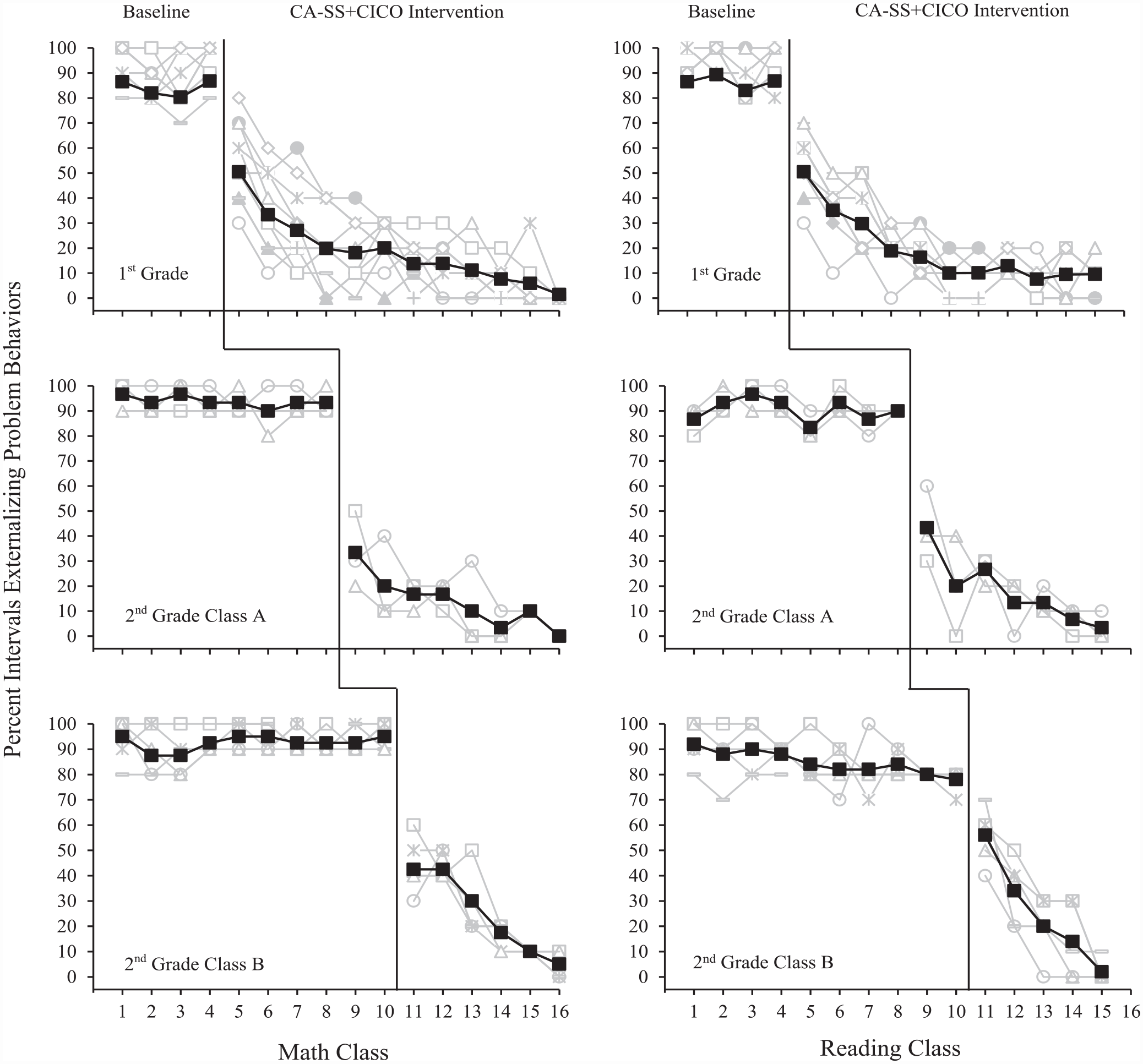
Student rate of externalizing problem behaviors.
SEARS-T Provides Mean Differences (Post–Pre) for Each Domain and Student
Similar to the work of Graves et al. (2017), the SEARS-T behavior-rating scale was used to evaluate internalizing social-emotional domains (i.e., self-regulation, social competence, empathy, and responsibility). Results indicated overall growth for most learners across the four domains, with only two learners showing no growth. In the self-regulation domain, one student did not show any growth with a mean difference of 0, while two other learners regressed with values of −1. Social competence and responsibility also showed slight regressions with a mean difference of −4 in social competence for one student and −1 for another in responsibility. See Table 1 for SEARS-T mean difference scores for each student.
Mean Differences Between SEARS-T Pre-test and Post-test.
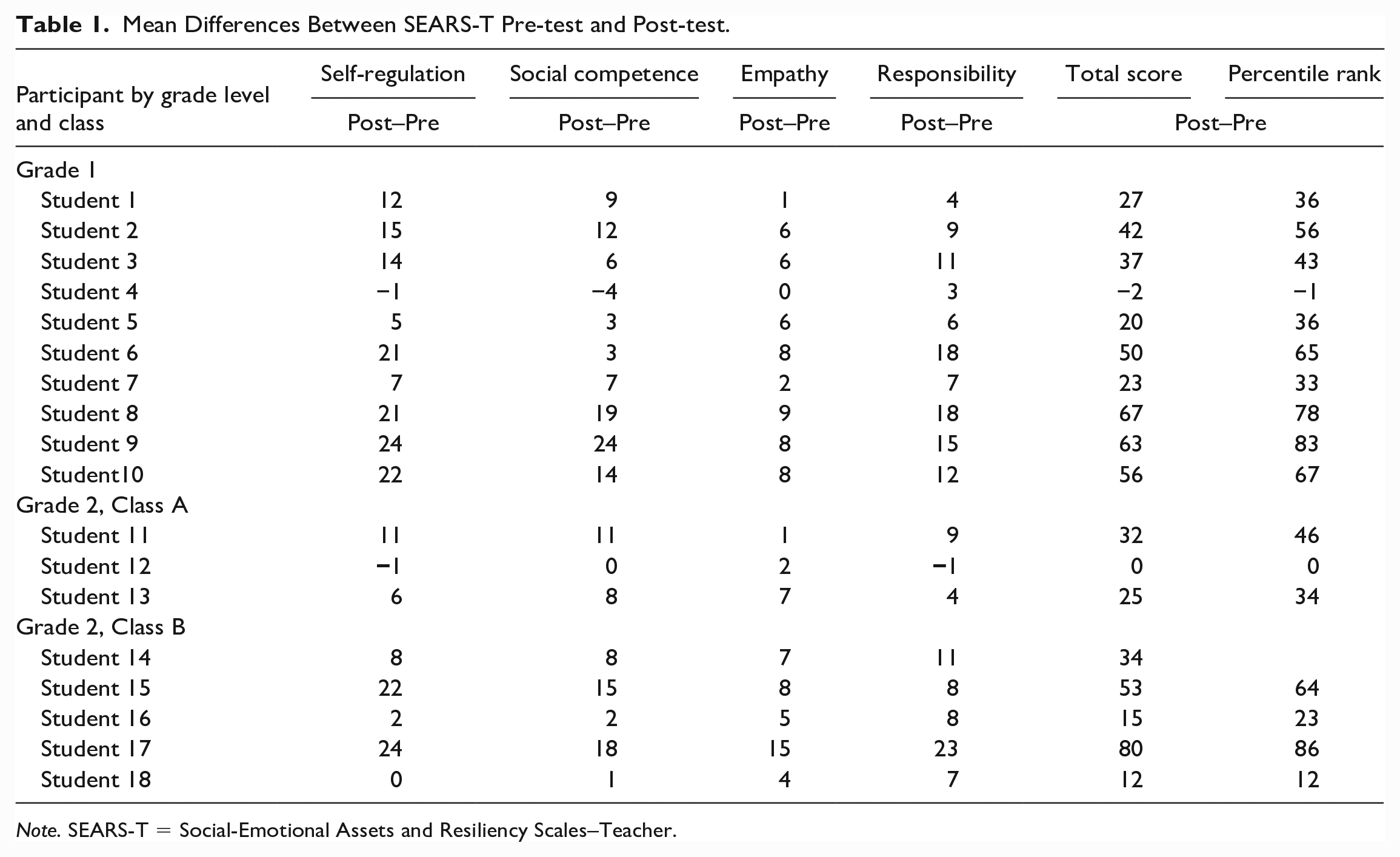
Note. SEARS-T = Social-Emotional Assets and Resiliency Scales–Teacher.
Social Validity
Teachers answered Likert questions on a 4-point scale. They agreed that learners improved, decreasing their disruptive behavior in the classroom. Scores ranged from 2 (slight improvement) to 4 (a lot of improvement; M = 3.57, SD = 0.65), indicating that teachers observed growth in student behavior. On average, teachers also indicated improvement in learners' academic performance (M = 3.36, SD = 0.84). Teachers' scores indicate that they agreed that the CA-SS + CICO intervention helped learners to be more successful in the classroom (M = 3.71, SD = 0.61). Scores also show that teachers would recommend the program for learners with similar social and behavioral issues (M = 4.00, SD = 0.00) and that they agreed with the intervention being practical to implement in the school setting (M = 4.00, SD = 0.00). See Supplementary Material Table S2 for a breakdown of teacher responses by question.
Researchers asked participating learners five open-ended questions regarding their experiences specific to the CICO component and one question on the overall CA-SS + CICO program. All learners agreed that they were comfortable meeting with an adult in the morning and afternoon. When asked about an instance when meeting with the teacher positively affected their day, participants gave examples such as feeling more prepared for class, trusting the teacher about personal feelings and emotions, and learning how to ask for help. Learners, responding to the helpfulness of the feedback, indicated that they enjoyed having someone to talk to, felt that it decreased their issues in the classroom, changed their attitude, improved learning, and helped them make friends. Learners were asked whether the CA-SS + CICO program helped them behave better in class, and they responded that they felt a change in attitude, thinking, and ability to focus and that they wanted to make their mentor proud. Participants indicated enjoyment in talking to their favorite teacher and in prizes, and they mentioned learning and enjoying being in class. However, some participants indicated that they did not enjoy thinking of daily goals or working on reading and worksheets. Lastly, participants left additional comments such as “I am happy at school now,” and indicated a decrease in aversive punishment at home.
Discussion
This study examined the effects of an intervention package consisting of a culturally adapted SEL curriculum and CICO on student rate of externalizing behavior and levels of social-emotional competencies in an urban elementary-school setting. The curriculum was adapted to support the recruited participants—first- and second-grade Black learners identified with or at risk for EBD. CICO prompted and reinforced behaviors aligned with the competencies of the SEL curriculum (Whitcomb & Parisi Damico, 2016). Consistent treatment effects showing an overall decrease in observed externalizing behavior across three tiers demonstrated a functional relation, with some participating learners reaching near-zero levels. Learners demonstrated significant growth in self-regulation, self-awareness, social competence, empathy, and responsibility. This is a promising finding showing that an intervention package including social-emotional and behavioral components may be an effective approach for learners with more challenging behavior. In addition, stakeholders found the intervention's goals, procedures, and outcomes to be socially valid. This contrasts with participant reports of Graves et al. (2017), who found the adapted curriculum to be somewhat relevant but expressed concerns related to the lack of focus on issues specific to urban Black males and on the needs of urban communities.
There is a current movement focused on teaching and promoting SEL practices (U.S. Department of Education, 2021) as part of a comprehensive approach to meet all learners’ social, emotional, behavioral, and mental health needs. It is essential that in the push to identify evidence-based social-emotional and behavioral supports, the field recognizes the need for and importance of culturally relevant interventions. Brown et al. (2018) only found 10 studies in their comprehensive search for studies focusing on social, emotional, or behavioral interventions including cultural adaptions for learners with or at risk for EBD. Authors stated the need for additional research surrounding the development and implementation of cultural adaptations for school-based interventions. This study adds to that limited literature base by offering a proactive and culturally responsive approach for at-risk learners, which contrasts with the reactive and exclusionary responses experienced to a greater degree by learners of color.
Based on the present author team’s review of the literature, this study is the first to evaluate the impact of an intervention package consisting of a culturally adapted version of Strong Start and CICO. This highlights the promising approach of combining an SEL curriculum with a targeted behavioral intervention for learners with and at risk for EBD. Results from this study differ from those of Farahmand et al. (2011), who found negative effects for programs targeting externalizing behavior and learners with existing behavioral problems in a meta-analysis of school-based mental health and behavioral programs for low-income and urban youth. On a similar note, the present results contrast with findings from previous Strong Start studies using the curriculum only (Caldarella et al., 2009; Merrell et al., 2008; Neth et al., 2020), which have illustrated gains in social-emotional knowledge and internalizing behavior, but no meaningful change in externalizing problem behavior. These differences could be attributed to the unique combination of first learning skills (CA-SS) and then practicing in authentic settings with individualized and regular feedback (CICO). Furthermore, this comprehensive intervention targeted both internalizing and externalizing behaviors. In isolation, research shows that CICO decreases externalizing behaviors (Maggin et al., 2015). Although, CICO alone lacks systematic instruction on social-emotional competencies, limiting its ability to address underlying internalizing behaviors or give learners strategies to tackle future socially and emotionally challenging events. Providing learners strategies to address strong emotions or maintain healthy relationships increases the likelihood they will be able to navigate their day without engaging in externalizing behavior. Future research should explore how this intervention package may also positively affect the maintenance and generalization across behavior and SEL outcomes.
Another unique contribution to the literature relates to the student and teacher pairings. This study included teachers and learners who were all Black. National data show that just under 14% of the total student population in the 2019–2020 school year were Black (OSEP, 2021), whereas only 7% of all teachers were Black in the 2017–2018 school year (National Center for Education Statistics, 2022). This is especially relevant when considering that research (Lindsay & Hart, 2017) has shown that exposure to same-race teachers is associated with reduced rates of exclusionary discipline and office referrals for Black learners. The teachers contributed to the cultural adaptation process in the current study, and it is possible that their understanding of their learners' backgrounds and communities influenced the CICO interactions and delivery of the CA-SS in a way that a White teacher could not replicate. Future research is needed to explore the impact of same-race implementers and input from teachers prior to study onset.
Limitations
There are limitations to consider for this study. First, maintenance and generalization phases were not included, which should be considered in future research to explore the dosage and follow-up supports necessary to ensure therapeutic effects. In addition, researchers did not follow-up on student progress the following school year or conduct a delayed posttest to assess maintenance and generalization effects. Second, it should be noted that the same teachers were involved in the SEARS-T screening, the intervention implementation, and the SEARS-T post-test, which may have resulted in some bias in scoring. Future research may consider recruiting individuals with knowledge of the student, in addition to the homeroom teacher, to complete SEARS-T, as well as exploring distal effects with the parent form. Third, this study did not include a second independent verification of implementation fidelity. The first author and a research assistant jointly observed lessons and listened to CICO audio recordings to assess fidelity rather than completing this task independently and comparing to examine agreement. It is possible that an independent rater may have found different fidelity scores, and this should be done independently in the future. Finally, this study investigated a multicomponent intervention (CA-SS + CICO), which does not allow one to draw any conclusions regarding the contributions of CA-SS compared with CICO in the overall effect (i.e., externalizing behavior and SEL outcomes). Future research should explore designs able to parse out the relative contributions of each component such as a design with sequential introduction of the components.
Conclusion
A significant percentage of Black learners are exposed to risk factors that affect their social, emotional, and behavioral well-being. In this study, the pairing of CA-SS, an SEL curriculum, and CICO, a targeted evidence-based intervention, was effective in reducing externalizing behaviors and improving outcomes in SEL domains. Teacher interviews on social validity found the CA-SS + CICO package easy to implement, and participating learners indicated the intervention package as helpful to them at school and home.
Supplemental Material
sj-docx-1-pbi-10.1177_10983007221133525 – Supplemental material for Social-Emotional and Behavioral Support for First- and Second-Grade Black Learners at Risk for Emotional and Behavioral Problems
Supplemental material, sj-docx-1-pbi-10.1177_10983007221133525 for Social-Emotional and Behavioral Support for First- and Second-Grade Black Learners at Risk for Emotional and Behavioral Problems by Aaron Rachelle Campbell, Mary Rose Sallese, Julie L. Thompson, Mack D. Burke and Meghan L. Allen in Journal of Positive Behavior Interventions
Supplemental Material
sj-docx-2-pbi-10.1177_10983007221133525 – Supplemental material for Social-Emotional and Behavioral Support for First- and Second-Grade Black Learners at Risk for Emotional and Behavioral Problems
Supplemental material, sj-docx-2-pbi-10.1177_10983007221133525 for Social-Emotional and Behavioral Support for First- and Second-Grade Black Learners at Risk for Emotional and Behavioral Problems by Aaron Rachelle Campbell, Mary Rose Sallese, Julie L. Thompson, Mack D. Burke and Meghan L. Allen in Journal of Positive Behavior Interventions
Supplemental Material
sj-docx-3-pbi-10.1177_10983007221133525 – Supplemental material for Social-Emotional and Behavioral Support for First- and Second-Grade Black Learners at Risk for Emotional and Behavioral Problems
Supplemental material, sj-docx-3-pbi-10.1177_10983007221133525 for Social-Emotional and Behavioral Support for First- and Second-Grade Black Learners at Risk for Emotional and Behavioral Problems by Aaron Rachelle Campbell, Mary Rose Sallese, Julie L. Thompson, Mack D. Burke and Meghan L. Allen in Journal of Positive Behavior Interventions
Supplemental Material
sj-docx-4-pbi-10.1177_10983007221133525 – Supplemental material for Social-Emotional and Behavioral Support for First- and Second-Grade Black Learners at Risk for Emotional and Behavioral Problems
Supplemental material, sj-docx-4-pbi-10.1177_10983007221133525 for Social-Emotional and Behavioral Support for First- and Second-Grade Black Learners at Risk for Emotional and Behavioral Problems by Aaron Rachelle Campbell, Mary Rose Sallese, Julie L. Thompson, Mack D. Burke and Meghan L. Allen in Journal of Positive Behavior Interventions
Supplemental Material
sj-docx-5-pbi-10.1177_10983007221133525 – Supplemental material for Social-Emotional and Behavioral Support for First- and Second-Grade Black Learners at Risk for Emotional and Behavioral Problems
Supplemental material, sj-docx-5-pbi-10.1177_10983007221133525 for Social-Emotional and Behavioral Support for First- and Second-Grade Black Learners at Risk for Emotional and Behavioral Problems by Aaron Rachelle Campbell, Mary Rose Sallese, Julie L. Thompson, Mack D. Burke and Meghan L. Allen in Journal of Positive Behavior Interventions
Supplemental Material
sj-docx-6-pbi-10.1177_10983007221133525 – Supplemental material for Social-Emotional and Behavioral Support for First- and Second-Grade Black Learners at Risk for Emotional and Behavioral Problems
Supplemental material, sj-docx-6-pbi-10.1177_10983007221133525 for Social-Emotional and Behavioral Support for First- and Second-Grade Black Learners at Risk for Emotional and Behavioral Problems by Aaron Rachelle Campbell, Mary Rose Sallese, Julie L. Thompson, Mack D. Burke and Meghan L. Allen in Journal of Positive Behavior Interventions
Footnotes
Declaration of Conflicting Interests
The authors declared no potential conflicts of interest with respect to the research, authorship, and/or publication of this article.
Funding
The authors received no financial support for the research, authorship, and/or publication of this article.

Supplemental Material
Supplemental material for this article is available on the Journal of Positive Behavior Interventions website with the online version of this article.
References
Supplementary Material
Please find the following supplemental material available below.
For Open Access articles published under a Creative Commons License, all supplemental material carries the same license as the article it is associated with.
For non-Open Access articles published, all supplemental material carries a non-exclusive license, and permission requests for re-use of supplemental material or any part of supplemental material shall be sent directly to the copyright owner as specified in the copyright notice associated with the article.
