



Abstract
The purpose of the study was to evaluate the effects of cooperative physical activities on social interactions of children with autism spectrum disorder (ASD) in China. Cooperative physical activities include procedures such as peer selection, peer practice, group task completion, and an interdependent group contingency. The intervention took place during inclusive physical education (PE) classes. Generalization of interactions with peers was evaluated during free play. Three preschool boys (ages 4–5 yrs) with ASD participated in the study, which used a multiple baseline design across the participants. Results indicated that the procedure effectively increased the frequency of appropriate peer interactions for all three children in the PE and free play settings. Although the frequency of inappropriate interactions increased after the intervention in both settings, the proportion of inappropriate interactions relative to appropriate interactions decreased for two children in the PE setting and for all three children in the free play setting.
Keywords
Autism spectrum disorder (ASD) is a neurodevelopmental disorder characterized by social impairments and repetitive behavior patterns or circumscribed interests (American Psychiatric Association, 2013). Social difficulties for children with ASD often lie in their inability to initiate and sustain interactions with others (Kasari & Patterson, 2012). As they grow older, these children tend to feel anxious about and avoid social situations, but at the same time feel lonely and isolated, and desire friendship at school (Bauminger et al., 2003). To ameliorate social problems in later childhood, interventions to improve peer interactions are needed at an early age.
The prevalence of ASD in mainland China is estimated to be 0.7%, close to that in Western countries. In mainland China, this totals approximately 13 million individuals (Zhou et al., 2020). Although resources and access to general education vary greatly in different regions of China, a growing number of students with ASD have been enrolled in general education systems in recent years (An et al., 2018). Research has demonstrated that children with ASD benefit academically, socially, and psychologically from full participation in inclusive education, more so than they do from specialized training in isolated settings (Crosland & Dunlap, 2012; Koegel et al., 2012). Research regarding interventions for Chinese children with ASD conducted in inclusive settings, however, is sparse (An et al., 2018).
Although interventions implemented in inclusive settings have advantages for children with ASD, careful considerations are needed to avoid potential drawbacks to those interventions. Lack of procedural fidelity, possible stigmatization or social exclusion of target children, and reduced instructional time for peer implementers are concerns (Chang & Locke, 2016; Gunning et al., 2019). Furthermore, target children and their peers may be required to behave in ways that are not consistent with their preferred interests or with their developmental levels (Koegel et al., 2012). It is important that social interventions designed to be carried out in inclusive settings are manageable for the implementers and developmentally appropriate and naturally reinforcing for students.
Cooperative learning is one strategy that can be used to structure learning activities that encourage students to engage in meaningful interactions. Students are divided into small groups, the members of which collaborate to work on projects, complete assignments, or practice skills, and share the same rewards at the end (Gillies, 2016). Important elements for successful implementation of cooperative learning include mixed-ability grouping, assigning tasks that require student interactions, teacher monitoring, instruction in cooperation skills, and individual and group accountability for achieving group goals (Gillies, 2016). In a meta-analytic study, Roseth et al. (2008) reported that cooperative learning, compared with individual or competitive learning, resulted in higher academic performance and more positive peer interactions.
Cooperative learning has been used to integrate students with ASD into general education settings and to improve their academic skills and social interactions with peers (Dugan et al., 1995; Kamps et al., 1995). Kamps et al. (2002) found that, compared with social skills training, cooperative learning produced better generalization of social skills outside the instructional setting. In these studies, learning activities involved the subject areas of reading and social studies for elementary students. Classwide training was provided on student responsibilities, rules of cooperative learning groups, and skills for social communication. Social interactions were evaluated as a collateral effect for improved academic gains through cooperative learning groups. Kohler et al. (1995) combined peer-mediated social skills intervention with an interdependent group contingency to increase social interactions during unstructured play activities (e.g., play with modeling clay or blocks) for preschoolers with ASD in inclusive classrooms. The teachers who implemented the procedures first trained target children and peers in social skills in a 15-min daily session for 15 days and assigned two typical peers to each target child to form a triad playgroup. Each group as a whole obtained a reward only if each member of the group had individually earned smiley faces for appropriate social behaviors. Kohler et al. (1995) attributed successful integration to this interdependent group contingency. The play activities used by Kohler et al., however, could be completed individually and were not structured to require children’s interactions; teacher prompts were required during the intervention. In addition, peers were assigned by teachers rather than being selected by target children themselves. Although peer-mediated interventions improved social interactions for target students with ASD (Dugan et al., 1995; Kamps et al., 1995, 2002; Kohler et al., 1995), classwide training required additional instructional time, and teacher implementers needed the appropriate skills to provide that training. Such requirements can potentially limit the feasibility of these interventions in settings where teachers do not have the necessary time and skills.
Cooperative learning in inclusive physical education (PE) classes has been recommended as particularly suitable for integrating children with ASD (Grenier & Yeaton, 2011; SHAPE America-Society of Health and Physical Educators, 2009). Physical activities can be structured for small groups and to require each person’s contribution toward a group goal; social interactions can be naturally embedded in these activities. Empirical studies of peer-supported physical activities in inclusive PE classes, however, are limited (Block & Obrusnikova, 2007; Qi & Ha, 2012). In a comparative study, Kļaviņa and Rodionova (2015) found that students with multiple disabilities demonstrated increased interaction with the teacher in the teacher-implemented condition and with peers in the peer-mediated condition in a PE class. Classwide peer tutoring has been shown to be effective in improving baseball skills (e.g., catching and striking) for children with ASD in inclusive PE classes (Johnson & Ward, 2001; Ward & Ayvazo, 2006), but the effect on student interactions was not evaluated in these studies. Brock et al. (2016) reported that social interactions between peers and students with ASD facilitated by paraprofessionals in inclusive art and computer classes also occurred in PE classes, but specific procedures for structuring physical activities to facilitate social interactions in the PE setting were not clear. Arranging cooperative physical activities in the inclusive PE context does seem a promising practice for increasing participation and social interactions for students with ASD.
The lack of evidence-based practices for integrating children with ASD into general education settings in China and the paucity of cooperative learning research conducted in the PE setting support the design of the present study. This study was the first attempt in China to evaluate the effects of cooperative physical activities on social interactions for children with ASD in inclusive PE classes. The intervention was designed with consideration of available resources and time constraints at the study sites; no additional time or alternation of curriculum was allowed. The baseline included individual practice and completion of physical activities. During the intervention, children chose a peer, practiced physical activities in dyads, and completed the tasks together to obtain individual and group rewards. The following research questions were addressed:
Method
Participants
Three preschool children enrolled in two full-time inclusive preschools participated in this study. The participants were between 2 and 5 years of age and had been diagnosed with ASD; they were able to imitate gross motor actions and follow instructions in group activities. Prospective participants were excluded from the study if they had a medical condition (e.g., susceptibility to seizures) or were receiving social skills training at the time of the study. The participants were identified by their teachers as lacking appropriate social skills.
Jun was a 4-year-old boy. His IQ score was 49 (moderate intellectual disability) as measured by the Chinese version of the Wechsler Preschool and Primary Scale of Intelligence–Revised (WPPSI-R; Wechsler, 1989; Zhang, 2009). Jun was diagnosed with ASD by a pediatrician using the Chinese version of the Childhood Autism Rating Scale (CARS; Lu et al., 2004; Schopler et al., 2002) and the criteria of ASD in the Diagnostic and Statistical Manual of Mental Disorders (American Psychiatric Association, 2013). His CARS score was 37.5 in the severe category. Researchers who observed Jun in the classroom reported that he followed one-step instructions, imitated gross motor actions when asked to do so, and echoed phrases that he heard. He did not communicate verbally and used pointing to indicate his wants and needs. He occasionally imitated his teacher’s gross motor actions in group activities but often engaged in stereotypic behaviors (i.e., watching his own finger movements and turning his body around in circles) or flopped on the floor during group activities. Jun did not respond to or initiate any interactions or conversations with peers.
Feng was 5 years old at the time of the study. His WPPSI-IV IQ score was 68 (mild intellectual disability) and his CARS score was 32, in the mild to moderate category. Feng followed one-step instructions, imitated gross motor actions, had functional communication skills, responded to simple social questions, and liked to ask his teacher “Why?” He usually engaged in solitary play with self-talk that did not make sense to others. He sometimes observed his peers’ activities but did not imitate or have any interactions with them.
Bo was a 4.5-year-old boy with ASD. His WPPSI-IV IQ score was 78 (borderline intellectual functioning) and his CARS score was 33.5 (mild to moderate autistic symptoms). Bo followed one-step instructions, imitated gross motor actions, and used functional communication skills (i.e., simple sentences) to request preferred items. He responded to and initiated interactions with adults but not children. He often engaged in solitary play and threw tantrums when access to preferred items or activities was restricted.
Setting and Materials
The study took place in two private inclusive preschools in a major city in central China. Jun and Feng were in the same preschool that operated full-time (Monday–Friday, 9 a.m.–5 p.m.). The school contained four classrooms: one kindergarten room (for children 5–6 years old), two prekindergarten rooms (for children 4–5 years old), and one preschool room (for children 3–4 years old). Jun was in one of the prekindergarten classrooms and Feng in the other. Each classroom included 15 typically developing children, one lead teacher, and one teaching assistant. The intervention was conducted during their regular PE classes on the school’s outdoor sports field.
Bo’s full-time inclusive preschool also contained four classrooms (one kindergarten, one prekindergarten, and two preschool rooms). Bo was in the prekindergarten classroom with 13 typically developing children, a lead teacher, and one teaching assistant. The intervention was conducted during regular PE classes in the school’s indoor gym.
Generalization of peer interactions to free play settings was observed during free play time in each child’s classroom. The classrooms had different layouts, but all included a circle time area, a reading corner, toys and board games on open shelves, and two or three workstations with a table and chairs. The daily activities in the preschools included language, social studies, science, music, art, PE, lunchtime, two snack breaks, and two free play periods. The children with special needs stayed in their classroom for most of the group activities and were taken out for individual lessons of 30 min in the morning and 30 min in the afternoon. According to their individualized curricular plans, the participants received individual training on eye contact, following directions, matching or labeling common items, and gross motor imitations.
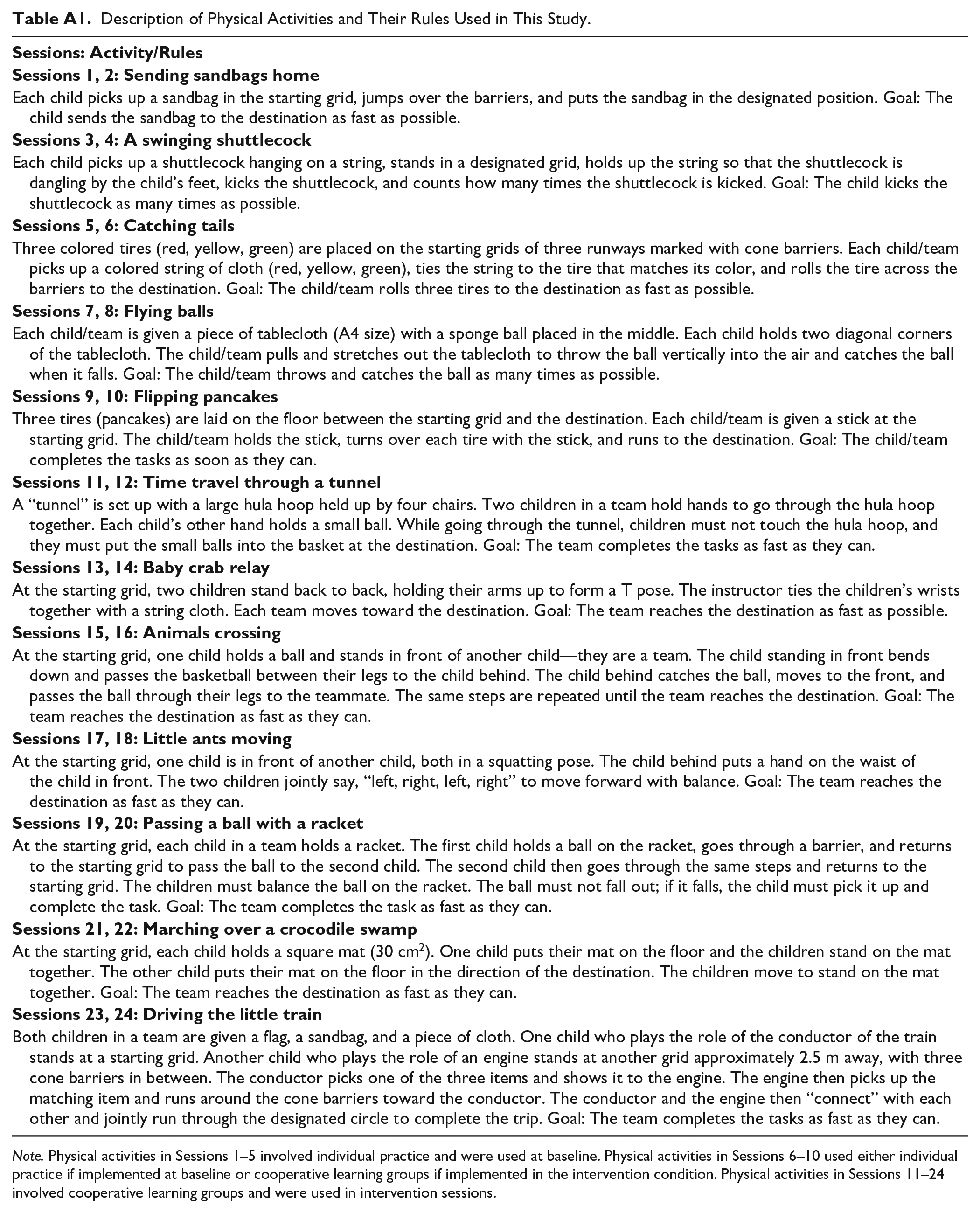
The physical activities employed in this study were selected from books of recommended group physical activities for preschool-age children (Zou, 2013). The descriptions of rules and materials used for these physical activities are outlined in Appendix A.
Experimental Design
A concurrent multiple baseline design across participants (Gast et al., 2018) was employed to evaluate changes in peer interactions during cooperative physical activities. The intervention was implemented in the PE setting in which the experimental decisions were made based on appropriate interactions. The intervention was introduced to the first participant once a stable baseline for appropriate interactions had been established across participants. When the first participant’s appropriate interactions were increased with at least two data values exceeding the highest baseline data value and displayed an ascending trend to demonstrate behavioral change in the intervention condition, the intervention was introduced for the second participant; the same criterion was applied to the second participant and then the third. Generalization of peer interactions was evaluated in the free play setting about 30 min after the intervention session. Nonoverlap of all pairs (NAP) was used to supplement visual inspection. NAP is a nonparametric measure for overlap between two phases and has good statistical power (Parker et al., 2011). In the present study, NAP measures the percentage of improvements for the target behaviors by pairwise comparisons across baseline and intervention conditions. A NAP value >.93 indicates that the intervention has a large effect, .66 to .92 a moderate effect, and <.65 a small effect (Parker et al., 2011). NAP was calculated using a web-based NAP calculator (Vannest et al., 2016).
Procedure
The instructor was a second-year graduate student of special education who had received 1 year of basic training in behavior analysis and completed two semesters of practicum in regular preschools. A classroom teacher or teaching assistant assisted the instructor by demonstrating the physical activity, directing off-task children back to the activity, resolving children’s conflicts when they occurred, and aiding any child as necessary. Assistants provided physical assistance to the participants in Sessions 7 and 8 as the task, catching and throwing a ball with a cloth, was relatively difficult. The participants did not require additional physical assistance in other sessions. Conflicts occurred among some children in the class during sessions but did not involve the participants. One physical activity was presented during each 25-min session; the same physical activity was implemented in two consecutive sessions. Activities implemented at baseline were structured for individual learning, and those implemented at intervention were structured for cooperative learning groups (Appendix A).
Baseline in the PE setting
Each baseline session comprised four components: 5-min warm-up, 5-min introduction, 10-min individual practice of physical activity, and 5-min wrap-up relaxation exercise. During warm-up, the entire class followed the instructor doing body-stretching exercises. The instructor introduced the selected physical activity by providing rules and modeling the actions of the activity. During individual practice, the children lined up and took turns, one at a time, going through the activity. The instructor and the assistant praised each child for task engagement and appropriate interactions with others or aided, if necessary. The instructor and the assistant monitored the entire class and verbally directed those children who were off-task back to the activity. Off-task behaviors occurred during baseline among typically developing children as well as among the children with ASD. At wrap-up, the instructor provided general praise for student participation and led the entire class in body relaxation exercises to conclude the session. Five baseline sessions were held with Jun, eight with Feng, and 10 with Bo.
Intervention in the PE setting
Each intervention session also had four components: 5-min warm-up, 5-min introduction, 10-min cooperative physical activity (1-min peer selection, 5-min peer practice, 4-min group task completion), and 5-min wrap-up with individual and group rewards. The warm-up and introduction were the same as at baseline.
A cooperative physical activity involved selecting a partner, practicing the activity with the partner, and completing the group tasks. The instructor asked the children to pair up with a partner of their choice (e.g., “I want two kids in a group. Boys and girls, find a kid you want to play with today.”). If a child approached a participant with ASD, and the participant did not respond, the instructor asked the participant whether he wanted to play with the peer, provided a verbal instruction with an echoic prompt to the participant (e.g., “S/he wants to play with you. If you want to play with him/her, say “OK.”), and waited for 3 s for the participant to respond. The verbal instruction with an echoic prompt was provided until the participant responded; typically, this happened after the instructor’s first prompt, and the participant usually agreed to play with the peer who approached him. If a participant did not find a partner, the instructor asked the participant, “Who do you want to play with?,” took the participant to the peer he indicated, and provided an echoic prompt, “Can I play with you?” The instructor waited 3 s for the participant to respond and repeated the same prompt until the participant responded positively and formed the dyad. If the peer preferred not to partner with the participant but with a different peer, the instructor provided another echoic prompt (e.g., “Who wants to team up with me?”) to assist the participant in asking for a partner from the whole class. The instructor immediately delivered praise to any children who spontaneously offered to partner with the participant. When several children volunteered, the instructor asked the participant to select the one with whom he preferred to partner. Such situations occurred 3 to 5 times for each participant at intervention because each participant tended to select the same partner at each session who was not always available. If the participant required assistance to find a peer, the process of finding a peer required about 1.5 min.
During peer practice, all children lined up in dyads and waited for their turn to practice the activity. The instructor or assistant did not remind or cue the participant’s partner to help the participant but provided specific praise (e.g., “It’s great that you encouraged your teammate” or “Nice showing him what to do”) when the partner spontaneously provided verbal reminders (e.g., “Come here”), modeling (e.g., “Look at me”), or reinforcement (e.g., “That’s right”) to the participant in the process. After peer practice, the instructor announced the group game time, and each dyad completed the tasks together as fast as they could over approximately 4 min. The instructor and the assistants praised each dyad for completing the game cooperatively. At baseline, the instructor and the assistant supervised the entire class and verbally directed those children who were off-task back to the activity. Off-task behaviors occurred in typically developing children as well as the children with ASD during early intervention sessions but not during later intervention sessions.
At wrap-up, an interdependent group contingency was implemented. Specifically, the instructor first provided praise and stickers to individual children who had followed the rules, played nicely, offered to team up with a participant, and assisted their partners during peer practice and group task completion. The instructor then provided additional praise and stickers to those teams in which both children had earned stickers and concluded the session. See Appendix B for a sample lesson plan used in the intervention.
One intervention session was conducted per day with three intervention sessions being conducted per week. The intervention condition lasted approximately 4 to 5 months for each child.
Generalization to the free play setting
Free play observation sessions were 20 min in length. These were conducted during free play time in each child’s classroom approximately 30 min after an intervention session. All children could play freely by themselves or with other children in any area of the classroom during this period. The teacher and the assistant monitored the activities and responded to children’s requests as usual. They did not initiate interactions, praise or comment children’s play behaviors, or provide any instruction to the participants.
Response Definitions
Dependent variables in the present study included the number and percentage of appropriate and inappropriate interactions exhibited by the participants in PE and free play settings. Event recording was used to collect data for target behaviors. An appropriate peer interaction was defined as any verbal or nonverbal communicative behavior directed toward a peer or a group of children that was suitable and relevant to the social context. Appropriate verbal communicative behaviors included greetings (e.g., “Hi”), inviting a peer (e.g., “Can I play with you?”), asking questions (“How do I do it?”), making comments (e.g., “This is fun”), giving directions (e.g., “I go first, and you follow me”), and answering questions (e.g., “Yes”). Appropriate nonverbal communicative behaviors included eye contact, gaze shifts, changes in body orientation, and hand gestures such as tapping a peer’s back to get attention, showing an item to a peer, looking when his name was called, nodding or shaking his head in response to a question, pointing to an item when asked where the item was, and handing an item to a peer when asked to do so. If a child displayed multiple appropriate interactions within 5 s, only one instance was counted. For example, if a child pointed to a ring and at the same time said, “Give me the ring,” the behavior was coded as one appropriate interaction. An inappropriate peer interaction was defined as any verbal or nonverbal behavior directed toward a peer or a group of children that was not suitable or relevant to the social context—such as grabbing others’ items without asking for permission, yelling, screaming, hitting, pushing, self-talking, or ignoring a peer’s initiations. If a child pushed another child and then grabbed something from that child within 5 seconds, the behavior was recorded as one inappropriate interaction. Prompted responses and verbal or nonverbal behavior directed to adults were not coded. A research assistant who did not participate in the ongoing activities followed the participant to videotape all sessions conducted in the PE and free play settings throughout the study. All data were collected from videotapes of recorded sessions. The data coders recorded the type of appropriate and inappropriate behaviors and the specific time these behaviors occurred in a session for the assessment of the point-to-point agreement.
Social Validity
Social validity was obtained via individual interviews with each participant’s lead teacher and teaching assistant who were asked two questions: (a) To what extent has the participant’s behavior changed after the cooperative physical activities were introduced? and (b) Do you have any suggestions to improve this intervention? The research assistant conducted individual interviews in each teacher’s classroom, asked one question at a time, and took notes with pencil and paper during interviews.
Procedural Integrity and Interobserver Agreement
Procedural fidelity and interobserver agreement were independently assessed by two graduate students of special education using video recordings of the sessions. The assessors were trained to assess the procedural steps and record the target behaviors of the study through reviewing the videotapes, observing the target behaviors, and discussing agreements and disagreements until 90% point-to-point agreement with the trainer was achieved for three consecutive sessions. Procedural fidelity was assessed for 30% of each condition for each child. A checklist consisting of the items and the steps for implementation was used. Checklist items for baseline sessions included the following: (a) preparing materials for the activity, (b) leading warm-up exercises, (c) introducing materials, (d) explaining and modeling the activity, (e) individual practice, (f) wrap-up with praise for participation and relaxation exercises, and (g) proper time control for each segment. Checklist items for intervention sessions were identical to those for the baseline sessions except for items (e) and (f). Item (e), individual practice, was replaced with three components: finding a partner, peer practice, and group task completion. Item (f), wrap-up activities, was replaced with individual rewards for good social behaviors and group rewards for teams. The percentage of procedural fidelity was calculated by dividing the number of correctly implemented items by the total number of items on the checklist and multiplying by 100. The procedural fidelity for baseline and intervention sessions was 100% for all sessions assessed.
Point-to-point agreement was assessed for 30% of the sessions for each child in each condition. The percentage of agreement was calculated by dividing the number of agreements by the total number of agreements and disagreements and multiplying by 100. The average agreement in the PE setting was 98.3% (95%–100%) for appropriate interactions and 100% for inappropriate interactions. The average agreement in the free play setting was 96.8% (89%–100%) for appropriate interactions and 98% (88%–100%) for inappropriate interactions.
Results
Figure 1 depicts the number of appropriate and inappropriate peer interactions exhibited by the participants in the PE setting. The children’s appropriate interactions with peers were stable at a relatively low level at baseline. When the intervention was introduced, appropriate interactions for Jun and Feng immediately increased to a slightly higher level with a variable ascending trend; for Bo, appropriate interactions immediately increased but soon decreased to the baseline level and then increased again with high variability without showing a trend. The mean frequency of appropriate interactions in the PE setting increased from baseline to intervention for all three children (see Table 1). Overlapping data measured using NAP for appropriate interactions were .97 and 1 for Jun and Feng, respectively, and .78 for Bo (see Table 1). No covariation across participants was found as vertical analysis shows that Jun’s appropriate interactions at intervention were slightly higher than those for Feng and Bo at baseline; Feng’s appropriate interactions at intervention were also slightly higher than those for Bo at baseline.
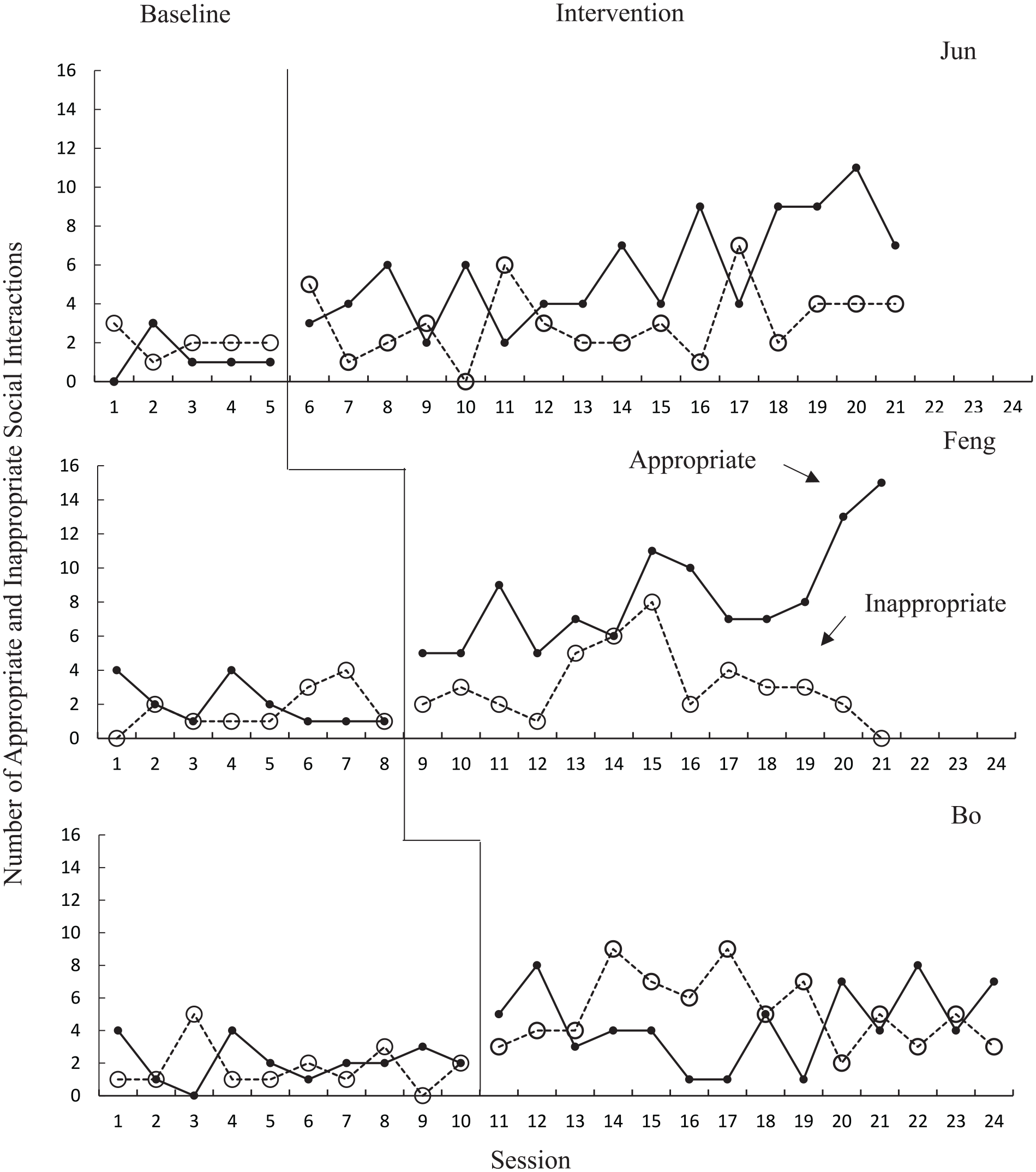
Number of appropriate and inappropriate social interactions in the physical education setting.
Mean Frequency and Percentage of Appropriate/Inappropriate Peer Interactions and NAP Values Between Baseline and Intervention Conditions for the Three Participants in the PE and Free Play Settings.
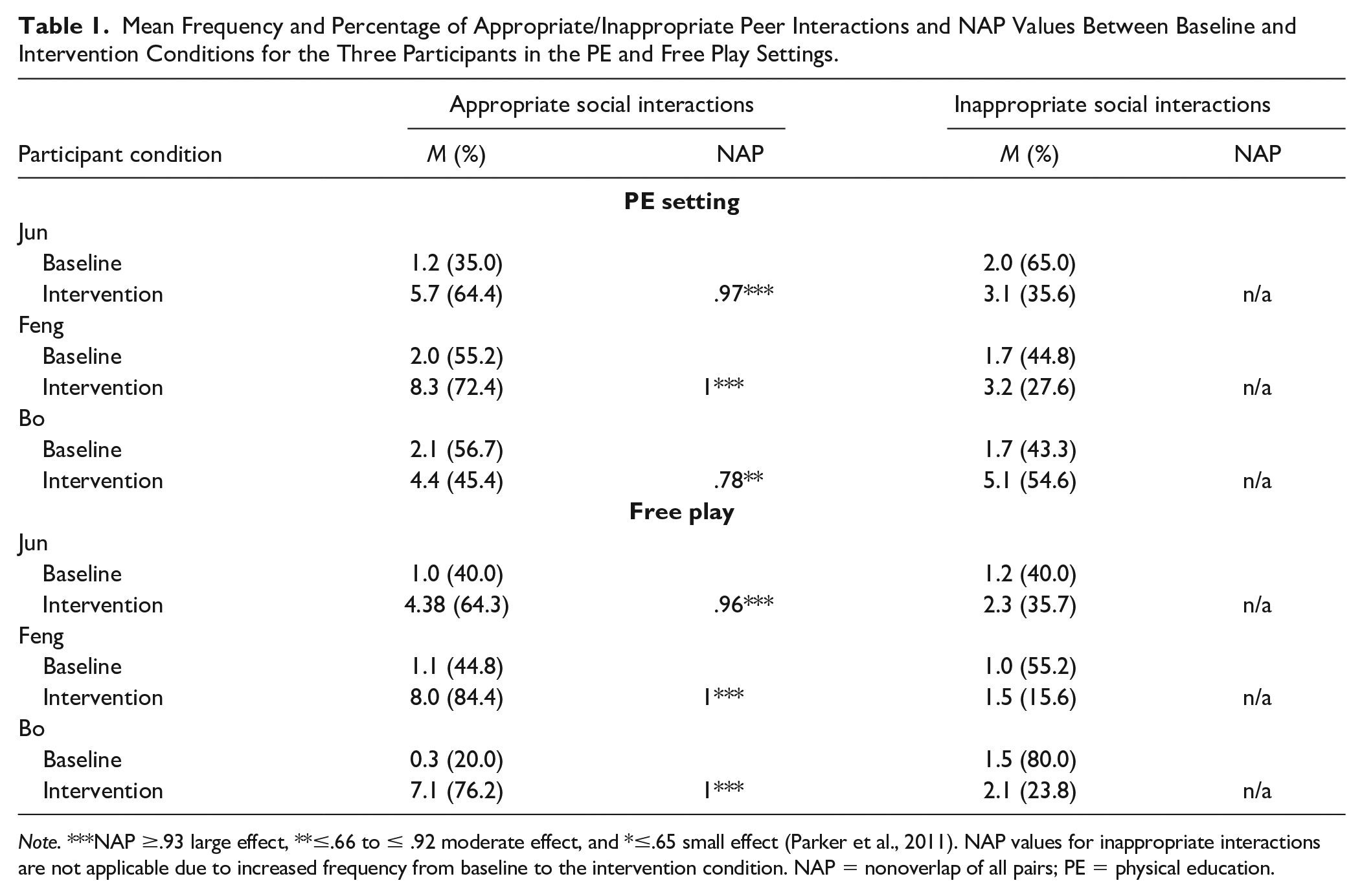
Note. ***NAP ≥.93 large effect, **≤.66 to ≤ .92 moderate effect, and *≤.65 small effect (Parker et al., 2011). NAP values for inappropriate interactions are not applicable due to increased frequency from baseline to the intervention condition. NAP = nonoverlap of all pairs; PE = physical education.
Figure 2 depicts the number of appropriate and inappropriate peer interactions exhibited by the participants in the free play setting. The children’s appropriate interactions were stable at a low level at baseline. In the intervention condition, Jun’s appropriate interactions started at a low level but gradually increased to a slightly higher level with an ascending trend and remained at that level. Feng’s and Bo’s appropriate interactions immediately increased to a relatively high level compared with baseline and remained at that level with some variability but without a trend. All three children’s mean frequency of appropriate interactions was relatively higher in the intervention than at baseline (see Table 1). NAP was .96 for Jun and 1 for Feng and Bo for the increase in appropriate peer interactions in the free play setting (see Table 1). Vertical analysis shows that Jun’s appropriate interactions at intervention were at a slightly higher level than were Feng’s and Bo’s at baseline; Feng’s appropriate interactions at intervention were at a relatively high level compared with those of Bo at baseline.
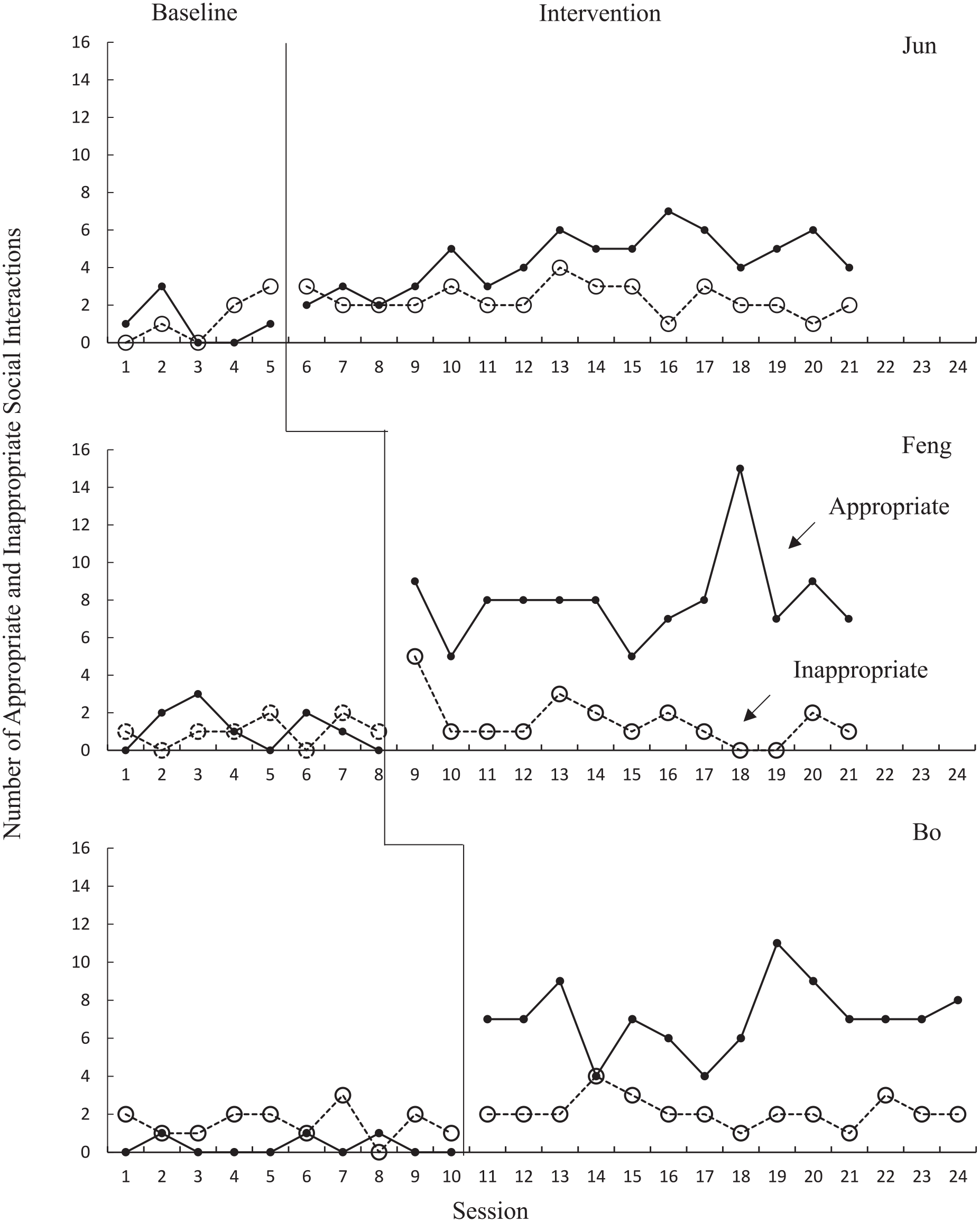
Number of appropriate and inappropriate social interactions in the free play setting.
The three children’s inappropriate interactions with peers were at a low level at baseline. As the total number of interactions increased in the intervention condition, inappropriate interactions also increased to a slightly higher level compared with baseline (see Figures 1 and 2). Despite the increases in the frequency of inappropriate interactions, the proportion of inappropriate interactions relative to appropriate interactions decreased from baseline to intervention for all three children in both settings, with one exception: Bo’s inappropriate interactions in the PE setting increased in proportion during the intervention condition (see Table 1). Overall, a functional relationship was demonstrated between the intervention and the increase in appropriate interactions but not the decrease in inappropriate interactions in both settings.
Social Validity
The lead teacher and teaching assistant from each participant’s class participated in individual interviews. All teachers and assistants unanimously indicated their satisfaction with the results of the intervention and reported that the group physical activities were fun and easy to implement. Jun’s teacher and teaching assistant noticed that Jun started to make friends and respond to other children and teachers more positively after the intervention. They suggested adding music at warm-up and repeating the activities but with increasing complexity in subsequent sessions. Feng’s teacher and teaching assistant noticed that Feng had more spontaneous interactions with other children during free play after the intervention. They suggested adding a brief story during warm-up to introduce the physical activity. Both teachers reported that they planned to adapt and continue the group physical activities. Bo’s teacher reported a noticeable improvement in Bo’s listening behavior in classes and positive interactions with other children after the intervention. They suggested that the group activities be extended to small groups of three or more children.
Discussion
The present study sought to evaluate whether cooperative physical activities were effective in improving social interactions between children with ASD and their peers at school. Results indicated that cooperative physical activities increased the number of appropriate social interactions in the PE setting where the intervention took place. Furthermore, appropriate social interactions were improved in the free play setting where children engaged in unstructured play activities. The proportion of inappropriate interactions decreased for two children in the PE setting and for all three children in the free play setting although, perhaps because of an overall increase in interactions between the participants and their peers, the number of inappropriate interactions (i.e., nonresponses to a peer’s initiations) actually increased from baseline to intervention conditions in both settings.
Changes to Social Interactions in the PE Setting
Results indicated that, after cooperative learning groups had been instituted, appropriate interactions for all three children increased in the PE setting with a large effect for two children and a moderate effect for one child (Bo). The components of cooperative learning used in this study included choosing a peer, group practice and task completion, and an interdependent group contingency. Having children select their preferred peers potentially made team members more likely to support each other. Teacher praise throughout the intervention potentially increased and strengthened peers’ prosocial behaviors (e.g., instructing and assisting) directed to the participant during cooperative activities. A positive learning environment was built through relevant consequences such as task completion, teacher praise, individual rewards, and group rewards. The inclusion of an interdependent group contingency not only emphasized the group goal but also required each member to complete his part toward that goal (Kohler et al., 1995). Positive interdependence, peer encouragement, and personal responsibilities in a team, all key elements to successful cooperative learning (Gillies, 2016), characterized this study’s cooperative learning groups.
Previous studies of peer-supported interventions involved the teaching of academic subject matter (Dugan et al., 1995; Kamps et al., 2002) or complex physical activities (Johnson & Ward, 2001; Ward & Ayvazo, 2006) to older elementary students. In these studies, teacher training and/or student training for tutoring and social skills were required prior to implementation. The teachers at our study sites, however, expressed the same concerns that many PE teachers have reported about lack of skills to implement complicated procedures and the additional time required for instructional preparation (Zimbelman et al., 2007). The present study, therefore, was devised with procedures that were easy to implement and feasible for teachers to manage, and with physical activities that were simple, developmentally appropriate, and, it was hoped, enjoyable for preschoolers. Instead of teacher training and/or student training, we embedded reinforcement (e.g., group task completion and teacher praise) within the cooperative physical activities to strengthen desired social behavior. Teachers simply demonstrated the tasks to the class, monitored the activity, praised desired social behavior, aided those in need, and resolved student conflicts when necessary. Results of the study indicated that appropriate interactions in the PE setting for children with ASD can be effectively increased by cooperative physical activities without altering curricular programs or requiring intensive training for teachers or students. It is possible that the cooperative learning arrangement with an interdependent group contingency facilitated natural peer interactions and encouraged group members to work collaboratively toward a common goal, providing ample opportunities for children with ASD to attend to relevant objects and peers in the environment and reducing the need for teacher assistance.
One problem that occurred during the intervention in the present study was that each participant tended to select the same peer as a partner for each session, but those peers were not always available. Thus, opportunities were created for participants to seek an alternative peer or to respond to an invitation from another peer. Our anecdotal observation suggested that teacher praise for those who spontaneously responded to a participant’s invitation may encourage peers’ prosocial behaviors and avoid potential stigmatization for the participants, a problem commonly occurring in a peer-mediated intervention (Chang & Locke, 2016; Gunning et al., 2019).
Although the proportion of inappropriate social interactions relative to appropriate interactions decreased for two of the three participants in the PE setting (Bo was the exception), the total number of inappropriate interactions was notably higher during the intervention than at baseline. (This finding was not expected but was consistent with the findings of a previous study by Hu et al., 2021.) We suspect the intervention might have directly increased prompts and initiations by peers, thereby increasing participants’ opportunities to respond and not respond, and resulting in increased numbers of both appropriate and inappropriate interactions. The decreased proportion of inappropriate interactions relative to appropriate interactions in the intervention provides preliminary support for this speculation. However, we do not have data on the number of peer initiations to support this notion, and further investigation is needed.
Examination of raw data indicated that the three children’s inappropriate interactions primarily consisted of ignoring a peer’s initiations. All of Jun’s inappropriate interactions in both settings involved ignoring a peer’s initiations. Feng and Bo each displayed three instances of aggressive behavior at baseline and one instance of aggressive behavior at intervention in the PE setting, as well as one instance of aggressive behavior at baseline in the free play setting. These aggressive behaviors consisted of grabbing items from others without permission or pushing a child who stood on their way. Thus, the children’s inappropriate interactions in the present study consisted primarily of passive behavior rather than of aggressive behaviors actively directed toward others, behaviors that would likely be detrimental to social interactions. We believe we can say for certain that the intervention did not result in an increase in aggressive behavior.
Responding to others was a behavior that was already in the repertoire of the three participants; ignoring others, therefore, was possibly related to their lack of coordinated attention to contextual cues surrounding others’ initiations (Kasari & Patterson, 2012). Training in joint attention and engagement with relevant objects and people in the environment are likely to be necessary to further increase appropriate interactions and decrease nonresponses for the participants.
Changes to Social Interactions in the Free Play Setting
Appropriate interactions for all three participants were greatly increased in the free play setting. This increase suggested successful generalization of appropriate interactions from cooperative physical activities in the PE setting to unstructured play activities. These findings are consistent with results from prior research (Brock et al., 2016; Kamps et al., 2002). Unlike the findings of a study by Kohler et al. (1995) in which teacher prompts were needed to facilitate social interactions in playgroups, the improved peer interactions in the free play setting of the present study occurred without teacher prompts. The successful generalization observed in the present study may be attributable to several factors: Rather than being taught social skills by an adult in an isolated setting, the intervention was embedded in ongoing activities in a natural setting where children with ASD were supported by typically developing peers. Also, social exchanges took place in a meaningful, integrated manner through cooperative activities with natural consequences relevant to the context. Finally, the peer selection procedure in this study promoted opportunities for multiple peers to interact with children with ASD in different physical activities, which further provided varied contextual cues to facilitate generalization.
In the free play setting, inappropriate interactions increased slightly in frequency for all children. As in the PE setting, the children’s inappropriate interactions involved ignoring others’ initiations, and the proportion of inappropriate interactions relative to appropriate interactions also decreased in the intervention condition. Specific training for joint attention and engagement is the key to further improving social interactions for the participants.
Limitations
Several limitations should be considered when interpreting the results of this study. Although the intervention was technically friendly and easy for nonprofessionals to implement, the fact that children with ASD continued to demonstrate nonresponses in the intervention suggests that their overall improvement in social interactions may be limited. As suggested, social skills training for the participants prior to beginning the intervention may be necessary to further improve the outcomes. If resources and time are available, classwide student training on role responsibilities in cooperative learning groups (Kamps et al., 1995), social skills training (Kohler et al., 1995), peer practice specifically for physical activities (Johnson & Ward, 2001), or peer training with prompting strategies (Hu et al., 2021) could potentially maximize overall improvement on social interactions exhibited by participants with ASD. In addition, training teachers and assistants to facilitate peer interaction in inclusive settings may be an option (Brock et al., 2016).
A second limitation concerns the outcome measures. Although peers’ prosocial behaviors were reinforced throughout the study, we did not include peer prompts or teacher approvals as outcome measures in this study. To ensure accurate interpretation of results, peer prompts and initiations that occur during intervention must be measured. Measuring peer prompts and teacher approvals is also helpful in evaluating the feasibility of the study’s procedures in practice. In addition, future studies should include teacher implementers in the PE setting to evaluate whether the results are generalizable to teacher implementers. Finally, short-term and long-term maintenance in both PE and free play settings should be included in future studies to evaluate maintenance effects.
Conclusion
The study was an initial step in addressing the lack of evidence-based teaching practices for children with ASD in inclusive education in China. The procedures of cooperative physical activities with an interdependent group contingency as used in this study effectively improved social interactions for children with ASD in the PE setting with the improvement generalizing to the free play setting. The study’s procedures can be used when resources and time for teacher or student training are limited. The results of this study are promising and have important implications for the inclusive education of young children with ASD in China. Preschool teachers and staff can arrange cooperative physical activities to encourage meaningful participation and positive interactions to maximize the benefit of inclusive education for children with ASD.
Footnotes
Appendix A
Description of Physical Activities and Their Rules Used in This Study.
|
|
| Each child picks up a sandbag in the starting grid, jumps over the barriers, and puts the sandbag in the designated position. Goal: The child sends the sandbag to the destination as fast as possible. |
|
|
| Each child picks up a shuttlecock hanging on a string, stands in a designated grid, holds up the string so that the shuttlecock is dangling by the child’s feet, kicks the shuttlecock, and counts how many times the shuttlecock is kicked. Goal: The child kicks the shuttlecock as many times as possible. |
|
|
| Three colored tires (red, yellow, green) are placed on the starting grids of three runways marked with cone barriers. Each child/team picks up a colored string of cloth (red, yellow, green), ties the string to the tire that matches its color, and rolls the tire across the barriers to the destination. Goal: The child/team rolls three tires to the destination as fast as possible. |
|
|
| Each child/team is given a piece of tablecloth (A4 size) with a sponge ball placed in the middle. Each child holds two diagonal corners of the tablecloth. The child/team pulls and stretches out the tablecloth to throw the ball vertically into the air and catches the ball when it falls. Goal: The child/team throws and catches the ball as many times as possible. |
|
|
| Three tires (pancakes) are laid on the floor between the starting grid and the destination. Each child/team is given a stick at the starting grid. The child/team holds the stick, turns over each tire with the stick, and runs to the destination. Goal: The child/team completes the tasks as soon as they can. |
|
|
| A “tunnel” is set up with a large hula hoop held up by four chairs. Two children in a team hold hands to go through the hula hoop together. Each child’s other hand holds a small ball. While going through the tunnel, children must not touch the hula hoop, and they must put the small balls into the basket at the destination. Goal: The team completes the tasks as fast as they can. |
|
|
| At the starting grid, two children stand back to back, holding their arms up to form a T pose. The instructor ties the children’s wrists together with a string cloth. Each team moves toward the destination. Goal: The team reaches the destination as fast as possible. |
|
|
| At the starting grid, one child holds a ball and stands in front of another child—they are a team. The child standing in front bends down and passes the basketball between their legs to the child behind. The child behind catches the ball, moves to the front, and passes the ball through their legs to the teammate. The same steps are repeated until the team reaches the destination. Goal: The team reaches the destination as fast as they can. |
|
|
| At the starting grid, one child is in front of another child, both in a squatting pose. The child behind puts a hand on the waist of the child in front. The two children jointly say, “left, right, left, right” to move forward with balance. Goal: The team reaches the destination as fast as they can. |
|
|
| At the starting grid, each child in a team holds a racket. The first child holds a ball on the racket, goes through a barrier, and returns to the starting grid to pass the ball to the second child. The second child then goes through the same steps and returns to the starting grid. The children must balance the ball on the racket. The ball must not fall out; if it falls, the child must pick it up and complete the task. Goal: The team completes the task as fast as they can. |
|
|
| At the starting grid, each child holds a square mat (30 cm2). One child puts their mat on the floor and the children stand on the mat together. The other child puts their mat on the floor in the direction of the destination. The children move to stand on the mat together. Goal: The team reaches the destination as fast as they can. |
|
|
| Both children in a team are given a flag, a sandbag, and a piece of cloth. One child who plays the role of the conductor of the train stands at a starting grid. Another child who plays the role of an engine stands at another grid approximately 2.5 m away, with three cone barriers in between. The conductor picks one of the three items and shows it to the engine. The engine then picks up the matching item and runs around the cone barriers toward the conductor. The conductor and the engine then “connect” with each other and jointly run through the designated circle to complete the trip. Goal: The team completes the tasks as fast as they can. |
Note. Physical activities in Sessions 1–5 involved individual practice and were used at baseline. Physical activities in Sessions 6–10 used either individual practice if implemented at baseline or cooperative learning groups if implemented in the intervention condition. Physical activities in Sessions 11–24 involved cooperative learning groups and were used in intervention sessions.
Appendix B
Sample Lesson Plan.
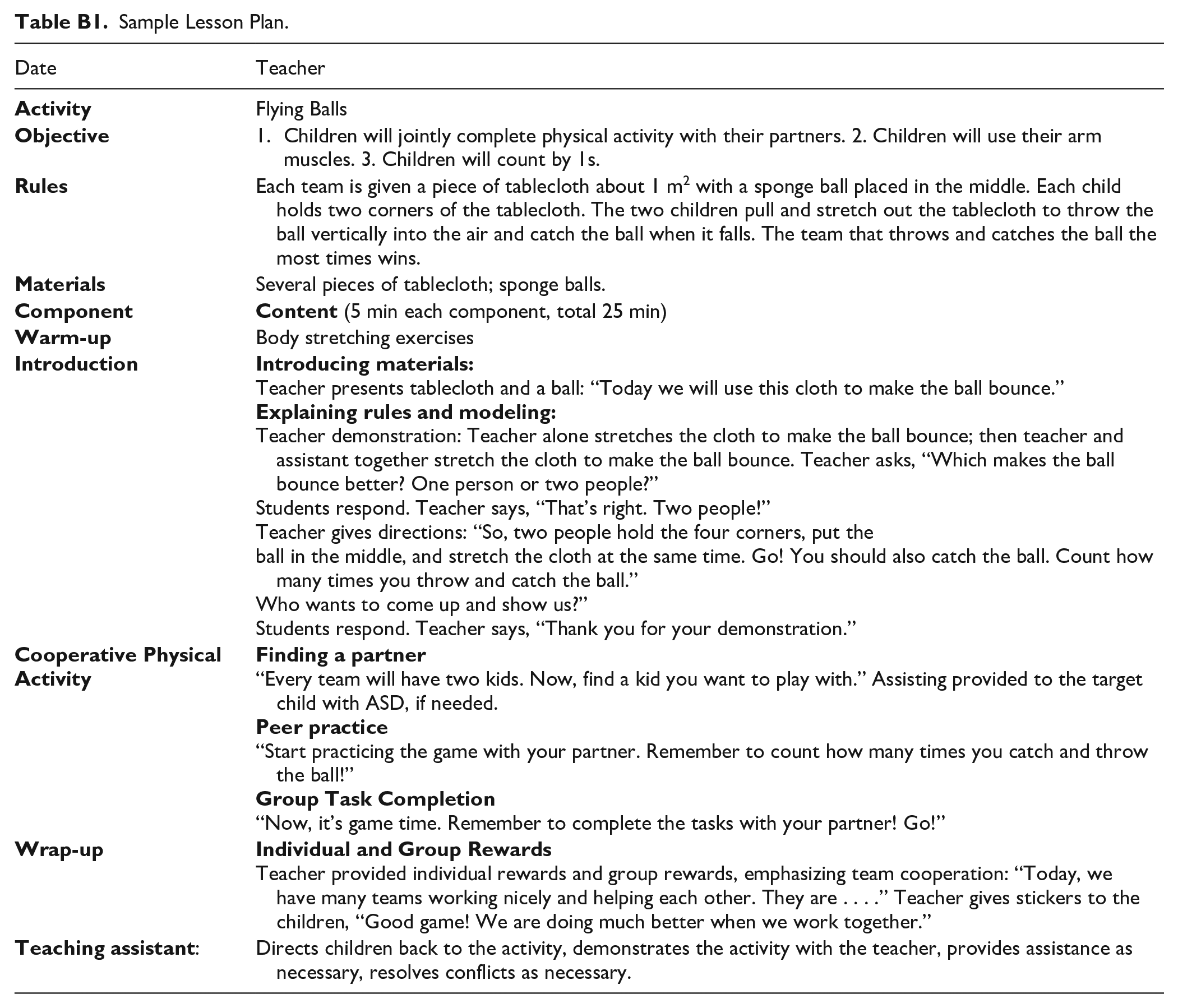
| Date | Teacher |
|---|---|
|
|
Flying Balls |
|
|
1. Children will jointly complete physical activity with their partners. 2. Children will use their arm muscles. 3. Children will count by 1s. |
|
|
Each team is given a piece of tablecloth about 1 m2 with a sponge ball placed in the middle. Each child holds two corners of the tablecloth. The two children pull and stretch out the tablecloth to throw the ball vertically into the air and catch the ball when it falls. The team that throws and catches the ball the most times wins. |
|
|
Several pieces of tablecloth; sponge balls. |
|
|
|
|
|
Body stretching exercises |
|
|
Teacher presents tablecloth and a ball: “Today we will use this cloth to make the ball bounce.” Teacher demonstration: Teacher alone stretches the cloth to make the ball bounce; then teacher and assistant together stretch the cloth to make the ball bounce. Teacher asks, “Which makes the ball bounce better? One person or two people?” Students respond. Teacher says, “That’s right. Two people!” Teacher gives directions: “So, two people hold the four corners, put the ball in the middle, and stretch the cloth at the same time. Go! You should also catch the ball. Count how many times you throw and catch the ball.” Who wants to come up and show us?” Students respond. Teacher says, “Thank you for your demonstration.” |
|
|
“Every team will have two kids. Now, find a kid you want to play with.” Assisting provided to the target child with ASD, if needed. “Start practicing the game with your partner. Remember to count how many times you catch and throw the ball!” “Now, it’s game time. Remember to complete the tasks with your partner! Go!” |
|
|
Teacher provided individual rewards and group rewards, emphasizing team cooperation: “Today, we have many teams working nicely and helping each other. They are . . . .” Teacher gives stickers to the children, “Good game! We are doing much better when we work together.” |
| Directs children back to the activity, demonstrates the activity with the teacher, provides assistance as necessary, resolves conflicts as necessary. |
Declaration of Conflicting Interests
The author(s) declared no potential conflicts of interest with respect to the research, authorship, and/or publication of this article.
Funding
This research project was supported by the National Social Science Foundation, China (19XSH020, PI: Sheng Xu) and Chongqing Natural Science Foundation(cstc2019jcyj-msxmX0538,PI: Sheng Xu).

References
Supplementary Material
Please find the following supplemental material available below.
For Open Access articles published under a Creative Commons License, all supplemental material carries the same license as the article it is associated with.
For non-Open Access articles published, all supplemental material carries a non-exclusive license, and permission requests for re-use of supplemental material or any part of supplemental material shall be sent directly to the copyright owner as specified in the copyright notice associated with the article.
