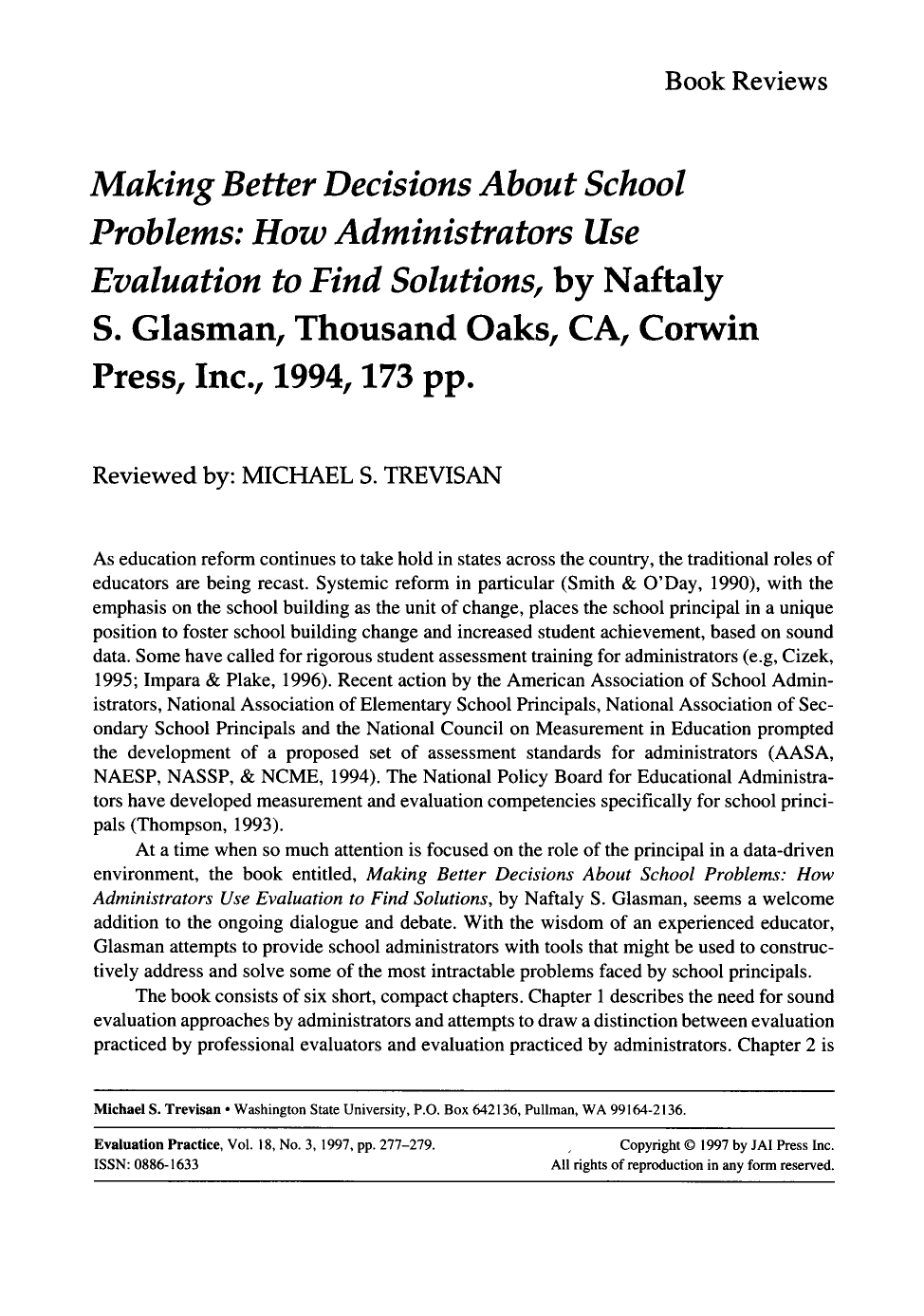
American Association of School Administrators, National Association of Elementary School Principals, National Association of Secondary School Principals, & National Council on Measurement in Education (1994). Competency standards in student assessment for educational administrators.
2.
Educational Measurement: Issues and Practices, 13(1), 44–47.
3.
CizekG. J. (1995, November). The big picture in assessment and who ought to have it. Phi Delta Kappan, 77(3), 246–249.
4.
ImparaC. J.PlakeB. S. (1996). Professional development in student assessment for educational administrators: An instructional framework. Educational Measurement: Issues and Practice, 15(2), 14–19.
5.
Joint Committee on Standards of Education Evaluation (1994). The program evaluation standards (2nd ed.). Thousand Oaks, CA: Sage.
6.
SmithM. S.O'DayJ. A. (1990). Systemic school reform. In FuhrmanS. H.MalenB. (Eds.), The politics of curriculum and testing: The 1990 yearbook of the Politics of Education Association (pp. 233–267). New York: Falmer Press.
7.
StufflebeamD. L. (1983). The CIPP model for program evaluation. In MadausG. F.ScrivenM.StufflebeamD. L. (Eds.), Evaluation models: Viewpoints on educational and human services evaluation.Boston: Kluwer-Nijhoff.
8.
StufflebeamD. L. (1996, April). Developing evaluation-oriented school principals. In E. F. Iwanicki (Chair), Measurement's role in school leadership. Symposium conducted at the annual meeting of the American Educational Research Association, New York.
9.
ThompsonS. D., (Ed.) (1993). Principals for changing schools: Knowledge and skill base.Fairfax, VA: National Policy Board for Educational Administration.