




Abstract
As evaluation practices evolve to better reflect the needs, values, and experiences of diverse stakeholders, it is essential for evaluators to recognize the expertise that comes from lived experience. Historically, marginalized communities such as people with disabilities have often been left out of evaluation processes despite the ethical and practical imperative for their meaningful inclusion. To challenge a paradigm of exclusion in evaluation and encourage evaluators to center the voices of people with disabilities in their work, this paper details the core principles of disability-led evaluation and introduces the Continuum of Disability Engagement in Evaluation.
Keywords
Program evaluation is often perceived as a neutral and equitable process of determining the degree to which programs are effective. However, this perception obscures the underlying assumptions and power dynamics, as evaluations are shaped by human choices, institutional power, and taken-for-granted assumptions about what counts as valid knowledge and which outcomes matter. Thus, approaches to program evaluation conceal the hegemony inherent in defining what constitutes knowledge and significance (Caldwell & Bledsoe, 2019; House & Howe, 1999; Wolfe et al., 2020). For example, in community-based education programs, indicators of success tend to be based on standardized test scores or attendance rates which are generally defined by stakeholders that are external to the program. As a result, evaluators may overlook local knowledge, cultural practices, or community-defined indicators of success that are more relevant to program stakeholders (Askew et al., 2012).
Despite increased attention to disability in education and social policy, disability has remained largely at the periphery of mainstream evaluation models (Ko et al., 2023). Conventional approaches to program evaluation have often reflected deficit-oriented assumptions that position marginalized populations primarily as recipients of services rather than as agents who shape what counts as value and impact (Askew et al., 2012; Caldwell & Bledsoe, 2019; Kushnier et al., 2023). When taken up in disability-related contexts, these paradigms risk reinforcing deficit constructions of disability and undermining the legitimacy of disabled people as knowledge holders within evaluation processes (Linton, 1998; Nijs & Heylighen, 2015).
At the same time, institutional accountability has historically shaped mainstream evaluation performance measurement, and compliance-oriented logics that privilege organizational priorities over the values of communities most affected by programs (Fetterman & Wandersman, 2007; House & Howe, 1999). As a result, dominant approaches have tended not to foreground the epistemic authority of program participants in defining what counts as value or impact (Cousins & Whitmore, 2024; Fetterman et al., 2013). This limitation is especially consequential in disability contexts given long-standing patterns of excluding disabled people's knowledge and leadership from decision-making and knowledge production (Darling, 2026; Scully, 2020).
The purpose of this article is to present a continuum of disability engagement, designed to guide the evaluation of programs, services, or systems with direct impact on disabled individuals or communities. The proposed continuum and set of principles are offered as a conceptual model intended to guide and provoke future evaluation design and practice, rather than to describe a model that is already fully implemented in any single program or context. We offer this work as an aspirational contribution to the field, with the goal of supporting the development of disability-led evaluation in practice over time. While this continuum is grounded in disability-specific contexts, it also speaks to broader considerations in evaluation practice that prioritize equity. The objective is not to argue that all evaluations must be directed by individuals with disabilities, but rather that evaluations involving disability (as a demographic, experience, or cultural identity) require knowledge and leadership rooted in the lived realities of disabled people. This perspective recognizes that issues of representation, authorship, and epistemic authority are particularly pronounced when disability is central to the evaluand.
As authors, we bring varied experiences and identities related to disability, and our positionality has greatly influenced this work. All of us identify as researchers. Some of us identify as disabled, some as non-disabled, and some have moved between such labels due to complex mental and physical health challenges over time. All of us have moved between roles as evaluators, teachers, service providers, and advocates. We use both person-first and identity-first language to reflect our different perspectives and to honor the diversity of expression within the disability community. While our collective experiences cannot represent the full range of that which all disabled people have or will experience, we share a commitment to centering disabled voices, advancing inclusive evaluation practices, and fostering open dialogue across research, policy, and practice.
In addition to our positionality as authors of this work, several earlier works helped lay the groundwork for our approach. These texts offer valuable context for understanding current calls for transformation. Over a quarter century ago, in a foundational article published as part of the Presidential Address in the American Journal of Evaluation (AJE), Mertens (1999) discussed the need for a paradigm shift in evaluation, placing central importance on the lives and experiences of diverse perspectives, including those of people with disabilities. In the same issue, Gill (1999) points out that “disability is highly informative” (p. 280), a perspective that extends beyond disability-specific settings and to evaluative practice in general. Her work leads us to challenge the naming of expertise, the inclusion strategies used, and power dynamics that influence both the design and products of evaluations. According to Gill, representation, inclusion, power, and rigor are fundamental considerations for any evaluator who is committed to promoting justice. Each of these factors requires evaluators to examine their own positionality as well as the structural forces that determine what and whose knowledge is privileged or marginalized.
Barbara Lee (1999) stated that “one problem is that it is always difficult to truly appreciate the lived experience of ‘otherness’” (p. 289). This difficulty still presents a great challenge to contemporary evaluation practice, particularly when nondisabled evaluators attempt to characterize or quantify the experiences of individuals with disabilities without their guidance. Although these articles were published more than 25 years ago, their insights remain strikingly relevant and underscore the persistent need to more fully integrate disability perspectives in evaluation contexts. These persistent challenges adequately representing and including lived experience with disability in evaluation contexts raise critical questions about the adequacy of existing evaluation frameworks. While ethical guidelines and professional standards acknowledge the importance of inclusion and stakeholder engagement (e.g., Yarbrough et al., 2010), they fall short in providing an explicit and proactive approach to disability.
The Limits of Inclusion in Evaluation
Before proceeding to a more nuanced conceptualization of disability in evaluation, it is important to examine the structural and epistemological barriers that systematically exclude people with disabilities from active contribution. These barriers are multifaceted and interconnected and include epistemic, methodological, institutional, sociocultural, and procedural concerns. One persistent way in which these barriers are manifested is through gatekeeping, a pervasive yet underexamined process of excluding key stakeholders in knowledge production (Moore et al., 2024). Gatekeeping practices are not value-neutral, but arguably, the product of ableism.
Ableism can be understood as seen and unseen forces that privilege nondisabled people while marginalizing those with disabilities through assumptions about what bodies and minds should be able to do (Friedman et al., 2024). Within program evaluation, this often appears when design choices, methods, or outcome measures take “normal” functioning as the standard, overlook accessibility, or fail to incorporate the perspectives and expertise of disabled people (Friedman et al., 2024). Gatekeeping in evaluation processes is characterized by both overt and structural exclusion, most significantly against individuals with intersecting marginalized identities. Gatekeeping reveals not only procedural biases but can also reveal deeper tendencies, such as epistemic injustice and structural ableism that can effectively silence disabled voices and perpetuate inequalities in knowledge production (Moore et al., 2024).
For a variety of reasons, approaches to evaluation often favor academic knowing, standardized protocols, and externally defined outcomes, effectively excluding the experiences of marginalized communities (Bundi & Pattyn, 2023; Kushnier et al., 2023). Even in some participatory and inclusive frameworks for amplifying stakeholder voices, individuals with disabilities are relegated to informant or advisory roles, rather than holding valued positions as thought leaders. The absence of meaningful participation and leadership of disabled people in the design of questions, methods, or interpretations of evaluations in favor of disabled people playing minor roles can also contribute to reinforcing tokenism (Beckwith et al., 2016) and further establishing power inequalities. The gatekeeping of disabled people in program evaluation efforts is also a product of rigid methodologies, inaccessible instruments (e.g., surveys that unnecessarily use complex language), evaluator bias, and narrow definitions of evidence that preclude the full and meaningful participation of disabled individuals (McGrath et al., 2025; Rios et al., 2016). These limitations reflect broader debates about authority in defining success, legitimizing knowledge, and establishing the standards by which programs are evaluated.
Gill (1999) argues that complete inclusion is more than symbolic and involves the dismantling of institutional barriers and a democratic distribution of power. While the exclusion of people with disabilities from evaluation efforts affirms their marginalization, the meaningful inclusion of disabled people significantly increases the validity, applicability, and ethical standing of research (Ghaderi et al., 2025). Power dynamics always intersect all evaluative decisions (Gill, 1999). Interrogation of that power means asking questions that cut to the heart of the matter: Who manages the evaluative process? Who gains from the knowledge produced? Who is valued as a producer of knowledge? Who is considered to be an expert?
Foundational Frameworks Guiding Disability-Led and Disability-Centered Evaluation
Disability-led and disability-centered evaluation practices are grounded in critical paradigms that challenge dominant evaluative values and epistemologies. Three interconnected frameworks serve as our foundation: Disability Justice, DisCrit (Disability Critical Race Theory), and epistemic justice. Together, they shift evaluation toward a process that fosters individual and collective agency for disabled people.
Disability Justice: Centering Interdependence and Access
Disability Justice, a term coined by disabled activists of color Patty Berne, Mia Mingus, and Stacey Milbern, refers to a cross-disability framework that centers access, self-determination, and an expectation of difference (Berne et al., 2018). This framework, born of a need to amplify multiply marginalized people historically excluded from the Disability Rights Movement, moves beyond a single-issue focus of disability rights and focuses instead on intersections of race, gender, sexuality, class, and more (Saia et al., 2024). There are 10 principles of disability justice: (1) intersectionality, (2) leadership of the most impacted, (3) Anti-capitalist Politic, (4) cross-movement solidarity, (5) recognizing wholeness, (6) sustainability, (7) commitment to cross-disability solidarity, (8) interdependence, (9) collective access, and (10) collective liberation (Berne et al., 2018).
Whereas Saia et al. (2024) trace the origins and principles of Disability Justice, we see its function also as a catalyst for equity in evaluation that serves as a guide that centers equity, interdependence, and collective access as necessary evaluative principles. The principles of Disability Justice call evaluators to challenge external and deficit-based metrics of success in favor of affirming disabled communities’ well-being and self-determination. It calls for a redefining of evaluative norms, like linear timelines, standardized results, and the idea of “objectivity,” by embracing an approach that centers relational accountability and access intimacy (Mingus, 2017). Disabled-led evaluation, therefore, should not simply “include” disabled voices but rather strive to incorporate the principles of Disability Justice in its methods, values, and frameworks.
DisCrit: The Intersections of Ableism and Racism in Knowledge Production
Dis/ability Critical Race Studies (DisCrit; Annamma et al., 2013) is a theoretical framework that combines aspects of Critical Race Theory (CRT) and Disability Studies (DS) to dually analyze race and ability. DisCrit is founded on seven principles: (1) interdependence of racism and ableism, (2) multidimensional identities, (3) social construction of race and ability, (4) privileging marginalized voices, (5) historical and legal aspects of dis/ability and race, (6) Whiteness and Ability as property, and (7) activism and resistance. This framework is a charge to recognize and amplify the voices and experiences of those whose voices have historically gone unheard in western academia, challenging dominant narratives and assumptions about dis/ability and race (Annamma et al., 2013; Saia et al., 2024).
Where Disability Justice provides evaluators with equity-based principles, DisCrit functions as an epistemological lens, interrogating how knowledge is produced, validated, and weaponized through ableist and racist structures. DisCrit pushes us to ask who makes knowledge, whose values determine results, and how evaluative power is authorized. It points out that mainstream appraisals tend to present disabled individuals of color as objects of research or possible threats, rather than learned theorists and experts. DisCrit also invites us to think about how even “well-intentioned” evaluation practice can be exclusionary through data collection methods, interpretive policy, or policy implementations that obscure systemic inequities. Disability-led evaluation practice, then, must also be antiableist and antiracist in methodology and capable of recognizing how systemic oppression shapes both what is being evaluated and how the evaluation process unfolds. This involves the rejection of pathologizing language, reframing deficits, and assuming nonuniversal definitions of success that ignore collective knowledge and cultural specificities (Annamma et al., 2013).
Epistemic Justice: Reclaiming the Right to Knowledge and Recognition
Epistemic justice (Fricker, 2007) is the right for all individuals to be heard and contribute to the production of knowledge. Voices who have been historically marginalized and oppressed, including disabled voices, are “knowers” who can contribute to broader and deeper social understandings of the human experience (Fricker, 2007). These voices have been and continue to fight for epistemic agency and justice (Verbeek et al., 2024). Epistemic injustice has historically manifested in common evaluation practices through the exclusion of the perspectives of people with disabilities and lack of recognition of their expertise and knowledge.
Epistemic justice complements both Disability Justice and DisCrit by underscoring the right of disabled people to participate as knowers and knowledge producers, tying together Disability Justice's demand for equitable evaluation and DisCrit's challenge to dominant epistemologies. Disability-led evaluation disrupts historical tendencies by placing individuals with disabilities not just as authoritative experts in their own lives but also as epistemic authorities and theory makers. This shift from inclusion to leadership demands that evaluators engage in deep reflexivity, overturn entrenched hierarchies of expertise, and build co-designed and co-owned approaches with disabled communities. Collectively, these ideas emphasize that evaluation is never completely unbiased. It always involves power, shaping who gets recognized, what is considered important, and whose voices matter. A disability-led evaluation framework, guided by Disability Justice, DisCrit, and epistemic justice, seeks not to “enhance” current systems through more efficient measurement but to transform those systems by redistributing power, disrupting ableist norms, and centering disabled people's leadership in defining value, evidence, and accountability.
The Continuum of Disability Engagement in Evaluation
The barriers that hinder the inclusion of people with disabilities in evaluations, such as gatekeeping and inaccessible methodologies (e.g., approaches that lack flexible means for stakeholder engagement), require not only critical examination but also concrete guidance for meaningful change. The following continuum offers a framework for understanding and potentially transforming how disability is positioned within evaluation processes. Disability-led evaluation exceeds other models that merely strive to involve individuals with disabilities; it demands that people with disabilities hold both epistemic authority (as knowledge producers) and structural authority (as decision-makers) throughout the evaluation process. This orientation aligns with broader shifts in evaluation theory that emphasize increasing stakeholder power, authorship, and control over the evaluative process (Espinosa-Fajardo et al., 2022; Fetterman et al., 2013).
For example, Espinosa-Fajardo and colleagues (2022) describe a progression that begins with “collaborative evaluation,” where evaluators lead the process and engage stakeholders, then advance to “participatory evaluation,” where power is increasingly shared. The progression ends with “empowerment evaluation” (p. 398), where stakeholders take primary control and evaluators serve as facilitators or coaches in the evaluation process. Similarly, disability-led evaluation represents a movement toward models of evaluation that are more than merely consultative but community-directed and justice-oriented. Unlike other mid-stages of the continuum (which may incorporate feedback or singularly address access needs), disability-led evaluation begins with the cultural priorities, leadership, and collective wisdom of disabled communities. Understanding the continuum and incorporating more inclusive approaches can help to reframe evaluative practice by shifting the origins of inquiry: disabled people are not respondents or solely beneficiaries, but potential architects of the evaluative questions, methods, and uses. Table 1 presents the Continuum of Disability Engagement in Evaluation, which we consider the centerpiece of this framework. Each level reflects a distinct positioning of disability in evaluation practice, from complete absence to disability-led approaches grounded in justice. The table provides more than a typology; it functions as a roadmap for evaluators to locate their current practice and identify pathways toward deeper engagement.
Disability Engagement Levels.
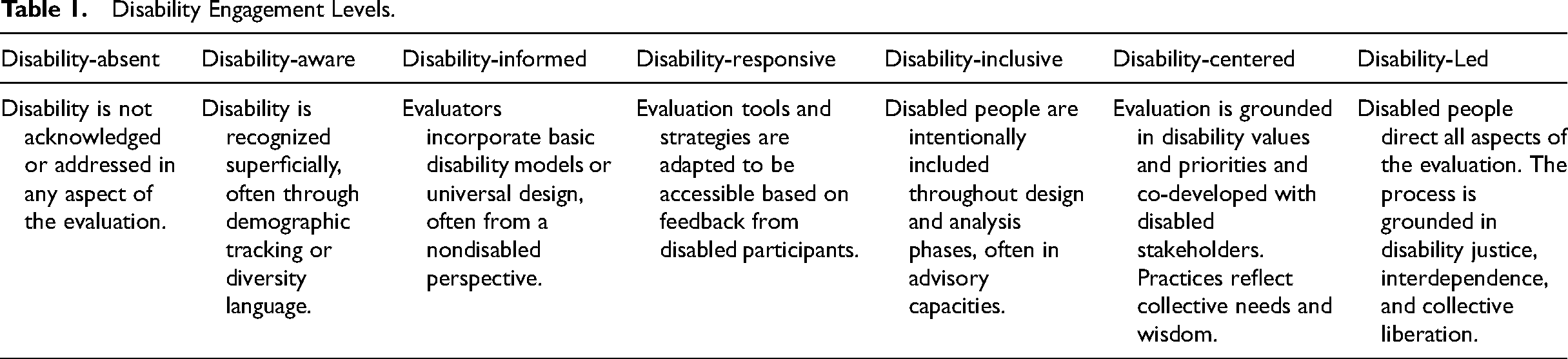
The continuum of engagement ranges from disability-absent to disability-led, reflects a conceptual trajectory that not only tracks inclusionary practices but also signifies a deeper epistemic shift. It maps how evaluation efforts may evolve from excluding disability voices altogether to embedding disability-led approaches grounded in justice and critical consciousness (Friere, 2000). However, as with many frameworks that imply linear progression, the risk lies in treating each phase as a checklist or compliance marker rather than a meaningful shift in power and practice. Programs may stall at “Disability-Inclusive” or “Disability-Informed” levels, mistaking representation for structural change. Without an underlying commitment to shifting epistemic authority and institutional accountability, these stages risk tokenizing participation, using disabled voices without shifting decision-making power. Integrating the principles of disability-led evaluation within this continuum surfaces a more profound reimagination of what evaluation is for, who it serves, and how it is conducted.
Considerations for Enhancing Disability Engagement in Evaluation
This integration also raises practical and ethical tensions for institutions and evaluators. For instance, funders may demand rapid outcomes, while disability-led approaches may require slower, relational timelines and definitions of success co-constructed with disabled communities. Similarly, traditional evaluations often prioritize quantifiable outcomes, whereas disability-led work foregrounds experiential knowledge and community-defined value. These tensions are not easily resolved, but they must be acknowledged as areas of negotiation rather than barriers to rigor (Kramer et al., 2011; Rios et al., 2016).
To operationalize this shift toward disability-led evaluation, it is essential to differentiate among the varied ways disability is positioned in evaluation practice. Not all engagements with disability are created equal. In fact, some merely acknowledge its presence, while others seek to transform the systems of knowledge and power that have historically excluded disabled voices. By naming and mapping these differences, we make visible the ideological and structural choices that undergird evaluative approaches. This is not just a matter of technique, but of orientation: to whom evaluation is accountable, and for what purpose it is conducted. To illustrate the varying levels of engagement, we present the Continuum of Disability Engagement in Evaluation (Table 1) as it applies to the evaluation context.
Bringing together the Continuum of Disability Engagement in Evaluation and the principles of disability-led evaluation allows us to see how deep structural and epistemic shifts are required to move from inclusion to leadership. Each level of the continuum reflects not just a difference in who is included but in how power, knowledge, and value are distributed. At one end of the continuum, including “Disability-Absent” and “Disability-Aware” categories, evaluation practices either ignore disability altogether or incorporate disability through surface-level accommodations or in demographic representation only. These stages of engagement fail to challenge ableist norms or confront the systemic barriers that shape disabled people's lives. As teams move toward more disability-centered practice, (“Disability-Informed,” “Disability-Responsive,” and “Disability-Inclusive”), there is greater attention to context, nuance, and equity, but without disabled leadership, evaluation remains extractive and externally accountable. In integrating the continuum with the principles of disability-led evaluation, the central insight becomes clear: transformation does not happen through greater inclusion alone. It happens when evaluative power is redistributed, when disabled people define the questions, performance measures, and outcomes that matter, and when evaluation is reimagined as a tool for justice, not surveillance or institutional validation.
Core Commitments and Principles Guiding a More Disability-Engaged Evaluation
By centering disability in evaluation, evaluation practice actively resists gatekeeping in all phases of evaluation (i.e., value definition, co-development of approaches, analysis of data, and determination of how results are used). Disability-led evaluation also prioritizes including disabled stakeholders through the most accessible methods possible. Instead of solely basing rigor in methodological integrity or institutional oversight, disability-led evaluation posits relational accountability, collective access, and community-determined outcomes as the most important priorities. Thus, access is less theorized as a checklist of accommodations and more as a dynamic and generative process that dictates the creation of knowledge. Ethical evaluation practices from this standpoint are rooted in solidarity and collective responsibility instead of protectionism or compliance.
In the current article, we put forward a conceptual continuum of disability engagement, the Continuum of Disability Engagement in Evaluation. The continuum demonstrates how there is a shift from “Disability-Absent” or “Disability-Informed” to “Disability-Centered” evaluation and how epistemic, methodological, and ethical control shifts at each phase of the continuum. The framework aims to advance disability-led evaluation as a form of justice-oriented alternative to dominant paradigms of evaluation. While rooted in theory, the article is written for evaluators, program designers and institutions seeking to realign their work with the leadership and wisdom of individuals with disabilities. Disability-led evaluation is not defined by any single method or technique, but by a cluster of underlying commitments that reshape the purposes, processes, and power dynamics of evaluation itself. These commitments influence every level of the work, including whose knowledge is recognized, how connections are formed, how access is understood, and who makes decisions. They are not discrete values but connected practices that shift together in the direction of justice.
The following principles offer a foundational framework for disability-led evaluation. Rather than functioning as a checklist, they represent interdependent points of reference to reframe how we understand knowledge, relationships, process, and power in the context of evaluation. First, the lived realities of people with disabilities are argued to be authentic and necessary sources of knowledge. Grounded in standpoint epistemology (Harstock, 1983), which recognizes that all knowledge is shaped by social position and lived experience, disability-led evaluation not only offers a nuanced and specific view or standpoint but can reveal what is often left out of dominant perspectives. Next, the framework emphasizes respecting this knowledge by cultivating long-term, trust-based relationships. These relationships then determine the way that evaluation is framed, not as a makeshift system of accommodations, but as a space focused on access, consideration, and overall engagement. These principles are a call to constructively interrogate the role and power of the evaluator, rejecting objectivity for a sensitivity to positionality and shared power relationships. These principles also do more than outline ethical objectives; they offer a template for reformulating evaluation processes in line with the wisdom, direction, and priorities of disability communities.
Principle #1: Valuing Lived Expertise in Evaluation
Disability-led evaluation starts with a clear idea: people with disabilities know their own lives best. They deal with systems and a society that often limit or ignore them, and because of that, they bring important knowledge that others do not have. When this knowledge is respected, evaluation changes from being something done to people into something done with them. It becomes a shared process. Scholars remind us that lived experience gives groups who are often left out a special kind of insight (Collins, 2000; Harding, 1996). Indeed, standpoint epistemology values the marginalized voice and experience, as it can provide knowledge often ignored by those historically in power positions (Harstock, 1983).
Others argue that people with disabilities must be seen as real “knowers,” with their voices shaping how we understand the world (Fricker, 2007). Disability Justice adds that leadership should come from those most affected, shifting power toward them. DisCrit also points out how ableism and racism combine to silence voices, and why lifting those voices is imperative (Annamma et al., 2013). Putting this into practice means involving people with disabilities in real roles (e.g., co-evaluators, advisors, or peers). For example, if a program for youth with disabilities is being studied, young adults could help design the interview questions. This way, the questions reflect what matters to them, not only what institutions deem important to measure. Evaluators might also include personal stories along with numbers, treating those stories as real evidence. Approaches like these move power away from evaluators alone and show that people with disabilities are partners in creating knowledge, not merely participants.
Principle #2: Honor Community Knowledge and Wisdom
Valuing lived experience demands more than acknowledging disabled people as holders of knowledge, it calls on evaluators to reorient their practice around how that knowledge is engaged. In disability-led evaluation, trust is not a soft or incidental outcome; it is a central practice rooted in mutuality, presence, and accountability. This principle affirms that community knowledge is not just something to be accessed or extracted, but something to be honored, on the terms, timelines, and conditions set by disabled communities themselves. By emphasizing community voice and addressing power imbalances through this focus, disability-led evaluation can effectively utilize tenets of decolonizing methodology (Smith, 1999). Honoring knowledge in this way means that relationship-building is not a prelude to evaluation, it is the actual evaluation. The evaluator's role shifts from an external expert toward that of a consistent collaborator (i.e., someone who shows up beyond data collection periods), who prioritizes consent over compliance, and who is willing to slow down to the community's pace.
Principle #3: Designing for Access and Dignity
Conventional evaluation generally rests on the myth of objectivity or the belief that evaluators are outside those communities they are assessing, making objective judgments (House & Howe, 1999; Mertens, 2019). However, disability-led evaluation does away with neutrality as a means of perpetuating dominant norms and hidden biases. It acknowledges that all evaluation is political (i.e., shaped by values, worldview, and positionality). This principle calls upon evaluators to be transparent regarding their function and perspective and, further, to negotiate decision-making with communities of persons with disabilities. Instead of being gatekeepers of information, evaluators are called to be reflective collaborators who listen, learn, and let go of power. In order to do this, a commitment to Universal Design for Learning is essential. Using the principles of Universal UDL in program evaluation includes proactively providing multiple means of engagement, representation, and expression, and can help ensure that all stakeholders, regardless of support need, are fully included and able to share their perspectives in ways that suit their strengths and needs (CAST, 2018).
Principle #4: Positionality Awareness and Power Sharing
Positionality awareness and the sharing of power prompt evaluators to reflect on how their identities, experiences, and roles shape their evaluation decisions. This principle calls for better transparency and shared decision-making, as well as a shift away from evaluator-driven control. More collaborative approaches that center the knowledge and priorities of individuals with disabilities is critical. The disability-led evaluation commitments are not separate beliefs or abstract values. They are interdependent commitments that both shape the purpose and the practice of evaluation. Utilizing ideas from Tervalon and Murray-Garcia's (1998) cultural humility framework, this principle requires evaluators to emphasize continued learning and self-reflection while building respectful, mutually-beneficial partnerships with the communities within which they work. Together, they offer a foundation for developing evaluations that resist extractive norms, redistribute power, and center the knowledge of disabled communities.
Clarifying Scope and Appropriateness of Disability-Led Evaluation
As disability-led evaluation potentially gains popularity as a justice practice model, its application should be critically considered. While the model goes beyond mere tokenism or inclusion to leadership, it is not intended to be a necessity for every evaluation context. Instead, it is a signal to reassert evaluative authority at those points where people with disabilities are most deeply impacted and to give priority to their epistemic perspectives when matters of access, equity, and inclusion are at stake. In this section, we introduce crucial deliberations of the appropriateness, breadth, and intricacy of evaluation driven by individuals with disabilities through an examination of three connected tensions: (1) the importance and role of context, (2) the usefulness of middle-range evaluation models, and (3) the interconnection between individual lived experience and evaluative expertise.
The Role of Context: When Is Disability-Led Evaluation Most Effective?
Disability-led evaluation is most strongly needed in contexts where disabled people are the primary stakeholders (e.g., evaluations of disability inclusive postsecondary education programs, accessibility policies, disability programs, or initiatives that offer health, housing, and employment solutions for people with disability). In these contexts, nondisability-led evaluations risk reinforcing paternalistic assumptions, misreading community norms, or missing structural barriers. They may also unintentionally reproduce ableist frameworks by privileging nondisabled perspectives as neutral or authoritative while marginalizing disabled ways of knowing and defining success. Accordingly, disabled leadership in these situations is not a luxury; it is a necessity for ethical rigor and epistemic justice.
There are numerous situations in which disability may be pertinent but not at the core of the program or service to be evaluated (e.g., in general equity programs, staff development activities, or community health initiatives). Requiring people-with-disabilities-driven approaches may be unfeasible in such cases or even inappropriate if disabled constituencies do not represent the primary population or have not indicated a desire for full leadership involvement. Instead, the focus should be on truly including individuals where their disability is most relevant, using methods that center their experiences to create practices that support their full participation and empowerment. Even when people with disabilities have a smaller role, using this lens can still change how evaluation is understood. The way we choose methods conveys a message about what really matters and whose voices count. Smaller steps such as making data collection more accessible or including stakeholder input in planning support a shift in evaluation from a technical task to one that values relationships. Thus, methods do more than produce findings; they also shape the culture of evaluation itself.
Middle-Range Models Are Not Failures: Focused Designs Continue to Redistribute Power
The Continuum of Disability Engagement in Evaluation discussed in this article is not intended to establish a hierarchy of value; rather, it is intended to explain the different levels of shared power, leadership, and epistemic inclusion. “Disability-Engaged” and “Disability-Centered” approaches represent significant and oftentimes requisite strategies for developing evaluations that are responsive and inclusive. In most circumstances, such intermediary models reflect the current capacity or readiness of organizations or communities, are temporary steps in the evolution toward disability-led approaches and facilitate meaningful co-design and collaboration, even where complete leadership is not achievable. It is not our intention to frame these approaches as less than sufficient. In fact, they can be considered legitimate and valuable contributions to fair evaluation. The key distinction is one of intentionality: are disability-program evaluators collaborating with disabled individuals, honoring their expertise, and redistributing power wherever possible? If that is the case, then disability-engaged and centered evaluations are not diluted forms of some idealized model.
The Importance of Expertise: Practical Expertise and Evaluative Abilities Must Be Blended
One potential concern that could be raised about disability-led approaches is the potential for blurring the line between lived experience and formal evaluative expertise. Undertaking an evaluation requires more than personal instinct; it requires methodological design, data analysis, ethical decision-making, and reporting results effectively. Not every individual, whether disabled or nondisabled, comes with this skill set, as evaluation requires specialized training and experience. This is not to suggest that disabled people not trained in evaluation techniques need to be excluded from leadership roles. Instead, it marks the need for capacity development and co-learning. Like community-based participatory research, which routinely includes training for community partners, disability-led evaluation may require infrastructural support so that disabled leaders are not tokenized or set up to fail. At the same time, disability-led evaluation calls for ensuring that disabled individuals with analytical and evaluative expertise are represented in leadership roles, while also building pathways for others to acquire these skills. Conversely, evaluators (especially those from outside the disability community) must seek training in the social, political, and cultural dimensions of disability to avoid reproducing ableist ideas and outputs. This synthesis of experiential and evaluative knowledge yields more powerful, pertinent, and attentive evaluations. Gill (1999) argues that insider perspectives do not threaten objectivity; instead, they help correct the bias that comes from doing evaluations about communities without including the voices of those who belong to them.
Illustrative Applications of the Continuum
Even though the Disability-Led Evaluation Continuum is introduced here as a concept framework, it is useful to illustrate how it could be applied in practice. We provide three brief hypothetical evaluation scenarios that map onto different points along the continuum:
Disability-Aware: A school district commissions an external evaluation of a new professional development program aimed at increasing inclusive teaching practices. Data are gathered almost entirely through teacher and administrator surveys. Disability is mentioned as an area of interest but students with disabilities and their families are not consulted in developing questions or interpreting findings. Thus, the evaluation acknowledges disability as an area but does not disrupt institutional beliefs or shift decision-making power. Although appropriate for documenting institutional progress, this level of engagement risks overlooking the lived experiences of disabled students. A more disability-engaged evaluation might, for instance, entail co-constructing items on surveys with students and their families so their priorities help define how inclusion is measured. Disability-Responsive: A government agency examines a vocational rehabilitation program by conducting focus groups of their disabled consumers, soliciting their responses to preliminary results. The information received from these informants has a direct bearing on some of the program recommendations, such as changes to intake procedures and modes of communication. However, disabled persons are consulted only after the framework of evaluation has been established, with the final responsibility of data analysis and reporting lying with non-disabled evaluators. This represents a more engaged and respectful model but still stops short of shifting epistemic authority. While valuable, this reactive model could be strengthened by inviting consumers with disabilities to serve on the evaluation steering committee from the outset, allowing them to shape the evaluation questions and ensure their priorities guide the evaluation's direction. Disability-led Evaluation: An Inclusive Postsecondary Education (IPSE) program for students with intellectual disability (ID), led by staff and administrators with disabilities, in conjunction with graduates with ID to serve as co-investigators in a longitudinal study evaluating their work. As a collective, the team collaboratively conceives evaluation questions, makes data collection accessible (e.g., peer interviews and photo elicitation), and collectively authors reports written to different groups, such as students and their families. By doing so, leaders with disabilities wield both structural and epistemic power, making the evaluation broadly accountable to disability community stakeholders rather than institutional ones. This scenario reflects the transformative aspect of the evaluative continuum with evaluation serving as a vehicle to achieve equity and elicit systemic change. This level of involvement is justified when the evaluand has a direct relationship with disability, reflecting how the redistributive aspect of power results in more valid conclusions and more equitable results.
These examples, albeit brief, reveal the potential of the continuum as a diagnostic or planning tool both for evaluators and institutions. They clarify how slight changes (e.g., shifting from consultation to co-design) shift power distributions in evaluation processes and what effects these changes have on the validity as well as the ethical grounds of evaluation. Used in this way, the continuum offers more than a theoretical addition but also a practical tool with which to reflect, self-evaluate, and grow.
Conclusion
The Joint Committee on Standards for Educational Evaluation's Program Evaluation Standards (2011) are one widely accepted source of standards for carrying out evaluations that are ethical, fair, and effective. Such standards as Utility (U2), which calls for responsiveness to all stakeholders, and Propriety (P3), which encourages respect for human rights and dignity, plainly endorse the active participation of disabled individuals. This paper has outlined a disability-informed continuum that aims to reimagine evaluation and not only includes the participants involved but also the structure of knowledge, power, and process. By decentering the location of epistemic authority and bringing in the embodied knowledge of people with disabilities into every phase of the evaluative design, this approach enables more inclusive, relational, and transformative modes of inquiry to emerge.
As programs, funders, and evaluators begin to engage more deeply with disability-led approaches, the goal is not merely better outcomes for disabled people as defined by evaluation teams that do not include disabled voices, but rather the cultivation of evaluative systems that are themselves guided by the priorities and leadership of disabled communities. Thus, this reorientation demands not just new methods, but new values. Yet, there are many questions that we must answer. For example, what are the constraints of institutional settings that are still dominated by entrenched measures and norms on having a disability-led vision? How do we build capacity for disabled leadership in evaluation without recreating the gatekeeping and credentialism we seek to dismantle? And what kinds of infrastructural commitments (e.g., funding models, timelines, reporting mechanisms) are necessary to facilitate long-term, community-led evaluations? There are no simple solutions to these questions. However, direct engagement with these questions is crucial to the evolution of evaluation practice that reflects (not simply accommodates) the knowledge, priorities, and rights of persons with disabilities
Footnotes
Declaration of Conflicting Interests
The authors declared no potential conflicts of interest with respect to the research, authorship, and/or publication of this article.
Funding
The authors received no financial support for the research, authorship, and/or publication of this article.
