




Abstract
In social media, food has become an arena of identity work for men, both content creators and commenters. Yet, the relationship between men who create food content and their followership has remained relatively underexplored. Drawing on interviews and netnographic fieldwork in Finland, this article focuses on how comments and commercial opportunities shape male creators’ operating environments within digital spaces centered around food, and how these environments shape ontologically secure positions and practices for men. This study demonstrates that social media work necessitates flexibility and self-minimization. Commenters were seen as both a resource and a threat, which led to cautious concessions towards both defenders of men’s conventional eating habits and their critics. Men’s social media work incorporated feminized elements of customer service, shaping hybrid masculinities. However, these practices were often driven by fear and caution, resulting in passive acceptance of various commenting cultures and allowing space for masculinist hostility towards veganism.
Introduction
Home cooking had, until the late 1990s and the emergence of male “celebrity chefs”, been relegated to daytime television and remained relatively culturally insignificant due to its emphatically feminized nature as household chore (Lewis 2020, 70–75). Following the success of Jamie Oliver’s The Naked Chef, many cooking shows of the early 2000s presented men as either professional chefs engaged in technically demanding cooking or “lifestyle guides” who can tell others how to consume and cook to live an ethical and healthy life (Leer 2016). This was also a time when the food industry started to aggressively seek new target audiences: various food products were marketed to men using relaxed “dude” characters who embodied the joy experienced in cooking, anti-elitism directed against fine-dining, and a “fearless freedom” to eat everything without worrying about health, ethics, or the environment (Contois 2020, 20–21).
Advertising has now shifted online and started to utilize widely followed social media personalities to promote products or services (Duffy 2017; Khamis et al. 2017). Contois (2020, 118) argues that, in the 2010s, both the “‘whatever’ attitude” associated with men and men’s central position in food media became politicized and problematized, especially in social media and by younger audiences. As a response to public criticism of men’s avoidance of responsibility related to reproductive housework and the environment, content creators now show caring and protective capacities as they show themselves participating in home cooking (Lewis 2020, 83–89) or following a vegan diet (Oliver 2023). Individual male participants in online discussions increasingly define their positive masculine identity through responsibility: “real men” cannot eat anything, anytime (Brookes and Chałupnik 2022). A new configuration of “hybrid hegemonic masculinity” (Messerschmidt 2018, 82) has developed on social media, characterized by the incorporation of performances and identity elements previously associated particularly with femininities.
Yet, the mainstreaming of ethical responsibility and gender equality discourses also faces resistance from men. Some male content creators stand out by showing grotesque images of meat and promoting anti-vegetarianism, anti-feminism, and indifference to health and environmental impact (Leer and Krogager 2022; Lewis 2020, 79; Lupton 2020). In anti-vegan online communities, the vocabulary and discursive logic of extreme men’s rights movement, mostly mobilizing young, white, and heterosexual men (Ging 2019), have gained a foothold: nationalism, racism, anti-feminism, and men’s leadership in relation to women and other species are tightly intertwined here (Gregson et al. 2022).
Despite previous research into men’s food-related identity projects online, the relationships between male food content creators and their audience and the audience’s influence on men’s choices in content creation have remained underexplored. This study draws on a diverse sample of interviews with 10 Finnish content creators who publish food-related videos on social media for compensation and netnographic fieldwork. It was guided by the following research questions: What kinds of operating environments do commercial interests and viewer feedback shape for male content creators? How do the expectations and norms characteristic of these environments limit and enable their content creation and gendered practices? Utilizing the concept of digital foodscapes, understood as distinct digital spaces constructed around a shared understanding of “good food” (Goodman and Jaworska 2020), theorizations of affective dynamics online (De Boise 2018; Nikunen 2019; Venäläinen 2022), and Garlick’s (2023) understanding of hegemonic masculinities as “imagined positions of ontological security,” I explore how social media work shapes hybrid hegemonic masculinities for content creators. I argue that, regardless of the target audience, entrepreneurial work amid constant emotional feedback within the “frenzied and highly reactionary cultural moment” surrounding food (Contois 2020, 117) fosters anxiety and necessitates flexibility and customer service.
Theorizing Affect and Masculinities in Digital Foodscapes
Goodman and Jaworska (2020) highlight the dispersion and fragmentation of food-related messages into separate conversational contexts on social media. I adopt their concept of digital foodscape to refer to a digital space created through the interaction of like-minded content creators and audiences. In a digital foodscape, norms and rules around discussing food are shaped by decentralized interactions between participants through a platform’s affordances, such as commenting, liking, and sharing. To shed light on how male creators’ masculinities are shaped in the interaction between creators, followers, and commercial partners, I draw on three strands of theorization. They include affective meaning-making and communality online, hegemonic masculinities rethought as attractive positions of ontological security, and hybrid hegemonic masculinities shaped by service and social media work.
Building on previous studies of affect online (De Boise 2018; Nikunen 2019; Venäläinen 2022), I define the affectivity of online communication as its potential to evoke emotions and actions in recipients (Ahmed 2010; Wetherell 2012). Consequently, I understand affect as circulating: through symbolic meaning-making, certain affective potentials can travel and, over time, certain meanings and related affects intertwine as commonsensical social practices (Venäläinen 2022). Nikunen (2019) argues that affectivity plays a key role in the detachment of various online communities from one another and the formation of like-minded groups: individuals seek to distance themselves from disruptive messages and surround themselves with content that pleases them, which also creates social cohesion and enables a sense of belonging in a certain social media community. Studies on men’s interest groups online have found that affectivity is not necessarily “irrational” or impulsive but conveys deep-seated pre-understandings of a society (De Boise 2018): shared affectivity draws on and reinforces existing experiences, attitudes, and group cohesion (Ging 2019; Venäläinen 2022). Yet, certain men and masculinities can also lose their legitimacy on social media quickly through semi-organized hate campaigns utilizing digital affordances such as anonymity, liking, disliking, sharing, and easily reproducible catch phrases and rhetorical tropes (Trott 2022).
Affectivity does not merely transfer emotional states from the sender to the receiver (Wetherell 2012, 141), but calls for actions that maintain individual happiness, harmony, and the approval of others (Ahmed 2010). I apply the concept of hegemonic masculinity, refined to be more sensitive to affectivity, to content creators whose masculinity both shapes and responds to prevailing norms. Hegemonic masculinity was initially defined as the currently normative and most honored way of being a man in a certain socio-cultural setting, constructed in dynamic, patterned, and dialectic relationships among men and between men and other genders (Connell 1995; Messerschmidt 2018). To make room for the analysis of embodiment and materiality of infrastructures in masculinity studies, Garlick (2019) seeks to detach the concept from patriarchal power relations and Marxian economic materialism and redefines hegemonic masculinities as ontologically secure positions for men. Hegemonic masculinities do not represent “coherent ideologies” but serve as “attractor” points towards which men are oriented through encounters with external boundaries: they offer a tension-free position subject to fewer external disturbances than other available positions (Garlick 2023) and as a result, a stress-free embodied mode (Garlick 2019).
Despite promising creative freedom, content creation also includes adapting to the wishes and expectations of followers whose viewing and consumption decisions directly affect the viability of a creator’s businesses and popularity (Duffy 2017; Khamis et al. 2017). This “neoliberal emphasis on the entrepreneurial self” exposes men to insecurities and calls for actions to ameliorate them (Garlick 2023, 184). I suggest that these neoliberal masculinities are hybrid, involving “strategic borrowing” of femininities (Bridges and Pascoe 2014; Wolfman et al. 2021). In addition to having to flexibly present the identity elements and beliefs their followers value (Whitmer 2017), people doing social media work also have to adopt feminized skill sets such as the ability to manage their own and others’ emotions and to softly steer the affectivity circulating on their channels without showing irritation or aggression (Duffy and Schwartz 2018; Mäkinen 2021).
This study is located in Finland, a socio-cultural context where discussions about both the sustainability of food production and gender equality are intense. Aavik argues that Finnish society is characterized by the advertising of food products related to vegetarian diets and a visible public debate about gender equality. Yet, “consuming animal products remains an important element of doing masculinity for most men,” against which vegans are repeatedly seen as a threat (Aavik 2023, 20, 123–126). Compatibly, feminism and gender equality are often perceived as hegemonic discourses in Finland; for some men, they represent a threat to men’s interests and well-being (Venäläinen 2022).
Research Design
The study draws on 19 semi-structured interviews with 10 Finnish men who make food-related videos for YouTube and TikTok for at least some compensation and netnographic fieldwork on their channels. The study sought to examine men whose content showcases them cooking and enjoying good food, resembling earlier food entertainment on television (Leer 2016, 2022) but within the context of entrepreneurial content creation on social media (Goodman and Jaworska 2020). Consequently, channels focusing solely on fitness, health, and ethics of food were deliberately excluded. Another inclusion criterion was references to commercial collaboration in content and attempts to earn compensation from content creation.
Participant Pseudonyms and Demographics
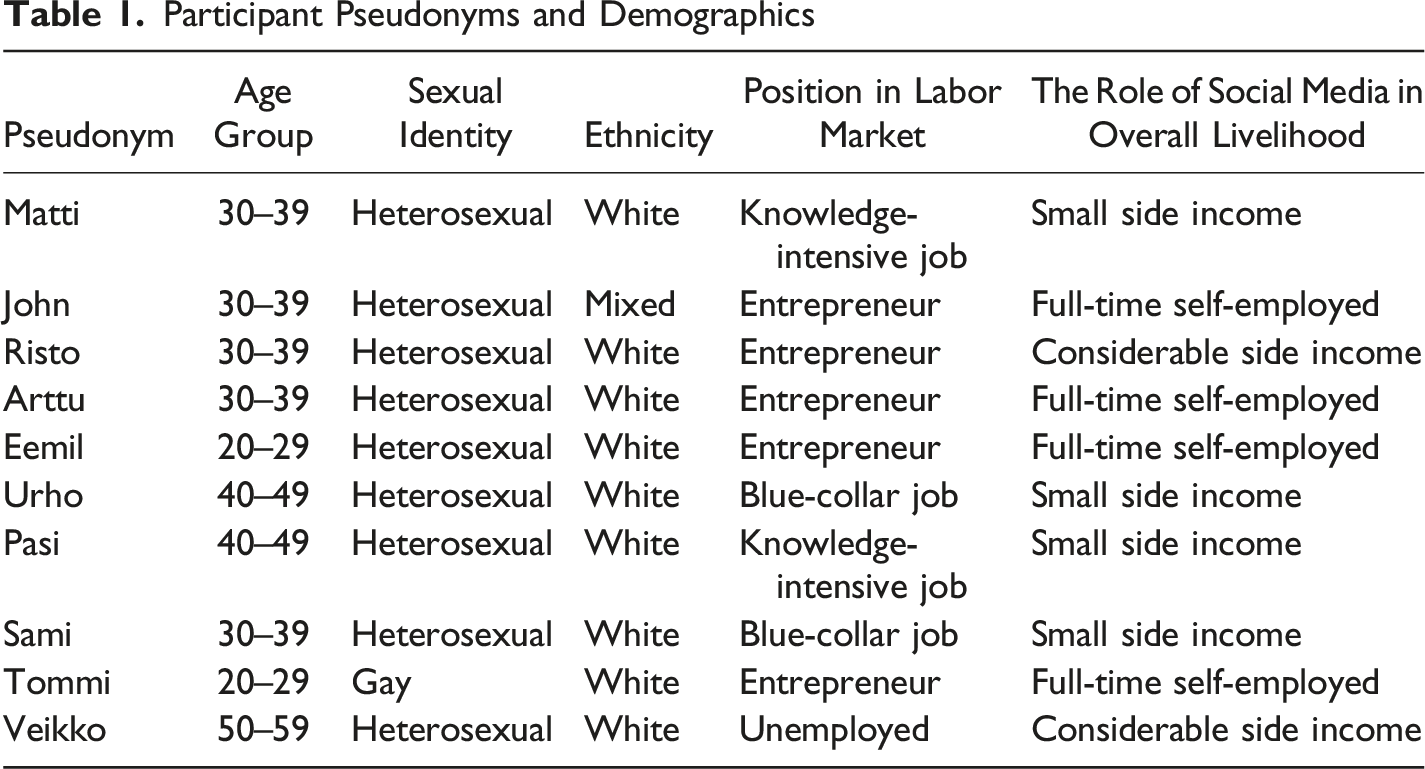
The participants’ most popular channel, either on TikTok or YouTube, had subscriber counts ranging from around 10,000 to around 175,000. In the small language area of Finland, even the most followed creators reported that monthly ad revenue from YouTube constituted only a small portion of their income. TikTok does not pay ad revenue. Follower counts, however, impacted the compensation they were able to receive from commercial collaboration: participants for whom content creation offered full livelihood had at least 80,000 followers. Given the narrow pool of potential participants and the goal of inclusivity, those in the sample expressed different perspectives on their content creation, viewing it as a hobby, part-time work, or a full-time job. This allowed for the analysis of how the number of followers, their level of commitment to following, and their demographic composition, along with diverse commercial interests, influenced the negotiation of masculinity.
The participants were located throughout Finland, in the Capital Region (N = 5), other large city outside the Capital Region (N = 1), and smaller towns (N = 4). The author, who conducted the interviews, and all participants lived in Finland and spoke Finnish at a native level. Due to long distances and the participants having limited time, most of the interviews, with one exception, were conducted via video call.
Nine out of ten participants were interviewed twice. The themes covered in the first interview were: personal work-related background, impetus related to starting content creation, daily routines of content creation and its positioning in relation to paid work and other daily activities, demographic composition of follower base and experiences of encounters with followers, financial compensation from content creation, and the effects of content creation on health and well-being.
At the beginning of each subsequent interview, possible recent changes in the participant’s activities in social media were discussed. If necessary, I also asked about issues that remained unclear or superficial in the previous interview. The second interview focused mainly on participant-induced elicitation. Following Hänninen (2020), I asked the participants to choose one long or several shorter recent videos of theirs they found particularly interesting in terms of, for example, success, ambitiousness, or exemplariness of the overall style they aimed for. Some participants did not prepare for this interview, so the videos were pre-selected. I chose recent ones to ensure participants could comment based on fresh memories, and with many comments to help them reflect on a wide range of viewer reactions. We discussed the creation process of the video and its audiovisual elements, as well as its reception, comments found interesting by either the interviewer or the participant, and the impact of viewer feedback on the participant’s subsequent activities on social media. Following the principles of netnography (Kozinets 2015), I familiarized myself with the channels before both the first and second interviews. I took field notes on the personal relationships and networks between the participants, the general features of the commenting cultures, and the videos and comments that the participants referred to during the interviews.
Informed consent was obtained from the participants to take part in the study. To ensure the anonymity of the participants and commenters, their names and nicknames, detailed information about their channels, and detailed information about comments and commenters have been omitted. I also did not express my presence as a researcher on their social media channels. Some identifying details have been altered.
The data was analyzed using abductive content analysis (Timmermans and Tavory 2012), where the notions of hegemonic masculinities as ontologically secure positions and digital foodscapes as places that offer different criteria for and affordances to achieve security informed and oriented the reading without determining “the scope of perceivable findings” (ibid., 173). The analysis began by coding the data focusing on the following aspects: financial and other goals presented by the participant for content creation, participants’ perceptions of the need to increase their channels’ visibility, the tone and meanings expressed in comments on their videos, and the ways in which the participants perceived viewer feedback to affect their activities on social media. Drawing on the digital foodscape concept, in the second stage of analysis, I made observations on the social connections between the participants as well as similarities and differences between their motives and actions in social media. Based on these two phases of analysis, different digital foodscapes and related hegemonic masculinities were identified.
Findings
This study focused on examining how commercial interests and audience feedback orient men’s actions as content creators. Based on the analysis, I suggest that differences in viewer demographics, follower feedback, and potential and realized earning opportunities created two distinct operating environments for men. First, I identified a meat-centered digital foodscape, predominantly occupied by male creators and viewers where they discussed their shared passion for meat. Here, creators perceived commercial collaboration mainly as a way to enhance the quality of the hobby: monetary income covered the costs of video production and brands provided specific products to be showcased in the videos. Second, I identified foodscapes where food was presented as a form of entertainment viewed by diverse viewer groups. Viewers were not fellow hobbyists but a more distant audience which creators aimed to please to maximize earnings.
Masculinities that provided a sense of ontological security for creators were hybridized in both contexts. However, they differed in the affectivities circulating within them and in how male creators prevented conflicts, avoided negative attention, and facilitated potential for positive emotions among viewers. In the meat-centered and male-dominated foodscape, creators aimed at maintaining legitimacy in the face of comments valuing the sustainability of meat and expertise in cooking it, as well as comments expressing masculinist and anti-feminist hostility toward vegans. Men catering for broader audiences either pursued neutrality, preparing for various criticism towards men’s conventional ways of engaging with food, or performed femininities that aligned with the tastes of their target audience.
In the following two sections, I present my findings in more detail. Each section is divided into two subsections: the first examines the construction of foodscapes through the interplay of contents, viewer demographics, audience feedback, and commercial opportunities; the second explores how these foodscapes influence men’s gendered practices and their sense of what is permissible and possible in this digital space.
Meat-Centered and Male-Dominated Digital Foodscape
Construction of the Meat-Centered Digital Foodscape
In this subsection, I demonstrate the construction of the meat-centered and male-dominated foodscape through similar content, social connections among content creators and between content creators and followers, shared limited and non-growth-oriented commercial interests among content creators, and content creators’ efforts to stabilize these spaces by limiting the visibility of their channels.
Matti, Risto, Arttu, and Pasi, in their 30s and 40s, were part of a network of acquaintances relatively visible in the Finnish meat-centered digital foodscape. They all posted videos on YouTube and, with one exception, on TikTok, and centered either mostly or solely on meat. They connected to each other as a network through collaborative videos. Their relationship had evolved from “mere video-collaboration” towards “more friendship-like collaboration in which we can also make videos” (Matti) which was based on “genuine camaraderie, common interests, and similar personalities” (Pasi). Urho, who published videos on TikTok, and Veikko, a YouTuber, were not acquaintances with the first four creators mentioned here. Yet, I demonstrate in the following sub-section that they were part of the same digital foodscape due to similar grammars and affective practices circulating across all six men’s channels.
Of these six creators, only Arttu reported that social media was “definitely a job” and the most important source of income for him, although he created other kinds of content and engaged in other business activities in addition to food content. Arttu had more followers than others; subscriber counts on other participants’ channels varied between approximately 10,000 and 30,000. Veikko reported that earning ad revenue from YouTube “fulfills the definition of work” but was not sufficient as a standalone income source; only when combined with other earnings did it enable a livelihood. Others called content creation a “hobby” (Matti; Urho; Pasi) or a part-time “funny job” (Risto) from which they were able to earn money or receive products through commercial collaborations and YouTube ad revenue.
They all noted that financial compensation and commercial collaboration were important for the meaningfulness and quality of content creation as a hobby. Matti noted that “even though this is a hobby, it involves expenses I need to cover”, due to which he had undertaken commercial collaborations for which he was monetarily compensated. At times, however, commercial partners contributed substantially to the content, as demonstrated by Risto’s account: Butchers […] sometimes give input that they have a certain kind of meat available. Without YouTube, I couldn’t just walk in there and talk directly to the butcher and say, “I want this.” […] The guy asked if I had ever smoked [a certain type of meat]. I said I hadn’t. He said they had some in the freezer and asked if I wanted to make a video about it now as it’s now available. I said “Of course.”
Although Risto’s videos did not have a large audience, they reached a certain hobbyist community comprehensively, which attracted advertisers. As Khamis et al. (2017) note, the relationship between influencer marketers and brands is two-way: brands leverage creators, but at the same time, they provide creators with opportunities and resources to stand out and enhance their credibility in the eyes of their followers. However, pursuing credibility in the hobbyist community limited collaborations. Matti noted that “too much commercial collaboration” had been “avenged” by viewers, while Risto stressed “honesty” and emphasized that videos should never seem to praise products solely due to partnerships.
Instead of financial gain, creators in this foodscape pursued high-quality social interaction and discussion about food. Pasi had an “intellectual and ideological” goal to “teach Finns to taste and cook other steaks than just tenderloin and sirloin” and change the “uninspiring Finnish meat culture.” His content creation was not “aspirational” in the sense of Duffy (2017); he was satisfied with his YouTube channel’s viewership and financials as they were. The channel constituted a “digital space” (Goodman and Jaworska 2020) in which he sought to create a sense of security for himself by limiting its visibility to only other “hobbyists”: I’ve been mentally prepared for trolling since day one. I mean groups that would repeatedly appear in the videos and comment things like “why do you eat meat,” “it’s unhealthy,” and “it causes emissions.” But that hasn’t happened so far. Maybe one of the reasons is that I haven’t made videos for publicity per se. I have only made joint episodes with other people in the same field. [...] I make content for those who are interested in it and it’s pointless for me to try to influence people.
During the interviews, Matti, Risto, Arttu, and Pasi, as well as Urho and Veikko, naturalized the fact that their videos were mainly watched by men. Pasi suggested that his videos were targeted towards “all people” interested in the “subject matter” while his follower statistics showed that “people interested in eating meat are mainly men between ages of 25 and 50” and “99 percent of [his] viewers are men.” According to Matti, it was “natural” that his videos were mostly watched by 28–38-year-old men; they included “foods that are perceived as men’s food, such as meat and less veggie fuss that women could like.” I suggest that while the videos in this digital foodscape were not necessarily for men or about “men’s interests” (Ging 2019), they still constituted a space for men in which discussing meat eating and normalizing it could continue relatively uninterrupted. Using Pasi’s self-positioning as an influencer who does not influence anyone as a springboard, I suggest that developing and affirming the meat hobby rather than attempts to engage in discussions about its justification were important for the creators operating in this foodscape. Their efforts to avoid provocation and enhance focus on the shared hobby affected their performances of masculinity.
Shaping Masculinity that Provides Ontological Security in Discussions About Meat
In this sub-section, I focus on how the hegemonic masculinity characteristic of this foodscape, which provides a sense of ontological security for content creators, is shaped by affective meaning-making and related bodily intensities. I start by demonstrating how secure positions for men centered around showcasing technical know-how and the sustainability of meat. Subsequently, I demonstrate how these positions do not prevent commenters from using channels to express hate speech against criticism of meat consumption, which creators tolerate and capitalize on rather than actively reject.
Content in this digital foodscape reflects some broader developments in the 2000s regarding the portrayal of men cooking in media: technical expertise, ambition, and innovativeness in cooking were emphasized at the expense of homosocial camaraderie and related decontextualized fun around food (see Contois 2020; Leer 2022). Unlike male creators who capitalize on the current discomfort surrounding meat by appealing to men identifying as meat-eaters (Leer and Krogager 2022; Lupton 2020), the actors in this digital foodscape sought to contribute to a shared meat hobby in a digital place where meat consumption did not need to be justified. For example, Pasi suggested that most of his videos were “tutorials” in which he guides “how to prepare a certain type of meat and how it should be handled and seasoned.” This restrained affectivity in his channel: Pasi noted that most of his follower feedback focused on “facts” rather than stressing identities and conflict-seeking positions related to meat.
In the 2000s, some representations of men’s limitless freedom to eat whatever they want has become problematized (Contois 2020), whereas references to nationalism, living close to nature, shorter supply chains, and locality have emerged (Leer 2016). Risto too reported that one of his main goals was to “make people eat more Finnish high-quality meat.” I asked him to express his opinion on a comment that said: “Meat is one of the causes of climate change, but with projects like this, we can support producers who may then be able to invest in sustainability and quality.” His response expressed excitement that the commenter had correctly understood the message of his videos: “Yeah, that’s exactly the core of what I’m doing here. I want to support everything that was said in that comment.” Through shared enthusiasm, the hegemonic masculinity within this foodscape was then shaped towards “vote with your fork” citizen-consumership (Johnston and Baumann 2015, 119), aiming at combining food experiences and sustainability.
Risto also noted that his followers defended him from attacks. Digital affordances shape communication styles on social media (Goodman and Jaworska 2020; Trott 2022): on YouTube, disliking and attaching answers to particular comments allowed viewers to counter and delegitimize opposition, such as a comment stating that “meat is murder”: Risto: I don’t have to defend myself; the commenters attack them right away. […] It is nice to know I’ve done something right. I’ve raised a community that defends me. […] He had written such a shockingly long message to answer the negative one. You had to open it separately, it looked on the phone like this (shows a measure longer than the phone with his hands).
Remembering the negative comment and the help received in delegitimizing it was framed by relief, gratitude, and enthusiasm for the collective justification of one’s own actions. However, all participants focusing on meat and many of their followers were aware of the sensitivity and public criticism related to the topic in Finland; not only attacking criticism of meat but also justifying meat consumption within this socio-cultural setting were legitimized in this foodscape.
However, digital affordances of a social media platform can also work against the intentions of content creators (Trott 2022). Meat-centered channels on YouTube and TikTok provided a space for hate speech against veganism and the criticism of meat. These repetitive comments manifested throughout the foodscape and utilized similar discursive tropes. Attempts to intervene would have affected the creators’ reputation in this environment. Thus, the capacities of steering affects rather than intervening them and handling one’s own negative emotions, previously a part of feminized customer service roles (Wolfman et al. 2021) and emphasized in social media work (Duffy and Schwartz 2018; Mäkinen 2021), also became part of the hegemonic masculinity characteristic of this foodscape.
Hateful and angry meaning-making towards followers of vegan and vegetarian diets often focuses on the supposed gender expression of the imagined opponent (Gregson et al. 2022). One of Arttu’s videos had a comment that said: “I can hear epic squealing from [the climate activist group] or other multicolored hair freaks [Crying-laughing emoji].” Although the comment positioned Arttu as a like-minded ally and coded his video as a legitimate performance of masculinity, he expressed both indifference and discomfort about it: “They can comment. Commenting typically increases a video’s visibility. But I don’t like confrontation and arguing online (laughs).” Many participants expressed helplessness about their inability to intervene in such commenting. Arttu suggested that it is “better to accept it” as “engaging in that war” “leads nowhere”. Risto reported that his primary strategy for steering the comments to suit his intentions was to ignore hateful comments and reply to comments he found constructive to enhance their visibility: “If I don’t answer them, then the situation will not develop in such a way that they would attack me.”
In addition to avoiding negative attention, there were other reasons why the participants were not motivated to remove or intervene in what they considered to be negative or unwanted conversation on their channels. Gaining any compensation from content creation requires attention and viewers (Duffy 2017; Khamis et al. 2017). Urho reported that although he did not want to alter his “content or lifestyles to attract other kinds of followers” besides men, it was still possible to increase his followership and thus compensation for his work. He found it useful that his viewers, most of whom were young men, not only posted comments mocking vegans but also used TikTok’s digital affordance that allowed these targets of hatred to be invited to watch his videos: “Every time Viral Vegans is tagged there, the number of viewers increases. The algorithm works like that. There’s no harm in that.” Although Urho found this activity to be somewhat childish, stating that “maybe as a young lad I could have fallen into that myself”, the opportunity for financial gain shaped him into an ally of anti-veganism.
A certain position of “ontological security from which the world may be viewed as under control” (Garlick 2023, 173) was constructed for male content creators who operated in the meat-centered digital foodscape. Creators had to demonstrate loyalty to the hobby community and not commercial partners. There was no need to refrain from discussions about the ethics and sustainability of meat: distancing a channel from careless, unecological lifestyles was a way to build a positive atmosphere with viewers who wanted to respond to the criticism of meat eating with arguments regarding sustainability and not just refute them. However, this discussion had to aim at continuing meat consumption, not questioning it. Veganism and othered identity groups associated with it were an object of hostile meaning-making for many commenters. The digital affordances of YouTube and TikTok not only discouraged creators from intervening in such commenting, but also made it possible to profit from it. In effect, creators ended up tolerating, benefiting from, and implicitly supporting comments in which an identity tied to meat consumption is constructed through hostility toward veganism.
Men’s Self-Minimization and Gender Flexibility in Entertainment Utilizing Food
Construction of Digital Foodscapes in Which Food is a Pastime
This sub-section focuses on the construction of digital foodscapes centered around entertainment and lifestyle content. This content was created specifically to attract large viewer numbers. At the same time, advertisers saw significant commercial potential in it, which motivated creators to grow their channels and enabled some participants to work for a full livelihood on social media. Unlike the male-dominated meat-centered digital foodscape, this content and its audiences did not constitute a cohesive digital foodscape with a distinct “good food grammar” (Goodman and Jaworska 2020). However, there were significant similarities between them: food was repeatedly framed as a pastime, which displaced food, its preparation process, and the content creators’ opinions about it from the focus. I start by discussing TikTok as a platform where men advertised food products by offering short-term joy and inspiration. Then, I focus on YouTube as a platform for person-centered lifestyle content.
TikTok is a social media platform that shows viewers random short videos based on their viewing habits. The platform does not offer ad revenue for content creators, which necessitates making a channel attractive to advertisers to generate income. In contrast to participants who aimed at contributing to a shared hobby around food, John, who had approximately 100,000 followers and a full livelihood from commercial collaborations with food brands and restaurants on TikTok, framed his target audience from the perspective of maximizing visibility: “My content is aimed at those interested in food, people who enjoy indulgence, and maybe even those looking for ideas and inspiration for their everyday life. There’s easily approachable content.”
John deliberately aimed to generate positive excitement, which had implications for the relationships with both commercial partners and audiences. While John’s restaurant and product reviews needed to be “informative”, he also constantly “softened” his message: “I can’t say my honest opinions. I would be thought of as a hater if I were to say an honest opinion about X or Y.” Moreover, John expressed uncertainty and suspicion about his viewers. John, along with other participants posting on TikTok, noticed that children were a key user group on the platform. To make the content circulate among different age groups and genders, it needed to be safe for children: “Someone might share my cooking video with their dad and mom in a family WhatsApp group. […] [The content] can’t be too daring, because in addition to the children, there are also their parents watching.” The dependency on advertisers and a restricted sense of freedom regarding viewers shifted growth-oriented male creators in TikTok away from a position of an unrestrained commentator of food towards a customer service role, both in relation to commercial partners and their audience. I demonstrate in the following sub-section that the attractive position as a non-provocative facilitator of enthusiasm had further implications for some creators’ performances of masculinity.
Unlike TikTok, on YouTube, viewers must search for content and choose from recommendations. YouTube also has a subscription system that engages viewers with their favorite channels. These result in relatively stable social ties between content creators and followers. Unlike in the meat-centered male-dominated foodscape, where advertisers found a narrow target group of hobbyists, here, advertisers utilized an engaging personality who attracted viewers. Food products were not the central topic of discussion but rather something the creators spent time with and which they incorporated into content about themselves.
Eemil, who also had over 100,000 followers on YouTube and TikTok and made his entire living from commercial collaborations with “brands” and YouTube ad revenue, considered his channels person-centered. Although many of his videos focused on food, the factor connecting different videos, which he termed “lifestyle” content, was his personality and not a specific issue or topic. Food products were framed as a part of pastime: It was a ‘not my arms challenge,’ meaning a cat is inside the shirt, but then my hands come in from the back, and I’m cooking that stuff while the cat’s head is there. This is how we included [the brand] in it to make it interesting for young people.
Once again, Eemil’s statement demonstrates that entertaining viewers and generating feelings of delight, rather than articulating what is and is not good food, were financially viable: it was enough to simply showcase a commercial partner’s product without needing to discuss its quality or preparation method. Person-centeredness, awareness of constant competition between creators, and the use of food as an attention grabber are characteristics of the current “social media entertainment” (Lewis 2020, 66–67). This differs from television which seeks to create coherent food-related narratives and convey a main character’s perspectives on food (Leer 2022). This also entails a departure from established ways of presenting masculinity in food media.
Men’s Self-Minimization and Mobility Between Identity Categories
In line with previous studies on men in service positions and social media, growth-oriented social media work meant profit-driven acts of flexibility and self-minimizing (Wolfman et al. 2021) and mobility in and out of identity categories (Whitmer 2017). I demonstrate hybrid hegemonic masculinities characteristic of these digital foodscapes by first examining self-minimization in the face of a demographically diverse audience, and then focusing on the incorporation of femininities as a part of appealing to an audience consisting mainly of women.
As mentioned in the previous sub-section, John repeatedly stated he could not express “uncensored opinions” for fear of being “canceled”. This did not necessarily lead him to incorporating feminized performances and identity elements into his content, but it still shaped him an ontologically secure position distanced from many masculinities constructed around food in legacy media: being a relaxed “dude” who performs for a homosocial camaraderie (Contois 2020; Lupton 2020) was not a possibility because children, their parents, and mixed-gender audiences were watching him. Moreover, expressing strong and critical opinions about food (Leer 2016, 2022) was excluded due to the financial ties to the products he reviewed.
Contois (2020, 117–118) argues that intense discussions on social justice and sustainability since the mid-2010s have problematized men’s relaxed postures and carefree “whatever” attitudes around food. As noted by Trott (2022), in the online space, hegemonic masculinity is negotiated by the platform’s users: digital affordances enable the repetition and amplification of negative feedback which has immediate effects on the status of a certain way of being a man. Eemil demonstrated that shareability and the ability of angry viewers to proactively expose his videos for other unfavorable gazes, constituted a source of continuous anxiety: I just feel that previously I could’ve made a video in which one eats only meat for 24 hours. […] In olden times, this kind of production would’ve gained interest, like “what are they eating during these 24 hours then.” Now they comment differently. Whatever you talk about, be it the price of electricity, government, foreign politics, world championships, human rights, skin color, gender minorities, it’s always a sensitive topic. Even if you say you just want to do good or express your own opinion and you’re not saying bad things, someone is going to get upset. It is not only one commenter, but there are ten. They unite against you, share the video, and say “hey, he said this thing on this video.” […] Some of those things might close some future collaborations.
Feelings of sadness, irritation, and fear led Eemil to position himself as a victim who is treated poorly despite good intentions. As De Boise (2018) notes, men’s bodily intensities that operate independently of their identity work shape their embodied masculinities in ways that can have both politically progressive and regressive potential. On one hand, the fear of “backlash” decreased his competence to act: careless promotion of meat-centric diets and voicing opinions about minorities were excluded. Yet, perceiving himself as a potentially misunderstood victim, Eemil searched for a secure position by constructing his channels as apolitical and neutral. Eemil appealed to different food ethical viewpoints equally and tolerated negative comments from them without indicating that he had chosen a side: “I have cooked vegetarian foods, as that has been asked of me. But then I noticed that comment sections were full of ‘Where’s meat?’ comments.”
For some participants, the viewers’ affectivity around, and ethical stances on, food were also a commercial opportunity and not just a source of anxiety, as evidenced by Tommi’s case. Tommi termed his videos “lifestyle content.” His earnings came from commercial collaborations with various “brands” he promoted on YouTube and TikTok, most of which were not food related. Tommi identified as a gay man who “stereotypically can be more interested in things that generally women are interested in,” such as cosmetics, which was why women “ended up” following him. As an entrepreneur he was “competing in a female-dominated field.” Tommi had adopted the practices characteristic of influencer marketing aimed at women, where a repeated effort to create a sense of intimacy enhances interaction between the creator and viewers and motivates them to return to the content (Duffy 2017; Mäkinen 2021): “I hope that it would feel to my viewers and followers as if we were hanging out together and that we were like friends.” Here, Tommi’s accounts differed from Eemil’s, who primarily emphasized his role as an entertainer, reported feeling distanced from his followers, and viewed commenters as “just usernames”.
Due to the reciprocity inherent in intimacy, Tommi’s followers had significant influence over his content. “Hanging out” was done preferably around food: videos in which he reacted to and commented on food products were repeatedly requested and a significant portion of his followers followed him “only for the tasting content.” In these videos, Tommi’s embodied reactions around food were important in entertaining and creating closeness between him and his viewers: “To increase the entertainment value, exaggerated reactions and similar theatricality are definitely included.” Many comments incited shared exaggerated opinions. In one video, Tommi dramatically expressed how bad a treat tastes. A comment under it continued the shared play: “It’s good that now the whole world knows how awful it is.” The seemingly extreme opinions expressed in both the videos and comments were mostly about matters of taste. Tommi’s videos allowed emotionally safe quarrels, which brought views and comments to the videos but were not at risk of producing genuine offense and subsequent negative publicity.
On the other hand, in videos that documented his everyday cooking, Tommi approached food ethics similarly to Eemil through self-minimizing, affirming others’ choices, and hiding his own ethical positions: I can give options. If I cook a chicken dish, I often mention that this can also be made with tofu. Followers’ comments and thoughts also influence me. I wanted to start showing more vegetarian food because I also make a lot of content related to cosmetics and there has been a request for content related to vegan and cruelty-free cosmetics.
Tommi’s way of being at the service of his viewers differed from John and Eemil: instead of caution and constant fear of “backlashes”, Tommi expressed closeness and familiarity with his followers. As a result of intimacy, the ontologically secure position was in constant flux: Tommi expressed the ethical beliefs and emotional responses that he felt were expected of him.
Concluding Discussion
So far, I have discussed masculinities that promise ontological security for men who create content in Finnish-speaking video-based food-related social media. Drawing on the concept of a digital foodscape, understood as a distinct combination of content, commercial partners, audiences, and meaning-making around discussing food, I focused on differences between the male-dominated digital foodscape focusing on the meat hobby and other foodscapes inhabited by women, children, or mixed-gender audiences where food was framed as a pastime. The study shows these foodscapes shape mutually different attracting positions for male content creators. Despite directing attention to the role of material infrastructures, digital affordances, and circulating and embodied affectivity in shaping hegemonic masculinities (Garlick 2019; Trott 2022), the present study contributes to discussions on hybrid hegemonic masculinities shaped by men’s efforts to negotiate the preservation of their lifestyle and certain privileges (Bridges and Pascoe 2014; Messerschmidt 2018).
The study demonstrates that many content creators and their followers, despite their aim to entertain and be entertained, are reacting to the crisis of the legitimacy of animal-based food on social media. Creators centering on meat aimed at constructing digital places where they can continue discussing meat with like-minded followers, most of which were men. The attractive configuration of masculinity was one of an expert in meat preparation, detached from the emphasized meat-eater identity (cf. Leer and Krogager 2022; Lupton 2020), who could reflect on sustainability issues related to meat production without positioning himself as an ally of meat critics. This pleased both men who eat meat while being aware of its environmental impact and men who are irritated by this concern and associated it with femininities and feminism.
When videos were made primarily for-profit, targeting audiences that do not consist of mainly adult men, the criticism of meat (Aavik 2023) and the problematizations of men’s relaxed positions towards food (Contois 2020) were assumed to be hegemonic affective practices. Performances of male expertise common in conventional food entertainment, such as outspoken hard criticism of food (Leer 2016), became problematic as creators often had commercial interests in showcased products. Against this background, creators were careful to not take sides, and some of them demonstrated embodied frustration and revulsion towards potential negative feedback. Here too, people hostile towards meat were associated with other identities and political opinions: while guarding against the idealization of meat-centric diets, an effort was also made to refrain from discussing other “sensitive” topics, such as gender minorities.
Consistent with previous studies approaching social media work as a field requiring capacities to serve and please, some flexibility and self-minimizing were present in all participants’ content creation regardless of the target audience. Previous studies on men working in and commenting social media have stressed men’s agentic and positive “strategic borrowing” of othered identity elements (Bridges and Pascoe 2014, 252) in how hybrid hegemonic masculinities are constructed (Brookes and Chałupnik 2022; Lewis 2020, 83–89; Oliver 2023; Whitmer 2017). The present study contributes to this discussion by highlighting how men’s embodied intensities involving fear and cautiousness orient them towards discursive and symbolic distance from identity categories as well as liminality and mobility between them. Heated debates about men’s eating practices (Contois 2020) and related uncertainties about men’s place in the world and gender order (Messerschmidt 2018) oriented creators towards all-pleasing customer service and caution, which can be interpreted as feminized practices characteristic of current social media work (Duffy and Schwartz 2018; Mäkinen 2021). This, however, allowed male creators to express only hollow stances on equality and sustainability issues, while on the other hand, it created space for the circulation of masculinist hate towards the criticism of meat consumption.
I conclude by arguing that, in the context of food-related social media entertainment, many men, both commenters and creators, demonstrate fear-tinged protection of their own lifestyle, either food-related choices or means of earning. Echoing previous analyses of masculinities online, I argue that the digital affordances of social media are particularly effective at facilitating and inciting the circulation of anger, feelings of entitlement, and victim positions among men (De Boise 2018; Ging 2019; Trott 2022; Venäläinen 2022). Heated affective practices characteristic of the discussions around food and food ethics, such as hate towards vegans or hostility towards men’s relaxed attitude towards meat, move male content creators and inform their decision-making. However, when creators discussed food-related ethical commitments in a positive light, they often spoke about them as finding a widely legitimate justification for food choices that are fundamentally recognized as problematic, such as meat consumption, or framed these engagements as control over the affectivity circulating in the digital foodscape they operated in. Although the creators aimed to entertain with their food-related content, they also saw the digital foodscapes they operated in as fraught with conflicting interests, carrying a risk of negative publicity. Echoing earlier analyses of men’s actions informed by neoliberal labor market positions (Garlick 2023; Wolfman et al. 2021), their accounts of their strategies used to mitigate these risks without presenting themselves as offended demonstrated a self-image as a rational agent. Yet, drawing on de Boise’s (2018) notion that men’s identity work can involve various bodily intensities, I note that this rational choice was repeatedly framed by uncertainty, fear, and victimhood.
Footnotes
Acknowledgements
I thank Helena Hirvonen, Laura Mankki, and Katariina Mäkinen for their comments on earlier drafts of this article. I also thank two anonymous reviewers for very insightful and helpful feedback and suggestions.
Declaration of Conflicting Interests
The author(s) declared no potential conflicts of interest with respect to the research, authorship, and/or publication of this article.
Funding
The author(s) disclosed receipt of the following financial support for the research, authorship, and/or publication of this article: This work was supported by the Koneen Säätiö (202103931).
