




Abstract
Engaging men in women’s empowerment is a global priority, yet there is still limited understanding of how men’s support for women’s empowerment is conceptualized across diverse demographic groups, particularly within communities undergoing change. This gap is especially critical in rural-urbanizing contexts, representative of many contemporary Global South settings, where individuals navigate tensions between respecting tradition while responding to novel social transformations. Using focus groups and interviews, this study examines how men’s support for women’s empowerment is conceptualized among young men, women, and elders in a fast-urbanizing Tanzanian community. Participants frequently noted supporting women’s employment and opposing intimate partner violence as markers of support, yet broader understandings diverged significantly by age and gender. Younger participants voiced transformative notions of empowerment, challenging traditional norms, and advocating for women’s empowerment in ways that disrupt age hierarchies, including educating elders. In contrast, elders framed support within boundaries that preserved male authority, while women prioritized practical forms of support over men’s more abstract, rights-based rhetoric. A particularly striking finding was the disconnect between young men’s vocal support for women’s empowerment and their limited actions to enact such support in daily life. These generational and gendered differences reflect participants’ varied priorities, exposures, and experiences, and offer insights into how gender roles are renegotiated in urbanizing communities.
Introduction
Achieving gender equality is a longstanding global priority (United Nations Development Programme, 2023), and as we grapple with the pursuit of a more equitable world, men’s role in supporting women’s empowerment has emerged as a focus of academic inquiry, public policy, and social activism (Barker et al. 2007; Connell and Messerschmidt 2005; Levtov et al. 2014). These efforts have produced a large corpus of knowledge, yet “women’s empowerment” remains a broad and ambiguous concept, spanning economic, social, reproductive, and sexual aspects of wellbeing (Cueva Beteta 2006; Desai et al. 2022; Gram et al. 2019; Richardson 2018). For example, one of the most widely cited definitions captures the concept vaguely, as being “about the process by which those who have been denied the ability to make strategic life choices acquire such an ability” (Kabeer 1999). Global health agencies have also prioritized generalizable metrics of both women’s empowerment (e.g., “Women’s Empowerment Index,” see UN WOMEN 2023), and men’s role in supporting women’s empowerment (e.g., “International Men and Gender Equality Survey,” Promundo 2019). Such metrics are useful in making comparisons across contexts and evaluating interventions (e.g., Levtov et al. 2014). However, generalized metrics may also be subject to ethnocentric bias and perpetuate blind spots with respect to how diverse communities comprehend shifting gender norms (Chang et al., 2020; Desai et al., 2022). This issue is pertinent because mismatched understandings between external agencies and communities, and indeed among community members themselves, may stifle both the development of relevant theory on gender role formation and effective interventions.
Addressing this gap, this paper describes how community members understand men’s role in supporting women’s empowerment in a rural-urbanizing town in Northwestern Tanzania. We argue that such contexts represent critical sites of gender norm negotiation, as individuals navigate pressures of maintaining respect for elders and tradition while responding to broader social changes. We take a qualitative approach, utilizing extensive focus group discussions and in-depth interviews conducted with young men, women, and elders. Using these data, we identify shared and divergent understandings of men’s support for women’s empowerment, paying particular attention to generational and gender differences. In doing so, we also consider how urbanization brings new influences (i.e., increased access to education, media, and external actors) that differentially affect community members and foster divergent notions of ‘supportive behavior’ (a term we use here to denote men’s support for women’s empowerment). Our study builds upon growing critique that research and policy on women’s empowerment often overlooks the multifaceted roles and viewpoints of men, particularly African men, and assumes a monolithic lack of support for women (Charles 2019; Dery et al. 2022). Recent scholarship presents a more nuanced picture of men’s perspectives, emphasizing a spectrum of beliefs, including in contexts undergoing urbanization and globalization (Dery et al. 2022; Everitt-Penhale and Ratele 2015; Langa 2020; Mfecane 2018). For example, in the urbanizing Northwestern Tanzanian setting of the current study, we demonstrated that, while many men declare support for patriarchal norms (i.e., men’s authority in decision-making, use of intimate partner violence, etc.), a notable proportion, especially those with higher socioeconomic status, privately reject such norms (Lawson et al. 2021). From this platform, here we explore understandings about what constitutes men’s support for women’s empowerment.
What Makes a Supportive Man?
While cross-cultural variation in gender norms is often simplified as a linear dimension of development, there is great diversity in the extent to which men (and women) in both the Global South and North can be considered to hold patriarchal ideology. Anthropologists, for example, have long recognized that small-scale hunter-gatherer populations have relatively egalitarian gender norms compared to farmers (Draper 1975), and shown how subsistence mode, variable kinship, marriage, and residence norms are correlated with differing rights, responsibilities and privileges of women and men (Bird and Codding 2015; Scelza et al. 2021; Smuts 1995; see also Alesina et al. 2013; Becker 2019). Moreover, a growing body of scholarship explores the configuration of “alternative masculinities” in African contexts, critiquing the western notion of hegemonic masculinity (Connell and Messerschmidt 2005; Morrell et al. 2012) and highlighting how African masculinities and perspectives on women’s rights are continually being renegotiated and redefined in response to broader social, economic, and cultural shifts (Dery et al. 2022; Dworkin et al. 2012; Everitt-Penhale and Ratele 2015; Langa 2020; Mfecane 2018; Sideris 2004; Silberschmidt 2001; Smith Jordan 2017; Wyrod 2016). These shifts create a dynamic context where men are both subjects and agents of change, grappling with new economic and social realities while also seeking to maintain conformity to cultural norms.
As traditional livelihoods become less viable due to economic pressures and shifts from agrarian to urban economies, some studies have documented ways men renegotiate gender roles and selectively support aspects of gender equality. For instance, studies in urban Uganda and Tanzania illustrate men increasingly endorse women’s wage labor, education, and political participation as these domains can enhance household status and economic security without directly challenging men’s authority (Bhojani et al. 2024; Wyrod 2016). At the same time, increasing exposure to global discourses on gender equality through media, education, and intervention from external organizations, has also been identified as a significant influence on gender attitudes as it exposes individuals to alternative models of masculinity. As exposure to these influences (i.e., tv, social media, education) varies among demographic groups, it may also foster diversity in attitudes. For example, some studies suggest younger African men hold more gender egalitarian views relative to their elders due to greater exposure to global media and education (Langa 2020; Smith Jordan 2017). However, these shifts may conflict with the influence of tradition and elders in shaping individual gender attitudes (Mfecane 2018), and ultimately conceptualizations of women’s empowerment. For example, extensive research has shown that men who adopt more supportive behaviors, such as sharing decision-making with their wives, engaging in domestic work, and rejecting violence, are often punished as they are seen as challenging tradition and disrespecting elders responsible for upholding these traditions (Ampofo 2001; Dery and Amoah 2022; Ratele et al. 2010; Sideris 2004). These punishments may lead to disconnects between private beliefs and public behavior, further complicating understandings. For example, past research in Tanzania concludes that individuals mask private support for gender equality in community interactions to maintain a “gender norms façade,” in which they conform publicly with gender norms they privately disagree with (Badstue et al. 2020; Galiè and Farnworth 2019; Ishungisa et al. 2024). In short, what it means to be a supportive man is complex, contested, and requires further study, particularly in communities undergoing rapid change where individuals must navigate diverse and potentially opposing influences.
Contributions of the Present Study
Our study advances understanding of the cultural construction of “supportive masculinity” in contexts undergoing urbanization. Past research on men’s gender attitudes has mostly focused on urban or rural settings (Ampofo 2001; Badstue et al. 2020; Bhojani et al. 2024; Dery and Amoah 2022; Dworkin et al. 2012; Langa 2020; Ratele et al. 2010; Sideris 2004; Silberschmidt 2001; Wyrod 2016), rather than rural-urbanizing communities amidst transition. Yet it is precisely in such transitioning sites that the negotiation of gender norms may be most apparent, as men navigate contradicting pressures of tradition and external and novel factors such as education, media, and international development interventions. Our study also makes the specific contribution of exploring how age, gender, urbanization, and tradition intersect to shape understandings of supportive behaviors. While previous studies have emphasized elders’ role in preserving traditional gender norms (Ampofo 2001; Dery et al. 2022; Mfecane 2018), we take the additional step of documenting generational tensions that emerge when younger men challenge tradition. Additionally, we address a notable gap in understanding with regard to specific behaviors men engage in to support women in rural-urbanizing contexts; cataloging locally-specific supportive behaviors and highlighting the gap between men’s understanding of what constitutes support and their current actions.
Methods
Study Setting
Fieldwork was conducted July-September 2022 within a rural-urbanizing demographic surveillance site in Mwanza region, Tanzania managed by the National Institute for Medical Research (NIMR) (Urassa et al. 2024). As a nation, Tanzania has made significant strides in advancing gender equality. In 2023 Tanzania was ranked 48th out of 146 countries by the Global Gender Gap index, up from 82nd in 2021 (United Republic of Tanzania 2023) and currently has its first woman president. However, inequality remains a significant issue. Women face high rates of intimate partner violence (IPV), vulnerability to land dispossession upon the death of their husband or separation, discrepancies in unpaid care and domestic work between men and women, continuing barriers to their sexual and reproductive health and rights (United Republic of Tanzania 2023), and relatively limited employment opportunities compared to men. Concurrently, Tanzania is facing rapid urbanization creating livelihood shifts, reductions in fertility, and associated increases in women’s autonomy; shifts analogous to those ongoing in countries and communities across Africa (Gwaleba 2018; Martine et al. 2013; Saghir and Santoro 2018).
The study community offers a lens to scrutinize the interplay between masculinity, social change, and gender within a case study representative of many other Global South communities undergoing rapid urbanization. Since 1994, the population has grown 3.7 percent per year, and the town center has sprawled into surrounding farmland absorbing previously-distinct nearby villages (Urassa et al. 2024). While recent migration has brought other tribes to the study region, the majority of residents identify as Sukuma (nearly 95 percent), the largest ethnic group in Tanzania, representing approximately 17 percent of the nation (Malipula 2015). The Sukuma traditionally lived in dispersed homesteads, maintaining large herds of livestock, but cattle keeping is declining in urbanizing areas as land holdings decrease in size and consumer goods have become a more important indicator of wealth (Wijsen and Tanner 2002). Agropastoralism and petty trade of agricultural products remain predominant income sources, but many residents participate in small businesses and skilled professions, such as tailoring or mechanical repairs (Hedges et al. 2018). Married women and girls are primarily responsible for household and childcare tasks (even while attending school), but women increasingly work outside the home. Primary income sources for women come from tending family farms, working as shop keepers, in restaurants, and engaging in petty trade (Kilgallen et al. 2022).
Sukuma customs can be described as patriarchal (Wijsen and Tanner 2002), with adolescent boys generally enjoying more support and favor than girls, and an expectation that men are primary breadwinners and hold more power and decision-making authority than women; notions which are reflected in traditional Sukuma songs (Masele and Lakshmanan 2021). Gender norms in the study community are patriarchal with low women’s empowerment in household decision-making, moderate levels of polygynous marriage, and a high burden of household work for girls and women (Dillip et al. 2018; Hedges et al. 2018; Wijsen and Tanner 2002). In Sukuma tradition, elders are highly respected, hold great authority, and are responsible for passing down and enforcing traditions relevant to young men and women’s gendered behaviors. Boys are expected to learn, hold, and preserve these community traditions and norms (Ishungisa et al. 2024). IPV in the study community is common; around 38 percent of women report experiencing some form of IPV in their lifetime, and often deemed acceptable (Kilgallen et al. 2022). However, gender norms are shifting for both men and women. Girls are now educated at near equivalent rates to boys, and women’s empowerment (as measured by relative authority in household decision-making) is higher in the study site compared to surrounding rural areas (Hedges et al. 2018; Schaffnit et al. 2019). The fertility rate in the region has decreased from 6.3 to 4.5 children from 1996 to 2021 and around 23 percent of married women aged 15–49 years report using contraception (Urassa et al. 2024). Since 2014, ongoing interventions in Mwanza region have been effective in reducing IPV rates and acceptance through gender-transformative trainings for men (Kapiga et al. 2019). Additionally, our recent work in the community (Lawson et al. 2021), indicates that some men support shifts towards greater equality. For a wider discussion of changing gender norms in Tanzania, see Badstue et al. (2020).
Data Collection
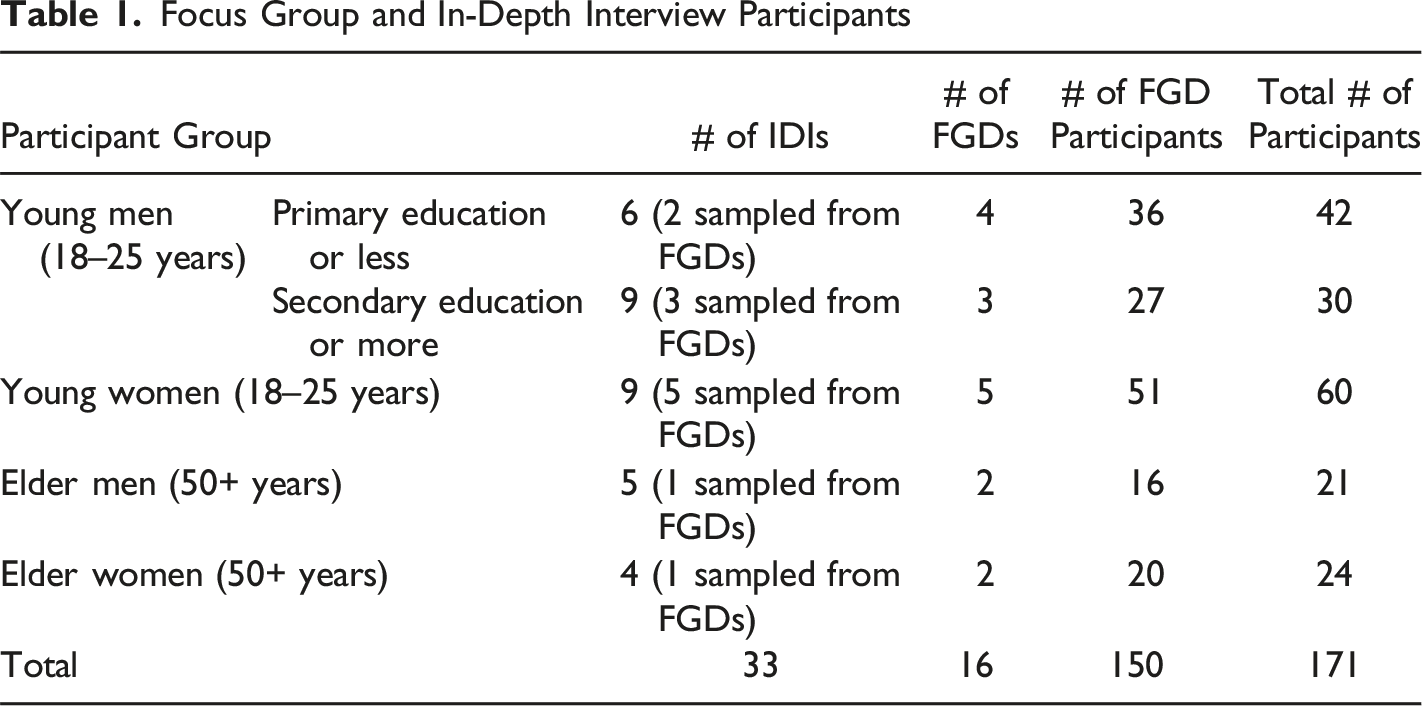
Following purposive sampling, 171 participants were sampled based on our inclusion criteria (gender, age, and residence) to participate in focus group discussions (FGDs) and/or in-depth interviews (IDIs). Sampling across diverse demographic characteristics allowed us to examine gender and age impacts, while limiting research activities to community residents helped minimize confounding that could arise from participants living outside of the community. FGD participants were recruited by FGD facilitators along with members of the research team. Potential participants were identified from the Health and Demographic Surveillance System (HDSS) (Urassa et al. 2024) based on age, gender, and residence in the study community, and then snowballing techniques were used to recruit further participants from the neighborhood in which the target lived. Snowball sampling was employed to encourage open and honest discussions. Discussions were led by the research team in Kiswahili, recorded using portable voice recorders, and later transcribed from Kiswahili to English. Each FGD lasted about 1.5–2 hours and involved 6–10 people; large enough to capture a range of perspectives, small enough to not become fragmented (Rabiee 2004). 16 FGDs were conducted: 7 groups of young men (18–25 years), 5 groups of young women (18–25 years), 2 groups of elder men (50+ years), and 2 groups of elder women (50+ years). Young participants were prioritized for discussions as they were the focus of the larger study design and because conversations with elders were generally stilted due to limited comprehension of discussion questions.
Focus Group and In-Depth Interview Participants
This study was granted ethical approval by the Tanzanian National Institute of Medical Research’s National Health Research Ethics Review Sub Committee (NatREC) (NIMR/HQ/R.8a/VolIX/4048) and the University of California, Santa Barbara Human Subjects Committee (6-22-0343). Informed consent was first gained from the community via presentation of the study objectives, requirements, and projected outputs to community leadership. FGD and IDI participants were then led through an informed consent process culminating in collection of their signature. Participants were given a hard copy of the study information sheet. IDI participants were not compensated, but FGD participants received transport to and from FGDs, compensation for their time, and refreshments.
Analysis
A hybrid approach was used to analyze data, combining both an inductive and deductive approach (Fereday and Muir-Cochrane 2006). In an initial inductive phase, the lead author reviewed transcripts of all FDGs and IDIs and drew up a codebook of dominant narratives. This then was supplemented by a deductive phase in which transcripts were explored purposely with an expanded codebook addressing any mentions of behaviors men can perform to support women’s empowerment locally, flagging understandings by young men, women, and elders respectively. Another categorization focused on agreement and disagreement in perspectives on supportive behavior between genders and generations, however few participants commented directly on how views on supportive behavior contrasted between groups of community members. Excerpts of transcripts were managed and analyzed in NVIVO 12 (Wong 2008), with the first, second, and last author making judgements on the most illustrative and representative quotations to present.
Results
Shared Understandings
Regardless of age or gender, participants commonly identified that supporting women’s right to work outside the home is an important way men can support women’s empowerment. This was frequently noted in reference to shifting community views, with participants characterizing Sukuma norms as historically limiting women’s movement and enforcing strict gender divisions of labor. “Sukuma people believe that the woman should stay inside to raise children and the man should look for food, to let the woman do just business is very hard because they don’t believe in that.” - Young Man, College Educated, FGD #8
Participants widely recognized that women’s engagement in wage labor was important because recent shifts in the economy necessitate a dual parent income to cover increasing costs of food, schooling, and desirable family living standards. Talking about hypothetical men deemed supportive of women, participants shared: “He would allow her [to work] because if a woman works, she also adds on to the family income thus, if they have children, they will be able to send them to a good quality school because both husband and wife have income to contribute at home.” -Young Woman, FGD#5, P10 “This good man will discuss with his wife and come into consensus that this wife should work in order to be able to take care of their children, provide them food as well as to improve their living standard in their family.” -Elder Woman, FGD#7, P5
Shifts in the economy were also viewed as leading to coinciding increases in demands on women’s time, constraining women’s ability to perform duties traditionally expected of them that is, cooking, cleaning, washing clothes, fetching water, and childcare all deemed kazi za wanawake or “women’s work.” Accordingly, all groups recognized that men assisting in domestic duties represents an important aspect of supporting women. Here the word assist is critical, as men are discussed as conditionally helping women with domestic work, that is, only if women are sick, busy, or absent. “If it happens you enter the kitchen to cook it is when your wife isn’t at home, you do the dishes if the wife isn’t around, but you don’t do those activities if your wife is around.” -Young Man, FGD#4, P6
Lastly, all participants discussed that a supportive man locally would be one who is opposed to IPV, defends women who are victims of abuse, and reports perpetrators. There was a clear shared understanding of formal legal and informal community-level procedures which a man should take when intervening on violence, indicating all groups had strong awareness of the realities of IPV in their community and methods with which to address it. “This young man who is against women abuse for instance he is passing somewhere and finds that a woman is beaten by her husband…he will follow legal procedures. He may go and report to the police or he might call the victims and advise them. It is not easy for him to see such kind of violence and ignore it.” -Young Woman, FGD#5, P7
Generational Differences
In general, young men and women were aware of women’s empowerment as a transformative concept, understood actions which men could take to support these efforts and acknowledged external influences (e.g., social media, tv, interventions, etc.) shaped their understandings. Younger participants voiced that a supportive man aids his wife economically and helps her to start a business, shares decision-making with his wife on issues of fertility (i.e., desired family size and spacing of births) and use of family planning methods, stands against IPV, educates peers & elders about women’s rights and gender discrimination, supports women’s attainment of education, and assists in domestic duties such as cooking, cleaning, and childcare. They indicated learning about women’s empowerment via globalization, by attending seminars on family planning or gender equality, and via radio, government messaging, social media (such as WhatsApp or TikTok), and television programs. They also learned from interactions with NIMR researchers who spoke about the importance of women’s empowerment and “haki sawa” (equal rights in Kiswahili). Given these exposures, participants were oftentimes aware of the English term “women’s empowerment”, and we frequently used this term directly in discussions and interviews. “We hear from the radio that many people support women’s empowerment, the government also supports women’s empowerment… and many institutions…Also I learn about maternal and child health from books, I listen to the radio, I watch TV, I attend seminars on the health and wellbeing of mothers and children…”- Young Man, College Educated, IDI “…globalization makes the world one community…like one village…we have the habit of copying from others as others adhere to equality…when we say others we mean the westerners, the people who look for equality, we just copy their lifestyle…[and] this kind of issue leads patriarchy to perish.” -Young Man, FGD #6
In contrast, the older generation held a more limited awareness of the concept of women’s empowerment. As such conversations about supportive behavior often became stilted, with, for example, elders finding it difficult to consider a hypothetically supportive man. To meet the goal of the study, we consequently asked in more specific ways about how a husband could practically support his wife or men could support women.
Elder men and women tended to conceptualize supportive behavior as fulfilling masculine gender roles (such as the man providing for his wife and family) or “permissions” that men can grant women (such as allowing women to work or travel) indicating they understood supportive behavior as actions which a man could take that did not challenge local gender roles. “He [the supportive man] is doing business and when he gets money, he brings it home to support his wife and his children.” - Elder Woman, IDI #3 “Yes, he may allow his wife to make movements, this is because she will ask permission before leaving whether she is going to visit her relatives or her mother or if they are sick people at her home place. He will allow her and set days for her to stay there.”-Elder Woman, FGD #4, P2 “Sometimes this good man may support and allow his wife to do business. Since he knows that my wife likes to work. So, he becomes a good man by permitting her.” -Elder Woman, FGD #4, P8
Young men and women described their elders as a significant barrier to men supporting women’s empowerment as they are resistant to change and enforce local gender roles, such as a gendered division of labor. “I lived with my grandparents… there when you [a man] are found doing dishes the beating you are going to get is unexplainable…because they mostly adhere to traditions that those are not activities that a man is supposed to do, the men’s activities were to herd cows, cultivation, irrigation and so on, those are the activities the Sukuma traditions consider to be for men, but when they find you going to fetch water, doing dishes, cleaning, the beating you are going to get will be a lesson to other boys of the house...” - Young Man, IDI
Because of the influence of parents and the older generation, young men and women acknowledged that an important way in which a man can support women is through advising and educating their parents to treat their sisters fairly and increase equality in the household. Men were encouraged to educate their parents as to the importance of their sister completing her education, for her to not be married early, and for boys to share responsibility in domestic duties. “…the majority of women or girls in this community end up getting pregnant, most of the times 6 or 7 out of 10 never make it to college after form four (completion of secondary education) …this is because of such challenges like I have mentioned; parents denying them this education. This is where these men especially educated ones who are supportive of women come in, he advises the parents that this girl child might help them in the future and by financing her education they are helping her too.” - Young Woman, IDI #1 “It happens in the society when a girl child passes her examination for instance form four examination and parents refuse to support her higher education, someone [a supportive man] advises these parents by drawing examples from the same society of someone who went to school and prospered.” - Young Woman, IDI #1
Another point of divergence between the younger and older generations was in their views on men supporting family planning. Elders generally did not see family planning as supportive of women, instead they often saw it as costly as it takes away potential contributors to both the family and society at large. Because elders grew up in a time in which children were more easily provisioned for by farming, and useful additional labor on family farms, they saw large families as beneficial for both men and women and a source of prestige. “…bearing many children was a prestige…they will help you in your work, you have ten children they will help you with farming then you will earn more” - Elder Man, FGD #7, P9 “a Sukuma woman refuses [to use family planning], she says I can’t sterilize it may stop us from giving birth to presidents who could help us in the future,” - Elder Man, IDI #18
Conversely, the younger generation often saw family planning as an important way men can respect women’s interests and support them as well as a useful tool for couples to adjust their family size as costs of child-rearing increase. “I will listen to my wife if she says that we should follow family planning methods for the number of children we should have… if they tell you something about family planning you should respect their advice…” - Young Man, IDI #3 “It [the use of family planning] is according to that relationship, they should agree on that from the beginning…it’s all about their income, if a man says, “I want to send my children to private schools so we should have three children whose education we can afford” that is their decision, they will plan depending on their income...” - Young Woman, FGD #7, P8
These generational differences in understandings may be explained by the fact that elders were considered averse to forms of “globalization” (e.g., social media, cell phones, tv) as some of them saw it as destroying Sukuma traditions. Younger participants noted that this aversion to forms of globalization made elders overall less aware of gender issues. “…there are elders who might believe that “the supportive man has been destroyed by globalization” many can believe this. They [elders] can be educated but they have no knowledge of gender issues.” - Young Woman, FGD #2
Gender Differences
Because conversations about support for women’s empowerment were stifled by limited awareness among elders, our comparison of gendered perspectives focuses on views of young men and women only. Young women tended to focus on small, daily actions men could take to relieve the burdens of living within a patriarchal system while young men preached the importance of political mobilization and advocating for women’s rights on a grander scale. When asked about how a man can support women’s empowerment, young men often used more abstract language: “The very supportive young man is the one who advocates for the women rights, all rights men have women should also have…” - Young Man, IDI #5 “The [supportive] young man is in the front line to abolish bad customs and traditions.” - Young Man, FGD #1
In contrast, young women generally spoke of rights in more specific terms expressing desires to be respected by men, have their opinions listened to and valued in household decisions (such as land purchases), to have men take care of their sexual health to protect them from disease, and to support their freedom to travel, work if they wished, make decisions about their sexual health and reproduction, and be free from violence. “Normally this [supportive] man will discuss with his wife so that everyone can speak out their opinions on the number of kids they need to have and family planning methods to use”-Young Woman, FGD #2, P2 “He [the supportive man] will be responsible for his health by making sure that he protects them [women] from any infectious diseases, which he knows that he can bring them home because of bad behaviors.” -Young Woman, FGD #1, P1 “He [the supportive man] can ask for advice from his wife about buying a land, they will discuss it to see what the wife has to tell him.” -Young Woman, FGD #6, P1
Realities of Supportive Behavior
Young men acknowledged that while they are aware of more basic supportive behaviors, such as taking their wives to the clinic or helping in domestic work, they are often not putting these behaviors into practice. For example, one participant noted a government order mandating men to go to the clinic with their wives but when asked whether men did this in the study community participants said: “…when a young man is told by his wife to attend the clinic he just rejects, by saying go and test alone…” Young Man, FGD #9, P4 “There’s no such thing…when the young man performs such duties he is seen as a woman… it is not right, it is abnormal to find a young man doing women’s work such as visiting the antenatal clinic with your wife…” Young Man, FGD #1, P7
One young man frankly disclosed that while men in the discussion had been talking about participation in domestic work as a way in which men could support women, such as washing clothes or children, they rarely manifested this supportive behavior in their daily lives as it was contrary to community norms and damaging to a man’s reputation. If a man is seen performing “women’s work” such as domestic tasks, community members (particularly elders and other men but also women) would perceive this man as umeolewa a Kiswahili term meaning “to be married.” In the Kiswahili language only men perform the action of marrying (kuoa), while women are the recipient of this action and are married (wanaolewa). Participants used the phrase umeolewa to indicate the perception that gender roles had been reversed and the man has lost control of the relationship now becoming the woman. “…we are just talking that we are washing clothes, but it is not true, in our community you could find maybe two men or none washing clothes. When you [a man] start washing clothes or wash the child, they [community members] would say that you’re bewitched or married by the woman (umeolewa)….” - Young Man, FGD #1 “…if they will see this young man washing clothes, cleaning dishes, cooking, looking after children etc. Obviously, this elder will ask his son are you the one who married or you’re the one who has been married (umeolewa)? Who is a husband and who is a wife?” -Young Woman, FGD #1, P4
Discussion
We explored community perspectives on men’s support for women’s empowerment in a rural-urbanizing town in Tanzania, finding both shared and divergent understandings. Below we discuss shared understandings before addressing how the interplay of tradition and urbanization creates distinct tensions across both generations and gender.
Shared Understandings of Support for Women’s Empowerment
There was a near universal recognition of the importance of men supporting women’s workforce participation. Participants described this as a shift away from tradition attributed to urbanization, noting that women’s employment has become essential to managing rising costs of urban living and the growing need for material investments in children’s education and health. These findings align with those of past research in urban Tanzania and Uganda which show men may selectively support domains of women’s empowerment that enhance household status and economic security but do not directly challenge men’s authority (Bhojani et al. 2024; Wyrod 2016). Our findings also suggest that men’s support for women working does not necessarily translate into equally sharing domestic responsibilities. Instead of equally dividing household tasks, men are described as conditionally “assisting” with domestic duties — such as when women are unavailable due to work or illness. This echoes findings from more urban settings in Tanzania and South Africa, where men’s domestic involvement is often conditional and reinforces the idea that the gender division of labor is being renegotiated in a way that preserves patriarchal control over the household (Feinstein et al. 2010; Ratele et al. 2010). These trends reflect broader national patterns: although more Tanzanian women have entered the workforce, support for gender equality in daily life remains limited, with women continuing to bear the bulk of domestic responsibilities (Fox 2016). We interpret these findings as an example of how gendered behaviors are being carefully adapted to navigate social and economic shifts without significantly challenging cultural norms that uphold men as breadwinners and women as homemakers, or undermining men’s authority (Wyrod 2016).
The widespread recognition of countering IPV as support for women’s empowerment is also noteworthy. This shared awareness likely stems from the high prevalence of IPV in the study community (Kilgallen et al. 2022) and recent interventions addressing violence in the Mwanza region (Harvey et al. 2018; Kapiga et al. 2019). However, the persistence of traditional conflict resolution methods which deem IPV a private affair alongside newer formal legal procedures highlights broader tension between local and external understandings of supportive behavior. Some men may still rely on traditional, private mechanisms to address IPV, avoiding newer formal legal avenues introduced by external interventions, which may be stigmatized or viewed as unreliable. This duality highlights the complex negotiation between longstanding cultural practices and emerging global norms, reflecting the challenges of aligning local customs with external efforts to combat IPV effectively.
Generational Differences
Our study reveals generational differences in understanding men’s support for women’s empowerment, contributing to literature on how African masculinities are being renegotiated in response to broader social, economic, and cultural shifts (Dery et al. 2022; Langa 2020; Wyrod 2016). Elder men and women held a limited comprehension of the concept, viewing support largely within the framework of behaviors that maintain traditional gender roles; such as fulfilling the breadwinner role or granting permissions for women to work or travel. In contrast, younger individuals demonstrated a more comprehensive understanding, viewing support as a transformative concept that includes shared decision-making autonomy, shared domestic duties, increased reproductive rights, and family planning. These generational gaps may be attributed to several factors. First, the term “women’s empowerment” itself, as noted by Desai et al. (2022), is ambiguous, reflects Western origins, and as such does not appear to reflect a singular locally salient concept for much of the older generation. Second, the younger generation has been more exposed to increases in education, media, and government initiatives promoting gender equality (Langa 2020; Levtov et al. 2014; Smith Jordan 2017). For example, in a parallel study young men reported learning about women’s empowerment through a Civics course in secondary school (Ishungisa et al. 2024), and Smith Jordan (2017) found that younger Nigerian men often hold more egalitarian views than their elders due to increased exposure to global media and education. Third, the differing economic contexts in which each generation was raised have shaped their views on what constitutes support, particularly for issues like family planning. Elders grew up in a time when child-rearing costs were lower, and children’s labor contributed significantly to household livelihoods, making large families more desirable and family planning appear costly. In contrast, younger generations are experiencing higher costs of child-rearing due to urbanization, a shift away from agriculture, and increased exposure to schooling, all of which have been linked to increased contraceptive use and smaller family sizes (Nanda et al. 2013; Snow et al. 2013).
While often framed as a battle of the sexes, support for women’s empowerment emerged as a key site of intergenerational conflict in our study. This finding further challenges notions of a monolithic lack of support among African men (Charles 2019; Dery et al. 2022) and presents a more complex picture: younger individuals may at times hold more egalitarian views but face significant resistance from older generations in actualizing supportive behaviors. Young participants reported facing social and even physical punishments from elders for engaging in supportive behaviors that deviate from normative gender roles, such as participating in domestic tasks or taking children to the clinic (Ampofo 2001; Feinstein et al. 2010). Consequently, both young men and women recognized the importance of educating elders on the value of women’s empowerment and gender equality. This finding is particularly surprising as it represents a direct challenge to established social hierarchies rooted in seniority, where respect for elders typically reinforces traditional gender roles. By performing these supportive behaviors, younger individuals are not only contesting gender norms but also questioning age-based power structures. These findings underscore the complex negotiations younger individuals are undertaking in these contexts of change where they attempt to balance new challenges of urban living and ideals of supportive behavior with long-standing cultural expectations of manhood (Dery et al. 2022; Silberschmidt 2001).
Gender Differences
Divergent understandings between young men and women provides valuable insights into the gendered dimensions of conceptualizing supportive behavior. Young women’s emphasis on practical, everyday support, such as respect, shared decision-making, and bodily autonomy, seems to reflect that their perceptions are shaped by the pressing daily realities of living under patriarchy. This focus aligns with Kabeer’s (1999) conceptualization of empowerment as the ability to make strategic life choices, with women prioritizing immediate, tangible forms of empowerment that address their lived experiences. In contrast, young men’s focus on broader, rights-based support reflects more global discourses which emphasize formal rights and structural change (Barker et al. 2007; United Nations Development Programme 2023). While important in the long-term, such focus may also divert men’s attention from day-to-day forms of support that young women prioritize but young men fail to actualize. Existing research in both urban and rural settings shows that men face possible social and physical punishments for engaging in supportive behaviors associated with caregiving or domestic roles, such as cooking or washing dishes, acts often viewed as women’s work, which may create a disconnect between men’s awareness of supportive behaviors and their willingness to act (Dery and Amoah 2022; Ratele et al. 2010; Rudman et al. 2013; Sideris 2004). In fact, young men noted that while they were aware of supportive behaviors, they often conformed to locally normative notions of masculinity to avoid facing punishment and stigmatization, such as being labeled “umeolewa” (married by a woman), mirroring findings from other communities in Tanzania, South Africa, and Ghana (Ampofo 2001; Badstue et al. 2020; Langa 2020; Ratele et al. 2010). Furthermore, men may be resistant to support women’s empowerment if they view advancements as threatening their patriarchal privilege, relative power and authority in the household, and ability to fulfill their prescribed gender roles (Bhojani et al. 2024; Dery and Apusigah 2021).
Conclusions
Our study makes clear that understandings of what constitutes men’s support for women’s empowerment can differ dramatically even within a single community. Moreover, we confirm that rural-urbanizing contexts present fertile ground for generating and testing both theoretically and policy relevant notions about how global and local forces interact to (re)shape masculinities. We encourage scholars of men and masculinities to embrace rural-urbanizing contexts as critical sites for examining the interplay of tradition and change, acting as crucibles that render generational and gendered tensions both unavoidable to community members and explicit to those researchers concerned with how gender norms are negotiated. Our findings highlight critical tensions across generations and genders, and document how men may navigate opposing pressures by selectively incorporating elements of global discourses on gender equality into their identities while also maintaining aspects of traditional patriarchal norms. This selective integration reveals the limits of rhetorical support for women’s empowerment, as younger men may vocally align with egalitarian principles yet fail to enact them in practice.
Considering implications for women’s empowerment initiatives, one potentially transformative avenue for interventions to advance women’s empowerment is via facilitating intercommunity dialogue. Constructive communication between generations, for example, may encourage mutual understanding and broaden conceptualizations of supportive behavior among elders to encompass notions of agency and support beyond current gender roles. Such efforts could reduce intergenerational conflict, which remains an underappreciated yet critical barrier to gender equality. Simultaneously, there is a need for targeted interventions to address the disjuncture between younger men’s rhetorical support and their practical engagement. Programs may consider developing initiatives that normalize and incentivize daily forms of support, such as shared domestic responsibilities and active participation in women’s decision-making processes. Finally, both theoretical models and interventionist programming looking to further women’s empowerment might consider moving away from use of the singular term, as this broad concept can lead to confusion or misinterpretation. Instead, initiatives may consider more contextually grounded approaches that balance women’s immediate material needs with the pursuit of long-term structural transformation, ensuring that empowerment strategies resonate with the lived realities of the communities they serve.
Footnotes
Acknowledgements
We thank the NIMR Mwanza Directors and our participants for their patience and hospitality. We also thank Michael Gurven, Nicole Thompson Gonzalez, and Charlotte Brand for their feedback.
Declaration of Conflicting Interests
The author(s) declared no potential conflicts of interest with respect to the research, authorship, and/or publication of this article.
Funding
The author(s) disclosed receipt of the following financial support for the research, authorship, and/or publication of this article: This research was funded by the University of California Santa Barbara and the National Science Foundation’s Doctoral Dissertation Research Improvement Grant (2241629).
