




Abstract
How do the so-called wars on terror impact queer lives and politics? This article addresses this question by exploring the racialized gender and sexual politics of Turkey’s own brand of war on terror and its ramifications for LGBTQI+ lives. Building on long-term ethnographic fieldwork with the disabled veterans of Turkey’s Kurdish war and public culture analysis, I reveal how the political construction of Kurdish militants as queer figures goes hand in hand with state terrorization of LGBTQI+ people in contemporary Turkey. I anchor my analysis in a novel counterinsurgency trope—“terrorists in skirts”—a trope popularized by the state-controlled media for psychological warfare purposes. I argue that the voyeuristic media fascination with cross-dressing militants is both symptomatic and constructive of an Islamist-nationalist authoritarian regime where terrorism and gender and sexual nonnormativity are violently conflated in state discourse and practice.
Introduction
How do so-called wars on terror impact LGBTQI+ lives and politics? How do counterterrorism discourses and practices produce, represent, and target sexual, ethnoracial, and religious Others? Feminist, queer, and critical race theorists have addressed these and similar important questions, especially since the launch of the United States-led Global War on Terror in 2001 (Khalili 2011; Puar 2007; Rana 2011; Razack 2005). Yet, the fact that such analyses focus almost exclusively on Euro-American imperial and settler colonial projects hinders our intersectional understanding of the gendered, sexualized, and racialized underpinnings of counterterrorism elsewhere (see Amar 2011; Byler 2021; Mikdashi and Puar 2016). What kinds of embodied configurations of Otherness emerge when counterterrorism is harnessed by an increasingly authoritarian, Islamist conservative, and right-wing nationalist populist regime?
This article answers the latter question by exploring the racialized gender and sexual politics of Turkey’s own brand of war on terror and its ramifications for LGBTQI+ lives. The Turkish state has waged a transnational, ethnopolitical counterinsurgency war against the Kurdistan Workers’ Party (PKK) guerrillas since 1984, construing it as “the struggle against separatist terror.” As the conflict escalated into war in the 1990s, counterinsurgency practices such as extrajudicial killings, forced displacements, and systematic torture became routinized. Despite holding several peace negotiations with the PKK during its two-decade rule, after 2015, Turkish President Recep Tayyip Erdoğan’s Justice and Development Party (AKP) resumed the armed conflict with the country’s transition into full blown authoritarianism. Concomitantly, the AKP launched an intense governmental backlash against LGBTQI+ citizens, who have become increasingly harassed and terrorized by security apparatuses under the pretext of counterterrorism.
The synchrony between the resumption of the counterinsurgency war and the anti-LGBTQI+ backlash was not coincidental. Taking inspiration from the long-standing feminist theorization of the gender and sexual dynamics of war and militarism (Cockburn 2010; Enloe 2000; Puar 2007; Sjoberg 2013; Yuval-Davis 1997) and from the burgeoning ethnographies of LGBTQI+ politics and state power in the Middle East (Atshan 2020; Karakuş 2022; Mikdashi 2022; Savcı 2020; Zengin 2024), I show how this synchrony was politically produced through the mutual construction of Kurdish militants as queer 1 figures and LGBTQI+ public presence as terrorist activity. I do so by tracing an emergent trope of counterinsurgency—“terrorists in skirts”—which refers to cross-dressing Kurdish/socialist militants who allegedly try to pass as women to avoid detection by security forces. This trope began to saturate government-controlled media just as the country descended into a full-fledged authoritarianism where gender and sexual nonconforming individuals were targeted by state homo/transphobia as not only deviant but also terrorist figures. In what follows, I outline the development of this trope since the earlier phases of counterinsurgency. I show how the trope merges imageries of ethnoracial and sexual alterity and in so doing interlaces the fantasies and practices of sexual and state violence against those historically constructed as national Others: Kurds, Armenians, and LGBTQI+ individuals.
My argument unfolds in five sections. In “Not A Manly War,” I draw from my work with Turkish disabled veterans to illustrate the longue durée gender and sexual formations of counterinsurgency. I discuss two main themes that run through my interlocutors’ narratives: the emasculation of guerrilla men and their association with Armenianness. “Terrorists in Skirts” turns attention to the recent phase of counterinsurgency when fighting moved from the mountains to the Kurdish cities. I show how the tropic figure of the “terrorist in skirt” emerged in the context of the urban trench war that ravaged the Kurdish region between 2015 and 2016, in which state violence took obscene sexual forms. “Travesti Terror” makes a historical detour to chart a genealogy of the juxtaposition of cross-dressing and terror in Turkish public culture. Looking at media representations of trans sex workers as terrorists, I examine how state violence is displaced onto gender nonconforming bodies as criminality and terrorism. In “Terrorists on Display,” I analyze the voyeuristic media fascination with the cross-dressing male militant figure, attending to the economies of desire and disgust that undergird psychological warfare. By exploring social media users’ responses to these news stories, I illustrate the ethnoracialized notions of gender and sexuality and fantasies of sexual violence that animate the everyday life of racialized state propaganda. Finally, in “Terrorist Queers,” I reveal how counterterrorism is mobilized so as to stifle LGBTQI+ resistance to the (hetero)masculinist political restoration (Kandiyoti 2013) project unfolding in contemporary Turkey.
Methodology
The data sources for this study include long-term ethnographic fieldwork with Turkish disabled veterans (Aciksoz 2019) and media coverage, social media posts, and texts of politicians’ speeches. Between 2005 and 2008, I carried out 29 months of ethnographic research with Turkish military veterans who acquired disabilities while fighting as conscripts against the PKK, collecting their life histories and carrying out participant observation in military hospitals, at political and religious ceremonies, and with grassroots organizations. In a country like Turkey where over 80% of the population uses the internet and social media, it is nearly impossible to conduct ethnography without considering online and mediatized spaces (Hallett and Barber 2014). To access these, I searched for the term etekli terörist(ler) (terrorist(s) in skirts) on the search engine Google and on social media platforms Facebook and X/Twitter. My search results pointed me to the websites and social media pages of pro-government news outlets, the mediatized speeches of politicians, and the online posts of individual social media users. I then carried out discourse and narrative analyses of these texts, paying attention to their affective and performative aspects and analyzing the visual images accompanying them (photos and memes).
Not a Manly War
“This is not a manly war.” I heard this phrase countless times from my disabled Turkish veteran interlocutors. Their understanding of “manly war” rested on a man’s courage to risk his own body and dignity in violence; since guerilla warfare did not involve direct confrontation between enemies, the veterans deemed it as unmanly. “Terrorists never fight like men,” they complained. In their masculinist nationalist cosmology, the guerrilla tactic of ambush and weapon of landmine violated the gendered codes of honor and indexed the cowardice of Kurdish guerrillas, whom they read as outside the confines of normative, respectable masculinity. When talking about ambush, landmines, or “terrorists,” disabled veterans’ war narratives always used the sexualized swear word kahpe (whore or fickle). These resorts to stigmatized femininity were central to veterans’ constructions of racialized and sexualized “terrorist” masculinities.
Yet the symbolic dichotomy between the lionhearted Turkish soldier and the cowardly kahpe PKK guerrilla often failed to hold up in these war narratives. Other phantasmagorical figures sprang up. One such figure was “the fearless.” An excessive performer of manly fight and valor, the fearless was said to charge soldiers headlong from the front, ignoring flying bullets and stopping only when killed. My interlocutors were firmly convinced that the berserk qualities of the fearless were a product of a psychotropic substance they called a “bravery pill”: “Due to the pills they took, terrorists scrambled over boulders like drunkards without thinking about hiding and taking cover.” In such accounts, gallantry—the natural masculine quality of Turkish soldiers—could only be chemically induced in Kurdish guerrilla men.
Another such figure that disabled veterans used to rhetorically emasculate male guerrillas was the “terrorist woman.” In their narratives, the guerrilla woman appeared as a ghastly figure. Possessing the stealth of a cat, she was a natural sniper and suicide bomber who incited dread among soldiers: “We were all afraid of terrorist women. They’re not like men. They’re merciless. She will sneak in and blow up a trench without even moving a muscle.” Depicted as merciless and cruel, the guerrilla woman in my interlocutors’ narratives embodied the prized traits of soldier masculinity in excess. These projections of female masculinity (Halberstam 1998) originated in the early Republican novels of the 1930s, narrating Kurdish rebellions where the Kurdish woman fighter was represented as a daring enemy who stood out among her craven male companions. Such colonial 2 tropes juxtaposed the emasculated man with the masculinized woman, establishing the utter racial and sexual alterity of the colonized through their gendering with inverse attributes.
Another recurrent trope that surfaced in both my interlocutors’ narratives and in the Turkish media was “the uncircumcised terrorist.” Claiming that they had witnessed the uncut foreskins of Kurdish guerrillas with their own eyes, several of my interlocutors were convinced that this detail authenticated the identity of guerrillas: “We used to pull the bodies of killed guerrillas with ropes and then strip them naked to make sure that they were not booby-trapped. Most of them were Armenians. I mean they were uncircumcised.” As absurd as they sound, such statements were bolstered by decades of state propaganda claiming that the PKK was a continuation of the Armenian Secret Army for the Liberation of Armenia. In the 1980s, right before the time the PKK announced its guerrilla war, this armed organization launched a wave of assassinations against Turkish diplomats, firmly establishing the discourse of terrorism in Turkish state parlance. In 1994, the governor of the Kurdish region, then under a state of emergency, Ünal Erkan, announced that 800 PKK members were of Armenian descent and that Armenians had created the PKK as revenge for the 1915 genocide (Şengül 2014). Similar arguments, implying that Kurdish guerrillas were in fact not (Muslim) Kurds but hidden (Christian) Armenians who feigned conversion from Christianity to Islam to escape the genocide, have been repeatedly made by ministers, highest ranking military officials, and news anchors on state television. Such conflations of Kurdish and Armenian “threats” inscribed the gendered, ethnoracial, and national alterity of guerrillas directly on bodies. In a sociocultural context where circumcision operates as a rite of passage into both religio-national community and normative masculinity, the uncircumcised terrorist trope suggests that guerrilla men are neither members of the imagined religio-national community nor proper masculine beings.
These tropes illustrate how counterinsurgency has always hinged on the cultural logics of Otherization that mobilizes gender, race/ethnicity, and religion in the service of militarized nationalism. While the tropes of gender inversion emasculate guerrilla men, the trope of the uncircumcised terrorist associates them with the spectral figure of the Armenian, who lurks as an absent presence at scenes of state violence. Through these tropes, ethnoracialized Kurdish masculinities manifest as both lack (of valor and honor) and excess (of foreskin) vis-à-vis normative and respectable Turkish masculinities. Tracking such tropes highlights the historical continuities in nationalist discourses and counterinsurgency structures.
Terrorists in Skirts
Turkey’s entrenched Kurdish conflict entered a new phase in 2015. As Syrian Kurds’ victories against Islamic State fanned Turkish nationalists’ fears of an emergent Kurdish state at its borders, the electoral victory of the pro-Kurdish Peoples’ Democracy Party (HDP)—an umbrella party that connects the Kurdish movement with socialists and progressive social movements—denied the AKP an absolute parliamentary majority for the first time since it came to power in 2002. Faced with domestic and regional crises, the AKP joined hands with ultranationalists and ended the peace negotiations with the PKK to push back against Kurdish political gains. The Kurdish movement responded by declaring self-rule in many cities which during the peace negotiations had come under de facto control of the PKK and its aligned youth militia. As the state sought to violently reassert control through military blockades and indefinite curfews, Kurdish militia braced for an urban guerrilla war. In 2015, the resulting urban trench war would bring what had been largely a rural war to the cities, killing thousands, leveling neighborhoods, and forcibly displacing hundreds of thousands.
This spatial shift transformed Kurdish cities into textbook colonial landscapes, where military conquest would culminate in the sexual conquest and penetration by the military masculinist gaze of the colonizer (Alloula 1986; McClintock 2013). Members of the police and the military shared photos and videos of their violent acts live on social media for the consumption of a voyeuristic nationalist public. The photos of the mutilated dead body of Ekin Wan, a Kurdish guerrilla woman, were shared by accounts apparently affiliated with state forces as a “direct assault on the honour and the virility of the enemy’s (the Kurdish man’s) masculinity and national values” (Mutluer 2019, 264), right at a moment when the female Kurdish combatants fighting against Islamic State were being glorified in the European media. Such mediatized state-sanctioned performances of sexual violence would become a distinctive feature of the psychological warfare of this new phase of the conflict.
Military performances of sexual violence inscribed not only bodies but also the built environment. In the vacated houses they occupied, state forces deliberately crafted stages of fantasized sexual violence, scattering condoms around and exhibiting women’s underwear with notes like, “We made love with this one” (Alkan, 2018; Baysal, 2016). In the midst of the wholesale destruction of Kurdish neighborhoods, harrowing images of soldiers and policemen posing in front of houses defaced with nationalist and militarist graffiti started to appear on social media. In a widely circulated image (@M4zlum, Tumblr, June 8, 2016), a soldier posed atop a bedroom make-up table, on whose mirror he had inscribed in lipstick, “Love in Yuksekova is fabulous” (Figure 1). In another, a soldier proudly posed in front of graffiti that read, “Love is best experienced in Bodrum” (@M4zlum, Tumblr, June 8, 2016). Here, the Turkish word bodrum referred both to a popular tourist destination with a reputation for hedonism and to apartment basements in the Kurdish town of Cizre, where more than 170 people who had taken shelter from heavy state forces shelling were burned to death. Soldier posing atop a bedroom make-up table in Yuksekova.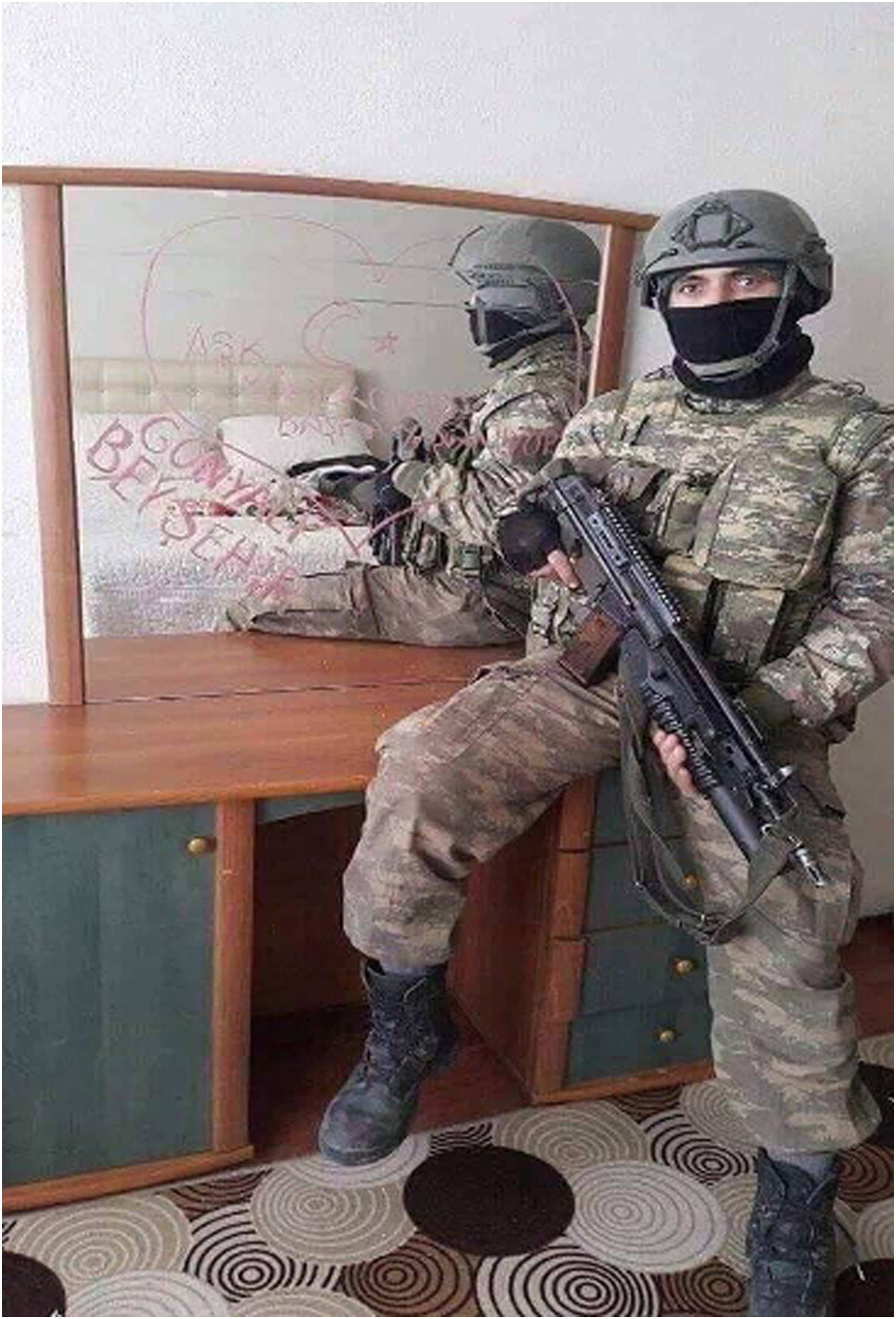
These graffiti and performances of state power and sexual violence reveal much about the specificities of the gender and sexual politics of war in the post-2015 era. While the repeated use of the word “love” in a context marred by rape symbolism and ethnopolitical state violence rebrands racist hatred as love (Ahmed 2004), a sadistic and grim sense of sexual humor characterizes the new nationalist state discourse. This peculiar humor is a cultural novelty that is very much a product of the 2013 Gezi protests. Indeed, most of the graffiti on the walls of bulldozed buildings involved sexist and homophobic language that obscenely mirrors the humorous political language of the Gezi protests. During the protests, city walls were covered with sexually offensive graffiti questioning Erdoğan’s penis size, heterosexuality, and impenetrability (Aciksoz and Korkman 2013a). Taunting Erdoğan with sexual threats of domination and feminization, the resistance often mimicked, defiled, and reversed Erdoğan’s masculinized power in the very same idioms he used to assert it (Aciksoz and Korkman 2013b). This gendered, sexualized, and even pornographic genre of political criticism, which ridicules masculinist performances of political power with feminizing and queering gestures, has been a globally distinguishing feature of the contemporary opposition to right-wing authoritarian populisms (Aciksoz and Korkman 2017). Now, the special forces, who, as loyalists of Erdoğan, were both captivated by and resentful against the affective power of the Gezi protests’ political humor, reasserted Erdoğan and the state’s heteropatriarchal domination through the dark doppelgänger of that same humorous language.
The previous section depicted how my disabled Turkish veteran interlocutors’ gender-inverted representations of Kurdish guerrillas operated in a way that fearfully revered ice-cold female guerrilla figures and simultaneously emasculated Kurdish male guerrillas as honorless cowards who could not fight a manly war without the help of chemically induced bravado. There, the ability to wage “manly war” was a masculinized trait veterans assumed Turkish soldiers possessed by default. The widely circulating special forces’ photos of graffiti evoked similarly sexist tropes of gender inversion. In some photos, masked soldiers menacingly posed in front of graffiti referring to the predominantly male Kurdish militants as girls: “Girls, we’re here! We’ve gotten into your caves!” Others displayed graffiti taunting the Kurdish militia as cross-dressing militants: “The fashion for dresses is over. We’re going to make you wear G-strings.” These graffiti were harbingers of the solidification of the trope of “terrorists in skirts,” which brought the longtime weaponization of gender and sexuality in the counterinsurgency war to a head.
News stories covering “terrorists in skirts” became popular within this context of sexualized siege. The first appeared on February 17, 2015, just before the collapse of the peace negotiations. A press release by the Turkish military reported a PKK attack on a paramilitary village guard’s house carried out by “terrorists in women’s clothes.” The media snapped it up. As is often the case in government-controlled media coverage of “terror events,” the content in different newspapers was verbatim. Newspapers used similar eye-catching headlines such as “They Raided Village Guard’s House in Skirts” (Milliyet, February 17, 2015), further embellishing their coverage with the same provocative subtitle: “A First in the History of Terror.”
Travesti Terror
The newspapers were mistaken. This was not the first time that cross-dressing and terror had been juxtaposed in public culture. That linkage had been established in the 1990s through the sensationalist media coverage of travesti terörü (transvestite terror) (Savcı 2020). As pejoratively used by the media, the term travesti referred to any sex worker assigned male at birth who wore feminine attire while working. 3
As evidenced by the high number of trans murders, trans sex workers lived precarious lives under the continuous threat of violence by police and clients, who often resorted to gay or trans panic defense to receive reduced sentences in court. Despite the widespread and state-sanctioned anti-trans violence, the media constantly constructed travestis “as irrationally violent, allegedly terrorizing innocent male bodies with pocketknives and switchblades as they roamed freeways for sex work” (Savcı 2020, 86) even when the cameras showed them being knocked unconscious in vicious beatings by multiple assailants. Titillating the public with headlines like “Tran-slash-tite” or “Slasher transvestite” and proudly presenting anti-travesti police units with net guns and tear gas (Milliyet, December 13, 2000), media coverage of trans sex workers played a major role in sexualizing terrorism and terrorizing sexuality in Turkey.
Like Turkey’s own brand of the war on terror, the notion of “travesti terror” was a product of the post-1980 military coup era and contributed to the securitization of the whole of society (Savcı 2020). While violently crushing the political left, coupist generals also sought to discipline and militarize the entire society, cracking down on what the generals saw as deviant bodies and identities. Trans sex workers were driven out of cities to the outskirts during the junta years (Selek 2001). Their heads were shorn and they were subjected to torture. All queer and trans public performances, particularly by men construed as “effeminate” or cross-dressing, were banned. After the ban was lifted with the return to civilian rule in late 1983, a handful of m2f trans singers (the “Diva” Bülent Ersoy), who had undergone gender-affirming surgery, obtained their pink female identification cards, and could refashion themselves as Muslim, upper-class, nationalist women (Altınay 2008). Yet, while some trans lives were (re)folded into the nation and citizenship (Puar 2007), the vast majority of the trans community would be exposed to further state terror.
The end of the official ban on trans visibility coincided with the PKK’s declaration of guerrilla warfare against the state in early 1984. As the armed conflict escalated into war, trans lives were also impacted. As undesirable elements of the population, trans sex workers and displaced Kurds had much in common. They co-inhabited the same poor quarters of Beyoğlu in Istanbul, where they were subjected to police violence at the hands of the infamous police chief, “Süleyman the Hose,” known for beating and torturing his victims with water hoses (Çalışkan 2019). Both communities were targeted through nationalist flag campaigns, which interpellated private citizens into displaying Turkish flags outside their street windows in support of the struggle against terror. When members of the trans sex worker community were forcefully evicted from their homes in Beyoğlu as part of urban cleansing, flag campaigns were organized by their fellow denizens in support of the police raids and roundups (Selek 2001). These practices highlight how loyalty to the gender and political regime merged with and was enacted through the discourse of terrorism.
This short genealogy of the violent conflation of gender and sexual nonnormativity with terrorism in public culture demonstrates how unwarranted media outlets’ emphasis on the novelty of the figure of the cross-dressing terrorist was in 2015. Since the 1990s, the discourses and practices around travesti terror have paved the way for future imaginations and governance of the linkage between gender/sexuality and terrorism (Savcı 2020), to eventually crystallize in the cross-dressing terrorist figure of the mid-2010s. While travesti terror materialized in tandem with state-sanctioned physical, structural, and symbolic violence targeting trans bodies, the figure of the “terrorist in skirt” has taken shape in relation to the vicissitudes of the military conflict, the changing media landscape, and the emergent alliances between Kurdish and LGBTQI+ activism (see Sandal-Wilson 2021).
Terrorists on Display
Before the breakdown of peace negotiations in 2015, the government-controlled media experimented with the terrorist in skirt figure, occasionally using it to refer to militants from outlawed leftist organizations. Perhaps unwittingly following in the footsteps of junta psychiatrists who depicted leftist prisoners as cases of politico-sexual pathology (Gürbilek 2013), these media represented militants as criminal and deviant gendered subjects, akin to travesti terrorists. Yet, it was during the urban trench war of 2015–2016 when this figure became an entrenched supplement to the state’s mediatized psychological warfare arsenal. This time, stories were accompanied by tantalizing details and images about the art of drag. The newspapers of January 14, 2016, which reported the capture of four terrorists in skirts in Silopi (Şırnak), then under siege, were typical. One newspaper drew the attention of the reader to “the skirts, headscarves, and apples the captured terrorists carried on their persons,” accompanying the text with a photo (Figure 2) showing a young bearded man wearing a loosely tied headscarf, a purple cardigan, and a cheap-looking skirt, holding an apple (Takvim, January 14, 2016). The man stood at attention and stared directly into the camera with a somewhat bashful and embarrassed but also fearful and defiant expression, while two other men were made to lay face-down at his feet on either side. This would become an iconic image, recycled time and again in similar news stories. Detained militant in Silopi holding apples.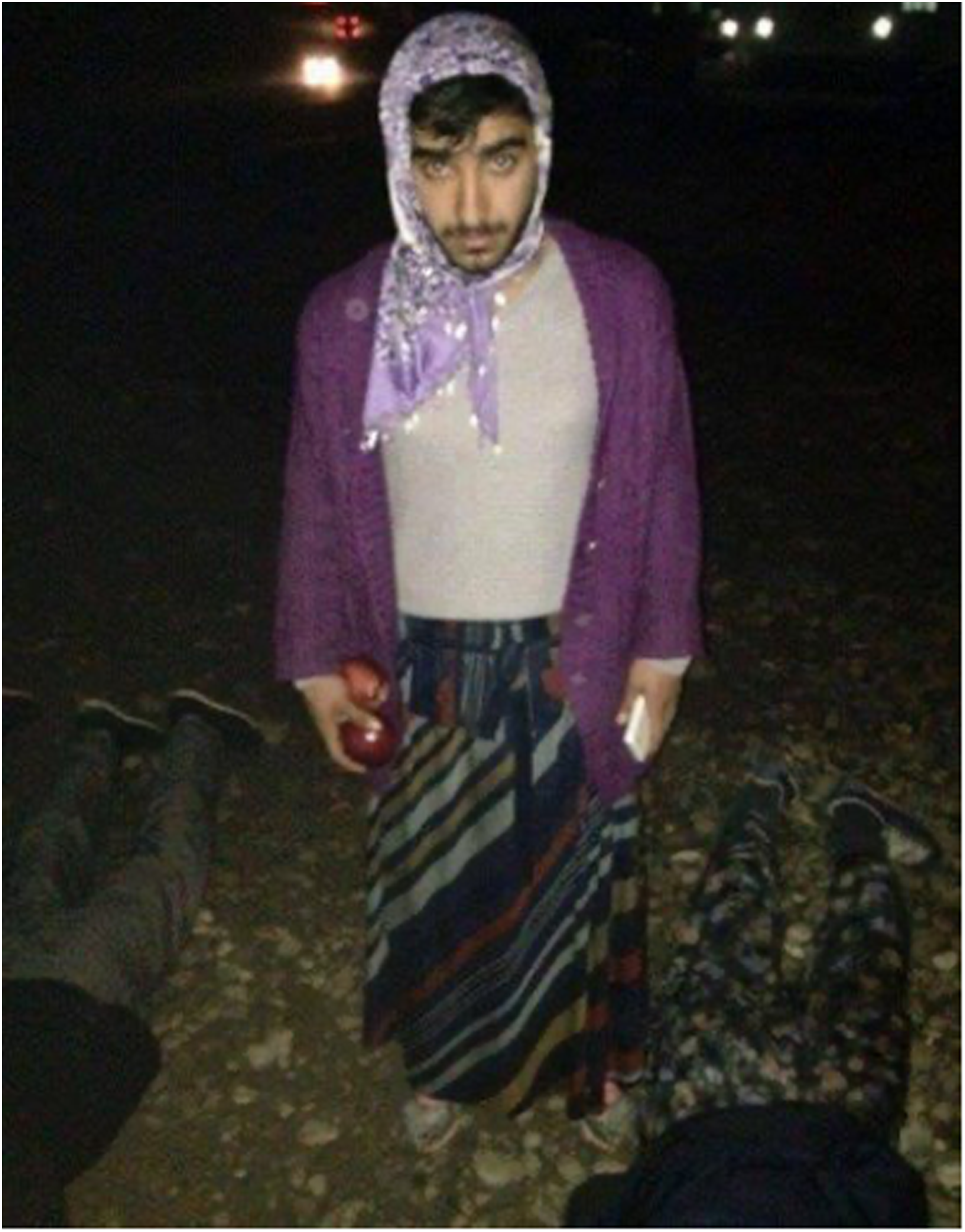
One reiteration of the image on an internet news portal owned by a crony of the AKP government is a brilliant example of the absurd forms taken by the voyeuristic media fascination with cross-dressing terrorists (Figure 3): the headline reads, “The terrorists in skirts have changed style” (En Son Haber, March 7, 2016). The piece covers a Molotov cocktail attack on an Istanbul bus stop by the Revolutionary People’s Liberation Party/Front (DHKPC). With the tagline “Skirt out, Yoga Pant in,” the text explains, “Previously earing skirts and evening gowns, the terrorists have started the fashion of yoga pants.” Bafflingly, photos of the incident show a masked militant attacking a bus, with no sign of a yoga pant. Instead, the story is bolstered with previously circulated photos of cross-dressing militants, including the person captured in Silopi (Figure 2). The text above his image playfully proclaims that “the terrorists in skirts have discovered the apple silicone [slang for breasts].” Next to it are two more widely circulated photos. The first shows two militants with faces obscured by scarves walking nonchalantly, the one in the front wearing a blue skirt. The superimposed text reads in English, “Silopi Fashion Week.” The second image shows a handcuffed man in a blue evening gown being escorted by soldiers with a text that reads, “Now You’re Leaving as a Bride,” alluding to a famous tragic love song. Underneath, another smaller line reads, “The PKK Has Taken out the Skirt to Wear Yoga Pants.” Voyeuristic media recycling of cross-dressing militants.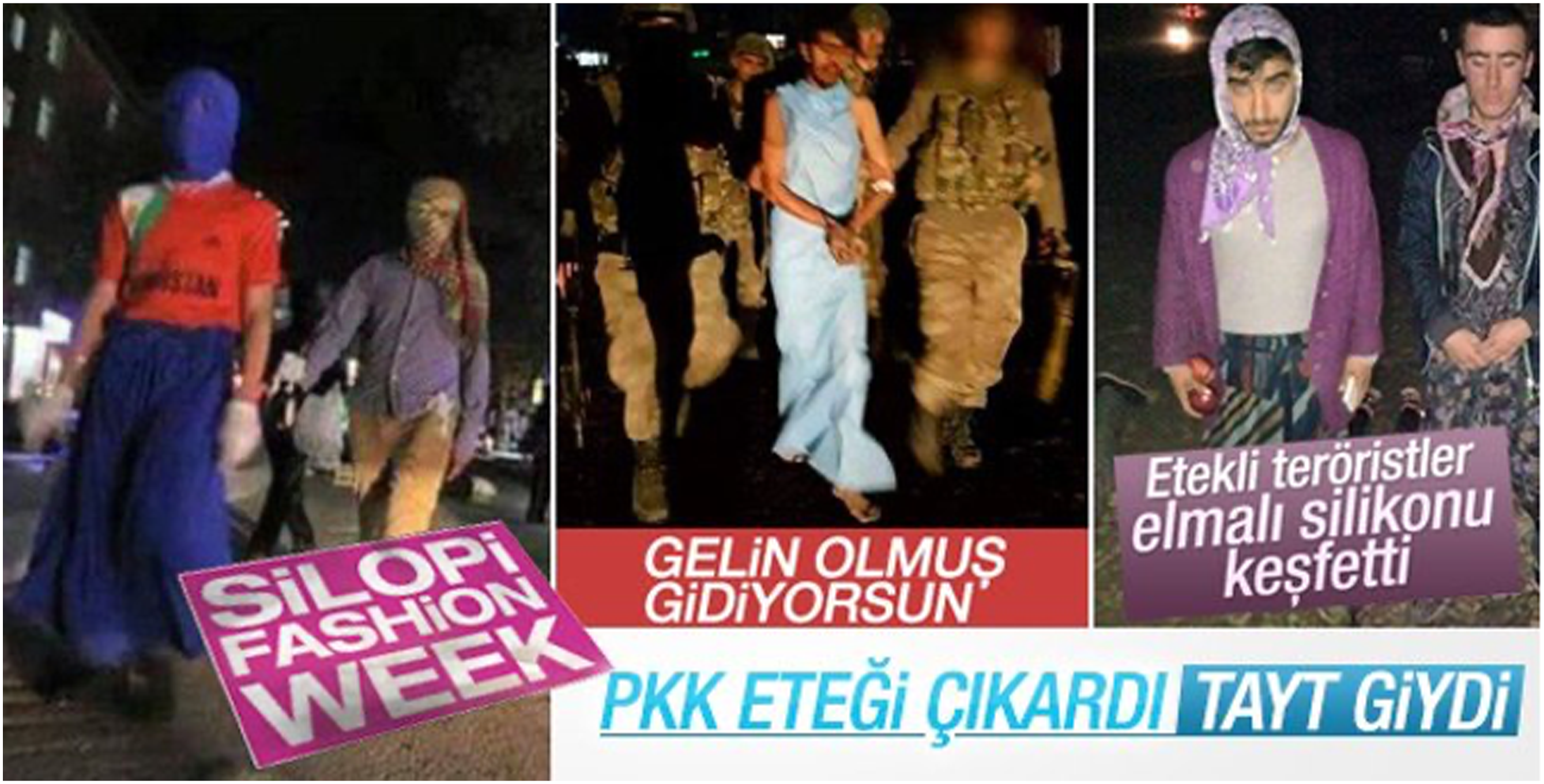
The media companies’ commercial motivations allowed them to cash in on the public anxiety over and fascination with the gendered ambiguities and desires around cross-dressing. Until they were banned in the nineteenth century under the influence of the colonial Western gaze and changing gender/sexuality regimes, young male cross-dressing köçek dancers were symbols of beauty and commonly sought objects of masculine desire in the Ottoman Empire (Ze’evi 2006), appearing as the beloved figure in poetry (Andrews and Kalpaklı 2005). Marginalized with the feminization of beauty and the heteronormalization of love and desire in the nineteenth century (Najmabadi 2005), cross-dressing performers were rendered invisible yet managed to survive through the Republican years. Although cross-dressing has mainly been used for comic effect in Turkish films and television productions, it arguably still retains its homoerotic allure, provoking feelings of fear and desire (Karayanni 2006). Despite a short ban during the junta years, the mediatized Turkish entertainment scene has always featured gender nonconforming characters, from the flamboyant queer “The Sun of Art” Zeki Müren to the popular drag artist, Huysuz Virjin (Grumpy Virgin), at least until 2007, when the Radio and Television Supreme Council banned drag performance on television. These histories influenced the news stories about the terrorists in skirts, which, while explicitly expressing moral disgust and condemnation, also transfixed audiences on the militants’ outfits by presenting them in accordance with the genre conventions of the immensely popular fashion reality shows.
Notwithstanding these queer/trans cultural resonances, the news stories about cross-dressing terrorists were also crafted to serve immediate political functions. The first of these was psychological warfare. The use of gendered and sexualized, even pornographic, imagery in war propaganda is nothing new. At least since the airborne leaflets dropped during World War II, states have used sexualized discourses and images directed at enemy soldiers for propaganda purposes (Friedman, 2009). Turkish mainstream media, which has always operated as a civilian propaganda network of the military since the early days of the Kurdish conflict, is intimately familiar with this war tactic. The representation of the mixed-gender Kurdish guerrilla units as promiscuous rape spaces and guerrilla commanders as serial child molesters and rapists are common themes in the media (Aciksoz 2019). Ever since 2018, when all major media corporations were bought up by crony businessmen to form a government loyalist “pool media,” disinformation and new fabrication have become the defining features of the media landscape. In such a context, the cross-dressing terrorist figure is deployed to emasculate and demoralize the “enemy.”
The media presents the cross-dressing terrorist as a doubly treacherous figure that violates not only the masculine codes of war but also the gender binary structures within which such codes are embedded. Building on well-established counterinsurgency tropes, this figure is then encoded and represented in contradistinction to virile male Turkish soldiers and, for the first time in the history of counterinsurgency, with professional female Turkish soldiers. Commissioned stories in pro-government media outlets glorify female Turkish soldiers who “make the PKK wear skirts” (İnternethaber, January 1, 2016). Interestingly, even as they construct cross-dressing militants as emasculated, effeminate, and available for sexual violence, such representations are predicated upon racialized stereotypes of Kurdish masculinity as excessively virile, traditional, and conservative. Echoing the weaponization of Orientalist ideas regarding the pathologized Arab masculinity to devise sexual torture at the Abu Ghraib Prison (Puar 2005), these figures are viewed as hyper-susceptible to the psychological effects of gendered and sexualized propaganda.
The second political function of the cross-dressing terrorist addressed fundamental questions within the moral economy of asymmetric warfare: these are, how, whether, and when to distinguish between the civilian population and combatants. These questions challenged state forces operating in colonial settings, from French Algeria to U.S.-occupied Iraq and Afghanistan. Gillo Pontecorvo’s anticolonial masterpiece, The Battle of Algiers (1966), perhaps the most influential (counter)insurgency film of all time, shows Algerian nationalist fighters effectively deploying cross-dressing to launch attacks on French colonial powers. In the film, Algerian men disguised as women don the veil, while women take off the veil and wear French clothes, engaging in cross-class, cross-religion, and cross-nation dressing. The actual Battle of Algiers and Pontecorvo’s realist film have served as insurgency and counterinsurgency manuals for decades, inspiring generations of militants and military organizations, including the Pentagon, which held a screening of the film in the early days of the invasion of Iraq.
During the urban trench war of 2015–2016, militants wore disguises and masqueraded in different social roles, using tunnels and holes in inner walls to engage in hit-and-run attacks before blending into the civilian population. In response, state forces ignored the risk of civilian casualties, heavily shelling the settlements with tank, artillery, and air strikes. The blurring of the line between civilian and combatant became most evident in Cizre, where more than 170 people who took shelter in random basements to protect themselves from artillery shelling were killed by state forces. In such a macabre context, the struggle to categorize who was civilian and who combatant also became a battlefield. While the Kurdish movement sought to utilize the civilian-combatant distinction to garner humanitarian support and sympathy, the state used it to erase civilian casualties, for example, by fixing the political identities of corpses as combatants through postmortem forensic means (Darıcı and Hakyemez 2019).
The figure of the cross-dressing terrorist reflected the grim realities of such categorial warfare but also reified them, muddying an already murky field to justify state violence against all residents, whether combatant or noncombatant, who refused to leave their neighborhood. The political aesthetics of the terrorist in skirt suggests that civilians are not civilians but rather terrorists in drag: a Kurdish civilian is in this logics a terrorist in disguise, always already cross-dressing. As a result, there can never be any civilian casualties as a result of Turkish military operations. This latter point was made evident by the former National Defense Minister, Nurettin Canikli, during the 2018 cross-border military operation euphemistically named Operation Olive Branch, launched to capture the Kurdish-held city of Afrin in Northern Syria/Rojava. Speaking in Parliament in response to the pro-Kurdish minister’s criticisms of civilian casualties, he maintained, “If there are casualties, they are civilian-looking terrorists wearing skirts, pretending to be civilians. Don’t mix them up. They are not civilians; they are terrorists.”
Social media responses to the news about the terrorists in skirts reveal the intimate binds between mediatized state propaganda and ethnoracialized notions of gender, sexuality, and sexual violence. The principally male users who comment on such news on social media platforms like Facebook and Twitter are fulsome in their use of misogynist, homophobic, and transphobic profanity, composing an online archive of hate speech. Some of these responses are characterized by the same kind of morbid sexist humor that permeated the security forces’ own cultural productions during the urban trench war of 2015–2016. Comments from this time on the Turkish media outlet A Haber’s Facebook account such as “Holy moly, a skirt can only look that good on a fag” are followed by ones like “Hi girls, let’s meet. I’m Mustafa.” 4 Yet, these comments are relatively innocuous when compared with the large majority on that account, which call for sexual violence against and torture of militants through rape, anal penetration, and castration, resonating with the publicly circulating post-9/11 U.S. fantasies of sodomizing Osama bin Laden to death (Puar and Rai 2002). “Subject those skirt wearers to anal impalement,” one commenter writes. “Now that they have worn skirts, castrate them all and finish the job,” another adds. Many comments involving sexual violence imagine the Turkish security forces as “active” penetrating parties who dominate the feminized and “passive” enemy, further feminizing him. “Now, our soldiers will intervene with batons,” one user writes. Another urges the security forces to “Take Nuri Alço with you to the operations,” referring to the legendary rape specialist villain of Turkish cinema.
In these online archives of hatred, sexual violence is imagined as a two-pronged punishment for gender transgression and betrayal of the nation. This articulation of cis-heterosexism and nationalism takes a distinctly racist form through the counterinsurgency trope of the “uncircumcised terrorist.” When taunting Kurdish organizations, leaders, and political parties, social media users mirror the state’s ethnopolitical discourse and with few exceptions refrain from referring to the “terrorists in skirts” as Kurds. They speak instead of “crypto-Kurds,” “uncircumcised terrorists,” and “Armenian spawns.” In this grotesque political discourse, wearing a skirt is as much a sign of unmanliness as uncircumcised foreskin, and both are manifestations of the concealed Armenianness of the terrorists, who only masquerade as Kurds. In other words, terrorists in skirts—Armenian male terrorists who disguise themselves as female Kurdish civilians—are triply cross-dressed.
One social media post that visualizes these imaginary links between the cross-dressing terrorist and the crypto-Kurdish Armenian is titled “This Year’s Armenian Fashion” (halkinhaberdunyasi, Facebook, February 19, 2016). Sporting a photoshopped image of the now imprisoned HDP leader Selahattin Demirtaş’ head edited onto a woman’s body in crop top and red miniskirt, the post reads, “Fashion designer Demirtaş put on display in İdil (Şırnak) the same collection he had previously exhibited in Cizre and Sur. He has prepared special blouses and skirts for terrorists in İdil.” A more sophisticated example of the same discourse is provided by a social media post commenting on an attached black and white photo of a Armenian newlywed couple, with the bridegroom wearing a robe (Figure 4) (salihzeki.ilgun, Facebook, May 9, 2019). The post rhetorically asks, “Have you ever wondered about the cultural roots of terrorists in skirts? Here is some historical information to satisfy your curiosity. This is an Armenian wedding in southeastern Turkey in 1908. This is a photo of the Avazyan [sic] family’s wedding, where the groom Hovannes is wearing a bridegroom’s skirt. Do you now understand why their grandchildren are out there burning the streets as crypto-Kurds?” The wedding picture of Hovhannes and Victoria Ainilian–Shnorhokians, Aintab, 1908.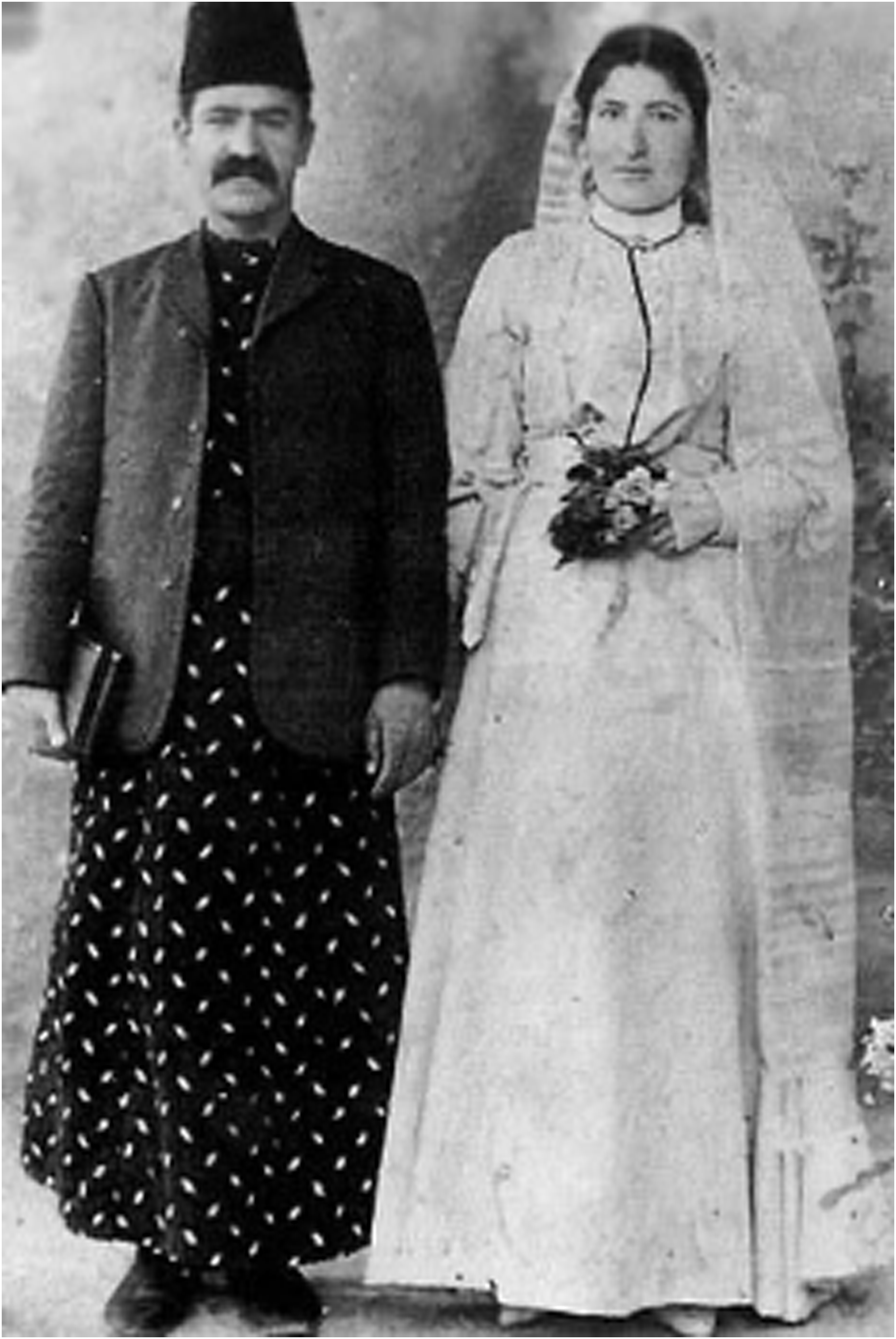
By merging the tropes of the uncircumcised and the cross-dressing terrorist, the perceived gendered and sexual perversions become perversions of ethnonational identity—and vice versa. Yet such conflation of the political and sexual threats to the nation finds its starkest expression in social media comments that directly link cross-dressing militants to sexual minorities: “They are used to wearing skirts. They are LGBT anyway.” “Their souls are LGBT. This is why they’re [LGBTs’] biggest supporters.” “They’re emulating the LGBT lifestyle.” “After all, they’re friends with LGBTI. They’re following the same path of betrayal.” What is most surprising in these comments is their use of the acronyms LGBT or LGBTI, which until the last decade were decipherable by only a small group of activists and cultural elites. The familiarity of these vulgar commenters with the acronyms LGBT or LGBTI is the product of the recent political history of Turkey, where queer and feminist movements have become formidable opponents of Islamic neoconservatism and important allies of the Kurdish movement. The next section addresses how these discursive entanglements of terrorism, queer/transness, and racialized ethnonational alterity play out in the ongoing heteromasculinist restoration project that underpins the neofascist coalition ruling Turkey today.
Terrorist Queers
Accompanying and complementing the process of producing terrorists as queer subjects was the fabrication of queer/trans individuals as terrorist subjects. The symbolic marker of this shift came right around the time of the collapse of peace negotiations with the 2015 ban on LGBTQI+ Pride activities and the police attack on the Pride parade with tear gas and rubber bullets. In its early years, despite its political Islamist roots and conservative ideology, the AKP had acted as a neoliberal center-right party, promoting democratization and gender equality in line with the requirements of the European Union accession process. In that relatively liberalized political climate, LGBTQI+ rights had become publicly debatable, and the first Pride march was organized in Istanbul in 2003. As the AKP transformed into a right-wing populist party in the 2010s and pushed the regime into electoral-authoritarianism and one-party/one-man rule, its nativist nationalist and Islamist neoconservative tendencies became more pronounced (Özkazanç 2020; Savcı 2020), setting in motion a (hetero)masculinist restoration project (Kandiyoti 2013), which sought to reverse reforms in gender equality and silence feminist and sexual minority voices, violently if need be.
The LGBTQI+ movement started to draw the particular ire of Erdoğan and the AKP after the 2013 Gezi protests, during which the LGBTQI+ movement and its slogans and symbols, especially the rainbow flag, gained unprecedented visibility and popularity. The 2014 presidential elections further drove a wedge between the AKP and the LGBTQI+ community, when HDP co-leader Selahattin Demirtaş, campaigning against Erdoğan under the slogan “We Won’t Let You Become President,” was fully endorsed by LGBTQI+ organizations. For both 2015 general elections, Erdoğan’s AKP campaigned on an anti-LGBTQI+ platform, hoping to lure conservative Kurds away from the HDP, which had become the first party to nominate an out gay candidate and showcased an explicitly pro-LGBTQI+ agenda. “We won’t nominate homosexual candidates,” Erdoğan lashed out at the HDP (Bianet, May 28, 2015) and was joined by other government officials, who made vehemently homophobic references to the Quranic story about the destruction of the biblical tribe of Lot. This strategy failed. Instead, the HDP secured a critical electoral success that robbed the AKP of its parliamentary majority in the June 2015 general elections. The AKP’s reaction was to end the peace negotiations and resume counterinsurgency, forging a de facto alliance with the fascist Nationalist Action Party (MHP) and using the discourse of terrorism to crack down on political opponents, which now included the LGBTQI+ communities and its organizations.
One of the building blocks of the neofascist war coalition that rules Turkey today is a deeply patriarchal commitment to heteronormative nationalism, which seeks to violently eliminate nonnormative gender identities, practices, and embodiments alongside other perceived national threats. Although there is no legal prohibition on nonheterosexual acts or identities in Turkey (Savcı 2020), the AKP government has increasingly banned the symbols and public activities of LGBTQI+ groups under the pretexts of security, public morality, and more recently, terrorism. Pride festivals and marches remain banned, and simply unfurling rainbow flags in public has become a reason for detention. Recently, student demonstrations against the highly contentious appointment of an AKP loyalist as rector of Istanbul’s Boğaziçi University have transformed into a battle over LGBTQI+ rights (Özbay 2022). During protests, several students from the LGBTI+ Student Club were arrested over an artwork depicting rainbow flags alongside an image of the Kaaba, Islam’s most important sacred site. Following tweets by the Interior Minister, Süleyman Soylu, calling the students “perverts,” the club was shut down on the grounds that it harbored terrorist propaganda material for the PKK. In their court hearing, the students were questioned by a judge who asked them: “Are you an LGBTI member?” (Bianet, March 23, 2021)
What we see in the judge’s seemingly odd question is the increasingly common use of the term “LGBTI” as an acronym for a terrorist organization, reflecting the outright conflation of queer public presence with terrorist activity and its de facto criminalization. In the speeches of government officials, “LGBTI” is now habitually uttered with other acronymic outlawed Kurdish/socialist organizations such as the PKK or DHKPC. Armed with conspiracy theories about “cocktail terror,” a QAnon-like conspiracy theory promoted by Erdoğan hardliners that equates any form of political dissent or nonnormative cultural expression with terrorism, the state-controlled media’s public relations efforts are already propagating that “the LGBT Terror Organization” should be banned. Erdoğan personally leads these efforts, conflating LGBTQI+ activism, student activism, anti-government demonstrations, and terrorism in his speeches on the Boğaziçi University protests: Are you a student or are you a terrorist who attempts to invade the rector’s office? This country will never be ruled by terrorists. We will never let that happen, and we’ll do what we must to stop it. This country will never experience the Gezi [protests] again…. Just as we turned Cudi, Gabar, and Tendürek [mountains in Turkey’s Kurdish region] into graveyards for terrorists, just as we entered their lairs, from now on, we will continue to do so everywhere. There is no such thing as LGBT. This country is national and spiritual and will walk toward the future with these values. (Anka Haber, March 2, 2021)
Although Erdoğan made the above remarks during a heated election campaign, it would be a mistake to see them as a “distraction from ‘real’ politics” (Korkman 2016). This and similar statements made by the highest echelons of the government and the judiciary explicitly embrace the terrorization of LGBTQI+ citizens in the name of fighting against terror. This embrace is both a symptom and a producer of the intertwined heteromasculinist logics of militarized counterterrorism and authoritarianism that are shaping gender and sexual politics not only in Turkey but also globally.
Conclusion
Writing right after 9/11, when the processes of securitization, militarization, and authoritarianism took firm hold in the United States, Puar and Rai (2002) noted how the war on terror incited violence against queers, specifically queers of color, by linking sexual deviancy to the monstrous figure of the terrorist and then using the terrorist figure to discipline and normalize the population. Yet, these earlier observations were somewhat eclipsed by Puar’s later framework of homonationalism (2007), which sought to account for the incorporation of certain queer subjects into the fold of the nation-state during and through the war on terror. Puar’s argument of homonationalism so brilliantly parsed out the reconfigurations of sexuality, race/ethnicity, and nation, especially in the settler colonial contexts of the United States and Israel, that a view on how heteronationalisms globally inform wars on terror fell somewhat out of the focus. Yet even at a time characterized by explosive trans visibility in the United States, the idea of the “cross-dressing terrorist” still haunted the Department of Homeland Security, who warned security personnel to watch out for terrorists dressing in women’s clothing (Clarkson 2020). Indeed, as Beauchamp (2019) argues, enforcement of gender and sexual conformity is very much woven into contemporary securitization and surveillance practices, which target trans people who are often culturally constructed as fraudulent and concealing something under their transgressive gender presentation.
In today’s global right-wing surge many of the gains of the partial and exclusionary neoliberal inclusion that underpinned the homonationalist assimilation of certain nonnormative subjects into the fold of the nation are being reversed. From Turkey, Poland, and Hungary to the United States and Brazil, LGBTQI+ communities across the world are coming under attack by transnational anti-gender movements and authoritarian regimes that brand gender and sexual minorities as undesirable foreign intrusions in cahoots with the nation’s enemies (Köttig, Bitzan, and Petö 2017; Kuhar and Paternotte 2017; Mylonas and Radnitz 2022). Russia’s Supreme Court just recently ruled that the “international LGBT movement” is an “extremist organization,” practically criminalizing all forms of LGBTQI+ activism in the country. Amid this hostility, a series of conflations animates anti-LGBTQI+ agendas and allows political actors to project all sorts of fantasized Otherness onto queer/trans bodies and identities, including evilness, Nazism, terrorism, extremism, fifth columnism, and pedophilia.
Reflecting these global processes, projections of gender and sexual alterity onto Kurdish militants have played a major role in the ethnoracial constructions of nationalism and terrorism in the course of Turkey’s war on terror. The militarist imaginaries of unmanly, Kurdish/Armenian, queer/trans terrorists have recently come to inform the Turkish ruling bloc’s virulent anti-LGBTQI+, gender-conservative turn, leading to amalgamations and conflations of terrorism and sexual nonnormativity and amplifying state violence against Turkey’s LGBTQI+ communities. In the heteronationalist security climate of authoritarian Turkey, all nonnormative sexual visibilities and collectivities are construed as potential terror subjects, conspiring to take Turkey down both through their affinity with the Kurdish movement and through their sinister attacks on the gendered moral edifice of the nation. Undoubtedly, those who are most affected by such processes are Kurdish queer/trans individuals, communities, and organizations forced to navigate securitization, surveillance, and political and economic violence in their political and everyday struggles (Karakuş 2022). These complex and contingent political articulations simultaneously affecting ethnic and sexual minorities in Turkey underscore the importance of a historically grounded critical analysis at the intersection of gender, sexuality, religion, race/ethnicity, political violence, and nation and nationalism.
Footnotes
Declaration of Conflicting Interests
The author(s) declared no potential conflicts of interest with respect to the research, authorship, and/or publication of this article.
Funding
The author(s) disclosed receipt of the following financial support for the research, authorship, and/or publication of this article: The fieldwork used in this article has been supported by the Wenner-Gren Foundation.
