




Abstract
The relation between masculinities and care is theoretically and empirically researched via the term caring masculinities. Until now, research has focused on adult men and has not explored the question of how care orientations are developed through processes of socialization. This article, therefore, presents findings on care experiences of adolescent boys. Based on 89 qualitative interviews that were analyzed using the deep hermeneutic method and grounded theory, four types of care orientations were identified. We find that care plays a significant role in boys’ lives, whereby the degrees of caring attitudes and practices as well as the specific connections between care and masculinity vary significantly. The article shows that pronounced care orientations are not necessarily accompanied by a rejection of traditional norms of masculinity and domination, as some scholars on caring masculinities suggest. We therefore argue for an open-minded approach to analyzing the ambivalent relation between care and masculinity.
Introduction
In recent years, research in the field of critical studies on men and masculinities has increasingly focused attention on analyzing the relation between care and masculinities. Most prominently, this is discussed via the term caring masculinities. According to Elliott’s (2016) praxeological concept, caring masculinities are characterized by a rejection of domination and thus can contribute to changing gender relations. In contrast, other scholars question the potential of men’s care for the destabilization of social masculinity norms (Hanlon 2022). This lively debate has focused primarily on the caring practices of adult men, while care orientations and practices of adolescent boys have hardly been addressed. Adolescence and boys’ socialization processes, however, constitute a key field of research when it comes to the possibility of the long-term transformation of masculinities, which is why this article addresses the interplay of adolescence, care, and masculinities.
In contrast to the debate on caring masculinities, research on boys and masculinities targets in large part on processes of the reproduction of masculine power and hierarchy, often within homosocial peer groups, which, as we argue in this article, is related to the theoretical concepts that many of the respective works are based on (Bourdieu 2001; Connell 1995). In these studies, boys are often portrayed as risk-taking and competitive while appearing to be emotionally illiterate (Way 2013) and not caring for themselves and others (Ruby and Scholz 2018). In this article, we want to critically address this impression by explicitly shifting the research perspective to the care orientations and practices of adolescent boys. In this endeavor, we use qualitative interviews with adolescent boys that were conducted during the course of a research project titled “Caring Boys? Alternative (research) perspectives on the social crisis of reproduction” 1 in Germany. Our focus is on the questions of how care is present in the boys’ everyday life contexts and what conceptions of care the boys interviewed develop. We examine the role care plays in the adolescents’ lives and discuss whether caring practices and attitudes are indeed accompanied by a rejection of domination (Elliott 2016).
First, we outline our theoretical framework comprised of concepts of care, adolescence, and masculinities. Second, we critically discuss recent debates on caring masculinities and empirical research on boys and masculinities. Third, we present our research design, followed by the presentation of our empirical findings. We were able to identify four different types of care orientations among the boys interviewed, all of which relate to masculinities in different ways. Finally, we discuss the implications of these empirical results for the theoretical conceptualization of caring masculinities and young masculinities.
Theoretical Framework: Care, Adolescence, and Masculinities
The theoretical framework for this article comprises concepts of care theories and theories of adolescence and masculinities. Following the logic of open-ended, reconstructive research, however, we do not understand those concepts deterministically but as “sensitizing concept[s]” (Blumer 1954: 7).
Building on approaches from care ethics (Noddings 2010; Tronto 1993, 2015), for our research project, we rely on a broad theoretical conception of care. Care is defined “as a species activity that includes everything that we do to maintain, continue, and repair our ‘world’ so that we can live in it as well as possible. That world includes our bodies, our selves, and our environment, all of which we seek to interweave in a complex, life-sustaining web” (Tronto 1993: 103). Since care takes place in the mode of relationality, we consider the centrality of interactions in everyday interpersonal relationships to be fundamental. In this understanding, both individual life and social coexistence are only possible against the background of a fundamentally mutual dependency in human relationships.
For the analysis, we use Joan C. Tronto’s model which differentiates four phases of care and allows care to be grasped precisely as a social practice and as a mutual relationship. A distinction is made between the attitudes of caring about and caring for as well as between the practices of caregiving and care-receiving (Tronto 2015: 5–7). While caring about is a matter of identifying the specific needs of a person, caring for means taking responsibility for those identified needs and addressing them. Caregiving represents the actual act of meeting someone’s needs; care-receiving, by contrast, is the practice that the person whose needs are addressed engages in. While ideally the relationship between caregiver and care-receiver is symmetrical, this is rarely the case in practice (Noddings 2010: 18–20). Care can be a highly hierarchical dynamic which, inter alia, often holds true for intergenerational relationships, such as those between parents and their adolescent children.
Emotions play a crucial role in interpersonal care relationships. Care often is accompanied by emotions such as compassion and love, but also shame, aggression, or anger (Stützel and Scholz 2022). Following a phenomenological perspective, we consider emotions as experiences of the lived body that are, for the most part, unconscious and uncontrollable (Demmerling and Landweer 2007). Emotions are determined by cultural norms and thus are heavily gendered. Historically, care as well as the emotions associated with care predominantly have been linked to femininity (Stützel and Scholz 2022).
The term adolescence, understood as a multifaceted process in which psychological, physical, social, and cultural dimensions become effective, focuses on socialization and individuation within the living environments of young people. Following King (2013), we understand adolescence not as a phase of life with concrete developmental goals, but as a psychosocial Möglichkeitsraum (i.e., space of possibilities; ibid., 39) for adolescent development. This space of possibilities functions as a framework for psychological, cognitive, and social processes that are inherent to the separation from and gradual individuation in relation to one’s own childhood, family of origin, and social context. Individuation in this understanding encompasses the formation of a newly constructed self-image and the reflection of one’s own life story, resulting in a reconfiguration of the inner and outer reality and the realization of one’s uniqueness (ibid., 51, 104–106). The specific manifestation of the space of possibilities for young people is determined by the different economic, cultural, and social resources available, especially provided by the family of origin (ibid.; Flaake 2015; Bourdieu 1983). Thus, the possibilities for adolescent development, to have a range of different experiences, and to try out various identity constructions vary significantly.
Following the works of Raewyn Connell, we do not understand masculinities as “a fixed entity embedded in the body or personality traits of individuals”, but as “configurations of practice that are accomplished in social action” (Connell and Messerschmidt 2005: 836). Masculinities are constructed under constant effort through social practice, through the process of “doing gender” (West and Zimmerman 1987) or, more specifically, “doing masculinity” (Meuser 2002: 53). Through this process, gendered practices are incorporated into the body and a person’s habitus (Bourdieu 2001). While we can make use of these theoretical foundations for the analysis of the reproduction of masculinities, we are faced with twofold challenges for our specific research. First, the theoretical concepts predominantly used in critical studies on men and masculinities, which for the German-speaking area are Connell’s (1995) “hegemonic masculinity” and Bourdieu’s (2001) “masculine domination”, do not place much emphasis on a theoretical conceptualization of young masculinities and the construction of masculinities in the adolescent phase. Connell’s concept of hegemonic masculinity is based on adults’ genders (Ruby and Scholz 2018), and Bourdieu’s theoretical work does not focus on the development of the gendered habitus during childhood and adolescence either – if anything, we can identify an “implicit theory of socialization” (Liebau 1993: 264, translation by authors) in his work. 2 Nevertheless, those theories are used as a theoretical basis in many works on boys and masculinities. 3 Second, these respective theories do not comprise a conceptual integration of care practices and masculinities. Although Connell ascribes a central role to the reproductive arena in her conception of gender relations, this is not conceived in connection with the construction of (hegemonic) masculinity (Connell 1995; Ruby and Scholz 2018). To some extent, the inclusion of care in theories of masculinities can be seen in the fact that active fatherhood is now understood as a new component of hegemonic masculinity (Nayak 2023). This is why we dedicate the following chapter to newer theoretical approaches that integrate care into masculinity research – namely, the concept of caring masculinities – and to research on boys and masculinity.
Caring Masculinities & Research on Boys and Masculinities
Caring masculinities are discussed as a “counterpart to traditional concepts of male power” (Scambor, Bergmann, and Wojnicka 2014: 570), such as the theory of hegemonic masculinity, and are intended to pave the way for a gender-just world. Karla Elliott defines the central features of caring masculinities as “their rejection of domination and their integration of values of care, such as positive emotion, interdependence, and relationality” (Elliott 2016: 241). Based on the feminist ethic of care, Elliott formulates a praxeological concept that assumes that boys and men can develop an emotional care attitude (caring about) through the practical execution of care activities (caring for). In the interplay of caring for and caring about, “men’s care can effectively change gender” (ibid., 254). But there is no consensus on whether this intention is realistic. Hanlon (2022) describes caring masculinities as “a concept encapsulating both skepticism and hope for egalitarian change” (ibid., 2). He points out that the interplay between care and masculinity that is accompanied by “navigating emotional expectations” (ibid.) can also “reproduce gender inequalities” (ibid.) and that “any simplistic notion that doing care equates with equality and destabilizes hegemonic masculinity is untenable” (ibid., 7). Hanlon underscores that caring and dominance can coexist in men’s lives: men (and boys) may exercise dominance in some fields of their lives, such as sports or gaming, but also may be caring in other parts of their lives. Hanlon also points out that men can engage with other men in a competitive or caring way in the same field depending on the situational context (ibid., 64).
In addition to this conceptual critique, we also find that most publications on the relation between masculinity and care focus on adult men, for instance, men working as nurses (e.g., Simpson 2009), childcare workers (e.g., Buschmeyer 2013) and fathering (Hanlon 2012). In contrast, the importance of care and the reproductive arena for boys’ adolescence has so far received little attention (King 2013). But it is worthwhile to look at more general research on young masculinities since, in some cases, those include empirical insights into boys’ care relations as a by-product.
As mentioned above, empirical research into boys’ everyday lives and practices often make use of Bourdieu’s and Connell’s theoretical concepts. This results in many works focusing on the reproduction of masculine domination and “the hierarchy of masculinities” (Connell and Messerschmidt 2005: 846), particularly within homosocial peer groups. As Meuser (2005) points out, masculinity and power relations are constituted in competition such as (ritualized) verbal harassment like rap battles or competitive drinking, and that violence against other boys contributes to the regulation of power hierarchies in social groups too. These “structural exercises” (Bourdieu 1993: 138; Meuser 2005) are based on the exclusion of girls and femininity, and on the display of risky and competitive behavior. In their book Young Masculinities, Frosh, Phoenix and Pattman (2002) use the concept of hegemonic masculinity and identify characteristics that lead to boys being more popular and therefore having a higher status and influence. These include hardness, being successful in sports, looks, the ability to compete verbally with other boys, no high educational aspirations as well as exhibiting a clear difference from girls and not doing anything ‘girly’ (ibid., 10). Similarly, Niobe Way argues in her research on boys’ friendships that masculinity is constructed by enacting a certain code of conduct, the so-called boy code. This code, a term originally introduced by William Pollack (Way 2011: 4; Pollack 1998), “equates being emotionally stoic, invulnerable, physically tough, and independent with being male” (Way 2011: 4). Oransky and Marecek (2009) also find that “masculinity requires acting invulnerable and stoic” (225) and that boys’ emotion practices are commonly penalized by other boys, often through being ridiculed. Frosh et al. acknowledge that masculinity is heavily linked to race and class (ibid., 2), an argument also made by Helfferich (2012) in her study on the masculinity construction by boys from disadvantaged backgrounds in Germany. Helfferich finds that the boys surveyed define masculinity in contrast to boys from middle class backgrounds whom they classify as unmanly. Simultaneously, they are highly conscious that, regarding future prospects, those boys probably will be on top of the hierarchy due to resources of power like education and knowledge. Thus, Helfferich argues for an understanding of “local hegemonic masculinities” (2012, 64, translation by authors).
While empirical works such as the above-mentioned studies primarily describe boys as being focused on competition (Meuser 2005: 313) and emotionally illiterate (Way 2013: 206), in some cases it also shows some insight into boys’ care relations. It becomes apparent that masculinity norms are not always congruent with everyday practices taken by the boys surveyed. Way shows that boys do value their friendships because they are “able to share their thoughts and feelings” (ibid., 202) – though they “begin to distance themselves from the very relationships that they hold so dear” (ibid., 204) during adolescence due to the increasing importance of cultural norms surrounding masculinity and maturity. Similarly, Oransky and Marecek (2009) make some observations that can be understood as caring practices such as distracting a friend who is in emotional distress. Frosh, Phoenix, and Pattman (2002) show that contrary to the widespread perception of boys not being able “to engage in sustained and reflective conversation about their feelings for and relationships with others” (ibid., 22) the boys surveyed proved to be quite articulate in the interviews about their feelings.
Although these studies provide some insight into caring practices, the strength of the theoretical concepts they are based on undoubtedly is that they allow for a critical analysis of the reproduction of masculine power. However, Seidler points out critically that “[w]ithin a framework unable to explore how a suppression of emotions becomes a way of affirming a ‘hegemonic’ masculinity, Connell is left to theorise masculinities exclusively as relationships of power” (2006: 53). In addition, we argue that the focus on practices of dominance in some cases can stand in the way of a more comprehensive analysis of boys’ everyday lives, including their caring activities. In that respect, the great attention paid to analyzing practices within homosocial peer groups does not sufficiently take into account that gender performances are context-specific and situational (Helfferich 2012). All this results in an image of boys as competitive and willing to take risks (Frosh, Phoenix, and Pattman 2002; Meuser 2005) while seeming not to care for themselves or others (Ruby and Scholz 2018). We therefore focus explicitly on the hitherto underexamined role of care in boys’ individuation processes while simultaneously trying to integrate this shift of perspective into theoretical concepts that allow for a critical analysis of power and hierarchy.
Examining Care Orientations: The Research Design
The results presented here derive from a research project in which we sought to establish a change of perspective so we can reconstruct the living conditions, relationships, practices, and orientations of adolescent boys, and to place care at the center of the analysis. This research perspective is based on the theoretical conception of adolescence as a significant phase for developing a sense of responsibility for others (King 2013).
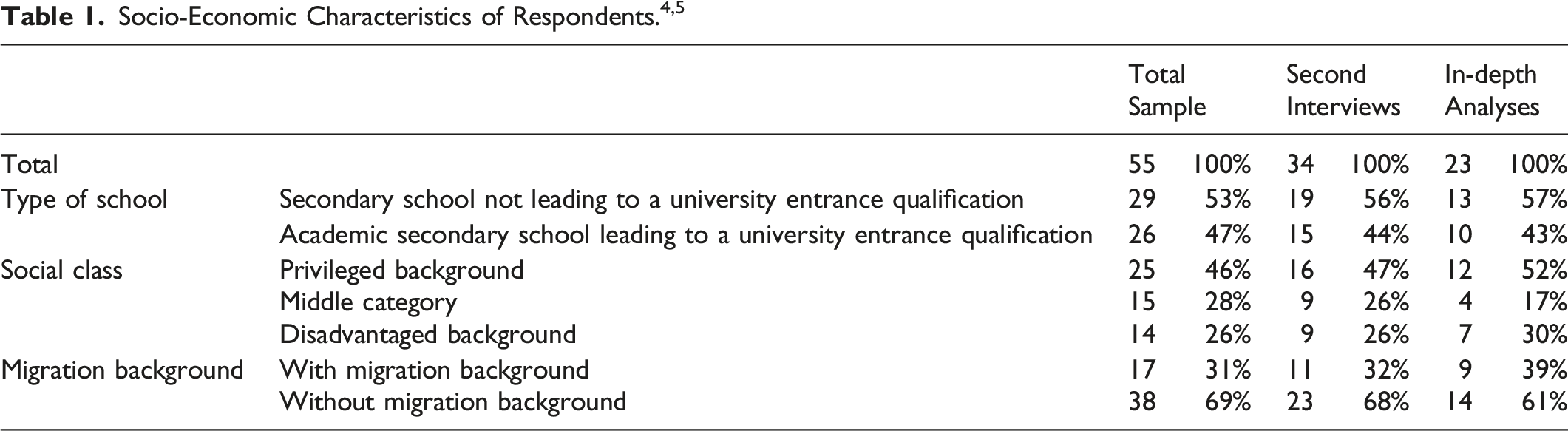
Given that most respondents were under the legal age of consent, we obtained consent forms from both the interviewee and from one legal guardian prior to the interview. The projects’ ethics procedure also included comprehensive measures to ensure anonymity and data privacy, as well as critical self-reflection regarding ethical conduct throughout all phases of the research process (Von Unger, Narimani, and M’Bayo 2014). In addition, the interviewers researched various local support institutions (e.g., youth counseling) prior to the interviews and referred boys to appropriate institutions in case they brought up topics the interviewers were not trained to address. A formal ethics approval was not required under national regulations and those of the German Research Foundation.
Regarding the project’s interviewing method, we needed a tool that effectively stimulates respondents to deliver broad narrations about their lives in order to make their everyday lives, their care experiences, and care relationships tangible for our analysis. For this purpose, we chose semi-structured interviews as a research tool (Helfferich 2011). On the one hand, this allowed us to focus on predetermined topics such as family relations, friendships, self-care, visions of the future, and changes brought about by the COVID19 pandemic, and, on the other, to open up room for the respondents to talk extensively about topics that concern them in their everyday lives. The 89 interviews were conducted by the project team consisting of two women and one man 6 and lasted between 40 minutes and 2.5 hours.
The analysis of the interviews was based on various methodological pillars complementing each other. The large amount of data on the one hand and the complexity of the research questions on the other required a tool for structuring and applying a rough analysis to the entirety of the data as well as a tool for comprehensive in-depth analysis. Thus, we chose a grounded theory approach (Strauss and Corbin 1991) to create case dossiers for each interview transcript. These dossiers include the respective case’s key points in relation to the research questions and were developed by applying open coding to the interview data. This proved to be fruitful for gaining a structured overview of the sample and preliminary research results as well as for selecting particularly interesting cases for a comprehensive in-depth analysis.
For the purposes of in-depth analysis, we applied the deep hermeneutic method (Bereswill 2007; König 2019; Lorenzer 1988), which is rooted in psychoanalytical principles. This approach not only allows for the uncovering of the manifest meaning of a text but also enables research into hidden aspects of meaning within a text: that is, in our case, the interview transcripts. While the manifest meaning reflects conscious notions and ideas that correspond to socially acceptable values and can thus be expressed, the unconscious hidden meaning may refer to unconscious desires, culturally rejected patterns or suppressed yearnings that are in conflict with social norms and therefore represent the unsayable. The method proves to be particularly applicable for research into adolescents since radical changes, conflicts, and tensions are inherent to the adolescent phase (King 2013), resulting in much unconscious meanings that need uncovering. In addition, the approach of going beyond the manifest meaning of the text turned out to be quite fruitful for addressing questions on care and masculinity: Research suggests that men often do not talk about care and the care work they provide since it is not associated with recognition and/or is in conflict with social norms (Scholz 2004). Hence, it also proves productive from this thematic perspective to use a method that enables access to the things that remain unspoken. 7
Unconscious meaning and conflicts are often indicated by inconsistencies or anomalies in the use of language such as gaps or sudden changes of subject that might lead to irritation, confusion, or other emotional reactions from the researchers (Bereswill 2007). Thus, our procedure was to identify affectively charged interview sequences that we then analyzed in group interpretation sessions through the so-called mode of scenic understanding (ibid.), which uses the researchers’ own subjective affects and associations triggered by the text as a tool to decode the hidden meaning of the text – since “the hidden meaning (…) is mirrored in our emotional response to the text” (ibid., 472). Those associations and preliminary interpretations were discussed within the interpretation group until a joint understanding was achieved. By including additional scenes from the interview, the interpretation process was gradually broadened so that central conflicts of the case could be elaborated. These case reconstructions conducted in the group setting in turn served as the foundation for the elaboration of 23 comprehensive case studies that linked the empirical findings to theoretical concepts.
In a next step, these in-depth case studies in combination with the case dossiers served as basis for the development of a typology of different care orientations among the boys interviewed. The construction of this typology was based on the logic of the grounded theory method (Kelle and Kluge 2010) and aimed at theorizing our empirical findings in regard to the complex relation of care, adolescence, and masculinity. We were able to identify four differentiated ideal types that we present in detail in this article.
Empirical Findings on Caring Boyhood
Empirically, in our material we find a differentiated picture of care orientations and practices in the lives of the boys interviewed. Our analyses show that care plays a central role in their everyday lives, whereby strongly diverging degrees and kinds of caring attitudes and practices become visible.
Based on the case dossiers and deep hermeneutic detailed analyses, discrete types could be identified that differ significantly with respect to how they connect care, adolescence, and masculinity. The aim here is to contribute to a better understanding of this complex relation. Four different care orientations could be identified: (1) Care as an Everyday Phenomenon, (2) Care as a Crucial Part of Identity, (3) Focus on Self as a Crucial Part of Identity, and (4) Worries as a Barrier to Care.
Type 1: Care as an Everyday Phenomenon
This first type describes adolescent boys who seldom speak explicitly about care practices. In many cases, care does not seem to be worth mentioning to them, which indicates that they do not have a very pronounced attitude towards care. At the same time, it becomes clear that a wide variety of care practices are present in these boys’ everyday lives. Within friendships, for example, there are many examples of caring practices. Asked whether he and his friends help each other when one of them needs support, one boy, Sören 8 , answers curtly: “Of course we help each other.” A very common care practice among the boys of this type is to distract friends in stressful situations so that they feel better (which also corresponds to the analyses by Oransky and Marecek 2009 or Way 2011). Deniz tells us that when someone in his circle of friends feels down, his friends “do build you up again by a good mood, they try to make jokes so that you feel better, they try to distract you from the topic.” Within the family, different kinds of care practices are evident, such as helping in the household, caring for younger siblings, or supporting grandparents. We can observe that particularly these care practices within the family differ significantly from class background to class background. Boys with more disadvantaged backgrounds tend to be much more involved in reproductive labor activities than boys from privileged backgrounds. Overall, however, this type includes boys from various class backgrounds – Care as an Everyday Phenomenon seems to occur across classes and within families both with and without migration background.
While care is present in the boys’ lives, these practices are not viewed as a relevant aspect of their identities in the sense of an orientation towards care but are rather a self-evident part of everyday life. The dimensions of caring about and caring for are therefore not very pronounced, but we can still see specific care practices in the sense of caregiving (Tronto 2015). The fact that their description of care, including self-care, is neither particularly detailed nor emotionally charged and is not elaborated in a conflicted way is partly due to the fact that the boys are seldom confronted with profound tensions and worries in their lives in general and in their care relationships in particular. Although (adolescent) conflicts are also present, the framework of a psychosocial space of possibilities (King 2013) proves to be conducive to coping with them.
In contrast to the diverse care practices, we were also able to identify limitations since, for example, care in form of emotional attentiveness and empathetic response to the needs of others hardly occurs in this type. Thus, in emotionally intimate situations, the boy code (Way 2013) proves in many cases to be an insurmountable barrier for boys of this type. Tobias, for example, reports that he does not really know how to console someone when they feel down and links this inability explicitly to gender: “This is something you somehow can’t really do among boys.” We found that such gendered barriers seem to be particularly strong when it comes to physical closeness and practices like hugs that some boys observe among girls but cannot imagine for their own homosocial relationships. In addition, they scarcely describe themselves as care-receivers, as Deniz, for example, shows: “I don’t really talk to my friends about my problems, also, up to now I didn’t really have any problems.” Our analysis suggests that this is related to the fact that the predominantly passive position in care relationships does not fit with the normative image of a masculine, autonomous adolescent (Way 2011). Overall, it can be assumed that the interplay of adolescence and masculinity requirements leads to the absence of care as a topic of conversation.
We find that these boys carry out care activities without caregiving conflicting with their constructions of young masculinities. This is related to the fact that these care practices are not gendered, they are done on the side and do not play a major role in the individuation and identity formation of the young people surveyed. Care activities can therefore be integrated into everyday life as long as they do not have apparent gender connotations. But there are limits to the range of possible care practices when they do have more distinct gender connotations.
Type 2: Care as a Crucial Part of Identity
A second type of care orientations could be identified for boys for whom care represents a part of their identity and is a resource for the construction of identity. Here, wide-ranging care orientations (caring about and caring for) and versatile care practices (caregiving) become evident that, in turn, are expressed explicitly and in detail and integrated into the self-image of these boys. They present themselves as people who help others and are always there for them. For example, Goran describes himself as follows: “I am always there when my mother needs anything; not just her, but my father also, yes.” The boys in this type take responsibility for the well-being of the people around them and care for them in many ways within the framework of different forms of care. In contrast to other types identified, emotional attentiveness is noticeable in this type, as, e.g., when Sven explains that he changes his little sister’s diaper because he loves her and wants her to be well. Another characteristic of this type is that care is also used preventively to avoid conflicts and create harmony. While boys of this type focus very strongly on the needs of others and their satisfaction, their own needs are hardly addressed and, in some cases, considerably neglected. Their strong identification as caregivers is thus often accompanied by a disregard for their own needs and an absence of pronounced self-care practices.
In this context, it is significant that all boys of this type are confronted in their lives with considerable conflicts, insecurities, and worries. These include, for example painful experiences within caring relationships (e.g., breaches of trust in close friendships or unrequited needs for affection in their relationships with their father; see also Schwarzenbacher and Başer 2023), existential worries such as an uncertain residence status, or serious problems at school. On the one hand, these insecurities lead to a narrowing of the psychosocial space of possibilities available to these boys (King 2013). On the other hand, the path of assuming responsibility and identifying as a caregiver helps them to find a way to deal with these uncertainties and painful experiences. In this way, the boys create an identity through which they gain self-confidence and can work through these difficulties. With the help of this identification, they succeed in expanding their space of possibilities under difficult conditions and can try out a specific image of themselves in this realm. With respect to social class, although not exclusively, most of the boys of this type are from disadvantaged backgrounds. This is in part reflected in the specific insecurities that they face, for example in Goran’s case whose family’s residence status in Germany is precarious. The class composition of this type is related to the fact that many boys with disadvantaged backgrounds have to be more involved in care practices due to their family’s socio-economic circumstances and thus often are more experienced in that realm than many boys from more privileged backgrounds. In addition, in many cases the respective boys have less varied opportunities and fewer economic and cultural resources than boys from more privileged backgrounds to try out different identity constructions and find something on which basis they can develop self-confidence. This might also contribute to some of them basing their identity on caring and the assumption of responsibility.
The positive value of care for shaping one's own identity does not automatically lead to a more general recognition of care work. For example, caregiving done by women, particularly that done by their own mothers, is not acknowledged in many cases. The non-recognition and sometimes devaluation of mothers (as well as girls and women in general) at the same time is often accompanied by an idealization of their fathers (Schwarzenbacher and Başer 2023). This can be seen, for example, when Sven talks about his parents’ company, where his father – whom Sven admires a great deal – is the manager and his mother a managerial assistant: “I always rag my mother when she says that work was so hard, then I always say, ohhh, sooo exhausting making coffee and shredding documents the whole day long (laughs).” In addition to the devaluation of women and femininity (Meuser 2005: 314–315), it is, with respect to theories of masculinities, also relevant that boys of this type explicitly describe themselves as actively being caregivers while their own care needs and role as care-receiver are excluded from their narratives. Since they are oriented towards taking an active role and assuming responsibility – aspects that meet conventional social requirements of masculinity – care can thus be integrated into processes of gendered individuation. The boys describe themselves in various ways as active and autonomous, as paternally caring, and as adult men through their framing of care as an act of assuming responsibility (Korn and Scholz 2022).
Within this type, (young) masculinities and care are linked more directly than in the first type (Care as an Everyday Phenomenon). It is striking that these young people engage intensively in care on a daily basis, including care in the mode of emotional attentiveness. They succeed in using these care practices as a means to process the transition from a child’s world to an adult world because they frame their care practices as the masculine assumption of responsibility. They can thus accomplish gendered individuation and identity formation. Such a strong care orientation is not in conflict with elements of more traditional masculinity constructions. The boys here devalue women and exclude their own care needs from their self-narratives, since the passive role of the care-receiver does not appear to be compatible with the adolescent concept of masculinity as both autonomous and active. With regard to the debate on caring masculinities, it is therefore clear that wide-ranging care orientations and practices do not have to go hand in hand with a rejection of traditional norms of masculinity. For example, there is no rejection of domination, which is defined by Elliott (2016) as an integral part of the ideal of caring masculinities.
Type 3: Focus on Self as a Crucial Part of Identity
The third type is characterized by the fact that, first, they do not have particularly defined attitudes towards care and care practices and that, second, they have a very strong focus on themselves. Some of the boys have wide-ranging self-care strategies and know what they need to feel a sense of well-being. For example, Elias knows quite well what he needs to do to feel better when he feels down: “Mostly I just lay down and read a book or look at my phone, or I go biking. Really, biking always helps because you’re simply outdoors.” The boys of this type have the opportunity to focus on themselves and to try out different identity constructions and self-images in their adolescent phase. This is often accompanied by a tendency towards self-optimization, for example, with regard to their performance at school, their professional plans for the future or their physical appearance, as for instance described by Justin: “I really like to work out on weekends, I like to get up in the morning and to get back home at 11 knowing that I’ve already accomplished something. I really like to work out (…), because I don’t want to be lanky, like be skinny, and I kind of like having a good body.” At the same time, their view of others and thus neither care orientations nor care practices play much of a role. The need to care about and for others is not very much addressed by these young people because it is not a particularly important part of their identity or not even acknowledged at all.
What is striking about this type is that they have few worries and tensions in their lives. They come predominantly from economically secure households and have a comparatively large space of possibilities for a broad range of experiences. Familial and friend relationships are usually described as relatively conflict-free in this type. Thus, within this type, the absence of fundamental conflicts and worries is accompanied by a strong focus on one’s own development and individuation, as well as a low level of interest in care. The interplay of a general lack of worry and a strong focus on oneself therefore seems to contribute to a low recognition of care.
Another characteristic of this type is that some of the boys show a very clear orientation towards social masculinity norms. In most cases, they are strongly influenced by a desire for autonomy, while care is not integrated into the development of their identity. The boys often move in homosocial circles from which girls are excluded, similar to Michael Meuser’s description of the structural exercises through which notions of masculinities are incorporated among adolescent boys (Meuser 2005). In this regard, these boys’ processes of individuation are strongly oriented towards the ideal of adult hegemonic masculinity (Connell 1995): They are very performance-oriented and want to be autonomous and professionally successful in later life. While caring for others is largely excluded from their life plans, there is a strong focus on themselves as well as pronounced strategies of self-care. This shows that a prominence of self-care does not automatically lead to a high capacity for empathy towards others, as is sometimes assumed in the literature on self-care (Conradi 2020).
Type 4: Worries as a Barrier to Care
In the fourth type, although a care orientation, that is, caring about, is evident, there is hardly any assumption of responsibility in the sense of caring for or engagement in care practices. This does not mean that the need to care for others is not understood or acknowledged, but this lack of caregiving is related to the fact that the boys are confronted with significant conflicts and burdens in their lives. These include, for example, profound stress from the pressure to perform at school, psychological problems such as depression, or experiences of bullying. These strains and the associated restrictions on the psychosocial space of possibilities available to them lead to intense uncertainty regarding their own self-image, which emerges when, for example, Viktor asks himself during a phase in which he felt down: “Does anyone even like me anymore?” As a result of the insecurities they face, boys of this type have little capacity to take care of others. Like the third type, they are very focused on themselves but in this focus are full of worries.
While the boys included in this type come from different social classes, we can observe class differences regarding the capacity and resources necessary for dealing with their insecurities and conflicts. Viktor, a boy with a privileged social background who suffered quite a bit from the pandemic’s impact on his everyday life, is able to adapt his self-care strategies by, for example, playing various musical instruments or meditating: “Playing basketball was not possible anymore, which is something I usually use to relax, and that is why my way out kind of was to start meditating (…). That really helps me to deal with stuff that I usually cannot put away so easily.” In contrast to Viktor, who has the cultural and economic capital to find new strategies, Kerem, a boy with migration background and from a less privileged social background, describes his everyday activities during the pandemic as follows: “Sitting around at home, gaming, sleeping, nothing else at all.” As a result of the pandemic’s impact on his life, Kerem fell into a state of resignation and has not been able to find new self-care strategies.
What is striking about this type is that, due to the insecurities that these boys face, they have to grapple intensely with themselves and their emotions. In many cases, this leads to a high degree of self-reflexivity, a good knowledge of their own needs, and detailed discussion of emotions. They also display vulnerabilities and, in contrast to the other types, describe themselves as care-receivers (Leja and Schwarzenbacher 2022). In many respects, they do not conform to the requirements of the boy code (Way 2013) and break with it to a certain extent. However, the restrictions arising from the requirements of masculinity also become visible in this type. The boys direct their demands for care primarily at girls and women and often their mothers in particular. In addition to this strong gendering of care demands, the requirements of masculinities can limit their willingness to accept care. Also, talking about emotions is often linked to the fear of being ridiculed (Oransky and Marecek 2009) and is tainted with shame, as explained by Claudio: “Sometimes I’m glad that I don’t show many emotions. Because, for example, one time I started crying in front of my girlfriend and at that moment I felt like a loser, like I really embarrassed myself.” Due to these barriers, these boys are more likely to be left to deal with their problems themselves, which in turn leads to an increased level of stress. The requirements of masculinity thus prove to be crisis-reinforcing and consequently also hinder the capacity to care for others.
As described above, this type is characterized by a high capacity for reflectivity and confrontation with one’s own emotions. These boys often have a strong care orientation towards others but cannot translate this into care practices due to the limits on their psychosocial space of possibilities. This shows an ambivalent tension in the relation between masculinities and care: On the one hand, the open thematization of emotions can lead to constructions of masculinity becoming brittle, but, on the other hand, this can have a crisis-reinforcing effect by stigmatizing the display of vulnerability (Oransky and Marecek 2009). This raises the question what framework conditions would be necessary for these boys to succeed in translating their care orientations into practices that reaffirm their self-confidence, as do the boys from the second type who are able to use care as a resource to form their identities. In addition, it is relevant to consider how spaces can be opened up to promote the potential for reflection about the social norms of masculinities and aspects of care associated with those norms, as well as about access to one's own emotions.
Discussion and Conclusion
From the perspective adopted in our research, we have been able to empirically reconstruct the important role care plays in the lives of adolescent boys – contrary to many works in the field of critical studies on men and masculinities that suggest that boys do not care for themselves and others (Ruby and Scholz 2018). The deep hermeneutic method (Bereswill 2007; König 2019; Lorenzer 1988) proved to be a suitable tool for our research. It allowed the uncovering of hidden meanings and unconscious conflicts which made it highly applicable to research on both adolescence as well as on the relation of masculinities and care.
We can observe four different types of care orientations in the sense of caring about and caring for as well as varying degrees of caregiving (Tronto 2015) with the aim of gaining a better theoretical understanding of the relations between care, adolescence, and masculinities. It becomes apparent that this relation is very complex and that, in the adolescent phase, different forms of the integration of masculinities and care exist, whereby dimensions of social class are interwoven with the specific manifestations of the different types. We find that care can be integrated into some boys’ everyday lives without coming into conflict with their construction of masculinities as long as those care practices are not accompanied by distinct gender connotations. In contrast to this pattern, there are also cases of boys having very pronounced care orientations that are strongly gendered through a framing of care practices as the masculine assumption of responsibility. Thus, a strong care orientation can be integrated with more traditional masculinity norms and play a crucial role in identity construction in the adolescent individuation process. But we also observe that some boys, predominantly boys from privileged social backgrounds, display a very low level of interest in caring for others and have a strong focus on their own well-being. Simultaneously, those boys seem to be oriented to rather traditional norms of masculinity, which raises the question as to what extent such pronounced self-focus and self-care represents a constitutive aspect of the construction of hegemonic masculinity or how this relates to the concept of masculine domination (Bourdieu 2001). Overall, we find that requirements of masculinities and maturity (Way 2013) can function as a barrier to care and to the display of emotions and vulnerabilities. The role of care-receiver in particular seems to be in conflict with social norms of invulnerability and autonomy related to adolescence and masculinities (Oransky and Marecek 2009). Thus, boys are often left alone to deal with conflicts and insecurities, which is why, in some cases, the boy code (Way 2013) proves to be crisis-reinforcing. But there are also cases of boys who have to deal with their emotions extensively and who manage to develop functioning self-care strategies, whereby the opportunities to do so often depend on cultural and economic resources and thus are related to social class. It becomes apparent that positive experiences in relation to emotional openness and as care-receivers without being ridiculed (Leja and Schwarzenbacher 2022; Oransky and Marecek 2009) can contribute to masculinity norms becoming brittle.
In this article, we have been able to establish that the interplay of care and the requirements of adolescence and masculinities are complex and in tension with each other. It becomes apparent that care orientations are not necessarily accompanied by the rejection of domination and that boys and men practicing care does not necessarily lead to a destabilization of masculinity norms (Hanlon 2022). In contrast, caring for others as well as self-care can be integrated into the construction of dominant masculine practices. Therefore, we do not argue for understanding the term caring masculinities as a normative ideal (Elliott 2016). Instead, we argue for using the term as a sensitizing concept and for an integration of this research perspective into theoretical approaches that also ensure a critical analysis of power and hierarchy in gender relations (Bourdieu 2001; Connell 1995). This could prove promising for enhancing the theorization of young masculinities and the construction of masculinities during adolescence, for this has not been a strong focus of the predominant theories of masculinities. By shedding light on the complex relations between adolescence, care, and masculinities, we hope that this article has contributed to this endeavor.
Footnotes
Declaration of Conflicting Interests
The author(s) declared no potential conflicts of interest with respect to the research, authorship, and/or publication of this article.
Funding
The author(s) disclosed receipt of the following financial support for the research, authorship, and/or publication of this article: This work was supported by the Deutsche Forschungsgemeinschaft (05403314).
