




Abstract
Effective communication is key to the quality of men’s intimate partner relationships. The current study examines men’s pathways and patterns for communication with intimate partners. Based on interviews with 47 Canadian and Australian participants (26–70-years-old; M = 40.87, SD = 10.59) who had experienced a relationship breakdown[s], three themes were derived: (a) Breaking through after breaking up, (b) Detailing deficiencies, and (c) Building skills and strategies. Breaking through after breaking up mapped men’s pathways in retrospectively evaluating and addressing their communication. Men’s self-work focussed on knowing themselves to more authentically communicate with partners. Detailing deficiencies included self-censoring characterized by men’s reticence to communicate their feelings for fear of conflict and/or the relationship ending. Building skills and strategies highlighted temporal dimensions of communication wherein men idealized regular formal check-ins with partners to discuss, and when necessary adjust the relationship. Connections between masculinities and men’s communication are discussed to guide tailored relationship programs for men.
Keywords
Introduction
In the specific context of intimate partner relationships, research examining men’s emotions and language has tended to problematize the lack of male introspection and empathy. For example, men’s collective silences and/or emotional outbursts (e.g., anger) (McQueen 2017) and the role these play in maintaining gender inequality have featured (Pease 2012). There has also been attention to sex differences, and somewhat inevitably, men’s comparative emotional, language and relationship shortfalls, which, at the extreme have manifested as intimate partner violence (IPV) and domestic violence (DV) (Campbell et al. 2010). Conspicuously absent in the literature however are empirical insights to men’s communication in and after intimate partner relationships. Such insights are critically important to programing, policy and practice developments dedicated to equipping men to sustain equitable partnerships, or amicably leave distressed relationships. The current article advances the field by sharing men’s pathways and patterns for communicating with intimate partners as a means to guiding upstream approaches to assist men to build better relationships.
Masculinities and Men’s Emotions, Language and Communication
Landmark frameworks detailing socially constructed masculinities and the role of hegemonic masculinity have been used to explain gendered hierarchies and men’s relational practices (Connell 2005; Connell and Messerschmidt 2005). Herein, the gendered dimensions of men’s emotions, language and communication have drawn research attention. For example, men’s emotions studies ascended during third-wave feminism, in line with efforts to address the increasingly visible (and therefore apprehendable) problem of men’s violence against women. While this scholarship continues to shift in terms of how men’s emotions are conceptualized particularly in regard to the interplay of agency and male privilege (Connors 2016; Pease 2012), there remains an emphasis on linking men’s emotional stoicism to masculine control and power when explaining their neglect of empathy, and poverty for emotional self-awareness (Connell and Messerschmidt 2005). Concurrently, academic and mainstream media explorations of men’s emotions have tended to centre on expressions of anger or rage; for instance, anger management programs prevail as interventions for men to learn to control their aggression, including negative verbal communication (Gottzén 2019). Focusing on men’s anger (and emotional stoicism) has however, perhaps inadvertently, essentialized men as universally unemotional and aggressive.
Notwithstanding the importance of research on men’s anger and violence, there has been scant attention to men’s positive expressions of emotion (such as caring behaviours) and the communication of men’s emotions in intimate partner relationships (Holmes 2015). Though gender stereotypes contrast women as displaying a greater range and frequency of emotions, with men less capable of accessing and communicating emotional states (Hess et al. 2016), research with heterosexual couples has indicated variations to these espoused differences. Holmes (2015) reported that men were comfortable with emotional talk, and among participants who were less talkative and more tactile, cuddling was understood as affection, and a form of emotion communication. Expanding the definition of men’s communicative acts of emotion beyond verbal expressions of intimacy has also been lobbied by Robertson and Monaghan (2012), who similarly described the embodiment of men’s emotions in shared activities and nonverbal gestures. Amid these (and many other) contexts, contemporary theorizing about masculinity has debated the degree to which emergent hybrid (Bridges and Pascoe 2014) and inclusive masculine practices (IMT) (Anderson and McCormack 2018) reproduce and obfuscate gender inequalities or represent lasting change in the gender order. As Robertson and Kilvington-Dowd (2019) suggest, if IMT theorists are correct, then the trend toward men more openly communicating their emotions will garner improved health outcomes.
Discourse analysts have examined men’s language and talk in the context of expressing emotions. Galasiński (2004) suggested that men talk about emotions in connecting their emotional experiences to masculine ideals. The caveat here was that men also managed their talk in accordance with social expectations – using distancing strategies to narrate their emotions and relationships (rather than talking about themselves as active agents) (Galasiński 2004). Research has also reported on men’s agonistic talk in which they tease male friends and playfully one-up by inserting wittier insults to the dialogue (Kendall and Tannen 2015). The wider gender and discourse literature, while diverse, tends to be situated in specific activities (i.e., workplace, meetings, social media sites) (Kendall and Tannen 2015), with little attention to men’s talk in the context of intimate partner relationships. Exceptions include qualitative research indicating that while men valued sharing emotions verbally with partners, alignments to idealized masculine protector identities limited the expression of their emotions (Patrick and Beckenbach 2009). The extent to which men engage emotionally vulnerable language has also been problematized in couples’ therapy research wherein men’s use of affective speech can be a ruse for maintaining control within their relationships (Smoliak et al. 2021). The implication here is that men (and by extension their partners) will benefit from more freely and authentically expressing themselves.
While masculinities researchers have described men’s emotions and language in relational contexts, communication as an integrated or discrete construct in men’s intimate partner relationships is poorly understood. de Boise and Hearn (2017) assert that it is often unclear whether sociologists are investigating the communication of emotion, or the experience of emotion in men. Further, Robertson and Monaghan (2012) observed that despite extensive debate about the male body, masculinities, and emotion work in relationships, emotions and communicative acts related to intimacy and connection have been “conflated” (p 159). At the same time, contemporary intimate partner relationships are defined by (and demanding of) reflexive practices about one’s own, and others’ communication and emotional states (Holmes 2015). In this article we consider the identification, expression and communication of men’s emotions as socially constructed practices (Ahmed 2004). We also connect communicative acts in and after intimate relationships to men’s discursive talk and embodied nonverbal actions, to denote varying alignments and resistance to hegemonic masculine practices.
That partnered men live longer than single men (Schünemann et al. 2020) and distressed and disrupted (i.e., separation, divorce) relationships pose serious mental illness challenges including male suicidality (Oliffe et al. 2022; Kõlves et al. 2011) underscores the need for upstream relationship programs. A recent review (Oliffe et al. 2021a) recommended relationship research be completed to transition gendered insights about men’s intimate partner communication toward IPV and/or DV prevention programs. Guiding program content, a review of men’s DV programs indicated that perpetrator behaviors were linked to difficulty managing emotions and poor communication and conflict resolution skills (Bates et al. 2017). A better understanding of men’s communication pathways and patterns in intimate partner relationships can advance the field to inform the development of tailored programs capable of promoting the health of individuals, families, and society.
Methods
Interpretive descriptive methods informed the use of individual interviews and constant comparative analytics to distil pathways and patterns, and account for variations in the participants’ narratives about communication in intimate partner relationships (Thorne 2016). The research question, What are men’s pathways and patterns for communicating with partners? was inductively derived based on participants’ emphasis on communication as central to the success (and breakdown) of their intimate partner relationships.
Data Collection
Following University ethics approval, e-posters describing the study were distributed via Twitter, Reddit (subreddits; AskMen, datingadviceformen, Divorce_Men and MensLib), Facebook and email inviting potential participants to contact the project manager. The main recruitment streams were Facebook posts and word of mouth among friends and peer-facilitated men’s groups focussed on personal growth and accountability for men experiencing intimate partner relationship break-ups. Recruitment targeted Australian and Canadian based men >19-years-old who had experienced the breakdown (i.e., break-up, separation and/or divorce) of an intimate partner relationship. We focused on Canadian and Australian men because culturally and socially there are many historic and contemporary similarities between the two countries in terms of intimate partner relationships including distress and dissolution rates and family law legislation (Australian Institute of Family Studies 2022; Statistics Canada 2022). Men meeting the inclusion criteria were sent a link to provide consent to participate in an individual interview, and submit demographics to a secure database hosted by Qualtrics. Once consent and demographics were completed, one of four interviewers (2 females and 2 males based in Canada) coordinated mutually convenient dates and times to conduct interviews via Zoom (Oliffe et al. 2021b). An email with a link to a password protected Zoom meeting was sent, and interviewees were provided a $100 (CAD or AUD) e-gift card to acknowledge their time and contribution to the study.
The interviews were guided by a semi-structured interview schedule, and the questions constructed in accord with masculinities theory and research on male socialization to encourage participants to dialogue openly (Genuchi et al. 2017). For example, participants were asked, “What are the most important skills to have in a relationship?”, “What strategies did you use to grow the relationship?” and “What do you wish you’d done differently during, and in the aftermath of the relationship breakdown?” Such open-ended interview questions invited participants to share their experiences across the relationship including the formation, distress within and dissolution of the partnership. Early on, we noted that participants consistently referenced and detailed communication as critically important. In the few interviews where communication was not explicitly mentioned by participants, we directly asked about communication patterns and challenges in and after their relationship.
Sample
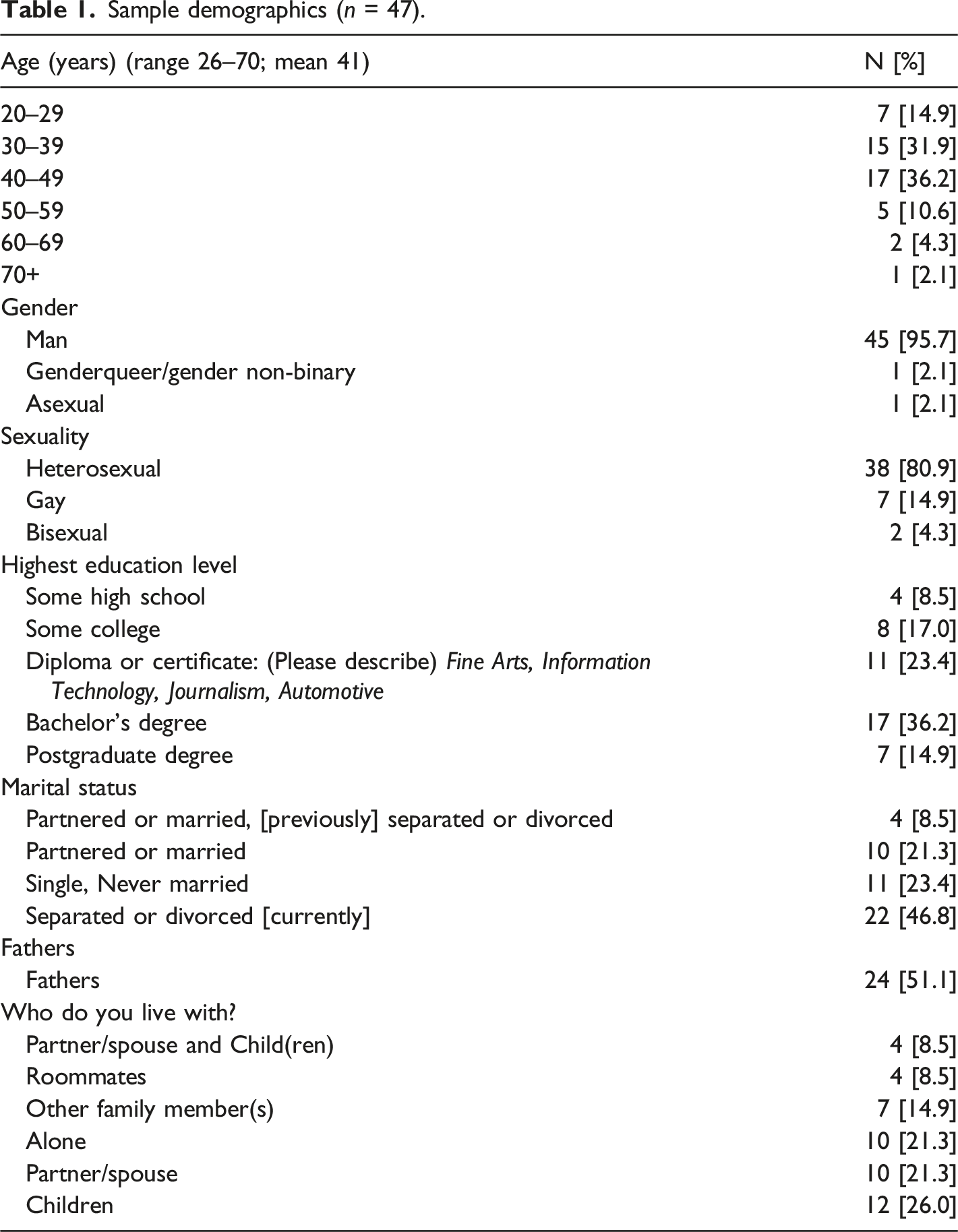
Sample demographics (n = 47).
Data Analysis
In reviewing, comparing and discussing the first five transcribed interviews, we evaluated the quality of the data, making memos to document initial insights and adjusting the interview guide to explore emergent findings. Amongst these early insights, participants consistently named communication as the key to their relationship. With the research question in mind, we read and compared each interview to devise a coding schedule. Initially we coded the interviews using open ‘parent’ node categories, including “skills men want” and “lessons learnt” before deriving connections between the data in these large codes. Descriptive communication ‘child’ node labels such as strategies, barriers and facilitators were used to fracture the data and compare the interview excerpts within NVivo 13. Comparing what each participant said in data assigned to the initial codes, we searched for pathways and patterns, and worked to contextualize variations to those trends in beginning to organize the findings. As the analyses progressed we purposefully looked to detail men’s pathways toward, and patterns within their communication (deficits and skills) in their intimate partner relationships. Through discussion and the writing up of the findings the author-team built consensus for the illustrative quotes and three themes; (1) breaking through after breaking up, (2) detailing deficiencies, and (3) building skills and strategies. To conceptually advance the descriptive findings, Connell’s (2005) masculinities framework was used to discuss the gendered dimensions of men’s communication. Researchers (JLO, GGM and MTK) assigned participant pseudonyms to link illustrative quotes.
Findings
Breaking Through After Breaking Up
Prompted by relationship breakdowns, men consistently referenced growing through self-work with a focus on improving their communication skills. Indeed, most participants spoke about breaking through after breaking up as transformative wherein they retrospectively examined the relationship[s] (and its demise), introspectively evaluated their communication (and behaviours), and looked to upskill as a means to improving their partnerships. This self-work did however take varying amounts of time and relationship exposures, and most men described their reactive use of substances and/or risky behaviours early on to escape or soothe the distress they experienced after a break-up.
Phil, a 35-year-old man, described ending a relationship upon learning that during a planned break from their 3-years partnership, his girlfriend had acted on her desire to experiment sexually (disclosing to him that she had been with several men in their month apart). Phil explained that on the night of the break-up, “I actually ended up having a panic attack and going to the emergency department.” In the weeks that followed he took some refuge in using “cannabis, stimulants and lots of alcohol” suggesting “I probably was drinking more and using more drugs than I ever have in my entire life.” Also 35-years-old, Brent detailed how his long-distance relationship suddenly dissolved, nixing his ill-timed announcement that he wanted to have a child with his now ex-partner. He reacted to the break-up by “dating recklessly”; I went hard into dating immediately again, sort of unconsciously kind of trying to replace her, and that was a bad fucking idea. I was still very hurt and I was too keenly looking for the things that went wrong in her [ex-partner], in other women, in a way that I was kind of projecting on them.
In line with normative masculinity and practices synonymous with hegemonic ideals, Phil overused substances to assuage his pain and calm his anxiety, while Brent offset his loss and embarrassment by hastily moving on in careless pursuits of a new partner. While these practices lacked cure qualities, they provided some temporary balm to subdue all that was being felt (anxiety, pain, anger, sorrow, regret) as well as what they might feel and therefore be (hopeless, worthless) in the aftermath of a failed relationship. These reactive responses did however eventually give way to more reflexive practices; as Brent conceded, he put a “damper on dating” and “decided to be sad by myself for a little while.”
Such pivots were also reliant on men easing their focus on ex-partners (and perceived wrong-doings) to introspectively evaluate their communication and behaviours. Manuel, a 44-year-old father who, a decade after separating, was still trying to negotiate co-parenting access of his daughter, eloquently summated his acceptance that; You can't change other people. You can't change your ex. You can't change the circumstances. Really, the only person you can change is yourself. So that's the lesson that I've learnt, it's really about changing yourself, changing your point of view, changing how you listen.
Manuel recognized that self-work would benefit him, as well as his new partnership (and their children) and future communications with his ex-wife and their daughter. He suspended efforts to control, the assignment of blame and prizing of self-profits – characteristics that had flowed from many men’s alignments to masculine dominance, competitiveness and self-reliance to foil their communication (and relationship[s]). Herein, Manuel also acknowledged past behaviors (control and dominance) synonymous with negative masculine stereotypes in emphasizing the changes he had purposefully made.
Also central to men breaking through after breaking up was knowing and authentically representing themselves in relationships. Indeed, most men asserted that they first and foremost needed to know themselves to be able to communicate effectively with partners. Mick, a 46-year-old participant, who disclosed that his infidelity had resulted in his partner leaving him, stressed the importance of being true and transparent from the outset; You've got to be authentic as a person…if you go into a relationship, because that's exactly what I wasn’t…I was a people pleaser. So you’re going through a relationship and they see you like, ‘oh, this guy's awesome’, but you’re like being…someone else. So then they finally see the real you, so that's why I feel like if you aren't authentic at the start, then you're not going to attract the people that you actually want in your life…I think it’s just about being real, being you. If you're going to be fake…then you're going to deter her away when she actually sees the real you is dying to come out.
Mick contrasted communicating interest and attraction to a potential partner (and urging reciprocation) with the deep communication work required to develop and sustain the relationship. Later in the interview he also proffered that childhood abandonment issues flowing from his parent’s separation had heightened his insecurities and impulsive serial cheating, for fear that he would be abandoned (again) by his partner when she saw him for who he really was. Conceding “all that relationship breakdown was on me”, Mick’s remedy (and perhaps redemption) came through his work to understand and address his vulnerabilities (and poisonous actions) as the nexus to better communicating with his now ex-partner (albeit in negotiating their co-parenting roles).
Breaking through also included men permitting (and pushing) themselves to feel and communicate what they felt without needing to rationalize or edit why they might be having uncomfortable feelings. The goal here was to over-ride the urge to keep it inside and/or articulate compelling explanations for all that was (often unintelligibly) felt. Jack, a 39-year-old divorced father, suggested that, “feeling vulnerable is fine and just because you’re a man, it doesn’t mean you can’t be vulnerable.” Jack assured us that men can garner important benefits by naming, sitting with, and sharing such transient emotional states. Rather than employing self-reliance to deny, control and/or mute his mood, Jack emphasized the need to work with what was being experienced. For many men, such introspection demanded professional and/or peer help. Adam, a 36-year-old man, talked about a relationship that “really broke me” in highlighting the benefits of professional counselling; The way I travel through now I really attribute…largely to my first big relationship failure and going to therapy and learning a lot about myself and about other people and about how to respond and how to communicate.
Adam disclosed the emergence of depressive symptoms in the aftermath of the break-up as strongly influencing his decision to see a therapist. Applying strategies from the array of skills he learnt in counselling, Adam used his “tool box…every day since developing that awareness.” Abridged to effectively self-managing, Adam, and most participants who accessed (and accepted) professional help, were intent on upskilling to become self-sufficient. The goal of therapy as self-sufficiency (rather than interdependence) might also be understood as a lingering alignment to idealized masculinities (i.e., self-reliance) for many men.
Some men, especially those feeling judged or underserved by professional services, found value in accessing men’s peer groups. This was especially the case for men negotiating co-parenting in the wake of a relationship breakdown. Liam, a 41-year-old father, while trying to orientate to impending legal proceedings, accessed a men’s group for “the emotions dealings.” He talked to some of his key learnings from attending group; Responding rather than reacting…speaking about your guilt if you’re going through any guilt in front of men is…it’s a really safe way of getting things out…Yeah, it’s just really the support…to know that other guys are going through their shit as well. And then, you know, there’s no man trying to save you when you’re talking about your stuff and especially your emotions, like you just get it out.
Liam spoke of being accountable to the other attendees in working through their experiences as a means to growing communication skills, and doing the work of identifying and expressing emotions. Whining, blaming, and victim identities were off limits; instead, group norms prized expressions of masculine accountability and collectively doing the self-reflection work to communicate more effectively in relationship breakdowns and/or future partnerships.
Breaking through after breaking up can be summarized as context bound and mapping across wide ranging individual progressions. Nonetheless, the willingness of participants to evaluate and address their communication with partners confirmed efforts to reject normative masculinities characterized by stoicism and/or anger in taking up the self-work to better their communications with intimate partners. In the following two themes men’s communication deficiencies and skills and strategies are detailed.
Detailing Deficiencies
The men’s accounts of their relationship breakdowns included detailing deficiencies pertaining to their communication. Narrating broken marriages, common-law unions and dating relationships, many participants reflected on what went wrong in assigning blame to themselves for injurious self-censoring. Herein, men suggested that they had ignored and/or hidden their feelings, values and perspectives from partners to such an extent that their thoughts were concealed and absent in their communications (or lack thereof) with partners. In turn, participants retrospectively recognized, and often mourned, how such omissions and silences had profoundly distanced them from their partner and the relationship. Driving men’s self-censoring were efforts to please partners, fear of being rejected, the avoidance of arguments and conflict, and a reticence to be seen (and judged) by partners as vulnerable or needy. Quintessentially, across short and long-term relationships, many men’s dire lack of agency in the partnership was characterized by behaviours and communication work that focussed on acting as though everything was fine.
In new relationships men were often intent on pleasing their partner, fearing disagreements and/or rejection if they expressed themselves fully and frankly. Chad, a 30-year-old man who began a summer romance hiking and biking with his new girlfriend, harboured great hopes for their long-term future together. Recognizing extremes in his partner’s mood and activity levels a couple months into the relationship, Chad craved but could not muster conversations to better understand her fluctuating behaviours, or express his care and strong feelings for her; I found it so difficult to communicate with my partner after a while, but maybe it's just like, I don't want to put myself in an uncomfortable situation or like I fear that I'm going to lose them. So, I don't want to express myself.
Piecemeal, Chad’s partner eased the growing stresses by bridging her request for some time apart to formally ending the relationship without explanation. Chad thoughtfully hypothesized a myriad of potential reasons for the break-up, but unswervingly his inability to initiate “strong heart-to heart conversations” prevailed as the spoiler to what he’d hoped would be their happy ending.
Self-censoring also emerged as injurious in longer-term relationships. Billy, a 48-year-old man, rued his quiet and the silences fueled by his naivety “that everything had to be perfect” when his waning 14-years marriage abruptly ended. Andrew, a 33-year-old man, on discovering his wife’s infidelity, ended up agreeing to her preference for an open relationship in an effort to “save the marriage.” In trying to honour his agreement, Andrew’s “serial monogamous” values were deeply sullied, and over time as their son grew he was unable to endure or discuss his need to change the arrangement. Reflecting on the self-censoring in and leading up to their separation, Andrew pinned his “low self-esteem” to an aversion for communicating “feelings with regards to my expectations.” He went on to say; I didn’t want to speak my truth because I was afraid of offending, and she wanted to overdo it to the point of trying to lay down guilt trips.
Underlying Andrew’s complicity, both in terms of agreeing to accommodate his partner “coming out as poli [polyamorous]”, and loathe to express his true feelings for fear of conflict, was chronic indecision and uncertainty – counter-masculine projects. In physically leaving the relationship he partitioned an end to the distressing effects of his partner’s polyamory, as Andrew noted, “I suddenly wasn’t as stressed out about it anymore.” Herein, Andrew’s self-censoring can be understood as injurious both in terms of the misery endured by (silently) staying in the relationship, and the agonizing decision to leave that crisis – which by extension meant forgoing co-parenting his son (until custody was resolved).
Self-censoring could also persist lifelong, as illustrated by Dusty, a 70-year-old man who indicated, “it’s still something that stops me because a part of me thinks [wife’s name] won’t like me or I’ll sound weak.” Here, Dusty’s idealized masculine self and wish to be strong, and therefore attractive to his partner, levered his self-reliance and stoicism to disallow disclosures that might out his vulnerabilities. Beset with the want to be needed and necessary (not burdensome) Dusty also talked at length about an array of longstanding insecurities pre-dating his current 12-years marriage. Included were details about his serial sabotage of previous relationships through infidelity, actions he took to avoid talking directly to partners about his anxieties. Dusty’s and Andrew’s interviews illustrated the potential for self-censoring to be a means for leaving as well as staying in a relationship.
For some men, self-censoring led to deep resentments and grievances that were eventually expressed in anger. Russel, a 33-year-old father, who was involved in divorce proceedings at the time of the interview, talked about how ignoring problems in his 8-years relationship, and the long-drawn-out settlement and custody negotiations, had given rise to his anger; Generally speaking, I would say I’m a very relaxed person, almost too relaxed. So what happens is, like if something is bothering me, I will just ignore, ignore, ignore it, and then I’ll snap after a very, very long time. So, I did that occasionally and I recognized that wasn’t healthy.
Anger, as a commonly expressed emotion for men, is both normed and deeply stigmatized, and Russel contextualized the ruptures of his patience– amid regretting those visible losses of control as hurtful, ineffectual and staining of his character. Moreover, being seen (and labelled) as angry obscured the cause or grievances fueling that emotion; instead, Russel’s loss of control was the primary (and defective) issue. Ironically, to remedy such an impasse, some men defaulted to self-censoring as less judged and troublesome than expressing their anger or searching for alternative strategies to articulate (and address) the hurt they felt.
Deficiencies also included men’s contributions to cyclical arguments enlarging the gulf in distressed relationships. Without the skills to navigate ‘agree to disagree’ conversations or resolve differences, some relationships were defined by ever present conflicts. Levi, a 31-year-old man regretted yelling and belittling his ex-partner when they had disagreements. Graham, a 45-year-old man recounted an injurious marriage in which he was increasingly critical of his wife. The couple engaged verbal arguments characterized by looping negative interactions to the extent that Graham was blinded to the pain inflicted by his verbal assaults; I remember her being really sensitive to a comment I made…I fucking don't remember what the comment was, but I remember it being an issue because it was said in front of her family and I remember…the same kind of sensitivity happening over here, like I would be more harsh of her when around my family, not necessarily in front of them, but I'd have these more negative feelings around whatever she said and did.
Consumed by the battle, many men reflected on their reckless communications, as well as the pointlessness of staying in (and trying to win) the argument. Also, in Graham’s case, regret was expressed for others being witness to the pervasive tensions and torment that defined his deteriorating relationship. For some men who had engaged such conflicts, addressing their accompanying communication deficits was inextricably bound to learning conflict resolution strategies. As Geoff, a 43-year-old man who had been married for 14 years said, “I don’t think you can pull the two [communication and conflict resolution skills] apart, that’s just me”. Alignments to normative masculine competitiveness and control surfaced as detrimental in these conflicts - fueling some men’s power struggles with partners and defiling the relationship as war-torn.
Defective communications also included deficits for reading the emotions and needs of partners. Harvey, a 53-year-old man who had been divorced twice detailed his inability to recognize, let alone accurately read and supportively respond to, a partner’s emotions; I think it would've been good to have somebody say, ‘to be a good husband, this is what you should do.’ Somebody to guide me and have me understand…how women think and to recognize the signs of when a woman is not feeling wanted or needed or valued. I'm still learning frankly and I look back and I recognize things that I could've done better, I could have been a better person and I didn't, just because I didn't know. I don't think I was intentional about it.
Denying vindictiveness, Harvey cited the ill-effects of being socialized, “I was impacted and marked by my father, because he was your typical 1970s dad, where he came home and sat down in the chair and my mother would make dinner.” Harvey’s comments illustrated the pervasive power of patriarchal masculine role models, and the potential for ill-fitting paradigms to be learnt and replicated.
Detailing deficiencies highlighted how self-censoring and other defective communications could configure diversely with the net effect of eroding the calm (and comforts) that had motivated men’s relationships in the first place. Taken together, it is fair to say that significant relationship harms could flow from what men did not, as well as what they did, communicate.
Building Skills and Strategies
Participants consistently prioritized building skills and strategies for communication as requisite to connectedness with their partner, and foundational to building and sustaining a healthy relationship. Indeed, effective communication was men’s utmost prized, and sought-after attribute. As Steve, a 34-year-old man, asserted in response to what he viewed as most important for ensuring a good quality relationship, “honestly, communication, communication, communication, that is number one. I can’t say that more loud. It is super important.” Reflecting on communication in the demise of a relationship[s] and/or contrasting the positive communication patterns with their current partner, participants suggested their skills and strategies were learnt – the by-product of relationship experiences. Herein, there were both masculine concessions that men were not innately gifted communicators, and drivers to build communication skills to meaningfully connect with partners. Martin, a 51-year-old man, said “having the awareness…of yourself and what’s coming up so that you can communicate with your partner” demanded wide ranging skills. In what follows, we share participants’ leading communication practices.
First and foremost, the temporal dimensions of communication were evident, where over the course of the relationship, in tandem with changes and challenges, the need to efficiently and reliably communicate with partners was crucial. For some participants this included informal communications, such as texts, used to signal their care by bridging virtual linkages to in-person interactions. Bryce, a 33-year-old man, referenced a new relationship, in its third month, to suggest; Even if the person is busy, just having a quick check-in, just sending a quick message and kind of planning out the day or something or just sort of knowing where the other person is at.
Bryce assured us that “it’s nice to have that little check-in” amid clarifying the need to “set clear expectations” about response times whilst avoiding the drudgery of “a partner that’s constantly texting you or constantly on the phone.” Workmanlike in his approach, Bryce’s text etiquette reflected his project management job skills, and readily adapting these strategies worked well for staying connected to his new partner (whom he had met at work).
Temporality was also evident in men’s assertions that communication needed to be established early on, and adjusted over time to ensure open pathways for [re]charting joint plans and resolving inevitable disagreements. Bob, a 61-year-old man warned “call it right away” when an issue emerges so that you can jointly “do something about it.” Similarly, Billy, a 48-year-old participant explained the need to build and adjust communication channels from the outset; I suppose you think, ‘oh, great, I've found someone perfect for me and that'll be it’, you’d be perfect together forever. And actually the concept that, no you need to constantly work on it and communicate and check in with each other is probably the most critical thing…men are pretty shocking at doing that.
Billy folded his experience of losing touch with his partner and the relationship over time into generalizations about men’s under-developed communication skills. Implicating emotional stoicism, his communication shortfalls were gendered – and explained away as embodied by most men. To compensate, a hard work ethic and problem-solving (also masculine ideals) were suggested by Billy as key to men building their communication skills. Disclosing his “shock” and “sense of betrayal” when at divorce mediation his ex-wife divulged that she had had an affair, Billy fore fronted how extensive travel for his job had estranged him from his wife and family. He went on to concede that “by the time I thought that we needed to talk about it [growing apart] she [ex-wife] had already moved on as in she had made the decision, I think the opportunity kind of had been missed.” Somewhat lamenting his focus on work, and the ultimate cost of his job, career aspirations and breadwinner identity, Billy underscored the critical importance of prioritizing regular and deft communication including (and perhaps especially) “uncomfortable conversations” to address and repair any potential disconnects.
Related to having uncomfortable conversations, many men spoke to the need to expect disagreements with partners. In these instances, communicating with a collaborative spirit and openness to compromise were essential to staying connected while working through diverse issues. Jack, a 39-year-old divorced father who was currently living with his new partner, suggested; Disagreements are fine, you don't have to agree on everything and disagreements can be healthy in a relationship and that's how people grow by learning different things. I mean, I got told ironically working for a cleaning company that my cleaning habits at home… ‘they’re really shithouse’ and I was like, ‘what do you mean?’ It’s clean and like show me and then I’m like, ‘oh yeah, okay, cool, thanks’. But then even things like I'm a rubbish cook, I've got my meals and if I go anything beyond those - I'm not too sure how to do this, I’ll communicate that to my partner and she helps.
Jack, and many men, referenced the domestic sphere and divisions of unpaid labour in how they connected with partners to optimize their home and its comforts. Harmonizing the domestic arena was strongly reliant on open communication and a reciprocity of shared contributions. In chronicling his domestic skill limits, Jack tilted toward normative (though dated) masculine (and feminine) stereotypes; but his willingness to incorporate his partner’s direction showed a commitment to gender equity reflecting contemporary masculine ideals for how men should be present, and operate in the domestic sphere (see Roberts 2018).
Rules of engagement for communication ranging from mechanistic strategies through treaties norming forthright formal check-ins were also detailed as priorities for connecting with partners. Quintin, a 49-year-old divorced man, described an agreed upon strategy used to cue him to his current partner’s needs; I would go and Google stuff and my partner would say, ‘stop it, I don't want a solution, I… just want you to listen to me’. We [men] suck at stuff like that. So, what I've basically done is I said, ‘I suck at that’ and the funny thing was my job was a problem solver. So whenever a problem would be presented to me, I'm looking for answers because that is the damn thing I've been doing for five years. So it got to a stage where I was like okay, ‘do me a favor, if you want to vent, just raise your hand’, say ‘I'm venting’. You do that, I will not move at all. I'll just let you vent. So not only that, I've developed that with my people at work as well…with my friends as well, I've told them, I said, ‘hey, I'm a guy who starts looking for solutions, just tell me you are venting and I'll relax my brain as well’.
Quintin proudly detailed his willingness (and watchfulness) to adjust his listening and responses in minimizing normative masculine communication deficits, and better connecting with his partner (and others). Holding in abeyance idealized masculine rationality and problem-solving (which served him well in his banking sector job and career), Quintin suggested he was able to disarm that finely tuned work skill to responsively adjust and ensure his partner’s need to be heard (rather than coached).
Building on this, participants also provided details about knowing the language and communication styles of partners, and having mutual understanding for why, how and what could be safely said and shared. Steve, a 34-year-old man, squared, “it’s important to know your love languages…but also your fight languages” to give compliments and ensure arguments did not “blow up into a bigger scenario than they have to be.” Andrew, a 33-year-old man, explained the relationship benefits garnered by regularly discussing issues with his new partner; We’re really good now at having those check-in conversations… ‘how are we doing? what is bugging you?’ and we call it the judgement free zone. What have I done this week that has pissed you off…Alright, so we’re going to have this talk and I’m going to tell you what I’m thinking, and I want you to know that it is coming from a place of love…so if I am saying anything that is offending you or makes you feel bad or whatever, like tell me, you need to tell me…I’m not going to cut you off. I’m not going to try and sway what you’re thinking…because obviously you have these feelings and these thoughts…that’s your right.
Herein Andrew, and many participants, talked to the need for formal check-ins to honestly express and exchange thoughts and feelings. In essence, the men’s purposeful talk and attentive listening was prioritized and scheduled to authentically communicate and adjust the relationship when necessary.
Alignments to masculine ideals and gender relations characterized men building skills and strategies for communication, which, on the whole, demanded many men’s work and ongoing attention. To varying degrees, men showed an openness to critique and change (contrasting patriarchal power and control), collaboration (contrasting competitiveness) and empathetic listening (contrasting problem-solving), thereby transgressing and/or reformulating masculine ideals to more effectively communicate with partners.
Discussion and conclusion
The current study offers important empirical insights to men’s pathways and patterns for communication in intimate relationships, and affirms the usefulness of Connell’s (2005) masculinities for interpreting those findings. Mapping communication gains in breaking through after breaking up highlighted participants’ introspections for evaluating their role in the relationship and its breakdown on route to making some adjustments. Similar to Berke et al. (2021), our findings revealed participants’ pathways to include substance use as a normative but ineffectual masculine strategy preceding (and at times pausing) the reflexive work necessary to learn from all that had happened in their relationship, and its demise. For many participants, accessing peer and/or professional services was key to breaking through (i.e., self-discovery and growth), and these help-seeking practices were normed as necessary for overcoming distress, learning to be introspective and committing to building communication skills and strategies. Though Parnell and Hammer (2018) highlight men’s self-reliance and emotional control as barriers to engaging couples’ therapy, the current study findings reveal many participants’ self-directed efforts for starting individual and/or group talk therapy. While this played to masculine stereotypes that men are not innately equipped with communication skills (or introspection), there was also evidence that some participants needed assistance to improve their mental health in the aftermath of a relationship breakdown. While such help-seeking can be normed as strength-based and asset-building, it is also possible that lock alignments to these normative frames (men as innately ill-equipped communicators) could be unhelpful in barring some men from self-work.
Detailing deficiencies revealed men’s communication shortfalls and their willingness to share how what they did and did not communicate abetted their relationship breakdown[s]. Self-censoring exposed undertows across men’s life course and relationships of diverse length. Though stoicism and emotional restraint have featured as explanatory masculine states limiting men’s communication, akin to Waling’s (2019) assertion, the current study findings highlighted complexities for how agency and structure entwined to influence participants’ actions and inactions. Indeed, co-constructed (and contested) masculinities shaped, and were shaped by diverse intimate partner gender relations. For example, self-censoring could reduce the risk of losing a partner, avoid conflict (and perhaps IPV), and/or conceal anxieties flowing to and from the relationship. Notwithstanding that men’s stoicism can be employed (and experienced by others) as controlling (Pease 2012), participants’ self-censoring accounts seemed to envelope their fears and shame, levering uncertainties for what they could or should communicate (and do). Regarding other defective communications, as previously suggested by Gottzén (2019), men’s anger and involvement with incessant arguing retrospectively revealed participants’ regret for embodying such normative (and deeply stigmatized) masculine practices, and their need to more effectively resolve conflicts and communicate with partners.
Regards building skills and strategies, communication was repeatedly flagged in the men’s interviews as requisite to connecting with partners and growing their relationships. Triaging communication work was rationalized as needing to compensate normative masculine shortfalls, and much of the men’s labour focussed on (and idealized) building from the outset regular check-ins with partners. In this context men’s communication was purpose driven and defined by routine and rules to ensure opportunities for openly discussing relationship matters with partners (thus reducing the potential for missed or misread relationship issues). Building on Galasiński’s (2004) assertion that men manage their talk in accordance with social expectations – we suggest that men’s preference for check-ins reflects normative masculinities in sanctioning and scheduling deeper level dialogue with partners. Collaboration and empathetic listening, as key communication skills, were also positioned as learnt strategies, and assets for communicating in and around partner check-ins. Herein teamwork allayed competitiveness, and attentiveness dispelled the predominance of advice-giving to make available important partnership communications.
While the current study findings are helpful in terms of thoughtfully considering what might be useful content for men building communication skills, as Oliffe et al. (2021a) suggest, there is a strong need to get upstream of men’s relationship crises and provide asset-building resources that are delinked from the stigma of deficit-based correctional IPV and/or DV services. Emergent findings suggest potential benefits for engaging boys and men in programs focussed on communication skills in intimate partner relationships. The current study findings also bare men’s active and acted upon desires to level-up their communication skills, and ideally such needs can be met ahead of (or to minimize) the injurious effects of a relationship breakdown.
Regarding the use of masculinity frameworks, as per de Boise and Hearn (2017) and Waling (2019), agency and structure were contexts diversely interacting to influence men’s pathways and patterns for communication. The openness of the men’s accounts disrupts some normative masculinities (i.e., stoicism, self-reliance, restricted emotionality) as evident in participants’ eagerness to talk with us, and the depth of their retrospections and disclosures. Such introspection and sharing of emotional states debunks trait-based assertions espousing men’s communication deficits as unitary and fixed. Rather, the current study findings provide insights to connections between masculinities and men’s communication, which seem key to contextualizing the gendered dimensions of men’s emotions (de Boise and Hearn 2017; Galasiński 2004) and language (Johnson and Meinhof 1996; Lawson 2020) in intimate partner relationships. It is also useful to consider the current findings within IMT (Anderson and McCormack 2018) and hybrid masculinity gender theories (Bridges and Pascoe 2014). Herein, participants’ willingness to self-reflect and disclose intense relationship experiences may support IMT’s social transformation claims whereby men’s communication of their emotions can be understood as an emergent normative strength-based project. By contrast, assertions in hybrid masculinities that some communication practices (i.e., self-censoring) merely reconfigure and shield men’s privilege and power (Bridges and Pascoe 2014) might also be at play. While participants indicated their alignment to, and endorsement of egalitarian relationships, the absence of triangulated data sources (i.e., couple-dyads, partner perspectives, fieldwork) limits our ability to formally evaluate the fit of the current findings with IMT or hybrid masculinities.
Study limitations also include the cross-sectional design and the collection of data during COVD-19. To address the first limitation, longitudinal studies might track men’s communication over time to evaluate the sustainability of changes and specific patterns. The current research was not a COVID-19 study per se, but because the data were collected in the first year of the pandemic it is likely that some of what was shared by the participants was influenced by that context. Related to this, it is possible that men self-selecting to take part were especially able and willing to communicate about intimate relationship issues and emotions. In addition, the sample was recruited (and interviewed) online and had high education attainment, and we did not formally compare sub-groups (i.e., sexual identity, ethnicity, age, country of residence) to distil potential differences. These sampling and analyses strategies limit the generalizability of the findings – and by extension the potential of the results to inform the development and deployment of geospecific men’s programs focused on addressing health inequities.
In conclusion, the current study findings reveal important connections between men’s communication and masculinities to make available pathways and patterns for disrupting normative masculinities and affirming introspection as an asset for garnering effective communication. These insights might also usefully guide existing programs such as Promundo’s (now Equimundo) Manhood 2 (Smith and Jamie 2019) that have taken aim at social norms of masculinity, as well as seeding new upstream IPV prevention efforts focused on men building better relationships.
Footnotes
Declaration of Conflicting Interests
The author(s) declared no potential conflicts of interest with respect to the research, authorship, and/or publication of this article.
Funding
The author(s) disclosed receipt of the following financial support for the research, authorship, and/or publication of this article: This study was made possible with funding by Movember (Grant #017801). JLO is supported by a Tier 1 Canada Research Chair in Men’s Health Promotion. SMR is supported by a Career Development Fellowship from the National Health and Medical Research Council of Australia (GNT1158881), and the Dame Kate Campbell Fellowship from the Faculty of Medicine, Dentistry and Health Sciences at The University of Melbourne. DK is supported by a Michael Smith Foundation for Health Research Scholar award.
