




Abstract
In light of gendered dynamics complicating masculine adoption of self-driving and electric vehicles (EV), we examine how Tesla’s video consumer stories envision masculinities within sociotechnical systems of automobility, exploring how corporate representations co-construct drivers and vehicles in gendered ways. Using multimodal critical discourse analysis, we show how the driver-car appropriates movement as a work of raced, gendered, age-dependent, and classed culture: EVs validate energy-soaked lifestyles in an age of climate change, enabling “green” enactments of fast, aggressive, and reckless styles of hegemonic driving performed by ecomodern masculinities; over-masculinized dynamics of techno-eroticism forge automated vehicles (AV) as technologically-advanced devices, crystallizing fantasies of men’s hegemonic love for technology within drivers’ mobility patterns. Tesla’s narratives sketch a future of mobility dominated by gendered sociotechnical adjustments, where neither energy-based nor technology-based reconfigurations of automobility spark critical conversations around reconfigurations of “behind-the-wheel” masculinities, leaving unquestioned what it means for them to demand space, speed, and comfort.
Introduction
Given that the dominance of privately-owned, internal combustion engine vehicles (ICEs) significantly contributes to climate change and air pollution (Graham-Rowe et al. 2012), car manufacturers face increasingly intense societal criticism. Responding to these discourses, Tesla—holding the highest market share of battery electric vehicles (BEVs) in 2020 worldwide (Wagner 2021)—strategically promotes electric engines as “zero emissions”, highlighting the lack of tailpipe gas emissions over possible sustainability downsides in the production, such as charging and disposal of electric batteries. 1 Following this rhetoric, Tesla constructs consumer adoption of electric vehicles (EVs) as a pro-environmental behavior that fosters the company’s mission of accelerating the world’s transition to sustainable systems of renewable energy (Tesla 2018).
Considering, however, that incompatibilities of values between environmentalism and hegemonic scripts of masculinity threaten masculine endorsements of sustainable consumption (Brough et al. 2016), Tesla’s environmentally conscious imageries might complicate male drivers’ willingness to ‘go electric’ and participate in the reconstitution of masculinities away from toxic entanglements of (white) patriarchal power and fossil fuel combustion (Daggett 2018). Additionally, further gendered issues might emerge in connection with autopilot, a technology that Tesla features on all its vehicles. Automated vehicles (AVs) might in fact prompt a “demasculinization” of automobility by engendering important redistributions of power balances on the road, as drivers are transformed into passengers (Balkmar and Mellström 2018). At the same time, following Hennighausen et al. (2016) work on male conspicuous consumption, Tesla seems to reiterate and exploit traditional links between hegemonic scripts of class-privileged, heterosexual masculinity and passenger vehicles through the vehicles’ performance (e.g., fast acceleration, speed), design, and price point. Marketing and selling luxury fast sport cars, Tesla affords wealthy male drivers a chance to perform masculine hegemony through demonstrations of aggressiveness, risk-taking, and reckless styles of driving, echoing ideals of violent and invasive masculine power that are culturally accessible to both white (Redshaw 2018) and Asian men (Louie and Edwards 1994).
Focusing on the ambiguity of these scripts of masculinity, we analyze how Tesla constructs its model of automobility across intersectional narratives of gender. In this light, we examine the question: how do Tesla’s consumer stories related to the transition to electric and AVs discursively shape scripts of (hegemonic) masculinities? How we move objects and bodies through spacetime influences how masculinities are socially constructed and have material existence: reconfigurations of these trajectories enable certain ways of performing identity through patterns of motion and immobility while disabling others, shaping the “horizon of agency, social relations, political formations, self-knowledge, and desire” (Seiler 2008, 6) that men navigate when taking a seat behind the steering wheel. It is with this in mind that we investigate how Tesla provides and constructs different possibilities for a limited sub-group of economically-privileged men to exist, act, and move using electric batteries and autopilot.
Drawing upon Connell’s (2005) concept of hegemonic masculinity as the configuration of gender practice “by which a group claims and sustains a leading position in social life” (p. 77), we understand corporate representations to display scripts of masculinity that we explore in light of the examination of their “relation of complicity” with the hegemonic project. We attempt to map out how Tesla envisions masculine driver-identities in light of the historical articulation of automobility as a predominantly white and class-privileged sphere of male influence, power, and agency (Hildebrand and Sheller 2018; Seiler 2008). Car manufacturers have the power to shape how drivers and vehicles are engineered and imagined within sociotechnical systems of mobility, especially novel ones: the transition to EVs and AVs opens a possibility to redesign and rediscuss automobility as a masculine practice where “alternative transformations of personal life are at stake […] [together with] alternatives futures of the collective gender order” (Connell 1990, 454). What remains to be answered is how Tesla may not only communicate EV and AV adoption as an opportunity to engage men in moments of contestation and separation from toxic entanglements of white patriarchal power, fossil fuel combustion, aggressiveness, and reckless styles of driving, but also how Tesla might capitalize on electric batteries and autopilot as technological adjustments safeguarding the undisturbed reproduction of predominantly white, class-privileged masculine hegemony on the road.
Automobility, Power, and Intersectional Masculinities
Arguing that “automobility is not just about movement or the convenience of getting from point A to point B” (Henderson 2006, 304), we explore the interwovenness of mobility and social identity, making sense of the car as an important political arena for the constitution of intersectional masculinities in contemporary societies. Historically, the apparatus of automobility “has channeled power in both the productive and repressive senses of the word” (emphasis added, Seiler 2008, 6), enabling (mainly) white, class-privileged, middle-aged men who are (temporarily) able-bodied to access empowering modalities of movement while marginalizing others by means of exclusion and immobility. As artifacts associated with expressions of power, wealth, and manual dexterity (Balkman and Hearn 2019), cars have afforded privileged individuals yet another chance to rationalize and materialize themselves as dominant subjectivities, disclosing the sociocultural and financial impossibility of purchasing fast luxury vehicles as a disempowering identity trait (Hennighausen et al., 2016). Such intersectional distributions of privilege and subordination have been crystallized in the configuration of public places around cars and drivers. Policymakers and urban planners have historically utilized automobility to enforce the institutionalization of patriarchal and racialized ways of dwelling and circulating; car-centered infrastructures (e.g., highway networks) have limited the movement of non-car owners forcing automobile dependency by design, often contributing to the physical segregation of wealthy individuals and (nonwhite), class-unprivileged communities in different urban and rural geographies (Henderson 2006).
Considering passenger vehicles as key arenas for the (re)constitution of domination, privilege, and inequality (Hildebrand and Sheller 2018), we analyze how Tesla enrolls male bodies of different ages and ethnicities into its apparatus of automobility, exploring the racialized and age-dependent scripts of masculinities that male owners mobilize when inhabiting EVs and AVs. Changing modes of fueling and driving a vehicle means shifting the material-discursive landscapes against which intersectional masculinities get forged and dismantled, stabilized and destabilized through ways of (not) engaging with particular forms of mobility. Hence, we explore the spectrum of masculine action that Tesla ascribes to men of different ages and ethnicities once they decide to equip themselves with electric engines and autopilot technology.
Co-production, the Driver-Car, and Hegemonic Masculinities
Approaching automobility as a sociotechnical enterprise enacted by assemblages of social and technological actors (e.g., driver, vehicle), we adopt a theoretical stance resting on Jasanoff’s (2004) idiom of co-production to examine how social and technological dimensions of automobility co-construct each other. In this light, we use Dant’s (2004, 74) definition of the driver-car as the sociotechnical construct formed by the unity of a driver and a vehicle: “the driver-car is neither a thing nor a person; it is an assembled social being that takes on properties of both and cannot exist without both”. As this actor moves and relocates, it acts as a result of the co-construction between the affordances of the vehicle (e.g. engine power, type of fuel) and the affordances of the driver (e.g. intersectional identity, responsibilities, desires, body): “it is the particular ways in which [the driver’s and the car’s] capacities are brought together that bring about the impact of the automobile on modern societies” (Dant 2004, 62). With this in mind, we understand Tesla’s driver-car as enacting gendered meanings of automobility through situated performances (West and Zimmerman 1987) that emerge from the relationship of co-production between the construction of a driver’s intersectional identity and the technological dimension of EVs and AVs.
Exploring these dynamics, scholars have argued that the driver-car enters a particularly impactful gendered space of action if the driver is a man. Hennighausen et al. (2016) show that wealthy drivers—especially young men—purchase expensive sport cars to enact heterosexual hegemony through lavish consumption and reckless styles of driving, flaunting performances of aggressiveness, risk-taking, and speed that have strongly shaped men’s behind-the-wheel masculinity (Balkmar and Mellström 2018). Equipped with explosive acceleration, men have often inhabited the road as a noisy, invasive, and dangerous actor capable of great destruction. Reflecting this, Redshaw (2018, 89) describes combustion masculinity as the enactment of “bursting, spurting speed and power […] [requiring] the constant burning of fuel” through which male drivers conform with the hegemonic project within their patterns of mobility: combustion power is “both the source of power and an expression of power”. Daggett’s (2018) conceptualization of petro-masculinity suggests that within Western petrocultures noisy, invasive, and intensive fossil fuel consumption can function as a spectacle of hegemonic masculinity; an icon of masculinist violence, pleasure, and virile empowerment against the threat of global warming and environmentalist critiques of oil-soaked lifestyles. Notably, combustion can be appropriated to perform hegemony also by Asian men: demonstrations of combustion power embody the attributes of physical strength and military destruction prescribed and crystallized in the concept of “Wu”, which Louie and Edwards (1994) recognize as a long-established Chinese ideal of masculinity. In this sense, we recognize combustion masculinity as the sociotechnical manifestation of contemporary class-privileged, mostly young, hegemonic masculinity in the context of automobility, culturally accessible to both white and Asian men.
Masculinities, Environmentalism, and EVs
Considering the ubiquitous characterization of EVs as a “pro-environmental technology” supported by corporate advertising, governmental policy, and scholars alike (Graham-Rowe et al. 2012), dominant imaginaries intimately associate EVs with environmentalism, thereby (re)shaping possibilities of co-production of intersectional gender identities and mobility patterns. Most notably, the “green” image of EVs threatens patriarchal, oil-soaked ideals of Western petro-masculinity, which secured exhibitions of hegemony through intensive fossil fuel consumption (Daggett 2018). Constructing automobility and environmental care as mutually exclusive practices, Western petro-masculinity couples climate change denial with violent displays of combustion power, sustaining the clash between the competitiveness and aim for short-term success of mostly white, class-privileged masculinities and the intra- and intergenerational concerns fundamental to environmentalism (Pease 2019). Exploring these dynamics, Brough et al. (2016, 568) point to the existence of a conceptual association between “greenness” and femininity taking the form of a “green-feminine stereotype” that might encourage men “to avoid or even oppose green behaviors in order to safeguard their gender identity”.
In virtue of its subversive potential, environmentalism can lend fertile ground for the (re)construction of a politics of masculinity away from toxic, violent, and harmful configurations of patriarchal power (Balkman and Hearn 2019). Scholars have argued that men often connect with feminist values, ethos, and practices through their involvement in the environmental movement: Connell (1990, 463) sees the “emphasis on collectivity and solidarity” and the “ideology of equality” typically cultivated within environmental groups as discouraging desires for domination and competitive individualism; similarly, “many ecofeminist writers have argued that men can be involved in ecofeminism and […] become gentle, caring, and nondominating” (Pease 2019, 118). In this sense, EV adoption can invite white male drivers to a process of contestation and possibly separation from hegemony, launching a feminist reconstruction of masculine driver-identities centered around care. Equipped with “green” and “zero emissions” vehicles, the driver-car provides an opportunity away from violence and aggressiveness to connect with the attentive consideration for others and the sensitive care characteristic of Elliott’s (2016) concept of caring masculinities. Yet—as research on caregiving fathers has shown—embracing care does not result in the wholesale rejection of masculine hegemony; rather, caring fathers view the exploration of their nurturing side as an opportunity to renegotiate which aspects of hegemony they want to distance themselves from and maintain a connection to (Hunter, Riggs, and Augoustinos 2017). In this sense, caring masculinities engage in the simultaneous rejection and uptake of hegemony.
Expanding on these complications, environmentalism can be weaponized to maintain hegemonic positions of masculine power: ecomodern masculinities might employ endorsements of ecological discourses as “attempts to incorporate and deflect [environmentalist] criticism in order to perpetuate hegemony” (Hultman 2013, 89). In this sense—constructed as “zero emissions” technologies—electric engines may enable drivers to disguise aggressive and fast styles of driving as acts of environmental care, safeguarding the undisturbed reproduction of white, class-privileged masculine hegemony on the road in times of climate change. Here, EVs might function as Günel’s (2019, 152) technological adjustments: far from sparking critical conversations around impactful driving styles, they possibly preserve hegemonic articulations of the driver-car without interrogating what it means for men “to demand space, speed, and comfort in the first place”. Additionally, EV adoption empowers men to exhibit hegemony in the form of progressive, future-driven identities. Men might capitalize on conventionally established corporate and policy-driven narrations of EVs as the future of mobility to materialize themselves as “pioneers”, i.e. tech and energy experts that are able to predict and appropriate futuristic energy transitions in their present patterns of mobility (Hultman 2013, 90). Similar dynamics were observed in solar energy communities, where male homeowners install rooftop solar panels to materialize future-oriented and progressive masculinity through their house (Standal, Talevi, and Westskog 2020).
As they negotiate their identity between hegemony, care, masculinity, and environmentalism, Asian men inhabit different heuristic and imaginative landscapes of gender action. In his work on Chinese consumers, Chan (2001, 382) underlines how the adoption of environmentally sustainable technologies in China is strongly shaped by Taoist philosophies and Confucianist traditions, which “portray man as only a part of nature and maintain that he should not try to master it”. Within these cosmologies, men might endorse environmentalism to align with long-established cultural ideals that prescribe the configuration of “the man-nature orientation” alongside scripts of harmony and respect rather than dominance and aggressiveness, as is typical for Western petro-masculinities. Emphasizing interdependence, in-group harmony, and group-oriented goals over individual competition and self-orientedness (Hofstede 2001), the cultural prominence of collectivism in East Asia might configure endorsement of environmentalist action as a project of masculine hegemony: through EV adoption, Asian men demonstrate to understand (auto)mobility beyond short-term effects and personal gratification in the here and now, materializing Confucian group- and long-term orientedness through patterns of sustainable mobility that reflect intra- and intergenerational concerns (Kim and Choi 2005). Drawing upon these insights, Qian and Yin (2017) showed that Chinese consumers’ intention to adopt EVs is significantly influenced by these Naturecultures, so that Asian men can ‘go electric’ to echo classical ideals of a considerate, respectful, future- and group-oriented masculinity.
Yet, against radical shifts in cultural norms and globalized masculinities, Confucian ideals face huge challenges in contemporary Asia (Louie 2015), so that Asian Tesla drivers might adopt EVs to seek configurations of manhood that exceed harmony with nature and collectivism. Being fast sports cars, Tesla’s EVs materialize both respect for nature and demonstrations of combustion power, echoing the harmony and balance between the genteel and refined qualities of the “Wen” and the attributes of physical strength of the “Wu” prescribed by the “Wen-Wu paradigm”, which Louie and Edwards (1994) recognize as a long-established Chinese notion of masculinity. But, more than anything, Tesla offers an expensive solution to practice and exhibit consumerism: as luxury vehicles, Tesla’s EVs participate in the reconstitution of both the “Wen” and the “Wu” as monetary power, allowing class-privileged Asian men to pursue and appropriate the unashamed flaunting of wealth that has become the hegemonic measure of a man’s worth in contemporary Asia (Louie 2015).
Masculinities, Technology, and AVs
Expanding on social studies of automobility, scholars have contended that AVs threaten men’s gender-hegemony by impeding sociotechnical enactments of combustion masculinity. Enforcing safe and legal regimes of mobility, self-driving vehicles strip drivers of the possibility of self-expression through aggressive, risk-taking, and fast styles of driving—all facets of behind-the-wheel masculinity that constitute important pillars of young men’s performances of hegemony (Balkmar and Mellström 2018). What is more, AVs jeopardize the desires of control that have historically inspired Western men across classes in their technoerotic fantasies of domination (Kleif and Faulkner 2003): driven by autopilot, men give up manual control over their own vehicle, losing access to what Weber and Kröger (2018, 16) recognize as a “major element of doing masculinity”. In this sense, AVs introduce technological innovations that seem to prompt a ‘demasculinization’ of automobility by endangering the position of power that men hold within sociotechnical systems of privately-owned automobility, obstructing the driver-car’s ability to act within mostly young and white spaces of hegemonic action.
Crucially, however, Manderscheid (2018, 38) sees “no reason to expect […] the principal gendering of the symbolic order to disappear simply because the driver’s position in the car disappears”. Most notably, the technological novelty that often characterizes AVs as futuristic artifacts might encourage white male drivers of all ages to embrace AV ownership to align with Western ideals and long-established tropes of “men’s love affair with technology” (Oldenziel 1999). Additionally, being sold at high price points, AVs lend themselves to be adopted as markers of success and illustrations of opulence that (financially privileged) men can utilize to materialize themselves as wealthy actors on the road. Following Louie’s (2015, 89) work on globalized Asian masculinities, AV adoption might constitute an especially important strategy of masculine practice in contemporary China, where a man’s worth is increasingly being measured through his capacity to “ostentatiously display his success by acquiring and parading worldly goods”. Here, the masculinizing power of conspicuous consumption especially applies when purchasing a luxury American brand: driving a Tesla in mainland China enables Chinese men to materialize expressively Western taste and success within their patterns of mobility—a set of highly-valued assets considering that if “having Chinese yuan is good, having American dollars is even better” (Louie 2015, 89).
In conclusion, AV adoption seems to elicit what Balkmar and Mellström (2018) call a ‘regendering’ of automobility, as men transform their transport vehicles in artifacts that crystallize their supposedly masculine passion for technology and innovation as well as their financial success within their mobility patterns. Yet, considering that car manufacturers often exclude non-white and non-Asian masculinities from corporate imaginaries around automated mobility (Hildebrand and Sheller 2018), the possibility to leverage AV adoption to partake in such configurations of hegemony remains a predominately white and Asian entitlement.
Method
To explore the narratives of masculinity and automobility, we analyzed 48 videos of approximately 1–2 min in length from Tesla’s official YouTube channel (Online Appendix B). Following Tesla’s classification, we sampled consumer stories: as professionally edited and staged videos, they closely resemble corporate advertisements. The videos typically feature a Tesla owner who describes what they like about the vehicle, their reasons for buying a Tesla, and how they use the car. During the voice-over, the owner is shown carrying out different activities with and around the vehicle, such as interacting with passengers, loading and unloading cargo, or driving. Although agreeing with Halberstam (1998) that women—or generally people who do not identify as male—can participate in the construction of masculinities, we restricted our analysis to representations of male Tesla owners, paying particular attention to their age, ethnicity, and any other characteristic that could contribute to shape their masculine driver-identities around intersectional structures of social categorization.
We analyzed the videos through Multimodal Critical Discourse Analysis (MCDA), which allowed us to explore how masculinities are represented and constructed across verbal and visual modes. Following Wodak and Meyer’s (2001) analytical endeavor to reveal the discursive nature of socio-cultural structures and power relations, we conducted a critical discourse analysis as we examined how corporate texts discursively categorize people, actions, and technologies under intentionally chosen frames of gendered, racialized, age-dependent, and classed meanings. Additionally, our analysis was multimodal as we investigated how meaning arises from the simultaneous co-deployment of verbal and visual semiotic resources of videos—namely spoken dialogues, words written on screen, and the images accompanying these. Hence, we took the narratives utilized by owners coupled with the visual representations of both the owners and their vehicles to shed light onto the masculinized sociotechnical realities that Tesla highlights in connection to the transition to electric and automated systems of automobility.
We took verbal and visual aspects of the video into consideration within different rounds of analysis to ensure in-depth understanding of how meaning is expressed in specific modes, as well as how modes relate intersemiotically. In a first round of analysis, we looked at spoken dialogues and how these construct masculinities across racialized, age-dependent, and classed meanings of automobility in a specific video; open codes were created by analyzing how owners describe themselves, the vehicle, and the activity of driving. Successively, we investigated visual representations in the videos and how these construct masculinities across racialized, age-dependent, and classed meanings of automobility; open codes were created by analyzing how owners, the vehicle, and the activity of driving are represented as well as a set of visual features that Machin and Mayr (2012) present as crucial elements of visual communication (e.g. angle, gaze, and poses). In a last round of analysis, we examined the interactions between textual and visual meanings to explore how these might be purposively coordinated to advance certain gendered discourses while silencing others.
Results and Discussion
Throughout the videos, gender, age, and ethnicity shape representations of Tesla owners as ecomodern combustion drivers and ‘nerdy’ technology enthusiasts, both in terms of frequency of depiction—the videos locate EVs and AVs within a predominantly older and white male sphere (Online Appendix A)—and imaginaries of sociotechnical reconfigurations around EV and AV adoption. Overall, men of different ages and ethnicities negotiate discourses of masculinity differently.
Before exploring these dynamics in the following discussion, we want to reiterate the constitutive role that class plays in configuring intersectional representations. Considering the vehicles’ high price point, Tesla sells innovative forms of automobility as an inherently classed consumption, disclosing EV and AV adoption as markers of middle/upper-class culture and lifestyles within the “games of distinction” among classes (Bourdieu 1984). Furthermore, by consistently silencing economic and financial considerations, logics of reasoning, and discourses on how owners make sense of their mobility choices, Tesla strengthens how class assumptions implicitly and tacitly reverberate throughout masculine representations. Hence, through the purchase and consumption of Tesla’s model of automobility, the driver-car appropriates movement as a work of raced, gendered, age-dependent, and—crucially—classed culture, articulating its existence as a sociotechnical actor along intersectional modalities of “doing difference” (West and Fenstermaker 1995).
Ecomodern Masculinities, Environmentalism, and Younger White Drivers
Tesla represents younger white men as endorsing environmentalism to validate ecomodern enactments of combustion masculinity. Such discursive dynamics are exemplified in a series of six videos centered around Coen, a 37-years-old white Dutch male Tesla owner, who is verbally constructed as an impactless driver; moreover, this ‘impactlessness’ is paralleled by visuals constructing an impactless vehicle.
Extract 1
I enjoy capturing the world we live in, and I like knowing (1.1) I am not impacting (1.2) the environment in a negative way (1.3). […] For me, electric is the future (1.4).
Coen characterizes his relationship with the environment in terms of impact (1.2) to then indicate that he finds satisfaction in the recognition of the ‘impactlessness’ of his actions (1.1), articulating environmentalism through discourses that contrast the violent rejection of environmental care typical of petro-masculinities (Daggett 2018). Meanwhile, shots portraying the car within majestic natural landscapes symbolically convey the vehicle’s ability to come in close contact with a pristine environment without polluting or negatively impacting it (1.3), so much so that Coen loves to “leave the city behind to become part of the landscape” as he drives through the French Alps.
By repeatedly presenting a sequence of written text reading “0 emission, 0 compromises”, Tesla articulates ‘impactlessness’ as a sociotechnical reality; the videos establish a conjunction between a characteristic of the vehicle grounded in engine technologies and a social trait of its driver—namely, the car’s lack of emissions during the drive and Coen’s freedom behind the wheel. As the “0 compromises” tagline is shown, Coen describes his driving experience as “ultimate freedom”, articulating a sense of liberty that is visually reflected in the emptiness of the natural environment the car is shown rushing through, further highlighted by the distant and moving perspective of the shot (Figure 1). Accordingly, by constructing driving a vehicle that runs on eco-friendly technology as a liberating social experience, Tesla imagines younger white men’s EV adoption as (re)shaping the driver-car into an environmentalist, impactless, and therefore free sociotechnical actor. Yet, considering Tesla’s high price point, access to such empowering configurations of the driver-car and the affiliated exhibition of progressive, future-driven masculinity (1.4) remains wrapped up in class privilege of wealthy drivers. Still from “See the World from a Different Perspective” (0:26).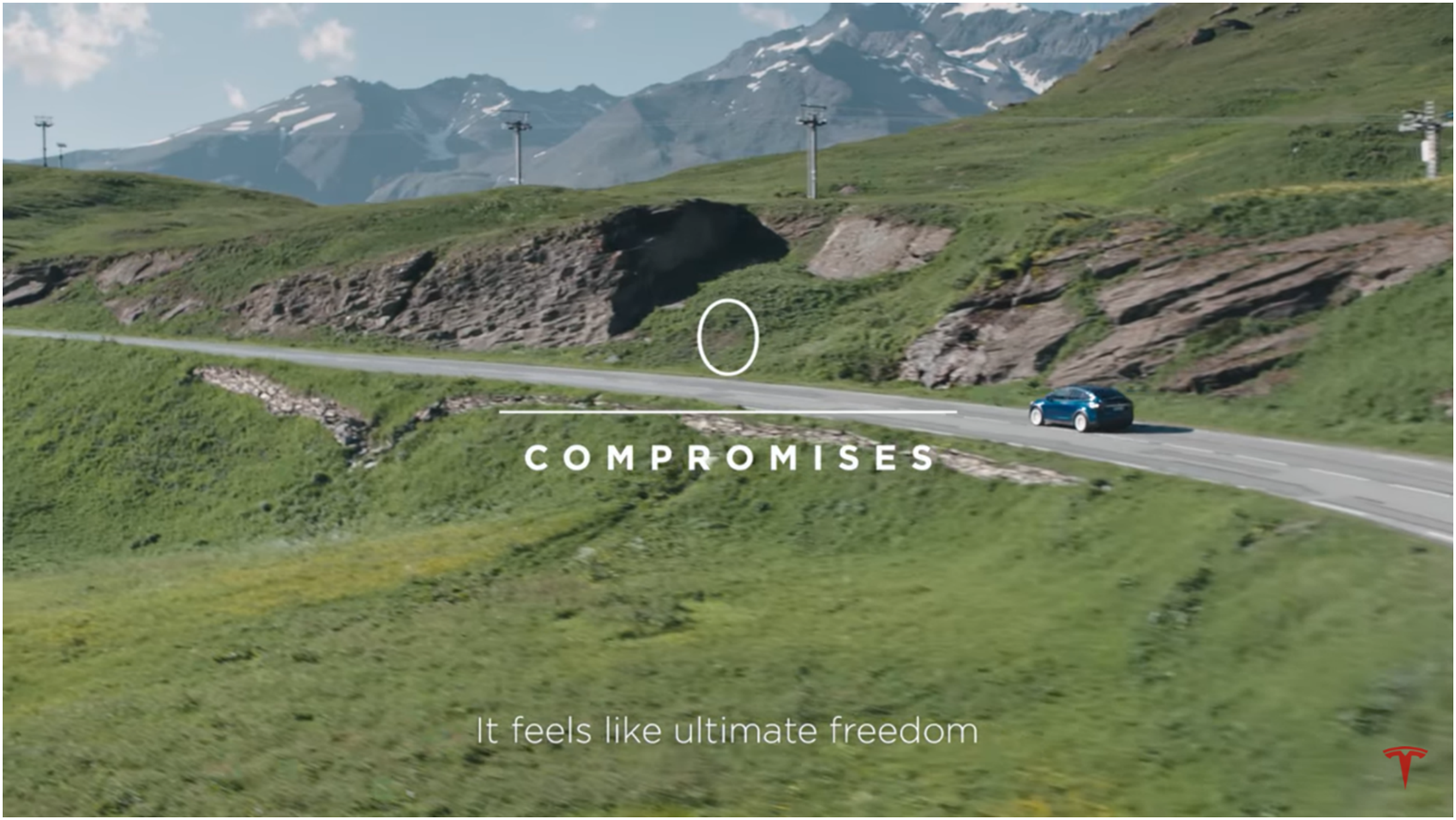
Crucially, younger white men’s freedom boils down to the liberty to perform combustion styles of driving, with shots closely resembling what Redshaw (2018) defines as typical representations of combustion masculinity. Most significantly, a video titled This is LUDICROUS depicts Tesla as a racing car by multimodally showcasing its acceleration; shots lowered down onto the street level visually give a sense of acceleration while the lack of background music acoustically emphasizes the sounds that the car produces as it accelerates. Interestingly, as the video ends with the car stopping on the finishing line of a racetrack, the text “1 sigh of relief” appears on screen while the driver is heard exhaling. This last shot can be interpreted in different ways; however, by showing the “0 emissions, 0 compromises” tagline right after, the video arguably constructs the driver’s exhale as expressing a sense of reassurance as he remembers that—thanks to the vehicle’s electric engine—he has not had a negative impact on the environment despite his combustion style of driving. Through a “0 emissions, 0 compromises” rhetoric avoiding any thematization of possible sustainability downsides in the production, charging and disposal of electric batteries (Hawkins, Gausen, and Strømman 2012), Tesla ties younger white men’ endorsements of environmentalism to exhibitions of combustion—reconciling what oil-based systems of mobility had shaped as conflicting gendered scripts.
In this way, Tesla’s imaginaries announce that combustion masculinity does not need to be sacrificed in the name of environmentalism because Tesla’s driver-car preserves the driver’s freedom to drive recklessly together with their ‘impactlessness’. What is more, Tesla’s narrative sets the possibility for the former to be grounded in the latter: by constructing the vehicle’s environmental ‘impactlessness’ as the combustion driver’s reassurance, the video seems to communicate that Tesla drivers can indulge in combustion driving because of the car’s engine technology. In this sense, Tesla’s representations resemble depictions of ecomodern masculinities (Hultman 2013): electric engines are constructed as impactless technologies that enable drivers to disguise combustion styles of driving as acts of environmental care, safeguarding the legitimacy of combustion masculinity during times of climate change—and ultimately create a space for white, class-privileged men to appear as part of the solution despite making up the bulk of the Western oil economy. Empowered by the vehicle’s “0 emissions”, younger white men avoid getting soaked in poisonous and detrimental patterns of oil-based mobility, acquiring (or maintaining) the liberty to configure their (reckless) driving style beyond “any compromise”; all they need to do is charge their vehicle.
By this logic, electric batteries afford the driver-car the capacity to ground endorsements of environmentalism within traditionally hegemonic energy-epistemologies: Tesla’s younger white male drivers choose electricity over oil but remain as “soaked” in violent and reckless consumptions of energy as petro-masculinities. Fully charged up, the car-driver penetrates and assimilates previously hostile and gender-threatening scripts of environmental care, rearranging itself as an ecomodern sociotechnical actor who, by moving and relocating, debunks that “preventing disastrous planetary change will require […] new ways of thinking about, valuing, and inhabiting energy systems” (Daggett 2019, 2). In this sense, Tesla’s BEVs discursively function as Günel’s (2019, 152) technological adjustments: far from sparking critical conversations on impactful driving styles, ecomodernism reduces environmental activism to a choice of alternative fuels, leaving unquestioned what it means for gendered, classed subjectivities “to demand space, speed, and comfort in the first place”.
Caring Masculinities, Environmentalism, and Older White Drivers
Unlike their younger counterparts, older white men do not ground articulations of environmental care in ecomodern rhetoric of the vehicle’s sociotechnical ‘impactlessness’, but rather make sense of their environmentalism as a proactive involvement to provoke positive societal impact. More precisely, these drivers predominantly explain their EV adoption in terms of a responsibility they hold towards others and future generations. Thomas, an older white Danish man appearing in Tesla Taxi Brothers, for example, describes how driving a Tesla as a taxi allows him to protect disadvantaged groups in his local community (i.e., villagers with hearing impairments) from noise pollution thanks to the silent electric engine. In this way, the technological dimension of the vehicle affords Thomas the possibility to express his other-orientedness through his patterns of mobility, aligning himself with the careful consideration for others characteristic of caring masculinities (Elliott 2016). Hence, Tesla imagines older white men’s EV adoption as (re)shaping the driver-car into an environmentalist sociotechnical actor that dismisses enactments of combustion masculinity and disseminates care as it moves and relocates. 2
Notably, far from rushing through desolated natural landscapes, older white men are predominantly portrayed driving in urban settings; a set of geographies that position the driver-car within networks of actors that transform its movements within gendered spaces of action. Obstacles populating urban environments (e.g. buildings, road signs, other vehicles, pedestrians) physically and symbolically discourage careless acceleration: Tesla’s vehicles are shown driving at reduced speeds or executing careful maneuvers (Figure 2), waiving scripts of combustion masculinity as enacted by younger white men. Restrained and slowed down, these vehicles are constructed as artifacts that owners use to carry out acts of care and stay close to individuals they care for; they drive children to school, share the car-space with other family members, or personally deliver goods to clients. For example, Fangio, a white Belgian male chocolatier appearing in a video called Sweet Ride, illustrates both physical and emotional proximity to others: he is shown using his Tesla to transport his chocolate to his clients while he vocally stresses that he does it himself to have that “personal touch” with them. Even when leaving urban settings, older white owners do not associate driving with individualist fantasies of freedom and solitary adventures that Tesla constructs as resonating with enactments of combustion driving: they remain physically and symbolically entangled within networks of care. Christian, an older white man from Luxembourg in a video called Family Ski Trip, characterizes his Tesla as a family car, praising it for its spaciousness, allowing him to comfortably share the car-space with two kids and a wife during a family holiday, when it is “extremely important to spend time together”. Still from “A Clean Future” (0:12).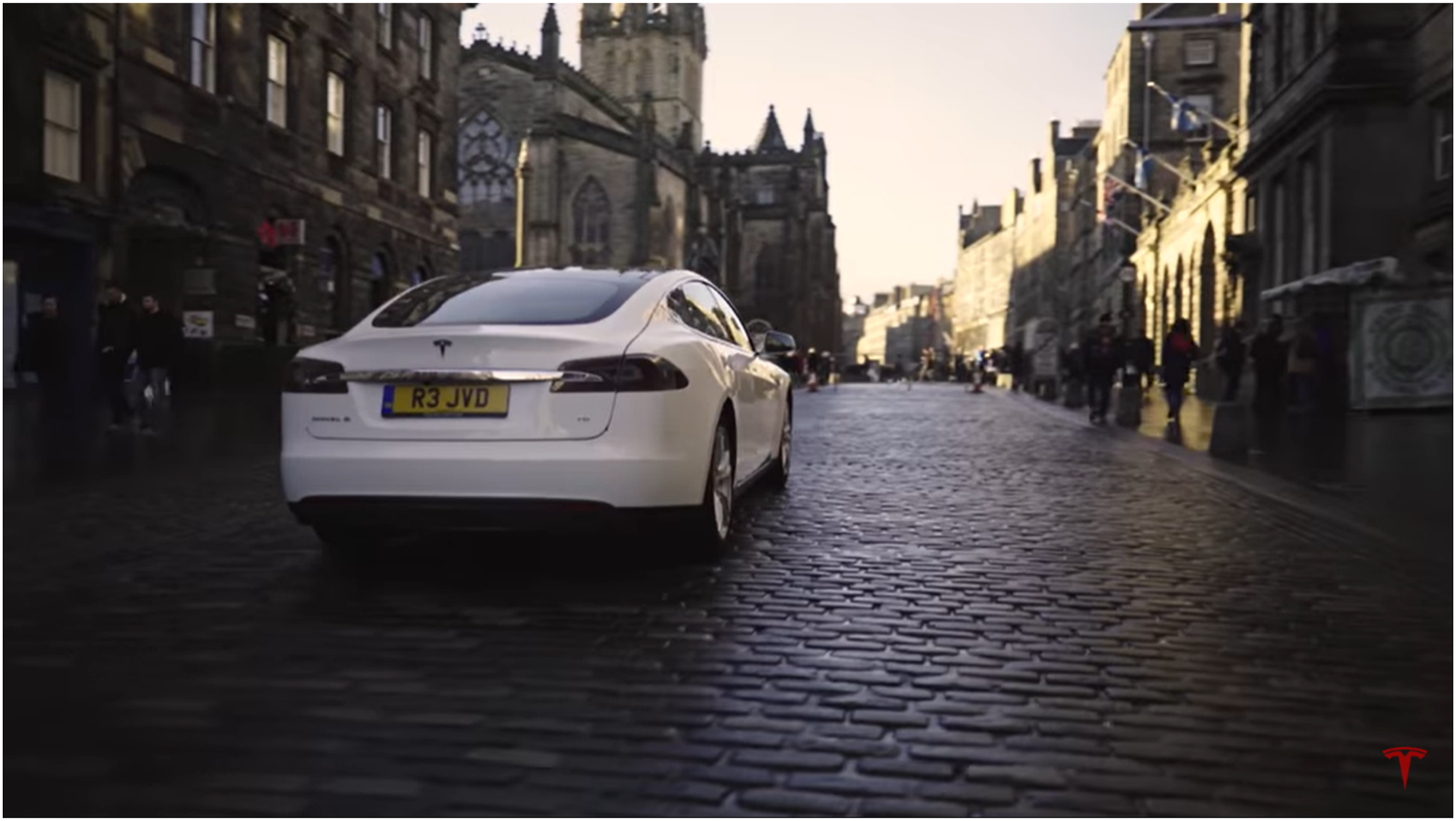
Wen-Wu Masculinities, Environmentalism, and Asian Drivers
The gendered discourses that Asian men employ to articulate discussions of environmentalism are significantly less structured on an age-dependent divide when compared to the ones employed by white men. The example of the Chinese drivers in Zero-emission Road Trip – East China shows how younger Asian owners participate in driver-car assemblages that move within spaces of gender action that, with respect to white masculinities, are represented as accessible to older owners only.
Extract 2
Imagine if everyone was driving a Tesla (2.1) and there would be much less pollution (2.2). If everyone were to drive electric cars, the sky would be blue again (2.3).
The explicit thematization of the problem of pollution (2.2) allows younger Chinese drivers to foreground understandings of their EV adoption as an act of environmental activism that resembles older white men’s commitment to accomplish a positive societal impact, which here is symbolized by the metaphor of the sky becoming blue again (2.3). By implicitly encouraging others to follow their example (2.1), younger Chinese men articulate electric mobility as a communal enterprise to be endorsed on a wide societal level, aligning their environmentalism with the cultural prominence of collectivism in Confucian nations (Chan 2001; Hofstede 2001). Notably, Tesla constructs group cohesiveness as an expressively Asian configuration of the driver-car: 81% [n = 13] of the videos featuring Asian drivers showcases multiple owners through collages of different consumer stories; in comparison, 78% [n = 25] of the videos featuring white owners portrays a sole driver. Additionally, while white men consistently introduce themselves by mentioning their name at the beginning of the video, Asian drivers are often not named. In line with this, younger Chinese drivers articulate a collective, activist adoption of electric automobility to positively affect street safety through EV adoption: they enact non-combustion styles of driving (i.e. moderate speeds and cautious maneuvering through urban environments) to echo classical ideals of a considerate, respectful, and group-oriented masculinity (Kim and Choi 2005). These configurations of non-aggressive gendered action remain unpopular amongst younger white men, who—inhabiting Western individualistic fantasies of freedom and solitary adventure (Hofstede 2001)—appropriate space on the road as invasive and dangerous actors capable of great destruction, utilizing impactless electric engines to fulfill desires of liberation from environmentalist and societal criticism.
Surely, when compared to Western standards of petro-masculine hegemony, Tesla’s representations of younger Asian men seem to display non-hegemonic scripts of masculinity wrapped up with benevolence and compassion. Yet, complications arise when drawing this conclusion; understanding Tesla’s representations as non-hegemonic purely in view of the absence of explicit endorsements of petro- and combustion masculinity would subject Chinese drivers to Western images of toughness and Western assumptions of a masculine “proclivity to violence”, none of which is necessarily and unilaterally reflected in Chinese ideals of masculinity (Louie and Edwards 1994). Indeed, Tesla’s representations of older Asian owners cannot be reduced to Western logics of hegemony: the case of a Chinese father appearing in Tesla in China is exemplary.
Extract 3
As a dad (3.1), I chose Tesla for its safety (3.2). […] A 7-year-old girl knows that there are electric cars. This way we planted a seed of environmental protection in a kid’s heart (3.3).
The man first employs discourses of safety (3.2) to construct himself as a protective father (3.1). He then switches to scripts of combustion as he enthusiastically praises Tesla for its capacity to accelerate from 0-100 km/h in less than 3 sec, and lastly combines environmentalist metaphors with a caring attitude towards his child (3.3). In doing so, he blends endorsements of environmentalism and paternal care with enactments of combustion driving in ways that were not recorded in relation to white Tesla owners.
Arguably, these discursive disparities originate from and are sustained by incongruities in how different hegemonic ideals dictate how care and combustion might (or might not) co-exist within masculinities. Measured up against Western standards of petro-masculinity prescribing the rejection of environmental care through violent celebrations of combustion (Daggett 2018), white fathers make sense of combustion as an intrinsically anti-caring activity, so that exhibitions of paternal care urge them to dismiss combustion masculinity to maintain a certain congruency of pro-caring (and possibly anti-hegemonic) discourses throughout the videos (Elliott 2016). Conversely, guided by the harmony and balance between two coexisting forces of “Wen-Wu” masculinity ideals (Louie and Edwards 1994), Asian fathers do not reduce fatherhood and combustion masculinity to strictly defined and mutually exclusive gendered scripts: the fluidity of discourses with which they merge paternal care with demonstrations of combustion power testify how caring masculinities (can) engage in the simultaneous rejection and uptake of hegemony rather than a wholesale rejection of masculine hegemony (Hunter, Riggs, and Augoustinos 2017). In this sense, Asian men draw possibilities of coexistence between gender scripts that white men recognize as contrasting facets of how masculinity might and should be “done”.
Technology Enthusiasm, Technoerotic Fantasies, and White Drivers
Tesla strongly differentiates how discourses of technology are articulated by white owners of different ages. While representations of younger men ascribe marginal importance to the technological interfaces Tesla owners have access to (e.g., built-in touchscreen, vehicle’s software), depictions of older men present extensive constructions of Tesla as a technologically advanced vehicle that exhibits a ‘nerdy’ enthusiasm for innovation. Better Over Time, a video featuring four white middle-aged American men, is illustrative.
Extract 4
We started, I wanna say, with a 3.2. Now we’re on 8 (4,1). […] So even in our classic 2012 car (4.2), it gets better with time (4.3).
Following one of the men’s initial software-centered description of his Tesla (4.1), all protagonists describe how Tesla “gets better with time” thanks to its ability to support software updates (4.3), praising their cars as a source of constant technological innovation that allows them to continuously construct themselves as innovation and technology enthusiasts, regardless of how old the “hardware” of the vehicle—or the driver – is (4.2).
Overall, autopilot feeds into these technology-driven imaginaries of automobility. Crucially, however, the reorganization of power balances engendered by automation complicates how men are able to align with Western logics of hegemony. Dan, a white middle-aged American man in The eight Kegs SUV, exemplifies how men’s discourses shift.
Extract 5
Our brewery is fully automated, so is my Tesla (5.1). I love technology as a whole (5.2). Autopilot: I'm addicted to it (5.3). It makes those frustrating drives and massive traffic fun because it takes over for you (5.4). It is fun, it is really fun (5.5).
Overall, Dan emphasizes his enthusiasm for autopilot – a “really fun” technology (5.5) he is “addicted to” (5.3) – seemingly proclaiming and celebrating ‘demasculinization’ of driving as a result of AV adoption. Indeed, by describing Tesla’s takeover (5.4) as “fun”, Dan raves about losing access to what Weber and Kröger (2018, 16) describe as a “major element of doing masculinity”, namely the driver’s manual control over the vehicle. At the same time, however, the video articulates Dan’s driving experience along strikingly masculine dynamics. By drawing a parallel between Tesla’s capacity to self-drive to his brewery’s capacity to “self-brew” (5.1), Dan foregrounds discourses that construct automation as a technology that plays a masculine role in his professional life: recurrent visual depictions of industrial machinery (Figure 3) are coupled with vocal characterization of Tesla the “ultimate beer run machine”, as the vehicle is praised for its capacity to accommodate eight kegs of beer for a delivery to a baseball stadium. A still from “The eight Keg SUV” (0:18).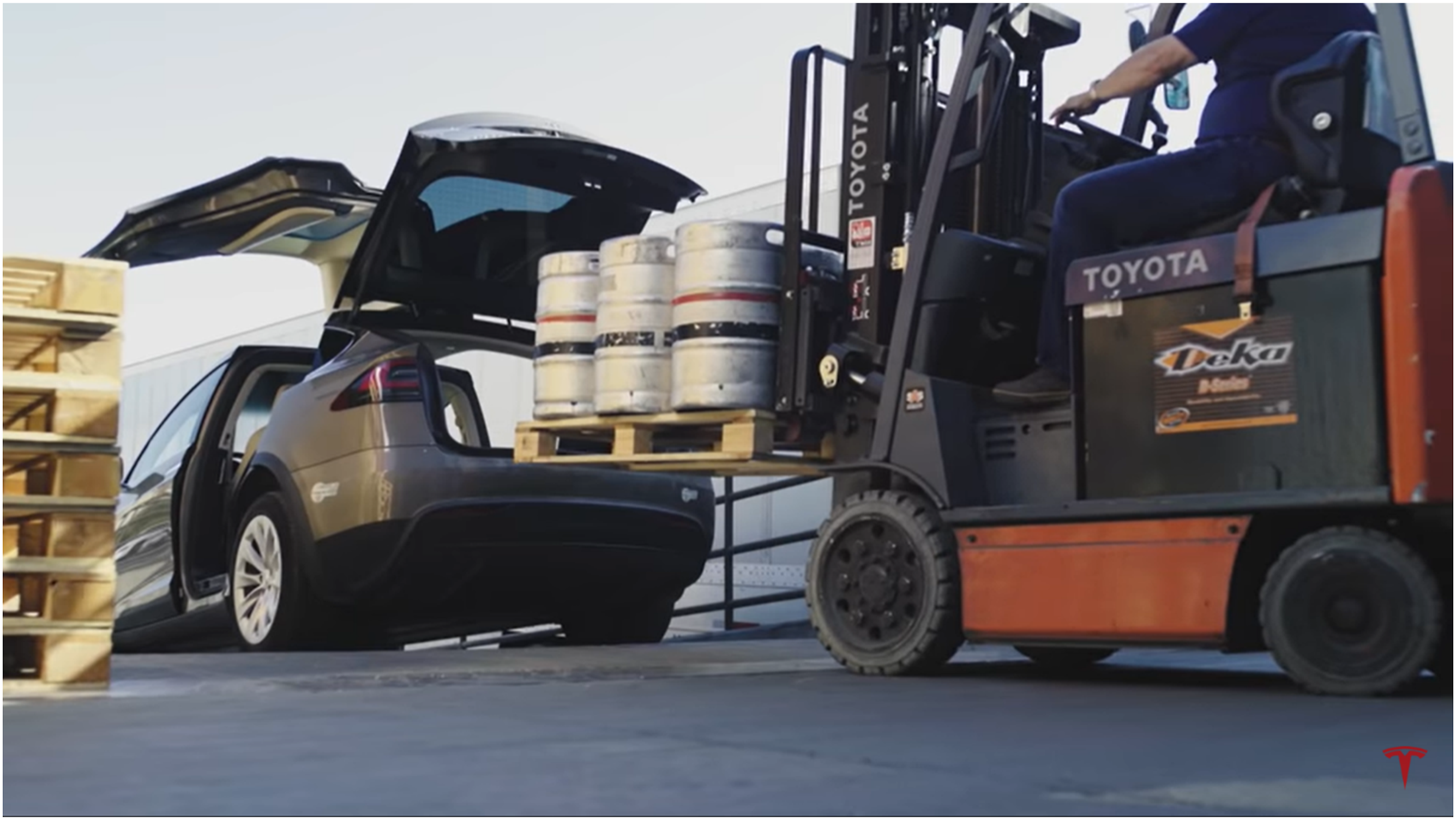
We take the ambiguity of these representations to illustrate Tesla’s attempt to leverage the Western hegemonic idiom of a masculine love for “technology as a whole” (5.2) against the threat that autopilot poses to desires of domination and control inspiring white men’s technoerotic fantasies (Kleif and Faulkner 2003). Multimodal constructions of enthusiasm and excitement along traditionally masculine technoerotic symbolism assist Dan in over-masculinizing automation and recasting men’s pleasure with technology in terms of amusement and play: stripped of control, men discover new intimacies in being “taken over” by something they love as much as technology. “Fun” articulates men’s experiences around over-masculinized emotional dynamics that reshape threats of submission and capitulation as proclamations of techno-eroticism and tech-savviness, crystallizing fantasies of “men’s love affair with technology” within drivers’ automated mobility patterns (Oldenziel 1999). Hence, expanding on Günel’s (2019) technological adjustments, we take amusement and play to function as social adjustments, which we understand as discursive devices tweaking social experiences in ways that advance solutions to sociotechnical problems that favor the maintenance of status-quo gendered subjectivities. Specifically, “fun” opens a space for men to redraw how power, pleasure, and masculinity intersect behind the wheel, where technoerotic fantasies of hegemonic masculinity are tweaked and maintained through newly redefined intimacies with automation. Yet, access to such empowering configurations of behind-the-wheel masculinity and the affiliated capacity to weave new hegemonic alliances between loss of control and technology remains wrapped up in class privilege of wealthy drivers.
Technology Enthusiasm, Combustion, and Asian Drivers
Reminiscent of our discussions on environmentalism, the gendered discourses that Asian owners employ to make sense of Tesla as a technologically advanced vehicle are significantly less structured on an age-dependent divide compared to the ones enacted by white owners. Specifically, both younger and older Asian men combine enactments of combustion with a passionate enthusiasm for technology and innovation, shaping gendered spaces of action that Tesla represents as remaining simultaneously inaccessible to white men. The case of Koutaro, an older Japanese man in Tesla Japan | Future, is exemplary.
Extract 6
For me, it is a device connected to the Internet of Things (6.1), it is not a car (6.2).
Koutaro characterizes Tesla as a technological device (6.1) and even explicitly denies it being a transportation vehicle (6.2), while he is shown performing combustion driving: the man is portrayed activating “Ludicrous Mode” right when he describes Tesla as a “device connected to the Internet of Things” (6.1). 3 Notably, the fluidity of these representations is not disturbed by the reorganization of power balances engendered by automation. In a video called Joy of driving, three Japanese men describe autopilot as a reliable and safe technology: significantly, this is the only instance in the corpus where a driver is depicted without their hands on the steering wheel during autopilot mode. Right after these scenes, the same men are heard praising Tesla’s capacity to accelerate from 0-100 km/h in less than 3 sec.
What is more, Tesla’s gender narratives illustrate, once again, the irreducibility of Asian men’s discourse to Western logics of hegemony. Measured up against Western desires of domination and control that traditionally inspire men’s technoerotic fantasies (Kleif and Faulkner 2003), white men make sense of autopilot as an intrinsically gender-threatening technology, over-masculinizing automation through technoerotic discourses of amusement and play before embracing it in their patterns of mobility. Conversely, guided by gendered cosmologies that do not prescribe self-centeredness and aggressive self-enforcement as strongly (Chan 2001; Hofstede 2001), Asian men do not reduce pleasure and individual submission to conflicting gendered scripts: the fluidity of discourses with which they articulate their “joy of driving” as a feeling deriving from a sense of safety and relaxation – as they give up manual control over the vehicle – as well as exciting thrills – as they deploy the machine’s combustion power – echoes the harmony and balance between two coexisting forces characteristic of traditional Chinese ideals of a “Wen-Wu” masculinity (Louie and Edwards 1994, Louie 2015). In this sense, Asian men draw possibilities of coexistence between gender scripts that Western men recognize as traditionally contrasting facets of how masculinity might and should be ‘done’, enthusiastically embracing their submission to autopilot without over-masculinizing automation or articulating it under technoerotic dynamics of an exciting loss of control.
Conclusion: Ecomodernism, Techno-Eroticism, and Sociotechnical Adjustments
Inspired by the ambiguity of gendered meanings disclosed within corporate discourses, we investigated how Tesla multimodally represents the transition to electric and automated systems of automobility, highlighting how these representations reflect and shape hegemonic masculinities between scripts of ecomodernism and techno-eroticism. Ultimately, Tesla advances inherently classed imaginaries that negotiate scripts of masculinity along intersectional logics of representation, associating drivers of different ages and ethnicities with different capacities to negotiate their masculinity as ecomodern combustion drivers and ‘nerdy’ technology enthusiasts.
In this paper, we showed that Tesla’s gender narratives sketch a future of mobility dominated by gendered sociotechnical adjustments, where neither energy-based nor technology-based reconfigurations of automobility seem able to spark critical conversations around radical reconfigurations of behind-the-wheel gendered subjectivities and the realities inhabited by these. Following Tesla’s imaginaries, electric and automated systems of automobility engender networks of actors that afford the driver-car the ability to adjust and tweak Western hegemonic ideals of masculinity to new spaces, forms, and modalities of action: petro-masculinity is adjusted and perpetuated through ecomodern energy-epistemologies; technoerotic fantasies of masculinity are tweaked and maintained through newly redefined intimacies with automation. Crucially, Tesla sells access to these rearranged modalities of gendered action as a privileged, inherently classed prerogative: the vehicles’ high price welcomes middle/upper classes as exclusive guests within the sociotechnical networks required to escape eco-criticism in an era of environmental crisis, embrace safe and automated as “fun” modalities of driving, and – crucially – construct these reconfigurations as reaffirmations of Western hegemonic masculinity. Here, automobility functions as a work of classed culture, where expensive vehicles remove wealthy drivers from gendered complications and societal criticism while structuring environmental sustainability and safety on the road as luxurious, conspicuous consumptions (Bourdieu 1984).
Tesla’s CEO Elon Musk – entrepreneurial multibillionaire, ecomodern environmental hero, and tech-magnate – sits right at the intersection of these (non-) adjusted hegemonic models of masculinity. Musk’s entrepreneurial ventures embody – and often merge – expensive, lavish consumption with ideals of ecomodernism and techno-eroticism, leveraging networks of energy and technology to mobilize gendered, classed subjectivities beyond the surface of our planet: if The Boring Company articulates a subterranean driver-car rushing through an “all-electric, zero-emissions, high-speed underground public transportation system” (The Boring Company n.d.), SpaceX shifts sociotechnical adjustments into space, envisioning “fully and rapidly reusable rockets” making “humanity multiplanetary” (SpaceX 2020). Hence – imagined, modeled, and engineered through Musk’s investments – wealthy masculinities acquire underground and extraterrestrial spaces of gendered action, extending their unquestioned demand for space, speed, and comfort to new geographies of colonialization.
Mobilizing and rearranging narratives of ecomodernism and techno-eroticism, we showed how Tesla affords Asian owners greater flexibility of movement within these spaces of behind-the-wheel gendered action. Drawing upon Louie and Edwards (1994), we argued that “Wen-Wu” ideals of masculinity generate greater possibilities of co-existence between structures of meanings that Western logics of hegemony may construct as conflicting: fatherhood and combustion; pleasure and submission. We take the fluidity of imaginaries tied to Asian owners to shed light onto the rigidity and inflexibility structuring Tesla’s representations of white owners. Specifically, by constricting white owners to structures of gender hegemony that dictate clear-cut, age-dependent forms and modalities of gendered action, Tesla employs a set of discourses that silences alternative (re)constructions of the driver-car assemblage. Particularly crucial in this sense is the absence of representations depicting younger white drivers embracing autopilot over combustion, that is ‘doing masculinity’ through techno-eroticism rather than ecomodernism.
Crucially, reflecting on the implications that the closure of these gendered representations might have on street safety highlights the importance of keeping these alternatives open. While Tesla structures both ecomodernism and techno-eroticism as sociotechnical adjustments that perpetuate gender hegemony, there is in fact an important distinction to make. Unlike electric batteries, “fun” evokes reconfigurations of driving yielding improved overall safety on the road, as the driver-car is afforded the capacity to achieve gender hegemony within safe and legal regimes of mobility. Surely, technoerotic fantasies of excitement might not convince drivers to dismiss combustion by actively questioning what it means for gendered subjectivities “to demand space, speed, and comfort in the first place” (Günel 2019, 152), but they at least have the potential to decrease (rather than increase) the impact of reckless and dangerous gendered subjectivities on the street, as the masculine driver fervidly allows technology to take over. Ecomodernism, instead, sustains and possibly enhances masculinities’ impact on environmental issues as well as the safety of others around them.
To provide further nuance to the discussions presented here, we propose several ideas for further research. Firstly, the lack of ethnic diversity in Tesla’s consumer stories was striking and may pertain to related differences in socio-economic status and to EV and AV adoption being particularly widespread in (parts of) Asia, Europe, and North America (Hertzke et al. 2019). Nevertheless, this explanation glosses over the ethnic diversity present in these regions. In addition to acknowledging a wider range of ethnicities, we encourage an exploration of intersectional issues related to class and socio-economic status in discourses around EVs offered at relatively lower price points. Finally, acknowledging the role that people who do not identify as male play in constructions of both masculinities and femininities (Halberstam 1998; Paechter 2006), future research could investigate how women, for example, participate in the reconfiguration of automobility that Tesla capitalizes on. These projects could explore how consumer stories represent, construct, and engage with the bodies and intersectional identities of female drivers onto impactless and technologically advances modalities of traveling across spacetime.
Supplemental Material
Supplemental Material - “Zero Emission, Zero Compromises”: An Intersectional, Qualitative Exploration of Masculinities in Tesla’s Consumer Stories
Supplemetary Material for “Zero Emission, Zero Compromises”: An Intersectional, Qualitative Exploration of Masculinities in Tesla’s Consumer Stories by Matteo Vivi1 and Anne-Mette Hermans in Men and Masculinities
Footnotes
Declaration of Conflicting Interests
The author(s) declared no potential conflicts of interest with respect to the research, authorship, and/or publication of this article.
Funding
The author(s) received no financial support for the research, authorship, and/or publication of this article.
Supplemental Material
Supplemental material for this article is available online
Notes
Author Biographies
References
Supplementary Material
Please find the following supplemental material available below.
For Open Access articles published under a Creative Commons License, all supplemental material carries the same license as the article it is associated with.
For non-Open Access articles published, all supplemental material carries a non-exclusive license, and permission requests for re-use of supplemental material or any part of supplemental material shall be sent directly to the copyright owner as specified in the copyright notice associated with the article.
