




Abstract
Critical masculinities scholarship has identified a number of ways in which abstention from sex, pornography, and masturbation works to repair and reproduce hybrid and hegemonic masculinities. Though the mercurial and plural nature of contemporary online masculinities is investigated on a number of fronts, analysis to date has often pinned down abstention to a particular subject position, often understood predominantly in its gendered dimensions. In this article, I argue that the anti-pornography, anti-masturbation movement NoFap should be understood as a site of political contestation for the meaning potential of abstention and that these subject positions should be read intersectionally. Through analysis of a large corpus of tweets (6,569) scraped from the micro-blogging site Twitter, I present evidence for seven distinct subject positions linked to discrete myths, which include extreme anti-feminist and anti-Semitic articulations. I argue that this bird’s-eye view of NoFap uniquely lays out competing myths in their specificity, facilitating a nuanced understanding of “morbid” identities.
Keywords
In late 2018, New Statesman tech writer Sarah Manavis described an “insidious” online trend: men challenging each other not to masturbate. If they did not ejaculate (or “nut”) for a month, they would complete “No Nut November” (Manavis 2018). She warned that behind this “risible comradery” lay far-right movements such as the Proud Boys, whose “Western chauvinism” invested anti-masturbation with a “dangerous, active misogyny” (ibid.). On NoFap.com, where the world’s most successful anti-masturbation movement hosts its discussion boards (see Hartmann 2020; Taylor and Jackson 2018) reaction to Manavis was swift and furious. Hers was a “sham article by a sham writer.” 1 Users stated that because NoFap promotes masturbation abstention as a remedy for addiction to pornography, which degrades women, they were engaged in the fight against misogyny. Some pointed to the forum rules, which explicitly prohibit discriminatory and exclusionary language. By contrast, others attacked the journalist’s analysis as typical of “SJW [social justice warrior] Liberals” intent on “creating their own ever-narrowing hellscape of acceptable speech and behavior.” While some defended NoFap as a progressive movement, others claimed that “feminists” like Manavis want men to be “frail and submissive” as they “hate masculinity and testosterone.”
NoFap has made several attempts to establish a mainstream, scientific, and apolitical orthodoxy around its program. To this end, a core doctrine (the “Porn Addiction Basics”) 2 is supplemented by moderated forum discussions, branded social media networks, and canonical YouTube videos (see Hartmann 2020). They insist that it is “unacceptable” to use NoFap “as a generic word for quitting porn or abstaining from masturbation.” 3 And yet NoFappers persist in articulating abstention from masturbation and porn as advancing specific and often extreme sociopolitical visions that deviate far from the official NoFap line. What might we learn from these dissenters, both inside and outside the official movement? Why is there such a struggle over the “true” character of NoFap? And what can analysis of this struggle tell us about contemporary masculinities?
This article reads NoFap as a site of political contestation characterized by discursive struggle to fix the meaning of masturbation abstention. Far from giving disproportionate scholarly attention to a marginal digital community, the analysis engages robustly with masculinist and right-wing discourses that are at the very center of anti-democratic political action, as evidenced by the occupation by Proud Boys (amongst others) of the U.S. Capitol on 6 January 2021. While research to date has focused on how hegemonic masculinity is repaired and reproduced in NoFap, whether seen through an anti-pornography (Taylor and Jackson 2018) or anti-masturbation (Hartmann 2020) lens, my approach here is to unpick the complexities of performances of sexuality, masculinity, and also of race and racism, through laying out a large corpus of NoFap articulations, to analyze how they cluster and why, without choosing a lens upfront. As I show below, practitioners of NoFap tend to construct their subjectivities within seven distinct mythic structures, certain of which are associated with the “toxic technoculture” (Massanari 2017) of the “manosphere” (Ging 2019; Van Valkenburgh 2018). This analysis thus responds directly to the call to account for NoFap’s relation to “manospherian subjectivities” (Hartmann 2020, 17). The bird’s eye view of NoFap goes further, making a number of masculinity’s “morbid symptoms” (Gramsci 1971, 276) visible, and bringing the dynamics of antagonistic worldviews into relief.
Saying No, Going Your Own Way
Outside of specific institutional contexts, men’s abstention from sexual activity bears an uneasy relation to hegemonic masculinity constructed as (hetero)sexually motivated and always “up for” sex (Terry 2012; see also Connell 1987). The “male sexual drive discourse” (Hollway 1984) produces men’s (hetero)sexuality as inevitable and beyond control, at times making sexual refusal unintelligible to others (Meenagh 2020). While it may be unexpected, abstention can work to bolster hegemonic masculinity, as a tactic to control the “unruliness” (Terry 2012, 875) of sex. Resistance both to social pressure from the “outside” and the internal pressure of the “sex drive” ultimately confirms masculine self-control and autonomy (Terry 2012). Similar dynamics are brought into play when men overcome “addiction” to (ostensibly shameful) pornography use, which is constructed as a masculine feat that underscores their “agency, autonomy, and accomplishments” (Burke and Haltom 2020, 22). When porn addiction is constructed as a medical condition rooted in brain chemistry, the fight against it is valorized. The religious men studied by Burke and Haltom (2020) mobilized the cultural schemas of their faith to access a “redemptive” masculinity that destigmatized their historical porn use, which they understood as the result of their God-given biological makeup being “hijacked.” The figure of the porn “addict” also enables the construction of the “non-addict” whose consumption of pornography is thereby normalized, as Taylor and Gavey (2020) observe in Aotearoa/New Zealand. Ethical debates over porn’s role in the reproduction of sexist social relations are thus crowded out by a medicalized discourse of addiction. While these addicts are convenient “scapegoats” for “normal” users, they may also be positioned as “victims” bravely battling their disease (ibid.). This is largely the discursive terrain of NoFap.
NoFap (“fap” ostensibly mimics the sound of self-pleasure) advocates masturbation abstention as the key behavior necessary for fighting pornography addiction. As Taylor and Jackson (2018) show in their analysis of the r/nofap subreddit, NoFappers’ rejection of porn is motivated not by feminist critiques, but by the threat it poses to the stability of the patriarchal order. Fapping to porn is the emasculating opposite of the achievement of “‘real’ heterosex” (2018, 629) and much of their conversation articulates standards for performing the role of a “real” man (2018, 631–633). In her analysis of the NoFap YouTube video canon, Hartmann (2020) identifies continuities between historical and contemporary processes of subject formation in masturbation discourse. Masculine self-relation in Western liberal societies is enmeshed in discourses of merit and reward, where the continent, self-contained, rational actor is constructed in opposition to femininity. Under the rules of this “meritocratic heterosexuality” increased effort from men is rewarded by pleasure from women, in a “totalizing rationality governing the exterior world, as well as the male organism” (2020, 16).
Hartmann notes that NoFap could be an “entry point” into “more explicit manospherian content” (2020, 17). “Manosphere” picks out the network of blogs, websites, and discussion forums where reactionary and anti-feminist masculinities are constructed and affirmed online (Ging 2019; Marwick and Caplan 2018; Van Valkenburgh 2018). Analysis of this formation has accounted for and taxonomized misogynist subjectivities in fringe spaces, including “involuntary celibates” (incels) and “men going their own way” (MGTOWs), who claim to choose celibacy (Ging 2019). Some of these identities are associated with extreme and virulent forms of misogyny, and with acts of terrorist mass murder such as those in Santa Barbara in 2014 and Toronto in 2018. Ging (2019) argues that denizens of the manosphere perform “hybrid masculinities” (Bridges and Pascoe 2014) as their “self-positioning as victims of feminism and political correctness enables them to strategically distance themselves from hegemonic masculinity, while simultaneously compounding existing hierarchies of power and inequality online” (Ging 2019, 651). Through constant online harassment they are able to push women out of specific online spaces and thereby “exert a powerful chilling effect on the Internet’s nonmanosphere spaces” (2019, 653; see also Marwick and Caplan 2018).
What is raised by both Hartmann’s suggestion (2020) of an “entry point” and Ging’s (2019) division of the Internet into manosphere and non-manosphere spaces is the question of whether online misogyny has identifiable boundaries and measurable dimensions. While certain sites may be easily classified as “belonging” in the manosphere, this is far more difficult to do with ever-multiplying online spaces for the expression of mercurial, hybrid, and evolving masculine identities. The “man” in the “manosphere” also risks restricting the discussion to sex and gender, distracting attention from other “key tropes” (Ging 2019, 647) such as racism and Islamophobia. Indeed, we need closer analysis of why NoFappers worry that masturbation is a threat to “western civilization” (Taylor and Jackson 2018, 631); why men fantasize about the rape of White feminists by “Abdul Mohammed Yousef Camel Jockey” (Ging 2019, 647); and why “experts” on pornography construct “abnormal” use as ultimately threatening a “strong New Zealand” (Taylor and Gavey 2020, 890). At a time when the identity politics of angry White men energizes anti-democratic movements, it is more important than ever to “ask the other question” (Matsuda 1991) in recognition of the profound interconnections of (hetero)sexist, racist, ableist, and classed hierarchies.
Mapping NoFap: Myths and Methods
In order to read attempts to “fix” the meaning of NoFap as part of on-going discursive struggle on a limitless semiotic field, I studied how the term has been used on the popular micro-blogging and social media platform, Twitter. While there are good reasons to be skeptical of the notion that Twitter functions as a true “public sphere” (see Fuchs 2014) the platform is known for its disputatiousness, as it creates room for the expression and contestation of a broad range of social and political positions, where varied identities are formed and performed (Papacharissi 2012). Discussion on Twitter tends to be less “secluded” than on specific Reddit threads, for example (Hartmann 2020). Twitter’s single stream of micro-blog posts separable into topics by hashtags or word searches allows for contestation across ideological spectra to be analyzed in ways not afforded by the organization of other social media platforms, which tend to be divided into groups, pages, or channels. My scrape of Twitter for all tweets containing the term “nofap” conducted in April 2019, using the open source python script twint.py, yielded a corpus of 200,285 unique tweets from 28,580 accounts. 4 “Big data” such as these do not, however, “speak for themselves” (González-Bailón 2013), and require robust and appropriately theorized qualitative frames to interpret their social import (see Marwick 2013).
In my analysis of this corpus, I was interested in how “nofap” appeared as an element of a particular “myth,” defined as “an ensemble of equivalential images capable of galvanizing the imaginary of [a social group] thus launching them into collective action” (Laclau 2014, 33). In post-Marxist, post-structural approaches to discourse analysis, this “myth” becomes hegemonic only when it fully inscribes itself onto the social imaginary, and much of human social and political life is interpreted as a struggle for hegemony between these “galvanizing” semiotic chains. Part of the work required from the discourse analyst is thus an account of attempts to fix the meaning potentials of discursive elements as “moments” in specific discourses. This is typically achieved when social agents “articulate” elements around core values or “nodal points” that give a discourse its unique character (Laclau and Mouffe [1985] 2001). What makes an articulation mythic is the extent to which it attempts to explain social life, to provide “answers” to the sense of “dislocation” created by the contingency of all forms of identification (Laclau 1990, 31). Individual subjectivity is produced where a particular explanation secures the affinity of a social agent, who is both interpellated by the discourse and works as the condition of its reproduction.
In a world where traditional masculinities have been undermined by neoliberalism, globalization, and other challenges to the gender order (Kimmel 2003; Van Valkenburgh 2018), the contingency of an idealized masculine identity becomes apparent, engendering the “morbid symptoms” (Gramsci 1971, 276) evident in the manosphere and elsewhere (see also Howson 2006). The purpose of my analysis of the NoFap corpus is thus to tease out and reconstruct the interpellation of specific subjectivities through processes of myth-making, sketching their logics, interconnections, and relative popularity.
On Twitter, the influence of specific users grows in proportion to how many people follow, retweet, like, or engage with them. For the purpose of this study, I focused only on regular, English-speaking, high-influence users, whom I defined as averaging two or more likes, retweets, or replies over four or more NoFap tweets. This narrowed a huge corpus down to 468 “influencers” and 8,579 tweets. Less than half of these influencers (211, accounting for 6,469 tweets) tweeted to support NoFap; the remainder engaged in mockery or ridicule, reportage or analysis, or used “NoFap” incidentally as part of a joke or meme. These articulations are also worthy of analysis, but here I consider only the myths articulated by highly engaged, NoFap-supportive, English-speaking Twitter influencers.
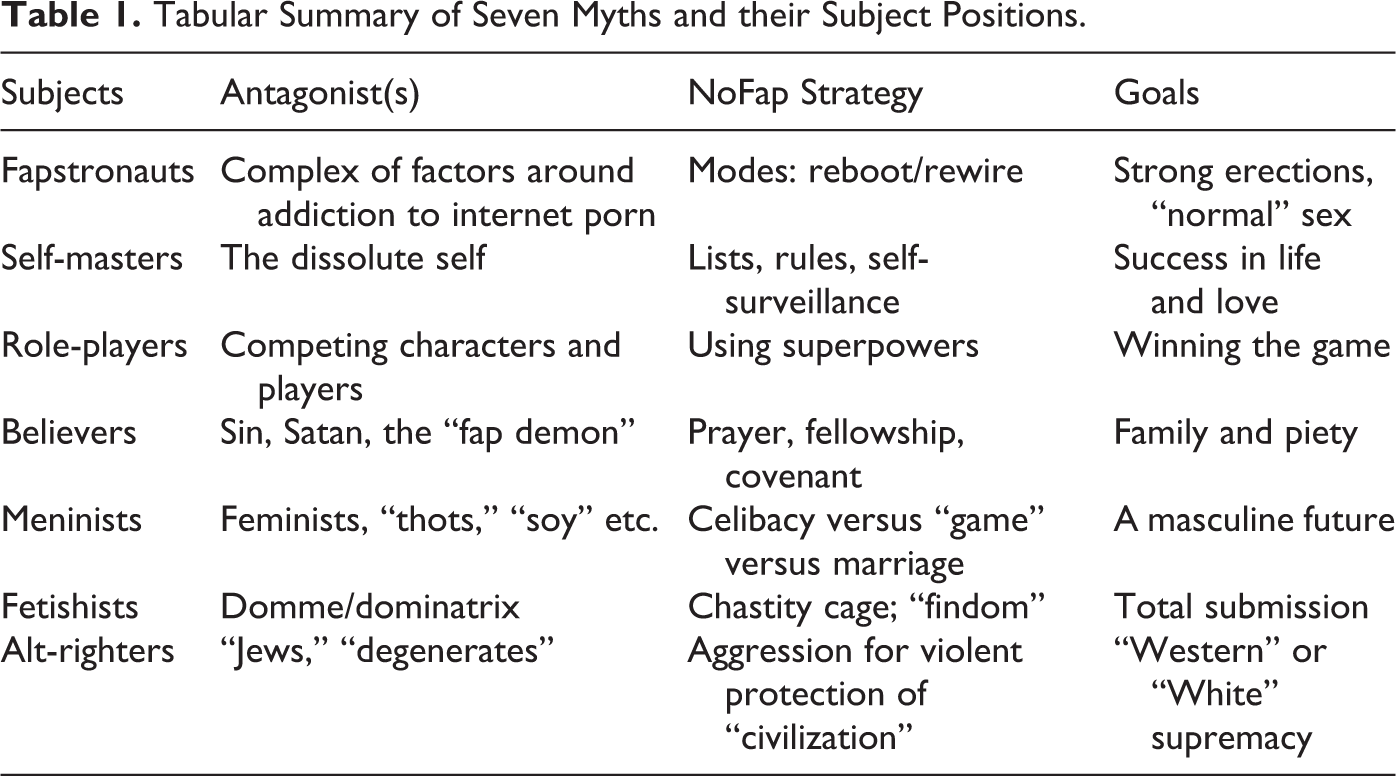
I analyzed the corpus using an iterative coding process, which identified recurrent words and semantic chains (tracked with AntConc software), still and video images, hyperlinks, as well as orthographic, typographic, and layout features. As I developed working theories for the relations of these elements, I assigned them to temporary discourse clusters, and then to aggregate small clusters into larger ones, resulting in the identification of seven distinct “image ensembles.” These clusters should not be understood as reflecting the essential “truth about” NoFap, or this sampling methodology as evidence of “positivist anxiety” (Prasad 2017, 2). These clusters are inevitably my subjective reconstruction of patterns in the discursive struggle. Each of the myths I identified interpellates a specific masculine subjectivity that is threatened in some way, requiring action from the NoFapper. The questions I thus asked within each of these myths were: Who is the ideal subject? What are their goals? Who/what antagonizes them? and What are their strategies to achieve their goals and overcome their antagonists? (Table 1).
Tabular Summary of Seven Myths and their Subject Positions.
Seven NoFap Subjectivities
I will now briefly map out each of these subjectivities, identifying typical moments in their mythic structure. Though the Twitter accounts quoted are all public, users may fairly expect not to be cited in research publications, I anonymize users participating in NoFap under what might be their own names (where I change the handle to @user01, 02…) but not those publicly promoting it (such as @gabedeem, an anti-porn activist and NoFap entrepreneur), nor those whose Twitter handles are pseudonymous and contain relevant semiotic material. Where individual words or short phrases are italicized without reference to a specific user or date, this indicates that they appeared in a number of different tweets. While some accounts belonged squarely in only one category, many articulated elements from more than one category. These overlaps are represented in Figure 1.
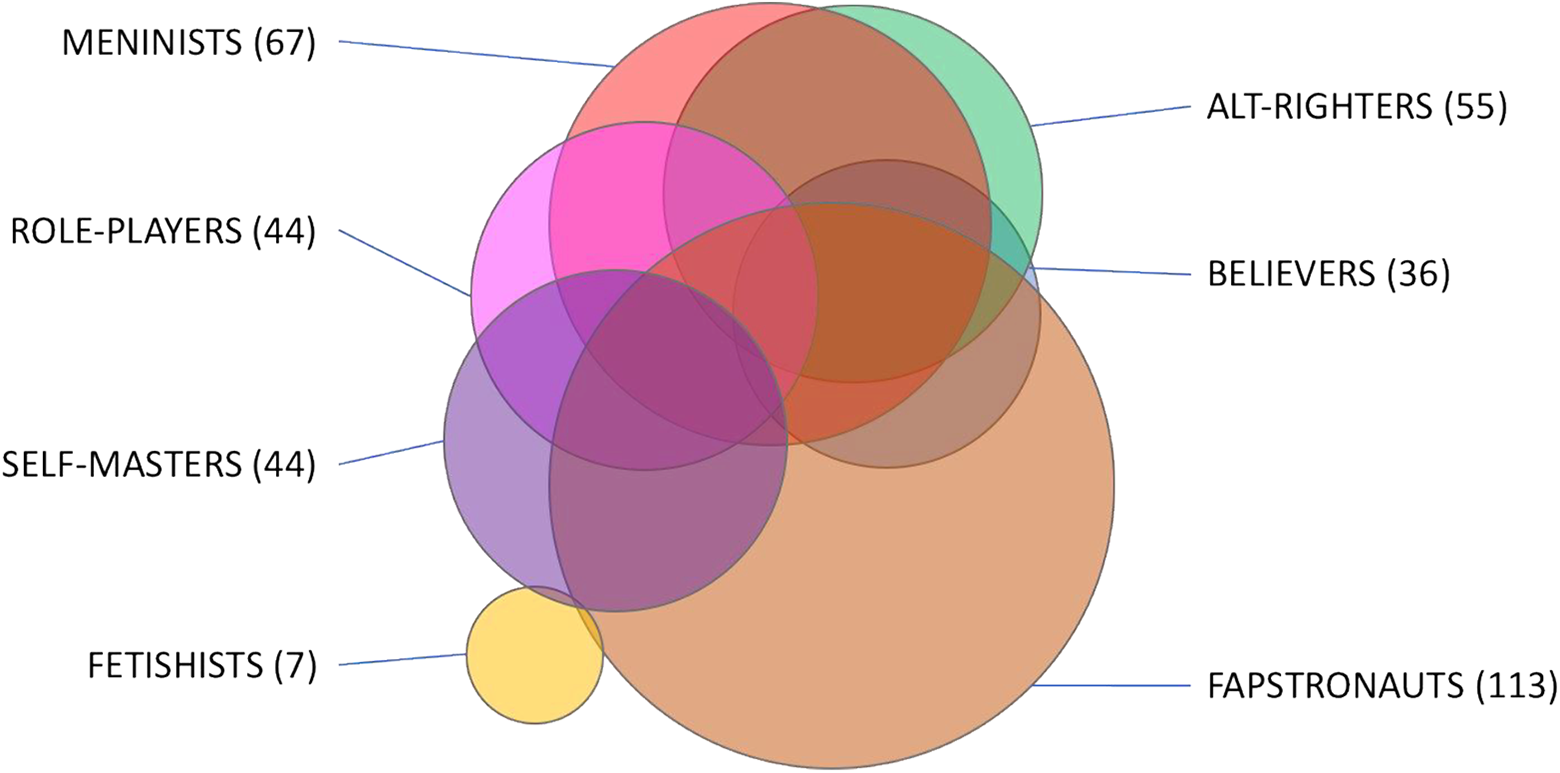
Subject Positions and Their Overlaps.
Fapstronauts
Mainstream NoFappers tend to stick most closely to the doctrine espoused on the official NoFap website. Many adopt the portmanteau term fapstronaut (with its prosodic parallel to “astronaut”) which is a key signifier in the official movement, combining the notion of a NoFap journey with the centrality of the rocket as an erect and powerful phallus symbol, mirrored in the NASA-like logo of the official NoFap brand. While Taylor and Jackson (2018) correctly shift the scholarly discussion of pornography away from “user effects,” it is very clear that for Fapstronauts themselves, abstention from pornography and masturbation is all about how porn-masturbation-orgasm (PMO) ruins their physical and mental health, most prominently by causing porn-induced erectile dysfunction (PIED). The chief benefit of NoFap they articulate is a bigger and stronger erection. Pornography addiction is medicalized (see Burke and Haltom 2020; Taylor and Gavey 2020) as an epidemic affecting “a generation of young men” (@Porn_Harms; 27 September 2017), and users congregate around hashtags such as #FightTheNewDrug. Fapstronauts discuss the findings of research into the “neuroscience behind porn addiction and sexual conditioning” (@gabedeem; 9 April 2018). Porn hijacks the brain’s reward system in which dopamine plays the central role: the porn user gets a dopamine hit when they orgasm, becoming “nothing more than a junkie chasing the next fix” (@user01; 15 March 2018). PMO addiction reduces the brain’s sensitivity to pleasure, but also causes “big dips in T [testosterone] levels” (@user02; 28 October 2017). In addition to PIED, PMO is associated with forgetfulness, depression, anxiety, suicidal ideation, loneliness, anhedonia, and premature ejaculation.
Young men are antagonized by an apparent paradox: the more available and ubiquitous porn becomes, the harder it is to stay hard, as the reward centers in their brains become less sensitive, and their libidos wither. This is linked by users both to drops in testosterone, and disgust at their own desires. Fapstronauts oppose in-born and normal sexuality to aberrant desires supposedly aroused by pornography: “How many people are ‘born’ liking bukkake, crushing, water sports, feces, torture[?]” asks @BrainRebalanced (22 September 2017). Porn use could result in “Straight dudes watching Gay Porn” (@KreativeVein; 15 October 2017) or even more alarmingly “Wiring Sexual Tastes to Hairless Genitalia,” thus causing pedophilia (@gabedeem; 21 March 2019). The queer/kink nausea engendered here supports Hartmann’s (2020) analysis of how “abject” desire that exceeds heteronormativity is seen as proof of the pathological nature of masturbation. The official NoFap account furthermore problematizes PMO as undermining “genuine connections in the real-world” (@NoFap; 9 September 2013), reproducing the notion of “real sex” for “real men” critiqued by Taylor and Jackson (2018). Only (sick) fappers would “prefer pixels” over “real girls” (@NofapExplorer; 14 February 2018). Throughout the Fapstronaut corpus, anxiety about the internet interfering with connections to the real world is a dominant preoccupation.
Several anti-pornography accounts that articulate feminist ideas promote NoFap (see e.g., @SuzzanBlac). However, ordinary adherents seldom problematize pornography for the harm it does to women. Indeed, women involved in porn are more typically constructed as reflecting badly on a real man because “no decent person respects a slut” (@user03; 7 November 2018). To become a real man the Fapstronaut must reboot or rewire his brain though adopting one of the suggested modes: soft mode is abstaining from porn; hard mode is abstaining from masturbation and porn; monk mode is abstaining from porn, masturbation, and orgasm, even with a partner. If he stays clean and sober, he starts to enjoy powers or even superpowers: the Fapstronaut is “extraordinary” while the porn addict is “ordinary” (@NoFap; 7 September 2013). Adherents use “your testosterone for YOUR OWN gain” (@user04; 26 September 2018) and report improved focus, concentration, happiness, and confidence, being more sexually attractive, being more likely to stick to goals, better dreams, including wet dreams, better sex, and boosts in sexual energy. NoFap is the “most UNBELIEVABLE cure for depression” (@alphavegan; 23 June 2018). These benefits accrue because the energy which would otherwise be wasted is freed up for other aspects of life through a process of “transmutation” (@user05; 26 January 2019). This idea, that sexual energy is a fungible resource that can be reallocated to other domains of life (school and work) reappears in other myths. Depressed, anxious about his connections with the real world, and lonely, especially after ejaculating, the Fapstronaut reclaims his agency by working to unplug his brain chemistry from the polluting online world, whose unwitting victim he has become.
Self-Masters
The second mythic formation typically presents lists of recommended habits, lifestyle tips, and other rules and regulations for self-improvement. NoFap is typically one among many activities that are prescribed, in addition to weightlifting, fitness supplements, financial advice (including the promotion of various cryptocurrencies), cold showers, and reading recommended literature, often the work of Canadian psychologist and internet personality Jordan B. Peterson, whom Self-Masters claim as a NoFap practitioner. On a typical list, an image of Peterson appears alongside the cover of Dale Carnegie’s “How to Win Friends and Influence People” and Robert Glover’s pick-up bible “No More Mister Nice Guy,” as well as tips for meal preparation and the correct haircut (@user05, 31 October 2018). These assemblages are typical of the self-help genre so intimately imbricated with neoliberal forms of capitalism (Chiapello and Fairclough 2002). In the atomistic world of self-improvement, societal structures are downplayed, and an individual’s mastery of their destiny is foregrounded. For Self-Masters on NoFap, body/mind and behavior are represented in mechanistic terms, where the ideal diet, sleeping habits, or other attitudes maximize one’s success within a set of norms, which include bodily fitness, financial wealth, and highly gendered notions of physical attractiveness and character.
The body is mechanized, but also financialized: masturbating to porn is the wrong investment to make with your “energy, money and opportunity cost” (@emperorofnofap; 7 November 2018). Good investments are tracked: push-ups done, books read, money saved, days on NoFap, and other goals are meticulously recorded in tweets. As Jones (2015) has argued, the ubiquity in digital culture of on-going self-measurement and auto-diagnosis constitutes the “entextualization of the self,” which works to increase a sense of agency through building a narrative where the individual is the hero of their own story. Self-Masters are also clearly jockeying for their position in the masculine hierarchy through specific “evidentiary stories” (Montemurro 2020). The role that NoFap plays for the Self-Master is a strong form of the transmutation thesis. As @emperorofnofap says: “My brain has changed a lot! Before #NoFap, it was full of sex and porn. Now all I think about is business and money!” (21 November 2018). While some dispense advice gratis, others have monetized products and services, the advertisement and sale of which works to reinforce the value of ideal masculinity, which men ought to invest in.
Role-Players
If Self-Masters are wound up in the urgency of self-discipline, the gamers and anime enthusiasts grouped together in this analysis as Role-Players take a more ludic approach to NoFap. Here, fictional worlds supplement the social with scenarios and characters taken from role-playing games and anime narratives. The users who contribute to the construction of this subject position tend to communicate with each other through elaborate analogies, that involve representing themselves through a range of avatars that undergird their performance of shared ownership of specific cultural artifacts, working to distinguish in- from out-groups (see Blodgett and Salter 2018, 137).
There are differences in emphasis within the group, with anime enthusiasts tending to be more sexually playful, and gamers more competitive, though many are both. Thus @NintendoSoyboy warns a competitor that he will “torture you with lewd yuis [pictures of Japanese women]” (2 November 2017) to get him to fap again, while in a performance of same-sex desire @nekofuccboi claims to be “doing nofap for Sovi [a male competitor]” (13 October 2017) in order to have sex with him. Though explicit discussions of masturbation and arousal in a homosocial context often veer into the queer, the discourse more typically centers on men discussing fantasy women, and disapproving statements such as “porn is gay AF [as fuck]” (@user06, 5 February 2018).
This subject position evinces ironic distance from NoFap to an extent not observed in other formations. Members often deploy comic overstatement, such as that while they were on NoFap they managed to “master the violin” (@pachkacigaret, 3 November 2017), or situate NoFap as a way to build up libido and sexual energy in order to then “revisit some of the [pornographic] classics” (@wrangelisland; 15 February 2016) and enjoy post-NoFap masturbation even more. There are references to being good at NoFap, to having a high score, to losing or winning the NoFap challenge. One competes with peers to achieve a rank and a high-ranking player has wizard or god or superpowers. In a discussion of famous men who supposedly do/did not masturbate—“Freud, Tesla, Newton, Jordan Peterson, Knights Templar”—NoFap is referred to as “an essential DLC pack for every Knight” (@user05; 26 January 2019). A “DLC pack” is downloadable content that augments characters in online role-playing games. In order to emulate those in their masculine pantheon, these men thus appear to be discursively constructing themselves as game characters, who download the content of masturbation abstention, in order to improve their chances of winning a game. Where the real world starts and the game world ends is not entirely clear.
Believers
For those who articulate NoFap as continuous with their religious beliefs, masturbation to porn is the root of “guilt and despair” (@LDSPornAddict; 3 April 2018) (see Burke and Haltom 2020). Masturbation is often constructed as sin. Some describe starting their NoFap challenge for Lent, and abstention as analogous to fasting. Bouts of masturbation are put down to possession by an “evil fap demon” (@NofapExplorer; 22 July 2017), or to “Satan’s snares” (@LDSPornAddict; 27 June 2018). Though the denomination of believers is not always clear, most are Christian, with many advocating (Catholic) confession.
NoFap is a path to forgiveness, purity, and “freedom from sexual sin” (@PowerofPuritySL; 12 March 2017)—and thus to “redemptive masculinity” (Burke and Haltom 2020). While mainstream NoFap discourse tends to construct masturbation abstention only as a means to fight porn addiction, Believers encourage the official NoFap movement to “embrace” anti-masturbation (@user07; 23 October 2018) for its own sake. The Catholic influencer Matt Fradd states that not masturbating is “pro-love/anti-porn” (@mattfradd; 29 September 2016), and love is typically articulated as romantic love, within marriage. Confessing their PMO addiction to their wife or priest is followed by repentance and atonement.
Abstaining from masturbation is a covenant between men, their families, and God, requiring prayer and frequent visits to church to maintain. Solidarity against temptation is often homosocial, with men reciprocally praying for each other. Men and women are constructed as currently or potentially occupying the role of wife and husband. The duty of a married couple is to have children: C.S. Lewis, who argued that if young men masturbate, they do not invest in their marriages and in having children, is cited as an authority (@user08; 9 May 2014). Similarly, “consequence free sex” (@user09; 12 March 2019) is said to lead to infertility. Believer discourse thus typically constructs sexual desire as serving procreative aims.
Meninists
A masculine identity that is at once aggrieved and aggressive was a distinct category in the NoFap data. Explicit anti-feminism, misogyny, and andreism (supposedly the opposite of feminism) together interpellate what I will call the Meninist. NoFap is recommended as part of three very different Meninist sexual programs: celibacy, promiscuity, and heterosexual marriage. These programs are not necessarily taken up by separate groups but may be stages in Meninist development, where one is adopted in order to lead to another. There is also evidence that advocates of these practices attempt to recruit each other to their camps.
Celibate men promote NoFap as a means to break addiction to women, who are “toxic and undateable” (@emergentreality; 11 January 2019). Men must cure themselves of “oneitis” (@wheniwasweak, 16 October 2017) if they are fixating on one woman specifically, or addiction to promiscuity in general in which case they have put “pussy on the pedestal” (@vinmenniti; 13 November 2016). NoFap is a way to take back control of their sexuality. MGTOW celibates assert an alpha masculinity, associated with the warrior, monk, or knight, that is opposed to beta males, nice guys, and involuntary celibates or incels, who are constructed as hierarchically subordinate (see also Heritage and Koller 2020). Celibates understand tfw no gf [that feeling when no girlfriend]—an admixture of sexual longing and loneliness that drives the sexual rage of the incel—but encourage “incel porn addicts” (@pachkacigaret; 6 November 2017) to use their rage at being rejected by women to stick to NoFap instead, and thereby to break their addictions. Porn use explains, “why you’re #incel and #niceguy” (@gaveupporn; 28 September 2018) in the first place. NoFap and celibacy work together to help them “master your passions” (@amongtheruins00, 24 November 2018).
Eventually, they might “control their sexual urges to better themselves in a way that gets them real pussy” (@gunsweedliberty; 16 March 2019). The pick-up artist (PUA) does not feature in this corpus per se, though similar libidinal structures seem to be at work. NoFap is said to result in “females salivating over me. Must approach. Pussy to be destroyed” (@Shadow_enigma0; 13 February 2018). Alongside promiscuity, heterosexual marriage features as a goal in the figure of the trad [traditional] wife who knows her proper social role, who in some articulations is the ultimate reward for the alpha masculinity facilitated by masturbation abstention. Thus Proud Boys founder @Gavin_McInnes quips that NoFap “Made my marriage 37% better” (27 Nov 2015). Trad wives also speak: @bravetheworld claims that the reason women fall behind is that “we haven’t had our own nofap movement” (14 February 2019).
Whether celibate, promiscuous, or married, Meninists share a lexicon of misogyny: women are pussy, thots (acronym for “that ho [whore] or hottie [attractive woman] over there”) or roasties (a metonymic reference to female genitalia turned into “roast beef” by frequent sexual activity). Feminism is constructed as subjugating men in many ways, but primarily in denying them guaranteed access to women’s bodies because of “feminist sex hostility” (@user11; 9 January 2018). Men perform their victimization hyperbolically; one Meninist even invokes slavery: men “have taken a tremendous beating […] and now they want off the plantation” (@emergentreality; 5 January 2019).
Pornography plays a specific role in the domination of men by women. In a revealing metonymy, pornography is constructed as a succubus. Porn sites are run “by feminists that want men docile and weak” (@user10; 28 January 2019). Because porn drains energy from men, it must be a feminist plot. Docile porn addicts occupy a range of beta masculinities: they are nice guys, soy, soyboys, manlets, or betas who are blue-pilled—that is, they have chosen to accept feminist modernity (see Van Valkenburgh 2018 for discussions of the lore of red/blue pills). By masturbating to pornography, a man becomes a cuck [cuckold] as he “watches other men have sex with a women he finds attractive, but doesn’t have sex with her himself” (@user01; 14 December 2017). The notion of the cuckold produces propertied entitlement to the bodies of women, as the action of cuckolding (in its archaic form) described what one man did to another when committing adultery with his wife, while her agency is barely relevant.
In Meninist discourse, the mainstream NoFap idea that masturbation abstention increases testosterone levels through semen retention is especially popular; testosterone helps men get “a deeper voice and increased facial hair growth” (@LokiJulianus; 3 January 2017) but it also makes them more aggressive and able to “Take control” (@MasculineFuture; 9 August 2017) of their sex lives. “NoFap is for True Alphas” while beta men stay “docile, weak and lethargic” (@user12; 14 November 2018). In certain articulations, an evolutionary psychological theory underlies these distinctions (see also Ging 2019), where gender roles are constructed as hardwired to sex, and porn is described as “maladaptive” (@user11; 17 February 2018) as it does not result in procreation. NoFap is thus again linked into a pro-natalist agenda: if you go on NoFap to stay celibate as opposed to “getting laid […] you’re essentially a bitch. What are the evolutionary benefits of that?” (@veritasnaut; 21 October 2018).
Fetishists
If powerful and sexually assertive women are the key antagonists to be resisted by Meninists, in the Fetishist articulation of NoFap they are the ultimate object of desire. The ideal of the man who is in control of his life that structures other discourses is inverted here. Though Fetishist influencers include gay male exhibitionists sharing their masturbation habits (@cuddlecraving) and sex clips (@smallfukbruh), others are voiced either by a submissive man (sub) or a female dominatrix (domme). The latter specializes in making fun of men’s small penises, instructing them to wear a chastity cage that prevents erections while locked, stipulating periods of NoFap, or commanding them to transfer money to her account for the pleasure of being financially dominated (findom). Men are not allowed to get an erection without permission: they are promised that she will peg them with her strap-on dildo, but she might also decide to cuck them by ignoring them and making them watch her have sex with another man. Accounts such as @WorshipCamryn stipulate when followers may orgasm, while @EbonyCashDiva laughs at subs such as “Andy” who was allowed to “stroke his dicklet a little just to see if it was still alive!” (31 August 2016) or “Hans” whose “lil pee-pee is now permanently soft” because of “#nofap” (10 January 2018).
The findom account @EbonyCashDiva is represented as run by a Black woman, who tweets she “has a dream…[that] every ‘sub’ & ‘slave’ be put on a 30 day #NoFap detox as standard […] Let’s rise, victorious!” (10 June 2016). Though referring to subs as “slaves” is not uncommon, her deployment of her “Ebony” body and her invocation of Civil Rights discourse (having a “dream” evokes Martin Luther King and “rising” Maya Angelou, among others) suggests she is strategically invoking the Master-Slave complex, where she owns and controls the former slaveholder (with a name such as “Hans”). If the racial, class, and gender orders demand to be upheld in everyday life, and a man is under pressure to be an attractive, gym-toned, and financially dominant White alpha whose penis is hard and whose libido determines when and with whom he will have sex, in the fantasy world of the fetishists he is allowed an escape, where all of these orders are inverted. As the sub account @herserving observes: “getting it locked up is liberating” (20 September 2018).
Alt-Righters
Alt-Right accounts (for a definition of the “alt-right” see Winter 2019) are often identifiable from clues in their banners or profiles, which might include references to Pepe the Frog, altered ethnonationalist symbols, or specific terms in their handles: @hyperboreanher1 (hyperboreans are White men of the north mentioned by Herodotus); @deus_vult23 (Deus vult! was the Crusader war cry); @AnimeSturmmann (a reference to the Nazi Sturmabteilung); or, less cryptically, @prowhitesunite.
NoFap Alt-Righters consider pornography a form of societal control and trickery; it is a plague on society, and it is their job to unmask who is behind the porn industry: Jews. User @gaveupporn reports on the financiers of pornographic companies and the servers on which the content is hosted: “FISHBEIN, SLIFKIN, ROSENBLATT; all Jewish surnames. The porn industry is owned and run by Jews. This is a fact so don’t shame us” (15 November 2018). When NoFap is accused of being anti-semitic one user claims this is an “admission that porn is a Jewish plot” (@BroChiRoe; 8 November 2018). Alt-Righters also troll the official @NoFap account for refusing to take a stronger stand against pornography, making them “unserious and unworthy” (@Cpt_Devereux; 16 November 2018). This user accompanied his tweet with a triptych of portraits: the German conservative historian Oswald Spengler, the Italian fascist philosopher Julius Evola, and founder of the American Nazi Party, Francis Parker Yockey. These figures ideologically connect pornography to the “decline” of the West, positioning the Alt-Right as Evola’s “men in the ruins” attending the palingenetic rebirth of Europe.
Jewishness is often referred to explicitly, but also through coded language such as sub-humans, Them, or using the orthographic convention of three brackets to imitate the echoing sound of Nazi media propaganda. Thus, for example, the purported Jewish plot behind porn appears in the corpus as “(((porn blackmail)))” (@user01; 19 September 2017). Supposed Jewish control of the pornography industry is constructed as being in service of draining men of their “vital fluid” because “They want you passive and weak! #Resist” (@user13; 13 November 2018). Conserving semen or sexual energy preserves virility and aggression, whereas fapping to porn makes one a degenerate. Alt-Righters often signal this by addressing each other as goy (s.) or goyim (pl.), voicing the supposed Jewish conspirators with the Yiddish term for non-Jews as a way to signal what Western, White, or European man is up against. Unsurprisingly, Alt-Righters more frequently advocate for extreme forms of violence against pornographers, such as shooting them (e.g., @nmm20c, 16 November 2018).
Overlapping Myths
There is a high degree of overlap between these mythic chains of “equivalential images” (Laclau 2014, 33), and subjectivities are thus pulled in a number of different directions, which may “galvanize” subjects into different forms of action. What most of the positions share is some theory of the transmutability and limited reserves of their masculine energy, which they lose when they masturbate to pornography. Pre-existing anxieties about their position in the “real world” combine in a moment of post-orgasmic tristesse to confront them with the realization that they have failed to live up to some masculine ideal. Their job as men thus becomes to conserve and focus their sexual energy on a higher goal. These goals are linked to notions of what a man ought to be, including “brave, dependable, and strong, emotionally stable, as well as critical, logical, and rational […] not only wealthy, but also in a position of power over others” (Coston and Kimmel 2012, 98). In the context of a plethora of political, environmental, and financial crises, egalitarian social change, and new forms of association afforded by the Internet, NoFap presents young men who fail to live up to these ideals with logics they can hold onto in order to make sense of their place in the world.
The Fetishist myth does not overlap with the other chains but reflects them. Elements such as cuck are articulated as part of a desired state of affairs, rather than as being at the heart of the problem. Not being allowed to have an erection, being financially dominated, and having your penis mocked by powerful women is wound up in sexual fantasy. The figure of the domme as both antagonist and object of desire mirrors her appearance as the object of misogynist violence in Meninist discourse; this myth also sexualizes part of the racial fantasy of the Alt-Right. Anxieties about occupying the historically dominant position of the successful White man go some way to explaining why “getting it locked up is liberating.”
The other six myths overlap significantly. Only 50 of 113 Fapstronauts articulated pure NoFap doctrine unmeshed with one or more of the other myths. There was also extensive overlap between Meninists and the Alt-Right. Pornography is blamed on almost interchangeable villains, with liberals and feminists, socialists and Jews often constructed as being of a piece. These men typically agree that the porn industry drains men of their “vital fluid”—which they need for aggression and for reproducing the race—but whether they explicitly articulate this as a Jewish conspiracy, or just as a symptom of a world ruined by feminism, is not always clearly stated.
It is worth noting that the goals articulated in six of the myths might be achieved in combination: Believers want to strengthen their marriages and affirm their piety, Self-Masters want to achieve financial and personal success, Alt-Righters want to preserve the “White race” from “degeneracy,” Meninists want to reclaim alpha masculinity, Role-Players want to win at a game that others will lose, while Fapstronauts aim to achieve a narrowly normative sexual health. How these aims are combined creates idiosyncratic permutations. Specific combinations may present specific dangers. Violent misogynist and racist fantasies combined with the ironic distance of the Role-Player, or the sacred mission of the Believer, for example, may be pathways into the kinds of real-world violence the world has recently witnessed, where fantasy worlds intrude dramatically in institutional spaces. There is also extensive evidence of men addressing each other across myths, attempting to win converts to their specific interpretations of the “evidence” for masturbation abstention. Believers insist to all who will listen that masturbation is “sin,” while Alt-Righters accuse NoFap of hypocrisy for not accepting that the (Jewish-run) pornography industry must be destroyed. The dynamics of recruitment into more or less “extreme” ideologies are thus visible in the battle for the meaning of sexual energy, its conservation, and loss.
Conclusion
Far from being a social phenomenon with a stable and singular character, NoFap is constituted by contestation for the meaning potentials of masturbation abstention. By examining how its highly engaged adherents make sense of their participation, it is possible to resist the discursive closure that managers of nofap.com seek when they decree that use of the term disconnected from its official meanings is “unacceptable.” Studying how the word “nofap” is used in context, in the tradition of post-structuralist approaches to language, discourse, and gender (Milani 2014) also entails suspending the choice of reading the movement through a gendered, or anti-pornography or anti-masturbation, lens, seeking instead to lay out how adherents themselves explain their participation, and to map their attempts at sensemaking as more or less coherent ensembles of images, in what I have termed “myths.” These myths are certainly gendered, but, as hegemonic masculinity itself, they are “fluid, intertextualized, always shape-shifting, and open to contestation, formed at the intersections of gender, sexuality, class, age, ethnicity, […] and history” (Milani 2014, 2).
Each of the myths is more complex than I have been able to lay out here: in mapping out plurality and struggle, I have aimed for breadth, and future research might thus further deepen analysis of these “manospherian subjectivities” (Hartmann 2020). Abstention strategies in Meninist discourse specifically suggest intricate dynamics between masculinity as performed through celibacy, promiscuity, and marriage, which would be important to tease out. Analysis of the very large corpus of tweets not in English would provide important insights into NoFap’s transnational circulation. A number of questions are also raised about the links between Believer, Meninist, and AltRight myths by the recurrence of Catholic and Crusader iconography, and their shared mobilization of pro-natalist logic. Psychoanalytic avenues of inquiry might also be promising, specifically given the inversion or mirroring of hegemonic orders within the Fetishist myth, where the antagonist is also the object of desire.
A recent corpus linguistic study (Krendel 2020) found that denizens of the manosphere construct themselves as victims, insecure and unhappy. The sense of social isolation, anhedonia, and anxiety about “real world” connections is similarly pervasive in the NoFap corpus. Instead of affirming this egocentric self-pity, scholarship must remain focused on how the construction of victim status galvanizes misogyny and racism around what are powerful social positionalities. The pathos of the fantasy that abstaining from masturbation, and taking control of your transmuted sexual energy, will allow the “extraordinary” to emerge from your “ordinary” self should be a spur to queer, feminist, deconstructive, and egalitarian approaches to gender that do not reproduce these crushing and dangerous normativities.
This analysis is presented not in order to conclusively fix a taxonomy of available masculinities, but to further open up space for pluralistic analysis of masturbation and pornography abstention. It suggests that, while there certainly are online spaces that are part of the manosphere, the precise dimensions, and boundaries of this space are unclear. The problematic “man” in the “manosphere” is furthermore an intersection of problems: of racism, nationalism, and ableism, as well as misogyny. Understanding these articulations in their specificity is an important task in the context of a world where the mythical articulations that emerge from contestations over concepts like NoFap have the potential to galvanize young men into horrific, real-world violence.
Footnotes
Declaration of Conflicting Interests
The author(s) declared no potential conflicts of interest with respect to the research, authorship, and/or publication of this article.
Funding
The author(s) received no financial support for the research, authorship, and/or publication of this article.
