




Abstract
This article uses the 2011–2019 National Survey of Family Growth to explore how masculinity attitudes differ by rural, suburban, and urban contexts across three social axes: sexual identity, race/ethnicity, and education. It examines within-group differences based on spatial context among 17,944 men aged 15–44 who are straight, gay/bisexual, Black, white, and Latino, as well as among men with less than a bachelor’s, a bachelor’s, and more than a bachelor’s. This contributes to existing knowledge in several ways: it is the first project to build on important qualitative studies through the use of a nationally representative sample; it contributes to the scarce research on how rural gay/bisexual, Black, and Latino men understand masculinity; and it examines how education shapes the relationship between spatial context and attitudes about masculinity. Results indicate that spatial context has a stronger relationship to attitudes among white men, straight men, and men without a bachelor’s than among Black men, Latino men, gay/bisexual men, or men with a bachelor’s or above. Theoretically, what this shows is that spatial context is more strongly related to masculinity attitudes for men who are advantaged on the basis of sexuality or race than for men who are marginalized on these axes. When significant differences emerged, rural men were more conservative than urban and suburban men, and suburban men were more conservative than urban men. These results show that there is a relationship between spatial contexts and attitudes about masculinity, but that it depends on social identity and level of education.
A robust literature shows that masculinity is shaped by a variety of factors, including race/ethnicity, socioeconomic class, dis/ability, religion, age, sexual identity, and nationality, as well as structural factors related to economic and political processes. Less work, however, considers the relationship between spatial context and masculinity. Much of the existing research in this area examines how rural areas shape enactments of masculinity. No research, however, has yet used nationally representative survey data to examine how attitudes about masculinity differ across spatial contexts. This article builds on the strong framework of qualitative studies to theoretically and empirically extend knowledge about the relationship between masculinity and spatial context. Its research question is: What is the relationship between spatial context and attitudes about masculinity among men with the same racial/ethnic identity, sexual identity, or education status?
This study uses the 2011–2019 National Survey of Family Growth (NSFG), which surveyed 17,944 American men aged 15–44, to explore how masculinity attitudes differ by spatial contexts across three key social axes: sexual identity, race/ethnicity, and education. Other research has demonstrated that these axes (as well as gender) are strongly related to social attitudes in the United States (Schnabel 2018). This project examines these identities further by testing whether and to what extent there are within-group differences based on spatial context. This article examines straight men; gay and bisexual men; white men; Black men; Latino men; men without a bachelor’s; men with a bachelor’s; and men with a master’s, doctorate, or professional degree to examine the relationship between spatial context and attitudes about masculinity within each aforementioned group. This article does not compare differences between groups but rather examines within-group differences for each social identity and education category based on spatial context. Examining differences in attitudes among men with the same identity or education status, but who reside in different spatial contexts, highlights the relationship between spatial context and attitudes about masculinity by controlling for other factors.
This article empirically and theoretically extends research about masculinity. Empirically, this article examines associations between masculinity attitudes and spatial context among different populations of men. Theoretically, it identifies whether spatial context is more strongly related to masculinity attitudes among some populations than others on the basis of sexual identity, racial/ethnic identity, and educational status, and thus whether larger systems of inequality shape these relationships. This article is also exploratory: it asks whether spatial context is meaningfully related to attitudes about masculinity in a generalizable sample and, therefore, whether masculinity research across all spatial contexts—not just rural contexts—should consider spatial context in data analysis.
Masculinity
Masculinity is something that is associated with men, but it is not necessarily tied to men, nor is masculinity simply a set of things that men do (Pascoe and Bridges 2015). Men can be feminine and women can be masculine, and there are many people who identify as neither men nor women who also express masculinity in varied ways. At the same time, most people express their gender in ways that reflect what others expect them to do given their gender identity, their biological sex, and the social situation (West and Zimmerman 1987).
Masculinity is an ongoing process: boys and men never “achieve” masculinity, but rather must continually maintain it. Strategies to do so include “claiming privilege, eliciting deference, and resisting exploitation” (Schrock and Schwalbe 2009, 281). Actions inconsistent with normative masculinity are policed by friends, family members, acquaintances, and others, and men often act particularly masculine in all-male spaces (Pascoe 2011). Masculinity is also relational; men’s masculinity is shaped in part by how they interact with women (Barber 2016; Pascoe 2011), as well as other men. There are numerous configurations of masculinity that differ based on context (Connell 1987; Connell and Messerschmidt 2005; Messerschmidt 2018). Many men today seek to construct masculinity in a “Goldilocks zone:” not violent, hypermasculine, or emotionally stunted, but also not anything that would be seen as obviously gay or feminine (Abelson 2019). Rather, many want to be in control of their emotions with the ability to be flexible about how they express themselves.
Spatial context appears to be a key factor that shapes masculinities. Most research that explicitly analyzes spatial context, however, focuses on rural men. Although there is a much larger literature on masculinity among urban and suburban men, much of this research does not analyze spatial context specifically. Research on rural masculinity is underrepresented in comparison to research on men in urban and suburban contexts, but what exists shows that enactments of masculinity do differ between rural and urban contexts. With this in mind, the article tests the following hypothesis: H1: Across population subsets, more significant differences will exist between rural and urban men than between urban and suburban men or suburban and rural men.
It is important to examine spatial context because it is deeply tied to social life. As Gieryn (2000, 473) notes, place shapes “social structural categories, differences, and hierarchies; arranges patterns of face-to-face interaction that constitute network-formation and collective action; embodies and secures otherwise intangible cultural norms, identities, memories—and values.” Gieryn’s (2000) analysis is of specific places, rather than broader types of spaces (i.e., rural, suburban, and urban areas), though his insights can be extended to space as well: particularly his explanation that “place is not merely a setting or backdrop, but an agentic player in the game—a force with detectable and independent effects on social life” (Gieryn 2000, 466). Relatedly, much as Bell (2007, 413) argues that it is important to study rural areas given “that which we consider rural is of significance to everyone,” spatial context should be a factor in sociological analyses given that everyone lives in some type of spatial context. Space both shapes and is shaped by social life.
Rural Masculinity
“Rural masculinity” is that which is “constructed within what rural social scientists would recognize as rural spaces and sites” (Campbell and Bell 2000, 540). Due to differing social contexts, masculinities in rural areas are distinct from those in urban locations. Central to the narratives of many rural men is a “country-masculine habitus,” which guides rural men’s “thoughts, tastes, and practices. It provides them with their fundamental sense of self; it structures how they understand the world around them; and it influences how they codify sameness and difference” (Desmond 2006, 393). In many rural areas, for instance, rural men construct masculinity in opposition to representations of urbanity (Leap 2017), emphasizing differences between themselves and urbanites.
Rural masculinities differ based on local context as well as intersections of social identities, but they also share many common traits, such as an emphasis on physical labor and toughness (Morris 2008; Kayzak 2012; Leap 2020). Another commonality, in many areas, is participation in hunting and other outdoor activities (Brandth 2016; Bye 2009; Leap 2020) and gun ownership (Mencken and Froese 2019), which signifies self-reliance and the ability to protect themselves and their family (Gahman 2015). Many rural men also engage in practices that contribute to gender inequality, for instance through possessiveness over women partners (Vogels 2020) or economic control (Filteau 2014). It is not socially acceptable for most rural men to express “softer” forms of masculinity, as some urban men do. The masculinity many rural men construct reflects fairly rigid expectations, which manifests in practices that negatively affect educational performance (Morris 2008) and their own health (Carnahan et al. 2018; Courtenay 2006; Creighton et al. 2017). Rural masculinities can change in response to shifting economic and structural conditions, but household gender inequality may nonetheless persist (Sherman 2009).
How masculinity differs across spatial contexts along the axes of sexual identity, race/ethnicity, and education are underrepresented in research. Few qualitative studies explore these topics, and no survey research using generalizable samples exists. Masculinity provides rural gay men some social acceptance in their communities which is otherwise lacking because of homophobia (Annes and Redlin 2012; Kazyak 2012; for related research, see Abelson 2016, 2019; Silva 2021). How masculinity attitudes differ among straight men or gay/bisexual men in different spatial contexts, however, remains unexplored, just as LGBTQ experiences in rural areas more generally are underexamined in research (Stone 2018).
Most research on rural masculinities is among white men and shows that many construct masculinity in racialized and classed ways: they valorize working-class occupations and create symbolic boundaries between themselves and Black men, who they often frame as urban (Leap 2017; Morris 2008; Morris 2012). Relatedly, most work on rural-urban political polarization focuses on rural white people (Cramer 2016; Wuthnow 2018). Few research projects have analyzed how Black and Latino men construct masculinity in rural areas in the United States (for exceptions, see Daniel-Ulloa, Sun, and Rhodes 2017; Schmalzbauer 2011; Snider 2017; Kogan et al. 2017), and consequently, one empirical contribution this project makes is analyzing the attitudes of Black and Latino men across spatial contexts. With that in mind, the article tests the following hypothesis: H2: Across attitudes, more significant differences based on spatial context will exist among straight men than sexual minority men, and among white men than Black or Latino men.
H2 is derived from research about sexual identity and race/ethnicity in the United States, which shows that social inequalities related to these two axes affect most aspects of life. Shared experiences of marginalization in the United States among sexual minority men, among Black men, and among Latino men could shape their experiences such that their attitudes are more similar across spatial contexts than straight men’s or white men’s. Because straight men and white men are not marginalized on the basis of their sexuality or race, their attitudes could be shaped more strongly by spatial context. H2 tests this reasoning.
Relatedly, there is little work on how spatial context modifies the relationship between educational attainment and social attitudes. Existing research shows that educational attainment of a bachelor’s or more is associated with more liberal attitudes compared to those without a bachelor’s (Schnabel 2018). This research suggests that higher education shapes attitudes and/or that there is a selection effect such that more liberal individuals are more likely to earn a bachelor’s degree. Either way, this could mean that attitudes among individuals with a bachelor’s degree or higher will be more similar than those without a bachelor’s.
Prior work suggests that spatial context shapes the attitudes of individuals without a bachelor’s degree. Rural residents in the United States are more likely to vote Republican than are suburban or urban residents (Gould and Bryan 2018), and they also hold more socially conservative attitudes (Johnson and Scala 2021). Demographic factors such as education and race partially explain these differences (Kelly and Lobao 2019). Indeed, educational attainment in rural areas is lower than in suburban or urban areas (United States Department of Agriculture 2017). At the same time, rural residents see themselves as distinct from residents of suburbs and cities and have different perspectives on many issues (Cramer 2016; Hochschild 2016). Together, these studies suggest that spatial context shapes attitudes, particularly among individuals without a bachelor’s degree; this pattern could also extend to attitudes about masculinity. This article tests the above reasoning using H3: H3: Across attitudes, more significant differences will exist among men without a bachelor’s than among men with a bachelor’s or among men with more than a bachelor’s.
Like H2, H3 is exploratory, since there is little existing research that addresses this issue.
Work on rural masculinity is unique in that it highlights how spatial context shapes enactments of masculinity. It explicitly focuses on spatial context whereas much other research about masculinity implicitly focuses on urban and suburban contexts through their samples, yet do not always analyze spatial context as part of their findings (for an exception, see Brekhus’s 2003 analysis of suburban spaces). This article builds on the insights of research about rural masculinity—which shows that spatial context shapes enactments of masculinity—to explore whether masculinity attitudes differ across rural, urban, and suburban contexts in a generalizable sample.
Differences Between Rural, Suburban, and Urban Masculinities
Although little work directly compares how men construct masculinity in rural and urban or suburban areas, existing research suggests that there are notable differences. Leap (2017) shows that many rural men explicitly construct masculinity in opposition to representations of urbanity as dangerous, due to Black men and criminals; sexually deviant, because of gay men; and lazy or “soft,” due to men who do not work hard enough or who do not perform manual labor. Relatedly, Abelson’s (2019) exploration of masculinities across U.S. regions showed that distinct masculine ideals exist across regions, and also that “masculinities in rural spaces were marked with more rigidity than flexible urban ideals” (204).
Other research also suggests that some urban and suburban men have more flexibility than rural men in how they enact masculinity. Some urban men, for instance, reframe certain beauty and fashion practices as compatible with masculinity (Barry 2018; Barry and Weiner 2019; Barber 2008, 2016). Similarly, some young straight urban men—especially men who are white and middle-class—adopt certain practices often associated with gay men (Bridges 2014). Urban areas typically have a greater range of masculinities than rural areas due to populations more diverse in terms of race/ethnicity, migration status, class, religion, subculture, or ideology (Moffatt 2012). In part for these reasons, as well as different economic structures in rural and urban areas, rural-to-urban migrants often experience substantial changes to how they enact masculinity (Choi and Peng 2016; Lin 2019). While there is extensive overlap between urban and suburban masculinities, there are also unique differences: for example, unlike urban men, some suburban men own homes large enough to create “man-caves,” or spaces demarcated as masculine (Moisio and Beruchashvili 2016), and also bolster masculine identities through do-it-yourself projects (Moisio, Arnould, and Gentry 2013). Overall, rural masculinities are often less flexible than those in urban or suburban areas, and there are fewer socially acceptable ways for rural men to enact masculinity.
Anti-rural bias may also affect enactments of masculinity among urban and suburban men, who may draw symbolic boundaries between themselves and rural men without acknowledging their own practices that contribute to gender inequality. This is similar to how “Hybrid masculinities may place discursive (though not meaningful) distance between certain groups of men and hegemonic masculinity” (Bridges and Pascoe 2014, 247), and how middle- to upper-middle class men who patronize men’s salons distinguish themselves from working-class men (Barber 2016). More research in this area is needed, however, because little research exists on how anti-rural bias shapes masculinity. (For a discussion of anti-rural bias more broadly, refer to Scott 2010 and Hartigan 2003.)
While there is a strong literature on masculinity and several rich qualitative studies about rural masculinity, which together highlight the importance of spatial context to enactments of masculinity, gaps remain. First, no nationally representative research has built on important qualitative studies to establish generalizable findings about masculinity attitudes between spatial contexts along the axes of sexual identity, race, or education. Second, few projects have explored how rural Black and Latino men in the West perceive masculinity. Third, few if any studies examine how education shapes the relationship between spatial context and attitudes about masculinity. And fourth, few studies directly compare the masculinity attitudes of rural, suburban, and urban men. This study empirically contributes to the literature on masculinity by analyzing whether spatial context shapes attitudes about masculinity. It also theoretically contributes to the literature by examining whether spatial context shapes masculinity attitudes more among certain groups of men than others due to larger systems of inequality.
Methods
All survey data are from the 2011–2019 NSFG, a multi-stage, probability-based survey of non-institutionalized Americans aged 15–44 (U.S. Department of Health and Human Services 2020a). The NSFG is conducted continuously and is released in multiyear waves: 2011–2013 (4,815 male respondents), 2013–2015 (4,506), 2015–2017 (4,540), and 2017–2019 (5,206) were available at the time of analysis. I pooled each of the four data releases and recalibrated weights according to guidelines in technical documentation (U.S. Department of Health and Human Services 2018). Men’s average interview time was between 50 and 60 min, and response rates ranged between 61.4% and 72.1%. Interviewers traveled to respondents’ homes to conduct interviews; sensitive questions (e.g., about sexuality) were self-administered using a computer the interviewer provided (U.S. Department of Health and Human Services 2019a).
Dependent Variables
The NSFG asked men (but not women) three attitudes about masculinity. Options for each were between one and four, corresponding to strongly agree to strongly disagree. I reverse-coded these responses so that conservative responses had higher values. Neutral responses were only offered if the respondent insisted; accordingly, few chose “neither agree nor disagree” or “don’t know.” These questions included: “
The five-point scale version of attitudes was recoded dichotomously for logistic regressions. 2 In binary versions of these variables, 0 represented liberal or moderate attitudes (strongly disagree, disagree, neither agree nor disagree, “don’t know,”) and 1 corresponded to conservative attitudes (agree, strongly agree). 3 There were thus three dependent variables which measured whether or not a respondent endorsed a conservative attitude about masculinity.
Key Independent Variable
The primary independent variable of interest is the type of metropolitan area in which respondents lived. The NSFG offered three options: (1) principal city of metropolitan statistical area (MSA) 4 ; (2) other MSA; and (3) non-MSA. The NSFG did not provide further detail about respondents’ physical locations. The NSFG coded locations according to Office of Management and Budget (2010) standards, such that non-MSAs were locations with fewer than 50,000 residents. Non-MSAs are not suburbs. Instead, they are physically distant and economically independent from other communities, as determined by commuting and employment patterns. Consequently, non-MSAs can reasonably be considered rural areas. 5 “Other MSAs” are rough indicators of suburbs or exurbs, that is, areas outside of larger cities that show a high degree of economic connection to those larger cities. 6 Principal cities represent the most populous urban area of an MSA. These three designations, unfortunately, collapse differences between suburbs and exurbs, between micropolitan and rural areas, and between large and small principal cities (Johnson and Scala 2021; Kelly and Lobao 2019). No other measures in the NSFG were available, however, and no other dataset provides a large-scale, nationally representative survey containing attitudes about masculinity. Thus, this measure, while imperfect, is the only one available to study this topic.
Control Variables
Relationship status included (1) married, (2) cohabiting; (3) single, never married; and (4) divorced, widowed, or separated. 7 Immigrant status was a binary variable measured as having been born outside (1) or inside the United States (0). Fatherhood was a binary variable indicating having biological children or non-biological children under the respondents’ care (1), or no children at all (0). Frequency of religious attendance was a seven-point variable, reverse-coded, including never, once or twice a year, 3–11 times a year, once a month, 2–3 times a month, once a week, and more than once a week. Age ranged from 15 to 44. 8 Century month of interview (i.e., month and year) was included as a control given that the NSFG is cross-sectional data pooled over 9 years. Military service (yes/1 or no/0) was included given that the military is a historically conservative institution that may affect masculinity attitudes. Employment status was measured as having worked (1) full-time, (2) part-time, (3) a mixture of both, or (0) not at all over the past year. Education was measured as (1) less than a bachelor’s, (2) a bachelor’s, and (3) a master’s, PhD, or professional degree. Race/ethnicity included (1) white, (2) Black, (3) Latino, and (4) “other.” Sexual identity included (1) straight and (2) gay, bisexual, “something else,” and “don’t know.” Sample sizes were too small to analyze gay and bisexual men separately. Respondents who reported a gay/bisexual identity (or “don’t know”/something else) but did not report at least one same-sex partner in their life were excluded from analysis. Because the population of men who identify as gay or bisexual is small compared to men who identify as straight, respondents mistakenly classified as sexual minorities (e.g., due to mistakenly answering the question about sexual identification or misunderstanding it) would substantially bias results. To ensure accurate estimates, the only men who were included in the sexual minority subsets were men who reported a sexual minority identity and same-sex behavior. 9
Sample Subsets
Sample subsets for education and sexual identity included the categories listed above. Race/ethnicity subsets included white men, Black men, and Latinos; men of “other” races were not analyzed as a separate subset because the NSFG makes it impossible to determine their actual reported racial identity. The following subsets of men were analyzed, with numbers in parentheses representing respondents within this subset: straight (16,752); gay, bisexual, something else, or “don’t know” (667); white (8,578); Black (3,208); Latino (4,334); under a bachelor’s (14,388), bachelor’s (2,507); and more than a bachelor’s (1,049). See Table 1 for breakdowns by metropolitan area.
Sample Characteristics.
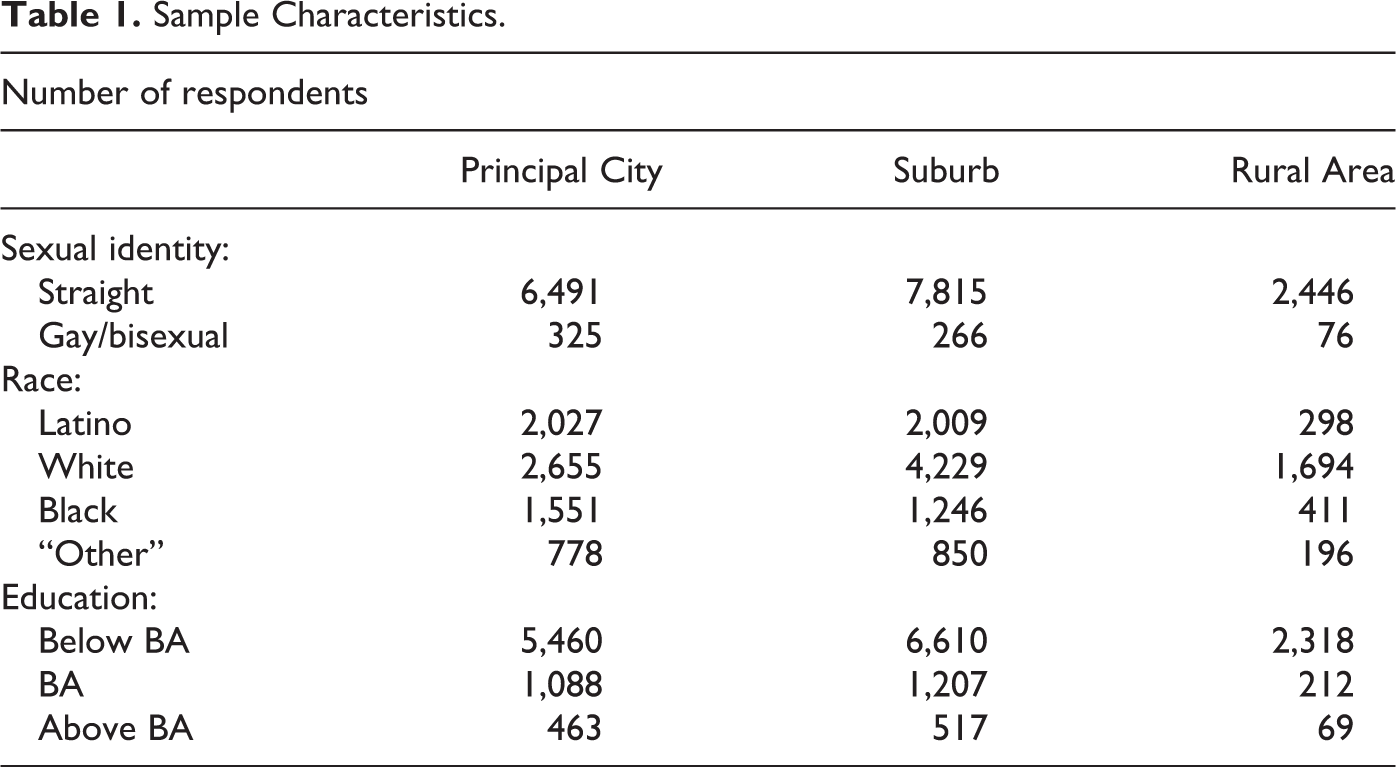
All analyses included the control variables listed in the prior section unless the control variable was the subset of analysis; for instance, education was not used as a control variable when analyzing men without a bachelor’s as a subset, and so on. Unfortunately, intersections of sexual identity, race, and education could not be analyzed because sample sizes were too small for many intersections when also including spatial context (particularly rural areas), hence it was necessary to analyze each separately.
Analytical Strategy
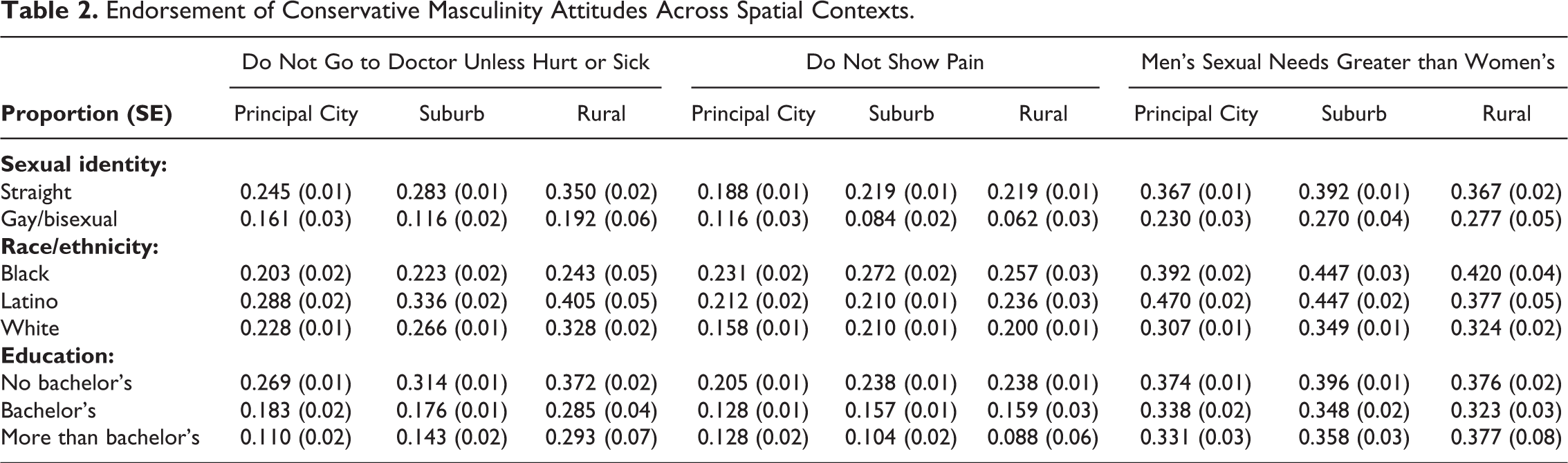
All data were analyzed in Stata/SE version 16.1. Recalibrated person, strata, and cluster weights were used to make all estimates nationally representative of Black, Latino, and white men aged 15–44 in the United States residing in non-institutional households. 10 The subpop option in Stata was used with the subsets to ensure accurate estimates of standard errors. The analysis proceeds in two parts. First, the proportion of each subset that endorsed conservative masculinity attitudes are calculated after adjustment for controls and presented in Table 2. Second, the magnitude and significance of differences in these proportions based on spatial context within each population subset are presented in Table 3.
Endorsement of Conservative Masculinity Attitudes Across Spatial Contexts.
Analyses of Difference in Endorsement of Conservative Masculinity Attitudes Across Spatial Contexts Within the Same Sexual Identity, Racial/Ethnic Identity, or Education Status.
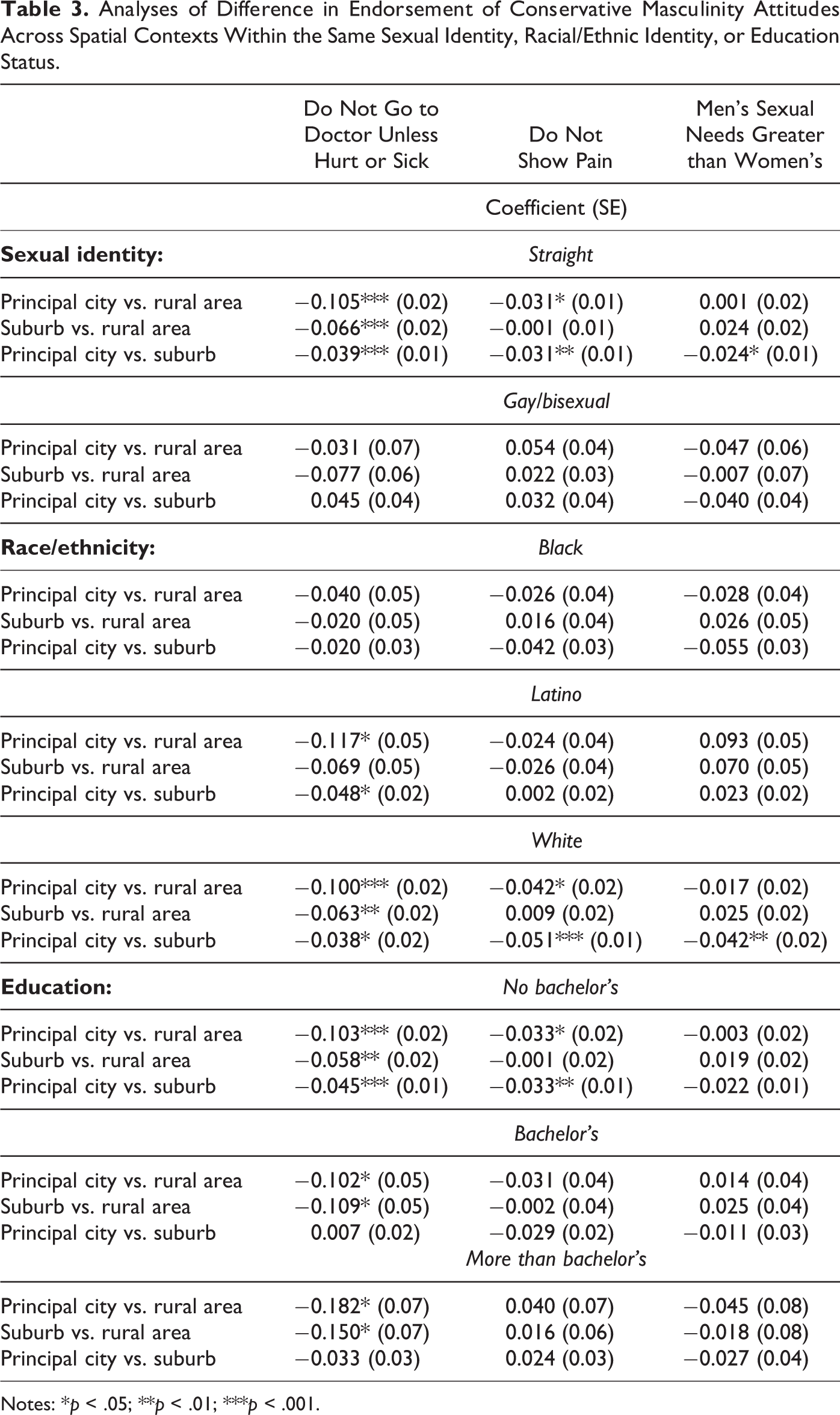
Notes: *p < .05; **p < .01; ***p < .001.
All proportions (Table 2) are calculated as post-estimation tests using the margins command in Stata, with the post, subpop, and vce(unconditional) options specified. The logistic regressions from which these margins were calculated adjusted estimates for all controls described earlier. Analyses of difference (Table 3) are performed using the lincom command. The results section focuses on post-estimation tests because their interpretations are more straightforward than odds ratios from logistic regressions (Long and Mustillo 2018).
Results
Table 2 presents proportions of men who endorsed conservative attitudes about masculinity, and Table 3 presents results from statistical tests that determine whether the proportions displayed in Table 2 significantly differ from one another. More significant differences emerged between men in principal cities and rural areas (9, across attitudes and subsets) than between rural men and suburban men (5), but there was an equal number of significant differences between men in principal cities and suburbs (9). This provides only partial support for H1. Where significant differences existed, all were such that rural men were more conservative, on average, than men in suburbs or principal cities. Similarly, all significant differences between suburban and urban men were such that suburban men were more conservative than urban men. Notably, endorsement of conservatism on the attitude about men’s sexual needs tended to be much higher than attitudes about going to the doctor or showing pain, showing that men’s beliefs about gender differences in sexuality are fairly widespread in all populations except for sexual minority men.
Regarding sexual identity, the only significant differences were among straight men, providing support for H2. Among straight men, a lower proportion of men in principal cities endorsed conservative attitudes about going to the doctor or showing pain than rural men: analyses of difference were −.105 (p < .001) and −0.031 (p < .05), respectively. For ease of interpretation, this means that, after adjusting for controls, straight men in principal cities were about ten percentage points less likely than rural men to endorse conservative attitudes about going to the doctor, and about three percentage points less likely to endorse conservative beliefs about showing pain. A lower proportion of suburban men than rural men endorsed conservatism about going to the doctor (−0.066, p < .001). Additionally, lower proportions of men in principal cities compared to suburban men endorsed conservatism about going to the doctor, showing pain, and men’s sexual needs (−0.039, p < .001; −0.031, p < .01; −0.024, p < .05).
Moving to race/ethnicity, no significant differences emerged among Black men, only two emerged among Latinos, and six emerged among white men, also providing support for H2. Among Latinos, a lower proportion of men in principal cities endorsed conservatism about going to the doctor than rural men (−0.117, p < .05) and suburban men (−0.048, p < .05). Among white men, a lower proportion of men in principal cities endorsed conservatism about going to the doctor or showing pain than rural men (−0.100, p < .001; −0.042, p < .05). A lower proportion of suburban men endorsed conservatism about going to the doctor than rural men (−0.063, p < .01). Lastly, lower proportions of men in principal cities endorsed conservatism about going to the doctor, showing pain, or men’s sexual needs than suburban men (−0.038, p < .05; −0.051, p < .001; −0.042, p < .01). 11
Moving to education, more differences emerged among men without a bachelor’s (5) than among men with a bachelor’s (2), or more than a bachelor’s (2). This support H3. Among men without a bachelor’s, lower proportions of men in principal cities than rural men endorsed conservatism about going to the doctor and showing pain (−0.103, p < .001, −0.033, p < .05). A lower proportion of suburban men than rural men endorsed conservatism about going to the doctor (−0.058, p < .01). Lower proportions of men in principal cities than suburban men endorsed conservatism about going to the doctor and showing pain (−0.045, p < .001; −0.033, p < .01). Among men with a bachelor’s, substantially lower proportions of men in principal cities compared to rural men, and suburban men compared to rural men, endorsed conservatism about going to the doctor (−0.102, p < .05; −0.109, p < .05). Moving to men with more education than a bachelor’s, similar results emerged: a much lower proportion of men in principal cities and suburbs endorsed conservatism about going to the doctor compared to rural men (−0.182, p < .05, −0.150, p < .05).
Statistically significant differences were substantively important in that the magnitude of most effects was large. 12 There is a meaningful relationship between spatial context and attitudes about going to the doctor and showing pain, and to a lesser extent men’s sexual needs, particularly among straight men, white men, and men with less than a bachelor’s aged 15–44 in the United States.
Discussion and Conclusion
This article is the first to use nationally representative survey data in the United States to examine within-group differences in masculinity attitudes based on spatial context. It fills several gaps in the literature, making three key empirical contributions and two key theoretical contributions. First, it builds on important qualitative studies to provide generalizable results about masculinity attitudes across spatial contexts. Second, it analyzes the masculinity attitudes of rural gay/bisexual, Black, and Latino men in the United States, all of whom are under-represented in current research about intersections of masculinity and rurality. Third, it investigates how the relationship between spatial context and masculinity attitudes differs among subsets of men with different levels of education, which has not yet been examined in the literature despite other research showing that education is strongly related to social attitudes (Schnabel 2018).
Theoretically, this project demonstrates that spatial context is more meaningfully related to attitudes about masculinity among straight men and white men, who are not marginalized on the basis of their sexuality or race/ethnicity, respectively, compared to their counterparts who are gay/bisexual, Black, or Latino. This project also builds on the foundation of qualitative studies about rural masculinity (e.g., Abelson 2019; Leap 2017) to show that spatial context is indeed related to attitudes about masculinity and should thus be analyzed in future studies. In other words, spatial context should be analyzed more explicitly in studies about masculinity regardless of whether that context is rural, suburban, or urban.
There are several takeaways from these results. First, spatial context has a stronger relationship with the attitudes this article measured among some subsets than others. No differences were evident among Black men or gay/bisexual men and only two significant differences emerged among Latinos. Second, significant differences that did exist were such that rural men were more conservative than men in principal cities or suburbs, and suburban men were more conservative than urban men. Similar to qualitative studies about urban men (Barry 2018; Barry and Weiner 2019; Barber 2008; 2016; Bridges 2014), these results suggest that men in principal cities are less likely to endorse certain conservative attitudes about masculinity than rural men (Abelson 2019), though this differs depending on both the population of men and the attitude. Third, there were more significant differences between rural and urban men than between rural and suburban men, though there were equal numbers of significant differences as between suburban and urban men. This finding highlights how salient rural-urban divisions are, despite economic ties and other rural-urban connections (Lichter and Brown 2011; Woods 2009). Rural areas are typically more socially conservative than urban areas, as are suburban areas compared to urban areas (Kelly and Lobao 2019). In short, rural and suburban social contexts are distinct from urban contexts, which both reflect and shapes attitudes on social issues, including masculinity.
The lack of many significant differences among Black, Latino, and gay/bisexual men may reflect their marginalized structural position in American society, which affects them regardless of spatial context (albeit in different ways depending on context). This is not to say that there are not within-group differences in masculinity attitudes, but rather that spatial context does not appear to be a major driver of the ones this article analyzed. Regardless of spatial context, institutional racism operates such that Black men experience marginalization across America, as do Latinos (Bonilla-Silva 2019; Collins 2004; Golash-Boza 2016). Gay/bisexual men experience numerous social, legal, and economic inequalities across the United States, and must construct masculinity in different ways than straight men since they cannot rely on heterosexuality to bolster their masculinity. Possibly as a result of these patterns of marginalization, spatial context is not a major driver of differences in the masculinity attitudes this article analyzed among Black men, among Latinos, and among gay/bisexual men. In contrast, the fact that straight men and white men had more within-group differences based on spatial context suggests that lack of marginalization on a particular identity may mean that other factors, like spatial context, shape certain attitudes more strongly.
It is also notable that more differences existed among men without a bachelor’s than among men with a bachelor’s or more than a bachelor’s. This finding suggests that higher education, whether due to the experience of higher education or selection effects of who earns a bachelor’s or more (or both), makes it such that spatial context is not associated with many differences among men with a bachelor’s or more regarding the masculinity attitudes this article analyzed. In contrast, the fact that many more differences were evident among men with less than a bachelor’s suggests that spatial context may shape their attitudes more strongly. These explanations are not provable with cross-sectional research, but findings are suggestive.
Future research can build on this project. Because the NSFG is cross-sectional, causality is impossible to prove. There could be selection effects such that respondents with particular attitudes about masculinity are more likely to move to spatial contexts with greater similarity in attitudes to their own, meaning that rather than spatial contexts shaping attitudes, attitudes could shape where respondents live. However, this is unlikely to be the sole explanation for the findings. Only 9.8% of Americans moved within the last year, and 62.3% of those who did move transitioned to a new residence in the same county (U.S. Census Bureau 2019). In other words, it is fairly uncommon to move to a rural area from an urban area or vice versa. Thus, it is likely that spatial context shapes attitudes to at least some extent. Further, integrating into new communities likely shapes attitudes as well, such that both processes likely occur: spaces shape attitudes and attitudes shape where people are willing to live. Additionally, as the NSFG only included men aged 15–44, surveys with a broader age range are necessary to analyze as well.
Third, more nuanced measures of spatial context are necessary. As Kelly and Lobao (2019) found, exurban residents are closer to rural voters than other suburban residents in their likelihood to vote Republican, whereas micropolitan residents are closer to suburban voters in their likelihood to vote Republican. There are also distinctions in social attitudes between people in large principal cities (e.g., a city of a million people) compared to smaller principal cities (e.g., a city of 85,000 people), as well as between large and small suburban counties (Johnson and Scala 2021). Thus, even as this study found that a three-category measure of spatial context was meaningfully related to masculinity attitudes, further distinctions between these three categories are necessary to further explore attitudes across spatial contexts. Lastly, no dataset other than the NSFG measures masculinity attitudes, is nationally representative, and is large enough to reliably estimate attitudes in small populations (e.g., rural gay/bisexual men), but ideally survey designers will include other masculinity attitudes beyond the three this study analyzed in future waves of large-scale nationally representative surveys.
In sum, this research shows that spatial context is related to certain attitudes about masculinity, but in ways that reflect how sexual identity, race/ethnicity, and education shape men’s experiences. The relationship between spatial contexts and masculinity attitudes, in other words, depends on racial/ethnic identity, sexual identity, and level of education. In terms of public health, this research shows that there should be targeted interventions based on social identity within particular spatial contexts. Men’s beliefs about going to the doctor and showing pain help explain many health issues men experience at higher rates than women, often as a result of being unwilling to express vulnerability and having a higher tolerance for risk (Baker et al. 2014; Plank 2019). This pattern is also tied to spatial context. In rural areas, for instance, some men engage in practices that harm their health, but which are also tied to masculinity in those areas (Helme et al. 2020). Understanding spatial variations in masculinity attitudes—about going to the doctor and showing pain—helps theoretically clarify the relationship between masculinity attitudes and spatial contexts, and also provides practical directions for public health professionals.
Footnotes
Acknowledgment
Thank you to the Sexualities Project at Northwestern (SPAN) for providing the postdoctoral fellowship that allowed me to begin work on this project.
Declaration of Conflicting Interests
The author(s) declared no potential conflicts of interest with respect to the research, authorship, and/or publication of this article.
Funding
The author(s) received no financial support for the research, authorship, and/or publication of this article.
