




Abstract
Urban informal settlements are sites of high HIV incidence and intimate partner violence (IPV). Young men in these contexts often draw on a youthful hypermasculinity that prioritize sexual dominance and displays of violence, although many aspire to a traditional masculinity, which is less violent and uses economic provision and social dominance to control women. Working with young men, we undertook a gender transformative and livelihood strengthening intervention to reduce HIV risk and IPV perpetration. We sought to understand how the wider social context shaped the project’s outcomes. We undertook thirty-eight in-depth interviews and three focus groups postintervention. We conducted thematic analysis using Campbell and Cornish’s conceptualization of social contexts: material–political context, relational–network context, and symbolic context to understand how contexts shaped outcomes. For the material–political context, livelihoods improved, but the continued high levels of unemployment meant that while men may have earned more they did not establish a new relationship to the economy; they still struggled to get jobs and only secured precarious and unfulfilling work. In the relational–network context, men’s main partners and family were supportive of men’s attempts to change, however only narrowly toward a traditional masculinity. Men’s peers were major barriers to men’s attempts to change. In the symbolic context, the accessibility of a “traditional” masculinity provided a resource for men to draw on, which contrasted with the youthful hypermasculinity. We argue that in these informal settlements the social contexts only enabled certain forms of change to occur for young men, limiting the potential for more radical gender equitable transformations.
Urban informal settlements globally, and in Southern and Eastern Africa, are rapidly growing (UN Habitat 2015). For young people, who have often migrated from rural communities, urban informal settlements, alongside providing opportunities for change, pose numerous challenges including limited employment, high levels of violence, and ongoing gender inequalities leading to poor health outcomes (Hunter 2010; UN Habitat 2015; World Health Organization and UN-Habitat 2010). In South Africa, urban informal settlements have twice the national average HIV prevalence (Shisana et al. 2009). Moreover, there is also a strong evidence that these spaces are sites of high levels of violence, including intimate partner violence (IPV) primarily perpetrated by men against women (Gibbs, Sikweyiya, and Jewkes 2014; Hunter 2010). The overlapping nature of the HIV and IPV epidemics is unsurprising, as they have the same root causes embedded in gender inequalities and patriarchal constructions of masculinity (Jewkes et al. 2010; Kim and Watts 2005).
For young men (those under thirty-five), a strong argument has been made that their particular vulnerabilities to HIV and perpetration of IPV against women both stem from masculinities shaped at the intersection of gender inequality and economic marginalization (Bourgois 2002; Jewkes et al. 2016; Silberschmidt 2001). Risky sexual behavior (particularly having multiple sexual partners) and the use of violence against women are both manifestations of a hegemonic masculinity (Connell 2005; Connell and Messerschmidt 2005), which emphasizes conspicuous performance of heterosexuality and dominance and control over women (Jewkes et al. 2016; Wood and Jewkes 2001). Young men’s emphasis on conspicuous heterosexuality may be further exaggerated in contexts where they feel unable to achieve other aspects of hegemonic masculinity, notably failing to occupy a provider role in the context of economic marginalization. Rather in a response fueled by low self-esteem and multiple vulnerabilities, young men place greater emphasis on domains that are within their grasp, with greater emphasis on sexual prowess/conquest, competition among men, and dominance and control over women (Bourgois 2002; Gibbs, Sikweyiya, and Jewkes 2014; Silberschmidt 2001). This can be conceptualized as a hypermasculinity (Herek 1986) rather than a new hegemonic masculinity (Connell and Messerschmidt 2005; Morrell, Jewkes, and Lindegger 2012) and can only be understood as a subordinated and relatively powerless masculinity vis-à-vis the hegemonic masculinity (Ratele 2013). Economic marginalization globally includes the collapse of formal wage labor as well as increasingly precarious livelihood strategies, which place men in weak economic positions, including in relation to women. This does not preclude the presence of other masculinities among young men in urban informal settlements.
In order to work with men to reduce HIV risk behaviors and perpetration of violence against women, a new generation of interventions has been developed which aim to “transform” masculinities (Dworkin, Treves-Kagan, and Lippman 2013; Flood 2011; Gibbs, Jewkes, et al. 2015; Jewkes, Flood, and Lang 2015). Such interventions seek to establish “radical” change in masculinities described by some as “democratizing gender relationships,” creating “‘positive masculinities” or “profeminist” masculinities, although others reflect that the change is much more modest and incremental (Gibbs, Vaughan, and Aggleton 2015; Jewkes, Morrell, et al. 2015). The more impactful of this new generation of interventions with men has moved away from a focus on individual attitudinal or behavior change toward addressing ideals of masculinity; specifically, they seek to transform hegemonic masculinities, and because HIV risk behaviors and IPV perpetration are rooted in the same constructions of masculinities through transforming this, they assume they will simultaneously reduce HIV risk behaviors and IPV perpetration (Edström et al. 2015; Jewkes, Flood, et al. 2015; Jewkes, Morrell, et al. 2015). This new generation of interventions often draws on participatory approaches to behavior change (Barker, Ricardo, and Nascimento 2007; Dworkin, Treves-Kagan, et al. 2013; Gibbs, Jewkes, et al. 2015) building on Paulo Freire’s (1973) work. Within the Freirian tradition, behavior change is only likely to occur through men engaging in dialogue through a range of techniques including body mapping, community mapping, and role-plays, which promotes reflexivity, critical reflection, and ultimately consciousness raising (Campbell and Cornish 2014; Gibbs, Vaughan, and Aggleton 2015; Jewkes, Morrell, et al. 2015).
Campbell and Cornish (2014) however argue that the focus in academic research on participatory interventions has been on small-group processes of change and identity transformation. This has meant there has been little analysis of how broader social contexts shape intervention outcomes (Campbell and Cornish 2012, 2014; Gibbs, Campbell, Akintola, et al. 2015). A small body of work has examined how structural factors including poverty, gender inequalities, lack of external services, HIV-related stigma, unsupportive media contexts and discrimination, and weak policies all contribute to weak intervention outcomes (Auerbach, Parkhurst, and Caceres 2011; Gibbs, Campbell, and Maimane 2015).
In providing a theoretical framework for understanding social contexts that shape project outcomes, Campbell and Cornish suggest characterizing social contexts as three interlocking spheres: (1) the material
In this article, we apply this theoretical framework to understand how harsh social environments shaped intervention outcomes for young men involved in a participatory HIV and IPV prevention intervention in urban informal settlements in South Africa.
The Stepping Stones and Creating Futures Intervention and Evaluation Findings
The data analyzed in this article were generated in the course of an evaluation of the Stepping Stones and Creating Futures intervention. The Stepping Stones and Creating Futures intervention focused on transforming masculinities toward more gender equitable ones and simultaneously strengthening men’s livelihoods. It was hypothesized that through transforming gender norms and strengthening livelihoods, this would reduce HIV risk behavior and IPV.
Stepping Stones and Creating Futures are participatory behavioral and structural interventions. Combined the interventions comprises 21, three-hour sessions focused on building skills and critical thinking around gender equality, communication, safer sex, and livelihoods (Jewkes, Nduna, and Jama-Shai 2010; Misselhorn et al. 2012). Stepping-Stones was first developed in the early 1990s for use in rural Uganda (Welbourn 1995). Since then it has been adapted and evaluated globally (Skevington, Sovetkina, and Gillison 2013). It is theoretically rooted in adult education theory, specifically Freirian notions of learning through dialogue and critical reflection. Sessions use participatory approaches such as group discussion, role-play, body mapping, and other similar techniques to encourage participants to start to engage in critical reflection and to develop social understandings of why they act/behave in the way they do with a particular focus on sex, love, and violence. Participants are encouraged to move away from a focus on personal responsibility to develop critical consciousness and start to transform group gender norms. Creating Futures uses the same group-based approach and similar activities to encourage reflections on livelihoods and job opportunities and was developed by a South Africa NGO in conjunction with researchers (Misselhorn et al. 2012). While Creating Futures does encourage critical reflection about the social drivers of weak livelihoods, there is greater emphasis on individual action and responsibility.
In 2011, we undertook a mixed methods formative evaluation of the intervention with 110 men, 80 percent were under the age of 25 (average age 21.7 years), and the majority had not completed school (Gibbs, Jewkes, et al. 2015; Jewkes et al. 2014). Descriptive data for the young male participants emphasized the low levels of work—only 65.2 percent had worked in the past twelve months—and qualitative data—suggested most men survived through informal temporary work and family support with some engaging in petty crime (Gibbs, Sikweyiya, and Jewkes 2014). There were also high levels of poverty, with 33.9 percent admitting to stealing in the past four weeks because of hunger (Jewkes et al. 2014). Daily they relied on informal peer networks for support, food, and security (Ragnarsson et al. 2010). Many of the young men conformed to a youthful hypermasculinity shaped by their social, economic, and political marginalization (Gibbs, Sikweyiya, and Jewkes 2014; Hunter 2010).
Participants came from two urban informal settlements in eThekwini District, South Africa. One settlement was larger with a mix of formal and informal housing. It was located alongside a highway, near a historically “black” township, with Durban a twenty-five-minute public taxi ride away. The other settlement was recently settled and located on a steep hillside, further away from work opportunities (Gibbs, Sikweyiya, and Jewkes 2014).
The evaluation of Stepping Stones and Creating Futures showed mixed results in terms of impacting on men’s lives, behaviors, and masculinities. Overall, men found the group-based sessions a supportive place to discuss the issues they faced in their lives, something they lacked in their daily experiences (Gibbs, Jewkes, et al. 2015). In terms of masculinities, positively the quantitative data suggested that men had become more gender equitable in their attitudes and were less controlling in their relationships (Jewkes et al. 2014).
Qualitative data seemed to support this shift, with men reportedly becoming less invested in their previous youthful hypermasculinity that prioritized seeking multiple sexual partners, using violence and high levels of alcohol use, and instead moving toward a “traditional masculinity” that sought to exert power through material provision in relationships, and at the same time was less involved in risk-taking and displays of dominance (Gibbs, Jewkes, et al. 2015). In this part of South Africa, a traditional masculinity emphasized male respectability through establishing and maintaining a heterosexual household and economic provision to the household (Gibbs, Sikweyiya, and Jewkes 2014; Hunter 2010). In addition, the use of violence as part of the traditional masculinity was less frequent (although still possible). Part of the process of change was that the men reported improved livelihoods (Jewkes et al. 2014), which it was argued supported their attempts to engage in a traditional masculinity through being able to provide in relationships (Gibbs, Jewkes, et al. 2015).
Yet, despite these overall positive changes, data emphasized that not all men changed, with some men returning to (or continuing with) similar patterns of behavior and lives and investment in youthful hypermasculinity as before the intervention (Gibbs, Jewkes, et al. 2015). Furthermore, the quantitative data suggested that the intervention had no impact on men’s perpetration of IPV, nonpartner rape, alcohol use, or involvement in crime (Jewkes et al. 2014), and while many men had improved work opportunities, this largely involved doing more temporary and poorly paid work rather than improving the quality of work they secured (Gibbs, Jewkes, et al. 2015; Jewkes et al. 2014). The qualitative analysis of the intervention enabled the complexity of the outcomes to be unpacked and understood rather than simply seen as “black boxes” and for understanding theoretical processes of change (Hatcher and Bonell 2016; Hatcher et al. 2011).
Methods
Data discussed in this article are from three sources (see Table 1 for summary). First, we undertook in-depth interviews (IDIs) with nineteen randomly selected men, whom we followed up and interviewed at three- and nine-month postintervention (Gibbs, Jewkes, et al. 2015). At the three-month postintervention interviews, men were asked about their experience of participating in the intervention, initial learnings, and whether they had tried applying learning in their lives. At the nine-month interviews postintervention, IDIs included a broader focus on men’s current lives, relationships with partners, violence, and also the challenges of changing. IDIs were typically 1–1.5 hours long.
Data Collected for Study.
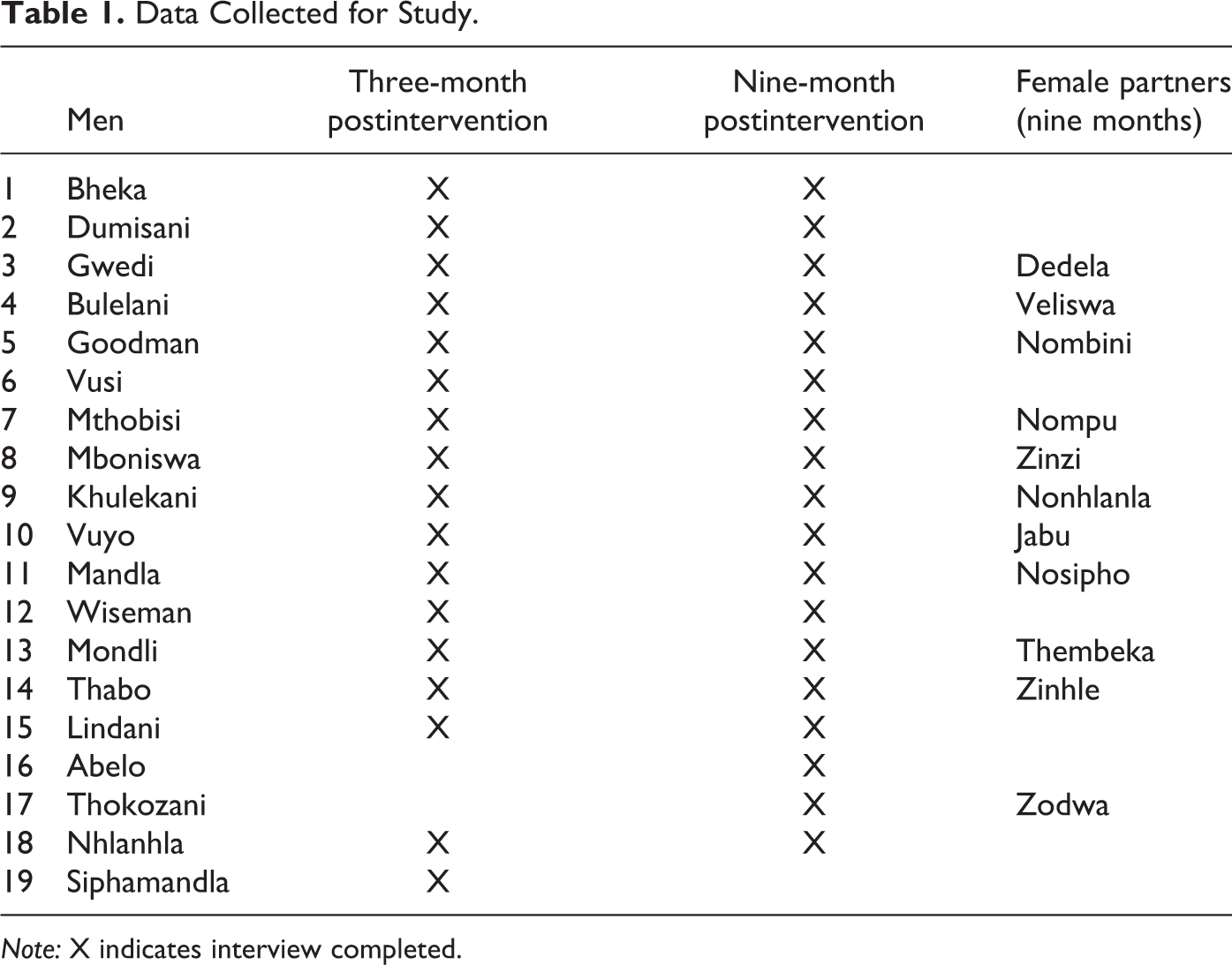
Note: X indicates interview completed.
Second, we asked men who participated in IDIs whether we could contact their main sexual partner to be interviewed at nine-month postintervention. In general, men agreed to this and provided phone numbers of women. We then independently contacted and sought informed consent from these women as autonomous individuals. If women proved hesitant to participate we did not follow-up, and we chose not to conduct interviews if there was concern about the woman’s safety. In addition, men were not made aware of whether or not women were interviewed, and if so when this happened. All were aware that information in interviews would be kept private; eleven women were interviewed. IDIs with women included a focus on their livelihoods, relationship with their partner, and whether they felt they saw any change in their relationship and partner’s behavior (or not). Interviews were forty-five minutes to one hour long.
Third, three focus group discussions (FGDs) were conducted with thirty-four men immediately at the end of the final session of the intervention using convenience sampling. As these were immediately postintervention, they focused on experiences of participating in the intervention and whether participants had attempted to put learnings into actions and the successes and challenges of this. FGDs were typically thirty to forty-five minutes in length.
All IDIs and FGDs were conducted by same-sex trained interviewers. Ethical approval was given by the ethics committees of the South African Medical Research Council and University of KwaZulu-Natal. Written informed consent was obtained from all participants. Names of study participants and locations have been changed to protect the identity of the participants. Interviews were digitally recorded and transcribed verbatim and translated from isiZulu into English.
Data Analysis
A coding frame was applied to the data, drawing from Campbell and Cornish’s (2012) conceptualization of social contexts: material–political context, relational–network context, and symbolic context. Data were subjected to thematic content analysis, initially at these broad levels before specific codes and subthemes were developed under each of the social contexts (Flick 2002). The preliminary analysis was undertaken by the first author. Our analysis sought to understand how these contexts had supported or hindered men’s attempts to change.
Results
The material–context of unemployment and poverty in some cases hindered men’s attempts to establish stronger livelihoods. Moreover, it effectively stopped men establishing a fundamentally different relationship with the economy. Social networks functioned to support men to change, especially when families and partners provided material and emotional support. However, men’s peers were unsupportive of men attempting to change, with men subjected to ridicule and at times physical violence; moreover, the types of change families and sexual partners supported were limited to narrow forms of traditional masculinity. The symbolic context provided opportunities and challenges for men; the different forms of masculinity circulating in the symbolic context allowed young men to draw on a “traditional” masculinity that supported their attempts to change, however, the existence of a dominant youth masculinity circulating in this particular context meant that they also faced jokes and ridicule from other men for attempting to change.
Material–political Context
For men, the material–political context provided significant opportunities for them to work more and increase their earnings (Jewkes et al. 2014). However, the nature of jobs and the types of work meant that despite increasing earnings, men remained in the same relationship to the economy as they had before, engaging in low paid, often temporary work. Despite a vibrant political context, there was no significant discussion of the role of political parties or social organization in interviews, suggesting young men were marginalized from these forms of politics.
Creating Futures sought to encourage participants to consider how they could develop small informal businesses and assess what opportunities existed for this. While these sessions were popular among men who needed to be working and earning money to survive (Gibbs, Jewkes, et al. 2014) and men actively started small businesses in response to the intervention (Gibbs, Jewkes, et al. 2015), men also described the ongoing challenges of small informal businesses. A number of men lacked “start-up” capital to buy goods or equipment that they required to utilize these opportunities: Respondent: I tried selling women’s clothes and when I looked at the capital to start the business I realised I cannot put together the whole amount but I had the motivation to get up and stand on my own two feet but money was the only burden. (FGD 1, end of intervention)
Was it better before?
Yes!
Earning R1500?
Yes!
What made it bad again?
After losing my machine, I spent money recklessly. I thought I’d save and buy another one, but it didn’t happen. (IDI, nine-month postintervention)
Creating Futures also developed specific skills, such as writing curriculum vitae (CV) as well as critical thinking around job opportunities that men reported were useful for seeking and securing jobs. Yet the continued high levels of unemployment meant jobs were simply not available for young men often, no matter how many times they sent CVs in and how hard they looked for work:
Is there anything that has not changed?
What has not changed is that I have not found a job, because with what I do [occasional DJ] I also wish I could have a job.
Why have you not found a job?
Like I said, yesterday I sent my CV out. I still am sending CVs but I have not had any responses. (IDI, three-month postintervention)
When men did secure work in the formal economy, their limited education—with the majority not having a school leaving certificate—meant the only work they could secure was often poorly paid, insecure and sometimes demeaning for them, as Lindani explained: I work as a cleaner. I really don’t like that job but I am working because I have no choice, I want to get another kind of job. (IDI, three-month postintervention)
Relational–network Sphere
Men spoke about having three sets of relationships that were important in their lives at the point of intervention: female sexual partners, families, and peers. Men’s main female sexual partners were generally supportive of men’s attempts to change. Indeed, men described how their partners encouraged them to engage in a range of “positive” behaviors, including saving money and taking HIV tests, which were broadly supportive of the transformative agenda the intervention was hoping to support. Women’s support for men was understood by men as an indication that their partners could see that they were becoming “better” boyfriends, more willing to support their partner, and able to provide for them:
…and your girlfriend?
She has also been very supportive and she is very happy that I came to Stepping-Stones because now she knows anything she needs she can get, so things have not been the same, they changed a lot. (IDI, nine-month postintervention)
In this context, being better boyfriends was as much about the young men starting to be able to provide in relationships (Gibbs, Jewkes, et al. 2015) as it was about developing caring and more nurturing relationships. This was partly because of the inseparable entanglement of romantic love and economic provision in young people’s relationships in challenging economic circumstances (Hunter 2010).
While many men did not live with their families, some received support from them in their attempts to change following participation in the intervention. Familial members who could afford to—and many could not (Gibbs, Jewkes, et al. 2014) —supported men’s attempts to change. This was primarily through providing small amounts of start-up capital to young men. Abelo described how his family helped him buy a tent to support his small barbershop:
How have your family helped you make a living in the past six months?
Ey, they helped me with money my brother you know…
How? Tell me a little bit more
I wanted some money before to add to buying a tent for myself, you see that tent is very expensive at the Game [supermarket] store, they gave me some money to add to what I had saved
did you initiate it or they offered help without you asking?
I came up with half of the money I had saved, you see and they added the other balance on top of what I had saved already. (IDI, nine-month postintervention)
In contrast to men’s sexual partners and families, young men’s peers, who they often relied on for day to day survival through sharing food and alcohol and also security in violent communities (Ragnarsson et al. 2010), were primarily described as hindering young men in their attempts to change. For instance, the intervention shown no impact on alcohol consumption and participants often described how their friends were a major factor in this:
What has been difficult in trying to change your drinking?
Ey, brother, friends you know. Friends are very hard to get rid of when you are trying to change, because they are always around drinking and you and find yourself drinking with them, but I tried to resist and avoid bad friends. (IDI, nine months)
Friends’ attempts to resist men changing went further than low levels of peer pressure and discouragement. One young man described how he was stabbed by one of his former friends because it was felt that he had crossed them, or insulted them, for not spending time with them anymore (Gibbs, Jewkes, et al. 2015).
While one-third of the men in the study had biological children (Jewkes et al. 2014), men rarely talked about their children, apart from in terms of needing to provide for them. Given the young age of most of the men and their children, it may be that children were framed by them only in terms of the demands they placed on men. Financial support for children was a driver for men seeking work and hoping to provide as a “good father” (Bhana and Nkani 2014).
Overall, relational–networks played a number of roles. First, peer networks typically hindered change actively and sought to constrain men’s attempts to change their identities and behaviors. Second, familial networks and female sexual partners tended to support change; however, the changes they supported were not radical “reconstructions of masculinity” premised on radical notions of gender equality and transformation (Gibbs, Jewkes, et al. 2015); rather, they were subtle shifts to other forms of masculinity circulating in the social context, ones that continued to emphasize male dominance and control over women, through establishing economic and social hegemony of a male breadwinner.
Symbolic Context
Although there are multiple masculinities in any context (Connell and Messerschmidt 2005), two closely related forms of masculinity prevailed in these informal settlements: a traditional masculinity, which could be considered hegemonic and emphasized the male provider role and a “hypermasculine” youth identity, which was an extension of this (Gibbs, Jewkes, et al. 2015; Gibbs, Sikweyiya, and Jewkes 2014; Herek 1986; Hunter 2010). While many young men implicitly drew on the youthful masculinity at the start of the intervention, the availability of the related and socially approved masculinity (the traditional masculinity) within the symbolic sphere was critical to support young men’s attempts to change, providing them with a social resource to draw on. Indeed, for some of the men who felt they had meaningfully changed after participating in the intervention, described this not as embracing new forms of masculinity or gender sensitive approaches, but simply as “growing up”:
How did your girlfriend, family, and friends respond to your change?
Most people thought it was just maturity, they don’t know that it is because of the training I was getting, they thought that I had grown up. (IDI, three-month postintervention)
While the traditional masculinity was a social ideal in these communities and something that almost all young men said they aspired to (Gibbs, Sikweyiya, and Jewkes 2014), it was also contested and challenged by young men who sought dominance for their hypermasculinity. Masculinities are not stable and while one may be “hegemonic,” it may also be contested by other forms of masculinity (Messerschmidt 2012). This contestation emerged through men making jokes and ridiculing those men who did attempt to change and who sought to move away from a youthful masculinity to a more socially conservative traditional masculinity:
Has anyone tried to make a joke about your progress?
My brother, you know how people from the community are. They always talk. If they see you carrying a bag, they’ll say who you think are because other people were unable to finish what I’m starting. I have a problem with that and I’m overactive. If they say that, I turn it back to them as a joke, because I know what I want for my life. (IDI, nine-month postinterview)
There was also continual policing of gender and heterosexuality within the symbolic context. Throughout the interviews, there was continual emphasis on the importance of heterosexuality in informal settlements and clear demonstrations of this (Gibbs, Sikweyiya, and Jewkes 2014). Attempts to challenge the dominant youth masculinity often resulted in men being labeled as “gay,” a social label perceived to be inconsistent with being a “real” man in this setting. Mboniswa described how he feared attempting to change and move away from a youthful masculinity for fear he would be labeled as gay:
With current relationships, I just have them because I don’t want to be labeled a gay man.
Are you saying a man without a girl is gay?
It becomes suspicious. (IDI, nine-month postinterview)
As such, the symbolic context did not so much provide alternative masculine identities that men could draw on as “templates” for change, but rather a competitive context among masculinities, within which men’s attempts to change were put under pressure from the youthful hypermasculinity they sought to move away from. Both the youthful masculinity and the traditional masculinity, which while varying in a number of ways, were still shaped by assumptions of heterosexuality and male dominance. Radically alternative gender-equitable identities did not appear to be available to men in this setting; indeed, the policing of gender identities was clearly evident.
Discussion
The case study of the Stepping Stones and Creating Futures intervention emphasizes the central role social contexts play in opening as well as foreclosing possible types of change. Typically, research on social contexts emphasizes how social contexts limit or support the potential for participants to change in general (Gibbs, Campbell, Akintola, et al. 2015; Siu, Wight, and Seeley 2014; Skovdal et al. 2011); rather, we suggest a slightly different reading of the role of social contexts in shaping change. Our analysis suggests social contexts do enable men to attempt to change but only in certain limited and constrained ways to already socially approved and sanctioned identities. Essentially, in each of the three contexts—material, network–relational, and symbolic—there was a tendency to support the status quo rather than enabling change (Steinberg 2008) or only enable men to adopt a few different positions within each context, none of which were radical forms of gender transformation.
In the case of the material–political context, while Stepping Stones and Creating Futures did enable some men to build greater earnings, the constrained labor market and wider context of 40 percent unemployment, and the challenges of establishing small informal businesses, hindered men’s ability to build stronger livelihoods. Moreover, even for those men who did work more and earn more, there remained a similar relationship between themselves and their work; essentially, they remained marginalized in the economic system, in poorly paying, tenuous work, which they felt was demeaning. If economic marginalization is a significant factor, especially when intersecting with gender inequalities, in shaping men’s perpetration of violence against women and HIV risk behaviors (Bourgois 2002; Gibbs, Sikweyiya, and Jewkes 2014; Greig 2009; Silberschmidt 2001), then the intervention did not, and could not, challenge this marginalization in any meaningful way. As such, the ongoing economic marginalization men experienced, despite the intervention, was a major factor limiting men’s ability to change through the intervention. Challenging the wider economic structures shaping men’s (and women’s) economic marginalization remains critical for transforming gender relationships, reducing violence against women, and HIV risk behaviors (Gibbs, Sikweyiya, and Jewkes 2014; Greig 2009; Kim and Watts 2005).
Both the relational–network and symbolic contexts were somewhat similar in providing constrained opportunities for men to change. Essentially, both contexts limited men’s options for masculine identities to either remaining within a youthful hypermasculinity or seeking to adopt a more traditional masculinity. In the symbolic context, both these masculine positions were available for men, although as is clear, men had to struggle to achieve either of these identities (Connell 2005) and there was continual contestation between these forms of masculinity. Similarly, peers sought to constrain men within the youthful masculinity, while female sexual partners and family members enabled and supported change toward a more traditional masculinity. Where men sought to step out in more radical ways from either of these identity positions—for instance, in not seeking to have a girlfriend or not “hanging out” with friends—there was symbolic and physical resistance to this and attempts to “discipline” men. The central role of male peer pressure in shaping men’s behaviors is clearly seen in an analysis of male perpetration of rape in South Africa, where men who were more resistant to peer pressure were less likely to rape (Jewkes et al. 2016), suggesting that peer pressure is critical in shaping both behaviors and the ability of men to change. The ingrained resistance to radical change from sexual partners and peers suggests there may be benefit from working with couples and/or peer networks as a way to promote greater gender transformative change; however, given the fluidity and complexity of young people’s relationships (Gibbs, Sikweyiya, and Jewkes 2014; Hunter 2010; Ragnarsson et al. 2010), this will require significant investment in developing appropriate techniques.
The lack of alternative masculine identities circulating in the symbolic context is a critical issue for small-group interventions such as Stepping Stones and Creating Futures. Participatory interventions do not establish radical new identities for participants; rather, they draw on existing identities already available in any given context (Campbell and Jovchelovitch 2000) and rework these into existing group identities. While there are options for men to develop different identities, these are often linked to wider changes, such as the adoption of religion (Hansen 2012) or an HIV-positive diagnosis (Reihling 2013; Sikweyiya, Jewkes, and Dunkle 2014), rather than being intrinsically accessible to all men. Moreover, the media rather than providing alternative representations of masculinity tends to reinforce dominant notions of masculinity (Gibbs and Jobson 2011; Luyt 2012). Working to introduce alternative masculine identities that resonate and are accepted in the symbolic contexts remains an important task in building more effective interventions.
In addition, young men are heavily invested in a youthful hypermasculine identity, and it requires significant work on their part to retain their position within masculine hierarchies (Bourgois 2002; Connell 2005). Older men, who are more established in their lives, identities, and “masculinity,” may find it easier to change as change is less threatening to their masculinity and identity as men. Indeed, much programming around changing masculinities has focused on transforming hegemonic masculinity rather than hypermasculinity. For instance, analysis of Sonke Gender Justice’s One Man Can intervention suggested much broader shifts in identity and behavior in their older and more rurally based men (Dworkin, Hatcher, et al. 2013; Hatcher et al. 2014). The pressures to conform to rigid hegemonic masculinities and masculine hierarchies and gender relationships may be substantially less in rural areas and among older men who are more established in their masculinity and who One Man Can worked with, than among young men in urban informal settlements, which Stepping Stones and Creating Futures focused on.
This article highlights a wider debate about the potential of Freirian inspired interventions to effect wide-scale social change (Cooke and Kothari 2001; Hickey and Mohan 2004). A possible criticism of the Stepping Stones and Creating Futures intervention is that it is not a truly Freirian project, remaining focused on supporting men to adapt to current contexts, rather than seek to transform these. If this is correct, it would help explain why it did not engender such radical change in men. Indeed, research highlighted that in challenging contexts facilitators moved away from participatory approaches to intervention delivery to didactic teaching methods and individualized analyses of behavior (Gibbs, Willan, et al. 2015). Furthermore, Stepping-Stones (and in turn Creating Futures) can be criticized for not adequately engaging in political structures (Edström et al. 2015). It is possible to contrast this assessment of the delivery of Stepping Stones and Creating Futures with other studies, which have managed to remain closer in implementation to Freire’s original approach, for instance, CANTERA’s workshops on masculinity in Nicaragua (Welsh 2001). Given the significant challenges at the contextual level, it may be that participatory interventions need to consider “mesolevel” interventions and approaches, ones that sit between individual- or group-level approaches and more fundamental wide-scale structural change, where the mesolevel may be more susceptible to change (Auerbach, Parkhurst, and Caceres 2011). Interventions at the mesolevel need greater research and consideration in order of how to conceptualize and operationalize these, be they network interventions, supporting economic strengthening in highly marginalized groups, or introducing alternative masculine representations in the media. These move away from “classic” Freirian interventions focused on small-group processes toward considering how other factors can be tackled in ways that support small-group processes more widely.
What is evident is that the radical transformation of masculine identities that this new generation of interventions working with men and boys, such as Stepping Stones and Creating Futures, claim as a goal is highly unlikely to be achieved. For the young men who drew on a youthful hypermasculine identity, the relational–network, material
Footnotes
Authors’ Note
This document is an output from the What Works to Prevent Violence: A Global Programme, which is funded by the UK Aid from the UK Department for International Development (DFID) for the benefit of developing countries. However, the views expressed and information contained in it are not necessarily those of or endorsed by DFID, which can accept no responsibility for such views or information or for any reliance placed on them.
Acknowledgments
We would like to thank the other team members who were part of the wider study, specifically, Nwabisa Jama-Shai, Laura Washington, Alison Misselhorn, and Samantha Willan. We would also like to thank the fieldwork staff and the participants for sharing their experiences with us.
Declaration of Conflicting Interests
The author(s) declared no potential conflicts of interest with respect to the research, authorship, and/or publication of this article.
Funding
The author(s) disclosed receipt of the following financial support for the research, authorship, and/or publication of this article: The original study was funded by the Swedish International Development Agency (Sida), Norwegian Agency for Development Cooperation (Norad), the Joint Gender Fund (South Africa), and the Medical Research Council of South Africa (SAMRC). Funding for this analysis comes from AG, Sida, and Norad. AG, RJ, and YS received funding from Department for International Development.