




Abstract
People tend to support social initiatives when they feel a psychological connection to the beneficiaries. This tendency often leads hospitality firms to prioritize social initiatives that appeal to customers over those that address the most urgent needs. While previous research has explored situations where people have pre-existing connections to beneficiaries, few studies have examined whether intentionally creating perceived closeness can achieve similar effects. This study explores whether linguistic framing using personal pronouns (“they” vs. “we”) can increase perceived closeness toward beneficiaries and, in turn, boost customers’ willingness to engage in social initiatives. Across two experiments, Study 1 found that using inclusive pronouns (“we”) enhanced perceived closeness to beneficiaries, which subsequently increased engagement intentions. Furthermore, Study 2 demonstrated that this pronoun framing effect was moderated by an individual’s power distance beliefs, the extent to which they perceive hierarchy when services are framed as exclusive. The pronoun framing effect was significant only among those with low power distance beliefs. These findings advance our theoretical understanding of how psychological distance can be strategically reduced through language used in campaign messages. They also offer practical guidance for hospitality managers seeking to design communication strategies that foster more meaningful and sustained customer engagement in social initiatives.
Keywords
Highlights
Using inclusive pronouns (“we”) increases perceived social closeness to beneficiaries.
Perceived social closeness positively predicts engagement intentions in social initiatives.
The indirect effect of pronoun framing through social closeness is stronger under low power distance beliefs.
Practitioners can utilize pronoun framing to better strategize social initiative communication.
Introduction
In recent years, global markets and investors have widely recognized that financial statements alone cannot fully explain a company’s value. This recognition has shifted attention to non-financial factors that influence long-term corporate sustainability and growth. Within this context, environmental, social, and governance (ESG) practices have emerged as a critical framework for assessing corporate value across industries (Chen et al., 2022; Mervelskemper & Streit, 2017; Puriwat & Tripopsakul, 2022). ESG encompasses environmental, social, and governance-related issues that significantly influence a company’s long-term sustainable value (Chen et al., 2022). More specifically, the environmental dimension involves protecting nature, conserving water, and reducing waste; the social dimension focuses on employee well-being, diversity, and inclusion; and the governance dimension addresses corporate transparency and ethical leadership (Back, 2024; Legendre et al., 2024).
While all three dimensions of ESG are important, recent attention has shifted from the environmental to the social dimension. Sustainability reporting trends in 2024 underscore the need to strengthen the social dimension, which remains at an early stage with limited shared definitions and benchmarks, in contrast to the environmental dimension that is already well established in investment and operational practices (McCalla-Leacy & Gnädiger, 2024; PERE, 2024). The call to strengthen the social dimension is especially salient in hospitality, where success depends heavily on human connections and community engagement (Altinay & Brookes, 2012; Baum, 2018). Reflecting this trend, many leading hospitality companies have strategically chosen and implemented socially focused initiatives. For instance, Accor has promoted inclusion through its culture of inclusion initiatives, such as recruiting people with disabilities and launching a Disability Inclusion Self-Assessment Toolkit for hotels (Accor, 2023). InterContinental Hotels Group’s Journey to Tomorrow 10-year responsible business plan commits to championing a diverse culture where everyone can thrive, improving community lives through skills training and dignity of work (InterContinental Hotels Group [IHG], 2021).
Despite these efforts, companies often face a subtle but important challenge: individuals may experience corporate social initiatives as distant or irrelevant, which weakens their engagement and intention to act. Psychological distance theory provides a theoretical lens to address this challenge. It suggests that people are more likely to support social initiatives when they feel a closer personal connection to the beneficiaries (Liberman et al., 2007). This means that individuals may not support every initiative led by a company, but are more likely to support ones that feel psychologically closer to them. Previous research on social initiatives has primarily examined how people behave when psychological closeness already exists, for example, comparing “close vs. distant” conditions or analyzing behavior in already close relationships (Beckes & Coan, 2011; Earp et al., 2021). However, limited research has investigated how psychological distance can be strategically reduced to enhance customer engagement. Therefore, it is necessary to develop communication strategies that can both garner public support and ensure that help reaches those most in need.
One way to address this need is through linguistic strategies that shape how messages are interpreted, and influence whether audiences feel included, connected, or distanced in social contexts (Santiago et al., 2021). Within this category, personal pronouns are especially salient beyond their grammatical function because they act as implicit social markers that signal connection, identity, and group membership (Fiedler et al., 2015). In fact, industries frequently rely on pronouns in social campaigns to frame collective engagement. For instance, Marriott’s #LoveTravels campaign emphasizes inclusivity with the phrase “We support our community together,” whereas the American Red Cross appeals to the public with the message “They need your help now” (American Red Cross, 2022). These practical examples are consistent with prior research showing that “they” emphasizes separation and strengthens out-group distinctions, while “we” fosters inclusiveness and reduces social distance (Brewer & Gardner, 1996; Fiedler et al., 2015). Such differences in pronoun use are meaningful because they shape how people perceive their connection to beneficiaries. In line with this, our study examines whether the use of personal pronouns enhances perceived social closeness with beneficiaries, defined as the psychological connection individuals feel toward those who benefit from a social initiative (Small & Simonsohn, 2008). This sense of closeness, in turn, influences behavioral intentions to engage in social initiatives—the willingness to support such initiatives through actions such as donating, volunteering, or advocacy (Zhao et al., 2023). Accordingly, this study focuses on comparing the mechanisms of collective pronouns (“we” and “they”) to investigate how pronoun use can strategically reduce psychological distance and promote engagement in social initiatives.
On the other hand, the effectiveness of these contributions can also depend on the situational context. One important factor is power distance belief, which refers to the degree to which people accept and feel comfortable with hierarchical differences (Yan et al., 2021). In the hospitality industry, hotels often emphasize services that highlight customers’ sense of exclusivity and special status, thereby reinforcing hierarchical distinctions. For example, Aman Hotels underscores exclusivity in their brand message that describes their offerings as “an experience meticulously crafted for the discerning few who seek only the finest in luxury hotel destinations and ultra-exclusive travel.” Similarly, The Peninsula Hotels highlight selectivity with the slogan “For those who accept nothing but the best,” consistently projecting an image of catering only to a privileged few. In these high-power distance environments, the use of inclusive pronouns such as “we” may be less effective, because customers are less inclined to feel socially close to beneficiaries.
Accordingly, this study has three objectives: (1) to examine whether inclusive pronouns (“we”) shape individuals perceived social closeness with beneficiaries compared with “they” pronouns, (2) to investigate whether perceived closeness increases individuals’ behavioral intentions to support social initiatives, and (3) to test whether power distance belief moderates this mediated process. Through these objectives, this study contributes theoretically by extending research on communication strategies and psychological distance, identifying pronoun framing as a driver of social closeness and prosocial engagement. Practically, it offers insights for organizations on how to design more effective messages that encourage broader public participation in social initiatives.
Literature Review
Social Initiatives and Customer Engagement
Social initiatives are collective efforts by individuals, communities, organizations, or governments aimed at addressing social problems, advancing public welfare, and promoting social justice (Georgallis, 2017). Unlike one-time donations or traditional charity, social initiatives are typically strategic and focus on creating long-term, sustainable impact (Kramer & Pfitzer, 2016). Such efforts have increasingly gained attention from the hospitality industry, where social initiatives often take the form of community-based tourism, support for local suppliers, or programs to enhance employee well-being (Font et al., 2012; Mihalič et al., 2012). These initiatives are particularly important in the hospitality industry, where companies have a significant influence on community well-being, employee welfare, and environmental sustainability (Jones et al., 2016; Kasim, 2006).
Traditionally, companies implemented social initiatives primarily to enhance their brand image or serve corporate interests (Bhattacharya & Sen, 2004; Margolis & Walsh, 2003). However, there is growing recognition that such efforts should also generate tangible positive change for society, not just benefit the company (Carroll & Shabana, 2010; Porter & Kramer, 2011).
Over the past decade, the concept of corporate responsibility has evolved from ad hoc charitable giving and compliance-driven corporate social responsibility (CSR) to more strategic, measurable, and stakeholder-oriented approaches such as ESG. Companies are increasingly expected not only to minimize harm but also to create tangible social and environmental value, often aligning their initiatives with global frameworks like the United Nations Sustainable Development Goals (Abhayawansa & Mooneeapen, 2022; Porter & Kramer, 2011). In the hospitality industry, this shift has led to a growing emphasis on sustainable and regenerative tourism, multi-stakeholder partnerships, and authentic community engagement (Higgins-Desbiolles et al., 2019; Mihalič et al., 2012). For example, Marriott International allows customers to donate unused loyalty points to support global and local nonprofit organizations through its “Marriott Bonvoy Points for Good” program that directly links customer participation to social impact (Marriott International, 2023). Similarly, Hyatt Hotels partners with local artisans and small businesses through its “Hyatt Thrive” initiative, creating shared value by integrating local suppliers into its operations (Hyatt Hotels Corporation, 2022). Hilton Worldwide also organizes large-scale employee volunteer programs such as “Travel with Purpose Week,” where staff contribute time to community projects ranging from food drives to environmental clean-ups (Hilton, 2023). As a result, customer engagement has emerged as a critical factor in the success of social initiatives. In particular, meaningful stakeholder involvement—especially that of customers—is now seen as essential for achieving business objectives and positive societal outcomes (Bhattacharya & Sen, 2004; Du et al., 2010).
Social Distance in Social Initiatives
People naturally view the world based on their immediate surroundings—the here and now. Nevertheless, even when something is physically close, people may still feel detached from it in their minds. This sense of separation is termed psychological distance, referring to the perceived gap between oneself and other people, events, times, or situations, typically from the perspective of the here and now (Liberman et al., 2007; Trope & Liberman, 2010). People can experience psychological distance in several ways. Psychological distance is commonly described in terms of four dimensions: temporal, spatial, hypothetical, and social (Liberman et al., 2007). Temporal distance refers to how near or far an event feels in time, which influences the level of urgency and concreteness people assign to it. Events that feel temporally close tend to prompt more immediate action, whereas distant events are viewed as abstract and less pressing (Spence & Pidgeon, 2010). Spatial distance concerns perceived physical proximity. Geographically close issues are often judged as more tangible and personally relevant, while distant issues tend to elicit weaker engagement (Fujita et al., 2006). Hypothetical distance captures the perceived likelihood of an event. When events are framed as highly probable or certain, individuals are more motivated to act; when framed as uncertain, they are often dismissed as remote possibilities (Wakslak et al., 2006). Finally, social distance refers to the perceived closeness or connection to others, distinguishing between in-group members and distant outsiders (Trope & Liberman, 2010). This dimension is crucial for understanding prosocial behavior, as people consistently show greater empathy and willingness to help those they feel socially close to (Duclos & Barasch, 2014; Winterich et al., 2009).
Among these dimensions, this study focuses on social distance because of its central role in shaping individuals’ responses and engagement (Duclos & Barasch, 2014; Winterich et al., 2009). Social distance captures the perceived closeness or connection individuals feel toward others, such as whether recipients are seen as part of one’s in-group (family, community) or as distant outsiders (Trope & Liberman, 2010). Research shows that people are more likely to empathize with, support, and engage in prosocial actions toward socially close beneficiaries (Duclos & Barasch, 2014; Winterich et al., 2009). For example, campaigns that frame beneficiaries as “your local community” or “people like you” consistently elicit greater support than those describing anonymous or distant groups (Aaker & Akutsu, 2009).
In the hospitality industry, social distance is especially salient because guest experiences are often mediated by relationships with local people and places (Altinay & Brookes, 2012; Baum, 2018). For example, True Blue Bay Boutique Resort in Grenada organizes coastal cleanups where customers work side by side with local residents, transforming beneficiaries from distant others into familiar community partners. Similarly, Ritz-Carlton’s Community Footprints program invites guests to participate in local service projects, such as supporting nearby schools or community centers, thereby fostering a sense of shared purpose with beneficiaries. These concrete, property-led initiatives demonstrate how hospitality firms can reduce social distance and enhance customers’ engagement with socially oriented initiatives.
The Role of Personal Pronouns in Psychological Distance
Language is a powerful verbal cue that shapes how individuals perceive their relationships with others, particularly through the use of personal pronouns (Fiedler et al., 2015). Personal pronouns, such as “I,” “you,” “we,” and “they,” refer to people or groups without using their specific names (Nook et al., 2017). In marketing communication, pronouns function as social categorization cues, signaling inclusion or exclusion from a social group (Aaker & Akutsu, 2009). Personal pronouns vary in the degree to which they signal group boundaries and social relationships. While singular pronouns such as “I” and “you” refer to individuals and emphasize a personal perspective or direct communication, plural pronouns like “we” and “they” express group membership and social categorization (Sela et al., 2012).
In the context of social initiatives, companies communicate with potential supporters, such as customers or the general public, to encourage them to help a beneficiary group (Aaker & Akutsu, 2009; Packard & Berger, 2021). Such communication is designed to encourage collective action. Specifically, it seeks to increase the participation of potential supporters in social initiatives and motivate them to help beneficiaries. In such settings, the use of plural pronouns (e.g., “they” and “we”) is effective because these pronouns signal group membership and boundaries, highlighting whether the reader is associated with the company and beneficiaries (“we”) or positioned as separate from them (“they”; Turner et al., 1979). Plural pronouns are especially effective for signaling group membership and boundaries, which are central to the concept of social distance (Perdue et al., 1990; Turner et al., 1979). Therefore, this study focuses on “they” and “we” as the most relevant pronouns for examining how personal pronouns can reduce or reinforce social distance in social initiatives.
Prior research has demonstrated that the use of inclusive pronouns (e.g., “we”) can foster a sense of shared identity and emotional connection with beneficiaries, thereby reducing perceived social distance and increasing support for social initiatives (Fiedler et al., 2015; Packard & Berger, 2021). For instance, Fiedler et al. (2015) found that a message framed with “we” increased recipients’ willingness to engage in prosocial behavior, suggesting that inclusive language can foster a sense of shared responsibility and collective motivation. Similarly, Aaker and Akutsu (2009) demonstrated that charitable appeals using “we” pronouns were more effective in engaging emotions and reinforcing a shared social identity among message recipients compared to those using “they” pronouns. Other studies have shown that the use of “they” tends to emphasize group boundaries, which can reduce identification with the beneficiary group and decrease motivation to participate in social initiatives (Sela et al., 2012; Turner et al., 1979).
Although prior research has demonstrated similar effects and has often attributed the impact of pronoun use to mechanisms such as emotional contagion or perceived responsibility, other mechanisms may also play an important role (Hou et al., 2023). The present study aims to explore this additional pathway. Extending prior research, this study proposes that the use of “we” compared to “they” has a stronger positive effect on perceived social closeness with beneficiaries and that this perceived closeness is a key psychological mechanism underlying support for social initiatives. Recent work in social psychology confirms that perceived closeness is a critical driver of prosocial engagement (Duclos & Barasch, 2014; Winterich et al., 2009). Distinguishing the specific mechanisms through which pronoun framing operates is important, as it enables the development of targeted communication strategies to foster stakeholder engagement (Chung & Pennebaker, 2007). Therefore, this study proposes the following hypothesis.
H1: Using the personal pronoun “we” rather than “they” has a stronger positive effect on perceived social closeness with beneficiaries.
Behavioral Intention to Engage in Social Initiatives
Behavioral intention refers to the self-reported likelihood or willingness of individuals to take specific action and is widely recognized as one of the strongest predictors of actual behavior (Ajzen, 1991). In the context of social initiatives, behavioral intention encompasses actions such as donating, volunteering, or advocating for a program (Batson, 2012). Understanding the factors that drive behavioral intention is critical for designing effective campaigns that promote social engagement.
The majority of prior research highlights the importance of psychological closeness in motivating prosocial action. Empirical evidence demonstrates that psychological closeness plays a critical role in determining whether individuals are willing to engage in prosocial behaviors (Small & Simonsohn, 2008; Trope & Liberman, 2010). The success of social initiatives often depends on the degree of psychological closeness individuals feel toward the beneficiaries (Bhattacharya et al., 2008; Peloza & Shang, 2011). Research consistently shows that people are more likely to support social initiatives that feel psychologically close, such as those within their local community or social group (Mittelman & Dow, 2018; Winterich et al., 2009). For instance, individuals are more willing to donate to local charities than to international ones, as local causes tend to feel more personally relevant and tangible (Ein-Gar & Levontin, 2013). Therefore, reducing social distance is critical for fostering engagement in social initiatives. When individuals perceive beneficiaries as socially close, they are more likely to feel empathy and a heightened sense of responsibility, which in turn increases their willingness to take action (Duclos & Barasch, 2014; Zagefka et al., 2011). Accordingly, this study proposes the following hypothesis:
H2: Perceived social closeness with beneficiaries has a significant positive effect on behavioral intention to engage in social initiatives.
The Indirect Effect of Pronoun Framing via Perceived Social Closeness
According to social categorization theory, pronouns serve as powerful cues that shape individuals’ perceptions of social closeness (Turner et al., 1979). When exposed to inclusive pronouns like “we,” individuals are more likely to perceive beneficiaries as part of their in-group, fostering a sense of shared identity and emotional connection (Gonzales et al., 2010). This perceived social closeness mediates the effect of pronoun framing on engagement in social initiatives by enhancing individuals’ willingness to engage in prosocial behaviors (Zagefka et al., 2011). For example, Aaker and Akutsu (2009) found that charitable appeals using “we” pronouns were significantly more effective in fostering emotional connection and increasing donations compared to those using “they” pronouns, because inclusive language made beneficiaries feel more relatable and emotionally connected. Therefore, pronoun framing influences behavioral intention mainly by increasing perceived social closeness, which acts as a key mediator in this process (Zagefka et al., 2011). Accordingly, this study proposes the following hypothesis:
H3: The effect of using the “we” pronoun on behavioral intention to engage in social initiatives is mediated by perceived social closeness.
The Moderating Role of Power Distance Belief
Power distance belief refers to the extent to which individuals accept or expect unequal power distribution within a society or organization (Hofstede, 1980). While power distance belief is traditionally considered a cultural dimension, recent research indicates that it can also be situationally activated and manipulated, even within short-term service encounters (Y. Kim & Zhang, 2014; Yan et al., 2021; Y. Zhang et al., 2010). For example, in their research, Y. Zhang et al. (2010) and Y. Kim and Zhang (2014) found that power distance beliefs can be situationally manipulated by exposing the study participants to products labeled with status-related words, such as “exclusive,” “privileged,” or “limited edition.” After seeing these words, the participants reported higher levels of power distance belief.
Hospitality settings often involve status signals and service hierarchies. These features can naturally activate or heighten power distance beliefs, as customers are frequently exposed to differentiated service levels, exclusive offers, and visible markers of social hierarchy (Lam et al., 2009). For example, Four Seasons explicitly emphasizes exclusivity, personalized service, and VIP treatment in their mission and marketing. Their service culture focuses on “offering only experiences of exceptional quality” and treating every customer as a VIP. These practices reinforce social hierarchy and exclusivity, making customers aware of differentiated service levels and their own special status within the hotel environment (Four Seasons Hotels and Resorts, 2025).
Power distance beliefs directly affect how close or distant people feel to others in social interactions. When individuals perceive themselves as having higher power or social status, they tend to recognize more hierarchy and experience greater psychological distance from others (Magee & Smith, 2013). On the other hand, those who perceive themselves as equal or lower in power are more likely to experience a sense of equality and closeness in these interactions (Y. Kim & Zhang, 2014). Research in consumer behavior further shows that beliefs about social hierarchy and inequality shape not only interpersonal perceptions but also a wide range of consumer choices and prosocial behaviors (Wang et al., 2022). For instance, individuals with higher power distance beliefs are more likely to accept inequality, show less prosocial intention, and maintain greater social distance from others (Y. Kim & Zhang, 2014). Moreover, when people feel superior or possess higher social status, they tend to exhibit more independent, self-focused behavior and less empathy or social closeness toward others (Kraus et al., 2009; Magee & Smith, 2013).
Based on the above reasoning, the effectiveness of inclusive pronoun usage may be conditioned by power distance beliefs. Individuals with lower power distance beliefs, who value equality and shared identity, are more likely to feel psychologically close to others when exposed to inclusive pronouns (Fiedler et al., 2015; Y. Kim & Zhang, 2014). This is because they tend to perceive social boundaries as more permeable and are more likely to endorse horizontal social structures, in which people are viewed as fundamentally equal regardless of their roles or status (Hofstede, 2011; Torelli & Shavitt, 2010). Such individuals often initiate informal conversations and collaborations with colleagues across ranks and are comfortable sharing their thoughts openly in group settings (Earley & Gibson, 2002). They also show greater receptivity to language that emphasizes shared group identity and connection, aligning with their preference for egalitarian communication and low hierarchical differentiation (Gudykunst et al., 1996).
In comparison, those with high power distance belief tend to prioritize hierarchy and social distinctions, making them less responsive to inclusive language and more likely to maintain psychological distance (Magee & Smith, 2013; Yan et al., 2021). Recent research also suggests that the impact of social initiative messaging can be moderated by power distance belief, with message effectiveness varying across different belief levels (Song & Wei, 2025). Accordingly, we propose the following hypotheses:
H4: Power distance belief moderates the effect of using “we” (compared to “they”) on perceived social closeness with beneficiaries, such that the “we” effect is stronger under low (vs. high) power distance belief.
H5: The indirect effect of pronoun framing on behavioral intention through perceived social closeness is moderated by power distance belief, such that the indirect effect is stronger for individuals with low (vs. high) power distance belief.
Figure 1 summarizes the conceptual model and hypotheses of this research.
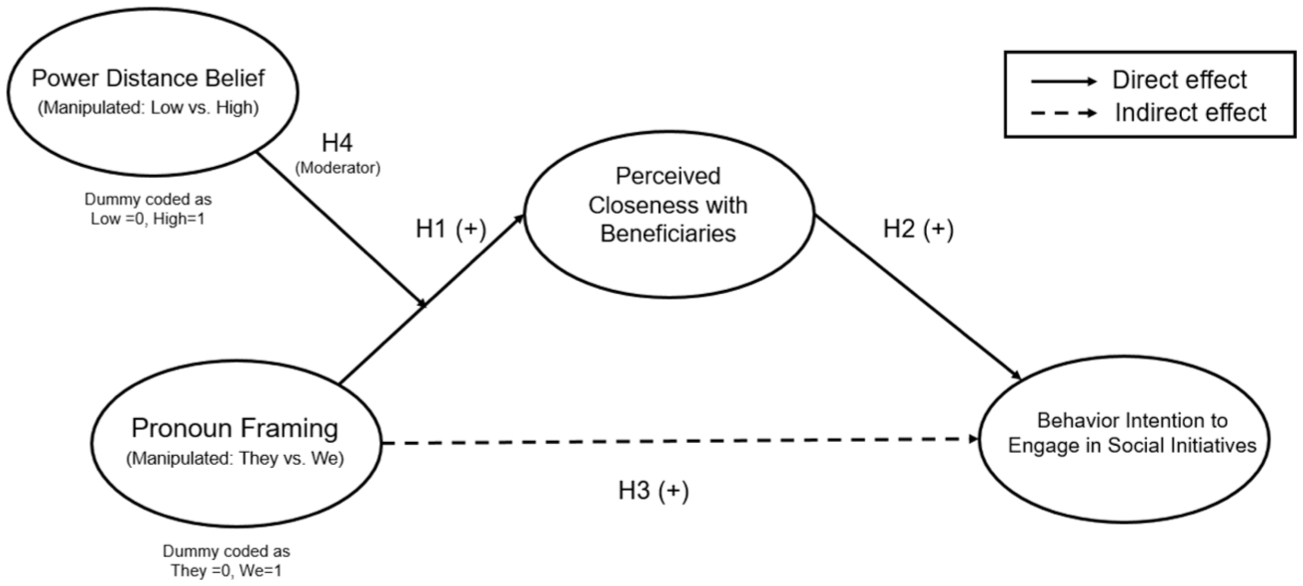
Conceptual model.
Study Overview
Two experimental studies were conducted to test the proposed hypotheses. An experimental approach was chosen because it enables a rigorous examination of the causal relationship between pronoun framing (“they” vs. “we”) as the cause and psychological closeness and willingness to engage in social initiatives as the outcomes. Unlike prior studies that mainly examined contexts with salient group identities, this study uses experiments to create and test situations where no such identity exists, thereby providing unique insights into the role of pronoun framing in bridging social distance. Study 1 tested whether using “we” (vs. “they”) increases perceived social closeness with beneficiaries and behavioral intention to engage in social initiatives. Study 2 replicated these findings and examined whether the effect is moderated by induced levels of power distance beliefs. These two studies complement each other by first establishing the main effect and then exploring its boundary conditions, providing a comprehensive understanding of how and when pronoun framing promotes social initiative engagement.
Study 1
Preliminary Study
Before conducting the main study, we carried out a preliminary study to ensure stimulus manipulation. Two message-framing conditions were created: In the first condition, the message used “they,” positioning the audience as separate from the beneficiaries (e.g., “They need water. . . Let’s save water for them.”). In the second condition, the message used “we,” highlighting a shared human condition and positioning the audience as psychologically connected to the beneficiaries through a universal need (e.g., “We all need water. . . Let’s save water for all of us.”). To examine whether pronoun-framing effects would generalize across issue domains, we selected three campaigns spanning distinct types of social initiatives: water conservation (environmental sustainability), refugee support (humanitarian and social justice), and disability support (diversity and inclusion). These domains map onto social priorities commonly emphasized in Hotels & Lodging industry standards (e.g., Human Rights & Community Relations; Employee Engagement, Diversity & Inclusion) and are repeatedly reflected in leading hotel ESG reports (e.g., Marriott’s Serve 360 points-donation and refugee hiring programs; Hyatt’s collaborations with local artisans/small businesses; Hilton’s Travel with Purpose Week).
A total of 180 participants were recruited via Prolific and randomly assigned to one of the two pronoun framing conditions (“they” or “we”). Within each condition, participants were exposed to one of three social campaigns (i.e., water conservation, refugee support, or support for disability rights) to ensure that manipulation was robust across diverse social issues. At least 30 participants were included in each campaign per condition, as recommended for pretests (Mattila et al., 2021). After viewing the stimuli, participants completed a manipulation check assessing how frequently they observed first-person pronouns (1 = None, 7 = Very Frequent). An independent samples t test confirmed that the manipulation was effective: Participants in the “we” condition (M = 4.11, SD = 1.37) perceived more first-person pronouns than those in the “they” condition (M = 3.45, SD = 1.86; p = .011).
To examine whether this manipulation worked consistently across different social campaigns, a two-way ANOVA was conducted with pronoun condition (“they” vs. “we”) and campaign (water conservation, refugee support, and disability rights) as between-subjects factors. The analysis revealed a significant main effect of pronoun condition, F (1, 350) = 8.71, p = .003, indicating that participants in the “we” condition perceived significantly more first-person pronouns than those in the “they” condition. There was no significant main effect of the campaign, F (2, 350) = 1.77, and the interaction between pronoun condition and campaign was not significant, F (2, 350) = 0.89, p = .412. These results suggest that the manipulation worked consistently across all three campaign contexts, and the effect of pronoun framing did not vary by campaign.
Main Study
This study employed a 2 (pronoun: they vs. we) × 3 (campaign type: water conservation vs. refugee support vs. disability support) full-factorial between-subjects design. Pronoun condition (they vs. we) was the primary independent variable of interest. Participants were exposed to one of three campaign types to examine the generalizability of the effect. The “they” condition was coded as 0, and the “we” condition was coded as 1.
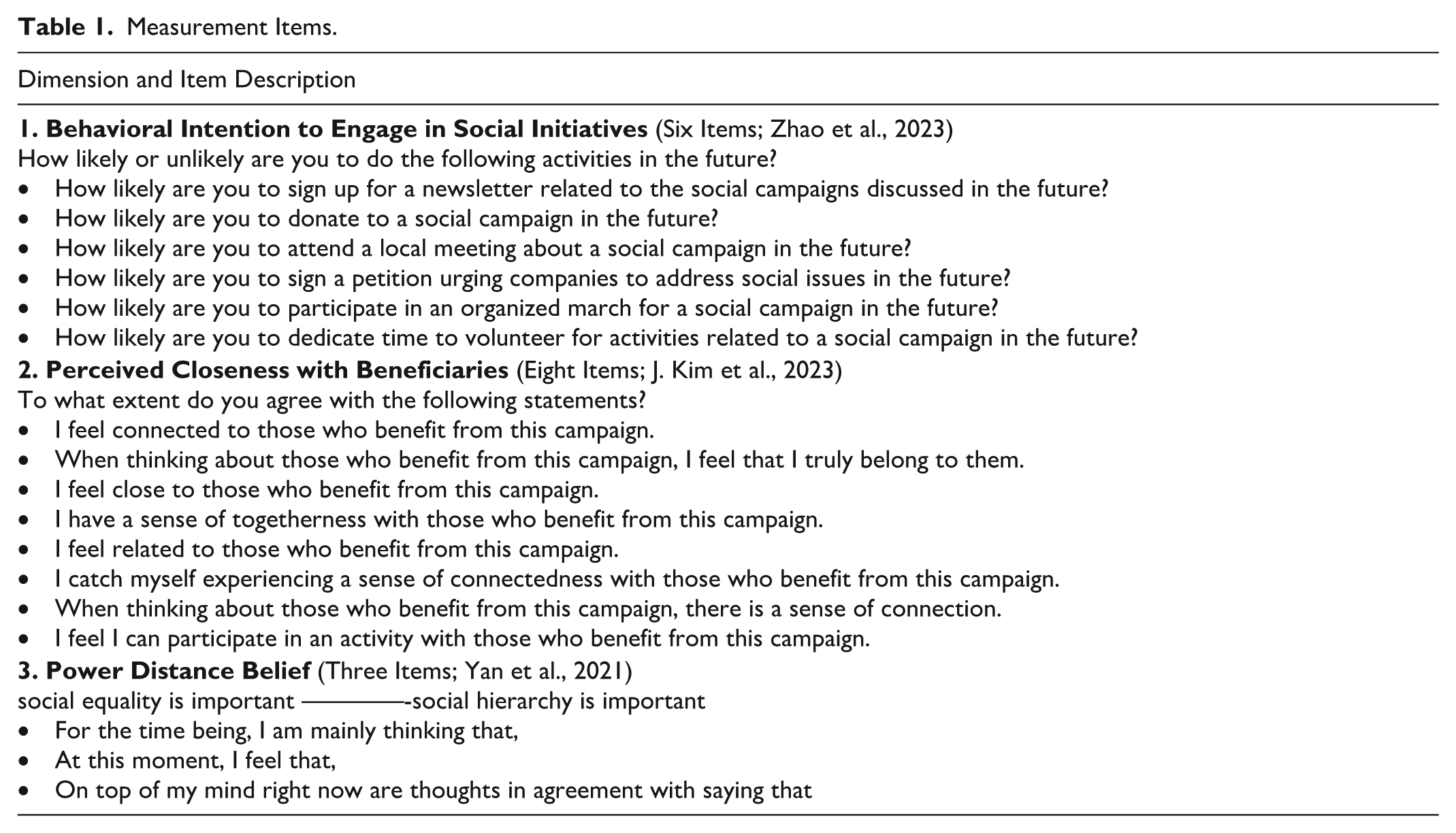
Participants were recruited using Prolific’s screening tools to ensure demographic diversity and eligibility. To qualify, individuals had to be at least 18 years old, fluent in English, and have stayed at a hotel within the past 2 years. Pretest participants were excluded. A total of 300 participants were randomly assigned to one of the six conditions, as determined by a priori power analysis (G*Power). Attention checks and incomplete responses were screened out. All participants received standardized compensation. Perceived social closeness was measured using an eight-item scale adapted from C. K. Kim et al. (2013; α = .96). Behavioral intentions to engage in social initiatives were assessed using a six-item scale developed by Zhao et al. (2023; α = .92). Measurement items for all constructions are presented in Table 1. Moral reasoning was included as a control variable to account for individual differences in prosocial orientation, as prior research has shown that pre-existing moral tendencies (e.g., moral reasoning, moral identity) can confound the effects of experimental manipulations on prosocial outcomes (Eisenberg et al., 2002; Reed & Aquino, 2003). By controlling for moral reasoning, we hold constant participants’ pre-existing prosocial orientation. This ensures that observed changes in social closeness and behavioral intentions can be attributed to the causal effect of pronoun framing, which is central to our research objectives. In-group bias was also measured to rule out alternative explanations, since individuals are more likely to engage in prosocial behavior toward perceived in-group members (Brewer, 1999; Turner et al., 1979). This clarification highlights that the positive effects of inclusive pronouns are not simply due to in-group categorization but instead operate through the mechanism of perceived social closeness.
Measurement Items.
Demographic information (age, gender, education) and measures of perceived realism and comprehensiveness of the materials were also collected. We conducted randomization checks and found no significant differences across experimental conditions for these variables. Therefore, they were not included as covariates in the main analyses. Moral reasoning was statistically controlled for in all analyses to account for individual differences. Data analysis was conducted using Model 4 of the PROCESS macro for SPSS (Hayes, 2018) to test the mediating effect of perceived social closeness on behavioral intention. The pronoun condition was entered as the independent variable, perceived social closeness was used as the mediator, and behavioral intention was the dependent variable, with moral reasoning included as a control variable.
Results
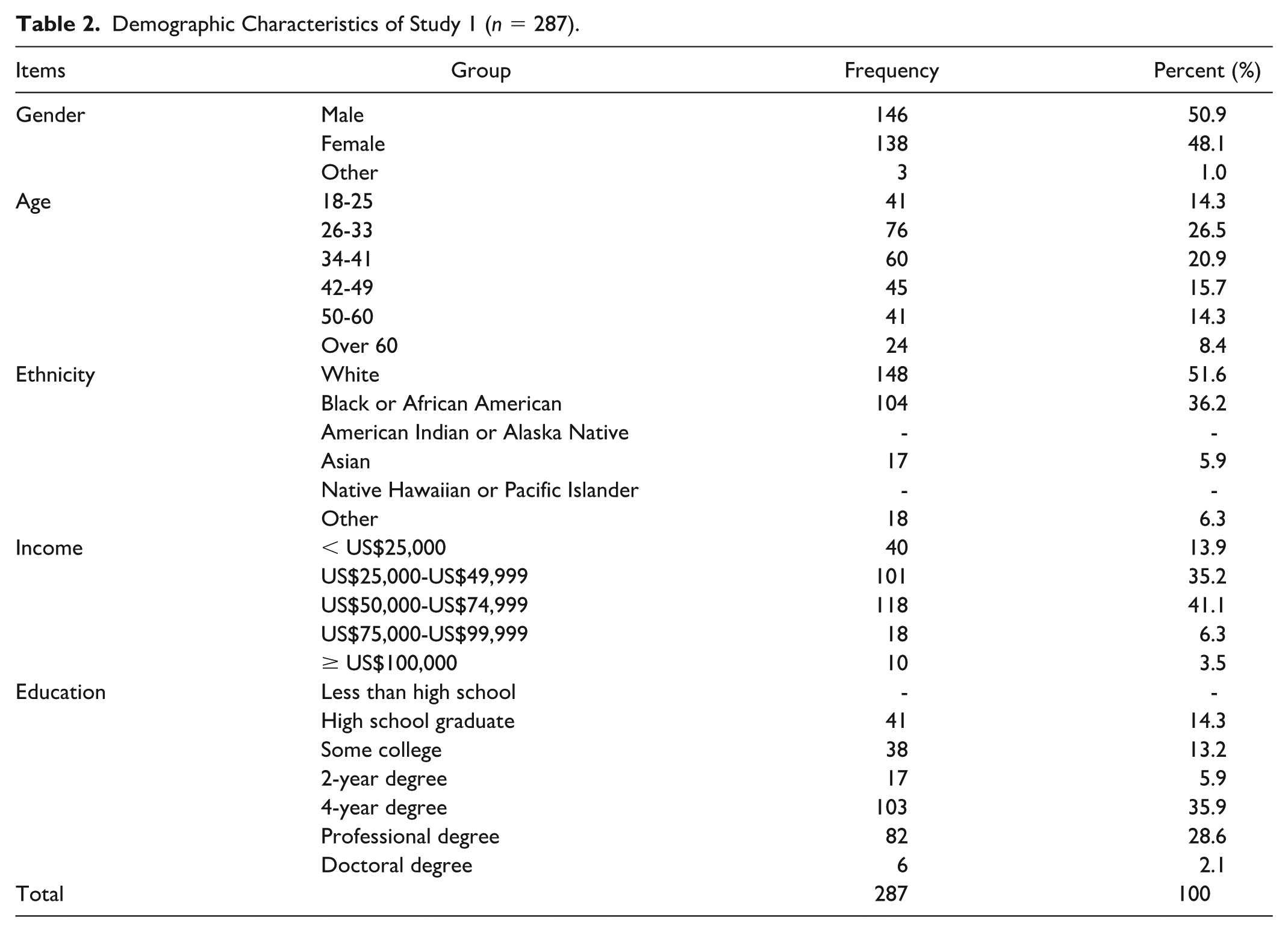
After excluding 13 participants who failed attention checks, we analyzed data from 287 respondents. The majority were women (48.1%) aged between 18 and 33 years (40.8%). Most participants identified as Black or African American (36.2%) or White (51.6%). Regarding income, 41.1% reported earning US$25,000–US$49,999 annually. The largest educational group had completed a 4-year degree (35.9%). Participants rated the framed message used in the experiment as moderately realistic (M = 5.79, SD = 1.24) and the message as highly comprehensible (M = 6.37, SD = 0.97). Detailed demographic information is presented in Table 2. To address the possibility that in-group bias may influence the results, we conducted an independent-samples t test to compare bias scores across the pronoun conditions. The analysis revealed no significant difference between groups, t(285) = 0.51, p = .609, indicating that the observed effects are unlikely to be attributable to group-based favoritism. Campaign type was included to test whether the pronoun-framing effect would generalize across different social initiatives; however, because no meaningful differences emerged across campaign types, we collapsed across campaign type in the analysis.
Demographic Characteristics of Study 1 (n = 287).
Participants in the “we” condition reported significantly greater perceived social closeness with beneficiaries compared to those in the “they” condition (γ = .42, SE = .08, t = 5.25, p < .001, 95% CI [.26, .58]), supporting H1. The pronoun framing manipulation accounted for 25.5% of the variance in perceived social closeness (R2 = .26). For H2, perceived social closeness significantly predicted behavioral intention to engage in social initiatives (β = .54, SE = .06, t = 9.79, p < .001, 95% CI [.45, .68]), explaining 59% of the variance in behavioral intention (R2 = .59). Consistent with H3, the effect of pronoun framing (“they” vs. “we”) on behavioral intention in social initiatives was fully mediated by perceived social closeness (β = .23, SE = .10, 95% BootCI [.03, .44]). Importantly, the direct effect of pronoun framing on behavioral intention was nonsignificant (β = –.20, SE = .14, p = .15, 95% CI [–.47, .07]), supporting the interpretation of full mediation (Hayes, 2018). To further assess the robustness of these effects, we conducted a 2 (pronoun: they vs. we) x 3 (campaign type: water conservation vs. refugee support vs. disability support) between-subjects ANCOVA on perceived social closeness, with moral reasoning included as a covariate. This analysis revealed a significant main effect of pronouns, F(1, 350) = 43.17, p < .001, partial η2 = .11, a significant main effect of campaign type, F(2, 350) = 3.89, p = .021, partial η2 = .02, and a significant Pronoun × Campaign Type interaction, F(2, 350) = 3.26, p = .040, partial η2 = .02. This pattern is consistent with the effects obtained using our original PROCESS models.
Study 1 provided initial evidence that the use of “we,” as opposed to “they,” increases perceived social closeness with beneficiaries. This result was consistent with previous research showing that inclusive language can help people feel more connected (Gustafsson Sendén et al., 2014; Sassenberg et al., 2017). While earlier studies often focused on situations with clear group identities, the present study extended this stream of research by showing that pronoun use alone can foster social closeness even in the absence of pre-existing group membership. In the hospitality context, these findings imply that even when customers do not have a direct or previous connection with the beneficiaries of the hotel's social programs, the use of inclusive pronouns in messaging naturally leads customers to feel greater social closeness toward the beneficiaries. Furthermore, this heightened sense of connection may, in turn, increase customers’ willingness to participate in or support these initiatives. These findings laid the groundwork for Study 2, which examined whether individual differences in power distance beliefs moderate the observed effects of pronoun use.
Study 2
Preliminary Study
A preliminary study was conducted to validate experimental manipulations for Study 2. It focused solely on testing the effectiveness of pronoun framing and power distance priming within the stimulus materials. Specifically, the manipulations targeted pronoun use (“they” vs. “we”) and power distance belief (low vs. high) within each integrated stimulus. To ensure consistency with Study 1, we used the same three social campaigns (water conservation, supporting refugees, advocating disability rights) based on ESG reports from major hotel chains.
The stimuli were presented as professional hotel pamphlets integrating sustainability initiatives with customer engagement strategies. Pronoun manipulation mirrored Study 1: The “they” condition framed beneficiaries as separate from the audience, while the “we” condition emphasized collective identity. Power distance belief was manipulated following Yan et al. (2021), with the low power distance condition highlighting egalitarian values and universal access, and the high-power distance condition using exclusive language and framing sustainability features as privileges for select customers. Representative examples of these stimuli are presented in Appendix B.
A total of 360 participants with recent hotel stays were recruited via Prolific and randomly assigned to one of four experimental conditions in a 2 (pronoun: “they” vs. “we”) × 2 (power distance: low vs. high) × 3 (campaign type: water conservation vs. refugee support vs. disability support) full-factorial between-subjects design, with all factors manipulated between subjects. For each condition, three versions of the social campaign stimuli (water conservation, refugee support, and disability support) were used, with 30 participants per version. After excluding four participants who failed attention checks, we analyzed data from 356 participants.
Manipulation checks confirmed the effectiveness of both manipulations. Participants in the “we” condition reported significantly greater detection of first-person pronouns (M = 4.38, SD = 1.64) than those in the “they” condition (M = 3.88, SD = 1.51; t(354) = 2.89, p = .004). For power distance, participants in the high-power distance condition rated social hierarchy as more important (M = 3.44, SD = 1.61) compared to those in the low power distance condition (M = 1.94, SD = 1.12; t(354) = 5.12, p < .001). Participants also rated the realism (M = 5.00, SD = 1.35) and comprehensibility (M = 5.87, SD = 1.20) of the stimuli, confirming their suitability for the main study. Measures for perceived social closeness (α = .97) and behavioral intention (α = .91) were consistent with those used in Study 1.
Main Study
Study 2 employed a 2 (pronoun: they vs. we) × 2 (power distance belief: low vs. high) × 3 (campaign type: water conservation vs. refugee support vs. disability support) full-factorial between-subjects design, with all factors manipulated between subjects. The “they” condition was coded as 0 and the “we” condition as 1. Low power distance belief was coded as 0 and high-power distance belief as 1. Participants were recruited through Prolific’s screening tools to ensure demographic diversity and eligibility. To qualify, individuals had to be at least 18 years old, fluent in English, and have stayed at a hotel within the past 2 years. Pretest participants were excluded. A total of 600 participants were randomly assigned to one of the 12 conditions, as determined by a priori power analysis. Attention checks and incomplete responses were screened out, resulting in 560 valid participants. All participants received standardized compensation. Perceived social closeness was measured using an eight-item scale adapted from C. K. Kim et al. (2013; α = .97). Behavioral intentions to engage in social initiatives were assessed using a six-item scale from Zhao et al. (2023; α = .91). Measurement items for all constructions are presented in Table 1. Demographic information (age, gender, education) and measures of perceived realism and comprehensiveness of the materials were also collected. As in Study 1, campaign type was initially included to assess whether the effects would generalize across different social initiatives. However, because none of the three campaigns produced meaningful differences in the key study variables, we subsequently collapsed across campaign types in all analyses. In Study 2, moral reasoning was not included as a control variable. In moderation analyses, including additional control variables can unnecessarily reduce statistical power and complicate the interpretation of interaction effects (Bernerth & Aguinis, 2016; Hayes, 2018). To ensure the clarity and validity of the moderation results, we estimated the model without additional covariates. To analyze the proposed model, we used Model 7 of the PROCESS macro for SPSS (Hayes, 2018), applying moderated mediation analyses across all hypotheses (H1–H5).
Results
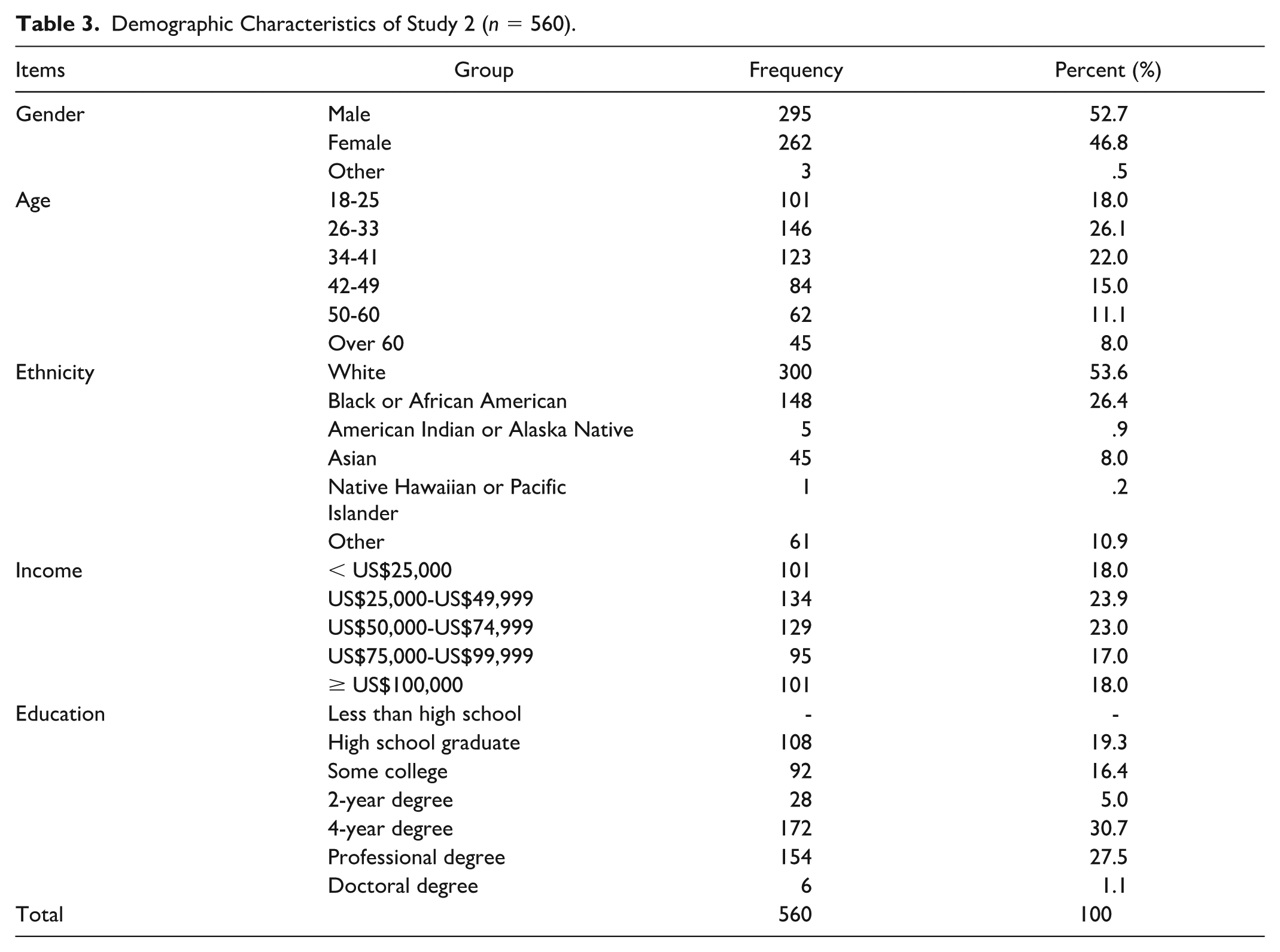
After 40 participants who failed the attention check were excluded, the final sample consisted of 560 participants. Gender distribution was nearly balanced (52.7% male, 46.8% female), and most participants were between 18 and 41 years old (66.1%). The majority identified as White (53.6%), followed by Black or African American (26.4%) and Asian (8.0%). Regarding income, participants were distributed fairly evenly across categories, with 23.9% reporting US$25,000–US$49,999 and 23.0% reporting US$50,000–US$74,999. In terms of education, the largest groups held a 4-year degree (30.7%) or a professional degree (27.5%). Additional demographic details are provided in Table 3. Participants found the experimental stimuli to be realistic (M = 5.00, SD = 1.35) and comprehensible (M = 5.87, SD = 1.20), supporting the validity of the study materials.
Demographic Characteristics of Study 2 (n = 560).
H1 was supported. Participants exposed to the “we” pronoun reported significantly greater perceived social closeness with beneficiaries than those exposed to the “they” pronoun (γ = .40, SE = .07, t = 5.62, p < .001, 95% CI [.26, .54]), accounting for 16% of the variance (R2 = .16). H2 was supported. Perceived social closeness had a strong positive effect on behavioral intention to engage in social initiatives (β = .69, SE = .03, t = 20.03, p < .001, 95% CI [.60, .77]), explaining 47% of the variance (R2 = .47). H3 was confirmed. The mediation effect was significant, with pronoun framing indirectly influencing behavioral intention through perceived social closeness (β = .28, SE = .05, 95% CI [.18, .38]). For H4, the results showed significant moderated mediation by power distance belief. The indirect effect of pronoun framing on behavioral intention through social closeness was significant for participants with low power distance belief (γ = .32, SE = .06, 95% CI [.20, .44]) but not for those with high power distance belief (γ = .014, SE = .07, 95% CI [–.01, .28]). The index of moderated mediation was significant (γ = .18, SE = .08, 95% CI [.02, .34]), confirming that the effect of pronoun framing was stronger under low power distance beliefs. H5 was supported. To further examine the robustness of these effects, we conducted a 2 (pronoun: they vs. we) x 2 (power distance belief: low vs. high) x 3 (campaign type: water conservation vs. refugee support vs. disability support) between-subjects ANOVA on perceived social closeness. This analysis yielded a significant main effect of pronoun, F(1, 474) = 33.43, p < .001, partial η2 = .07, whereas the main effect of campaign type was not significant, F(2, 474) = 0.69, p = .622, partial η2 = .00. Several interactions involving pronoun and power distance belief were significant, and the overall pattern closely mirrored the PROCESS-based conditional process analyses.
A one-way ANOVA further revealed that participants with low power distance beliefs reported significantly greater perceived social closeness (M = 3.98, SD = 1.46) than those with high power distance beliefs (M = 3.58, SD = 1.51), F(1, 558) = 10.22, p = .001. These results suggest that individuals who are less accepting of hierarchy tend to feel more socially connected to the beneficiaries of social initiatives. Figure 2 shows that within low and high-power distance groups, the use of inclusive pronouns (“we”) led to higher perceived social closeness than the exclusive pronoun (“they”). Specifically, under low power distance, participants in the “we” condition reported higher closeness (M = 3.81, SD = 1.45, n = 31) than those in the “they” condition (M = 3.26, SD = 1.16, n = 36). A similar pattern was observed in the high-power distance group, where the “we” condition yielded higher closeness (M = 4.01, SD = 1.46, n = 296) than the “they” condition (M = 3.58, SD = 1.51, n = 257). In summary, all four hypotheses were statistically supported. The findings consistently demonstrate that inclusive pronoun framing enhances perceived social closeness and behavioral intentions, and that this effect is most pronounced among individuals with low power distance beliefs.
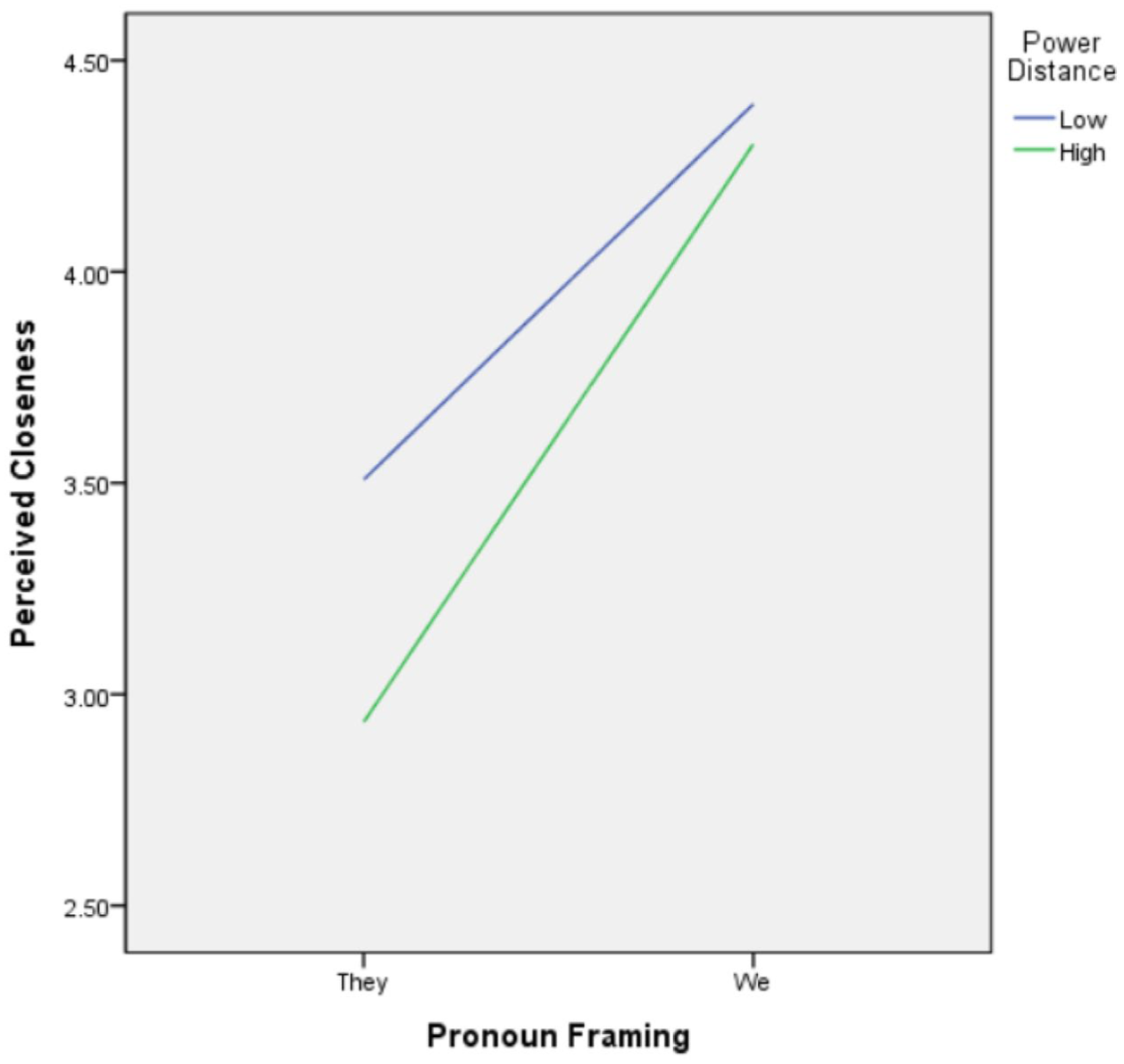
Interaction effect of pronoun framing and power distance on perceived closeness.
The findings of Study 2 replicate the main results of Study 1, showing that the use of “we” significantly increased perceived social closeness, which in turn enhanced the behavioral intentions of participants. This outcome supports previous research indicating that collective language can foster psychological closeness and motivate prosocial behavior (Pronin et al., 2008; Sassenberg & Matschke, 2010).
Importantly, Study 2 further demonstrates that the effect of pronoun framing is moderated by individual differences in power distance belief. The positive impact of the “we” pronoun was observed only among individuals with low power distance beliefs, highlighting that personal beliefs about hierarchy shape the effectiveness of inclusive messaging (X. A. Zhang et al., 2015). This finding extends prior work by showing that linguistic cues and individual value orientations interact to influence social engagement. These findings suggest that even the use of inclusive pronouns in hotel social initiatives messaging may not be universally effective. Specifically, for customers who perceived high power distance beliefs (or social hierarchies from hotel vision or identity), the use of inclusive pronouns may not increase their perceived closeness to beneficiaries or their willingness to engage with hotel-led social initiatives. This implies that the success of inclusive messaging in hospitality marketing or sustainable communication may depend on situational cues that shape how hierarchy is perceived within the service environment.
Discussion and Conclusions
Summary of Findings
Across two experimental studies, the use of inclusive pronouns (“they” and “we”) was found to increase perceived social closeness, which in turn enhanced behavioral intentions to engage in social initiatives. Study 1 demonstrated that “we” pronoun framing significantly increased perceived social closeness and that this effect fully mediated the relationship between pronoun use and behavioral intention. Study 2 extended these findings by showing that the effect of inclusive pronouns was moderated by power distance belief. Specifically, the positive impact of “we” language on social closeness and behavioral intention was significant only among individuals with low power distance beliefs.
Theoretical Implications
This study offers several theoretical implications. First, this study advances theoretical understanding by extending the role of inclusive pronouns beyond explicit group boundaries. While prior research has largely treated pronouns as markers of in-group membership (Sassenberg & Matschke, 2010) and has linked social distance to how people respond to others (Liberman et al., 2007; Trope & Liberman, 2010), much less is known about whether inclusive pronouns alone can generate perceived social closeness in contexts where group boundaries are not salient. Recent research in sustainable hospitality has begun to address this gap by showing that personal pronouns can shape how customers perceive their relationship with providers and, in turn, their willingness to act sustainably (e.g., Yu et al., 2024). In the hospitality literature more broadly, research has predominantly focused on customer–firm or customer–brand relationships when examining prosocial initiatives, such as how customers respond to corporate social responsibility messages or cause-related marketing (e.g., Fatma et al., 2018; Martínez & Del Bosque, 2013). By contrast, research directly examining the customer–beneficiary relationship remains limited. This gap is notable given that many hospitality social initiatives, such as donation programs, community engagement, and social impact campaigns, inherently involve a beneficiary group. Addressing this understudied relational dynamic represents a meaningful theoretical contribution of this work. Building on this line of inquiry, the present study shifts the focus to customer–beneficiary dynamics and, within plural pronouns, contrasts inclusive (“we”) with exclusive (“they”), thereby offering a new perspective on how pronoun use fosters perceived closeness. Our findings show that using inclusive pronouns increases perceived social closeness even without clear group distinctions. This broadens existing theory by shifting the view of pronouns from being merely identity markers to also being subtle generators of interpersonal closeness in everyday communication. In line with applied linguistics research that highlights how language functions as a marker of social distance and proximity (Semin, 2011), this finding positions inclusive pronouns as psychological distance regulators rather than mere grammatical forms. This suggests that the influence of pronouns is not limited to reinforcing existing group identities but can also serve as a subtle tool for building new social connections and mobilizing support for social initiatives in broader contexts (Orvell et al., 2022). Thus, the study extends psychological distance theory by demonstrating that micro-linguistic cues can actively create social proximity. This goes beyond the prior view that language merely reflects existing closeness (Liberman et al., 2007; Trope & Liberman, 2010).
Second, this study clarifies the mechanism through which inclusive pronouns influence behavior. Prior work has established that psychological distance shapes judgments (Liberman et al., 2007; Trope & Liberman, 2010), and that feeling socially close increases helping (Duclos & Barasch, 2014; Winterich et al., 2009). However, research on pronoun framing has rarely explained the specific pathway that links subtle linguistic cues to action. Our findings show that inclusive pronouns increase perceived social closeness, which in turn makes individuals more willing to help. By identifying this step-by-step process, the study demonstrates how micro-linguistic framing can shape not only perceptions but also behavioral intentions. This makes a particularly important theoretical contribution to hospitality research. Prior studies on prosocial initiatives have mainly examined what messages say. For example, whether benefit- versus loss-framed appeals or self- versus other-focused messages lead to more favorable customer responses (Fatma et al., 2018; Martínez & Del Bosque, 2013). In contrast, this study shifts attention to how messages are expressed, showing that even micro-linguistic features such as inclusive pronouns can foster social closeness and, in turn, prosocial intentions (Packard & Berger, 2021). By moving beyond content-level framing to highlight language form as a theoretical mechanism, this study extends hospitality communication research and integrates linguistic cues into psychological distance theory as key regulators of engagement (Kacewicz et al., 2014).
Third, this study extends psychological distance theory and message framing research by showing that the effectiveness of inclusive pronouns depends not only on message content but also on situational context. Prior research has emphasized how temporal, spatial, hypothetical, or social distance shapes persuasion and behavior (Fujita et al., 2006; Liberman et al., 2007; Trope & Liberman, 2010). However, little attention has been given to how micro-level linguistic cues interact with contextual norms such as equality versus hierarchy (Hofstede, 2011). Our findings demonstrate that inclusive pronouns foster social closeness and prosocial intentions more strongly in egalitarian contexts than in hierarchical ones. Prior research has shown that cultural norms and power distance beliefs shape how people interpret interpersonal closeness and respond to others (Hofstede, 2011; Winterich et al., 2009). Yet studies on message framing have rarely tested whether the persuasiveness of linguistic cues depends on such contextual factors. By showing that inclusive pronouns are most effective under egalitarian norms, our study identifies both a linguistic mechanism that reduces social distance and boundary conditions that determine when this mechanism succeeds. In this way, the research extends psychological distance theory by integrating message content with situational context in predicting prosocial engagement.
Practical Implications
Recent industry reports emphasize that the social dimension of ESG is now a necessity rather than an option in the hospitality industry, and the question of how to implement it in truly actionable ways has become a central challenge for managers (Energy & Environment Alliance, 2024; Taiwo, 2023). In this context, the present study offers practical strategies for hospitality managers seeking to realize meaningful social engagement with employees, customers, and communities. First, hospitality companies can intentionally use inclusive pronouns in communications related to social initiatives across diverse cultural contexts. While hospitality and tourism messaging often require cultural tailoring, our findings indicate that inclusive pronouns serve as a cross-cultural communication strategy that resonates with customers across cultures. Thus, hospitality managers should incorporate inclusive pronouns (e.g., “we,” “our,” and “together”) in customer communications and marketing materials to reduce psychological distance between customers and the recipients of the company’s social efforts. For example, when Marriott launched its #LoveTravels campaign, it employed a globally standardized messaging strategy, using inclusive slogans such as “We support our community together” and “We welcome everyone to join our efforts” across diverse markets. Rather than tailoring messages for specific regions, Marriott applied the same inclusive pronouns globally by highlighting the universal appeal and effectiveness of such communication. This approach made customers feel included and increased their willingness to participate in Marriott’s social programs and share positive feedback (Marriott International, 2024).
Second, companies can train employees to use inclusive pronouns during customer interactions, especially when encouraging participation in prosocial activities. For instance, simple role-play exercises or brief communication workshops can help employees practice using inclusive language in realistic situations. Employees should be encouraged to say, for example, “We invite you to join our community event,” “Together, we can make a difference. Join us in our upcoming volunteer program,” or “We hope you will be part of our sustainability initiatives.” This approach can be extended to digital channels, such as email invitations, application notifications, or social media posts, using phrases like “Let’s make an impact together.”
Third, companies can reinforce the sense of connection after participation by using inclusive language in follow-up communications. After a customer participates in a social initiative, send personalized thank-you messages that highlight the shared accomplishments. For example, Hyatt Hotels uses personalized post-stay emails, such as “Thank you for joining us in supporting local students. Together, we provided essential school supplies to children in need,” to reinforce social closeness between guests and beneficiaries and encourage continued engagement in social initiatives (Hyatt Hotel Corporation, 2024).
Fourth, companies need to consider the situational context when using inclusive pronouns, especially regarding power distance cues. The effectiveness of inclusive language is heightened in environments that emphasize equality. When designing campaigns or events, the setting and messaging should support a sense of partnership rather than a hierarchy. Luxury hotel club lounges that emphasize exclusivity and hierarchy often use individual-focused language (“exclusive for our valued members”), and, in these settings, inclusive pronoun framing is less effective in driving participation in community or charitable activities. Recent research also shows that inclusive communication strategies are more successful in low power distance environments, where participants respond more positively to egalitarian messaging ( J.Zhang et al., 2025).
Finally, these findings suggest potential applications beyond hospitality corporate settings, particularly in public-sector communication. In the public sector, increasing public participation in social programs and policy initiatives remains a persistent challenge. In fact, the Organisation for Economic Co-operation and Development (OECD) has raised concerns about the declining level of public participation, even as such engagement becomes increasingly essential in addressing societal issues (OECD, 2025). The OECD emphasizes the importance of designing public communication that presents people as members of a shared community, rather than as separate individuals. In response to this concern, this study may offer a useful communication strategy. The use of inclusive pronouns could help reduce the psychological distance between the public and the beneficiaries of policy programs, making people feel more socially connected to public efforts. Consequently, this may encourage greater involvement in prosocial initiatives promoted by government agencies or public institutions. Similarly, in the context of ESG reporting, governments and organizations could adopt inclusive messaging strategies to reduce psychological distance from collective sustainability goals, thereby encouraging broader stakeholder engagement.
Limitations and Future Research
This study has several limitations that point to important directions for future research. First, it relied on self-reported behavioral intentions rather than direct observations of actual behaviors. While behavioral intention is widely regarded as the most immediate and reliable psychological predictor of subsequent action (Ajzen, 1991; Armitage & Conner, 2001), prior research has highlighted an intention-behavior gap, in which not all intentions translate into real-world behaviors (Sheeran & Webb, 2016). Although this limitation does not diminish the implications of the current findings, future research should extend beyond self-reported behavioral intentions to examine whether the effects of pronoun framing translate into observable actions. For example, in hospitality contexts, researchers could investigate whether customers who receive sustainability newsletters or social initiative invitations framed with inclusive pronouns subsequently register for volunteer activities or participate in community events. Such field-based approaches would provide more robust evidence that pronoun framing reduces psychological distance and promotes real-world engagement.
Second, a further limitation is that while our findings highlight the benefits of inclusive pronoun framing (“we” vs. “they”) in increasing social closeness and behavioral intention, such strategies may not be equally effective across all hospitality segments. For example, in ultra-luxury hotels such as Four Seasons, brand identity is built on exclusivity and a promise of a singular, elite guest experience. In such contexts, guests may not naturally interpret “we” messaging as inclusive, but rather perceive it as inconsistent with the exclusive positioning of the brand. More broadly, our findings suggest that pronoun framing effects may depend on context, and luxury settings could represent a boundary condition where inclusive language is less effective. Future research should therefore investigate how pronoun framing interacts with exclusivity in luxury hospitality. For instance, studies could examine whether “we” framing dilutes perceived exclusivity, or, alternatively, whether carefully crafted inclusive messaging can be aligned with luxury brands’ increasing emphasis on social responsibility.
Third, this study included three types of social initiatives (i.e., water conservation, refugee support, and support for disability rights) and found no significant differences in the effect of pronoun framing or social closeness messaging across these initiatives (ANOVA, p > .05). This finding suggests that the positive impact of these strategies may be robust across a range of prosocial causes. However, the effectiveness of these strategies may still vary in the context of more polarizing, controversial, or personally salient initiatives, such as those involving political activism, religious causes, or highly divisive social topics. Winterich and Barone (2011) suggest that the alignment between the cause and the values or beliefs of the individual (cause–person fit) can significantly influence engagement in prosocial campaigns. For future research, it would be valuable to investigate whether the positive effects of inclusive pronoun use and social closeness messaging persist when hotels promote more controversial or sensitive initiatives.
Fourth, another limitation concerns the underlying mechanism of pronoun framing. In the current research, we proposed and tested perceived social closeness as the key psychological process linking pronoun framing to behavioral intention. However, an alternative explanation is that pronoun framing may implicitly signal different motives (e.g., “we” implying other-serving motives vs. “they” implying self-serving motives). Because we did not directly measure perceived motives, we cannot fully rule out this possibility. Future studies should therefore incorporate explicit assessments of perceived motives to disentangle whether the effects of pronoun framing are uniquely driven by enhanced social closeness or by motivational inferences.
Finally, this study focused on perceived social closeness as the key psychological mechanism influencing prosocial behavior, which was appropriate given the context and aims of the research. While psychological distance theory includes other dimensions (e.g., temporal and spatial distance), these are related but distinct constructs that may also influence prosocial behavior in different contexts. For example, temporal distance (i.e., how immediate a beneficiary’s need is perceived) can affect willingness to help (Eyal et al., 2008), and spatial distance (physical proximity) can influence empathy and prosocial responses (Cialdini et al., 1987). Although these psychological distance dimensions were beyond the scope of the current study, future research could explore how their activation interacts with social distance to further elucidate the mechanisms underlying prosocial behavior.
Footnotes
Appendices
Declaration of Conflicting Interests
The authors declared no potential conflicts of interest with respect to the research, authorship, and/or publication of this article.
Funding
The authors received no financial support for the research, authorship, and/or publication of this article.
