




Abstract
This paper introduces monster theory as a novel theoretical lens to conceptualise climate change within tourism studies. It argues that climate change represents a “hyper-monster,” a vast, systemic entity whose presence reveals the tourism industry’s deepest anxieties and challenges it with an existential crisis. Drawing on the monster theory’s core theses, the paper analyses how climate change embodies societal fears and threatens tourism’s future. It explores how this monster is born of global (in)difference and systematic injustice, controls the boundaries of what is possible for global travel, and paradoxically generates contradictory demands, such as “last chance tourism.” By framing climate change as a hyper-monstrous force, the paper presents a novel analytical framework for tourism and its (un)sustainability in the Anthropocene.
Highlights
Climate change is conceptualised as a ‘hyper-monster’ in tourism studies
Defines ‘hyper-monster’ via Scale, Reflexivity, Mediatisation, and Boundary-policing
Applies monster theory to highlight affective & moral dimensions of crisis
Sets dual research agenda (propositions & critical inquiry) and managerial actions
Introduction
Tourism studies have long engaged with monsters, considering them as powerful diagnostic tools, embodying the anxieties and contradictions of the sociocultural systems that produce them (Ek, 2016). However, none of the existing monsters equals the systemic scale, ontological threat, and reflexive nature of the crisis currently facing tourism—that is, climate change. While the foundational literature on climate change in tourism has provided essential scientific and managerial frameworks focusing on adaptation (Kaján & Saarinen, 2013), resilience (Scott & Gössling, 2022), and vulnerability (Shakeela & Becken, 2015), these analytical lenses often fail to capture the profound affective and moral angle of the crisis. The sterile language of climate change as a major societal “challenge" or an environmental “issue” can obscure the terror, denial, and perverse desires that define the tourism industry’s relationship with a world increasingly suffering from warming and extreme weather events. To bridge this gap, we argue that a new analytical lens is required, that is, one that can articulate the climate crisis not just as a management problem, but as an existential and ethical confrontation of growing tourism demand and urgent environmental conservation needs.
This Insight & Foresight feature paper introduces monster theory as that missing analytical lens, conceptualising climate change as a “hyper-monster.” We argue that climate change is a planetary-scale entity whose temporality, spatiality, and affective intensity radically exceed conventional imaginaries. Conceptually, it functions as a creature born of the tourism industry’s own hyper-mobility and fossil-fuel dependence (S. A. Cohen & Gössling, 2015), presenting it as a monster of our own making. By framing climate change as a hyper-monster, we provide a framework to analyse the reflexive co-production of the crisis, the new moral boundaries it enforces, and the ambivalent desires it generates.
This paper proceeds by first outlining the theoretical foundations of monster theory and formally defining climate change as a hyper-monster. It then integrates perspectives from critical theory (Foucault, Baudrillard, Haraway) to deepen the analysis. Lastly, it applies this analytical framework to produce implications for tourism policy and hospitality operations, concluding with a programmatic agenda for future research.
Theoretical Foundations: Monsters and Climate Change as a Hyper-Monster
Monsters are potent cultural figures, that is, entities that exceed categorisation and embody the anxieties, contradictions, and desires of the societies that produce them (Weinstock, 2017). They are not merely aberrations or threats, but diagnostic tools that make visible what a culture cannot comfortably articulate (Nirta, 2021). Monster theory, developed by J. J. Cohen (1996), offers a critical framework for reading monsters as symptoms of cultural disorder and social transformation. It proposes a new method of sociocultural analysis, that is, reading societies and cultures through the monsters they produce, viewing history itself as a text among texts, fragmented, unstable, and open to reinterpretation.
Cohen acknowledges that a “post-theoretical” age rejects grand narratives (Hamilton et al., 2024) but suggests that monsters offer a productive way to trace cultural anxieties, contradictions, and unspoken desires across time and space (J. J. Cohen, 2012) as an entry point into what he terms “teratology,” or the study of monsters (Mittman, 2017). J. J. Cohen (1996) introduces seven theses as a flexible, open framework for understanding how monsters reflect and construct cultural meaning. According to these theses, monsters: (1) embody cultural moments; (2) defy containment; (3) resist categorisation; (4) prey on the “other”; (5) patrol the limits of the possible; (6) reflect forbidden desires; and (7) transgress boundaries.
Monsters have long held symbolic power. For instance, in literature, Frankenstein’s creature is not born evil but becomes monstrous through rejection, showcasing the ethical consequences of unchecked scientific ambition and social exclusion (Botting, 2003). The Golem of Jewish folklore, an artificial being originally created to protect a community, turns destructive when its creators lose control, symbolising the risks of over-rationality (Glinert, 2001). In recent popular culture, the monster Godzilla materialises collective anxieties surrounding nuclear technology and geopolitical trauma (Zornado & Reilly, 2021). These narratives depict monsters as mirrors of excess and as consequences of systemic failures concerning society and the environment.
Tourism studies have recognised both literal and metaphorical monsters (Ek, 2016). Mythical creatures such as the Loch Ness Monster (Carr & Tully, 2025), Dracula (Reijnders, 2011), and various ghosts and paranormal entities (Holloway, 2010; Light et al., 2021) have inspired destination imaginaries and tourism flows. Parallel to these, metaphorical monsters have emerged in the form of overtourism (Frey, 2021), the commodification of culture (Philip, 2024), gentrification (Lee & Han, 2022), and economic leakage (Candela et al., 2009), each revealing structural injustices and affective tensions within the tourism system.
None of these monsters, however, equals the systemic scale and ontological threat posed by climate change. We argue that climate change represents a hyper-monster, that is, a planetary-scale entity whose temporality, spatiality, and affective intensity radically exceed conventional imaginaries of crisis. This monster is not only omnipresent and elusive, but paradoxically of our own making. It is a creature born of hyper-mobility with its fossil-fuel dependence (S. A. Cohen & Gössling, 2015) and over-consumption (Nghiem et al., 2024) that has fuelled modern tourism for the last few decades, thus making it a monster of the industry’s own making. Like the Frankenstein’s creature, it reflects the destructive outcomes of our desires and ambitions. Like Golem, it acts beyond our control. Like Godzilla, it signals ecological vengeance and planetary distress (see Box 1).
Defining the Climate Change Hyper-Monster.
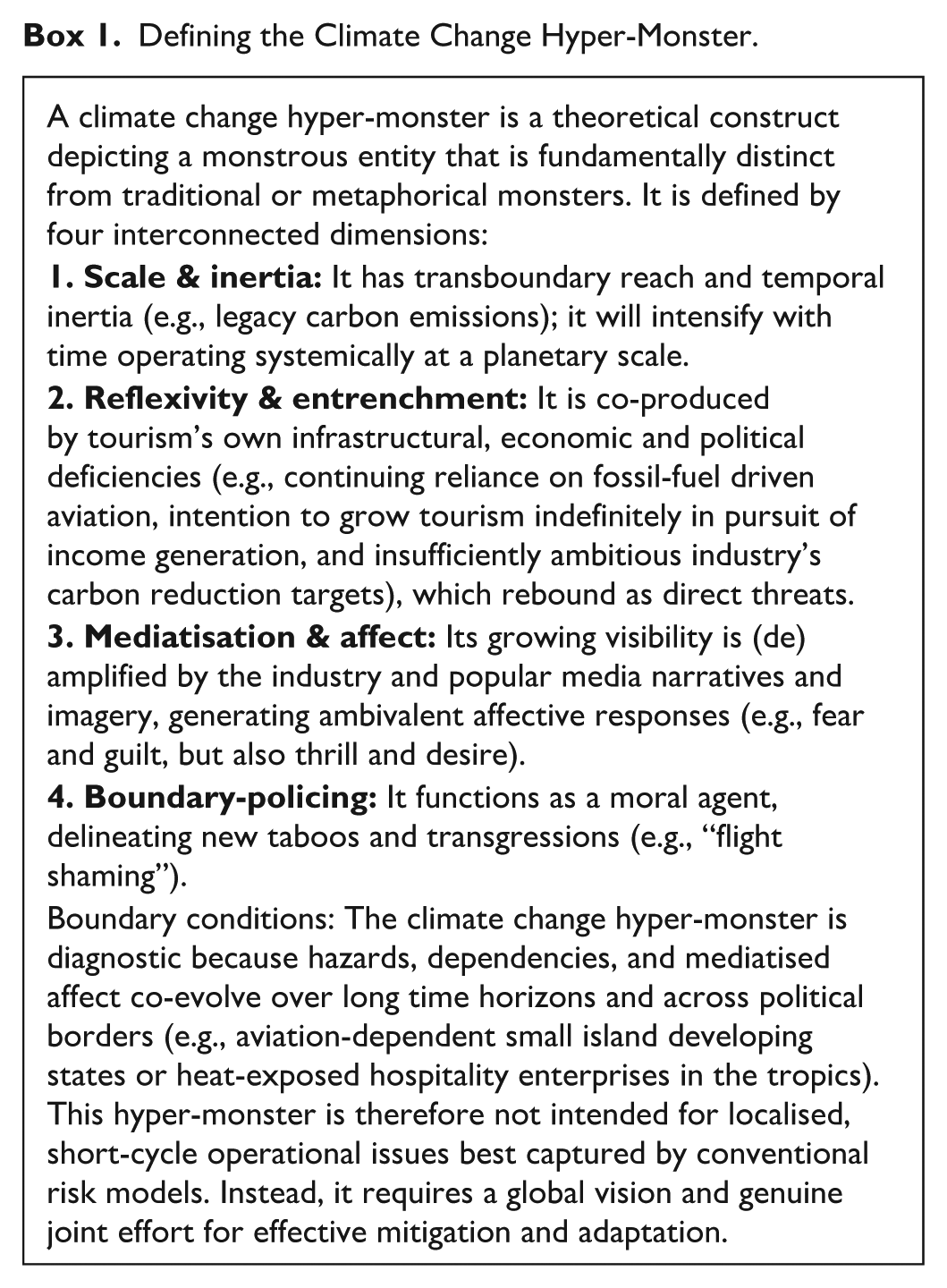
The four dimensions outlined in Box 1—(1) scale & inertia; (2) reflexivity & entrenchment; (3) mediatisation & affect; and (4) boundary-policing—provide the boundaries of the climate change hyper-monster and differentiate it from more conventional metaphorical monsters in tourism, such as “overtourism,” which can be considered one of the drivers of the climate change hyper-monster (Blázquez-Salom et al., 2023), but not the hyper-monster itself. Each dimension builds on J. J. Cohen’s (1996) original framework to demonstrate a link between the climate change hyper-monster and its specific manifestations in tourism. These manifestations are further detailed in Table 1.
The Climate Change Hyper-Monster’s Dimensions and Their Relation to Tourism.
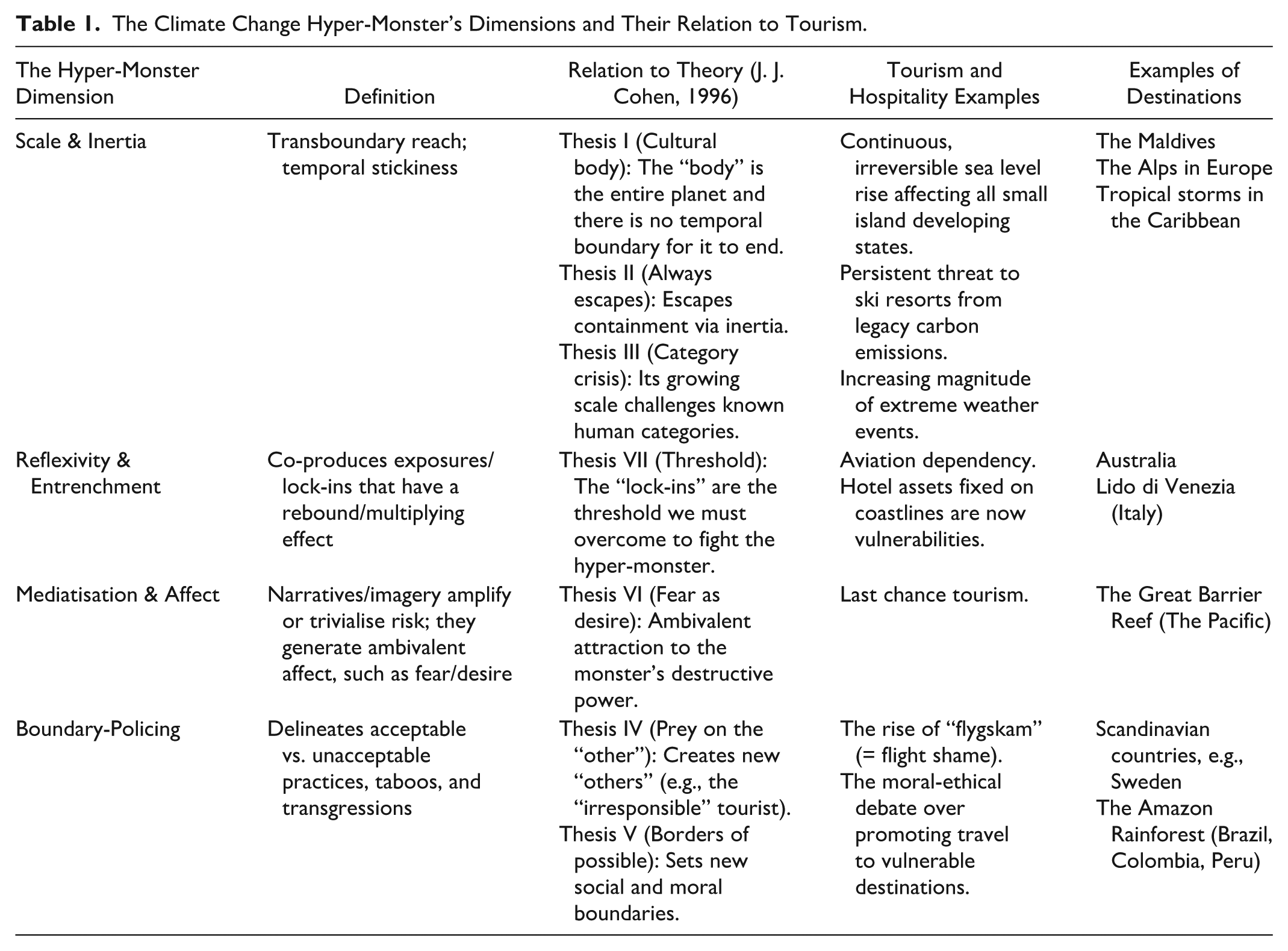
It is important to position the climate change hyper-monster against related concepts which have been proposed to explain societal challenges, such as “wicked problems” (Rittel & Webber, 1973), “socio-technical/carbon lock-ins” (Unruh, 2000), and “hyper-objects” (Morton, 2013). While “wicked problems” and “lock-ins” can indeed aid in diagnosing the complex, path-dependent nature of the climate crisis, such as tourism’s dependency on hyper-mobility (S. A. Cohen & Gössling, 2015), these terms remain policy- and management-focussed, thus lacking affection. Similarly, while Morton’s (2013) “hyper-object" captures the ontological scale of the threat, it can mask the industry’s specific reflexivity, that is, the extent to which the climate crisis is not just an external object, but a monster of our own making. The hyper-monster lens bridges these gaps by integrating systemic scale with moral agency and affective intensity. As its dimensions show (Table 1), it underlines the reflexive co-production of the crisis (i.e., it is a monster born from the tourism industry’s own desires and “lock-ins”) and its moral/affective boundary-policing (i.e., it creates new taboos, guilt, and desires). This enables the analysis of such phenomena as “last-chance tourism" (Thesis VI) and “flygskam” (Thesis V) in a way that the other, existing analytical lenses cannot do most effectively.
Further, this new lens of analysis must be distinguished from the discourse of “sustainability” itself. While the climate change hyper-monster is, in effect, the materialisation of un-sustainability, the term “sustainability” and the related Environmental, Social, and Governance (ESG) framework have been criticised for becoming overly plain and managerial prompting companies and individuals to mimic them rather than genuinely engage with (Milne & Gray, 2013). Besides, these terms also fail to capture the affective and ethical issue of the climate crisis (Dossa & Kaeufer, 2014). Therefore, framing climate change as the hyper-monster can at least partially address this failure. This framework is not a new way of explaining or re-branding sustainability, but a critical tool to analyse the complex psycho-social drivers and consequences of the crisis, that is, the fear, the denial, the perverse desires (Thesis VI), and the moral transgressions (Thesis IV) that the rather political and managerial language of “sustainability” does not always communicate effectively.
With these distinctions in mind, this paper introduces monster theory as a novel analytical lens for tourism studies. More specifically, where extant research provides the critical “what” and “how” of climate change (i.e., the real-life impacts on tourists and destinations and the managerial responses, such as measurement of vulnerability and adaptation measures), the hyper-monster lens adds complementary “why” and “so what” lenses—that is, it provides a critical and affective framework for analysing why we have failed to act, how the crisis is psychologically experienced, and what moral and ethical demands it places on us. By applying J. J. Cohen’s (1996) seven theses, now re-contextualised through the hyper-monster’s dimensions (Table 1), we build on this framing for interpreting tourism’s unsustainability in the Anthropocene and for imagining its more ethical futures.
Theorising Monsters Beyond Cohen (1996)
While J. J. Cohen’s (1996) framework provides the primary analytical foundation for this paper, it is important to recognise that his concept of the “monster” can be further enriched by engaging with other critical theorists. More specifically, perspectives from Foucault, Baudrillard, and Haraway offer complementary—and at times conflicting—ways to understand the climate change monster’s nature and function.
First, the concept of monster can be traced back to the ideas of Foucault and, more specifically, his concept of genealogy (Foucault, 2003). This concept suggests a method of historical analysis focusing on the origins and development of power relations, knowledge, and social norms. According to Foucault’s (2003) genealogy, monsters are not simply natural or fixed entities but are shaped by the ways societies define what is dangerous, deviant, or in need of control. In tourism, the climate change hyper-monster emerges not just from global warming and extreme weather events, but from how these phenomena are framed through scientific discourse, political agendas, media narratives, and affective public reactions (Bulfin, 2017). These overlapping discourses make climate change visible in particular ways, often as a threat that must be managed through expert knowledge, political and economic incentives, technocratic intervention, and, increasingly, voluntary behavioural change (Fløttum & Gjerstad, 2017). Importantly, Foucault would prompt us to ask: Who produces the climate change monster, and to what ends? What truths, fears, and subjectivities are mobilised in invoking its image? A Foucauldian perspective challenges us to examine how tourism governance, in naming and responding to the climate change hyper-monster, may reinforce dominant power structures that depoliticise the crisis and obscure more profound questions of (in)justice, (in)equality, and (ir)responsibility (Foucault, 2003).
Second, by discussing postmodernism, Baudrillard (1994) refers to the concepts of “simulation” and “the hyperreal,” arguing that, in the modern world, the boundaries between what is real and what is a simulation of reality have become blurred to the point of their indistinguishability. Baudrillard (1994) posits that media, technology, and marketing play a major role in constructing and maintaining hyperreality by creating and disseminating simulations and representations that shape individual perceptions of the world. Baudrillard’s (1994) ideas can therefore be interpreted as suggesting that the climate change hyper-monster may be less a reflection of real danger and more a hyperreal figure, an endless play of signs, simulations, and mediated disasters that saturate tourism imaginaries (Featherstone, 2018). Instead of provoking genuine political or behavioural change, the images of climate change, such as melting glaciers, flooded cities, and vanishing islands, broadcast by popular media, entertainment industry and celebrities are often repeated and consumed as spectacles (Boykoff & Goodman, 2009). In tourism, this is evident in new ways of marketing destinations, where the destruction caused by climate change becomes something to observe, photograph, and emotionally experience (Miller & Del Casino, 2018). Such marketing approaches have prompted consumption voyeurism in such destinations as Tuvalu, thus questioning the geniality of tourist concern about climate change and its negative effect on vulnerable communities (Farbotko, 2010). Importantly, this process can even question the narratives of ecological restoration; for instance, while popular culture and animation movies, such as Disney’s Moana with its monsters, can be used to teach cases in sustainable tourism (Ramdas et al., 2024), as a commercial product it can also package this complex crisis into a consumable, spectacular form. This can distract public attention from climate change and portray it instead as a cartoon-like, fun story rather than an existential threat to the planet, thus leading to its Disneyfication (Midkiff & Austin, 2021). Ultimately, the climate change hyper-monster becomes aestheticised and increasingly consumed, detached from the deeper structures, such as economic inequality, carbon dependency, and colonial histories, that produce it (Korstanje, 2019). This calls for caution: while the monster metaphor can stimulate affect and raise awareness, it also risks depoliticising climate change by turning it into visual entertainment rather than a structural, collective crisis requiring urgent transformation (Miller & Casino, 2020).
Lastly, Haraway (2015) calls for moving away from describing the Earth’s current age as Anthropocene. She argues that this name simply emphasises the supremacy of humans, their individualism and self-invented exceptionalism (Haraway, 2020). Instead, Haraway proposes the idea of the Chthulucene with the name analogous to Lovecraft’s monstrous creatures. This idea suggests that monsters are not just terrifying outsiders, but symbols of deep interconnectedness (Alberro et al., 2024). Unlike Cohen’s monsters, which threaten boundaries and cause disruption, Haraway’s creatures, such as the many-armed Cthulhu she uses as an analogy, represent complex and intertwined relationships between humans, animals, machines, and the Earth itself (Haraway, 2015). From this perspective, climate change is not a giant monster attacking us from the outside; it is a chronic condition which we are already living inside, that is, a complex mix of ecological, technological, and historical forces that we have created ourselves. Haraway urges us not to fight or escape this hyper-monster, but to “stay with the trouble”: to face it, live with it, and take responsibility through shared, cooperative efforts (Haraway, 2018). This way of thinking challenges the usual heroic stories, such as the need to slay a dragon, and instead encourages a more caring, humble, and collaborative approach to living with the planetary crisis.
These additional theoretical lenses highlighting the monster’s construction (Foucault), its spectacular nature (Baudrillard), and its entangled reality (Haraway) provide a rich supplementary analytical context for the application of J. J. Cohen’s (1996) seven theses, which we examine next to understand in depth the climate change hyper-monster’s specific relationship with tourism.
The Climate Change Hyper-Monster and its Seven Theses
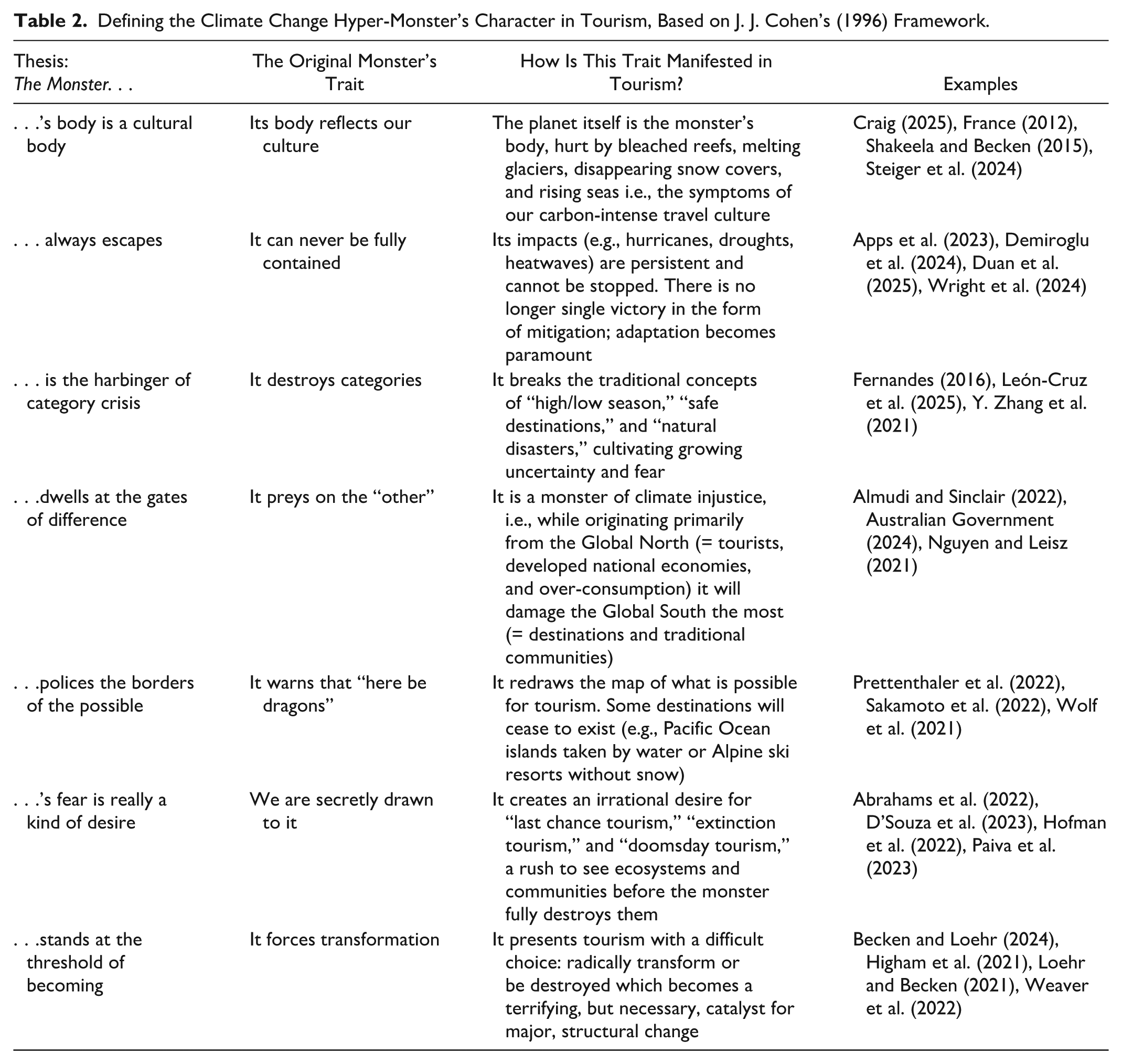
Having defined climate change as a hyper-monster, we now apply J. J. Cohen’s (1996) framework in detail to examine its specific character in tourism. Each thesis uncovers a different dimension of climate change’s hyper-monstrosity, and Table 2 summarises the connection and provides examples from the literature.
Defining the Climate Change Hyper-Monster’s Character in Tourism, Based on J. J. Cohen’s (1996) Framework.
Thesis I: The Monster’s Body is Cultural
J. J. Cohen (1996) argues that a monster’s body is never its own, but represents a cultural construct, a physical manifestation of a specific time and place. Accordingly, the climate change hyper-monster’s body is the planet itself, and its physical degradation manifests in the consequences of our global culture of over-consumption.
For tourism, this is not an abstract concept. The climate change hyper-monster’s body is exemplified by the bleached corals of the Great Barrier Reef (Craig, 2025). It can also be observed in the retreating glaciers and decreasing snow cover, whose disappearance threatens the existence of ski tourism economies, such as those in Switzerland, Austria, the United States, and Canada (see Steiger et al. (2024) for a review). Lastly, it can be seen in sea level rise endangering key destinations, many of which hold a status as a world heritage site, such as Venice (France, 2012), Tuvalu (Mortreux & Barnett, 2009), and the Maldives (Shakeela & Becken, 2015), potentially turning popular holiday resorts and entire cities into risky outposts. The climate change hyper-monster is thus corporeal; its body is a direct and increasingly horrifying reflection of the carbon-intense culture of global tourism (Lenzen et al., 2018).
Thesis II: The Monster Always Escapes
A key feature of the monster is that it cannot be captured. It can be fought, at times successfully, such as in the case of Van Helsing, who has pledged to “set the world free” by fighting vampires (Light, 2017). However, it can never be truly defeated; it always returns (J. J. Cohen, 1996).
The scary logic of the climate change hyper-monster is that it is a creature of inertia (Scott & Gössling, 2025). Even with radical global action and multi-stakeholder collaboration, such as the United Nations Conference of the Parties (COP), its acceleration ensures that it will continue to “escape” our control for centuries to come. For example, although COP has been held regularly since 1995, the most recent edition in Baku continues to rely on pledges rather than real performance measurement, thus effectively endangering the urgent action required for climate change mitigation (Scott & Gössling, 2025).
Further, the escape of the climate change hyper-monster is not a single event but a series of manifestations. For instance, it escapes into the atmosphere as a hurricane, damaging Caribbean Island destinations (Wright et al., 2024), and also as a heatwave in destinations where tourists become cautious about visiting due to increasing weather uncertainty and a growing likelihood of air pollution (Duan et al., 2025). It can also escape from the melting permafrost as methane, accelerating its growth, often due to intensified tourism development in the Arctic and Antarctic (Demiroglu et al., 2024). It escapes into the ocean, where it contributes to the dissolution of marine ecosystems due to acidification, thereby damaging natural habitats that attract tourists (Apps et al., 2023). For the global tourism industry, this means there is no final victory, only a few, temporary and fragmented, successful fights (Gurtner, 2016), but essentially a permanent state of adaptation, resilience and emergency response to a hyper-monster that can never be truly restricted (Filimonau & De Coteau, 2020).
Thesis III: The Monster Is the Harbinger of Category Crisis
Monsters succeed in breaking down the distinctions we use to order the world (J. J. Cohen, 1996). This is well exemplified by zombies, who represent creatures that are neither entirely dead nor alive, thus cultivating a feeling of uncertainty about the unknown and disseminating fear (Luckhurst, 2015).
The climate change hyper-monster excels at this, creating categorical crises for the tourism industry. It dissolves the reliable binary of “high season” and “low season” as weather becomes unpredictable and “shoulder seasons” are distorted by extreme weather events (Amelung et al., 2007). Besides, it blurs the line between a “natural disaster” and a human-caused event. For example, while hurricanes were once attributed to largely natural causes, they are now more frequently linked to anthropogenic activities (Reed et al., 2022). The very category of a “safe” destination to travel to enjoy a holiday without interruptions caused by unpredictable weather becomes unstable as many traditionally “tranquil,” “peaceful,” and “safe” destinations, such as Rhodes (Greece), Mallorca, or Girona (Spain), become suddenly overwhelmed by unprecedented droughts, flash floods, showers, fires, or storms (Fernandes, 2016; León-Cruz et al., 2025; Y. Zhang et al., 2021). Thus, the climate change hyper-monster introduces growing risks and uncertainty into an industry that has built its reputation on selling stability, predictability, and comfort (Baggio, 2008), forcing a crisis in how we categorise, perceive, and adapt to weather-related travel risks, seasonality, and destinations themselves (C. Xie et al., 2020).
Thesis IV: The Monster Dwells at the Gates of Difference
Monsters are used to construct and police the boundaries of the “other” (J. J. Cohen, 1996). In other words, monsters are born from our perception of what/who is different from us, and therefore become separated, oppressed, and excluded (J. J. Cohen, 2012). These different individuals or groups are often demonised or marginalised, and the monster becomes a symbol of the “us versus other” divide (Kearney, 2005).
Accordingly, the climate change hyper-monster is an agent of global injustice (Rastegar & Becken, 2025) because it is born primarily from the historical emissions of the industrialised Global North, the primary source of international tourists. Concurrently, its most devastating impact occurs in destinations of the Global South, such as the island states of the Pacific and Indian oceans (Rastegar et al., 2023). In other words, it is a hyper-monster that preys on (class, race, income, and gender) differences. The low-lying island nations, such as Tuvalu that have become a state of climate refugees (Australian Government, 2024), the subsistence farming communities in mountainous regions, such as those in Vietnam (Nguyen & Leisz, 2021), and the indigenous populations, such as those in the Amazon (Almudi & Sinclair, 2022), whose lands become most vulnerable are the ones who will suffer from climate change the most, despite having contributed the least to this hyper-monster’s creation, see Ngcamu (2023) for a review. This creates a monstrous situation where the privilege of high-carbon travel for some directly fuels the existential threat to others, making climate change a hyper-monster that underlines the brutal inequalities of the global economy in general and international tourism in particular (Sheller, 2021).
Thesis V: The Monster Polices the Borders of the Possible
Monsters serve as warnings against transgression, marking the edges of the map with “here be dragons” (J. J. Cohen, 1996). Such warnings serve to discourage exploration of specific areas; they also aim at suppressing the idea of challenging established (societal and intellectual) norms, thereby maintaining the status quo (J. J. Cohen, 2012).
The climate change hyper-monster is literally redrawing the map of what is possible for global tourism. It is setting hard, physical boundaries on future tourist activities that can be difficult, if not impossible, to negotiate. For example, although artificial snow can be used to replace natural snowfall, it is often expensive and cannot fully substitute the experience of skiing in the mountains (Joksimović et al., 2021). Paradoxically, it can exacerbate the climate change hyper-monster as artificial snowmaking consumes considerable amounts of energy and water (Y. Xie et al., 2025). Therefore, the border that the climate change hyper-monster polices is the very biophysical limit of the planet, given the interconnectedness of human activities, including those related to tourism, as per above (François et al., 2023).
The climate change hyper-monster warns that the fantasy of affordable, frictionless global travel, which we have enjoyed to date, has multiple negative consequences. For example, the climate change hyper-monster dictates that ski tourism is no longer possible below a certain altitude (Prettenthaler et al., 2022). It also suggests that popular beach resorts, built just centimetres above sea level, such as those in the Maldives (Sakamoto et al., 2022) or the Pacific (Wolf et al., 2021), have no long-term future. In other words, the climate change hyper-monster controls our over-confidence, increasingly demonstrating that not all destinations will be available to us forever, no matter how much we are willing to pay (Durán-Román et al., 2021) and regardless of how advanced the technology (for example, biofuels or fully electric vehicles) can become to reduce the negative repercussions of climate change (J. Fletcher et al., 2021). The most feasible option is to adapt, as many mitigation targets have already been missed (Scott & Gössling, 2021).
Thesis VI: Fear of the Monster Is a Kind of Desire
J. J. Cohen (1996) suggests that we are secretly drawn to the monster’s freedom and power. Despite the fear, we are often fascinated with monsters, and this fascination stems from our hidden desire to explore the forbidden and the unknown (J. J. Cohen, 2012).
With the climate change hyper-monster, this is reflected in the promotion of new destinations emerging as a result of the changing climate, such as the Nordics (Mayer et al., 2023). Some of these “emerging” destinations aim to capture the market share of (more) “established" destinations, benefiting from significant tourism investments and increased tourist spending (King, 2025). More important, however, is that the fascination with the climate change hyper-monster also manifests as a tragic, new form of tourism, “last chance tourism,” see Barton and Goh (2025) for a review, “extinction tourism” (Hehir et al., 2023), and “doomsday tourism” (Discovering the Arctic, 2025). All these tourism forms have one thing in common: they are all driven by the desire to see a place or an animal/bird species before it is gone. For example, tourists travel to see the melting glaciers of the North (Abrahams et al., 2022), to dive on dying coral reefs (Hofman et al., 2022), or to spot polar bears on the gradually thinning Arctic ice (D’Souza et al., 2023). Paradoxically, the fear of the climate change hyper-monster’s destructive power creates a desire to witness its devastation (Paiva et al., 2023). This desire is monstrous because it is a feedback loop, that is, the carbon-intense travel required to participate in this form of tourism is substantial due to the remoteness of last-chance tourism destinations (Lv et al., 2024). This directly accelerates the end of the very attraction being visited and mourned. It is a desire to consume the last of something precious, a final act of appropriation before the hyper-monster claims it completely.
Thesis VII: The Monster Stands at the Threshold of Becoming
Ultimately, monsters force us to re-evaluate our world and ourselves, standing at the “threshold of becoming" (J. J. Cohen, 1996). Monsters are our creation, yet they also serve as agents of transformation (J. J. Cohen, 2012). Monsters provide an opportunity for us to challenge ourselves and the societies in which we reside, confronting and overcoming our fears to evolve intellectually, culturally, and socially (J. J. Cohen, 1996).
Accordingly, we argue that the climate change hyper-monster challenges the tourism industry with an absolute choice: transform or perish. Its existence and growing nature make incremental change towards environmental sustainability (Becken & Loehr, 2024), and passive engagement with it (Weaver et al., 2022), insufficient. It forces the industry to form a new identity (Loehr & Becken, 2021), demanding a radical reimagining and a major rethink of its purpose, structure, and ethics (Higham et al., 2021). The climate change hyper-monster asks the ultimate question: What must tourism become to survive in the world which this hyper-monster is creating? We argue that it serves as a catalyst, a terrifying yet necessary agent of dramatic change that signals the end of one era of mass, irresponsible, and unsustainable tourism, demanding the birth of other—that is, responsible, regenerative, and sustainable—tourism practices.
Concluding Remarks: Implications of the Climate Change Hyper-Monster for Tourism and Hospitality Theory and Practice
We argue that conceptualising climate change as tourism’s hyper-monster is more than a metaphor: It provides a critical drive for re-evaluating the very foundations of tourism and hospitality theory and practice. It moves the discourse from one of manageable, technical and/or organisational “problems” to one of existential, hyper-monstrous confrontation. This framing has implications for how we research, plan, and engage in tourism in a new and terrifying age.
Theoretical Implications
First, the climate change hyper-monster demands a paradigm shift from growth to resilience and even degrowth. The dominant theoretical models in tourism, grounded on ever-increasing arrivals and economic expansion, are rendered obsolete by a hyper-monster fed by that very growth. Future tourism theory must be grounded in the principles of resilience (Scott & Gössling, 2022), adaptation (Kaján & Saarinen, 2013), regeneration (Dredge, 2022), and, most controversially, degrowth (R. Fletcher et al., 2019), thus exploring models that prioritise ecological stability and community well-being over volume production and money making.
Second, the climate change hyper-monster centralises ethics and climate justice. As a creature that disproportionately harms the world’s most vulnerable, it forces tourism scholarship to move beyond simplistic host–guest binaries (Guia & Jamal, 2025). Theories of post-colonialism (Dube et al., 2024) and climate justice (Rastegar & Ruhanen, 2023) must become core to scholarly analysis, rather than peripheral, secondary, supplementary, or complementary. Here, the analytical lens of climate change hyper-monster does not replace political economy critiques of neoliberalism in the context of sustainable development, but creates the affective urgency for these critiques to be heard more vividly. Accordingly, in the time of rapidly changing climate, we need to increasingly ask: Who has the right to travel, at what cost, and who pays the price?
Lastly, the climate change hyper-monster redefines “sustainability” as a baseline for survival, no longer a niche market or an “on-request” business. The concept of sustainable tourism, which continues to be treated as a sub-field within the tourism body of knowledge rather than its cornerstone (Sharpley, 2020), has become a prerequisite for any tourism theory. Responding to McCabe’s (2024) call for internal theory-building in tourism, we argue that any novel theories developed in tourism studies must be shaped around sustainability and, most importantly, climate change. Accordingly, any novel theoretical model in tourism that does not account for decarbonisation, resilience, adaptation, regeneration, justice, biodiversity conservation, and planetary boundaries is no longer fit for purpose in a world dominated by the climate change hyper-monster.
Practical Implications for Policy-Making and Destination Management
Before detailing specific interventions, it is critical to articulate why framing these actions as a response to a climate change hyper-monster is strategically superior to simply positioning them against “climate change.” While the operational tactics, such as heat protocols and retrofits, may be familiar, the conventional “climate change” framing has often led to inertia, treating these as compliance costs or distant risks to be managed incrementally. The “hyper-monster” analytical lens challenges this by reframing them as existential imperatives. It reveals that the tourism industry’s current model is not merely “vulnerable” but is actively feeding the very destructive force that threatens to destroy it (see Thesis VII). This shift in perspective, that is, from “managing climate risks” to “confronting a hyper-monster of our own making,” may provide the missing, yet increasingly necessary, affective and moral urgency to drive radical pro-environmental transformation. The following implications, therefore, are not designed as an exhaustive list of interventions, but an illustrative set of strategic responses designed to stop feeding the climate change hyper-monster and start surviving it.
For practitioners, such as national tourism boards and destination managers to local tourism operators, the climate change hyper-monster’s presence demands immediate and radical changes in practice. First, destination management must shift its focus from marketing tourism to regeneration, crisis management, and adaptation. The primary task is no longer simply attracting visitors but protecting destinations from the hyper-monster’s unpredictable yet predictable impact. This means investing in climate-resilient infrastructure, such as coastal defences for Venice (Giupponi et al., 2024) and water conservation projects for destinations (McCarroll et al., 2024), and developing advanced crisis preparedness and response plans for extreme weather events and anthropogenic disasters.
Second, decarbonisation becomes a condition of operation. The industry’s social license to operate will be contingent on its ability to reduce its over-reliance on fossil fuels (Peeters & Papp, 2024). This necessitates a practical shift towards promoting lower-carbon transport, such as rail, to and within a destination, investing in renewable energy for tourist accommodation facilities and visitor attractions, conserving water, and reducing waste across the tourism supply chain.
Third, the climate change hyper-monster requires product and seasonal diversification. Businesses that have traditionally relied on certainty and stable climatic conditions face extinction. The practical imperative is to innovate and diversify away from at-risk attractions (Solarin et al., 2025). Ski resorts must become year-round mountain destinations; coastal areas must develop their cultural, culinary, and inland assets to reduce their sole reliance on the threatened beach. This requires unconditional thinking to identify novel business opportunities and “brave" decision-making to break conservative mindset.
A concrete example is Türkiye. Its new “Go Türkiye” (2025) national tourism branding campaign represents a policy level shift away from a focus on traditional “sun and sea” products. An analysis of its official digital channels (Go Türkiye, 2025) illustrates this change, with creative and financial resources strategically re-allocated to emphasise cultural heritage, culinary richness (e.g., “Deliciously Türkiye,” see Memis (2024)), and sustainability. To support this shift, there are now discussions in Türkiye about the potential ban of all-you-can-eat hotel buffets in an attempt to combat the challenge of food waste generation which adds significantly to climate change (Deutsche Welle, 2025). The utility of this diversification strategy in a specific, popular destination, which has been designed to address the issues of overtourism, environmental degradation, and the increasing summer heatwaves in coastal hotspots of Türkiye, is confirmed in multiple academic sources as a potent move to reduce the negative effect of seasonality on various destinations (Dalir, 2024; Garanti, 2022; D. Zhang & Xie, 2023).
Lastly, the climate change hyper-monster demands an end to aggressive tourism marketing and a turn towards radical honesty. The practice of marketing a “guaranteed” perfect climate is becoming unrealistic. This is illustrated by a 2023 campaign from the Isle of Wight which, to encourage staycation in the UK, offered a “sunshine guarantee” (TimeOut, 2023). Another example is the United Arab Emirates (UAE) which, usually being very dry, has recently been exposed to extreme downpours (Poynting & Silva, 2024). This also calls for institutionalising risk communication. In Venice, for example, “honesty” is now an operational necessity, with the MOSE flood barrier system’s communication protocols mandating official public advisories to manage tourist expectations during intensified acqua alta (high water) events (Giupponi et al., 2024). This new practice can even aim at incorporating climate action from tourists, such as voluntary participation in local restoration and conservation projects (Ghaderi et al., 2022), into the tourism product itself.
Practical Implications for Tourism and Hospitality Operations
Beyond the destination level implications, the climate change hyper-monster framework can aid in tourism and hospitality operations, thus linking theoretical dimensions to real-life, operational practice. First, the monster’s Scale & inertia dimension (see Table 1), specifically its persistent, non-linear temporality (see Thesis II), requires tourism and hospitality operators to move beyond short-term “weather-proofing" to long-term “monster-proofing” of assets. Because the climate change hyper-monster “always escapes” containment, capital investment must shift from mitigating occasional risks of extreme weather events to hardening infrastructure against a permanent state of climate crisis. The increasing frequency and intensity of heatwaves, droughts, and storms, driven by the climate change hyper-monster’s persistent, systemic nature (Thesis I, II, III), necessitates capital investments in energy and water infrastructure to make operations more resilient (Salehi et al., 2021). This can include the use of high/better efficiency building management systems, enhanced thermal insulation (in colder climates), use of renewable energy sources, such as solar or hydro, adoption of in-situ grey water recycling, and backup power to withstand external shocks. For instance, luxury hospitality operator Soneva has developed and implemented a Total Impact Assessment tool that audits the environmental (including carbon) costs of this business across its entire supply chain, acknowledging that true resilience requires accounting for planetary-scale impacts beyond the resort gate (Corporate Maldives, 2022). Such a holistic approach enhances the adaptability of Soneva to climate change shocks, setting a model for other hospitality businesses.
Crucially, for hotel owners, managers, and investors, this dimension challenges the traditional capital cycle. It suggests that standard refurbishment strategies, such as every 7–10 years, are no longer sufficient (Igosheva et al., 2024). Instead, decision-making must now explicitly evaluate the option of managed retreat, that is, liquidating assets in hyper-vulnerable destinations, such as the Maldives or Venice, before the climate change hyper-monster renders them uninsurable, versus investing in expensive “fortified hospitality” defences, such as in the case of Venice’s MOSE flood barriers.
Second, the Scale & inertia dimension, expressed as growing frequency of extreme weather events, such as heatwaves, combined with the climate change hyper-monster’s Boundary policing function (i.e., creating new legal and moral duties of care) fundamentally re-configures the legal and moral landscape of labour. By making traditional working conditions risky, the climate change hyper-monster creates new taboos around “heat-exposed labour” that transform staff safety from an operational key performance indicator (KPI) into an existential license to operate (Kainaga et al., 2022). This implies establishing and reinforcing the adoption of tolerable thresholds for kitchen, laundry, and housekeeping departments, where the impacts of heat can be especially pronounced. This also calls for redesigning shifts or changing rota frequency to avoid peak heat hours. Lastly, this suggests investing in appropriate personal protection equipment, such as appropriate clothing/uniform for outdoor working staff, and regular indoor air quality and temperature monitoring. This has already become reality in the sectors of hospitality and events, such as in the case of religious festivals taking place in tropical regions. Here, rising temperatures have forced operators to implement rigorous heat-stress protocols for both staff and pilgrims, defining a new physical boundary for safe operations (Kadum et al., 2025).
For Human Resources (HR) and General Managers of hospitality enterprises, this requires a major shift in mindset, that is, workforce welfare in light of the rapidly changing climate is no longer just a legal compliance issue but a critical factor for operational continuity (Šavrič et al., 2025). For instance, the climate change hyper-monster dictates that, during extreme heat events, the “boundary" of the possible (Thesis V) may require hospitality providers to close outdoor dining spaces or suspend house-keeping services to prevent fatal staff exposure to heat, regardless of guest demand.
Third, the climate change hyper-monster’s Reflexivity & entrenchment dimension demands a re-evaluation of organisational procurement policies and Scope 3 carbon emissions. The industry’s “lock-ins” (see Thesis VII) to globalised, carbon-intense supply chains for energy—but also for food—are a key to how the climate change hyper-monster co-produces itself. Responding to this challenge requires auditing the embodied carbon in building refurbishment projects and enforcing supplier codes to demand verifiable de-carbonisation of building materials (Filimonau et al., 2021). For instance, Accor have committed to eliminate single-use plastics, such as toiletries and cups, and have set science-based targets for pollution reduction (Accor, 2025). Likewise, Hilton have trialled carbon labelling of menus in their restaurants, inspiring guests to experience more carbon-friendly stays (Hilton, 2023). These examples represent the hospitality industry’s attempts to dismantle the reflexive “lock-ins” of their own global procurement systems. Further interventions can also involve provision of vegan/vegetarian meals, sourcing food locally to avoid food miles, and the adoption of regenerative business models in food service (McGregor et al., 2025).
Fourth, the climate change hyper-monster’s Mediatisation & affect dimension reveals that the crisis is fought not just in the physical environment, but also in the psychological landscape of the guest. Tourism and hospitality operators must actively counter the climate change hyper-monster’s capacity to generate chaotic, media-driven anxiety through transparent risk communication. This transforms “radical honesty” from a marketing risk into a trust-building necessity. On the one hand, this dimension suggests that capitalising on the ambivalent desire (Thesis VI) for last chance tourism where operators market the spectacle of the hyper-monster’s destruction, such as trips to the Great Barrier Reef, should be avoided to enable recovery. This avoidance can be facilitated by using cross-industry commitments or voluntary agreements, such as ethical codes of conduct, where tourism and hospitality companies commit not to promote the climate change affected sites and fragile ecosystems (Loehr & Becken, 2021). On the other hand, this dimension creates a new operational burden of managing guest affect. Tourism and hospitality operators must therefore address popular media-driven anxieties, such as news of local wildfires or flash floods, with transparent risk disclosures and communication of contingency planning (Bhaskara et al., 2023).
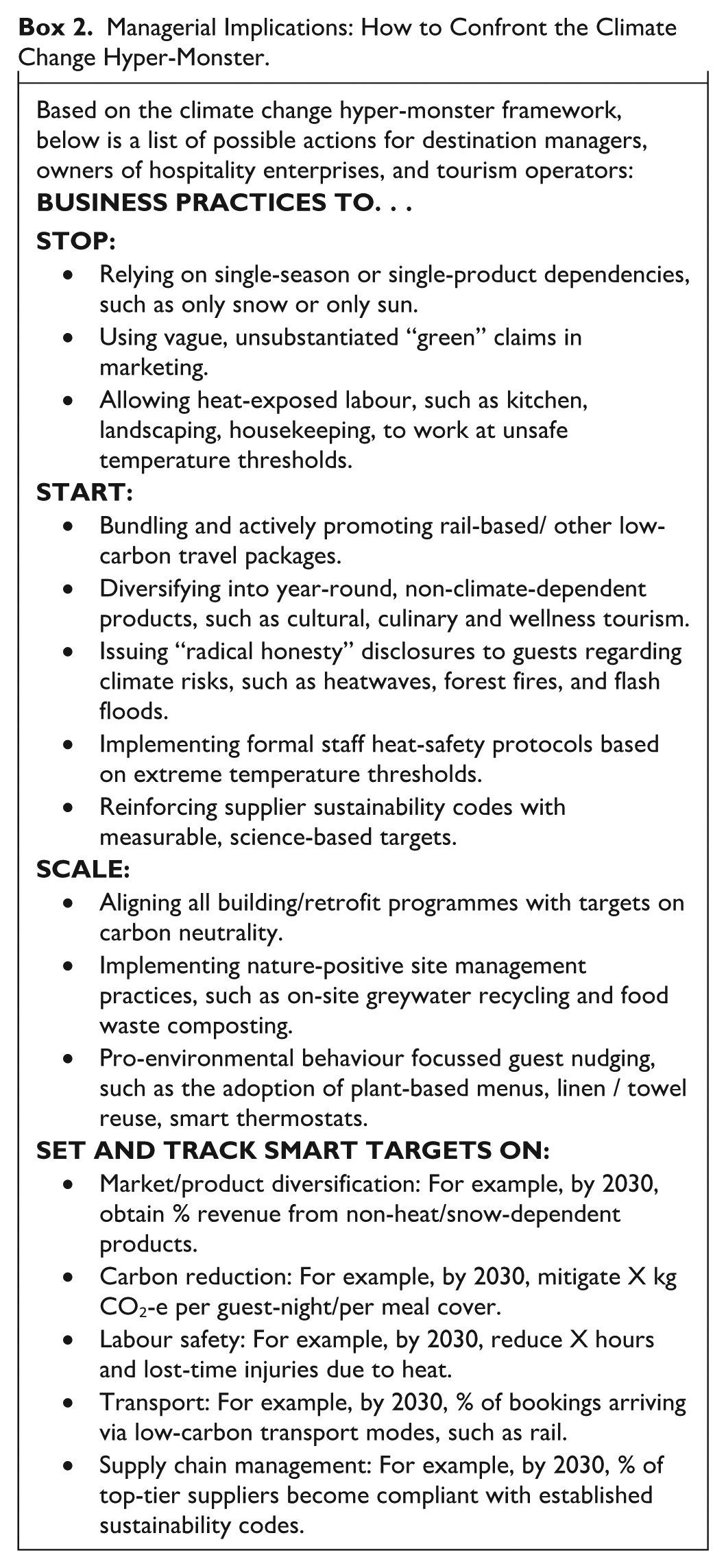
Lastly, the climate change hyper-monster’s Scale & inertia and Boundary-policing dimensions necessitate a diversification of the hospitality portfolio. Importantly, this should be not only a destination-level task but increasingly an operational level strategy. Such strategy can involve re-designing product portfolios to avoid or reduce heat- and snow-dependent properties, providing travel packages with integrated public transport options, and developing product offers that are less dependent on or beat the effect of seasonality (Garanti, 2022). For instance, during heatwaves, tourist/guest activities can be offered in “green” areas, such as nearby forests, or indoors. This will, however, require alignment between destination governance and firm-level action—that is, while destination managers must enforce appropriate zoning that prohibits new developments in climate change hyper-monster prone areas (Thesis V), hospitality operators must transparently disclose the physical risks (for example, of heat waves with their negative implications for health and well-being) to insurers, but also investors, to avoid the sudden shock of asset de-valuation when climate change driven accidents happen. This applies to such popular destinations as Spain and Greece where, in 2024, increasing temperatures caused the death of several foreign tourists (“Extreme heat poses ‘real risk,’” 2024). Box 2 outlines the key managerial implications for confronting the climate change hyper-monster.
Managerial Implications: How to Confront the Climate Change Hyper-Monster.
Future Research Directions
The conceptual framework developed in this paper outlines an agenda for future research. First, beyond specific topics, the climate change hyper-monster framework offers a versatile methodological tool for tourism and hospitality scholarship. Researchers can operationalise the new framework in three ways: (1) as a sensitising concept in qualitative inquiry, using the dimensions (e.g., reflexivity, boundary-policing) to code interview data on tourist affect and industry anxiety; (2) as a comparative lens to analyse how different destinations negotiate the hyper-monster’s uneven geography (e.g., contrasting the “forced adaptation” of small island developing states with the “last-chance” marketing of polar regions); and (3) as a critical structure for discourse analysis, enabling scholars to deconstruct policy documents and corporate sustainability reports to reveal the rhetorical strategies used to obscure the climate change hyper-monster.
Second, the paper calls for empirical testing each of the climate change hyper-monster’s dimensions. More specifically, the following proposals need to be validated in subsequent studies:
Proposal 1 (to test the Scale & inertia dimension, see Table 1): Tourism and hospitality firms adopting heat-safety protocols for labour reduce lost-time injuries by a measurable percentage without a negative impact on guest satisfaction scores. This proposal emerges from Theses I and III.
Proposal 2 (to test the Reflexivity & entrenchment dimension): Greater aviation dependence (a “lock-in”) predicts slower destination-level diversification away from heat-exposed products despite rising climate vulnerability, an effect mediated by sunk-cost path dependencies. This proposal emerges from Thesis VII.
Proposal 3 (to test the Mediatisation & affect dimension): The “last-chance” tourism framing boosts short-run visit intentions but contributes to post-trip cognitive dissonance. Further, it suppresses repeat visitation and discourages pro-environmental behaviour, at home and away, relative to “stewardship” or “restoration” framing. This proposal emerges from Thesis VI.
Proposal 4 (Boundary-policing): “Radical honesty” disclosures, such as explicit advisories on anticipated heatwaves, reduced air quality or flash floods, increase trust and foster loyalty among risk averse tourists, outperforming generic “climate commitment” or “green” claims. This proposal emerges from Theses IV and V.
Third, the climate change hyper-monster framework calls for a complementary critical and interpretive agenda that engages with the power, discourse, and lived experience of the hyper-monster, drawing from Foucault, Baudrillard, and Haraway. This prompts research questions that the above propositions cannot answer alone. From the Foucauldian (Power/Discourse) perspective, the following question should be asked: Who gets to define the climate change hyper-monster and the “appropriate” responses to it? How do these definitions reinforce existing power structures (e.g., Global North vs. Global South) or marginalise community-led solutions? From the Baudrillardian (Spectacle/Hyper-reality) perspective, the following question can be posed: Does the spectacular mediation of climate disasters in tourism marketing (e.g., the “last-chance” aesthetics) lead to political apathy rather than genuine behavioural change? How can the cycle of consuming the hyper-monster as entertainment be broken and who needs to be involved? Lastly, from the Harawayan (Entanglement) perspective, the following question should be asked: What would a tourism practice grounded on “staying with the trouble” or “we are all in it together” principle look like? This calls for case studies of community adaptation projects, animal justice in conservation, and regenerative business models that extend beyond temporary “fixes” to fully and knowingly embrace collaborative ways of living with climate change.
On Metaphor, Responsibility, and Depoliticisation
The choice to use a metaphorical framework in this paper was a deliberate methodological step. Metaphors are not decorative; they are foundational to human cognition, structuring how they perceive, understand, and act on complex, abstract concepts (Lakoff, 1993). The current metaphors for climate change describing it as a “challenge,” “issue,” or “societal problem” may be insufficient as they fail to generate the necessary affective and ethical response. Therefore, the climate change hyper-monster is proposed as a more potent analytical metaphor which can re-frame the climate crisis in the urgent, moral, and existential terms.
It is important to acknowledge that the climate change hyper-monster framework does not argue that climate change is a fictional creature, such as Frankenstein or Godzilla. Instead, it suggests that because climate change is a terrifying scientific fact, it generates a profound cultural and affective response that functions as a hyper-monster, revealing our societal contradictions in a way that scientific reports alone cannot. This mirrors Haraway’s (2015) use of a monstrous, fictional entity—the Chthulucene—to name a very real, systemic, and entangled condition holding an exceptional destructive power.
However, when proposing a new, more affective metaphor of the climate change hyper-monster, it is also important to acknowledge the essential risks of this approach. As the earlier discussion of Baudrillard (1994) highlighted, there is a danger that framing the climate crisis as a hyper-monster can depoliticise it, turning a major structural, environmental and socioeconomic problem into a spectacular, fatalistic, or even entertaining show. As exemplified by the never-ending rhetoric of climate change scepticism (Hornsey & Lewandowsky, 2022) and even denial by some U.S. political leaders (Boulianne & Belland, 2022), this poses a critical risk of assigning this major societal challenge the status of a myth or a fairytale (Micu et al., 2022).
It is therefore important to establish clear guardrails. The climate change hyper-monster lens is not intended to displace structural analysis but to energise it. It should be considered a critical supplement to, not a substitute for, the vital work of political-economy, justice, and post-colonial critiques on climate change mitigation and adaptation in tourism. This new framework is not an excuse for fatalism, but a tool to better articulate the affective and moral dimensions of a crisis that is too often reduced to plain political or managerial language. The climate change hyper-monster lens must always be paired with demands for real action, such as hard decarbonisation targets, legally binding staff protections, and transparent risk disclosures in the tourism industry.
A brief example demonstrates how this new lens can change the diagnosis. A conventional risk model might frame increasingly erratic weather as “seasonal variability,” considering it an operational problem which is manageable, or which will disappear soon itself without intervention. The climate change hyper-monster lens can reframe this viewpoint. Through its Boundary-policing dimension (Thesis V) and the moral charge it carries (Thesis IV), it re-positions this “variability” as an ethical and disclosure failure. Marketing a “guaranteed” perfect holiday (TimeOut, 2023) is no longer a gamble but a transgression, that is, a failure of the tourism industry’s duty of care and a dishonest act of what the philosopher Imre Lakatos defined as “monster-barring” (Dutilh Novaes, 2022). This definition highlights a strategy in argumentation which involves questioning the legitimacy of the alleged counter example. For instance, in tourism, it can occur when arguing that climate change is just another, fancy name for unpredictable weather patterns affecting a specific destination rather than the tourism industry as a whole (Viken & Heimtun, 2024). Such approach should be avoided as it can hide a terrifying reality and the ever increasing negative consequences of climate change for global tourism.
Conclusion
The climate change hyper-monster is here. It is a creature of our own making, and it stands at the gate. Acknowledging its hyper-monstrosity and the responsibility of tourism for feeding it is the first step towards confronting the terrifying and transformative work required if tourism is to survive the new world that accelerating climate change is shaping.
This paper is positioned as an exercise in both insight and foresight for the tourism sector. As an insight, the climate change hyper-monster framework reframes our understanding of climate change, moving beyond sterile technocratic and managerial definitions to reveal the profound affective, moral, and reflexive dimensions of the climate crisis that traditional analytical lenses tend to obscure. As foresight, this paper offers a concrete roadmap for the future of tourism, translating this novel theoretical reframing into a programmatic research agenda and a set of actionable strategic imperatives for industry’s survival.
Accordingly, this paper provides a conceptual foundation for understanding climate change as a hyper-monster, through the lens of Cohen’s theory, complemented with insights from other critical theorists. While the tourism industry has long pragmatically embraced mythical or constructed monsters, such as vampires, ghosts, and cryptids, to attract visitors and generate economic value, the scholarly literature remains limited in its application of comprehensive theoretical frameworks to interpret climate change itself as a hyper-monstrous force. Although this paper does not directly engage with critical perspectives such as genealogy, semiotics, postcolonial theory, or feminist critique, we argue that framing climate change as a hyper-monster, and recognising our involvement in feeding it, can inspire a more profound ethical and political reckoning with its consequences.
This conceptual approach invites tourism scholars to challenge the industry’s foundational logics and to imagine transformative responses to a crisis of our own making. It invites neither panic nor passivity, but reflection and responsibility: to recognise that what was once seen as progress, such as hyper-mobility, now feeds the very force that threatens the industry’s future. If monsters embody what a culture cannot bear to face, then facing this hyper-monster may yet offer a path, not back to what was, but forward to what must become. The question is no longer whether we can outrun it, but whether we are willing to stand in its shadow, look it in the eye, and change for the good.
Lastly, we must acknowledge the boundary conditions of this novel analytical lens. The climate change hyper-monster framework has the foremost potential when analysing systemic, long-horizon, and affectively charged phenomena, such as last-chance tourism and destination/species extinction. It is less helpful for localised, technical, short-cycle operational issues, such as daily energy/water consumption or specific solid waste management protocols in particular tourism and hospitality firms. Here, conventional risk management and engineering models remain the superior and sufficient tools to address local/regional environmental challenges. Future research should therefore apply the analytical lens proposed in this paper selectively, using it to diagnose the systematic/structural and major moral breakups of the climate crisis rather than to re-describe and re-present every operational sustainability challenge in hyper-monstrous terms.
Footnotes
Declaration of Conflicting Interests
The authors declared no potential conflicts of interest with respect to the research, authorship, and/or publication of this article.
Funding
The authors received no financial support for the research, authorship, and/or publication of this article.
