




Abstract

Introduction
Decision-making in the tourism and hospitality context is rarely as rational as neoclassical economic models (i.e., rational decisions following utility maximization) suggest. In particular, travel decisions involve a high level of perceived risk (Boto-García et al., 2025; Nam & Yang, 2025) and uncertainty (Ni et al., 2025) because they require a choice about a future emotionally-charged experience which is difficult to evaluate based on rational criteria (Karl et al., 2021). Additionally, the abundance of choice when it comes to travel decision-making, potentially leading to choice overload (Park & Eves, 2024), further impedes the application of traditional economic choice models in tourists’ decision-making analyses. The complexity of human behavior and the variety of influencing factors shaping decision-making call for alternative theories and methodologies—such as behavioral economics—to explain tourist behavior.
Behavioral economics, an interdisciplinary research area involving psychology as well as economics, allows us to investigate the influence of psychological, cognitive, emotional, cultural, or social factors on individual decision-making processes. It differs from neoclassical economics because decision-making is not seen as fully rational, but rather as a process that can be suboptimal due to cognitive shortcuts such as heuristics or biases, emotional responses, and contextual or situational cues. Rather than a substitute for traditional economic theories, behavioral economics is an extension that can explain behavior from a psychological perspective (Li et al., 2022).
Advancing Behavioral Economics Research in Tourism and Hospitality
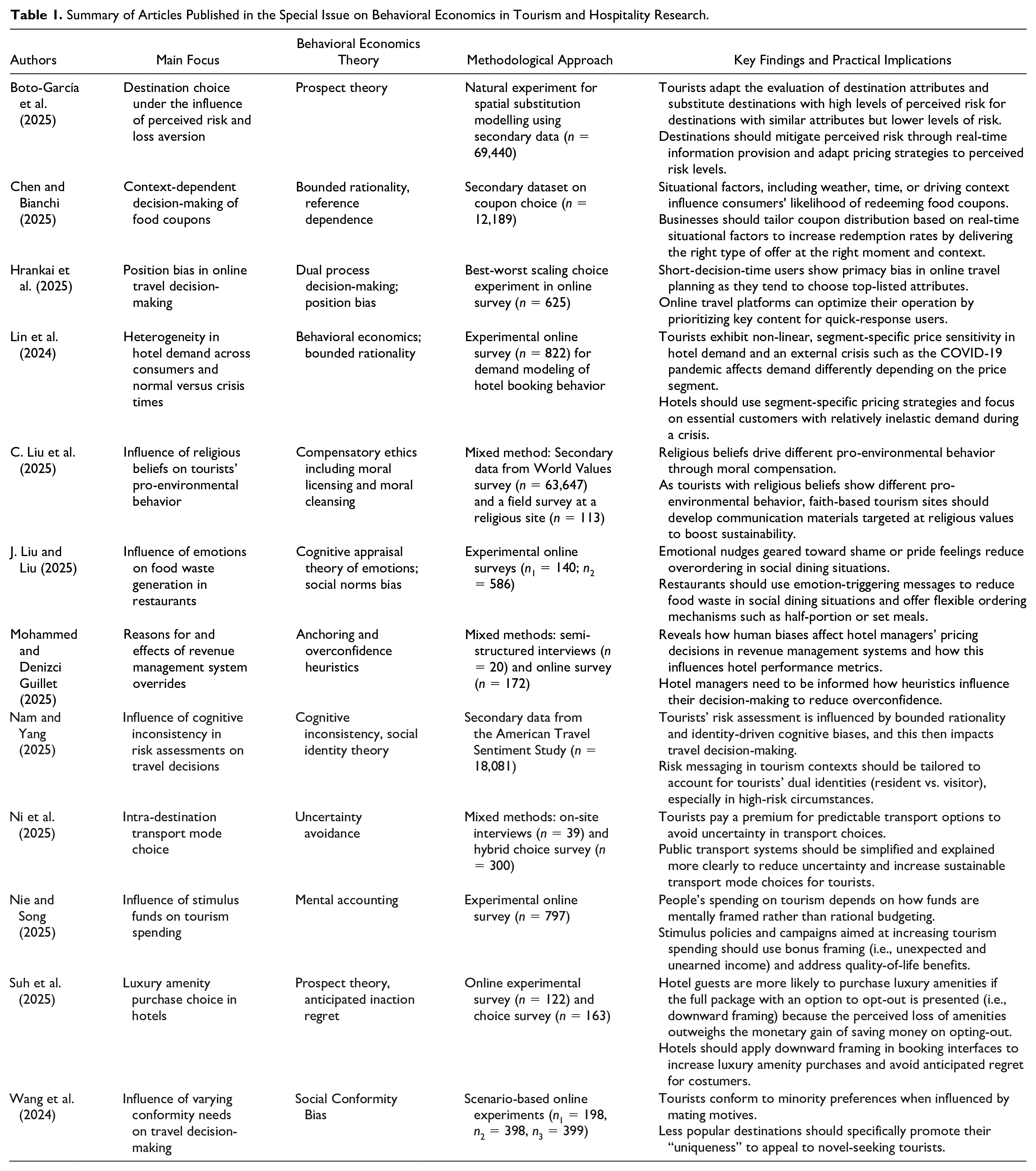
This special issue includes 12 tourism and hospitality studies to advance behavioral economics in this research area by applying novel theoretical frameworks or by developing innovative research designs to better capture actual behavior (see Table 1 for an overview). Articles in this special issue address a variety of different tourist behaviors ranging from destination and transport choice (Ni et al., 2025; Wang et al., 2024) to amenity purchases in luxury hotels (Suh et al., 2025), highlighting the diversity in applications of behavioral economics. Moreover, the articles demonstrate that behavioral economics can be a useful framework across all stages of a tourist’s journey, from pre-trip planning (e.g., Hrankai et al., 2025) to during-trip behavior (e.g., J. Liu & Liu, 2025) and post-trip behavior (e.g., C. Liu et al., 2025). These studies are summarized below to outline their theoretical, methodological, and practical contributions (see also the Table for a concise summary).
Summary of Articles Published in the Special Issue on Behavioral Economics in Tourism and Hospitality Research.
Theoretical Advancement of Behavioral Economics in Tourism and Hospitality Research
By replacing traditional neoclassical models of behavior, studies in this special issue are able to better explain actual behavior in tourism and hospitality contexts that may result from biased decision-making processes. Collectively, they highlight how cognitive biases, heuristics, emotions, and social identity shape tourist behavior. For example, several papers building on prospect theory by Kahneman and Tversky (1979) demonstrate how framing of information significantly impacts destination (Boto-García et al., 2025) or amenity (Suh et al., 2025) choices. Whilst information framing related to loss aversion, for example, is relatively well explored in the tourism and hospitality literature, reference dependence in relation to contextual or situational factors—another element of prospect theory—is yet to be fully introduced into this research area. Chen and Bianchi (2025) take an important step forward in this direction and exemplarily show how people’s purchase choices change depending on the situational context of the decision-making time. They show that people’s choices systematically change depending on the social setting, time or weather conditions, highlighting the dynamic and context-sensitive nature of decision-making.
Beyond individual cognitive mechanisms, research in this special issue also extends our understanding of social identity as a driver of tourists’ perceptions and decision-making. For example, Nam and Yang (2025) introduce social identity as an additional component of risk perception and suggest that people may experience cognitive dissonance when balancing their tourist versus resident identity, each associated with differing perceived levels of travel risk. This conceptualization of dynamic risk perception opens new avenues for research, and their study lays important groundwork for future exploration.
Methodological Advancements in Behavioral Economics Research in Tourism and Hospitality
Studies on behavioral economics in tourism and hospitality tend to focus on identifying distinct influence factors of decision-making (Li et al., 2022; Song et al., 2023) without strongly considering how behavioral economics may explain tourist behavior, particularly at the macro level. Consequently, the link between individual decision-making and aggregate behavior change is often missing (Song et al., 2023). This special issue attempted to address this research gap and was hoping for innovative research designs using a multi-level approach where data from the individual level are combined with macro-level aggregate data. The study by Nie and Song (2025) makes an important contribution by exploring individual tourism spending decision-making to better explain how governmental interventions at the macro level unexpectedly impact tourist demand. Interestingly, their study reveals that mental accounting—the idea that people spend their financial resources differently depending on how the money was earned, how much they received and what the intended use is (Shefrin & Thaler, 1988)—can help explain why governmental or firm-level stimulus checks framed as “bonuses” are more likely spent on travel. Combinations of qualitative interviews to explore perceptions in depth with quantitative surveys to establish results at a higher level also contribute to behavioral economics research that explains why certain observations at the macro level occur. For instance, Ni et al. (2025) combine on-site interviews with tourists about their transport choice mode with a hybrid choice survey to calculate the impact of uncertainty avoidance on public transport choice during a holiday. Using large-scale secondary data to explore some elements of travel decision-making can also provide interesting insights without the high research costs associated with primary data collection. Nam and Yang (2025) provide novel insights into the relationship between travel risk perceptions and travel decisions, based on the large-scale American Travel Sentiment Study (n = 18,081). They particularly show that the situational context when measuring risk perceptions plays an important role: People’s self-identification as tourists or residents significantly influenced risk perceptions, highlighting that risk perception is a dynamic rather than static concept.
Practical Implications of Behavioral Economics Research in Tourism and Hospitality
Based on this new understanding of behavioral economics in tourism and hospitality, the authors of all articles have provided useful practical recommendations for the industry regarding external communication strategies for customers and internal business strategies. First, the tourism and hospitality industry needs to carefully consider how information is communicated to consumers. For instance, emerging or novel destinations with fewer visitors should specifically promote their exclusivity to active uniqueness-seeking as an important psychological determinant in travel decision-making (Wang et al., 2024). Another communication example aims to change guest behavior towards pro-environmental choices through emotional appeals related to shame or pride (J. Liu & Liu, 2025). The second communication recommendation proposed by the articles in this special issue relates to when or in which sequence information is presented, rather than how information is presented to consumers. Suh and colleagues’ (2025) study on luxury hotel amenity choice demonstrates that downward framing (i.e., making a choice to remove amenities) might be more viable to increase revenue than the commonly used approach of upward framing (i.e., making a choice to add amenities). The driver behind this choice behavior lies in the anticipation of regret for missed opportunities. The third recommendation on communication from the articles in this special issue is personalization or adaptation of information provision for different decision-maker types. This includes placing key offers earlier for tourists with short response times on tourism platforms because they are more likely to be influenced by position bias than tourists with longer processing times (Hrankai et al., 2025).
Besides communication recommendations, practical implications are made related to business strategies for managing tourism and hospitality organizations. For example, a study on the heterogeneity of hotel demand using large-scale hotel booking data by Lin et al. (2024) suggests that hotels need to apply more flexible and dynamic pricing strategies that reflect consumer preferences (e.g., economy versus luxury hotel) in a given macro-level context (e.g., global health crisis versus normal; Lin et al., 2024). Another managerial recommendation from this special issue is based on a multi-method study by Mohammed and Denizci Guillet (2025) exploring how behavioral heuristics influence hotel managers’ decisions to override revenue management systems. They suggest implementing training programs that help managers understand how specifically anchoring and overconfidence biases impact their decision-making and how revenue management systems are impacted by overriding. Going beyond the hospitality context, research in this special issue also provides easily adaptable recommendations for public transport in tourist destinations: The hybrid choice model developed by Ni et al. (2025) clearly demonstrates how the uncertainty of choosing public transport due to unclear information discourages tourists from traveling on public transport while on holiday, even though this would be a more sustainable option compared to other transport modes.
Final Remarks
The articles compiled in this special issue make a valuable contribution to behavioral economics research in tourism and hospitality; they establish a critical foundation for advancing this emerging field of research. That said, some critical research gaps remain unaddressed. First, some findings are based on behavioral intentions captured in surveys and scenario-based experiments, which, while insightful to explore the mechanism of decision-making, may not fully capture actual behavior. Incorporating real-time behavioral tracking methods such as mobile GPS data to investigate tourists’ spatial patterns, online clickstreams to analyze decision fatigue or other influencing factors of travel planning decisions using platforms such as booking.com, or digital booking logs of tour operators that capture actual booking behavior, could enhance the ecological validity of behavioral economics research in tourism. Second, although cultural influences are acknowledged in several articles, the lack of systematic cross-cultural comparative research in tourism and hospitality remains. The difficulties in publishing repeated studies and the cost of conducting multiple experiments in different settings limit our understanding of how behavioral biases may manifest differently across diverse cultures. Most importantly, with the increasing use of AI-driven personalization tools in tourism and hospitality, there is an urgent need to examine how these technologies influence consumer biases and decision-making. Current literature offers some initial insights (e.g., Tuomi et al., 2025) and outlines how AI-driven personalization may be used to change behavior (e.g., Majid et al., 2024), but a systematic behavioral economics framework that links AI-driven personalization to decision-making and biases is yet to be developed for the tourism and hospitality context. Beyond personalization, new generative AI technologies shift consumers from active rational decision-makers to passive recipients of AI-curated choices. While they can enhance convenience, they also introduce new biases, manipulative tactics, and trust challenges—altering what “rational” behavior means in the digital age. Future research should incorporate the influences of generative AI into a more comprehensive behavioral economics framework and further advance tourism and hospitality research.
This special issue aims to spark greater interest in behavioral economics research in tourism and hospitality. With valuable theoretical frameworks and innovative methodological tools, we hope future behavioral economics research in tourism and hospitality will continue to play a key role in fostering intellectual curiosity, driving further innovation, addressing industry challenges, and supporting the global pursuit of sustainable development goals.
Footnotes
Declaration of Conflicting Interests
The authors declared no potential conflicts of interest with respect to the research, authorship, and/or publication of this article.
Funding
The authors received no financial support for the research, authorship, and/or publication of this article.

Author Biographies
Gang Li, PhD (email:
Marion Karl, PhD (email: