




Abstract
This study adopted discrete choice modeling to examine the effects of a set of situational factors on consumers’ redemption of coupons in food and beverage businesses. The situational factors delineate a multitude of in-vehicle scenarios in which consumers expressed their preferences for five types of coupons displayed on their smartphone. Controlling for the socio-demographics of respondents and coupon attributes, we found that almost all situational factors which characterized the in-vehicle scenarios, including weather, temperature, time of driving, and driving companion, have significant effects on the likelihood of coupon redemption. The situational effects become evident when consumers choose among different types of coupons rather than simply accepting or rejecting a single coupon. Consumers also make reference to corresponding consumption activities (dining, drinking, takeaway) when deciding to redeem coupons. The study results suggest that firms should take into account situational factors when deciding where, when, and to whom a coupon should be distributed. This dynamic approach can help nudge consumers toward accepting a specific coupon with a particular discount in a particular situation.
Keywords
Highlights
This study examined situational factors on consumers’ coupon redemption in hospitality.
We found that almost all situational factors about in-vehicle scenarios have significant effects.
Situational effects are evident when consumers choose among different coupons.
Choice differences are not evident for coupons in the food and beverage sectors.
Situational factors are crucial for coupon design and distribution.
Introduction
Coupons are among the most popular and convenient promotion tools used by firms in a wide range of consumer goods and service industries. Not only can coupons be used for initiating price competition between firms, but they are also a tool of price discrimination by individual firms. The dual role of coupons is particularly evident in food and beverage sectors, where low levels of product differentiation usually lead to intense price competition. In the marketplace, coupons can take a multitude of forms, ranging from traditional clipped newspaper or magazine coupons and direct mails, to electronic or mobile coupons, which are distributed on the Internet or via consumers’ mobile devices. Over the past decade, electronic coupons have surpassed traditional coupons in both quantity and value due to their ease of use for both firms and consumers (Danaher et al., 2015; Nayal & Pandey, 2022; Nayal et al., 2021). The global market for mobile coupons was estimated at US$630.3 billion in 2023 and is expected to reach US$1.6 trillion by 2030 (Global Industry Analysts, 2024). For consumers though, any coupon, regardless of form, is a price discount provided by firms that needs to be redeemed within a specified period of time and/or under certain purchase conditions. Therefore, whether and the extent to which coupons can aid firms’ marketing strategies lies in consumers’ redemption intentions. A recent study has shown that coupon redemption rate is only 18% (Gabel & Guhl, 2022), which is deemed too low to meet firms’ marketing goals.
In standard economic models, coupons are nothing but price discrimination (see Chen, 2021). A coupon can function as either second-degree or third-degree price discrimination, depending on whether it is used to encourage additional purchases from the same consumer(s) or to attract different consumer segments. In both cases coupons can increase the quantity of sales for firms and hence producer surplus or profits. On the other hand, price discounts associated with coupons entice consumers to purchase more, and hence coupons can also increase consumer surplus. It follows, as standard models predict, that consumers should accept a coupon once it is available. It is worth noting, though usually misunderstood, that such a normative decision prescribed by standard models has taken into account the net benefit of coupons to consumers (Narasimhan, 1984), that is, the price discount minus the opportunity cost of collecting and redeeming coupons. 1 Hence, any rejection of a coupon by consumers can only be attributed to a mismatch between their willingness to pay—that is, demand elasticity—and the price discount that the coupon confers. Put differently, coupons that are supposed to be distributed to consumers with more elastic demand end up in the hands of those with less elastic demand, and hence get ignored and rejected by the latter. Even if we assume that firms have perfect information and hence can match consumers’ willingness to pay with the price discount of a coupon, there is no guarantee that the coupon will be accepted by all target consumers in all circumstances. The reason is that standard models assume that consumers are perfectly rational and hence are driven exclusively by economic incentives, namely the price discount and the opportunity cost associated with collecting and redeeming coupons. In the real world, however, consumers are not perfectly rational, and their redemption decision of coupons could be spontaneous and impulsive. This is not only because such a decision is of low involvement and thus requires minimal consideration, but also because the context in which a coupon is presented may obscure consumers’ rational decision in one way or another. When deciding to accept or redeem coupons in a particular context, consumers may encounter additional context-specific benefits or costs that are too implicit to be factored in by standard models. Exclusion of the context by standard models could bias consumers’ true probability of coupon redemption. It is also likely that consumers accept one type of coupon over another only in a certain context, or accept the same coupon on one occasion while rejecting it on another.
In this study we aimed to examine whether—and the extent to which—a series of contextual factors can affect consumers’ redemption of coupons. Specifically, we focused on one of the most common situations in the U.S. market—the in-vehicle scenario—where consumers receive coupons on their smartphone while in their vehicles. The in-vehicle scenario is so ubiquitous in the United States that it has become one of the key arenas for firms to promote their products using mobile devices (see Wang et al., 2017). Within the in-vehicle scenario, people are usually unable to make complex decisions that may involve a sufficient amount of money and time. Instead, many people are inclined to make exceedingly simple decisions, such as buying a coffee at a drive-through or checking their smartphone while waiting at traffic signals, and so on. In this study we controlled a set of sociodemographic characteristics that could influence consumers’ demand elasticity, and hence their coupon redemption. These factors are important in standard models, for they enable firms to infer consumers’ willingness to pay and hence decide the face value of coupons. We also controlled consumer experience and coupon attributes, because they could be correlated with consumers’ willingness to pay and their redemption behavior, as shown in previous studies (Inman & McAlister, 1994; Mills & Zamudio, 2018; Taylor, 2001). Controlling these factors allows us to single out the effect of contextual factors on consumers’ coupon redemption.
Literature Review
The Structural Environment
Standard economic models assume that individuals make decisions in a certain and static environment. When it comes to market transactions, such an environment encompasses all information, ranging from the price and quality of a product and consumers’ choice set, to budget, all of which is perfectly known to consumers. Decision-making can thus be seen as an individual’s response to this environment conditional regarding their well-defined preferences. Standard models explain decisions by solving a set of utility functions that represent consumers’ preferences (see McFadden, 2001). Hence, decision-making turns out to be mechanical and deterministic. Despite their predictive power and mathematical tractability, standard models are normative benchmarks of human behavior in the sense that consumer choice is explained as if individuals were behaving rationally in a deterministic environment (see Friedman, 1953). A series of studies by Simon (1950, 1956, 1959) questioned the assumption of perfect rationality and the descriptive adequacy of standard models. Simon saw decision-making as interactions between individuals with bounded rationality and the uncertain and dynamic structural environment. Both bounded rationality and the uncertain environment lead to human behavior being capricious and inconsistent. Moreover, decision-making is a psychological and cognitive process and thus affected by consumers’ psychological states, such as regret versus rejoicing (Bell, 1982; Loomes & Sugden, 1982) and disappointment versus elation (Loomes & Sugden, 1986), which can be stimulated in certain environments or contexts.
Structural Environment and the Context
A wealth of studies has touched upon or drawn reference to certain aspects of the structural environment. Among them are the sequence of alternatives in a choice set (Loewenstein & Prelec, 1993), framing effects (Tversky & Kahneman, 1981), and social preference (e.g., Fehr & Schmidt, 1999), which are assumed irrelevant in standard models, but have appreciable impact on how individuals make decisions in the real world. Sher et al. (2022) argued that individuals are sensitive to choice contexts, exemplified by frames, procedures, or menus of choice. These contexts lead to behavioral anomalies, including preference reversal, asymmetry between willingness to pay and willingness to accept, and violation of the independence axiom, among others (see Starmer, 2000). It is usually in psychology that researchers specify what the structural environment or a context should incorporate in order to explain certain behaviors. For instance, Bandura (1977) classified contextual factors to include social, situational, and temporal circumstances, in which individuals’ behavior is shaped by the occurrence of certain events. R. W. Belk (1974, 1975) categorized the situational factors of consumer purchase by including physical and social surroundings, temporal perspective, task definition, and antecedent states. Thomadsen et al. (2018) extended the scope of context effects from the representation of a choice set to include social occasions, situational factors, time of purchase, and weather conditions.
While economists agree with psychologists on the importance of contextual factors in affecting decision-making (Bandura, 1977; Belk, 1975; Rozin & Tuorila, 1993), some studies have failed to distinguish between an incentive that directly enters the utility function and a context that indirectly shapes decision-making. Also, context has been mistaken in many studies for consumer budget and product characteristics, such as price and availability of choice alternatives (Otto et al., 2022; Powell et al., 2010), functionality of goods (Wakefield & Inman, 2003), and promotions (Badgaiyan & Verma, 2015). In fact, these factors are either consumer constraints, incentives, or market outcomes, and hence are accounted for by standard models. Thomadsen et al. (2018) defined contexts as being any factor that shifts—rather than alters—choice outcomes through affecting the process of decision-making. This definition is consistent with Ben-Akiva and colleagues’ (2012) definition, which highlights that context only affects the process of decision-making, so the purpose of studying context is to increase behavioral richness in choice modeling. Therefore, context should neither change the choice alternatives available to individuals nor limit or alter consumer constraints. Yet, the role of context in decision-making is absent in standard models because the decision process is deemed irrelevant, and so is the context that shapes the decision process.
Context Effects on Decision Making
Empirical research on context effects has been devoted to food purchase and grocery shopping (Cohen & Babey, 2012; Jaeger & Rose, 2008; Meiselman, 1996, 2006; Rozin & Tuorila, 1993). Not only is the decision of what food to purchase context-dependent, but the consumption experience is also amenable to contextual factors. According to Rozin and Tuorila (1993), food consumption is sophisticated. It involves interactions between oral and nasal stimulation and culinary contexts, such as food labels, surroundings, and social settings. In addition, both consumers’ food experience in the past and expectations about future reactions to food constitute temporal effects, which can stimulate food consumption. Wakefield and Inman (2003) found that consumption occasion and social context (i.e., consuming alone or with others) influence consumers’ decision-making through affecting their price sensitivity of food. Meiselman (2006) also highlighted that food consumption is affected by social contexts, such as the number of people present, duration of eating, and verbal feedback, as well as physical contexts, for example, whether eating takes place in hospitals, schools, military facilities, and so on. As concluded by Cohen and Babey (2012), physical contexts are as important as social contexts because they can affect consumers’ decision-making through altering their heuristic processes.
While studies in psychology have suggested several frameworks for researchers to classify and operationalize contextual factors (e.g., Bandura, 1977; Belk, 1975), it is the choice problem under investigation that determines what contextual factors need to be incorporated in empirical research. For instance, in Wang and colleagues’ (2012) study of grocery shopping, the situational factors were shopping conditions (e.g., type of items purchased, time spent at checkout) and store conditions (e.g., length of queue at checkout). In Chocarro and colleagues’ (2013) study of consumers’ choice of distribution channels, the contextual factors were specified in a long list, including store tidiness, clarity of website layout, distance to the store from the consumer’s residence, purchase time, the presence of others at the time of decision, and the opportunity for social interaction in the store. In Gelderman and colleagues’ (2011) study of consumer choice of self-service technology, the key contextual factors included situational aspects, such as perceived crowdedness and role clarity, and the social context, such as employee interaction. In Dabholkar and Bagozzi (2002), the situational factors that determined people’s use of self-service technology were perceived waiting time and crowdedness. Regarding the elderly shopping for groceries online, Kvalsvik (2022) found that mobility and distance to the store were the most important situational factors.
Coupon Redemption Behavior
Early studies have primarily focused on the effects of coupon attributes on consumers’ redemption behavior. These attributes include the face value and expiration date of coupons, the number of coupons available to consumers, and the brands and types of products for which coupons are redeemed (Bawa et al., 1997; Chakraborty & Cole, 1991; Inman & McAlister, 1994; Mills & Zamudio, 2018). Yin and Dubinsky (2004) showed that coupon redemption is affected by framing effects on the face value (e.g., cents off, percentage off, and reduced price) and the availability of regular price information. While consumer profile is important for firms to infer consumers’ willingness to pay, many studies found that demographics alone are poor predictors of people’s coupon redemption intentions (e.g., Mittal, 1994; Ramaswamy & Srinivasan, 1998). Taylor (2001) found that consumption experience, such as purchase frequency, is a key predictor of coupon redemption. Ramaswamy and Srinivasan (1998) found that individuals with different psychological, attitudinal, and behavioral attributes place varying emphasis on the economic and psychic benefits and costs of coupons, which in turn affect their coupon redemption. Nayal et al. (2021) found that consumers’ perceived risk of privacy has a negative effect on their coupon redemption. In a cross-cultural study, Lalwani and Wang (2019) found that consumers’ cultural backgrounds and values are important determinants of the likelihood of their coupon redemption. They went on to conclude that consumers with an interdependent self-construal, such as Asians, are more likely to redeem coupons than those with an independent self-construal, such as Caucasians.
Despite their importance in consumption decisions, context effects have seldom been studied in relation to coupon redemption. Compared to decision-making in purchase and consumption, coupon redemption is much simpler and more convenient, as the monetary or time costs incurred—if any—are negligible for consumers. Transactions involving coupons are also small expenditures, which are typical in the restaurant industry. Hence, coupon redemption is arguably impulsive and highly responsive to context. Danaher and colleagues’ (2015) study was one of the few studies—and perhaps the largest one—to examine context effects on coupon redemption. They distributed 144,000 mobile coupons with 134 different types to some 8,500 individuals, and found that location and time of delivery have significant effects on coupon redemption. In addition, they found that several coupon attributes, such as face value, the length of expiration, and product type, are important for redemption of both mobile and traditional coupons. Spiekermann et al. (2011) highlighted the importance of location and distance in coupon redemption. They found that promotion campaigns in city centers appear more sensitive to distance than in suburban areas in determining people’s intention to redeem coupons.
Data
The data were retrieved from Wang and colleagues’ (2017) “In-vehicle coupon recommendation dataset,” which was originally collected for machine learning. This data set can be accessed from the UCI Machine Learning Repository, which is an online archive for researchers to share data for machine learning and mathematical modeling. The primary purpose of the repository is to enable researchers to experiment with various modeling approaches and therefore examine the validity of different models. Our study is one of these endeavors in the sense that we used a conventional econometric modeling approach, rather than machine learning, to explain and predict coupon redemption.
This data set contains 12,684 observations on prospective consumers’ stated preference for coupons provided by five types of food and beverage businesses: (a) cheap restaurants (price below $20 per person), (b) expensive restaurants (price between $20 and $50 per person), (c) coffee houses, (d) bars, and (e) takeaways. For simplicity, we also use the five businesses to refer to the five types of coupons, respectively. All coupons had a uniform face value of 20% off the regular price, with the expiration length randomized to either 2 hours or 1 day for each coupon. The data were collected using Amazon Mechanical Turk in 2015 in the United States, where respondents were interacting with a recommendation system of mobile coupons. The key feature of this recommendation system was that each type of coupon was shown randomly to respondents, alongside a variety of pre-designed in-vehicle scenarios that people might encounter in their daily routine. These in-vehicle scenarios were characterized by five categories: (i) weather, (ii) temperature, (iii) time of driving, (iv) driving companion, and (v) driving destination. Figure 1 shows an example of a coupon presented in a certain in-vehicle scenario.
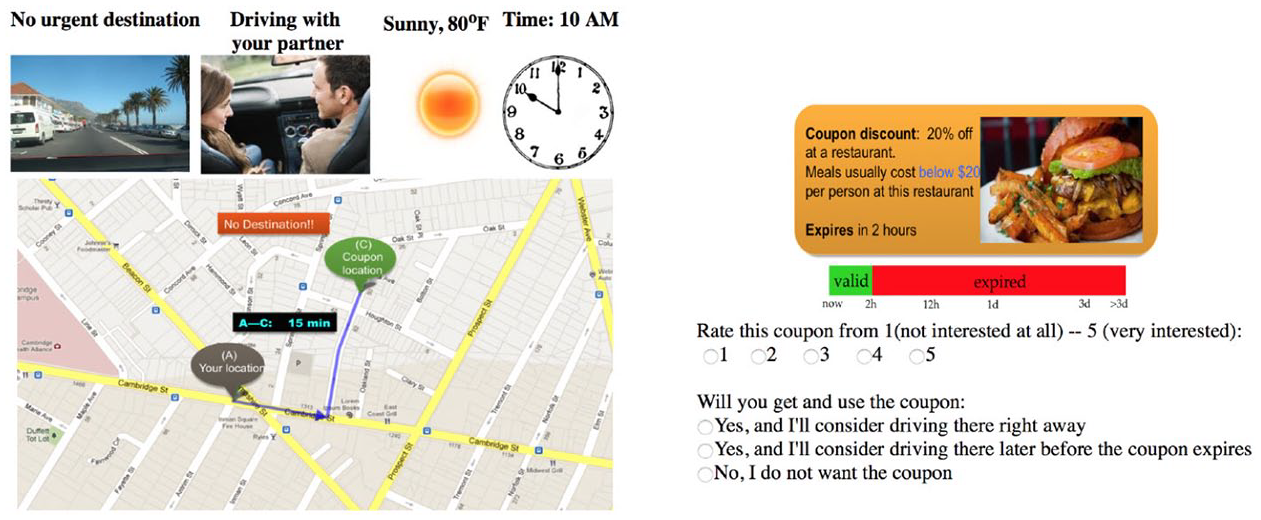
Example of Coupons in an In-Vehicle Scenario
Table 1 shows the distribution of the responses in all in-vehicle scenarios, characterized by a total of 18 attributes in the aforementioned five categories. The 18 attributes delineate the situational factors which, as we hypothesized, may affect consumers’ redemption of coupons. This treatment was in accordance with Belk’s (1974, p. 157) definition of situational factors, which include “all those factors particular to a time and place of observation which do not follow from a knowledge of personal (intra-individual) and stimulus (choice alternative) attributes, and which have a demonstrable and systematic effect on current behavior.” As articulated further by Belk (1975), situational factors are neither personal attributes, such as personality, intellect, gender, and race, which are general and stable, nor product features, such as brand image, quality, size, and function, which can generate utility to consumers. This treatment was also in line with the role that context plays in influencing the decision-making process rather than directly altering the choice set and budget constraint (Ben-Akiva et al., 2012; Thomadsen et al., 2018).
Situational Factors of In-Vehicle Scenarios.
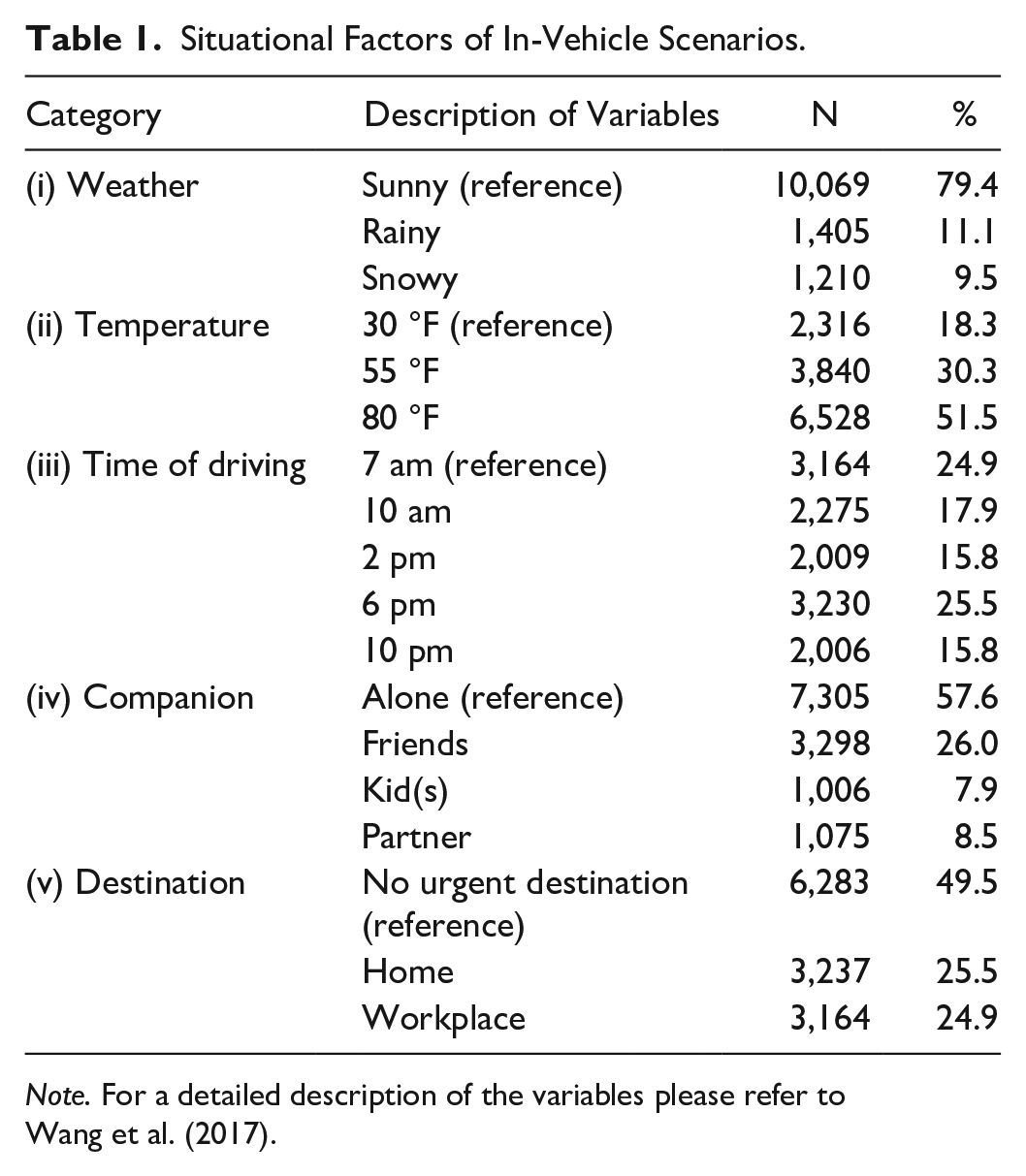
Note. For a detailed description of the variables please refer to Wang et al. (2017).
The problem in this survey was formulated as follows. The survey required respondents to imagine themselves being in the in-vehicle scenario when receiving a coupon via their smartphone. Respondents were then required to state their choice regarding the coupon. 2 To answer “Will you get and use the coupon?” respondents were presented with a choice of three options: (a) “Yes, and I’ll consider driving there right away,” (b) “Yes, and I’ll consider driving there later before the coupon expires,” and (c) “No, I do not want the coupon.” Note that in the data set Wang et al. (2017) coded “1” to indicate respondents’ acceptance of a coupon, namely choosing either (a) or (b), and “0” to indicate a rejection, namely choosing (c). Hence, the original choice set was binary. In addition, the survey collected respondents’ sociodemographic information and consumption experience with the five businesses as well as coupon attributes. Table 2 shows the key socio-demographic data of the respondents.
Respondents’ Sociodemographic Data.
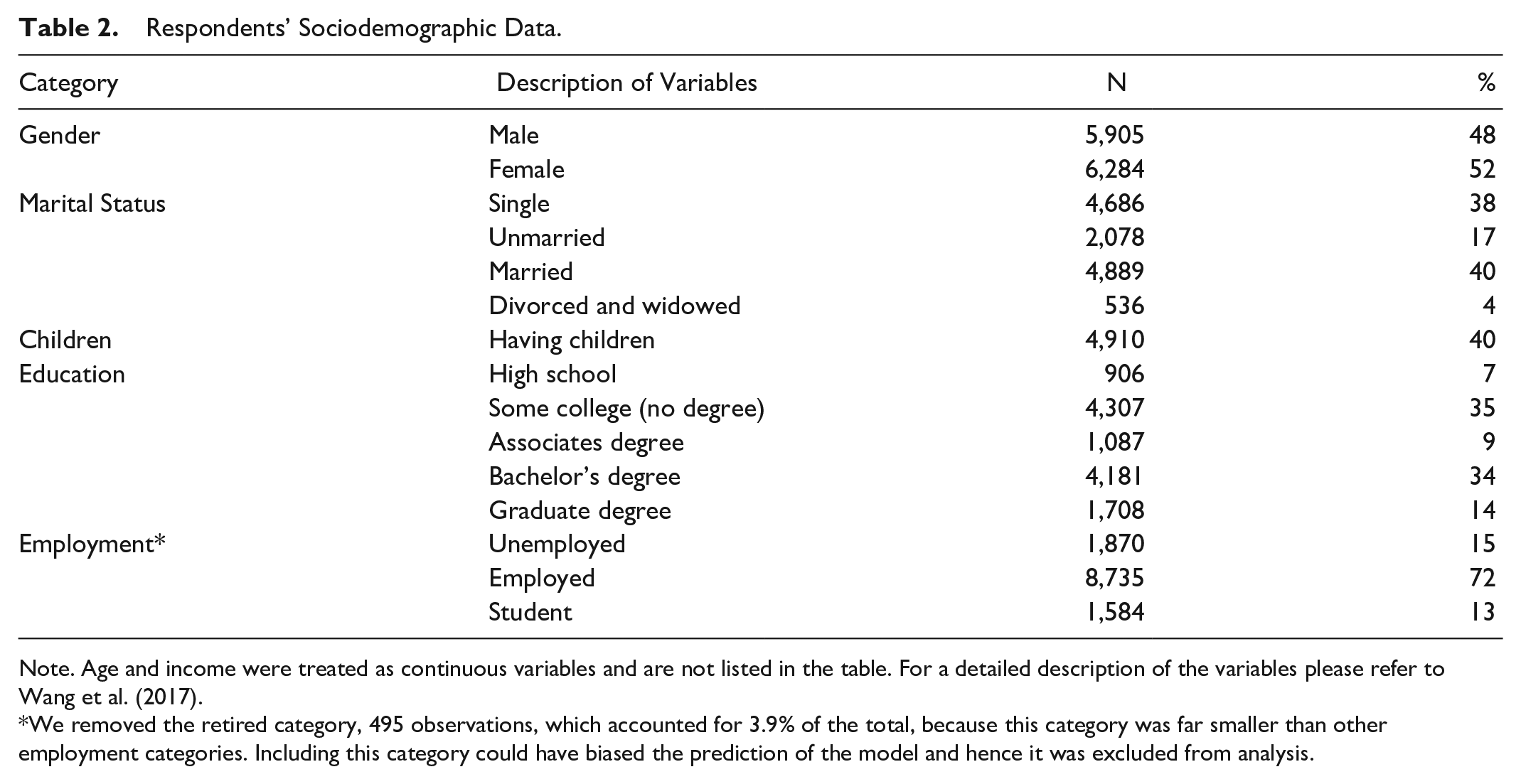
Note. Age and income were treated as continuous variables and are not listed in the table. For a detailed description of the variables please refer to Wang et al. (2017).
We removed the retired category, 495 observations, which accounted for 3.9% of the total, because this category was far smaller than other employment categories. Including this category could have biased the prediction of the model and hence it was excluded from analysis.
Methods and Models
Choice Sets and Decision Rules
We aimed to estimate the probability of consumers’ choice of coupons being affected by the situational factors outlined in Table 1. Since in the original dataset respondents were shown each of the five types of coupons randomly, their choice of whether to accept a coupon or not was independent of coupon types. The original choice set was binary for each type of coupons, denoted by
There are two interpretations of the behavioral mechanisms of coupon choice based on the multinomial choice set
Models
We applied discrete choice methods to estimate consumers’ choice of coupon. To model discrete choice, we first specified the utility of each alternative in the choice set for a representative decision-maker in the data set as:

where

where
We started with the binary choice model as a benchmark, using the binary choice set

where
The binary logit model in (3) can conveniently be extended to the case of the multinomial choice set

From (4), it is evident that the binary logit model is a special case of the multinomial logit model. As the size of the multinomial choice set reduces to two (i.e., binary), the multinomial logit model in (4) is reduced to the binary logit model in (3).
To examine the effect of the structure of the five alternatives, we partitioned the choice set
Since the structure or membership of the five alternatives was unobservable to the researcher, the error terms in their utilities were assumed to contain the unobserved common membership, and hence the error terms associated with each alternative in (1) were no longer independent. In the model, the probability of the decision-maker choosing alternative

where
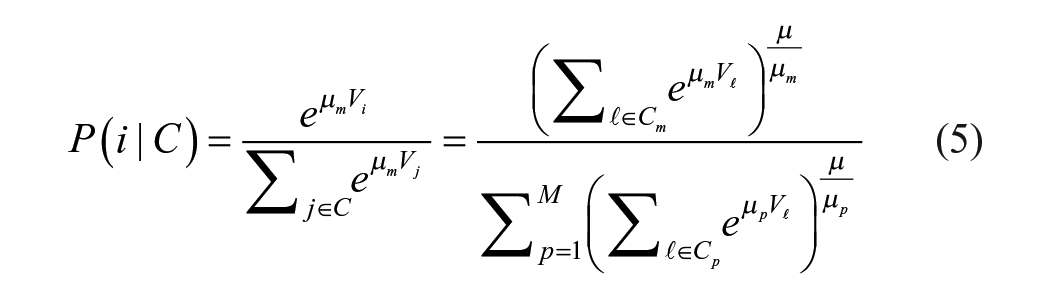
where
Note that the nested logit model is characterized by two key parameters that capture the effects of both the nest structure (µ) and nest-specific alternatives (µm for
Results and Discussion
Results of the Binary Logit Model
Table 3 shows the results of the binary logit models for the five businesses. In general, consumers’ sociodemographic characteristics have limited power in explaining their acceptance of coupons in all five businesses. In particular, for coupons provided by expensive restaurants (b) and bars (d), consumers’ sociodemographic characteristics have no or very little impact on their acceptance of coupons. For coupons provided by cheap restaurants (a), consumers’ age, occupation, and income are statistically significant in affecting their acceptance of coupons. For coupons provided by coffee houses (c), consumers’ marital status is statistically significant. For coupons of takeaways (e), consumers’ age, marital status, and education levels are statistically significant. We found that consumer experience with coffee houses (c) has positive effects on coupon acceptance, but the effects of consumer experience with the other four businesses are not significant. This is perhaps because coupons provided by coffee houses are ubiquitous in the marketplace, and hence consumers are accustomed to taking advantage of coupons when patronizing coffee houses. As for coupon attributes, we found that distance has statistically negative impacts on coupon acceptance for all five businesses. Of the five categories of situational factors, weather conditions and temperature have significant effects on consumers’ acceptance of coupons in cheap restaurants, but not in the other four businesses.
Results of the Binary Logit Model.
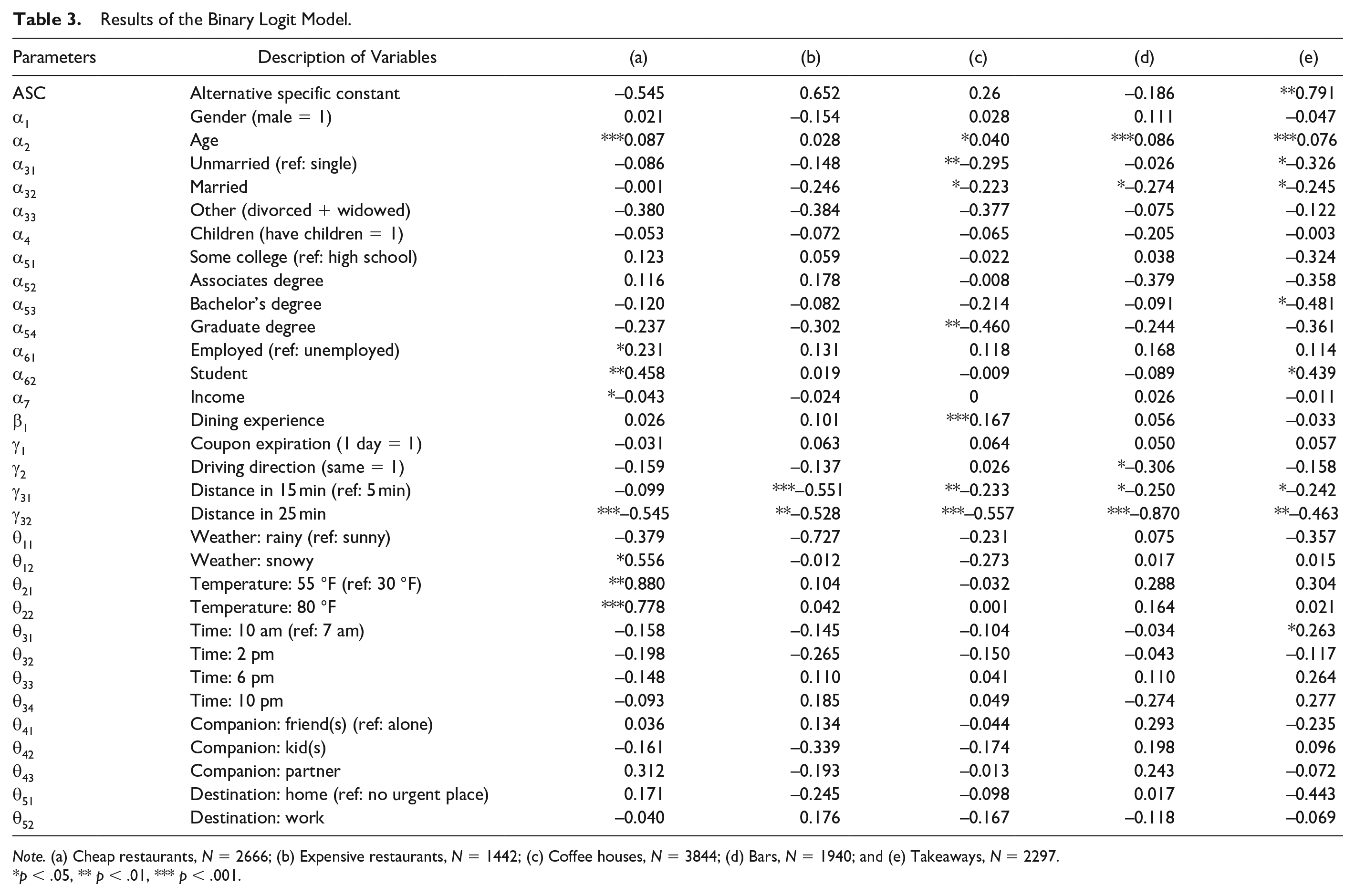
Note. (a) Cheap restaurants, N = 2666; (b) Expensive restaurants, N = 1442; (c) Coffee houses, N = 3844; (d) Bars, N = 1940; and (e) Takeaways, N = 2297.
p < .05, ** p < .01, *** p < .001.
Results of the Multinomial Logit Model
As shown in Table 3, the binary logit model does not provide sufficient evidence for the impact of situational factors on coupon acceptance. This is perhaps because situational factors might interact with coupon types to determine whether or not consumers would prefer a particular type of coupon instead of simply accepting or rejecting a coupon regardless of type. This interaction is accounted for by the constructed multinomial choice set with five alternatives corresponding to the acceptance of coupons in each of the five businesses.
To further test the effects of situational factors on coupon acceptance, we used hierarchical regression and analyzed the four blocks of independent variables in sequence in the model. Table 4 shows the results of the four specifications of the multinomial logit model. Similar to the results of the binary logit model, sociodemographic variables, other than marital status and education, had little or no impact on consumers’ acceptance of coupons in all five businesses. Consumer experience with the five types of businesses is not statistically significant. Unlike the results of the binary logit model, we found that coupon expiration turns out to be statistically significant and negative, suggesting that the likelihood of accepting coupons increases as the expiration period becomes shorter. This result is consistent with the findings of Danaher et al. (2015), which suggest that consumers experience a sense of time urgency with mobile coupons, so a shorter expiration period can increase redemption rates.
Results of the Multinomial Logit Model.
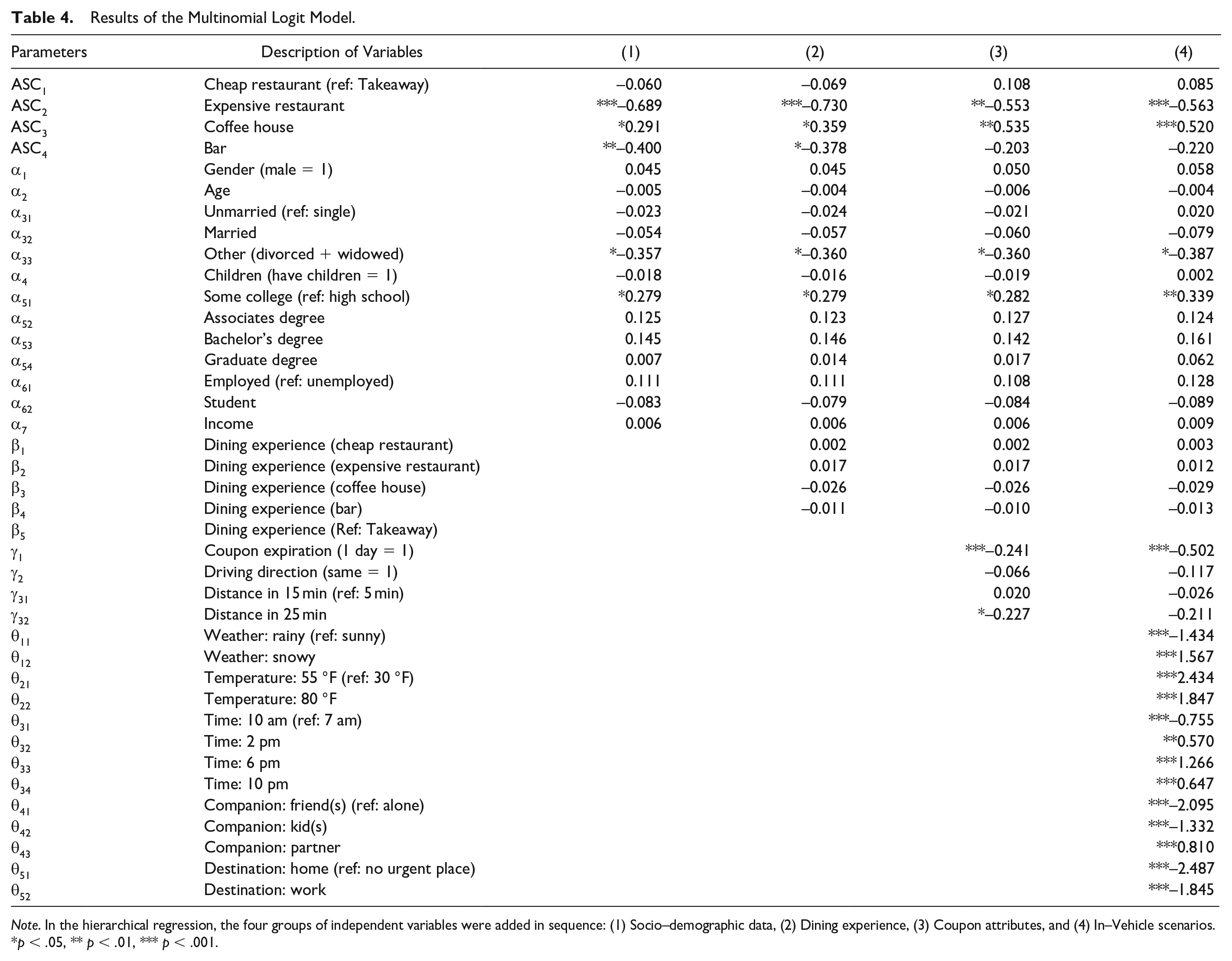
Note. In the hierarchical regression, the four groups of independent variables were added in sequence: (1) Socio–demographic data, (2) Dining experience, (3) Coupon attributes, and (4) In–Vehicle scenarios.
p < .05, ** p < .01, *** p < .001.
Table 4 shows that all situational factors (θ’s) become statistically significant. Consumers are less likely to accept coupons on rainy days, but are more likely to accept them on snowy days when compared to sunny days. Consumers are more likely to accept coupons when driving in high temperatures (55 °F and 80 °F) compared to low temperatures (30 °F). With regard to the timing of coupon distribution (10 am, 2 pm, 6 pm, and 10 pm), consumers are more likely to accept coupons in the afternoon (at or after 2 pm) than in the morning. When driving with companions (i.e., friends, kids, partner), consumers are unanimously less likely to accept coupons, but more likely to accept coupons when driving with partners. Consumers are less likely to accept coupons when they have specific destinations, such as home or the workplace, compared to when they have no urgent destinations.
Results of the Nested Logit Model
We hypothesized two structures for the multinomial choice set based on the sectors to which the five businesses belong and the nature of consumption activity, respectively. In the first structure, we distinguished between food ([a] Cheap restaurants, [b] Expensive restaurants, and [e] Takeaways) and beverage ([c] Coffee houses and [d] Bars) to create two nests. In the second structure we distinguished between dining ([a] Cheap restaurants and [b] Expensive restaurants), drinking ([c] Coffee houses and [d] Bars), and takeaway ([e] Takeaways) to create three nests. Table 5 shows the results of the two specifications of the nested logit model. We did not find the effects of the two nest structures on consumers’ acceptance of the five types of coupons. This result suggests that consumers may not take into account the sectors of businesses or the nature of their consumption activity before deciding whether to accept a coupon or not. It is worth noting that in the nest specification of food and beverage, all situational factors turn out to be statistically insignificant. In the nest specification of dining, drinking, and takeaway, all situational factors are statistically significant and have the same signs as those in the multinomial logit model. Since the nest structure is not significant, this nested logit model cannot be distinguished from the multinomial model.
Results of the Nested Logit Model.
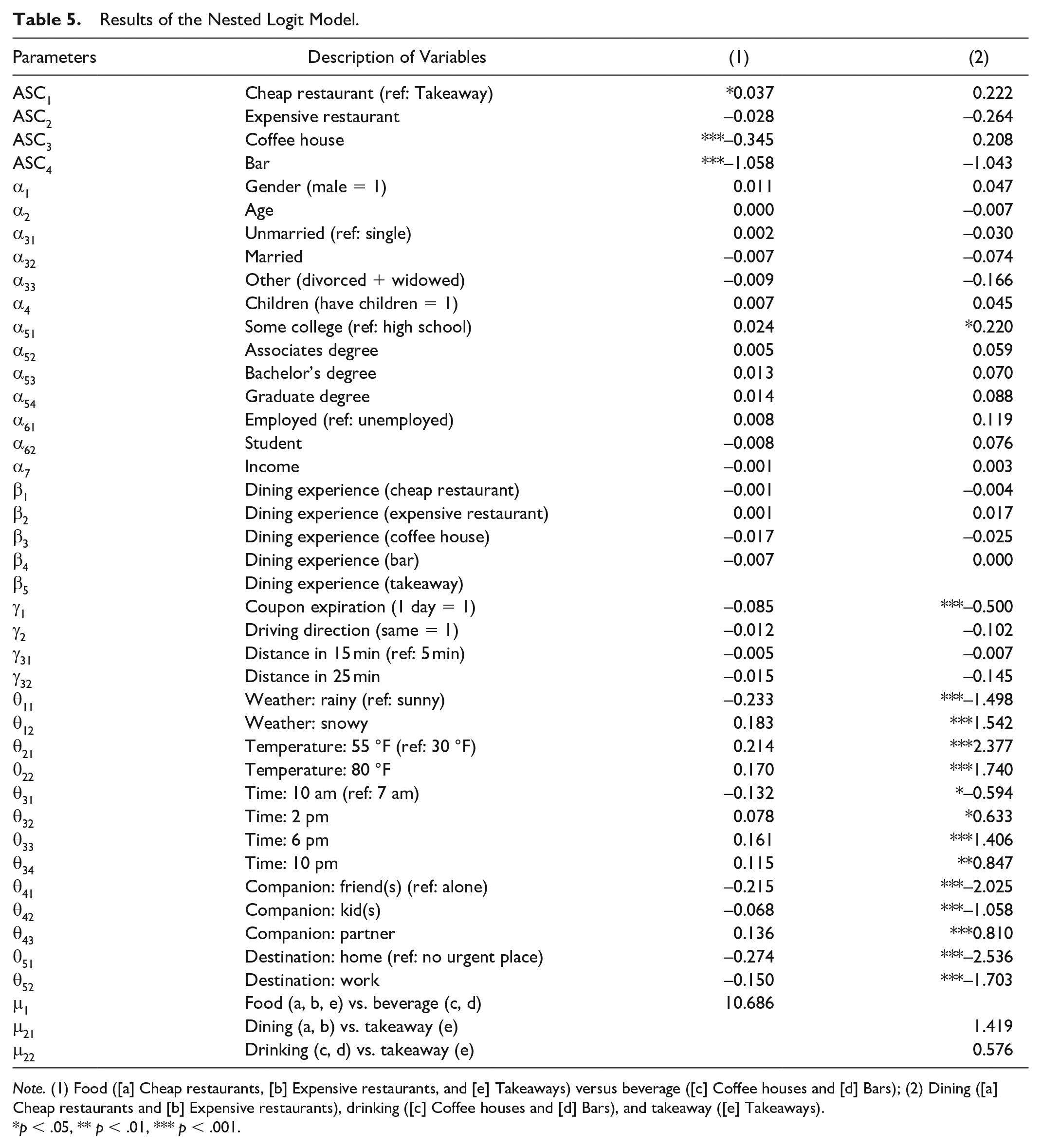
Note. (1) Food ([a] Cheap restaurants, [b] Expensive restaurants, and [e] Takeaways) versus beverage ([c] Coffee houses and [d] Bars); (2) Dining ([a] Cheap restaurants and [b] Expensive restaurants), drinking ([c] Coffee houses and [d] Bars), and takeaway ([e] Takeaways).
p < .05, ** p < .01, *** p < .001.
Likelihood Ratio Tests
To assess whether the four groups of independent variables—particularly those situational variables measuring in-vehicle scenarios—improve the model fit, we conducted a series of likelihood ratio tests. We estimated four restricted models by setting the coefficients of each of the four groups to zero and then compared them with the full models in which all coefficients are free parameters. Table 6 shows the likelihood ratio values of the five binary logit models. We found that the inclusion of coupon attributes (γ’s) in the model significantly increases the model fit of all five models. In addition, sociodemographic factors (α’s) increase the model fit of four models except for expensive restaurants (b). Dining experience (β’s) and in-vehicle scenarios (θ’s) only increase the model fit of one model, with regard to coffee houses (c) and cheap restaurants (a), respectively.
Likelihood Ratio Test (Binary Logit).
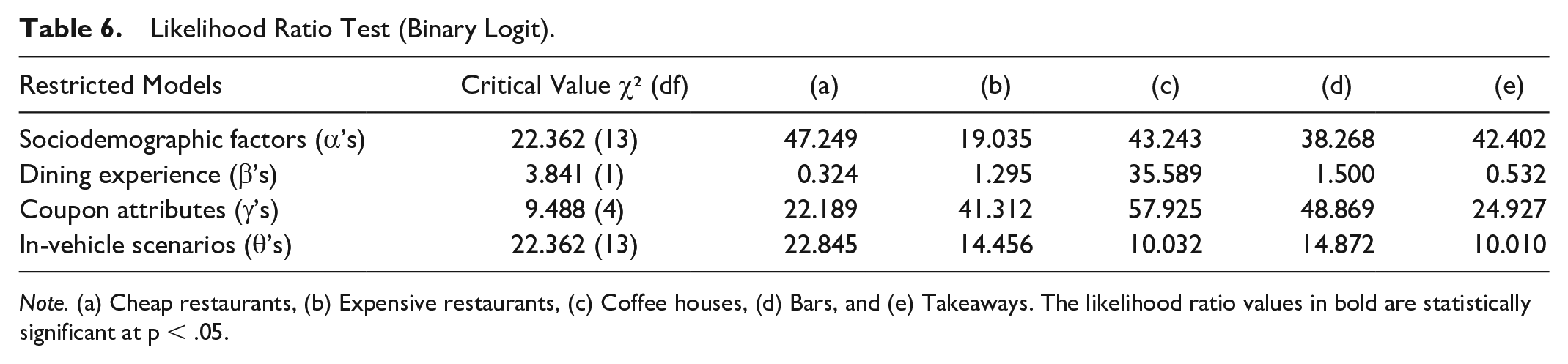
Note. (a) Cheap restaurants, (b) Expensive restaurants, (c) Coffee houses, (d) Bars, and (e) Takeaways. The likelihood ratio values in bold are statistically significant at p < .05.
Table 7 shows the likelihood ratio values of the multinomial and nested logit models. We found that coupon attributes (γ’s) and in-vehicle scenarios (θ’s) are the only two groups of variables that significantly increase model fit. This result not only confirms our hypothesis that in-vehicle scenarios play a key role in predicting consumers’ coupon acceptance but also aligns with previous studies on the effects of coupon attributes on coupon redemption (e.g., Bawa et al., 1997; Chakraborty & Cole, 1991; Inman & McAlister, 1994; Mills & Zamudio, 2018). We also found that sociodemographic factors (α’s) and dining experience (β’s) do not increase model fit. This result lends support to previous studies which found that sociodemographic factors have little power in explaining coupon redemption (e.g., Mittal, 1994; Ramaswamy & Srinivasan, 1998).
Likelihood Ratio Test (Multinomial and Nested Logit).
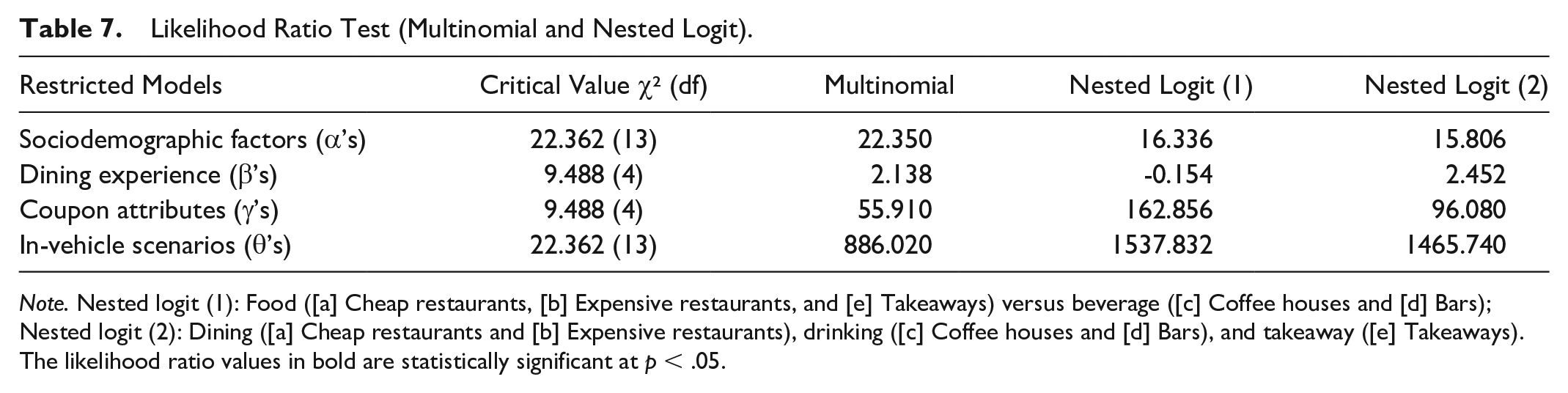
Note. Nested logit (1): Food ([a] Cheap restaurants, [b] Expensive restaurants, and [e] Takeaways) versus beverage ([c] Coffee houses and [d] Bars); Nested logit (2): Dining ([a] Cheap restaurants and [b] Expensive restaurants), drinking ([c] Coffee houses and [d] Bars), and takeaway ([e] Takeaways). The likelihood ratio values in bold are statistically significant at p < .05.
Conclusion
Theoretical Implications
We adopted a discrete choice modeling approach to examine the determinants of coupon redemption in a multitude of in-vehicle scenarios. We found that almost all situational factors, ranging from weather and temperature to time of driving and driving companions, have significant effects on the likelihood of coupon redemption. Consumers who accept or reject coupons show categorically clear behavioral patterns, which are not explained by their sociodemographic characteristics but by various scenarios in which they receive coupons. Note that these situational effects exist only when in-vehicle scenarios interact with type of coupon, as shown in the multinomial model. In other words, coupon redemption may not be sensitive to situational factors if a general coupon, which can be used for various consumption purposes, is distributed. The behavioral implications are: when making decisions in certain scenarios, consumers tend to make their choice as specific as possible, thereby resulting in immediate actions. On the other hand, almost all situational factors about in-vehicle scenarios affect consumers’ coupon redemption in relation to dining, drinking, and takeaway. This result suggests that consumers make reference to their specific consumption behavior when deciding to redeem coupons and hence take into account the functionality of consumption in coupon redemption in addition to the type of coupon.
In standard economic models these situational factors are regarded as part of supposedly irrelevant factors (see Thaler, 2016) and hence are discarded in choice modeling. This study has shown that not only are situational factors relevant, but they, along with other dimensions of human behavior, can also increase behavioral richness of choice models. Due to the experiential nature of services, consumer decision in hospitality and tourism is arguably more context-dependent than in other general consumption situations, such as daily grocery shopping. Therefore, situational factors that may be trivial in determining general consumer choice could be augmented in the consumption of hospitality and tourism. However, we should not overplay the effect of situational factors or the context. Not only are situations and contexts transitory and specific, but we also need to use a large number of these variables in order to predict decisions with reasonable accuracy. Also, because situational factors are specific, the applicability of certain situations to other purchase or consumption scenarios is limited. This is one of the reasons why machine learning algorithms in this regard could outperform conventional econometric modeling approaches.
Practical Implications
To make coupons an effective promotion tool to achieve firms’ marketing goals, it is crucial to understand not only whether consumers redeem coupons, but also the specific context or scenario in which their decisions are made. Such decision-making seems straightforward if we only consider the benefits and costs associated with coupon redemption. Decision-making in consuming tourism and hospitality goods and services can be subtle and complicated, because many contexts and scenarios in which coupons are distributed can obscure consumers’ ability to make rational decisions. Therefore, not only should firms decide the type, face value, and expiration length of a coupon, but they also need to take into account the context and scenario in which the coupon is distributed. Since a consumer’s decision of whether or not to accept a coupon involves little reasoning and cognitive effort, these contextual factors may largely determine whether the coupon will eventually be accepted and redeemed.
In this regard, mobile coupons provide tremendous opportunities for firms to tailor coupons based on the interactions between coupon attributes, consumers’ personal characteristics, and situational factors. In business practice, firms can develop a set of key coupon portfolios in advance to stipulate a wide range of face values, or discounts, that are aligned with sales objectives, along with other key attributes of coupons, such as expiration length and condition of use. Depending on where, when, and to whom a coupon is distributed, firms can therefore generate and distribute the final coupon via a consumer’s mobile device, with the face value that matches the consumer’s willingness to pay in a particular scenario. In this regard, the insignificance of consumers’ sociodemographic characteristics in many studies could be attributed to the failure of conventional coupons to target the right consumers. This dynamic coupon distribution strategy, as we proposed, is not only cost efficient for firms but can also increase coupon redemption. By leveraging the influence of situational factors, firms can nudge consumers toward accepting a particular coupon with a particular discount in a particular scenario.
Limitations
This study has several limitations. First, even though the multinomial choice model highlighted the importance of situational factors in explaining coupon redemption, the choice set was constructed from five separate binary choice sets. For future research, it is necessary and preferable for researchers to collect data by presenting respondents with an actual five-alternative choice set. Second, we did not model any explicit mechanism of situational factors that affect consumers’ coupon redemption behavior. Contextual or situational factors are highly specific and diverse and hence cannot be systematically incorporated into stylized economic models. Third, we should not exaggerate the results of this study to claim that standard models are of little use in explaining coupon redemption. The value of standard models lies in their generality and tractability, while our study is context-specific in the sense that the in-vehicle scenario is one of many scenarios or contexts one can explore. When facing a different choice problem, we need to reconsider the context or scenario. To aid business strategies though, specific contexts or scenarios are more useful than generic behavioral principles prescribed by standard models. Fourth, the validity of our analysis could be compromised by the fact that many variables are categorical and dummy variables, as the data set was originally designed for machine learning rather than econometric modeling. As a result, the analysis was affected by multicollinearity, which would have weakened the statistical significance of the independent variables in the model.
Finally, it is worth noting that the Covid-19 pandemic has had a substantial and unprecedented impact on both society and individuals. The impact may have led to profound behavioral changes in the consumption of hospitality goods and services, including coupon redemption. Mobile coupons were likely more favored during the pandemic because they are contactless. Also, in-vehicle scenarios were arguably more common during the pandemic for purchasing and receiving hospitality goods and services, as dine-in options were largely limited or unavailable due to widespread lockdowns. Despite the importance of these factors, the data set, which was collected in 2015, does not capture such information. Hence, behavioral changes that could be attributed to these factors remain unexplored in this study. Future research should take the effect of the Covid-19 pandemic into account to better understand coupon redemption during and after the pandemic.
Footnotes
Declaration of Conflicting Interests
The authors declared no potential conflicts of interest with respect to the research, authorship, and/or publication of this article.
Funding
The authors received no financial support for the research, authorship, and/or publication of this article.
