




Abstract
The paper addresses how individual rankings of destinations change between non-crisis and crisis conditions, and across different types of crises under conditions of bounded rationality in the face of shifting risks and uncertainties. The impacts of three types of potential crises—heatwaves, epidemics, and terrorism—are analyzed using novel multi-perspective experimental methods linked to a five-country international survey of risk attitudes and knowledge. Destination preferences, including strong persistence during crises, are explained by how the influence of tacit and codified knowledge is shaped by the familiarity heuristic and recency bias. Individual responses are also moderated by tolerance of and competence to manage risks. The findings have implications for destination management and marketing.
Highlights
The paper addresses how destination rankings change across (non-)crisis conditions.
Experimental methods are linked to an international survey of risk attitudes.
Persistence of destination preference is explained by tacit and codified knowledge.
Individual responses are moderated by tolerance of risks and competence to manage risks.
Introduction
Tourism destinations are sensitive and vulnerable to different types of crises, including economic crises, terrorist attacks, natural disasters, wars, political conflicts, and a range of health crises. There has been growing interest in how crises impact tourist intentions and behavior (Duan et al., 2022; Ritchie & Jiang, 2019). However, research has mostly been fragmented, focusing on a single crisis and a single country, and sometimes on a highly specific tourist group (Karl, 2018), or on responses to generalized crisis conditions rather than to specific crises and destinations (Sönmez & Graefe, 1998). Consequently, there have been calls for comparative studies of the impacts of crises on multiple destinations (Fuchs et al., 2024; Ritchie & Jiang, 2019). In response to these research gaps, the paper examines how different types of crises—in contrast to a non-crisis condition—impact individuals’ rankings of destinations, a key dimension of tourist decision-making (Saito & Strehlau, 2018), in five countries. These are substantial and pressing academic and practical issues.
Responding to the lack of strong conceptual foundations identified by Ritchie and Jiang (2019) in the tourism crisis literature, we focus on how tourists make decisions under conditions of risk and uncertainty in the context of information overload and incomplete information (Stiglitz, 2000; Williams & Baláž, 2015). This poses both theoretical and methodological challenges. In terms of theory, we bring together perspectives from both behavioral economics (heuristics; Tversky & Kahneman, 1974) and economic psychology (risk attitudes) to analyze decision-making. Destination rankings are informed by tourists’ previous knowledge of destinations (where they deploy the familiarity heuristic; Gursoy & McCleary, 2004) and, when faced with new information, the recency bias (Jeng & Fesenmaier, 2002). These heuristics provide the keys to destination preference persistence. In addition, we analyze the role of risk attitudes (both general and context-specific tolerance of, and perceived competence to manage, risk; Williams et al., 2022).
In terms of methodology, the lack of comparative research on this important topic partly reflects the reliance of most extant research on survey data relating to particular crises. There are significant limits to the extent to which traditional survey data allow researchers to control for the influence of factors other than knowledge and risk considerations on decision-making when examining crises that occur in different time periods and places (Karl, 2018). This paper, therefore, innovatively uses a series of multi-perspective experimental methods to analyze differences in tourist destination rankings in different source countries. It adopts within-subject choice experiments based on tourists’ trade-offs between the attribute levels in destination rankings under non-crisis and different potential crisis conditions. The experiments are linked to a separate survey that provides a detailed deconstruction of the participants’ tolerance of and competence to manage risks.
In summary, this research has three main objectives:
(1) to examine how knowledge influences destination-ranking decisions in crisis and non-crisis conditions;
(2) to examine how risk attitudes influence destination-ranking decisions in different types of crisis conditions; and
(3) to assess the extent to which tourists’ rankings of tourism destinations are persistent in the face of different types of crises compared to non-crisis conditions.
Literature Review
Theoretical Perspectives
The tourism literature tends to understand tourist decision-making as “rational, logical, and involving complex reasoning that is both abstract and affect-free” (McCabe et al., 2016, p. 3). General models of tourist consumer behavior, such as utility maximization and/or the planned behavior approach, assume that tourists perform exhaustive information searches and, consequently, engage in comprehensive cognitive processing to identify the optimum destination alternative. In the substantial literature on tourist decision-making in relation to evaluating and selecting destinations (Kock et al., 2016), much of the research is underpinned by the founding work by Lancaster (1971) on the characteristics-based theory of consumer choice, and is based on a rational, cognitive processing of information. Bounded reality makes these assumptions questionable because, as Kahneman (2003, p. 1449) explains, there are “systematic biases that separate the beliefs that people have and the choices they make from the optimal beliefs and choices assumed in rational-agent models.” Moreover, decisions are made under conditions of radical uncertainty (Johnson et al., 2023). While one of the sources of this is the finite nature of mental processing, aleatory uncertainty is also important—that is, external conditions in the world around us (Kay & King, 2020), notably non-stationary processes, and the unpredictability of human agency.
Over time, in recognition of how knowledge is processed under conditions of bounded reality (Kahneman, 2003), there has been a shift in tourism research from cognitive studies to “fast, intuitive, affect-driven” decision-making and the heuristics involved in evaluating destinations (Papatheodorou, 2001) under conditions of information overload or incomplete information (Lee & Lee, 2004), rather than extensive information processing. This is especially so in times of tourism crises, such as terrorist attacks or outbreaks of infectious diseases. At such times, individual decision-making is likely to benefit from fast and frugal decision rules (heuristics and mental shortcuts) rather than complex evaluation strategies (Gigerenzer, 2001). The present study focuses on familiarity heuristics and recency bias, which are discussed in the following sections. This is combined with an analysis of the role of individuals’ risk attitudes in decision-making in conditions of bounded rationality.
We first position destination ranking within the broader literature on tourist decision-making and discuss perceived destination image, which is recognized as a key influence on rankings. As destination image has been extensively researched, this serves as a departure point for examining the two main inter-related theoretical foci of the paper: the role of knowledge (subject to familiarity and recency biases) and risk attitudes under conditions of bounded rationality. Taken together, these provide a novel theoretical framework for analyzing not only how individuals respond to crises but also how preference persists across business-as-usual and different crisis situations.
Tourist Decision-Making and Destination Assessment
There are many different conceptualizations of decision-making, but a common theoretical foundation for destination decisions is provided by the consumer purchase decision process model: problem recognition → information research → alternative evaluation → purchase decision → post-purchase behavior (Kerin et al., 2011). Once an individual has a tentative plan to travel in a specific time, whether in a non-crisis or a crisis situation, they may first identify a choice set of potential destinations (problem recognition) and draw on both existing and newly acquired knowledge in order to assess and rank the potential destination set (alternative evaluation) before a destination is finally chosen (purchase decision). This model frames the central concern of this study which is the alternative evaluation stage: that is, the assessment and ranking of destinations.
Destination image is the most frequently studied aspect of the pull factors of destinations (Prayag & Ryan, 2011), and it is a multifaceted, formative, and composite construct (Afshardoost & Eshaghi, 2020). Image is defined as “an individual’s diverse cognitive and affective associations relating to a destination” (Kock et al., 2016, p. 32) with sensory and structural properties. The overall image constitutes a holistic impression, a “sum of beliefs, ideas, and impressions a person has of a destination” (Stylidis et al., 2017, p. 185), and it has cognitive and affective components (Michael et al.). There is a consensus in the extensive research on destination image that it positively affects tourists’ destination choices and intentions to visit (Afshardoost & Eshaghi, 2020; Stylidis et al., 2017), as well as destination loyalty (Chi & Qu, 2008). Image is generally regarded as the key consideration and has been extensively researched. Therefore, while it is included in our analysis, this paper focuses on the role of knowledge and risk attitudes in destination assessment and ranking.
Destination Knowledge and Tourist Decisions
Any travel includes a range of potential risks. However, safety and security are usually considered among the most important concerns in international tourism (Reisinger & Mavondo, 2005). Unsurprisingly, therefore, major risk events, such as terrorist attacks, natural disasters, and infectious diseases, loom large when tourists make decisions that are framed by a heightened awareness of risk. Faced with various risks associated with travel to an unfamiliar environment—especially an international destination—tourists rely on their prior knowledge about the destination, or seek new knowledge through information searches to assist their decision.
The categorization of knowledge can be approached in terms of the difference between codified and tacit knowledge (Polanyi, 1966). Codified knowledge comes from a range of sources, including both paper and, increasingly, digital formats (Mills & Law, 2013). Tacit knowledge is effectively personal knowledge—the sum of what is known about a destination (Pike & Ryan, 2004)—and the most important source is previous experience acquired via personal visits to a destination (Sharifpour et al., 2014). Knowledge, both tacit and codified, reduces risk and uncertainty when making decisions (Gursoy & McCleary, 2004; Sharifpour et al., 2014; Wong & Yeh, 2009), informing destination decision-making, including destination evaluation and ranking or choice. Previous visits to a destination, as a source of tacit knowledge, contribute to destination image formation (Wong & Yeh, 2009). Tourists with extensive experience in travel (Gursoy & McCleary, 2004; Karl et al., 2020), or who have previously visited a destination (Sönmez & Graefe, 1998), are also less likely to be deterred by risks and uncertainty.
The familiarity heuristic is key to how tacit knowledge from previous visits is applied in decision-making in complex environments such as destination decision-making (Gursoy & McCleary, 2004). Both cognitive perception and affective evaluation enhance familiarity with the destination (Artigas et al., 2015). Familiar places, in turn, are easier to recall (availability) and are perceived as less risky and more enjoyable, making them more likely to be chosen again due to the cognitive ease associated with familiarity (Karl, 2018, p. 137). Destination familiarity can also enhance affective perceptions and increase the likelihood of visiting a destination (Milman & Pizam, 1995). When considering alternative destinations, previous visits provide a benchmark for comparison. Destinations previously visited may seem more appealing or safer compared to the unknown new destination.
Knowledge, especially tacit knowledge in the form of destination familiarity, has a significant effect on the relationship between the destination image and the intention to visit. Therefore, the following hypothesis is proposed:
H1: An individual’s past knowledge of a destination significantly affects destination decision-making (i.e., destination ranking) in the business-as-usual condition.
Tourism Crises and Risk Attitudes
Knowledge is undoubtedly important when individual tourists make decisions about destinations when they have imperfect information (Stiglitz, 2000), and in conditions where risk tolerance and competence to manage risk are important. Tourist decision-making is always informed by risk considerations, but crises represent significant changes in the external environment within which these decisions are made (Ritchie & Jiang, 2019), specifically in destination choice (Karl et al., 2020). New information becomes available, and is likely to loom larger than existing knowledge because it is recent, and recency bias (Jeng & Fesenmaier, 2002) is a component of the availability heuristic (Tversky & Kahneman, 1973). This is especially true of significant negative information because, as prospect theory suggests, potential losses loom much larger than potential gains to individuals—“loss aversion” (Lin et al., 2024). The roles of risk are potentially heightened in tourism because the characteristics of the sector make it highly vulnerable to crises (Ritchie & Jiang, 2019).
Although the general impacts of crises on tourist decisions have been recognized, individual tourists behave differently in such situations, and their risk attitudes play a moderating role, as illustrated by the COVID-19 pandemic (Williams et al., 2022). Research in this field indicates the existence of a “general risk trait” and domain-specific risk attitudes. The general trait is a disposition to take risks across multiple life domains, such as gambling, risky sports, or investing in risky financial assets (e.g., Sahm, 2012). There is also a distinctive tourism domain of risk stemming from the intangibility of tourism experiences and advance purchasing, often over lengthy time spans (Boksberger et al., 2006), as well as the “displacement” effects of consuming tourism experiences in “other places” about which tourists have limited tacit knowledge compared to their usual place of residence (Williams & Baláž, 2015). Both general attitudes towards risk and the risks associated with specific places and situations impact whether individuals are deterred from visiting destinations.
The challenges posed by risks associated with a crisis situation can, to some extent, be moderated by perceived competence to manage these. The acquisition of knowledge about potential destinations is key to enhancing competence (Williams & Baláž, 2015), so that perceived competence strongly reflects previous experience (Tversky & Kahneman, 1974). This helps explain why, during a crisis, some individual tourists are more persistent and less likely to change their travel plans than others (Karl et al., 2020). In short, risk attitudes include an individual’s tolerance of, and competence to manage, general risks and travel risks. The following hypothesis is thus examined:
H2: An individual’s risk attitudes significantly moderate the impact of a crisis intervention on destination ranking.
Preference Persistence
Preference persistence has been studied in tourism, but mostly in non-crisis settings, although it has been verified in the context of tourism demand, often based on time-series econometric analyses of general temporal consistency (e.g., Song et al., 2008). However, there is little substantial research on individual preference persistence in tourism in the context of bounded rationality and risk attitudes or risk perceptions. Hajibaba et al. (2015, p. 49) have addressed one aspect of this: the extent to which tourists demonstrate different degrees of resilience to crises, identifying market segments, including whether there are “crisis-resistant tourists” who exhibit “stable behaviors across all forms of crises.” Conceptually, Hajibaba et al. (2015) focus on how the propensity to take risks (Rohrmann, 2008)—both in different domains and generally—has previously influenced individuals’ risk behavior in relation to different types of internal and external crises. A major limitation of this approach is that the different situational factors influencing past behavioral decisions at different times in different decision-making environments cannot be controlled for, even though they may be highly significant. The present study aims to bridge the above gaps.
Our starting point is that when consumers face choices of products with multiple attributes, they may not be able to judge exactly the importance of each attribute, what integration rule to adopt when assessing alternatives, or how to make trade-offs among these (Häubl & Murray, 2003). As such, an anchor-and-adjustment process of decision-making tends to be implemented (Muthukrishnan & Kardes, 2001). The initial impression or preference acts as an anchor, and new information (e.g., new alternatives or changes of original attributes) does not necessarily lead individuals to adjust their initial position. Instead, they tend to hold onto their initial beliefs even though the evidence supporting these has been questioned, discredited, or negated (Muthukrishnan & Kardes, 2001). Preference persistence can also be explained by other mechanisms such as confirmation bias (Nickerson, 1988), regret avoidance (Bell, 1982), and sunk costs (Thaler, 1980). However, here we consider two aspects of the availability heuristic: familiarity and recency. On the one hand, the recency of new information about a crisis exerts a substantial influence on decision-making. However, risk-averse tourists are also drawn to the familiarity of well-known destinations (Karl et al., 2020). The interplay between these shapes the extent to which there are likely to be persistent destination preferences. Based on the business-as-usual preference equating to familiarity, the following hypothesis is examined:
H3: An individual’s destination ranking in the business-as-usual condition can predict the destination ranking in crisis conditions, revealing destination preference persistence.
In addition, preferences under crisis conditions are likely influenced by individuals’ risk attitudes (Hajibaba et al., 2015; Williams et al., 2022).
Types of Crises
There has been increasing research into the impacts of crises on both demand and supply, and the interaction between these (Corbet et al., 2019; Novelli et al., 2018). These events are known to have variable impacts on deterring tourists (Sönmez & Graefe, 1998; Williams & Baláž, 2013). There are a variety of crises, ranging across phenomena such as floods or heatwaves, epidemics, and political/terrorist events, all of which have substantial impacts on tourism in general, but are unevenly distributed across destinations (Hajibaba et al., 2015; Ritchie & Jiang, 2019). A recent literature review on crisis management research in the hospitality and tourism industry (Wut et al., 2021) identifies several main types of crises: terrorism, health issues (including COVID-19), political events, natural disasters, and human errors (such as air crashes). The relative importance of specific crises varies over time and strongly depends on recent contingent developments. This study excludes the (mostly short-lived) impacts of policy development and human errors and, instead, concentrates on three significant recurring risk themes, which are discussed below: terrorism, natural disasters (heat waves), and health issues (pandemics). These are the types of crises most commonly investigated by tourism researchers (Duan et al., 2022).
There is clear evidence of the importance of terrorism-induced crises (Pizam & Smith, 2000). Terrorist attacks tend to have immediate and substantial impacts on tourists’ choices of destinations, and they tend to be localized in one or more countries at any one time, with airline connections being suspended or substantially scaled back (Corbet et al., 2019); there are also distinctive lagged and spatial spillover effects (Krajňák, 2021). Climate change impacts are widespread and visible in regions encompassing 85% of the world’s population (Callaghan et al., 2021). The past 2 decades have seen numerous major heatwaves in Europe (Lhotka & Kyselý, 2022), and their impacts on popular tourist destinations are widely reported (Ma & Kirilenko, 2020). Their negative effects on tourism can, to some extent, be managed where a significant amount of time can be spent in air-conditioned spaces, but outdoor activities are vulnerable. There has been increasing research on health crises (Lopez-Velez & Bayas, 2007), and these are considered to have the strongest influence on tourist intentions and behaviors (Novelli et al., 2018), especially pandemics such as SARS and avian flu (Senbeto & Hon, 2020), and COVID-19 (Pappas, 2021). Pandemics can have global impacts, and the negative consequences can be difficult to manage for individual tourists.
Some studies have analyzed the extent to which tourists are deterred differently by different types of crises (e.g., Sönmez & Graefe, 1998), including the importance of perceptions of the extent to which the negative consequences are manageable (Williams & Baláž, 2013). However, the existing research has limitations. First, most studies do not consider how individuals make decisions between a range of specific destinations rather than in terms of a general response to different types of crises; consequently, they tend to decontextualize the crises by failing to take into account other aspects of the destinations, as well as tourists’ knowledge of these. Second, there is a lack of multiple case studies (Ritchie & Jiang, 2019). As Hajibaba et al. (2015, p. 48) comment:
A major shortcoming of the research reported in the existing literature is . . . [the lack of studies] across destinations, trip contexts and kinds of crises. . . . This makes it impossible to derive insights from past research regarding general propensities to take travel risks and to determine potential resistance across destination and crisis contexts.
This study addresses this shortcoming by considering multiple countries of origin and destination, as well as three types of crises.
Research Framework
This paper seeks to go beyond the limitations of prior research by adopting experimental methods to elicit responses to both non-crisis and different hypothetical crisis scenarios, across named destinations. The business-as-usual “non-crisis” ranking of specific destinations is compared to the rankings made in response to three types of crisis scenarios (infectious disease, natural disaster, and terrorism); changes in information (codified knowledge) are specified for the specific destinations in each of the three crisis scenarios analyzed. We then analyze the extent to which knowledge and risk attitudes (as discussed in the literature review) explain variations or persistence in how individuals respond to these different scenarios.
Figure 1 illustrates the overall research framework, which also suggests the analytical procedure. A two-stage research framework is proposed to study tourists’ destination decision-making processes. First, in a business-as-usual situation (Stage 1), a general destination decision (i.e., ranking of alternative choices) is considered to be affected by the formed destination image, tacit knowledge (familiarity heuristic and past visitation experience), codified knowledge about the destination choice set, and information search behavior, which reveals hidden knowledge. In addition, the relationship between destination image and ranking is also moderated by past visits. Although not the focus of this study, including the moderating effect enhances the model’s completeness, as supported by the relevant literature.
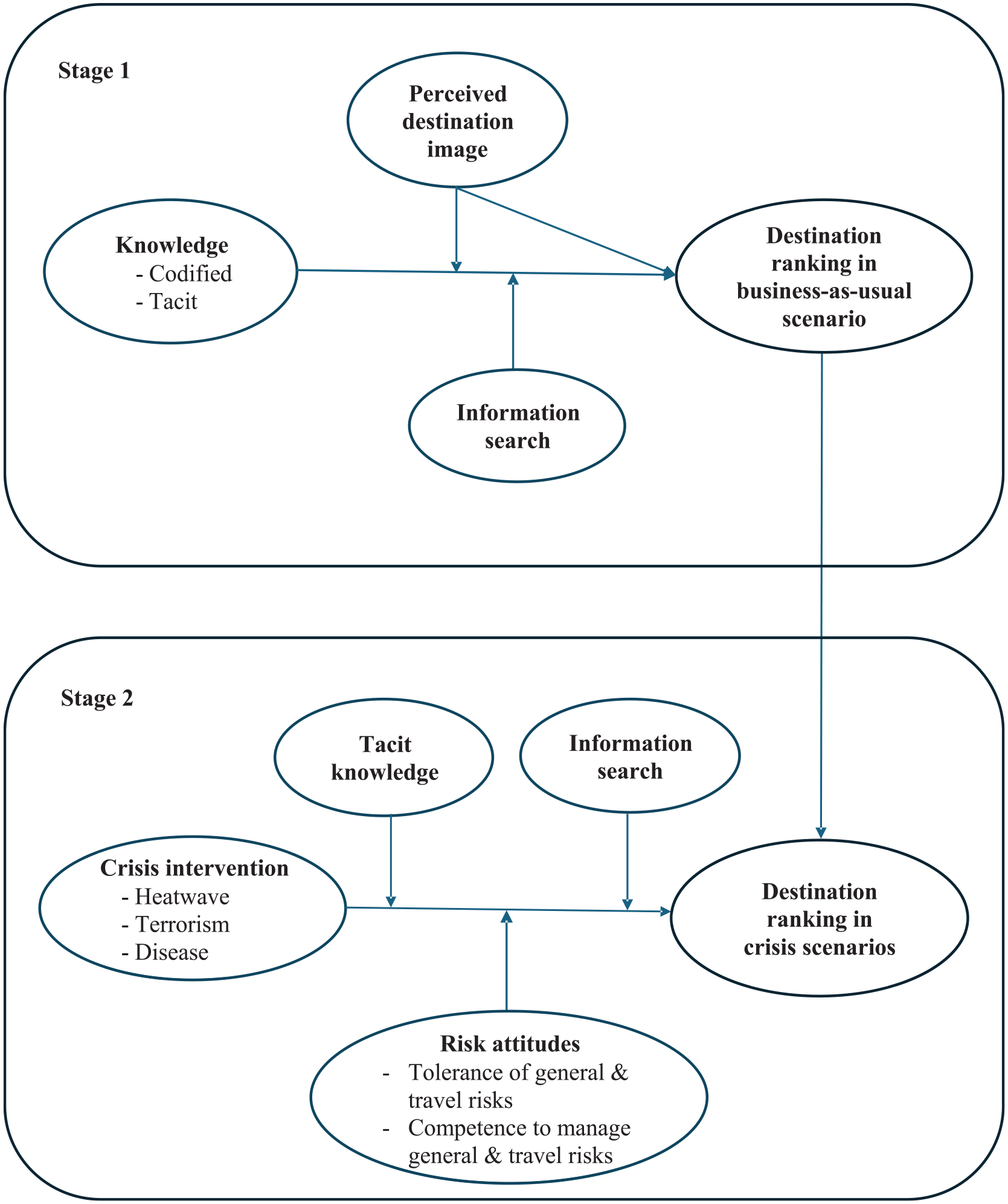
Research Framework and Analytical Procedure.
Tourists’ destination preferences in the business-as-usual condition form a reference point for decision making in a crisis scenario. Tacit knowledge (familiarity) is a key factor for preference persistence, while new knowledge about the crisis and recency indicate the likelihood of changes in preferences (Stage 2). Meanwhile, the moderating effects of risk attitudes (tolerance of, and competence to manage risk in both the general and travel domains) on the relationship between crisis intervention and the new destination rankings will be investigated, along with the moderating effects of perceived destination image and past visits.
Methodology
Overview of Research Design: Destination Decision Modeling
We adopt a multi-perspective approach (Saito & Strehlau, 2018) to destination decision modeling based on an experimental design. Experimental methods generally have significant advantages over survey and secondary data in terms of control, comparability, and the replication of research findings, and they are well-suited to establish causality (Viglia & Dolnicar, 2020). We apply a within-subject design (“business as usual” plus three crisis scenarios) to the experimental research, with each participant being subject to repeated interventions. The experiment is repeated in different countries to enhance the external validity.
The research also examines the impact of knowledge and attitudes to risk on preference for specific destinations. This innovatively combines the findings of the experimental research with survey data. The modeling process combines multi-attribute models of destination decisions with models on decision-making under risk conditions.
Sample
The study had 1,531 participants (after screening and cleaning) from the five largest international tourist expenditure source countries: the United Kingdom, Germany, France, the United States, and China. The sampling began in March 2021 and provided a total of 9,186 ranking pairs for a within-subject experiment. This is above the required sample size of 4,364 ranking pairs for ordinal outcomes (Whitehead, 1993) with six equally distributed levels, a two-sided alpha of 0.05, a power of 0.8, and a conservative odds ratio of 0.9. The experimental software was initially prepared in English, and the survey agency (KANTAR—a major global marketing data and survey agency with access to over 100 million survey respondents worldwide) translated the software content into German, French, and Chinese. These were back-translated by native language speakers to check for accuracy.
Participants for the experimental task were randomly selected from a pool that had participated in a prior large-scale online survey with nearly 15,000 initial respondents, as part of a larger research program. This large-scale survey was conducted in partnership with KANTAR. The sampling procedure of the original survey reflected a reasonably good representation of the population in terms of age and sex distributions as well as broad regional representativeness within each of the five surveyed countries. The demographic profiles of the participants in the experimental study, and the profiles of the original survey respondents, are included in Table A1 of the Appendix (see the online supplemental material); there is a high consistency between the two sets of profiles.
The survey elicited respondents’ answers to questions about travel behavior and attitudes to risk (general and tourism specific; tolerance and competence to manage), as well as their socioeconomic and sociodemographic characteristics. The questions on risk attitudes were drawn from the literature: general risk tolerance (Dohmen et al., 2005; Grable & Lytton, 1999); tolerance of travel risk (Sönmez & Graefe, 1998); competence to manage general risk, and competence to manage travel risk (Williams & Baláž, 2013); and intolerance of uncertainty and ambiguity (Carleton et al., 2007; Freeston et al., 1994; Kruglanski et al., 2013; Roets & van Hiel, 2011).
The combination of data from the survey (particularly about participants’ risk attitudes) and the experimental research tool enabled deeper insights into patterns of information processing and decision-making.
Experimental Procedure
The research tool was adapted from the studies of Monti et al. (2012) and Baláž et al. (2016) on complex decision-making, and involves active and repeated manipulation of experimental situations. The experiment was performed via innovative, online-based, Mouselab-type software, which mapped participants’ information searches and decision-making processes in relation to the selection and ranking of tourist destination countries under different risk scenarios. The model includes destination characteristics, appeals, and images. The choice of destination attributes was informed by multi-attribute models of tourism destination choices (Seddighi & Theocharous, 2002). See the online Appendix for the measurement items of key constructs and experiment settings.
The participants were first presented with the project description and then the business-as-usual scenario. In order to simulate incomplete information conditions (Stiglitz, 2000), and based on Monti et al. (2012: 209) and Baláž et al. (2016), participants could only reveal up to 50% of the initially concealed information about each of the six international European destination choices. Information on price was most frequently asked for, followed by safety, and then the attitudes of host communities.
Participants ranked their preferences among the six destinations, and their knowledge and perceived image of each destination. Each national sample had its own set of five European destinations. The United Kingdom, Germany, Italy, France, and Portugal were the specified destinations for the United States and Chinese samples. In the German, French, and British samples, their own countries were exchanged for the Netherlands in the list of countries to be ranked. These selected destinations have been among the most popular ones in Europe, even for European (e.g., French, German, and British) tourists. This ensured the validity of the experimental design.
After the business-as-usual scenario, three intervention scenarios were introduced: (i) a new infectious disease, (ii) terrorism, and (iii) a heatwave. The choice of intervention scenarios was guided by their contrasting characteristics, as discussed in the literature review.
The intervention risk levels for individual destinations were modeled upon real-world data. The European heat wave list (Lhotka & Kyselý, 2022) was applied to indicate heat risk levels; the Europol (2024) European Union Terrorism Situation and Trend reports were used to set terrorism risk levels; and the COVID-19 cumulative standard mortality rates (August 2020, Villani et al., 2020) were chosen to model risk levels for a future pandemic.
The order of intervention scenarios for individual participants was randomized to avoid ordering effects. Descriptions of the intervention scenarios and an example of the Mouselab-type screen are included in the Appendix.
Data Analysis Methods
The rank-ordered logit choice model (Beggs et al., 1981) was employed following the proposed two-stage research framework outlined earlier. The model can be used to analyze the preferences of individuals over a set of alternatives (i.e., the full rankings of destinations) rather than only the most preferred alternative. In this model, each choice of the rankings can be considered a multinomial observation. That is, a participant first chooses the top destination out of a possible set of six, then chooses the second-ranked one out of the remaining five, and so on. The dependent variables are rankings of destination choices pre-intervention (Stage 1) and post-intervention (Stage 2). For intuitive interpretation, the rankings are reversed so that a value of one represents the least-favored destination, with six being the most-favored. Therefore, the values of dependent variables can be interpreted as the “worth” or attractiveness of a destination. To gauge the robustness of the main effects of key variables, moderators were introduced into the models progressively, as indicated by M11, M12, and so on.
Results and Analysis
Destination Rankings Across Intervention Scenarios
Table 1 summarizes the average destination rankings for each national sample in the experiment under the business-as-usual and three intervention scenarios. All interventions impacted on average country ranking. The effect, however, was relatively limited within the same scenario across all five countries (see Table 1; also see Tables A3 and A4 in the Appendix for turmoil rates). The countries given more severe shocks tended to receive a relatively large drop in ranking, while the destinations assigned relatively lower risks received an increase in ranking.
Average Destination Rankings in Different Scenarios by National Samples.
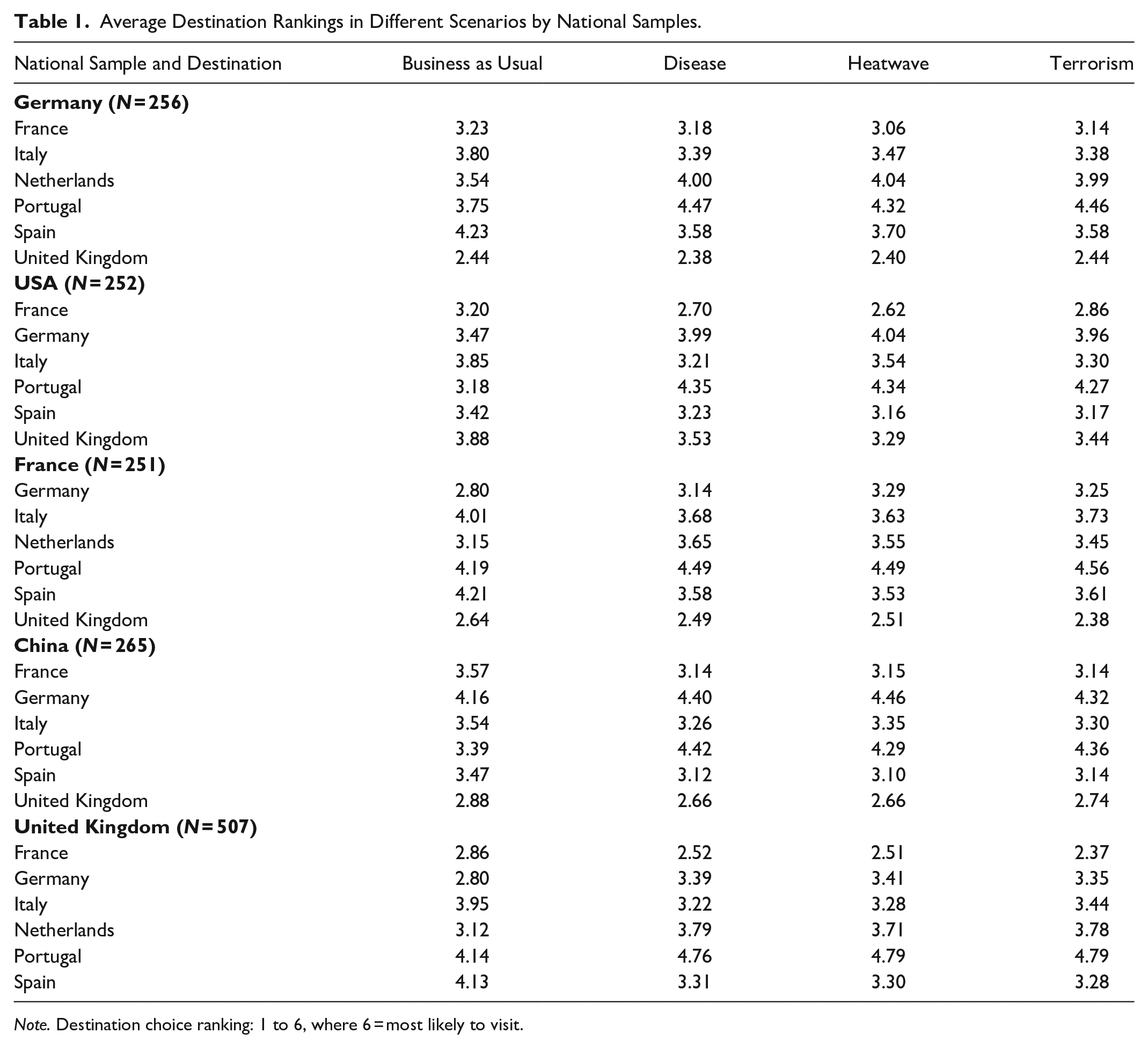
Note. Destination choice ranking: 1 to 6, where 6 = most likely to visit.
Modeling Destination Rankings
This section summarizes the results of the rank-ordered logit choice modeling results, revealing the roles of knowledge and risk in forming perceived destination image and destination rankings—both for the original business-as-usual rankings and the three risk intervention scenarios.
Stage 1: Destination Rankings Before Crisis Interventions
At Stage 1, business as usual was assumed without any crisis intervention. At this stage, we examined the effects of destination image and past visits as tacit knowledge as well as codified knowledge by revealing such information as destination attributes (price, safety, and resident attitude) and the moderating role of past visits in the relationship between destination image and destination ranking. The results are shown in Table 2.
Stage 1: Overall Models of Destination Rankings in Business-as-Usual Conditions.
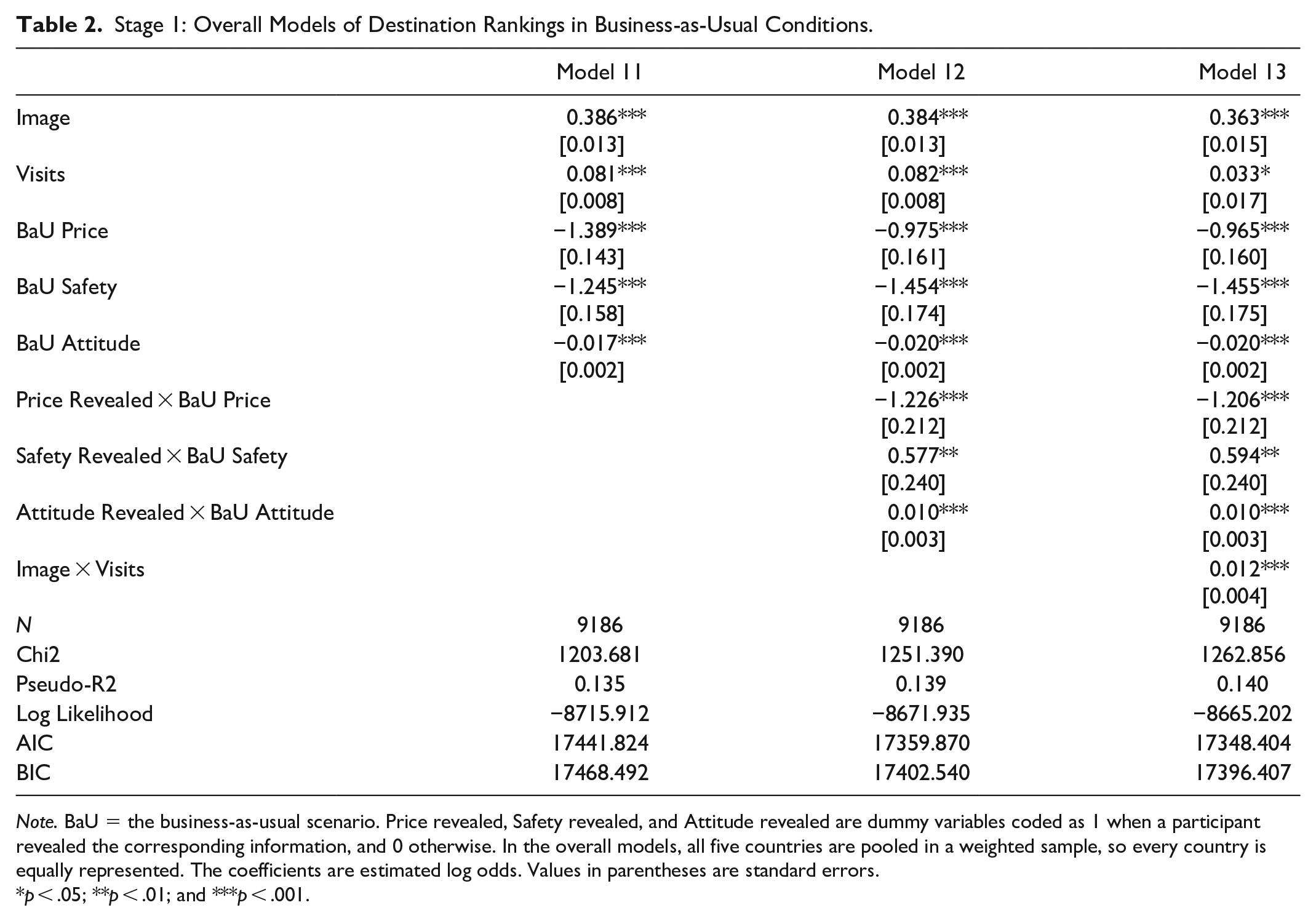
Note. BaU = the business-as-usual scenario. Price revealed, Safety revealed, and Attitude revealed are dummy variables coded as 1 when a participant revealed the corresponding information, and 0 otherwise. In the overall models, all five countries are pooled in a weighted sample, so every country is equally represented. The coefficients are estimated log odds. Values in parentheses are standard errors.
p < .05; **p < .01; and ***p < .001.
As shown in Table 2, the main effects of the business-as-usual attributes (price/safety/attitude) on rankings are significant. Nevertheless, since such information stored in long-term memory may not always be accurate, or is not always recalled in decision-making, its effect may be enhanced (in the case of price) or corrected (for safety and attitude) by newly acquired codified knowledge that has been stored in the immediate/short-term memory, if a participant chose to reveal the corresponding attributes. These are modeled as interactions with revealed price/safety/attitudes. For example, the main effect of local attitude toward tourists in the business-as-usual scenario (BaU attitude, measured by the ranking out of 37 European countries as shown in Appendix B in the online supplemental material) is −0.020 in Model 13. This means that the odds of preferring to visit a destination would decrease by
The above results based on the overall sample are largely confirmed by those of the country-specific models, although minor national differences are observed. As presented in Table 3, the main effects of destination image, tacit knowledge, and codified knowledge on destination rankings were significant in most models across all the five countries under study, except for past visits in the Chinese case. This exception is mostly likely because the majority of Chinese participants did not have past visit experience in any of these European destinations. When the interactive term between codified knowledge and revealing was considered, some national differences are observed, implying that different source markets have different priorities in their destination decision-making.
Stage 1: Models by Country on Destination Rankings in Business-as-Usual Conditions.
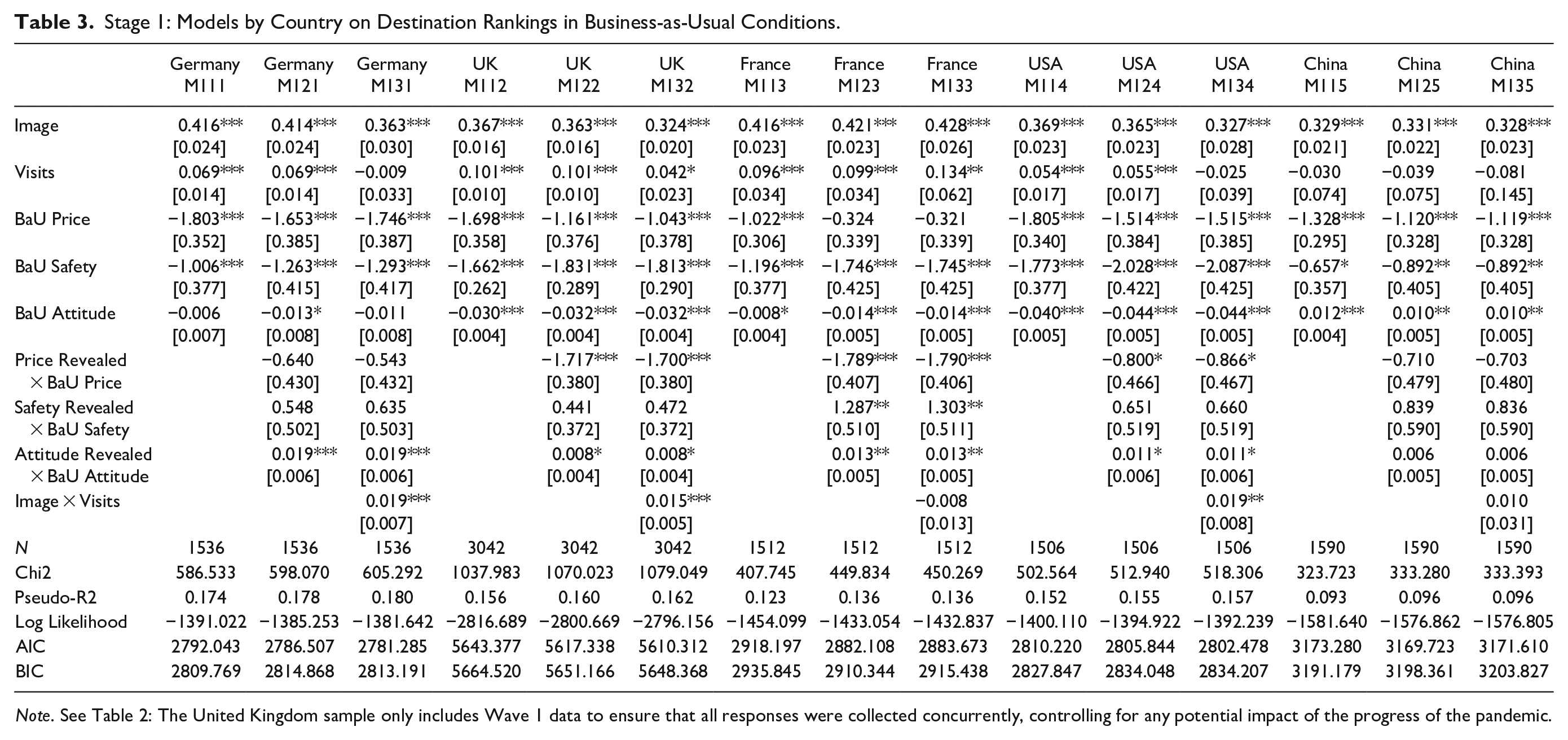
Note. See Table 2: The United Kingdom sample only includes Wave 1 data to ensure that all responses were collected concurrently, controlling for any potential impact of the progress of the pandemic.
Stage 2: Destination Rankings After Crisis Interventions
The results of the overall models at Stage 2 show that both the original rankings of destinations and the risk associated with the intervention scenario have a significant impact on the rankings after crisis interventions (Table 4). Interestingly, the marginal effect of the original ranking is nonlinear across all scenarios, where it increases faster as the ranking moves further away from the reference rank (i.e., ranking = 3), with the largest incremental effect observed at the highest ranking (as illustrated in Figure 2). Such nonlinear effects indicate strong preference persistence for the most favored destination; even if there is a crisis, tourists would still display a relatively high preference for the highest-ranked destination, which would be higher than the preference for less favored destinations.
Stage 2: Overall Models on Destination Rankings Post-Crisis Interventions.
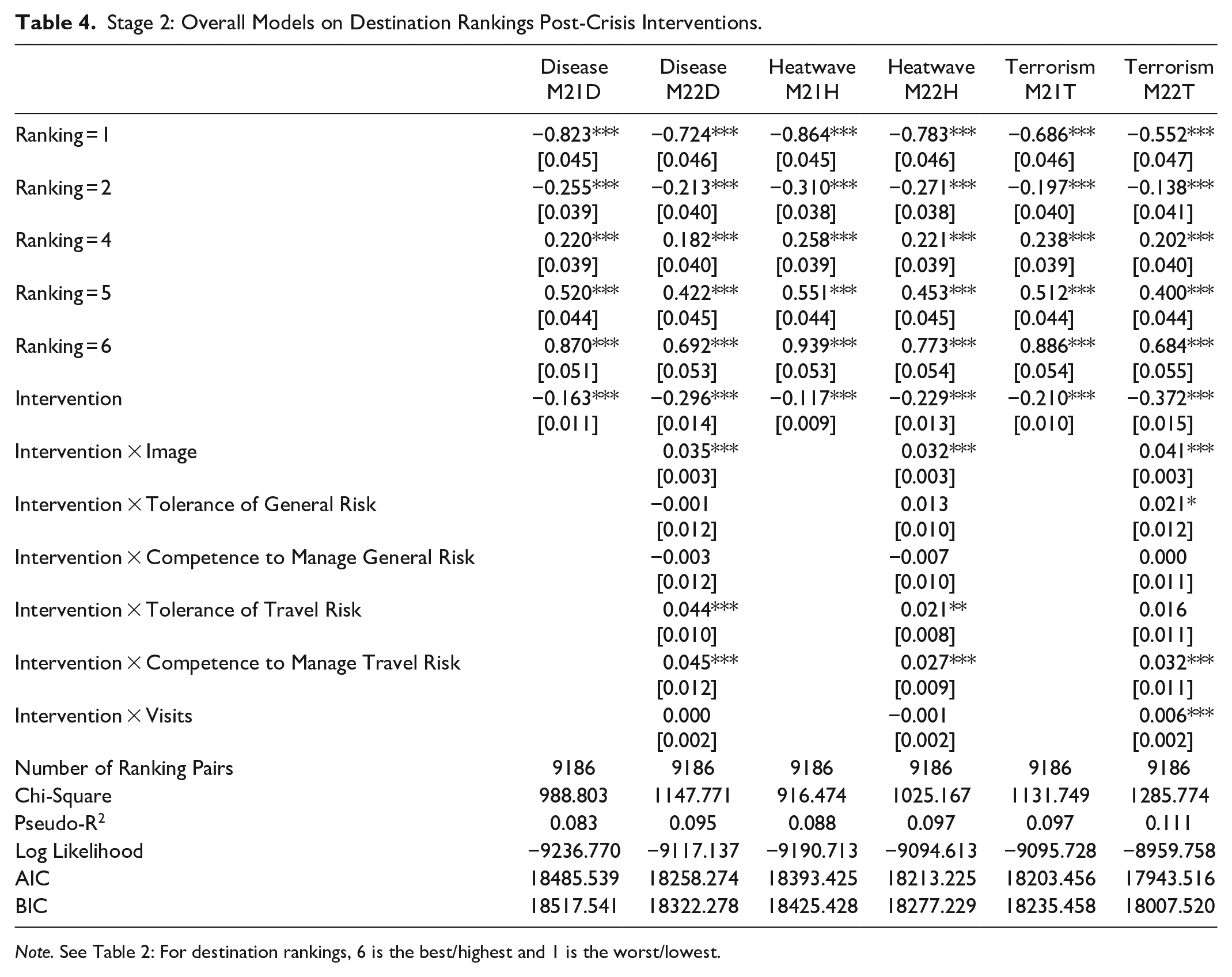
Note. See Table 2: For destination rankings, 6 is the best/highest and 1 is the worst/lowest.
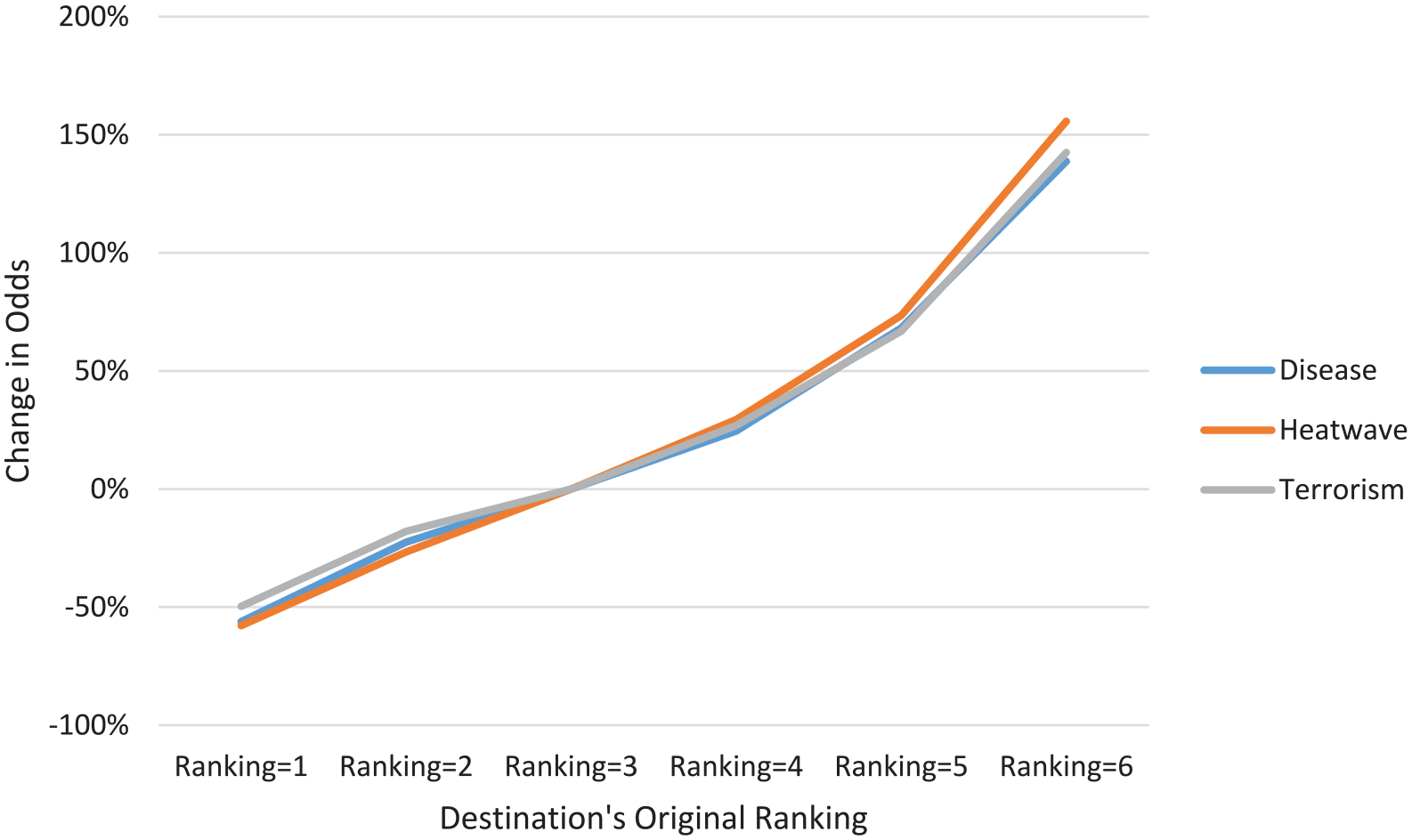
Percentage Change in the Odds of Preferring to Visit a Destination Relative to the Original Ranking = 3.
Among the three scenarios, the terrorism intervention has the highest impact on the destination rankings. Before considering the moderating effects, when the original ranking remains unchanged, for every 1-point increase in terrorism risk at a destination, the odds of preferring to visit that destination decrease by
To gain further insights, country-specific models were estimated for each type of crisis (see Tables A5–A7 in the Appendix). In each of the three crisis scenarios, the crisis intervention has a significantly negative impact on destination rankings across all five markets. In addition, at least two of the mitigation effects of risk attitudes are found to be significant in the cases of Germany, the United Kingdom and the United States. In the cases of France and China, it appears that destination image plays a more significant role than risk attitudes in mitigating the negative impact of crisis interventions. The mitigation role of the destination image is significant in other countries, too.
Discussion
Our analysis pointed to a nuanced interpretation of the roles of both different types of knowledge and risk attitudes in shaping destination preferences. Here we discuss each of our three general hypotheses.
First, there was evidence to support Hypothesis 1, that an individual’s past knowledge of a destination significantly affects the destination’s ranking in the business-as-usual condition. Although it was observed that destination image had a stronger impact on destination ranking in the non-crisis situation than (stated) country knowledge and/or history of previous visits (see also Afshardoost & Eshaghi, 2020; Stylidis et al., 2017), image is itself related to knowledge. Furthermore, past visits to a destination (an important source of tacit knowledge and the familiarity heuristic) did enhance both the effect of knowledge on image and the effect of image on destination preference. In addition, various forms of codified knowledge (price, safety, and residents’ attitudes) also significantly influenced destination rankings. This accords with the importance attached in the literature to the role of codified knowledge—but especially of tacit knowledge—in the formation and updating of destination images (Wong & Yeh, 2009). This operated in two ways: (1), the business-as-usual attributes can be interpreted as proxies of long-term memory (tacit knowledge and familiarity), and the design of the experiment allows the participants to consider these; (2) however, this tacit knowledge can be enhanced/corrected by new codified knowledge about these attributes if the participant reveals them in the business-as-usual scenario. There seem to be complex inter-relationships between codified and tacit knowledge, as well as image, that require further theoretical attention.
Second, there was evidence to support Hypothesis 2, that an individual’s risk attitudes significantly moderate the impact of a crisis intervention on destination ranking. Risk attitudes play key roles in the persistence of rankings in response to crisis scenarios. Individuals with higher tolerance of travel risk and more competence in managing travel risk were less likely to be affected by the experimental interventions. These mitigation effects were significant in all but one instance. This broadly accords with the existing evidence in the limited literature on the disaggregated components of risk attitudes (Williams & Baláž, 2013).
Third, the evidence supports Hypothesis 3, that an individual’s destination ranking in the business-as-usual condition can predict the destination ranking in crisis conditions, revealing destination preference persistence. Indeed, there are high levels of preference persistence. This accords with the findings by Karl et al. (2020) that risk-averse tourists prefer familiar destinations over unfamiliar ones. Risk aversion and the familiarity heuristic (Tversky & Kahneman, 1974) enhance the persistence of destination preferences under the business-as-usual condition. However, the findings are more complex than this because they indicate the importance of the anchor-and-adjustment process of decision-making (Muthukrishnan & Kardes, 2001). The business-as-usual scenario provides a strong baseline anchor, but the information provided about the hypothetical interventions also has an impact on the rankings of the top-ranked destination countries and/or countries that experienced the most severe events. This aligns with the probable importance of the recency bias and the potential role played by the “availability bias heuristic” (Gilovich et al., 2002), whereby individuals tend to weigh their judgments towards the most recent information they have received. Overall, then, there is evidence to support the role of an anchor-and-adjustment process (Muthukrishnan & Kardes, 2001). Both the familiarity heuristic and recency bias are evident, as is the influence of risk attitudes.
Conclusions
Key Findings
A review of crisis management studies in tourism (Wut et al., 2021) suggests that risk perceptions are overwhelmingly related to destination image and revisit intentions. There is little research on the persistence of destination preferences. Furthermore, quantitative and qualitative research designs dominate the methodology of crisis management studies (Wut et al., 2021), with the potential for experimental approaches to simulate destination decision-making being relatively neglected.
This study responds to the limitations of extant research in the comparative analysis of destination preferences in non-crisis and diverse crisis situations. It combines multiple perspectives on destination preference with two linked sources of evidence (experiment and survey) to establish the impacts of major crisis scenarios, tacit and codified knowledge, and risk attitudes on tourist destination decisions. An advantage of the experimental methods is that they go beyond previous research because they also allow a direct comparison of the impacts of different events on the rankings of selected destinations, as well as comparisons to the business-as-usual scenario.
The most important finding of this within-subject experimental design is that it identifies remarkably persistent predictors of overall destination rankings in all three interventions or crisis scenarios. In particular, the highest original ranking has the highest increment of impact compared to other ranks across all scenarios. This indicates that the preferences for the top-ranked destinations are likely to be even more persistent than the other ranks in the business-as-usual condition when impacted by each of the three crises.
The second major finding is that different crisis scenarios did have different impacts on destination rankings. Terrorism generates the largest change in rankings among participants, followed by disease, and then heatwaves. These results broadly agree with the findings in the tourism literature, mostly based on survey data, about terrorism risk and health concerns being major deterrents to international travel (Corbet et al., 2019; Sönmez & Graefe, 1998; Williams & Baláž, 2013). However, the findings go beyond these by analyzing the role of knowledge as well as image, and by assessing differential effects across both crises and destinations.
Theoretical Implications
This paper demonstrates how individuals make tourism decisions regarding destinations under a business-as-usual (non-crisis) condition versus under crises. Individuals encounter conditions of risk and uncertainty (Williams & Baláž, 2015) and information overload and incomplete information (Stiglitz, 2000). In contrast to the prevailing assumptions in the literature about rational decision-making models (Kock et al., 2016; McCabe et al., 2016), they, therefore, tend to employ fast and frugal decision rules (heuristics, mental shortcuts) rather than complex evaluation strategies (Gigerenzer, 2001) when ranking destinations. The two most important shortcuts examined in this paper are the familiarity heuristic (Gursoy & McCleary, 2004) and recency bias (Jeng & Fesenmaier, 2002). These heuristics underpin the high levels of persistence observed in the experiments. Tourism crises (such as terrorism, heat waves, and pandemics) generate new information (which, in this study, is codified), and the recency heuristic affects the risk perception of destinations. However, familiarity counteracts recency and partly interacts with it to generate remarkably high levels of destination preference persistence. As such, this study provides a new perspective to advance the understanding of tourist decision-making under crisis conditions.
A second theoretical contribution of this study is that it reveals an additional layer of complexity in tourist decision-making because, in this environment of heightened risk and uncertainty, the extent of the persistence depends on individuals’ risk attitudes. The value of adopting a risk attitude as opposed to a risk perception perspective is that it differentiates between tolerance towards risks and uncertainties, and competence to manage them. Some individuals may perceive that they have sufficient competence to manage risks and still be willing to travel to destinations severely affected by various risky events. In these instances, risk attitudes help explain the remarkable stability of destination preferences, although there may be reduced persistence amongst less tolerant individuals may be reduced. In short, the study demonstrates the importance of integrating theoretical perspectives rooted in knowledge and risk attitudes, and the concepts of familiarity and recency.
Practical Implications
The research also has important implications for policy and practice. First, although the persistence of destination rankings in the face of different major crises is seemingly a source of reassurance for destinations (and individual establishments), it is important to avoid “one-fit” practical responses. There are different challenges and opportunities for destination marketing, depending on whether or not the destinations have strong images. In general, the persistence in rankings favors established destinations which have strong images in a group of previous customers with tacit knowledge of them. For these, the priorities are to reinforce those images and to emphasize notions of familiarity and trust at a time of heightened uncertainty. In contrast, while other less-affected countries can perceive opportunities, the high degree of persistence in rankings underlined how difficult it can be to present themselves as alternative destinations. For these destinations, the priority is to target risk-averse tourists more prone to re-evaluate their destination plans when crises affect their highest-ranked preferences (Hajibaba et al., 2015). In effect, destinations can exploit the effects of the recency bias on tourist decision-making when targeting this segment of risk-averse tourists. This can be either through generic marketing that focuses on their relatively risk-free characteristics, or by targeting more risk-averse tourists. This strategy can be challenging to operationalize due to limited data on individuals’ risk attitudes. However, sociodemographic characteristics are generally associated with risk tolerance/aversion, which may provide a more accessible surrogate of risk attitudes. For both destinations with strong and weak images, this research underlines the importance of acquiring a deep knowledge of that image (Ryu et al., 2013).
Second, in light of the importance of codified and tacit knowledge for potential tourists’ destination decisions, destination marketing needs to consider the different stocks of such knowledge in different markets. French, British and German markets, for example, have relatively good tacit knowledge—familiarity—with the main European destinations. In contrast, the United States and Chinese markets have less tacit knowledge about European destinations. Therefore, different marketing messages are needed to address different market knowledge gaps. It is difficult to substitute for the tacit knowledge acquired by tourists from previous visits. But possible strategies include highlighting the tacit knowledge of the destination held by others, for example, by weaving into marketing materials the positive stories of highly visible individuals with long associations with, and strong tacit knowledge of, particular destinations. This also chimes with Walters and Mair’s (2012) findings about the importance of using celebrities with established associations with places when marketing these.
Limitations and Future Research Directions
Although the research is conceptually and methodologically innovative, it has some limitations. First, the research sample was large, but—as is common in experimental research—it was not representative of each country, which indicates the need for further research across not only a wider selection of origin countries and destinations but also on samples that draw on the range of population characteristics. Second, given resource constraints, only three types of crises were analyzed: other crises—such as civil unrest or catastrophic natural disasters, such as earthquakes—with different types of temporality also need to be investigated (see Ritchie & Jiang, 2019). There is also scope to investigate the impact of multiple overlapping crises, although that will require different experimental designs. Third, a limited set of decision attributes was used in the research design so as to limit the cognitive load of the task for the participants. Future research could address some of the more intangible attributes, such as perceived social norms, as well as destination crisis management and trip flexibility. Fourth, preference persistence was only analyzed via cross-sectional research across different types of crises; however, there is also a need for multi-wave longitudinal research that addresses how persistence or volatility in risk attitudes influences decision-making (see Baláž et al., 2024). Finally, only two key heuristics were investigated in this paper, whereas there are a large number of other lesser-known heuristics, as well as various forms of cognitive bias (Wattanacharoensil & La-ornual, 2019), which can be investigated in relation to tourists’ decision-making under crisis conditions.
Supplemental Material
sj-docx-1-jht-10.1177_10963480241310819 – Supplemental material for Tourist Decision-Making and Types of Crises: Risk Attitudes, Knowledge, and Destination Preference Persistence
Supplemental material, sj-docx-1-jht-10.1177_10963480241310819 for Tourist Decision-Making and Types of Crises: Risk Attitudes, Knowledge, and Destination Preference Persistence by Jason Li Chen, Vladimír Baláž, Gang Li and Allan M. Williams in Journal of Hospitality & Tourism Research
Footnotes
Declaration of Conflicting Interests
The authors declared no potential conflicts of interest with respect to the research, authorship, and/or publication of this article.
Funding
The authors disclosed receipt of the following financial support for the research, authorship, and/or publication of this article: This work was supported by the Economic and Social Research Council (ESRC) in the UK [grant number: ES/V013009/1], and the Slovak VEGA Grant (No. 2/0001/22).

Supplemental Material
Supplemental material for this article is available online.
Author Biographies
References
Supplementary Material
Please find the following supplemental material available below.
For Open Access articles published under a Creative Commons License, all supplemental material carries the same license as the article it is associated with.
For non-Open Access articles published, all supplemental material carries a non-exclusive license, and permission requests for re-use of supplemental material or any part of supplemental material shall be sent directly to the copyright owner as specified in the copyright notice associated with the article.
