




Abstract
This study triangulates historiographical and scientometric reviews to provide a systems perspective on film tourism. The three phases of historiographical analysis (exploration, growth, and maturity) correspond to the three clusters of scientometric analysis: (i) initial research exploring film tourism development and management, (ii) growing the field through studies on film tourists’ perceptions and practices, and (iii) reaching maturity through extending research into different cultural contexts and meaning-making processes. Based on the analysis, we offer a set of directions for future research, including the need to integrate sustainability research and film tourism studies in developing country contexts, as well as intertextuality and its impact on film tourism. We further recommend research on developments in media consumption and its impact on film tourism, investigation of the relationship between digitalization and film tourism, and the need for interdisciplinary research. Finally, we suggest combining product life cycle analysis to complement historiographical analysis for robustness.
Keywords
Highlights
We lack a coherent body of historical, synthesized knowledge associated with film tourism.
This study offers a comprehensive systems analysis of film tourism scholarship through historiographical and scientometric approaches.
The historiographical review tracks the evolution of film tourism from its inception to maturity.
We suggest combining product life cycle analysis to complement historiographical analysis for robustness.
Introduction
Recent decades have seen an explosive growth in the phenomenon of people traveling to locations from films or television series, so-called “film tourism” (e.g., Beeton, 2016; Connell, 2012; Kim & Reijnders, 2018). Research into this phenomenon started in the late 1980s with some isolated exploratory studies (see, for example, Cohen, 1986). Since the early 2010s, this research field has evolved into one of the trending research themes, not only in tourism studies, but also in other fields, including cultural geography (e.g., Mostafanezhad & Promburom’s [2018] study of the politcal-economic relations of China and Thailand), sociology (for example, Okamoto [2015] discusses the postmodernism of “anime” and “manga” tourism), media studies (for example, Thelen [2020] shows that fans of popular shows create their own associations of tourism destinations without the official endorsement of show creators or other authorities), and fan studies (see Seaton and Yamamura [2015] for Japanese popular culture tourism). As such, film tourism is considered to be one of the most visible niches of tourism within academic publications on the subject (Connell, 2012; Moritz et al., 2024; Thelen et al., 2020; Reijnders et al., 2024).
Despite the remarkable scholarly progress in gaining an inclusive understanding of this field, there have been few comprehensive literature reviews of film tourism research, with the most prominent one dating back to 2012 (see Connell, 2012). In order to provide a path for the future development of the field it is important to understand the past and have a holistic systems analysis of the field (Donthu et al., 2021; Klarin, Park, and Kim et al., 2024); however, at this stage, we still lack a coherent body of historical, synthesized knowledge associated with film tourism. As highlighted by Beeton (2016) as well as Kim and Reijnders (2018), the field of film tourism has become highly multi-disciplinary (see also, Connell, 2012; Lundberg et al., 2018; Thelen et al., 2020), but the integration between these different disciplinary perspectives is still lacking. It thus requires interdisciplinary scholarly efforts to create more synergy between these fragmented efforts and perspectives on film tourism.
Through this integrative approach, we aim to work towards a robust historiographical and themed complementary and confirmatory scientometric analysis of film tourism to overcome potential drawbacks of literature reviews using a sole method (Klarin, Suseno, and Lajom, 2023). In order to ensure development of the field, it is important to gain a systems overarching perspective on the topic, which leads to informed directions for the future development of the field (Donthu et al., 2021; Klarin, 2024). Our methodological contribution is about incorporating product life cycle theory into historiographical analysis to highlight phases of research with factual publication numbers that corroborate findings of historiographical analysis. Finally, an unbiased algorithmic mapping afforded through content co-occurrence analysis in scientometric research also supports the historiographical findings of the three phases of research development.
Methodology
This study adopted two complementary review methodologies: historiographical and scientometric. Combining historiographical and scientometric methods is necessary to gain a systems perspective of scholarship. Systems thinking requires an emergent (what has been covered and what is to be uncovered) and holistic (an overarching view of elements and interconnections) understanding of a phenomenon to provide a robust and multi-faceted review (Klarin, Ali Abadi, and Sharmelly et al., 2024; Suseno & Standing, 2018). Historiography, in this sense, provides an emergent perspective through a deep, contextual understanding of the evolution and development of a field over time, highlighting significant milestones and shifts. In contrast, scientometric methods offer a holistic broad overview of the literature, identifying key topics, trends, and relationships through data-driven techniques. Together, these methods ensure a comprehensive systems view that includes both detailed historical contexts and overarching patterns, enhancing the rigor and depth of the study. This dual approach provides a more comprehensive or complete understanding of the research landscape, revealing interdisciplinary connections and emerging research areas that may not be immediately apparent through historiographical methods alone. Such a methodological triangulation can assess the body of literature in a systematic, rigorous, and holistic way by identifying critical research gaps and, from there, make legitimate suggestions and directions for future research.
Historiography is a legitimate method of critical review, as confirmed by its usefulness for business and management research (Goodman & Kruger, 1988; O’Brien et al., 2003). Beyond this historiographical critical review of film tourism research, a scientometric literature review aids in providing an overview of key topics. Such a scientometric approach to a literature review involves an objectified, systematized process of research selection and analysis (Klarin, 2024). It provides a thorough understanding of the researched topic to establish an overarching perspective on film tourism research using scientometric methods, which are known for providing the most insightful interdisciplinary and/or multidisciplinary overviews of research phenomena (Donthu et al., 2021; Klarin, 2024). In doing so, the scientometric review will utilize a content co-occurrence analysis, together with bibliometric descriptors to provide the most comprehensive scientometric review of the film tourism literature. This approach involves identifying frequently used terms in a body of text, establishing relationships between them based on their co-occurrence, and then mapping these terms into distinct research streams according to their relatedness (Galvin et al., 2021).
Data Collection and Processing
To carry out the comprehensive review of film tourism literature, we extracted all tourism and travel publications that contain film, media, screen, cinema, TV, popular culture, contents, anime, and manga, as well as all related and synonymous variations of the above terms, as of September 11, 2023,from the Scopus and WoS databases. The final search terms included: media(-induced/-related) touris*/travel/pilgrim*, screen(-induced/-related) touris*/travel/pilgrim*, film(-induced/-related) touris*/travel/pilgrim*, cinema*(-induced/-related) touris*/travel/pilgrim*, TV/television(-induced/-related) touris*/travel/pilgrim*, pop(ular) culture(-induced/related) touris*/travel/pilgrim*, contents(-induced/-related) touris*/travel/pilgrim*, anime(-induced/-related) touris*/travel/pilgrim*.
In total, we extracted 866 studies from Scopus and 651 studies from WoS. After a Scopus and WoS datasets comparison, we found that WoS contained 169 unique relevant results that were not available in Scopus. After reading through the topic areas (titles, abstracts, and keywords) of the combined dataset, it was found that 415 publications had no relevance to film tourism research within the social sciences or humanities, for example, those studies that used the tourism context for a different topic in a variety of disciplines, including computer science, chemistry, biology, mathematics, and others. After the inclusion and exclusion phase, the full dataset for the current study comprised 620 relevant film tourism studies (see Figure 1 for the study selection criteria).
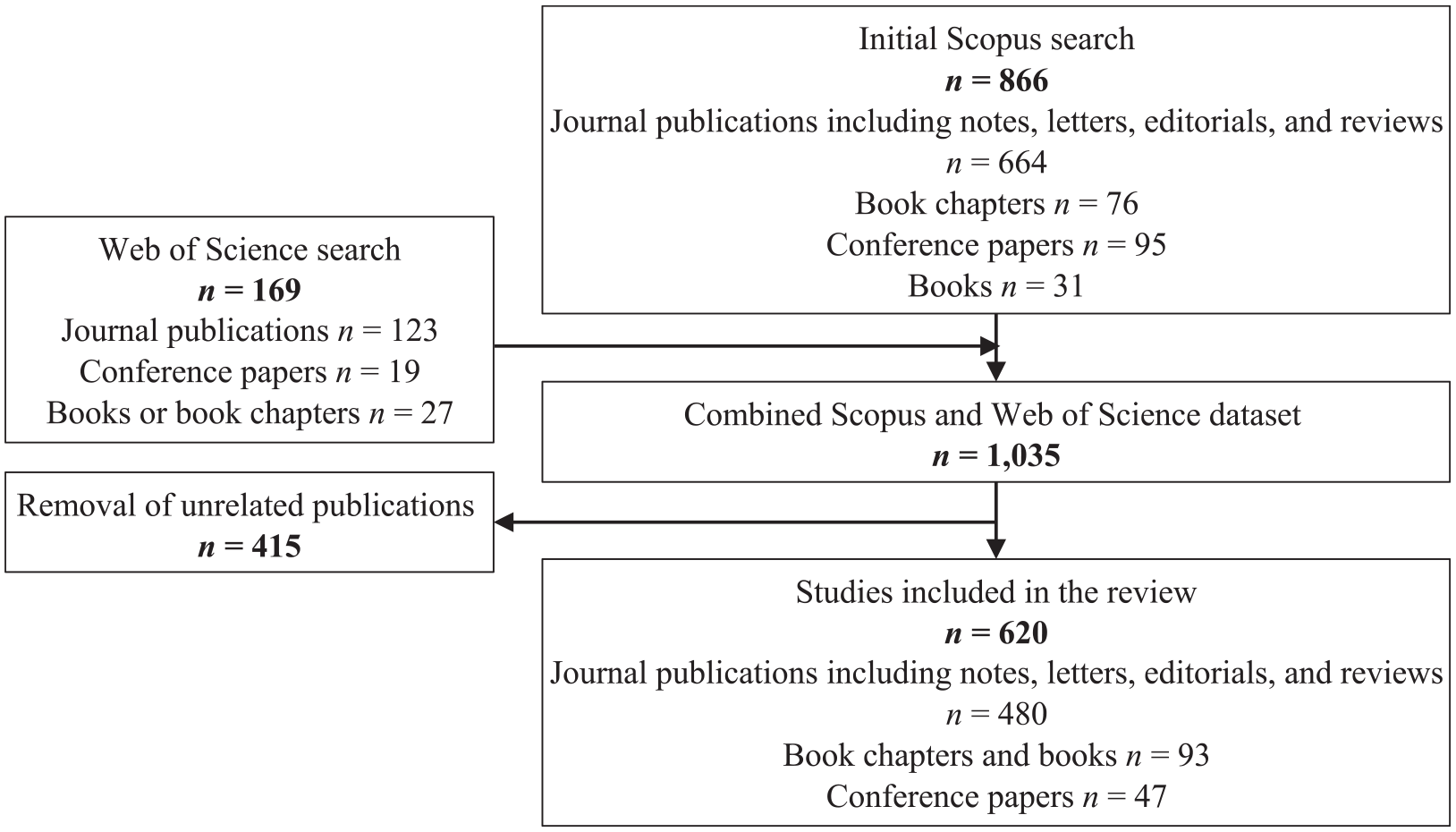
Results of the Search and Study Selection Criteria.
Historiographical Analysis
The historiography method was first adopted for developing a scholarly history of film tourism literature as an amalgam of knowledge evolution, transition, and progression. According to O’Brien et al. (2003, pp. 137–138), historiography refers to “an empirical research paradigm using an interpretative or qualitative approach which focuses on a chronology over a substantial period of time in order to obtain a fuller and richer attending of a situation or set of circumstances.” Drawing on the earlier work of Elton (1989), O’Brien et al. (2003) recommended that historiography follow the nine steps of rigorous interpretative research that loosely synchronizes with the seven steps of a scientometric literature review, as described below. The data analysis for the historiographical review is based on the comprehensive dataset of film tourism studies extracted from the two largest academic extractable databases, Scopus and Web of Science, described in Steps 2 to 5 below.
Historiography provides a general, historical framework, showing the development of film tourism as a research field from the early 1980s until the current day, classifying its different phases of development. The scientometric review essentially complements the historiographical review and allows us to further identify the key themes and trends within those phases on a more detailed level.
Scientometric Analysis
In conjunction with the historiographical critical review, this study closely followed the steps proposed by Klarin (2024) as best practice in scientometrics. In the first step, we identified the following research question: What are the most prolific themes and topics within film tourism research, and how have these developed over time? This question aids us in identifying the main research themes in the field of film tourism, and approaching these from an integrative critical perspective, by providing a scientometric review as well as a heavily condensed chronological overview of the literature. Second, the study is set up through a large overarching systems analysis based on a substantial body of film tourism scholarly publications, including journals, conference proceedings, books, and book chapters from the two largest structured and extractable academic databases: Scopus and Clarivate’s Web of Science (WoS; Harzing & Alakangas, 2016). In the third and fourth steps, described in the data collection and processing section above, we extracted all the publications related to film tourism from Scopus and WoS databases to be further analyzed using scientometric software.
In Step 5, we used VOSviewer software, which is capable of mapping large maps onto distance-based clusters based on a co-occurrence matrix where items that have high similarities are algorithmically located close to each other (for more details see van Eck and Waltman, 2010), in order to have an unbiased outlook on the research. This study further combines bibliometric author, publication, source, institution, keyword, and country-based analyses together with content-based analysis, possible through extractions and linkages of commonly occurring noun phrases, to provide an overarching analysis of the film tourism literature (see Klarin, Park et al., 2023). In steps six and seven, we interpret, report, and discuss the results, which are presented in the following sections.
The Intellectual Structure of Film Tourism Findings
An effective intellectual structure analysis involves a systems perspective of not only the current state of the research domain, but its development and emergence (Klarin, 2024). Intellectual structure, in this sense, generally refers to a hierarchical system of research themes in the discipline, interconnections between the themes, and a holistic analysis of the topic (García-Lillo et al., 2017; Klarin, 2020; Liu et al., 2015). As such, prior to the discussion of the main themes of the scientometric literature review, we outline how film tourism has evolved and developed over the last decades as a field of research. A cross-sectional analysis of the dataset from a historiographical perspective shows that the evolution of film tourism research can be divided into three distinctive periods: the exploration stage (pre-2006), the growth stage (2006–2016), and the maturity stage (2017 onwards) in terms of research directions over the years.
To derive the three phases of film tourism we applied the well-established product life cycle theory (Rink & Swan, 1979) to the film tourism scholarship to numerically identify the positioning of the research based on research publication data supported by the historiographical analysis of film tourism scholarship. The year-on-year growth of the scholarship can be utilized as a precursor to labelling the phases of the research domain. As such, we compare an impressive approximate rate of 9% growth in tourism research year-on-year (Klarin, Suseno, and Lajom et al., 2023), as well as a 21% growth in global scientific output between 2015 and 2021 (United Nations Educational, Scientific and Cultural Organization [UNESCO], 2024), to a less impressive film tourism average yearly growth rate of 4.35% from 2017 to 2023. With research evidently dropping from its peak in 2020—as demonstrated in Figure 2—it is safe to assume that film tourism is in its maturity and saturation stage as per product life cycle theory (Rink & Swan, 1979).
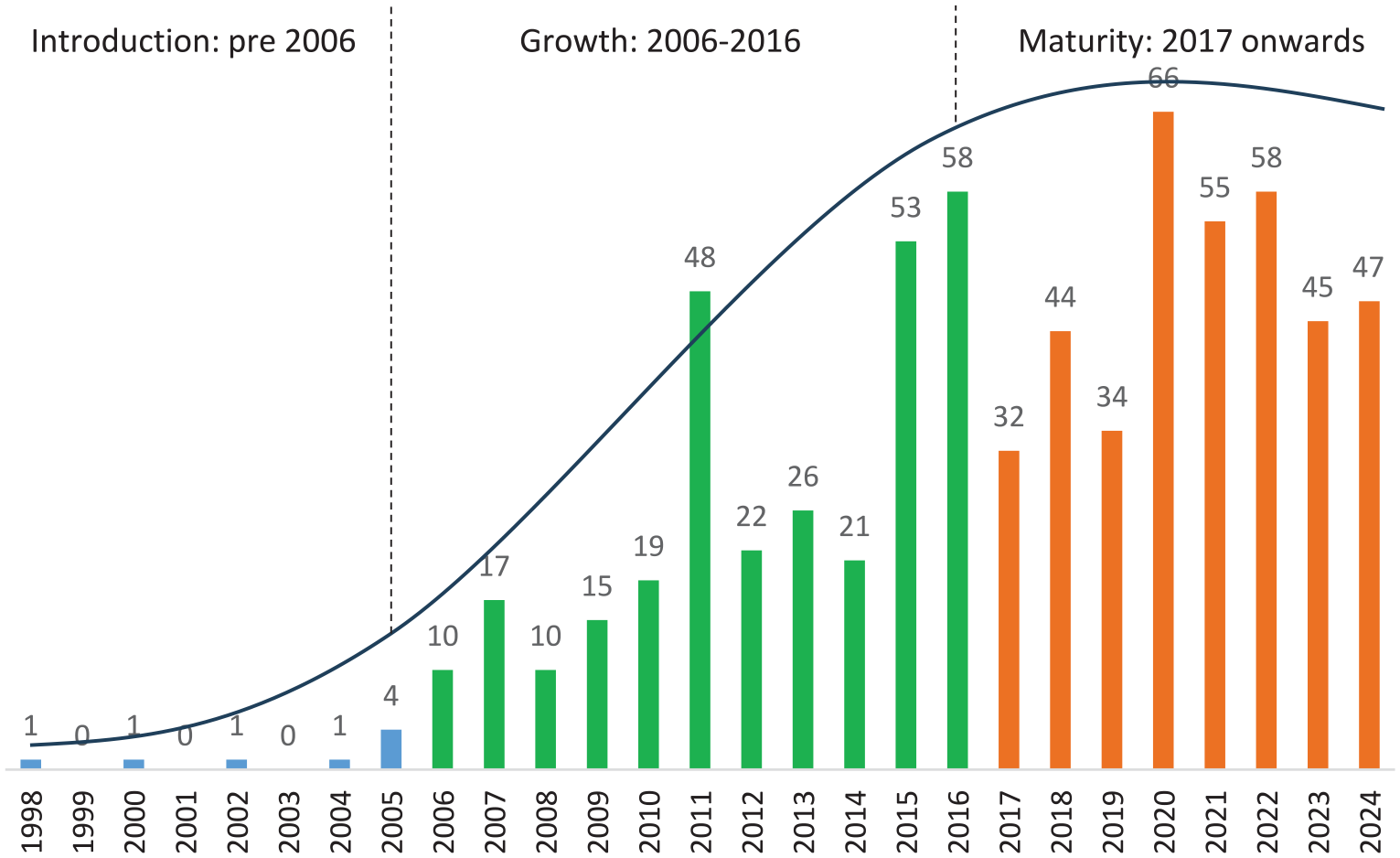
Number of Film Tourism Publications in Scopus and WoS.
It is important to note that product life cycle theory does not include the scholarship’s historical evolution and cannot identify the future trends of the scholarship. It merely highlights the numbers of and growth in publications over time and can be used as a guiding tool to identify what stage the state of the scholarship is at. Therefore, it becomes necessary to combine life cycle theory, which provides a structured framework to numerically identify the stages of development, with historiography, which offers a contextual analysis of these stages within historical narratives, allowing for a deeper understanding of the factors influencing each phase. For a more detailed analysis of the historical development and likely future trends, it is necessary to provide the historiographical analysis, described next.
Historiography of Film Tourism Scholarship
Described as a “justify field” (Beeton, 2010, 2016), the scholarly research on the subject was descriptive and atheoretical at the exploration stage (pre-2006). Experts attempted to narrate or describe “what is happening?” in the realm of film tourism phenomenon with particular attention to compiling anecdotal evidence drawn from case studies predominantly within Western contexts, such as the United States and the United Kingdom (e.g., R. W. Riley & Van Doren, 1992; R. Riley et al., 1998; Tooke & Baker, 1996). Until the inception of the first comprehensive research-based monograph presenting an introduction to the concept of “film-induced tourism” in 2005 (Beeton, 2005), our understanding of this phenomenon remained limited.
Neither methodological nor theoretical development was yet established then, and several different yet similar terms had been coined and thus were interchangeable. These include but are not limited to “screen tourism” (Tooke & Baker, 1996), “media pilgrimage” (Couldry, 1998), “movie-induced tourism” (R. Riley et al., 1998), and “media-related tourism” (Busby & Klug, 2001). In this study, the generic term “film tourism” is adopted for the same rationale as in Kim and Reijnders’ (2018) work on film tourism in Asia; that is, it is the most widely used term in related literature which intersects at media, culture, and tourism.
Beeton’s (2005) seminal work as the first comprehensive, definitive reference that provided the complexities and subtleties of film tourism, further ignited the unprecedented growth of film tourism research that certainly represents the breadth and depth of various disciplinary—or even interdisciplinary—inquiries, echoing its inherent nature and characteristics (Beeton, 2010, 2016; Kim & Reijnders, 2018; Tzanelli, 2007), which is thus described as a “multi-disciplinary post-modern study” (Beeton, 2010, p. 1).
At the growth stage (2006–2016), a great deal of knowledge creation and development in the areas of sociology (Tzanelli, 2007), geography (Roesch, 2009), cultural studies (Reijnders, 2011), and social psychology (Kim, 2012a; Roesch, 2009), as well as marketing (Hudson & Ritchie, 2006) and communication and media studies (Kim, 2012a, 2012b), was evident.
Moving from the applied business and management aspects derived from a positivism paradigm approach, it was evidently a welcome advancement from earlier descriptive, numerical studies to more theoretically sound and empirically rigorous research, responding to “why,” “how,” and “so what” questions in a more in-depth manner (Beeton, 2010). Moreover, the increasing attention from both academics and practitioners alike was documented (Kim et al., 2009; Roesch, 2009).
During the growth stage, Tzanelli’s (2007) research, alongside some earlier works (Couldry, 1998; Torchin, 2002), in the realm of contemporary, globalized culture from a sociological perspective, was an important milestone for film tourism research progression that was a timely response to a common appetite for more theoretical comprehensions of the phenomenon (e.g., semiotics and ideology). Proposing a fundamental question: “What exactly do film viewers and potential tourists consume?”, Tzanelli (2007, p. 8) postulated that (post)modern consumers such as film tourists become reflexive agents who are trained and/or educated to adopt the semiotic logic of “symbolic sign values” (Baudrillard et al., 1976) in their everyday encounters with tangible and intangible experiences, referring to Baudrillard and colleagues’ (1976) work on the political economy of signs.
Unlike the earlier work on film-induced tourism (Beeton, 2005), Tzanelli (2007) coined a new term “cinematic tourism,” created by the production and consumption of cinematic representations of places and cultures, and attempted to tackle the complexities of relevant industries’ responses to the film tourism phenomenon with case studies drawn from America, Europe, Asia, and Australia, combining the above theoretical lens as the analytical framework.
Two other monographs that functioned as important cornerstones of this developing field of research were written by Roesch (2009) and Reijnders (2011). Roesch (2009) approached film tourism from a consumer perspective, paying particular attention to the multilayered experiences of film (location) tourists in a more theoretically nuanced manner, while criticizing the underlying limitations of previous studies on tourist perspectives of film tourism, drawing from various disciplines, including geography, sociology, and (environmental) psychology in particular. In 2011, Reijnders’ book on places of the imagination further added to this, based on the concept of “lieux d’imagination” (places of the imagination) coined by Pierre Nora (1984–1987). Drawing on extensive ethnographic material, this examined the representations of landscapes in popular narratives that have inspired film tourism, whilst also investigating the effects over time of such tourism on local landscapes, and the processes by which tourists appreciate the landscapes, experiencing and appropriating them into their imagination. Lieux d’imagination developed a new theoretical understanding of film tourism, building bridges between sociologists and cultural geographers, as well as those working in the fields of media and cultural studies, popular and fan culture, tourism, and the sociology of leisure.
Despite the successful transition from the exploration stage (pre-2006) to the growth stage (2006–2016), research at the most recent time frame (2017 onwards) has explored this phenomenon from a more qualitative, interpretive perspective, linking research on film tourism to wider sociocultural developments and debates within the social sciences and humanities, while stagnating in terms of theoretical enhancement and further progression on cross-disciplinary and interdisciplinary approaches. Taking into consideration these mixed observations and interpretations, it is called the “maturity stage.”
One example at this maturity stage (2017 onwards) is manifested in the heightened scholarly attention for understanding the film tourist experience, a topic which was theoretically explored by Roesch (2009) and Reijnders (2011) in the second phase but still remained under-researched (see Connell, 2012). This has been developed further in the maturity stage. As such, linkages have been made to cultural identity and heritage as an alternative approach to film tourism (e.g., Bąkiewicz et al., 2017; Ono et al., 2020). Another development characterizing this mature but saturated phase of film tourism research is related to increasing attention being paid to distinctively non-Western manifestations of the way(s) in which film and tourism intertwine (e.g., Nakayama, 2021; Teng & Chen, 2020).
For example, Kim and Reijnders (2018) made their timely scholarly effort of making an in-depth examination of the breadth and scope of the film tourism phenomenon with particular focus on Asia, in response to the past and current asymmetry between the Western and the non-Western focus, given that the predominance of the Western hegemony and paradigm in film tourism studies has been challenged in the recent decade (Kim et al., 2009). Kim and Reijnders (2018, p. 5) responded succinctly to this paucity, stating:
It would be inaccurate and problematic to presuppose audience reactions and tourist behaviours associated with film tourism if future film tourism research were restricted to the immediacy of English language and the recognisable histories and traditions of Western screen production.
Despite the welcome progress at the maturity stage (2017 onwards), there is limited evidence to support the improvement of cross-disciplinary and/or interdisciplinary research on film tourism that truly crosses the boundaries of each discipline’s ontological and epistemological perspectives. This trend was also witnessed as one of the limitations and thus suggested as an avenue for future research directions a decade ago (Connell, 2012). With some exceptions, as mentioned earlier, a large number of publications have duplicated the previous theoretical and methodological approaches, and some have diversified the geographical research contexts and media content, including emerging film tourism destinations such as India (Nanjangud & Reijnders, 2022) and Brazil (Póvoa et al., 2021). Also, it is noteworthy that we witness a welcome growth in longitudinal studies (see Kim & Park, 2023; Thelen et al., 2020) and perspectives of multi-stakeholders, with particular attention to the diversity of local communities and residents (see Croy et al., 2018; Thelen et al., 2020). The longitudinal studies are particularly timely and significant, given that Connell (2012) claimed that the previous studies experienced a shortfall in explaining the entire process and spectrum of film tourism impacts, as the extant literature looked at the fractional – often peak time, of the investigated case studies as one-off.
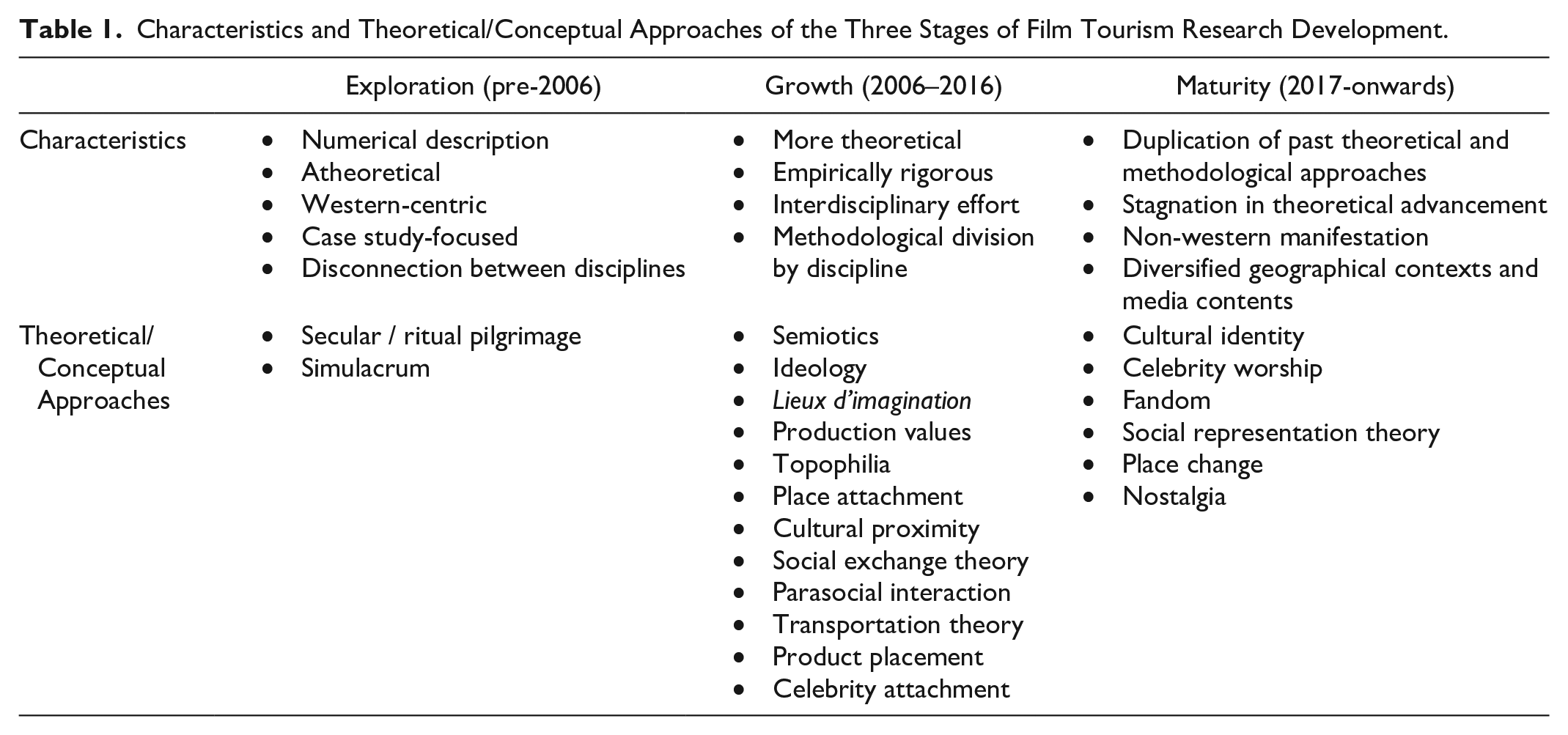
These phases from the historiographical perspective aim to provide a first overview of the development of film tourism research as summarized in Table 1. The identified theoretical or conceptual approaches are not a comprehensive list, nor are they in any particular order. They are predominantly adopted as the key theoretical or conceptual frameworks for the extant literature under examination at each of the three phases. To offer a more comprehensive understanding, it is now important to zoom in on the specific topics and themes that drove research in these respective periods from a scientometric perspective.
Characteristics and Theoretical/Conceptual Approaches of the Three Stages of Film Tourism Research Development.
Theme Clustering
The algorithmic positioning and clustering produced three distinct clusters of research themes: (i) film tourism development and management (Red); (ii) film tourists’ perceptions and practices (Blue); and (iii) cultural contexts and meanings of film tourism (Green). Any terms evident in the map can only appear in one cluster, and the size of each term indicates its occurrence in the selected literature under investigation. Considering the fact that each word appears in only one cluster, it is unsurprising to see the overlap between the clusters. For example, the terms “film” or “film tourism” will inevitably appear in all clusters, but will be allocated to clusters that are most relevant to their discussion. To provide the state of the art of film tourism scholarship, it is necessary to discuss each cluster using the themes that are present within. The results of the thematic representations, which are built into a visual map that was generated by the VOSviewer software, are presented in Figure 3.
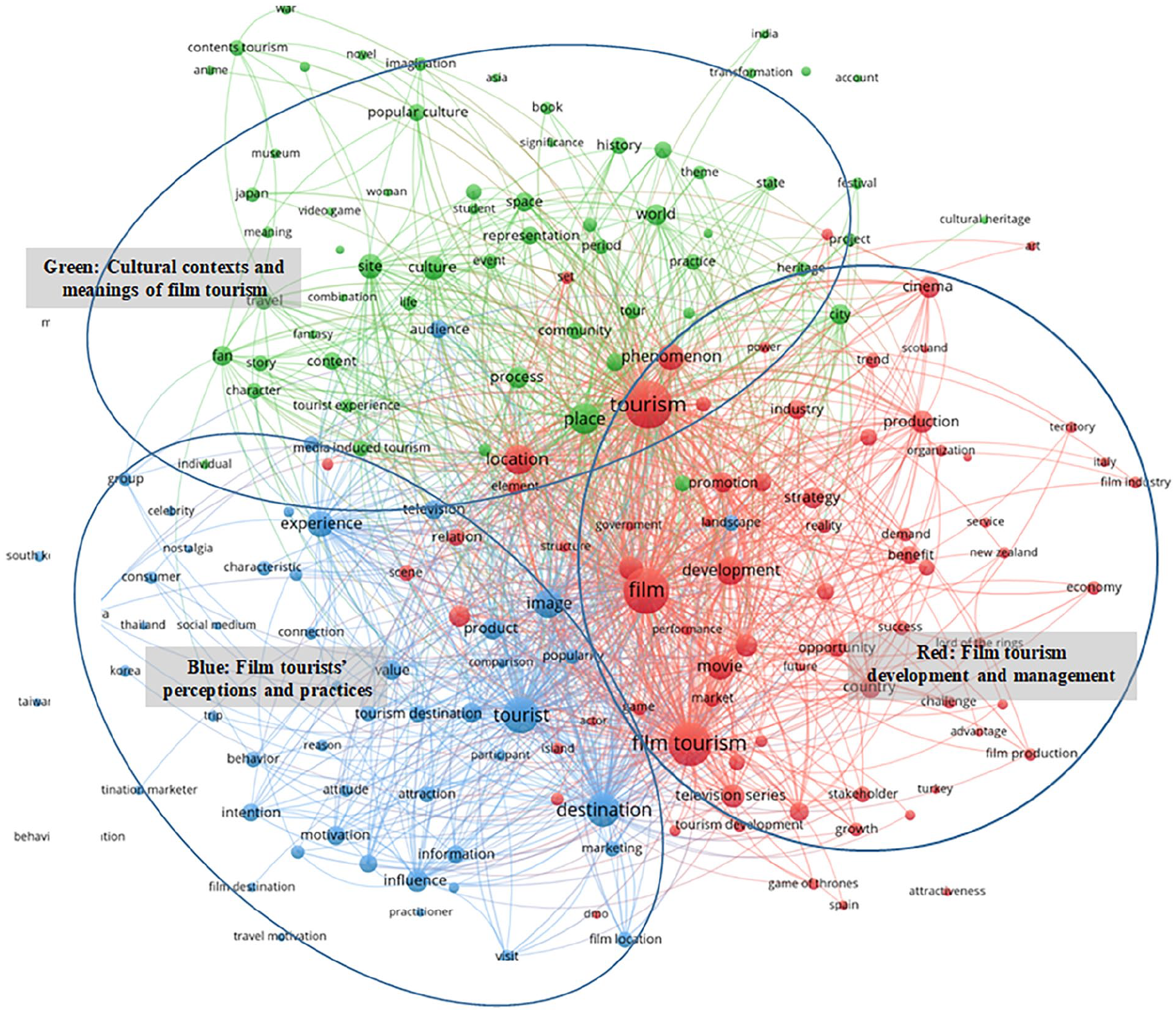
Map of the Film Tourism Scholarship.
In the next section, corresponding to the earlier discussions from the historiographical perspective, these clusters will be discussed individually, starting with the red cluster as this was at the outset of the film tourism literature and features film tourism most prominently. We then review the blue cluster as it followed on from the exploration stage (pre-2006) and was the capstone of the growth stage (2006–2016) of the scholarship. Finally, we outline the maturity stage (2017 onwards) where other subcategories of film tourism emerge and interplay, thus improving the scholarship into many overlapping and extending inquiries, with unsolved limitations in the green cluster.
In addition to the visual representation of the film tourism scholarship, as presented in Figure 3, and the cluster analysis (elaborated on below), this study offers two additional tables that provide bibliometric (based on citation information) thematic results. As such, Table 2 offers top trending themes that appear in the most recent articles and themes that are prevalent in the documents that receive the highest normalized citation counts, as well as key findings, methodologies utilized, and theories and concepts from each cluster.
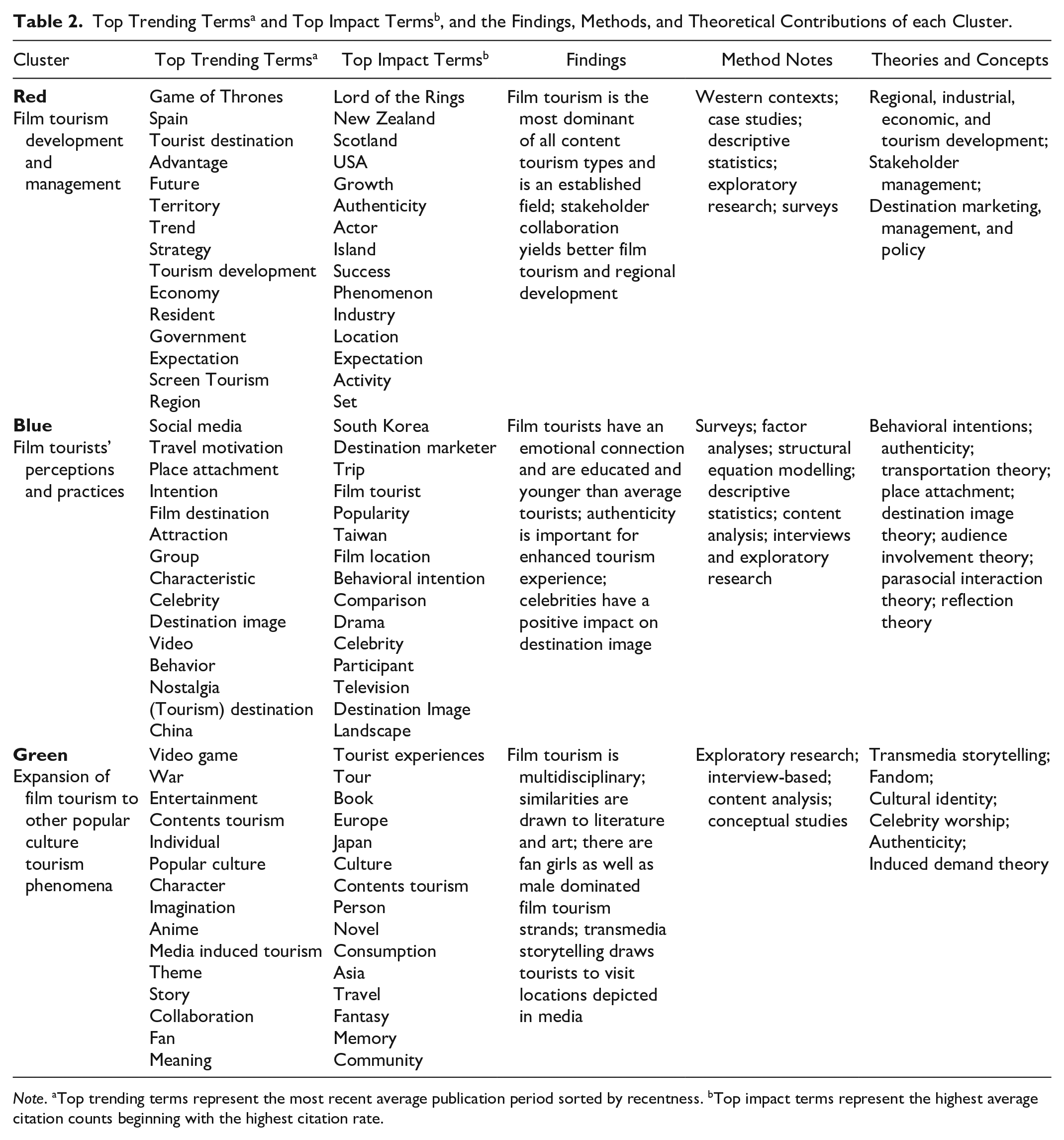
Note. aTop trending terms represent the most recent average publication period sorted by recentness. bTop impact terms represent the highest average citation counts beginning with the highest citation rate.
Red: Film tourism development and management
The top trending terms and impact terms in this cluster (see Table 2) indicate the necessity of proactive collaborations between the relevant film tourism stakeholders—such as destination marketing organizations (DMOs)—and the media (e.g., TV series) production industry, including media promotion teams for successful and sustainable film tourism development and management at the national, state, regional, and local levels (Croy, 2010; Hudson, 2011; Hudson & Ritchie, 2006; Thelen et al., 2020; Yoon et al., 2015). Furthermore, Beeton (2016) highlighted the existent power relations between the DMOs and media companies in film shooting locations, which makes an important contribution towards understanding the (lack of) success of film tourism related businesses.
The focal point herein is on regional economic (re)development planning and (promotional) strategies in view of the economic potential of film tourism in various geographical locations (Kim et al., 2015; Wray & Croy, 2015), although these are very often from a short-term economic perspective with little or no sound long-term planning and development strategies (Kim & Nam, 2016). Despite empirical research into the role of development policy in recognizing and promoting film tourism, it has often been shown in studies that governments lack systemic, long-term policy strategies to take advantage of and support film tourism as an alternative tourism market segment for sustainable regional (re)development and rejuvenation (Beeton, 2016; Kim & Nam, 2016; Thelen et al., 2020). Similarly, local governmental policies can also prevent or mitigate the effects of over-tourism and overcrowding resulting from a popular film or television series. However, literature provides insights into developmental strategies; for example, Larson et al. (2013) suggest three tourism development policy strategies based on in-depth case studies of Twilight Saga locations: taking no action, fabricating, and safeguarding place authenticity. Each has its own merits and drawbacks. As such, Beeton (2016) suggests matching a film’s appeal to the audience and touristic appeal of a destination, thus highlighting the need for comprehensive, active film tourism planning and destination management at all levels (Croy, 2010).
As important as the above, is an emphasis on the organization and management implications from a film tourism destination perspective. This management aspect of film tourism, however, has managed to carve its own research niche with particular attention on two of the most successful film tourism cases associated with the Lord of the Rings trilogy in New Zealand (Beeton, 2016; Buchmann, 2010; Croy, 2010) and the Game of Thrones in Spain (Castro et al., 2023) and other filmed locations such as Croatia and Northern Ireland (Tkalec et al., 2017). Based on the themes explored, Lundberg et al. (2018) proposed a typology of the synergistic exploitation of cultural assets and tourism offerings to six strategies: aligning films to destinations, embedding of themes into destinations, fostering filmset visiting, building place identity using media discourses, using destination promotion in films, and connecting tourists to destinations managed by policymakers.
This echoes Thelen and colleagues’ (2020) criticism of the fact that the current film tourism literature has predominantly focused on exceptionally successful international cases such as those mentioned above. The vast majority of films and other media products, such as TV series, result in limited noticeable tourism consequences (Beeton, 2016; Croy, 2010; Kim et al., 2017; Thelen et al., 2020). This is largely because film tourism planning and development requires a carefully designed set of strategies for destination and/or place marketing and management amongst the relevant stakeholders (Beeton, 2016; Heitmann, 2010; Wray & Croy, 2015). For example, Croy (2010) posited that careful planning and promotion investment by destination management organizations—using an example of Tourism New Zealand and its scrupulous involvement and financial support in making and promoting the Lord of the Rings trilogy—created enhanced awareness and familiarity with the destination that has subsequently led to increased film tourism (Croy, 2010). However, using econometric and computable general equilibrium modeling, Li et al. (2017) demonstrated that the Lord of the Rings trilogy has had little impact on the tourism economy of New Zealand, whereas the Hobbit Trilogy had significant positive impacts, which may be attributed to effective marketing strategies and media convergence. Such progress is welcomed to counteract the methodological problems that led to a less realistic economic impact using a phantom demand, especially in commercially-oriented reports commissioned by tourism organizations alike (Connell, 2012).
The significant role DMOs play in creating the success of film tourism is the focus of this part of the red cluster, which is also supported by the success story of the spin-off effects of the Game of Thrones in Croatia (Tkalec et al., 2017) and Spain (Castro et al., 2023). In the case of Spain, the Andalucía Film Commission actively promoted film tourism in the region via the project Andalucía Destino de Cine, launched in 2018, which localizes the sites where national and international media productions such as the Game of Thrones, Star Wars, and Lawrence of Arabia were filmed. These discussions lead us to explore perceptions and practices of film tourists as follows.
In summary, the red cluster focuses on the development and management of film tourism, emphasizing the need for proactive collaborations between DMOs and media production industries. Successful case studies, such as the Hobbit Trilogy in New Zealand and Game of Thrones in Spain, illustrate the potential economic benefits and the necessity of aligning film appeal with destination marketing. Methodologies employed include both qualitative approaches relying on content analysis and case studies as well as quantitative approaches including econometrics and survey-based research. Theoretical frameworks include regional economic development planning and promotional strategies. Key findings highlight the importance of strategic planning and management by DMOs, the role of media in promoting destinations, and the need for long-term policy strategies to support sustainable film tourism.
Blue: Film tourists’ perceptions and practices
It is not surprising that the blue cluster, labelled “film tourists’ perceptions and practices” emerges as a standalone theme, as it has been well documented that previous film tourism literature predominantly focuses on film tourism impacts from a tourist perspective (Beeton, 2016; Connell, 2012; Kim & Reijnders, 2018; Thelen et al., 2020). This cluster also includes studies on film tourism market segments based on motivations and on-site experiences in film tourism destinations (Kim, 2012b; Macionis & Sparks, 2009; Rittichainuwat & Rattanaphinanchai, 2015), aiming to provide a specific set of managerial and practical implications for tourism experience. An example is the strategic destination image management processes for film tourism in the context of Chinese film tourists to Korea (Zeng et al., 2015).
Originally, research within the blue cluster was dominated by a quantitative methodological approach, examining the characteristics and profiles of film tourists (Kim & O’Connor, 2011), film tourists’ motivations (Macionis & Sparks, 2009; Rittichainuwat & Rattanaphinanchai, 2015), their on-site experiences (Carl et al., 2007; Kim, 2010, 2012a; Reijnders, 2010), perceived destination image associated with film and/or TV series (Fu et al., 2016; S. Lee et al., 2008; Muhoho-Minni & Lubbe, 2017; Yen & Croy, 2016), and future behavioral intentions (Kim & Kim, 2018; Yen & Teng, 2015). It is notable that relatively less scholarly attention has been paid to other equally important aspects, such as host communities and residents in film tourism locations (Beeton, 2016; Connell, 2012; Croy et al., 2018; Kim & Park, 2023; Thelen et al., 2020).
Over time, a more qualitative perspective and explanatory treatment or approach have become leading themes in research on film tourist perceptions, behaviors, and experiences in this cluster, which was not the case a decade ago (Connell, 2012). Moreover, since the 2010s there has been a great deal of relevant knowledge generated from the fields of communication and audience studies, and film and media studies, as well as from cultural studies and social sciences such as sociology and cultural heritage (Beeton, 2016; Kim & Reijnders, 2018), which have significantly enhanced the breadth and depth of inquiry in this field of study.
Within this cluster of film tourists’ perceptions and practices, for instance, Kim’s (2012a) research on the social psychology of film tourism was acknowledged as a welcome step forward in ameliorating in-depth explanations of the link between film and tourism from an audience perspective. This theoretical approach shifts away from traditional consumer behaviors in tourism to focusing on how people watch and interpret media (like films and TV shows) in their daily lives. This media consumption can lead them to become film tourists, visiting locations featured in the media they enjoy (Connell, 2012).
Relevant theoretical approaches herein refer to audience involvement theory, parasocial interaction theory, reflection theory, and transportation theory, drawn from media and audience studies. Benefiting from Kim’s (2012a) eminent work, further studies mushroomed to understand the cause–effect relationship between the production values of media programs (e.g., storylines, characters, celebrities, locations, and landscapes) and film tourism, with particular attention on the role of the cult of celebrity, or celebrity worship, in predicting tourist intention to visit film tourism destinations (Kim & Kim, 2018; Kim et al., 2019; Teng & Chen, 2020; Wong & Lai, 2015; Yen & Croy, 2016). For example, Kim et al. (2019) demonstrated that celebrities had a significant effect on national image and that this resulted in the popularity of celebrity-related products, and intentions to visit film locations. Teng and Chen (2020) further emphasized the importance of authentic film encounters and continuity in building stronger ties with celebrities through fan clubs, eateries represented in films, and locations to induce tourists’ loyalty to destinations.
Responding to anecdotal evidence that films induce tourism, Rittichainuwat and Rattanaphinanchai (2015) empirically demonstrated that film tourism motivated only one third of tourists who actually travelled to film tourism destinations in Korea. It is interesting to note that Korea serves as the prevailing geographical focus of this cluster, reflected in the “Korean Wave” or the “Hallyu” phenomenon (Connell, 2012; Kim & Nam, 2016). These phenomena initiated and continue to generate film tourism in the pan-Asian region and beyond. Other contexts that have been studied globally include Turkish TV series-induced tourism (Balli et al., 2013), and the Chinese Lost in Thailand blockbuster’s impact on film tourism in Thailand (Mostafanezhad & Promburom, 2018).
One major limitation of the previous studies in this cluster, however, is the paucity of cross-cultural and/or cross-national comparative studies—with a few exceptions (e.g., Kim, 2012c)— considering that each individual film tourist has a subjective view on intention to travel (see, for example, Kim, 2012a, 2012b; Rittichainuwat & Rattanaphinanchai, 2015). This is largely because individuals have a trove of personal imagery and stories that they are attached to—and which form a part of their identities—and thus dictate tourism preferences and motivations for film tourism (Reijnders, 2016), which certainly points to the need for cross-cultural and cross-national studies on the matter.
In summary, the blue cluster focuses on film tourists’ perceptions and practices, and addresses key issues such as the impacts of film tourism from tourists’ perspectives and the strategic management of destination images. Initially dominated by quantitative methodologies, this research has evolved to include qualitative approaches, providing deeper insights into tourists’ behaviors and experiences. Theoretical frameworks like audience involvement theory, parasocial interaction theory, reflection theory, and transportation theory underpin these studies. Key findings highlight the significant influence of celebrities on national image and tourists’ intentions to visit film locations, the importance of authentic film encounters, and the need for more cross-cultural comparative studies to understand diverse tourist motivations and preferences. This evolution reflects a broader and more nuanced understanding of film tourism, integrating insights from media, audience, and cultural studies.
Green: Cultural contexts and meanings of film tourism
Over the past decade, it has become apparent that film tourism branches further out to other contents and types of popular culture tourism and is essentially multi-disciplinary in nature. For example, Podoshen (2013) found similarities between film tourism and the dark tourism of black metal fans in aiming to reconcile perceptions of imaged landscapes with the topographical reality of visited locations. Similarly, S. J. Lee and Bai (2016) demonstrate that pop culture has a significant influence on destination image among international tourists based on a fandom of the Korean pop star Ahn Jae-Wook.
In a similar vein, Seaton and Yamamura (2015) hosted a special issue on “Contents Tourism” describing its emergence and growing popularity in practice and research. The first article in the special issue outlines the prevailing phenomenon of otaku (mainly with Japanese anime and manga) tourism that is attractive to predominantly male fans of anime in visiting and, importantly, sustained interaction and organization amongst communities and travelers in Japan (Okamoto, 2015). This is further supported by Yamamura (2015) and Ono et al. (2020) where it is demonstrated that there is a need for interaction between local communities, producers, and tourists/fans, as it brings benefits to all stakeholders.
However, Sugawa-Shimada (2015) demonstrates that anime and, more broadly, contents tourism, is not a male-dominated tourism phenomenon, given that the Japanese rekijo (history fan girls) phenomenon is also attracting attention as it is a young women’s sociocultural feminist movement which praises the heritage tourism that appears in anime, literature, and video games based on historical facts. S. J. Lee et al. (2018) extended the unification of fans phenomenon to pop culture, including music, drama, films, and celebrities, which is explained through positive emotional responses and attention to pop culture in the context of Korea.
It as also been found that film tourism constitutes heritage tourism in a similar way to literary and art tourism forms. Martin-Jones (2014), for example, demonstrates how VisitScotland promoted Scottish heritage and tourism through The Da Vinci Code, Braveheart, and Brave. Tzanelli (2013) offers a book devoted to how cinematic tourism is a facet of the wider heritage tourism, which is traditionally dependent upon customs, lands, artifacts, and ideas. Contemporary media thus offers new cultural industries disseminating heritage and its associated impact on tourism (Bąkiewicz et al., 2017; Tzanelli, 2013).
This development fits a wider phenomenon, noted by Jenkins (2006), referring to the transmedia form of storytelling in contemporary popular culture, whereby film and television are not standalone products, but part of larger transmedia franchises which exploit popular narratives across a wide array of media formats and platforms. This is also a matter of scope. While research papers often tend to focus on one articulation of popular culture, books seem to offer a broader approach that allows for an exploration across texts and mediums. Recently, several edited volumes have been published that emphatically embrace a comparative, transmedia approach to the relationship between media and tourism, noteworthy examples being The Routledge Handbook of Popular Culture and Tourism (Lundberg & Ziakas 2018), The Routledge Companion to Media and Tourism (Mansson et al., 2020), and Locating Imagination in Popular Culture (Van Es et al., 2021).
In summary, the green cluster addresses the extension of film tourism into other forms of popular culture tourism, such as dark tourism and contents tourism. This cluster primarily utilizes exploratory case study- and interview-based research with a focus on the interaction between various stakeholders, including tourists, local communities, and producers. Theoretical frameworks include transmedia storytelling and audience involvement theory. Key findings highlight the significant influence of pop culture and fandoms on destination image, the benefits of sustained interactions among stakeholders, and the importance of cross-media narratives in shaping tourism experiences.
Discussion and Directions for Future Research
This study has offered two distinct analyses of the film tourism scholarship: a historiographical approach combined with a scientometric review of the literature. The historiographical review described the inception of film tourism pre-2006 through to the growth stage, 2006–2016, which had a significant impact on the theoretical and empirical development and amelioration of the film tourism field, finally transitioning to the maturity of research, which is reflected through replication studies and diversifying research contexts from 2017 onwards.
In addition, the scientometric review allowed us to further identify the key themes and trends within those phases on a more detailed level. It demonstrates three research clusters: (i) film tourism development and management, (ii) film tourists’ perceptions and practices, and (iii) cultural contexts and meanings of film tourism—largely conflating with the three phases of introduction, growth, and maturity, as identified in the historiographical analysis. The red cluster discusses the foci and boundaries of film tourism coinciding with the introductory stage of the scholarship. The blue cluster loosely reflects the growth stage, as the largest theoretical development is captured within this cluster, discussing the antecedents, processes, and outcomes of film tourism impacts from a multiple stakeholder perspective. This echoes the growth stage from the historiography analysis, which includes a substantial list of theoretical or conceptual approaches from a variety of disciplinary areas, as presented in Table 1. Finally, the green cluster somewhat conforms to the saturation and maturity of the field, bringing in limited cross-disciplinary discussions from other fields of research to introduce and connect related tourist experiences and local communities’ responses to film tourism.
Directions for Future Research
Gaining access to the entirety of the film tourism scholarly research combined with the expertise of the film tourism international research team puts us in a unique position to analyze the scholarship from a systems perspective, identify gaps, and suggest directions for further development of the field, also taking into consideration suggestions for future research made in previous studies. We have identified seven future research directions that will be key for the next phase of development in the field of film tourism research.
First, while our review found only a few isolated studies on the (un)sustainability of film tourism (e.g., Kim & Park, 2022; Sakellari, 2014), it is surprising that the sustainability theme is largely missing in the substantial body of film tourism literature. It is especially pertinent for tourism research and practice to incorporate the sustainability perspective as environmental, social, and governance (ESG) institutionalization is underway globally (Mooneeapen et al., 2022). This coincides with the United Nations Sustainable Development Goals’ (SDGs) for 2030 push for sustainability due to the accumulated threat of reaching ecological limits and intensified everyday dialogues on global climate change and the subsequent greater sociocultural tensions, and is pertinent in tourism research and practice (Higgins-Desbiolles, 2021).
The sustainability discourse of film tourism was previously documented in multiple contexts, for example, the modification of the Maya Bay set for The Beach in Thailand, and the ecological damage this caused, which was further worsened by the sudden influx of international film tourists who primarily sought a pristine tropical beach paradise (Law et al., 2007). This was described as “a process of destructive environmental transformation (Law et al., 2007, p. 145)”. The detrimental effects of construction and demolition of outdoor film sets in Korea through unreasonable fierce competition between regional and local governments to stimulate regional economic development for the sake of their political campaigns (Kim et al., 2015) has been reported: it also did not prioritize longer-term social and cultural sustainability. This drawback leaves room to rethink the way we exercise film tourism, and how it needs to move towards being more sustainable.
Second, our review has highlighted several studies undertaken in the Global South, but the numbers are still minimal and, overall, the field of research remains limited to empirical analyses in the Global North (Nakayama, 2021). This was also identified as a research gap in film tourism a decade ago (Connell, 2012) and, to date, remains underexplored (Martens, 2023; Póvoa, 2024; Reijnders et.al. 2024). Consequently, there is a need for more collaborative research on film tourism outside of the Global North, which allows for a cross-cultural approach to film tourism, looking at the cultural specificities of the phenomenon, as well as a diachronic perspective. Furthermore, comparing cases from around the world will allow us to link film tourism to wider societal debates and issues, and the underlying power dynamics. For example, as many Western countries are currently critically rethinking their colonial past, film tourism potentially offers a keyhole into the ways in which this process unfolds on the level of representations—in popular culture as well as in tourism imaginaries (Hanchey, 2023; Reijnders et al., 2024; Swanson, 2022).
Third, the notion of “intertextuality” in media consumption (i.e., TV series and film) and its potential role in film tourism was once mentioned by Kim and Long (2012), in the hope of the changes in the focus and approach of academic research on future film tourism studies. However, few or no follow-up studies have been noticed since, as evidenced in the current review. This surprises us, as the emergence and popularity of Asian-born digital webtoons (and webnovels) have cultivated new audiences and have played a significant role in creating yet another important layer of popular media production and consumption in Asia and beyond (Jin, 2022; Shim et al., 2020; Yecies et al., 2020). Webtoons, a portmanteau of “web” and “cartoon,” are a type of contemporary digital comic, and have been an influential source material for many successful Korean TV dramas such as Kingdom (2019) and Itaewon Class (2020) since the mid-2010s, which has led to exporting the source material to other countries such as Japan and the United States for their own TV or film adaptations.
According to Jin (2022), the rise and popularity of Korean webtoons has reshaped the nation’s (and beyond) popular culture market due to the growth of “transmedia storytelling,” referring to the flow of a story from an original text to various other media platforms, such as films, television, and digital games. In this regard, the interplay between intertextuality and transmedia storytelling, rooted in the term “extension,” that is, that “which expands our understanding of the original by introducing new elements into the fiction” (Jenkins, 2010, p. 945), fundamentally alters how global audiences consume popular media products through the convergence of cultural content and digital technologies (Jin, 2022), which thus creates a new dimension and scope of film tourism phenomenon and so calls for the development of a set of new theoretical or conceptual approaches. Many contemporary examples of film tourism are related to transtextual media franchises (Reijnders et al., 2024, pp. 1–18). However, this has not been captured yet in the field of film tourism. In essence, there is a need for more research into how the interconnectedness of different media forms, and how the spread of stories across various platforms are influencing film tourism. This could lead to a deeper understanding of how media consumption patterns are changing and how they can be leveraged to enhance film tourism.
Fourth, while our review has taken a long-term perspective on the development of the field of film tourism, starting in the 1980s, recent times have seen fundamental changes in our media ecology that are not yet integrated in the study of film tourism. For example, the popularity and growth of new media or alternative media (platforms), such as over-the-top media services including Netflix and Apple TV+, so-called Internet-distributed TV services, have influenced and shaped the existing ecology and landscape of media production and consumption over the last decade. From a production perspective, it allows the production of more complex and richer stories, especially in the format of TV series or serialized TV (non-)fiction, and it facilitates a higher level of audience’s self-control over what they watch from a consumer viewpoint (Steiner & Xu, 2020). Taken together, it has led to the phenomenon of “binge-watching” (see Castro et al., 2021; Jenner, 2017; Shim & Kim, 2018). Binge-watching, and perhaps other types of unconventional media consumption behaviors and patterns, affect one’s viewing experiences and subjective affective states (Castro et al., 2021), and thus challenge traditional audience and reception studies that have predominantly relied on uses and gratifications theory (Shim & Kim, 2018; Steiner & Xu, 2018).
With increasing numbers of scholarly papers paying attention to the topic, it is noteworthy that this notion has not been reflected in the field of film tourism, for example, in terms of decision-making process regarding watching or visiting film tourism locations or destinations. In this regard, it is anticipated that, to a large extent, the level of audience involvement with a media product through parasocial interaction and identification, as an essential motif or trigger of film tourism (Kim, 2012a), could be challenged in the situation of binge watching, which suggest the need for timely future research on this lacuna. We are uncertain as to whether on-demand film consumption patterns positively or negatively affect the intentions or travel practices of individuals. As such, we recommend investigating the impact of the relationship between on-demand streaming coupled with binge watching on film tourism.
Fifth, the rise of information technology and digitalization has had a huge impact on how tourists move around the world (Happ & Ivancsó-Horváth, 2018). As of now, little is known about how digitalization works out in practice in the case of film tourism. On the other hand, film tourism could be used as a great starting point to explore the complex interplay between media and mobilities in a digitalizing world. Overall, future research on the role of digitalization in film tourism could explore how digital tools and platforms enhance the promotion and accessibility of filming locations. For example, investigating the impact of virtual and augmented realities’ experience on tourists’ decisions to visit film sites could provide valuable insights. Additionally, examining the role of social media and online communities in shaping film tourism trends and behaviors would be beneficial.
Sixth, despite the welcome growth and enrichment in the film tourism scholarship, as documented in this review, there is little evidence to support any actual improvement in cross-disciplinary or interdisciplinary research in film tourism. As confirmed from the historiographical analysis, previous studies have tended to be bound by conventional disciplinary practices and boundaries that perpetuate divisions and disconnections between various disciplinary approaches (see discussions in Moritz et al., 2024; Thelen et al., 2020) with some exceptions (e.g., Koarai & Yamamura, 2022; Martin-Jones, 2014; Mostafanezhad & Promburom, 2018). Thus, we make a clarion call for more comprehensive treatment and study of the film tourism field that truly cross the boundaries of each discipline’s ontological and epistemological perspectives.
We recommend interdisciplinary research in film tourism for several reasons. First, integrating insights from a variety of disciplines—including economics, marketing, cultural studies, and others—can develop a more nuanced understanding of how films influence travel behavior, destination image, and local economies. For example, Attack on Titan (AOT) manga (comics or graphic novels) spurred popular anime (animated) TV series, which then led to a two-part feature film in 2015. Fans of AOT have turned fictional locations to fan tourism destinations in Nördlingen, Germany and Hashima Island, Nagasaki prefecture, Japan (Thelen, 2020). Fans have also been active in drawing connections between fictional wars between two nations in the fantasy series and real-life conflicts between Korea and Japan, contributing to research on history and culture (Koarai & Yamamura, 2022). Second, combining different disciplinary perspectives can lead to innovative solutions for challenges in film tourism. For example, insights from environmental science can help manage the ecological impact of increased tourism at film locations (see, for example, Buckley, 2011), while marketing strategies can enhance destination branding. Furthermore, effective tourism policies and planning require input from multiple disciplines. Urban planners, economists, and sociologists can collaborate to create sustainable tourism strategies that benefit local communities and preserve cultural heritage (e.g., Murzyn-Kupisz & Działek, 2013). Building on the above, interdisciplinary research encourages critical perspectives that challenge traditional views. This can lead to a deeper critique of how film tourism affects social dynamics, cultural representation, and economic disparities. In sum, adopting a cross-disciplinary approach, researchers can address the complex and multifaceted nature of film tourism more effectively, leading to more comprehensive and actionable insights.
Finally, we propose a novel methodological analysis of combining product life cycle categorization to that of the historiographical examination of a research scholarship. This dual analysis is complementary where the product life cycle can be confirmatory in findings to the historiographical analysis and vice versa. This offers two methodological contributions in itself, which require further validation through other research studies. First, research publication growth over time can indicate the various stages of the product life cycle. In our case, the lackluster growth of film tourism research between 2016 and 2024 demonstrates the maturity and saturation of research development in film tourism. This finding was supported by our international collaboration of film tourism experts’ interpretation of the field in our historiographical analysis in Section 3.1. This primarily indicates that the research stage can be predicted by established product life cycle theory. Second, it is then theoretically possible to predict the eventual decline and/or further development of the field through life cycle extension. We therefore suggest applying the product life cycle theory and historiographical analysis together to increase robustness of historiographical analysis and to potentially predict the development of the field.
Conclusion
This study has offered a comprehensive systems analysis of film tourism scholarship through historiographical and scientometric approaches. The historiographical review tracks the evolution of film tourism from its inception to maturity, highlighting significant theoretical advancements and diverse research contexts. The holistic scientometric review identifies three key research clusters: development and management, tourists’ perceptions, and cultural contexts, which align with the three phases of the scholarship highlighted in the emergent historiographical analysis of the literature. Critical gaps in the literature, particularly concerning sustainability, Global South perspectives, intertextuality, and the impact of new media, suggest directions for future research. This further emphasizes the need for interdisciplinary collaboration, also advocating integration of the insights from various fields to enrich understanding and address challenges in film tourism. Finally, a novel methodological contribution could involve combining product life cycle analysis with historiographical examination, offering a confirmatory and complementary nature of the two analyses together. This dual approach not only validates findings but also enhances the robustness of research trajectories in film tourism.
Footnotes
Declaration of Conflicting Interests
The authors declared no potential conflicts of interest with respect to the research, authorship, and/or publication of this article.
Funding
The authors received no financial support for the research, authorship, and/or publication of this article.
