




Abstract
Globalization and digitalization raise questions about the contemporary role of national culture. Investigating digital business models (BMs) in the travel industry, this study clarifies the effects of national cultures on them. Thirty-nine impactful aspects of national cultures— 25 institutional and 14 ideational—are identified based on qualitative research. These aspects are derived from various cross-cultural frameworks and include three newly suggested cultural dimensions. The proposed model clarifies the mechanism of the impact. The study restates the significance of national cultures in the digital era and places emphasis on the importance of both institutional and ideational sides of national cultures. The study would be helpful to practitioners in deciding on suitable places for a business opening and localizing BMs across international borders.
Highlights
We conducted 35 interviews with leaders of businesses, accelerators, and market experts.
We propose a detailed model of effects of national cultures on digital BMs in tourism.
We identified 39 impactful aspects: 14 dimensions and 25 institutional aspects.
We reveal and describe 3 cultural dimensions absent in the previous literature.
Introduction
The entire travel ecosystem has been altered by digitalization in the sector (Solvoll et al., 2015). In the recent Digital Vortex, Yokoi et al. (2019) show that the Hospitality and Tourism industry continues its way towards digital disruption and the changes caused by digital transformation are accelerating. To quickly adapt to the new terrain, travel companies must create new business models (BMs). A “digital BM” is the key concept of digitalization and implies the exploitation of digital technologies in business activities for new revenue and value-producing opportunities (Caputo et al., 2021; Guggenberger et al., 2020; Ritter & Pedersen, 2020). The travel ecosystem increasingly includes digital BMs (Hsu et al., 2017; Perelygina et al., 2022; Yokoi et al., 2019): Online Travel Marketplaces, Metasearch Platforms, Subscription and White Label services (Perelygina et al., 2022), Peer-to-Peer BM (Miao et al., 2023), and so forth. Now the travel ecosystem includes strong traditional and digital players at the same time. From this perspective, the BM concept has a special significance for the modern travel industry; digitalization causes the development of digital BMs in two ways: (1) transformation of traditional BMs into digital ones and (2) invention and creation of innovative digital BMs (Mitas et al., 2015).
Inequalities in digital adoption exist between nations and regions in the travel sector. Even within Western Europe, the percentage of online reservations varies significantly. For example, Mediterranean countries have ICT integration below average by European standards, in contrast to Central and Northern Europe (Gómez et al., 2018). Attitudes toward mobile technologies are also country-specific. In the Asia-Pacific region, 48% of online booking reservations are from mobile devices, while, in the United States, the share is only 21% (Phocuswright, 2017). From the supplier perspective, the digitalization gap could be clearly seen in the development and revenues of travel startups. The top six countries of the numbers of travel startups headquarters in 2021 are the United States, the United Kingdom, India, China, Germany, and Spain (Travel Tech Essentialist, 2021). The highest market capitalization was achieved by travel startups in the United States, India, China, Argentina, Germany, and the United Kingdom (Prieto, 2019). Summarizing, digital travel businesses in some countries have evidence of rapid growth, while those in others, including some developed countries, have had more modest growth. Economic, political, and sociodemographic aspects are used by researchers to explain variances in the development of digital travel businesses between nations (Billon et al., 2010; Kraemer et al., 2005), as well as the digital gap between developed and developing nations (Norris, 2001). While digital BMs are the core concept of digitalization (Guggenberger et al., 2020; Ritter & Pedersen, 2020), no in-depth research has investigated the impacts of national cultures on digital BMs in the travel industry.
National cultures have been found to affect the degree of technology adoption, the approach to innovation, and the development of traditional (non-digital) businesses. Many researchers (see Hofstede, 1980, and later works; and Trompenaars & Hampden-Turner, 1993; Schwartz, 1994, 1999, etc.) have examined the influence of national cultural characteristics on traditional businesses. Van Everdingen and Waarts (2003) found that the level of technological development and innovation is also closely linked to a country’s cultural values. Global ICT adoption is influenced by national cultures (Bagchi et al., 2004; 2013; Zhao et al., 2014). However, a thorough analysis of how national cultures affect digital firms and their BMs has not been carried out.
The research question is: How do national cultures affect the development of digital BMs in the travel industry? The study’s purpose is to explore the influence of national cultures on digital BMs in the global travel industry. The study first looks at the mechanisms by which national cultures influence the development of digital BMs in the travel sector, and then identifies aspects of national cultures that have an impact on these BMs. It will construct a model of these mechanisms.
As a qualitative study, this study derives insights and reveals the role of national cultures for travel businesses in conditions of globalization and digitization which tend to blur cultural distinctions across nations. The second contribution lies in the explored mechanisms of effects and impactful aspects (dimensions) of national cultures on the development of digital BMs. Moreover, this study stresses the importance of differences in societal institutions and their impact, and the necessity of taking them into consideration alongside the ideational side of national cultures. The application of the findings is not limited to a single region or a country because the study has an intercultural context.
Literature Review
National Cultures
The concept of national culture
The phenomenon of culture is being interpreted by countless theories and models. Extensive cross-cultural research has established that culture is multidimensional (e.g., Jackson, 2015) and multi-level (Erez & Gati, 2004). Academics distinguish individual, group, organizational, national, and global levels of culture (Erez & Gati, 2004). Schein’s model (Schein, 1985) defines three layers of each culture: behaviors and practices (the external layer that can be observed immediately); norms and values, which can be both written and unwritten; and values and basic assumptions (the least visible layer).
Theories of national cultures: Ideational approach
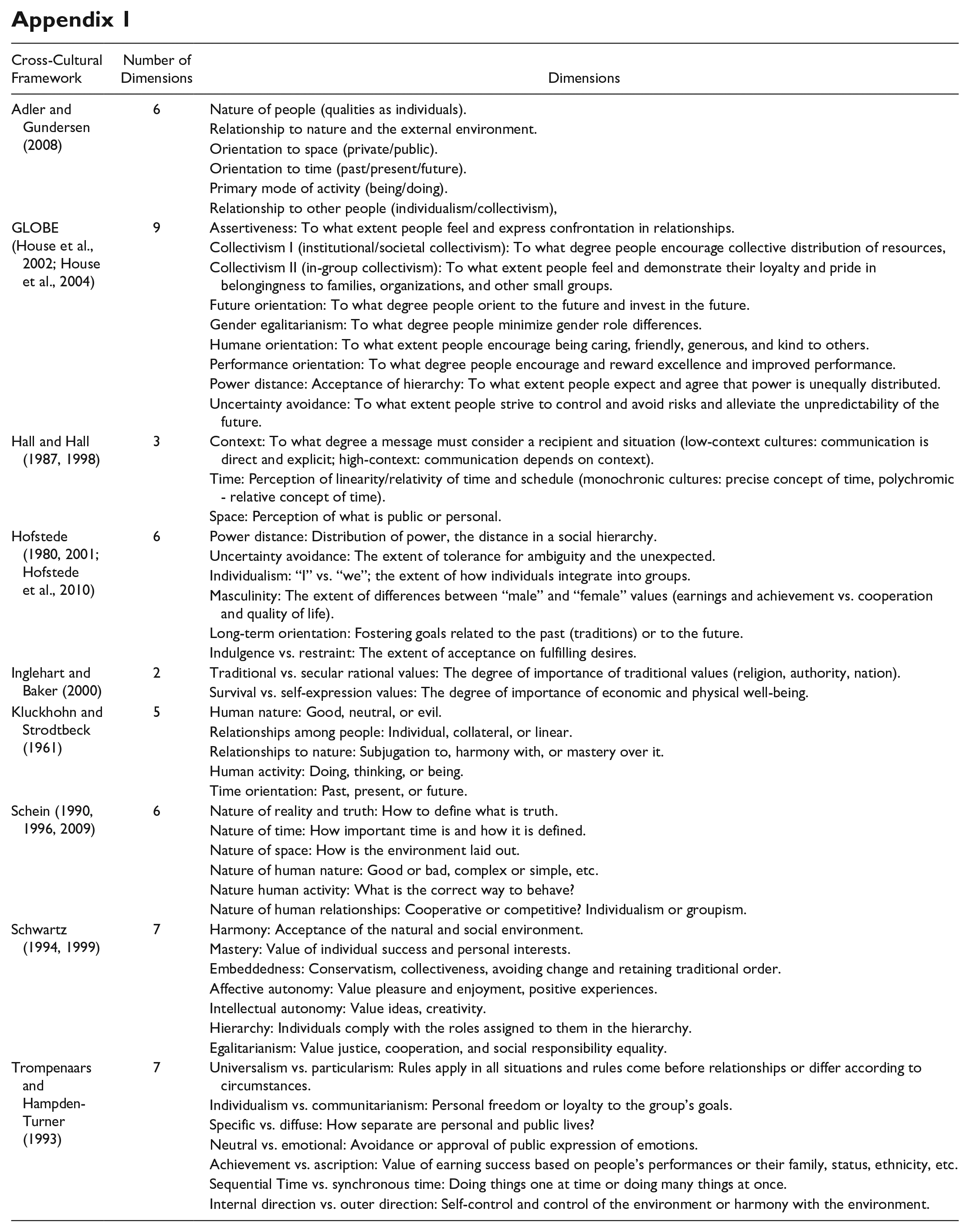
The ideational approach views national cultures as combinations of values, norms, and beliefs (Child & Tayeb, 1982). These theories typically use quantitative techniques and are formed into groups of dimensions that represent a country’s cultural values. The foundation of cross-cultural dimensional methods lies in the work of Kluckhohn and Strodtbeck (1961), who suggested a framework consisting of five dimensions. This had a big impact on how cross-cultural studies developed after that (Browaeys & Price, 2011). Appendix 1 lists the common ideational theories on national cultures.
The most well-known and dominant theory in cross-cultural research is the theory by Geert Hofstede (Chanlat et al., 2013; López-Duarte et al., 2016; Nakata, 2009). Hofstede’s (1980) original methodology included four dimensions: power distance, uncertainty avoidance, individualism, and masculinity. The dimensions of long-term orientation (Hofstede, 2001) and indulgence versus restraint (Hofstede et al., 2010) subsequently complemented the framework. Hofstede’s theory has been noted for its clarity and parsimony, as well as its resonance with managers (Kirkman et al., 2006). López-Duarte et al. (2016) confirm that the prevalence of comparative studies at the national level has led to the common application of this framework.
Many alternatives to Hofstede’s framework have been developed, including Schwartz’s framework (Schwartz, 1994, 1999), the GLOBE project (R. House et al., 2002; R. J. House et al., 2004), the cultural dimensions framework of Edgar Schein (1990, 1996, 2009), the framework by Inglehart and Baker (2000) based on the World Value Survey, Hall’s cross-cultural framework (Hall & Hall, 1987, 1998), the seven-dimensions framework (Trompenaars & Hampden-Turner, 1993), Adler’s dimensions (Adler & Gundersen, 2008), and so forth. More details on each framework are provided in Appendix 1.
There have been applications for these frameworks as well as others, or combinations of them (for example, Steenkamp, 2001). Similarities to Hofstede’s or Kluckholn and Strodtbeck’s framework and the strong connections between the dimensions have drawn criticism, though. For instance, the first four dimensions of GLOBE are direct extensions of Hofstede’s framework. Because they do not adhere to contemporary standards, existing cross-cultural theories are criticized by academics. The frameworks frequently devalue intra-country variety and stick rigidly to territorial limits (Baskerville, 2003; Mazanec et al., 2015; McSweeney, 2009). Their questionnaires have empirical (non-theoretical) designs (Thomas & Peterson, 2014). The frameworks have also been criticized for their limited number of dimensions that leads to significant oversimplification (Thomas & Peterson, 2014), and their lack of consideration of geopolitics, religion, ethnicity and history, language, and other specific contexts (e.g., Primecz et al., 2016). Recent studies recommend applying a polycontextual approach and including new aspects of cultural differences (Kirkman et al., 2017; Primecz et al., 2016; Tsui et al., 2007).
Theories of national cultures: Institutional approach
The institutional approach is another side of national cultures. This approach is based on the specifics of institutions in a national society (Peng, 2002), for example, political, economic, social, and legal grounds. The term “national context” (or “institutional environment”) refers to the complex of institutions of a nation. Considering social institutions as “the tangible manifestations of cultural distinctiveness” (Child & Tayeb, 1982, p. 46), institution-based theories admit the existence of connection between the institutions and cultural values. The characteristics of a nation’s social institutions are reflected in its people and organizations. Institution-based theories evaluate through the perspective of social activities, practices, and structures. Research based on such theories has typically taken a qualitative approach.
Social institutions can be formal or informal, and various related categories and components have been identified. For example, Usunier (2013) specifies relationship patterns, the legal system, and language and communication. Tayeb (2003) recognized various types of national and international institutions, including multinational companies, mass media, education, religion, family, a country’s political systems, social and economic policies and practices, regulation and legal practices, trade unions and industrial relations, capital markets (investments), and intergovernmental organizations. The institutional approach is less developed than the ideational approach, as the influence of social institutions on national cultures has not been as much of a focus as the dimensional theories previously discussed.
Application of cross-cultural frameworks
Recent reviews of the literature on cross-cultural studies in international business show that quantitative approaches predominate by a wide margin (López-Duarte et al., 2016) because comparative studies are prevalent (Tsui et al., 2007; Usunier, 1998). The use of exploratory investigations and qualitative approaches is sparse, despite the fact that some researchers have argued for it (Hofstede, 2015; López-Duarte et al., 2016). By offering a high degree of conceptualization, theory creation, and detailed descriptions of actual phenomena, qualitative cross-cultural research can make a substantial contribution (Doz, 2011).
Studies on hospitality and tourism also mainly consist of country-level comparisons and quantitative methods (Crotts, 2016), and Hofstede’s framework is also commonly applied (see, for example, Song & Wei, 2024). Main topics in tourism and hospitality literature are customer behavior (covering themes such as brand awareness, trip planning, purchase intention, and satisfaction) and human resource (teamwork, leadership, and employee satisfaction). Very few have investigated management issues from the travel industry perspective and, unlike cross-cultural research, studies of tourism and hospitality have demonstrated a relatively balanced representation of countries from different regions (Crotts, 2016).
Business Models
Concepts of BM and digital BM
The term business models (BM) emerged in academia in the 1950s (DaSilva & Trkman, 2014; Novak, 2014). The use of the term in academic papers increased significantly in the 1990s (Zott et al., 2011), and has since been developed further (DaSilva & Trkman, 2014; Novak, 2014). The concept of BM has evolved from a simple “description of the sources of revenues” (Timmers, 1998, p. 4) to the more constructive definition of “a set of elements and their relationships and allows expressing the business logic of a specific firm” (Osterwalder et al., 2005, p. 10), and then to the modern conceptualization as “the way of doing business” (DaSilva & Trkman, 2014). The idea of a BM is now confirmed to be foundational to any business (Magretta, 2002).
The BM concept is an essential construct representing value-creation processes in any organization (Amit & Zott, 2001; Chesbrough & Rosenbloom, 2002). BM being an intermediate layer between a company’s strategy and business processes (Veit et al., 2014), helps to understand, analyze, and make strategic-oriented decisions (Osterwalder et al., 2005; Pateli & Giaglis, 2004; Shafer et al., 2005). BMs delineate the roles of the various actors involved (Al-Debei & Avison, 2010). While a company’s strategy represents its long-term aims, its BM describes what the company currently is (DaSilva & Trkman, 2014).
The term “Digital BM” has become more common with spread of information and communication technologies (ICTs) and the development of digital business. Some researchers have viewed the digital BM concept as any type of e-business (e.g., Novak, 2014) or e-commerce (e.g., Gordijn & Akkermans, 2003). However, Veit et al. (2014) highlight the importance and in-depth transformations caused by technology adoption: “a BM is digital if changes in digital technologies trigger fundamental changes in the way business is carried out and revenues are generated” (p. 48).
Digital BMs are an essential element of digitalization. Digital transformation in a company occurs when it applies and incorporates digital technologies into its BM (Ritter & Pedersen, 2020). Digital BM is the result of digital transformation and innovation and implies the exploitation of new disruptive technologies (Caputo et al., 2021).
Digital BMs in the travel industry
The digital BM concept is particularly significant in the modern travel industry, as digital technology has had a major transformative impact (Mitas et al., 2015; Pencarelli, 2020; Wade et al., 2021). Tourism companies adopt new technologies and develop more adaptive and innovative BMs (Spencer et al., 2012). According to Reinhold and colleagues’ (2017; Reinhold, Zach, & Krizaj, 2019) research on BMs in tourism, the great majority of papers are focused on BM success criteria, designing BMs for specific sectors such as hospitality or food services. Various BM typologies have been developed for various tourism and hospitality sectors, including airports and air companies (Diaconu, 2012; Frank, 2011), destination management organizations (Reinhold, Beritelli, & Grünig, 2019), tourism BMs for digital public content (Kreinberger et al., 2014), yacht tourism (Battistella et al., 2018), and so forth.
The newly grown digital travel industry is characterized by customer-centricity and high personalization (Mitas et al., 2015), the boom of online distribution (World Economic Forum, 2017) and, recently, especially of mobile channels. Most importantly, current technological changes in the travel industry pose existential risks to tourism SMEs (Mitas et al., 2015) which have limited resources in comparison to large online travel agencies and Google. In these conditions, understanding the role and mechanism of national cultures might be existential for BM innovations among tourism companies.
The topic of digital BMs in tourism has been less investigated (Reinhold et al., 2017; Reinhold, Zach, & Krizaj, 2019). Value creation has been the main focus of digital BM studies, such as through mobile apps for cultural tourism (Ammirato et al., 2022), or specific BM configurations—for example, for a spa tourism enterprise (Szromek & Naramski, 2019) or Peer-to-Peer BM (Miao et al., 2023). General typologies of BMs were suggested by Schmidt et al. (2017) for ICT-enabled travel companies, and by Perelygina et al. (2022) for digital travel companies.
Impact of national cultures
As few studies have examined the impact of national cultures on BMs, this section reviews the effects of national cultures on strategy, business processes, and ICT adoption, which are concepts closely related to digital BMs.
Strategy and culture are closely connected (Hammerich & Lewis, 2012; Schoenberger, 1997). National culture can influence strategy on two levels (Tayeb, 2003; Schneider & De Meyer, 1991; Thomas & Peterson, 2014): individual (for example, the manager’s or customer’s level) and collective (i.e., the organization or industry level). Yeung et al. (2016) show that national culture has a significant impact on managers’ decision-making in the hospitality franchise purchase process (an example of the individual level). At the collective level, national cultures can affect, for instance, the development of strategies (Fatehi, 1996; Schneider, 1989), competitiveness strategies (Trice & Beyer, 1993), and company goals (Porter, 1990). Strategy implementation also varies across countries (Bartlett et al., 2011).
The effects of national cultures on strategy are also noted regarding the institutional side of national cultures. Cross-cultural management challenges have been observed in terms of bribery and corruption, employee relations, technology transfer, stewardship, competition, consumer protection, transparency/disclosure, and finance and taxation (Steers et al., 2010). Schneider and Barsoux (2003) see national context in government policies, the role of government and unions, market conditions, educational systems, history, economic and political systems including ownership structures, currencies, investment culture, governance structures, business systems, laws and regulations, labor-management relations, and international organizations.
In both ideational and institutional terms, the organization of business processes and organizational design are connected with national culture. Three dimensions by Hofstede (power distance, uncertainty avoidance, and individualism) are suggested to affect business process models (Wehner et al., 2017). Jayaganesh and Shanks (2009) identify the effects of power distance, individualism–collectivism, uncertainty avoidance, and performance orientation (Hofstede’s framework and GLOBE) on business process management. Schneider and Barsoux (2003) recognize the impact of four domains of institutional context on organizational processes: (1) policies and procedures, for example, formalization and standardization of procedures; (2) control systems including the centralization of control and coordination; (3) information processing such as transparency and communication patterns; and (4) decision-making, including who makes decisions, who is involved, where, and how quickly.
Effects of national cultures in the digital era
Although cross-cultural studies show a significant impact of cultural differences across nations in a wide range of business processes, there is no consensus on the role of national cultures in the digital era. One point of view states that globalization and digitalization significantly reduce cultural differences globally (Fang, 2005), or even make the effects of national cultures irrelevant. Globalization and digitalization have created a “global culture” and it is overwhelming national cultures. (Bird & Stevens, 2003). For example, Peng (2013) states that the modern strategy of global business is oriented toward global culture, unlike the traditional approach, where the strategy considers cultural differences and cultural distances. However, this position could also be explained by the effect described by Hammerich and Lewis (2012), called: “fish can’t see water”: Personal bias can skew perceptions of the impact of culture. Thus, the aim of this study is to investigate the presence and the mechanisms of the effects of national culture on digital travel businesses.
Existing studies about the effects of national cultures on attitudes toward technology and innovation arrive at different and inconsistent results. Bartholomew (1997) states that a country’s technological development is rooted in its history, cultural values, and attitudes. Social institutions have an important role to play (Kogut, 1991), and, for instance, education and legislation open up opportunities for companies to use and valorize (Tayeb, 2003). However, the effects of different aspects of national culture on ICT adoption can be positive or negative. Van Everdingen and Waarts (2003) conclude that, at the national level, higher indexes of power distance, uncertainty avoidance, and masculinity are associated with low innovation adoption, while long-term orientations have a positive influence. High individualism and low power distance are strongly related to ICT product adoption (Bagchi et al., 2004). Low indices of power distance, individualism, masculinity, uncertainty avoidance, and long-term orientation, according to Medcof and Wang (2017), are characteristics of cultures that foster exploratory innovation. In contrast, those who favor exploitative innovations score highly on short-term orientation, uncertainty avoidance, masculinity, power distance, and collectivism. The effects of national cultures can also be observed in e-commerce adoption. Yoon (2009) noted effects of long/short-term orientation, uncertainty avoidance, and masculinity on acceptance of e-commerce by consumers. Also, high-context and polychronic cultures (two dimensions by Hall and Hall, see Appendix 1) have significantly higher adoption rates for online retailing (Gong, 2009).
Methodology
Research Context and Research Approach
This study adopted a qualitative approach and pragmatic grounded theory in order to obtain in-depth understanding and theory-building. Although previous studies offer multiple cross-cultural theories, existing frameworks do not satisfy modern requirements of cross-cultural research (Baskerville, 2003; Mazanec et al., 2015; McSweeney, 2009). Researchers suggest applying a consolidated cross-cultural approach (Doz, 2011’ López-Duarte et al., 2016; Primecz et al., 2016; Tsui et al., 2007) and diversifying methodology (Hofstede, 2015; López-Duarte et al., 2016). The grounded theory approach is adopted because explorative qualitative cross-cultural research can make a significant contribution by providing rich descriptions of real phenomena, a strong level of conceptualization, and theory building and theory development (Doz, 2011).
Cross-cultural studies can be classified based on the cultural context in question. Adler (1983) distinguishes three approaches to research in this field: research within one nation (unicultural context), investigating differences and similarities across cultures (comparative context), and examining specific aspects of a culture that influence the object of research (intercultural context). The aim of this study is not to investigate one national culture or compare nations or regions, but to reveal effects, mechanisms, and affecting aspects of national cultures. Therefore, the study adopts an intercultural perspective. The intercultural perspective of the study requires the acceptance of existence of multiple points of view, taking into account various narratives both throughout the data gathering process and when evaluating the findings. Pragmatists acknowledge the validity of various approaches as well as the reality of various points of view (Morgan, 2007). The pragmatic research paradigm encourages pluralism, making it easier to take into account participants’ varied points of view (Tashakkori & Teddlie, 2010).
Data Collection
Data were collected through in-depth semi-structured interviews. Secondary sources such as professional tourism media and market reports were used in the screening of potential participants. The selection of participants followed stratified purposive sampling to ensure that different groups of experts were represented (Orcher, 2016). The study settled two stratification criteria: occupation and region of residence (three and four groups, respectively). The choice of these groups aims to represent different points of view across the industry. In addition to practitioners who have experience in developing their digital travel companies, market experts possess in-depth knowledge of the general picture of digital business in the travel industry. Travel accelerators and incubators are the centers where many digital travel businesses start their growth. Table 1 shows the sample design.
Sampling of the Study.
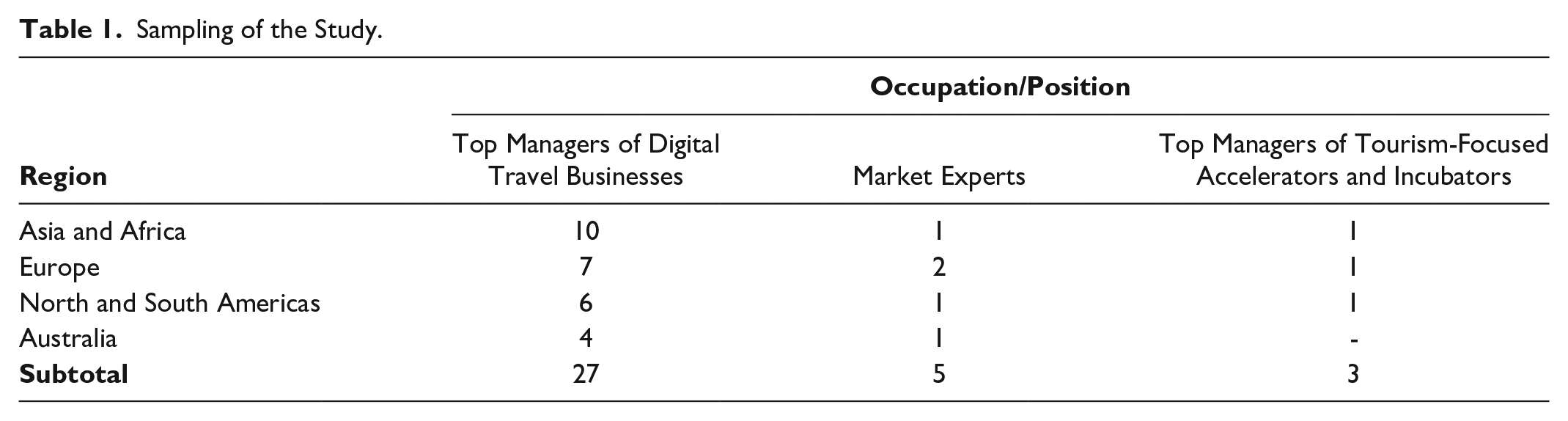
Through the first selection criterion—occupation—the study established three groups: Top managers of digital travel businesses (Chief Executive Officers [CEOs], Chief Operating Officers [COOs], or managing directors with at least 2 years of experience), top managers of tourism-focused accelerators and incubators (CEOs, COOs, or managing directors with at least 2 years of experience), and market experts (academic and applied researchers with at least 7 years of experience in the field of digital travel business). Through this, the study aimed to cover the three main perspectives in the travel industry. The second criterion—business location—ensured the representativeness of participants from different parts of the world.
Overall, 35 interviewees participated in the study, each of whom represented a different company. As Table 1 shows, the numbers of participants across groups is unevenly distributed, which reflects the general population. For example, the group of digital travel business leaders is significantly larger than the other two groups, which corresponds to the predominance of digital travel businesses in the ecosystem.
The participants were aged between 24 and 63 years. The majority were male (88.5%, 31 out of 35), which roughly corresponds to the current distribution in the area of digital travel. The interviewees had a wide range in their level of education—from graduating high school to doctorate degrees—however, the majority of participants had at least a postgraduate level of education. The average professional experience of the participants in the travel industry across groups was 14.4 years, with 12.6 years for the digital travel business leader group, 28.8 for market experts, and 7.4 years for travel accelerator and incubator leaders. The data collection covered all continents except Antarctica. The diversity of the cultures and the availability of the interviewees were the main criteria, which influenced the locations represented. The map in Figure 1 shows the geographical locations of all interviewees.
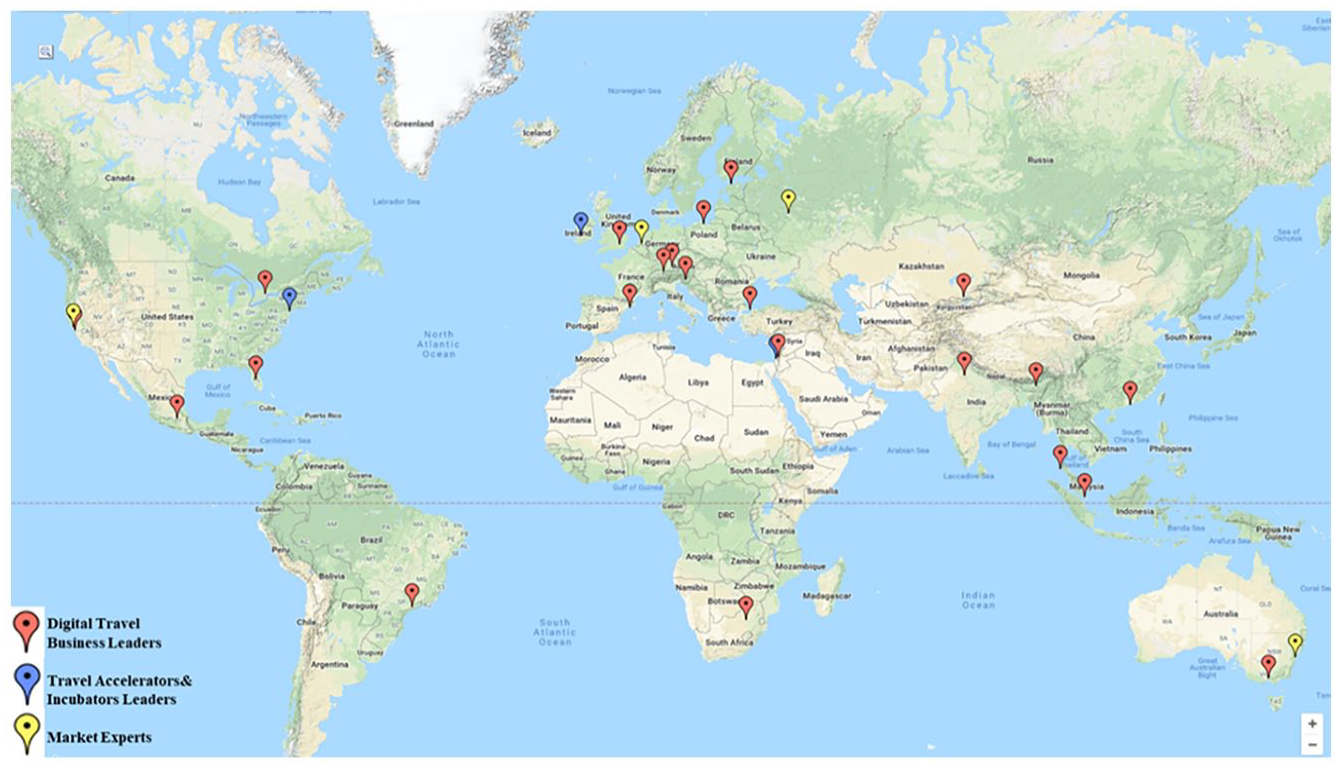
Geography of Data Collection.
The interview design consisted of four sections: terminology reconfirmation, opening questions, key questions, and background questions (Hennink et al., 2011). Terminology reconfirmation was conducted to ensure that both interviewer and interviewee defined key terms similarly. Opening questions established contact and outlined the topic. The third (main) section was aimed at examining cross-cultural aspects affecting digital BMs in the travel industry. This included various open and closed questions regarding the effects of national cultures. Examples are “Have you seen any influences of national cultures on the development of digital BMs in the travel industry among different countries? Direct? Indirect?” “Do national cultures affect BM of your company? How? Do you know any other cases of influences (e.g., competitors)?” and “What aspects/features of national cultures affect the development of digital BMs around the globe?” These questions were adjusted for each group after consideration of the specifics and backgrounds of its members. In addition, this section included tests of understanding (Healey & Rawlinson, 1994) that facilitated evaluation of whether the interviewers sufficiently understood the replies. The interviews ended with questions about the participants’ demographic information and professional, educational, and cultural backgrounds.
The interviews were conducted in one of two languages depending on the interviewee, with 83% (29 participants) preferring English and the remaining six preferring Russian, as it was their native language. All the interviews were conducted by one interviewer in the space of 5 months. Most of the interviews (26) were conducted online, and the rest (nine) were face-to-face interviews. The interviews lasted between 28 minutes and 2 hours 28 minutes. The average duration was 47 minutes.
Data Analysis
The data collection process ended when the data were saturated: new themes and categories did not emerge in the last interviews (Corbin & Strauss, 2008; Glaser & Strauss, 1967). For exploratory studies adopting the grounded theory approach, data saturation shows sufficiency (Morse et al., 2002; Saunders & Townsend, 2016), and then data collection is considered complete (Dingwall et al., 1998).
Combining inductive and deductive analyses was used to improve the validity and reliability of the findings. Qualitative (thematic) content analysis was used to consider both explicit and implicit content such as themes and key ideas. The data analysis included parallel inductive and deductive coding procedures. Open coding (inductive category formation) started with working through the interview texts line by line, developing categories and labels, followed by rounds of revisions of the category system and coding rules, and finishing with an intercoder check (see “Steps of Inductive Category Development” by Mayring, 2014). Simultaneously, the axial coding process (deductive) is used to develop categories from theory. After an in-depth review of theoretical frameworks (see the literature review and Appendix 1), main categories and sub-categories were identified, and coding rules were developed. After that, the process of coding was conducted with subsequent revisions of categories and coding schemes (see Mayring, 2014). The deductive part of the analysis was performed using NVivo (Version 11), while no software was used for the inductive part. For validation and reliability checks, randomly selected interview transcripts were encoded by two researchers independently. Inconsistencies between the two analyses were discussed and coding rules were adjusted to ensure reliable and consistent coding.
Findings
Presence of the Impact
Most interviewees agreed that national cultures influence travel businesses and specifically BM development. The effects of national cultures on digital travel business were noted by almost all of the participants (32 out of 35); for example: “Cultures act differently, cultures communicate differently, very differently. And cultures have different experiences of travel, and also different expectations of services”; “The needs are different. The way of thinking is different.”
Only three respondents did not observe a noticeable influence of national cultures on BM development in the modern travel industry. They suggested that national cultures lacked power in the modern digital world and had little or no effect, and that political, economic, and technological factors were much more significant. They also felt that digital BMs did not need to be adjusted to local cultures because they were universal. The same BMs can be applied throughout the world because of similar global trends.
Thirty out of the 35 participants shared that their businesses encountered difficulties caused by differences in national cultures: “The things we’re able to do in one country, we may not be able to do in another country. . . . You have to do things in a very different way.” Two participants expressed positive views about cultural differences. They had developed their businesses based on cultural differences across countries: “We’re counting on the fact that they all have quite different ways of doing business.”
Mechanisms of Effects
Two stages of impact
The interviewees pointed out that national cultures typically affect the creation and implementation of digital BMs on two stages of an organization’s growth: the start of a new business and internationalization. Thus, in the first stage (start and initial business development), the culture of a country of origin shapes the BM. A travel company’s physical location is typically where it tests its business ideas and a new BM. Even digital technologies must be tested on a smaller scale, as new travel companies will not have immediate global reach: “The plan was to start globally, but then very quickly we decided to focus on Australia and New Zealand to run the experiment, the tests—because, to be successful you have to focus, and we couldn’t focus everywhere.”
Culture also has an impact when a company enters new markets and thus a new cultural context. Most of the participants said that the same BM cannot be applied to all countries because of cultural differences. Any BM configuration must be adjusted during internationalization. The entrance of a digital travel company to the global market requires reshaping its BM because of the cultural specifics of the new country(ies): “I’m an Australian company and I just pick up and get in the States? No, it won’t work. The way they do business in the States doesn’t suit the way people do business in Australia.”
Effects of geography and history
When describing the mechanisms through which national cultures have an effect, the interviewees highlighted the significance of a country’s geographical and historical contexts. These factors can significantly influence national cultures: “The geography is also a part of a culture.” Although these factors are beyond the control of people, they are aware of the effects: “That’s a thing. That’s what is happening.” The term geography implies a broad meaning and includes the internal specifics of a territory (climate, natural barriers and connectivity, predominant landscape, etc.) and external factors (distances to other countries and the geopolitical situation, etc.). The term “history,” in this case, refers to both global and local processes and includes, for instance, forms of government, military conflicts, the political context, the digital divide, and so forth.
Stakeholders’ approach
The respondents stressed that internal and external stakeholders played a critical role in how national cultures affected BMs. They suggested that national cultures initially affected stakeholders’ attitudes toward BM configurations, or parts of them (such as specific revenue models), and their attitudes then shaped BM development.
A wide variety of stakeholders involved (both internal and external) was noted by the interviewees. Respondents mentioned the influence of customers, managers, investors and owners, suppliers, communities, government, and local authorities, for example:
• Suppliers and wholesalers: “In the US, suppliers feel like they have more market power and they don’t need to pay as much for the services.”
• Government: “So it matters what a country does in terms of how they [authorities] manage their resources for tourism.”
• Employees: “You can get away with a little bit of that in terms of automation but there’s a certain amount of human attention that is required to make that happen. I don’t think that fits very well with cultures that like to be offline a lot. The thing I love about Australia is that they like work–life balance. It doesn’t fit well with the culture of building and always-on digital presence.”
Affecting Aspects of National Cultures
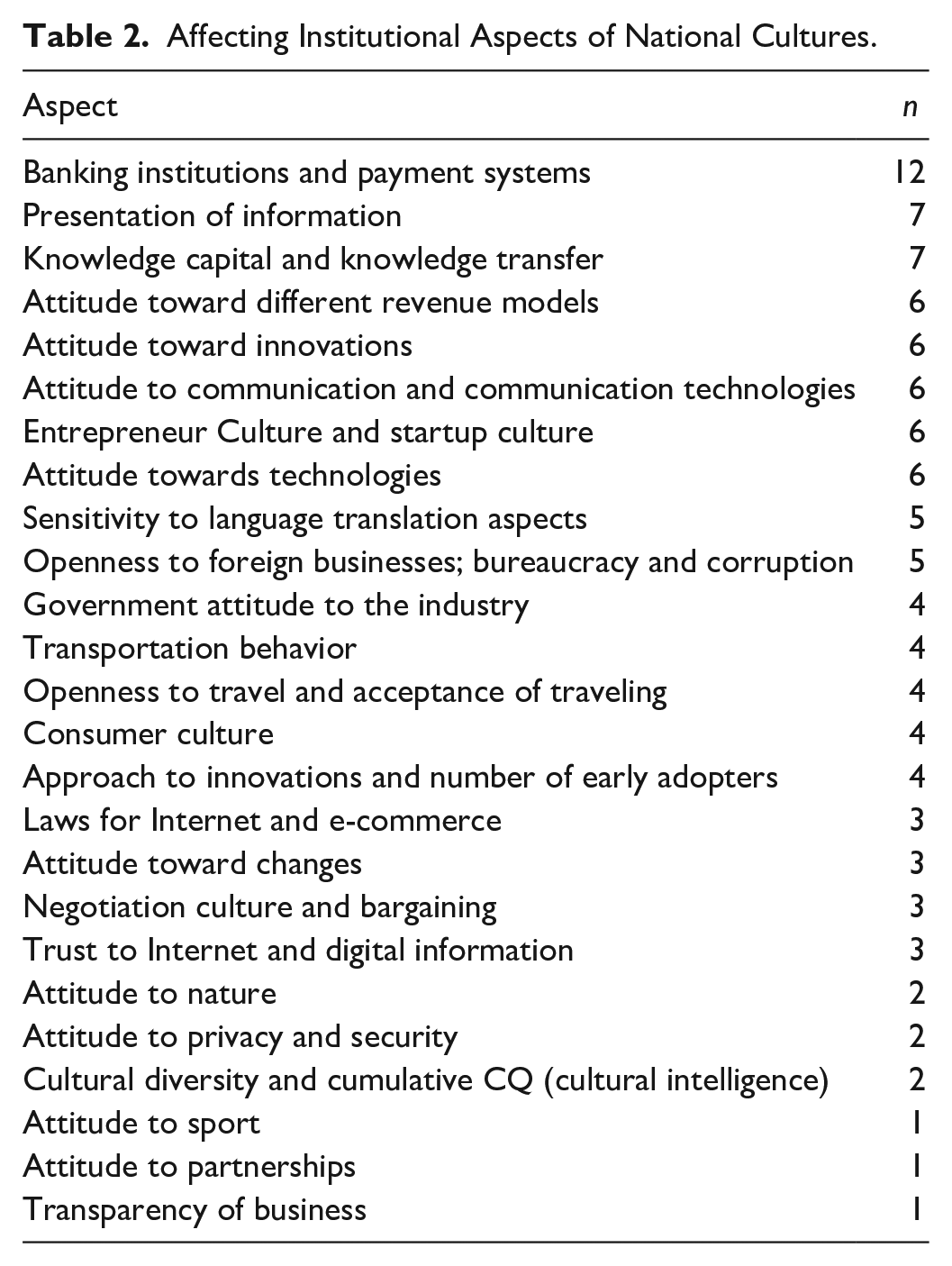
Regarding affecting aspects, 39 were revealed. The explored effects include various aspects from different frameworks. Tables 2 and 3 show institutional and ideational aspects, respectively, and the number of participants who mentioned each of them. Of the 39 aspects, 25 belong to the institutional side of national cultures, and 14 are ideational. Two aspects have the highest number of references: (1) attitude to payment systems and banking institutions (institutional aspect); and (2) uncertainty avoidance (ideational aspect). Twelve interviewees mentioned each of the aspects.
Affecting Institutional Aspects of National Cultures.
Affecting Ideational Aspects of National Cultures.
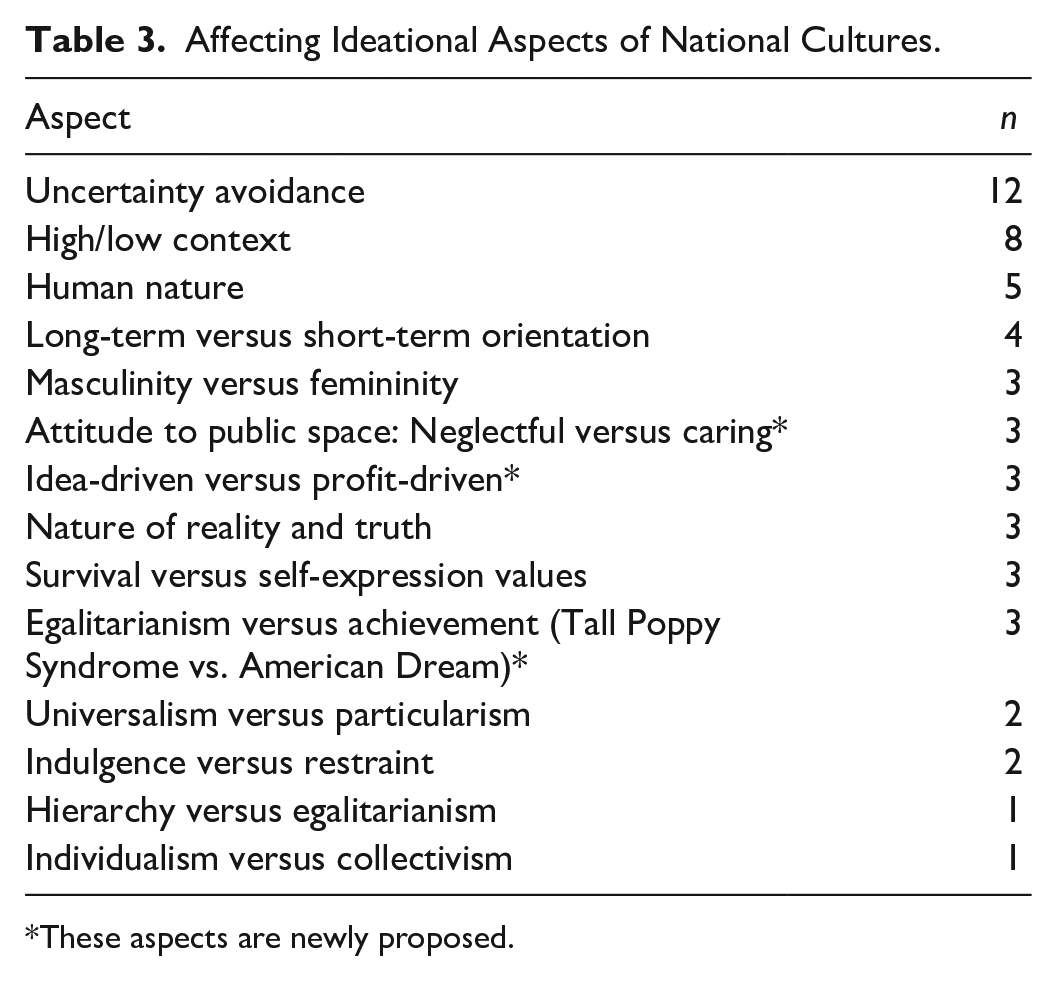
These aspects are newly proposed.
Data analysis included an analysis of latent content, as the participants may have made various references to one aspect. For example, uncertainty avoidance was observed from different sides (see below). Being attributed to the same aspect (uncertainty avoidance), these points were observed in different behavioral patterns (artifacts). Other institutional and ideational aspects were also expressed in various ways.
• Preferences of payment plans (United States – low score, and Turkey –high score):
“For example, you can buy something, subscribe something for long-term. American people subscribe for everything but in Turkey they buy just one time.”
• Planning and customer behavior (Russia – very high score)
“If a person is from Russia, Ukraine, Belarus, (s)he most likely does not plan, (s)he is more spontaneous: ‘What if tomorrow a bear eats me up and I will not go on vacation? So I do not book now.’”
• Starting a new digital travel business (Israel – high score):
[about Israel] “They have a fear of failure. They prefer not to take any chances, and they prefer to have their own quiet life, easy life.”
• Trust to digital services and perceived risk of using them (Austria – high score):
“The strength of the offline model is confidence and familiarity. Yes, Austria still has a lot of offline travel agencies. There’s a level of risk that might have to be taken.”
Discussion
Almost all of the study’s participants confirmed that digital BMs are influenced by national cultures. A few of the interviewees, nevertheless, disagreed with this stance. First, if their companies were conducted in culturally similar environments, they might not ever have encountered significant cultural differences. Minor cultural distinctions would not impact on how their BM developed. Second, it is possible that interview subjects were oblivious to cultural differences due to personal prejudice. This effect was described by Hammerich and Lewis (2012) and is known as “fish can’t see water.” Summarizing, 39 affecting aspects of national cultures are identified: 14 of them represent the ideational side of national cultures (values/dimensions), while 25 of them are institutional (related to social institutions).
Impactful Ideational Aspects
Fourteen affecting ideational aspects of national cultures include 11 dimensions from different existing cross-cultural theories (see Appendix 1) and three dimensions not introduced in the previous literature. The ideational aspects and their authors (if applicable) are as follows (in alphabetical order).
Human Nature—good or bad (Schein; Adler & Gundersen; Kluckhohn & Strodtbeck)
Hierarchy Versus Egalitarianism (Schwartz)
High/Low Context (Hall & Hall)
Individualism Versus Collectivism (Hofstede)
Indulgence Versus Restraint (Hofstede)
Long Term Versus Short-Term Orientation (Hofstede)
Masculinity (Hofstede)
Nature of Reality and Truth—how to define what is truth (Schein)
Survival Versus Self-Expression Values (Inglehart & Baker)
Uncertainty Avoidance (Hofstede, GLOBE)
Universalism Versus Particularism (Trompenaars & Hampden-Turner)
As other studies have confirmed, BM development is connected to some of the dimensions proposed by Hofstede, GLOBE, and Hall. Thus, the most-referred to uncertainty avoidance has also been recognized by Jayaganesh and Shanks (2009), Gong (2009), and Yoon (2009). The effects of the individualism versus collectivism dimension have been previously noted by Jayaganesh and Shanks (2009) and Wehner et al. (2017). Gong (2009) confirmed the effects of high/low context. However, the power distance dimension lacks support in the findings, which is in contrast to the studies of Wehner et al. (2017) and Bagchi et al. (2004). Similarly, the effects of monochronic versus polychronic perception of time (Hall & Hall, 1987, 1998) are not supported, unlike in the previous study by Gong (2009). Effects of other dimensions proposed by Hofstede have been explored, such as long-term versus short-term orientation, indulgence versus restraint, and masculinity versus femininity. Moreover, this study has identified the impact of other dimensions proposed by Inglehart and Baker, Trompenaars and Hampden-Turner, Schein, and Schwartz. The impacts of these dimensions have not been previously explored.
Proposed New Dimensions of National Cultures
The three newly identified dimensions of national cultures are discussed as follows and are based on the respondents’ descriptions and the cultural values behind them.
1. Idea-driven versus profit-driven refers to whether ideas or profit provide the basic motivation to do business. Businesses may be more likely to be sustainable in idea-driven nations, where making profit is less of a goal. The respondents included the Middle East countries in this group. Conversely, profit-driven cultures are likely to ensure in advance that they will make a profit, and thus the motivations are mainly financial. Interviewees cited Scandinavian countries as examples of profit-driven nations.
2. Attitude toward public space: Neglectful versus caring looks at attitudes towards shared spaces and things. Some cultures are conscious and caring about public space, while others are indifferent or neglectful. Unlike previous literature, this dichotomy does not analyze perceptions of what is public or personal. The focus of this dichotomy is on opinions and behaviors.
3. Egalitarianism versus achievement (Tall Poppy Syndrome vs. American Dream) refers to attitudes toward an individual’s accomplishments, success and high status. The typical U.S. phenomenon of the American Dream is one extreme, in which an individuals’ advancement is praised. The Tall Poppy Syndrome, which is typical for Australia, represents the other extreme. It is characterized by negativity and criticism of outstanding people. Despite the fact that these two phenomena have been mentioned in the literature (Mandisodza et al., 2006; Schein, 1985), this dichotomy has not been developed further into a cultural dimension or examined in other countries.
Impactful Institutional Aspects
To systematize, institutional aspects were grouped into domains. Figure 2 represents 25 impactful institutional aspects summarized into four domains. An aspect may be included in multiple domains. Four domains are attitudes towards tourism in general and the travel industry, business and market-related issues, attitudes towards ICT, and approach to innovations. Perceptions of tourism as a phenomenon of activity—including attitudes toward travel in general and attitudes toward other facets of tourism, such as transportation, sport and outdoor activities, and nature—are referred to as attitudes towards tourism and the industry. The existence of tourism-related intellectual capital and the capacity to transfer this information, as well as governments’ perspectives on the travel industry, are two aspects directly relevant to the travel business. The group of business and marketing aspects includes a variety of aspects related to market culture (such as negotiation and bargaining cultures, attitudes toward revenue models), management-related components (such as attitudes toward partnerships), and specifics of financial institutions, such as payment systems and banking institutions. Perceptions of technology, payment systems, communication technologies, and startup culture are all included in the group of attitudes toward ICT. The approach to innovations is based on Rogers’ (1983) theory of diffusion of innovation. The early adoption by owners, investors, and customers is critical for development of digital BMs. This domain of aspects of national cultures also includes overall cultural intelligence (CQ), the theory proposed by Bucher (2008).
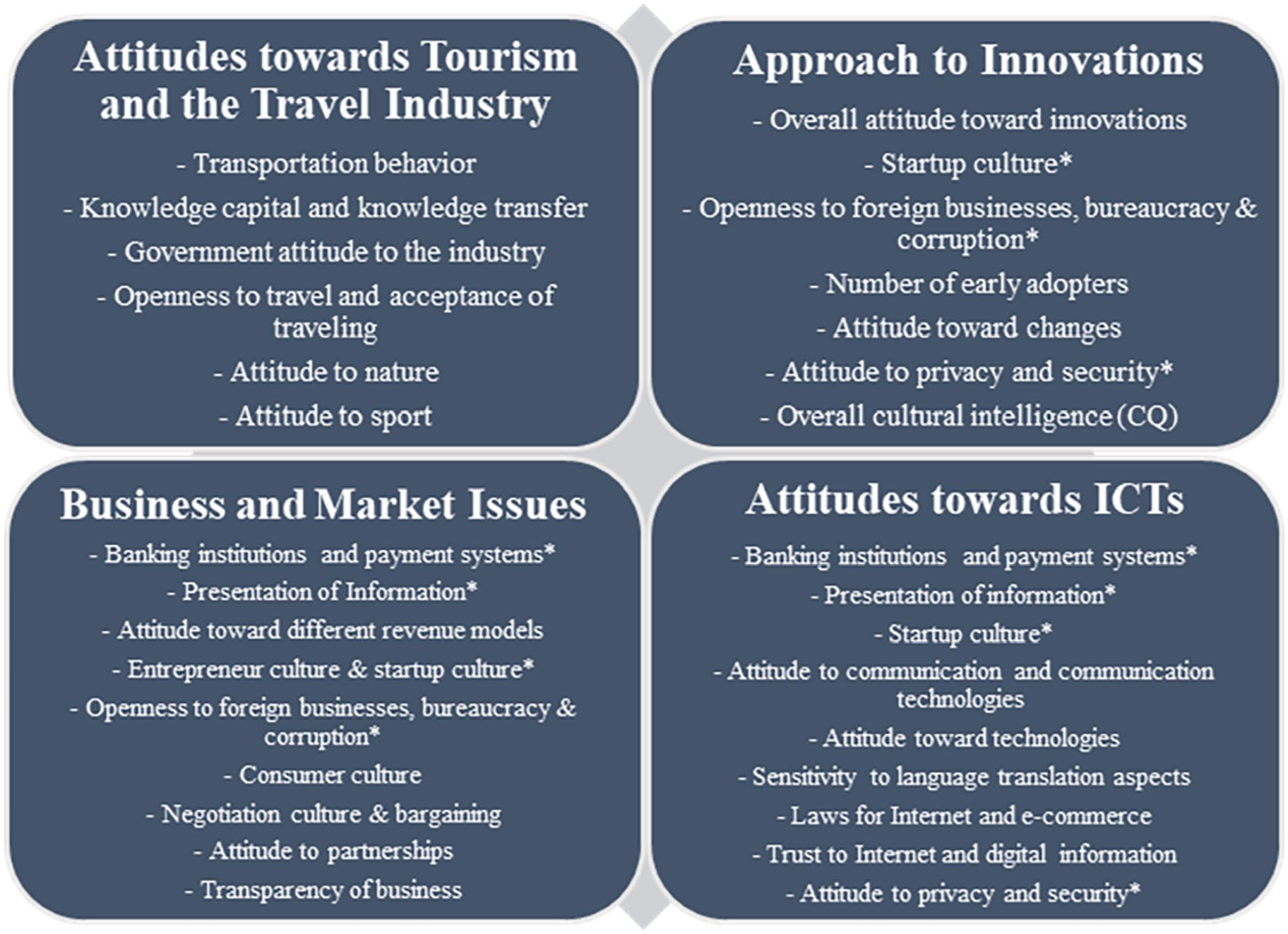
Four Domains of Affecting Institutional Aspects.
These findings closely correspond to those of previous literature. Schneider and Barsoux (2003) also found effects of state policies and regulations, currencies, social welfare philosophy, business practices, and legislation. However, other effects noted by Schneider and Barsoux (such as the impact of educational systems, and differences in attitudes toward investments and towards intergovernmental organizations) were not identified in this study. Like Steers et al. (2010), the study has confirmed the effects of corruption and environmental attitude.
As noted in the literature review, institutional aspects of national cultures are consolidated into 13 social institutions by Tayeb (2003). The results of this study go beyond this figure, presumably because new social institutions have grown since 2003, such as the startup culture. Second, Tayeb’s (2003) study research did not take into account the particulars of the travel business because it was more generic in nature. Third, this study’s methodology of in-depth interviews and its intercultural perspective allowed for the discovery of new aspects of the institutional side of national cultures and their effects.
Proposed Model
Initially, history and geography shape national cultures (see section ‘Effects of geography and history’ above and Tayeb, 2003), which then affect stakeholders’ mindsets and attitudes to BMs. These attitudes in turn shape digital BMs. National cultures consist of institutional contexts and the specific system of values (ideational context). The proposed model of the study is presented in Figure 3.
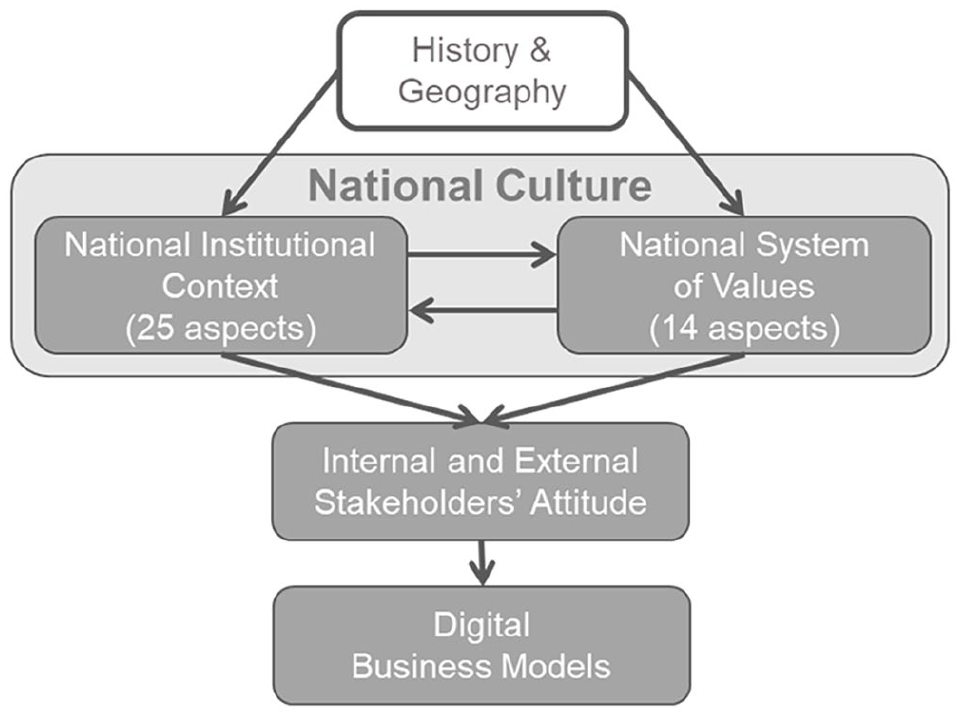
Proposed Model.
Two significant and influential aspects that affect national culture are a nation’s historical evolution and geographic location. Geography defines a country’s climate, landscape barriers, and distances to other countries, which, in turn, affect people’s cultural values, attitudes toward travel, sport, innovations, and communication, among other characteristics and social institutions. Similar to geography, local and international historical developments, turning points, and events influence a nation’s system of values, languages, religions, and numerous social institutions. The literature has addressed these relationships. Tayeb (2003), for instance, noted that history, climate, and geography are significant factors that shape national cultures. By examining the shared histories of nations, Hofstede (1980) further defined cultural clusters. Bartholomew (1997) established the historical foundations of attitude to innovations affecting technology and firm behavior.
Two sides of national cultures (ideational and institutional) are interconnected. Both the findings of this study and the previous literature (see Bartholomew, 1997; Child & Tayeb, 1982; Steers et al., 2010) confirm their mutual influence. National cultures are two-sided phenomenon and institutional aspects are just as essential as the ideational side despite the fact that most studies in the cross-cultural field disregarded the institutional aspects of national cultures.
The model also shows the mechanism of how national cultures impact the development of digital BMs through stakeholders’ mindsets. The mindsets of internal and external stakeholders, including customers, suppliers, owners, managers, employees, and investors, are influenced by national cultures, as evidenced by our findings. Similarly, Thomas and Peterson’s (2014) model includes the mediating effect of managerial mindsets as a particular case of cultural differences affecting organizational designs. Steers et al. (2010) also noted the mediating effect of employment relations, and Dalby et al. (2014) highlighted team and customer involvement as affecting BMs in the internationalization stage. However, these models only considered limited numbers of stakeholders, while the proposed model considers the attitudes of all stakeholders (internal and external).
Conclusions
This study aimed to identify the effects of national cultures in the global digital travel ecosystem and their impact on the development of digital BMs. The study revealed the mechanism of the effects, identified affecting aspects, and proposed a model illustrating these effects. The model could be used to understand the relationships between the dimensions of national cultures and BMs in the digital travel sector, as well as to build and analyze digital BMs, clusters, and digital initiatives in tourism. Furthermore, the study concludes the effects into two sides: ideational and institutional. Institutional aspects were organized into four domains and ideational aspects into 14 dimensions, of which 11 have been previously described in various frameworks. Based on dichotomies revealed by respondents, three new cultural aspects are proposed. The newly proposed cultural dimensions expand opportunities to analyze national cultures in more detail in future studies. With an intercultural perspective, the study does not aim to make comparisons among countries and their cultural contexts. The study’s implications are not geographically restricted and can be applied beyond a single region or a few countries because it was not specifically focused on a particular country or region.
Implications
The study contributes to theory, first by restating the role of national cultures for digital travel businesses. The results demonstrate that national cultures continue to have an impact on the travel industry despite globalization and digitization, which can blur cultural distinctions across nations. Cross-cultural research thus remains significant and relevant in the world of modern digitalization. The second contribution lies in the explored mechanisms of effects and the impactful aspects (dimensions) of national cultures on the development of digital BMs. National cultures affect stakeholders’ mindsets and, in turn, shape BMs. The study identified 39 affecting aspects of national cultures: 14 of them belong to the ideational side of national cultures (values/dimensions), and 25 of them represent the institutional context. Third, this paper highlights the significance of the institutional side to national cultures. The institutional component of national cultures has received less attention in earlier works, which has undervalued them. The results of this study stress the importance of differences in societal institutions and their impact, and the necessity of taking them into consideration alongside the ideational side of national cultures. This complementarity is essential for future high-quality studies on national cultures.
On the practical side, understanding the role of national cultures and the mechanisms of their impact could be beneficial for travel businesses at different stages of their development. Thus, knowledge of the influential aspects can help in selecting suitable countries in which to start new travel businesses, and suitable BMs for specific cultural contexts, which can ensure the successful development of a business. In addition, consideration of national cultures is important in times of international expansion, and when adapting or localizing a BM for a particular region. Considering the effects of national cultures can help to minimize the risks and apprehension associated with BM adoption.
Limitations and Future Directions
First, as a qualitative study, this paper suggests a model and provides insights and novel findings for future application, but further statistical tests are required. For example, the extent of the influence of the four domains should be further examined in future tourism studies. Three newly suggested dimensions of national cultures (idea-driven vs. profit-driven; attitude toward public space: neglectful vs. caring; and egalitarianism vs. achievement [Tall Poppy Syndrome vs. American Dream]) require further validation by quantitative studies. Also, this investigation did not consider intra-national variations of national cultures. Mentions and examples of countries and regions in this study imply relatively homogeneous characteristics. However, within-country variations exist, as noted by previous literature, and people’s values and behavior differ within a country (e.g., McSweeney, 2009). Discussing national cultures with interviewees typically leads to the reporting of average values or typical behavior. Third, the effects of time zone differences and physical distance as being a part of the geographical roots of cultural differences were never mentioned by participants and require further investigation. Finally, the applicability and scalability of the proposed model (Figure 3) have limitations. On the one hand, the overall mechanism of the effects is likely to be applicable to other industries, which also was partially supported by previous studies (Bartholomew, 1997; Tayeb, 2003; Thomas & Peterson, 2014). On the other hand, the list of affecting aspects is expected to be peculiar for every industry.
Two directions should be considered by scholars for future research. The first recommended direction is the impact of national cultures in cases of adopting a BM across countries. In particular, BM adoption could be analyzed within a single multinational company, between different companies, and in cases of international mergers and acquisitions. The second direction is further research of cultural specifics at the cluster level. The impact of cultures was also noted at a regional/cluster levels. Research on the culture of clusters, such as New England or the Greater Bay Area, is recommended for future studies.
Footnotes
Appendix
| Cross-Cultural Framework | Number of |
Dimensions |
|---|---|---|
| Adler and Gundersen (2008) | 6 | Nature of people (qualities as individuals). |
| Relationship to nature and the external environment. | ||
| Orientation to space (private/public). | ||
| Orientation to time (past/present/future). | ||
| Primary mode of activity (being/doing). | ||
| Relationship to other people (individualism/collectivism), | ||
| GLOBE (House et al., 2002; House et al., 2004) |
9 | Assertiveness: To what extent people feel and express confrontation in relationships. |
| Collectivism I (institutional/societal collectivism): To what degree people encourage collective distribution of resources, | ||
| Collectivism II (in-group collectivism): To what extent people feel and demonstrate their loyalty and pride in belongingness to families, organizations, and other small groups. | ||
| Future orientation: To what degree people orient to the future and invest in the future. | ||
| Gender egalitarianism: To what degree people minimize gender role differences. | ||
| Humane orientation: To what extent people encourage being caring, friendly, generous, and kind to others. | ||
| Performance orientation: To what degree people encourage and reward excellence and improved performance. | ||
| Power distance: Acceptance of hierarchy: To what extent people expect and agree that power is unequally distributed. | ||
| Uncertainty avoidance: To what extent people strive to control and avoid risks and alleviate the unpredictability of the future. | ||
| Hall and Hall (1987, 1998) | 3 | Context: To what degree a message must consider a recipient and situation (low-context cultures: communication is direct and explicit; high-context: communication depends on context). |
| Time: Perception of linearity/relativity of time and schedule (monochronic cultures: precise concept of time, polychromic - relative concept of time). | ||
| Space: Perception of what is public or personal. | ||
| Hofstede (1980, 2001; Hofstede et al., 2010) | 6 | Power distance: Distribution of power, the distance in a social hierarchy. |
| Uncertainty avoidance: The extent of tolerance for ambiguity and the unexpected. | ||
| Individualism: “I” vs. “we”; the extent of how individuals integrate into groups. | ||
| Masculinity: The extent of differences between “male” and “female” values (earnings and achievement vs. cooperation and quality of life). | ||
| Long-term orientation: Fostering goals related to the past (traditions) or to the future. | ||
| Indulgence vs. restraint: The extent of acceptance on fulfilling desires. | ||
| Inglehart and Baker (2000) | 2 | Traditional vs. secular rational values: The degree of importance of traditional values (religion, authority, nation). |
| Survival vs. self-expression values: The degree of importance of economic and physical well-being. | ||
| Kluckhohn and Strodtbeck (1961) | 5 | Human nature: Good, neutral, or evil. |
| Relationships among people: Individual, collateral, or linear. | ||
| Relationships to nature: Subjugation to, harmony with, or mastery over it. | ||
| Human activity: Doing, thinking, or being. | ||
| Time orientation: Past, present, or future. | ||
| Schein (1990, 1996, 2009) | 6 | Nature of reality and truth: How to define what is truth. |
| Nature of time: How important time is and how it is defined. | ||
| Nature of space: How is the environment laid out. | ||
| Nature of human nature: Good or bad, complex or simple, etc. | ||
| Nature human activity: What is the correct way to behave? | ||
| Nature of human relationships: Cooperative or competitive? Individualism or groupism. | ||
| Schwartz (1994, 1999) | 7 | Harmony: Acceptance of the natural and social environment. |
| Mastery: Value of individual success and personal interests. | ||
| Embeddedness: Conservatism, collectiveness, avoiding change and retaining traditional order. | ||
| Affective autonomy: Value pleasure and enjoyment, positive experiences. | ||
| Intellectual autonomy: Value ideas, creativity. | ||
| Hierarchy: Individuals comply with the roles assigned to them in the hierarchy. | ||
| Egalitarianism: Value justice, cooperation, and social responsibility equality. | ||
| Trompenaars and Hampden-Turner (1993) | 7 | Universalism vs. particularism: Rules apply in all situations and rules come before relationships or differ according to circumstances. |
| Individualism vs. communitarianism: Personal freedom or loyalty to the group’s goals. | ||
| Specific vs. diffuse: How separate are personal and public lives? | ||
| Neutral vs. emotional: Avoidance or approval of public expression of emotions. | ||
| Achievement vs. ascription: Value of earning success based on people’s performances or their family, status, ethnicity, etc. | ||
| Sequential Time vs. synchronous time: Doing things one at time or doing many things at once. | ||
| Internal direction vs. outer direction: Self-control and control of the environment or harmony with the environment. |
Declaration of Conflicting Interests
The authors declared no potential conflicts of interest with respect to the research, authorship, and/or publication of this article.
Funding
The authors received no financial support for the research, authorship, and/or publication of this article.
