




Abstract
This study examines the role of visiting relatives (VRs) travel in enabling the interdependencies between transnational sojourners and their stay-behind family members. VRs travel is found to facilitate cross-border support exchange while preserving geographically stretched family ties. This study contributes to the theory by demonstrating that the current understanding of social exchange theory does not adequately explain the dynamics of VRs host-guest interactions, because some previously unidentified factors (e.g., felt obligation and family life cycle) also shape visiting and hosting behaviors. At a practical level, the findings help both sides better understand each other’s needs and respective roles in VRs travel. This study contributes new knowledge to the field of tourism planning and management, by revealing motives and patterns that lie behind VRs travel, while suggesting that the VRs travel market is more diverse than it seems to be, as parent and non-parent visitors tend to have different expectations of hosting.
Keywords
Highlights
VRs travel facilitates cross-border social exchange and shapes family wellbeing. Sociocultural nuances improve use of social exchange theory in VRs travel research. Family life cycle acts as a theoretical lens in exploring the dynamics of VRs travel. Elderly parents and non-parent visitors have different expectations of VRs travel.
Introduction
Although COVID19 disrupted global travel and migration (Gössling et al., 2020), in an era of transnationalism, international migration between countries is expected to increase (A. Liu et al., 2021; A. T. Liu et al., 2023) with sojourners’ migration strategies remaining multiple and circular (Choi & Fu, 2018). Transnational sojourners tend to maintain close ties with stay-behind family members throughout their migrant trajectories (Baldassar et al., 2014) because the geographically stretched ties play an important role in shaping the lives of both sides (Conkova & King, 2019), acting as “the ultimate unit of sharing and caring” that preserves wellbeing (Bryceson, 2019, p. 3045). Even so, prolonged separation may gradually weaken their family ties (Baldassar et al., 2016). Although phone calls and video communications are helpful, they are often inadequate (Baldassar et al., 2014), as family ties are best preserved through face-to-face interactions (Janta et al., 2015). Weakened family ties potentially lead to tension, conflict, and sadness (Wang, 2016).
Prolonged separation also threatens the wellbeing of transnational sojourners (Baldassar, 2008; Collins, 2010) and their stay-behind families (Janta et al., 2015), because living worlds away constrains family-based support exchange (Baldassar et al., 2014). In particular, elderly parents frequently encounter serious care drains (Boccagni, 2015) and lack of emotional support, which produce a sense of loneliness, loss, and regret (Baldassar, 2007).
Some researchers indicate that visiting relatives (VRs) travel plays an important role in addressing the challenges sojourners and their stay-behind family members face, by enabling them to strengthen their bonds (Backer & Lynch, 2017; Griffin, 2014), and effectively exchange essential support (R. King & Lulle, 2015; Yousuf & Backer, 2017). However, to date, researchers’ understanding of the role of VRs travel in shaping family ties and wellbeing remains insufficient (Backer, 2019; Backer et al., 2022).
Furthermore, few studies examine such effects of VRs travel from a non-Western perspective (R. C. Capistrano & Weaver, 2017). Non-Western approaches are required to achieve a wider understanding of the transnational social phenomenon (Backer et al., 2020), as there are clear differences in motive, behavior, and meaning between Western and non-Western VRs travel (Schänzel et al., 2014). Also, most extant studies lack theoretical underpinning (R. C. G. Capistrano & Weaver, 2018; Munoz et al., 2017). From a non-Western perspective, this study explores the role of VRs travel as an enabler of interdependencies between sojourners abroad and their stay-behind family members, using social exchange theory.
Social Exchange Theory
Social exchange theory offers two principles to interrogate the phycological dynamics within social relationships (Beckman-Brindley & Tavormina, 1978) and interpersonal interactions (Y. Zhang et al., 2020), offering good insights (H. K. Lai et al., 2021). People are inclined to assess the benefits and costs of social exchange and are often more willing to engage in the exchange in which perceived benefits outweigh costs (Nugroho & Numata, 2022). Also, people appreciate reciprocity in social exchange (Gui & Koropeckyj-Cox, 2016).
Social exchange theory is useful for interrogating the meanings behind VRs host–guest interactions, which reflect a nexus of reciprocity and family solidarity (R. C. Capistrano & Weaver, 2017; Ugargol & Bailey, 2018). For example, the theory was used to understand the support exchange between Chinese sojourners abroad and their elderly parents in China, suggesting that the stay-behinds who visited migrant children to assist with childcare (out of family altruism) are more likely to receive eldercare in times of need (Xu et al., 2018).
The limitations of the theory, however, include lack of theoretical sophistication (Ward & Berno, 2011), oversimplification of the mechanism of social exchange (X. Li & Wan, 2017), and inadequacy of predicting attitude (Park et al., 2017). Some researchers suggest that the theory needs to be extended to include other factors which may help better explain the dynamics behind the formation of people’s attitude towards social exchange (Eslami et al., 2019; Strzelecka et al., 2017). Therefore, this study examines the role of social exchange theory in interrogating the dynamics behind VRs host–guest interactions while seeking to develop the theory to better depict the transnational social phenomenon.
Transnational Interdependencies
Transnational Sojourners
Siu (1952) defines a sojourner as an immigrant who resides in a foreign country for a considerable length of time without being acculturated. Jandt (2001) depicts sojourners as the people who migrate to a host country for diverse purposes, such as employment or educational opportunities, and reside in the destination for a certain length of time, usually from 6 months to 5 years. In an era of transnationalism, this definition overlooks two distinctive features of sojourner: (1) changing migration strategies and (2) living between homes.
Transnational sojourners periodically change migration strategies to meet their family members’ changing needs throughout the family life cycle (Wall & Bolzman, 2013). Their stays in host countries are therefore open-ended and their migration patterns are multiple and circular in nature (Zufferey et al., 2021). For a sojourner, the distinction between home and away is somewhat blurred (Choi & Fu, 2018), as they continually negotiate a sense of home on an ongoing journey (Green et al., 2008).
Transnational sojourners tend to live between homes during their journeys. Reduced costs of international travel enable sojourners and their stay-behind family members to visit each other more easily, while diversified means of communication create a sense of co-presence (Buffel, 2017). Sojourners can thus simultaneously live in both their countries of residence and countries of origin, building complex, stretched, and borderless social worlds (Bell, 2016), and geographically stretched family ties (Griffin, 2014).
Because of the distinctive features, the term sojourner is used in this VRs travel research, although other terms (e.g., immigrant and diaspora) also reflect migrants’ long-term destination experience (B. King, 1994; Pasura, 2010). Given their fluidity and rich destination experience, sojourners play an important role in bridging tourism destinations and their stay-behind families and friends, greatly contributing to VFR tourism marketing (Bakri et al., 2023).
Transnational Family Ties
Family ties between sojourners abroad and their stay-behind family members are often intentionally preserved (Bryceson, 2019), in “a highly flexible social formation” (Kobayashi & Preston, 2007, p. 152), so that family cohesion can be retained. This lays the foundation of felt obligation and the desire to pursue collective wellbeing (Baldassar et al., 2016). For instance, Chinese transnational sojourners and their stay-behind family members often preserve a sense of familyhood by maintaining emotional closeness (J. Liu et al., 2018), or “long-distance intimacy” (Tu, 2016, p. 12).
Transnational family ties act as conceptual bridges that “serve emotional and material needs” (Bryceson, 2019, p. 3043), by enabling cross-border exchange of various forms of support (De Silva, 2018), including financial (i.e., remittance) (Janta et al., 2015), emotional (Kornienko et al., 2018), and instrumental support (e.g., childcare and eldercare) (Conkova & King, 2019). The long-distance intimacy of Chinese sojourners and their stay-behind family members is a foundation of transnational support exchange (Wang, 2016), enabling them to achieve “the balance point between their resource pool and the challenges they face” (Dodge et al., 2012, p. 230).
Although contemporary migration research covers a broad range of topics (Bolzman et al., 2017), extant studies on transnational families and the means through which family wellbeing can be preserved are still relatively few (J. Liu et al., 2017). Even though the COVID19 pandemic once disrupted international travel (Neuburger & Egger, 2021), VRs travel remains an essential means by which sojourners and their stay-behinds can create shared memories, strengthen family ties, and exchange essential support in times of need (Backer et al., 2022), and so deserves more scholarly attention.
Visiting Relatives Travel
Visiting friends and relatives (VFR) travel represents a quarter of cross-border travel and contributes to tourism recovery during post-crises era and economic downturns (Bakri et al., 2023). It denotes “a form of mobility (i.e., the movement of humans) influenced by a host that involves a prior personal relationship and a face-to-face interaction between host and visitor within the destination” (Munoz et al., 2017, p. 482). Although VFR travel has received increasing attention over the past two decades (Seaton, 2017), it is still an understudied field of research (Zentveld & Yousuf, 2022) with a small group of influential thinkers producing most of the publications and heavily dominating the field (Backer et al., 2022).
Also, there is an imbalance of research in VFR travel. Most studies adopt quantitative approaches to investigate its economic implications, while studies that use qualitative constructionist approaches to deepen understanding of its social meanings are slowly emerging (Humbracht et al., 2022). In particular, only a few studies explore the role of VFR travel in facilitating the exchange of support between, and enhancing the wellbeing of, transnational sojourners and those who remain behind (Backer et al., 2022). For instance, in some U.S.–China transnational families, Chinese sojourners are keen to host their stay-behind parents and rely on their childcare assistance, as the migrants face the challenge of balancing work and childrearing (Xie & Xia, 2011).
However, at times, VRs host–guest interactions may also damage the wellbeing of both sides (Backer, 2019). Hosting VRs travel may be boring and exhausting while making sojourners financially vulnerable (Shani & Uriely, 2012), especially when the meaning of hospitality is distorted (Janta et al., 2015). Unpleasant interactions may lead to tensions and conflicts, potentially threatening wellbeing and family ties (De Silva, 2018). For instance, in some U.K.–China transnational families, Chinese sojourners enjoy childcare assistance from their visiting elderly parents, while tending to feel frustrated with the conflicts that frequently emerge during the visits (Tu, 2016). It is therefore important to further explore the social impacts that underpin VFR travel and set it apart from other forms of travel (Griffin, 2013).
This study interrogates the role of VRs travel in shaping family wellbeing. VRs host–guest interactions enable both sides to “experience each other fully, with all five senses” (Baldassar, 2008, p. 252) so that support can be better exchanged (R. King & Lulle, 2015), family ties strengthened (Backer & Lynch, 2017), and time and mobility issues overcome (Schänzel et al., 2014). This study does not discuss Visiting Friends (VFs) Travel because the VRs and VFs are two forms of travel that play different roles in shaping the lives of migrant hosts and visitors (Zentveld & Yousuf, 2022). This research has a Chinese perspective. Understanding the unique social meanings of Chinese VRs travel in shaping family wellbeing is valuable, because of the uniqueness of Chinese migrant hosts and visitors, from sociocultural, economic, and historical aspects (M. Li et al., 2024).
Chinese Transnational Families
Chinese people’s international migration history is surprisingly long (T. E. Li & McKercher, 2016), with inflected migratory flows (Low, 2014). In the first century B.C., some political and religious exiled Chinese people were forced to move to Japan (W. L. Lai, 2004). Until the mid-20th century, several waves of Chinese people left their homeland and settled in global destinations (Han & Khemanitthathai, 2022). The post-1949 international emigration control signaled a significant policy change, which constrained Chinese people from participating in international travel, because of the politicization of its border (Biao, 2003).
Since 1979, the Open-Door Policy gradually opened China’s previously closed society (van Dongen, 2022), as the Chinese government changed its view of emigration, considering it a means to integrate into the international community (Biao, 2003). Since then, changes in legislation and accumulated wealth have enabled Chinese people to move overseas for more employment opportunities, less competitive education, and a better natural environment (T. E. Li & Chan, 2018). For example, those from poor coastal areas tend to consider emigration an important means to improve their socioeconomic status—if not the only means (Biao, 2003).
Now, Chinese people relocate around the globe with high intensity and frequency (M. Guo et al., 2018), with sojourn trajectories perceived as extensive worldwide circuits of return (L. S. Liu & Wu, 2017). A primary motive behind their ongoing sojourning is family members’ changing needs throughout the family life cycle (S. Guo, 2016). For instance, in U.K.–China transnational families, young Chinese sojourners are inclined to stay in the United Kingdom to provide their children with a better education, while middle-aged sojourners tend to return to their homeland, because of stay-behind parents’ growing need for support (Tu, 2016).
Of note, as traditional familial interdependency is threatened, Chinese sojourners and their stay-behind family members face challenges. In Chinese tradition, the family represents the most important source of support (Xie & Xia, 2011). When they live worlds away, Chinese sojourners are often unable to acquire adequate support from their homeland (Ip, 2006), and a sense of guilt is likely to emerge because of the prolonged absence from elderly parents (Tu, 2016), threatening their emotional wellbeing (Wang & Collins, 2015).
Chinese stay-behind parents also face challenges (M. Guo et al., 2018), because the Chinese tradition of filial piety is constrained by prolonged separation, which denotes an almost insurmountable barrier to exchanging essential support (Zhan, 2013). Thus, the meanings of traditional family values are continuously renegotiated (Tu, 2016) with elderly parents often experiencing a lack of support (J. Liu et al., 2018), and thereby reduced wellbeing (Xu et al., 2017).
Such problems are more serious in one-child families. The unique situation created by the 1979 one-child policy, which was lifted in 2016 (J. Zhang, 2017), has led to large numbers of transnational one-child families where the only-child travels overseas, creating a social issue of empty-nest parents remaining in China without emotional and physical assistance from their offspring (X. T. Feng et al., 2014). The result is growing tension between elderly parents’ increasing needs for support and sojourners’ extended stays overseas (Liang & Wu, 2014).
Family Life Cycle
A family can be perceived as an entity, which undergoes changes throughout its life cycle (Wilson, 1985). Some migration researchers have suggested that the family life cycle can be used as a theoretical lens through which transnational interactions between far-away family members can be understood and explained (Baldassar et al., 2014; Bryceson, 2019). In the field of tourism, a six-stage family life cycle framework was proposed by Wells and Gubar (1966), which helped researchers to better understand tourist behavior, and has continually undergone reconstruction (Kim et al., 2020).
Some studies argue that VRs travel patterns and host–guest interactions are greatly shaped by the stage of family life cycle a transnational family belongs to (Janta et al., 2015; Young et al., 2007). Forms of support that family members need and their felt obligations change as the family move from one life stage to another (Horn, 2017), resulting in changes in cross-border support exchange within the family (Wall & Bolzman, 2013). Yet, researchers’ understanding of the relationships between the family life cycle and VRs visiting and hosting behaviors needs development (Backer & Lynch, 2017).
The research reported here further explores such relationships, by using the family life cycle as a theoretical lens to interrogate the ongoing changes in cross-border social exchange as families move from one life stage to another (reflected in VRs travel behaviors) while using social exchange theory to underpin the exploration of the mechanism behind VRs host–guest interactions in general. The two theories are therefore integrated.
This study uses New Zealand as a social laboratory to interrogate the life experiences of Chinese transnational families. The country used to prefer British migrants (McKinnon, 1996) and strictly controlled the number of Chinese migrants (Fairburn, 2003). The 1987 Immigration Act led to the arrival of successive waves of immigrants from around 200 different ethnic backgrounds (Chan, 2017), including Chinese sojourners (Z. Feng et al., 2011). In 2018, Chinese represented about 5% of the country’s population, forming the third largest ethnic group (Statistics New Zealand, 2020). Before the 2020 pandemic, over 40,000 VFR visitors from China contributed more than 200 million NZD (120 million USD) to the country’s tourism sector every year, suggesting a profitable market (Statistics New Zealand, 2019).
Consequently, this study addresses the following research question: How does VRs travel shape the lives of sojourners abroad and their visiting family members? To address this question, the study explores the nature, meanings, and dynamics of VRs host–guest interactions, within the context of Chinese transnational sojourners in New Zealand hosting their family members from China.
Methodology
Research Paradigm
In this study, the researcher’s shifting positionality allows him to constantly move between the roles of Chinese sojourner and researcher. Such a unique positionality enables strong cultural empathy, uncovers deeper meanings behind discourses, and contributes to an insider view (Cousin, 2010). Because of this positionality, the research is underpinned by a social constructionist philosophy, which enables an understanding of co-existent multiple realities (Williams, 2016). That is, everyone builds a special reality in their mind, using their own life experience, and understands the world according to such a unique reality (Schwandt, 2003).
Within social constructionism, consciousness, language, and shared meanings collectively construct knowledge (Weinberg, 2014). Researchers do not collect data, but co-produce realities, together with their participants (Corlett & Mavin, 2018), through actively exchanging views and negotiating meanings, which are “merged” (Phillips et al., 2013, p. 5). Therefore, during in-depth interviews, the researcher and participants actively communicated with each other. During focus group discussions, the researcher encouraged group interactions by suggesting that the participants listen to, respond to, and challenge each other’s opinions. In so doing, the diverse meanings within the transnational phenomenon were uncovered.
Sampling Method
Snowball sampling was used to recruit participants. This method enables researchers to approach participants who are hard to find (Bryman, 2015) and has been used in prior migration research that explored the interactions between Chinese sojourners and their stay-behind social connections (T. E. Li & McKercher, 2016). As a Chinese sojourner, the researcher started recruitment using his personal network of Chinese sojourners and WeChat groups, which act as information centers for Chinese communities in New Zealand. The researcher invited Chinese sojourners to join this study and introduced himself to other sojourners, or their stay-behind family members in China.
This study used a modified matched sample method, adapted from previous studies, which collected life experiences from both sojourners abroad and stay-behind families (Cave & Koloto, 2015; Joarder et al., 2017), including visiting and hosting experiences in VFR travel (Humbracht et al., 2022). In this study, the participants were matched based on their paired nations of residence and roles in host–guest interactions, rather than on family ties. The initial plan to build family tie-matched samples proved difficult because most participants had privacy concerns and were reluctant to provide paired family members’ contact information. However, knowing that their paired counterparts were not involved in this study stimulated unreserved sharing of visiting and hosting experiences (Joarder et al., 2017).
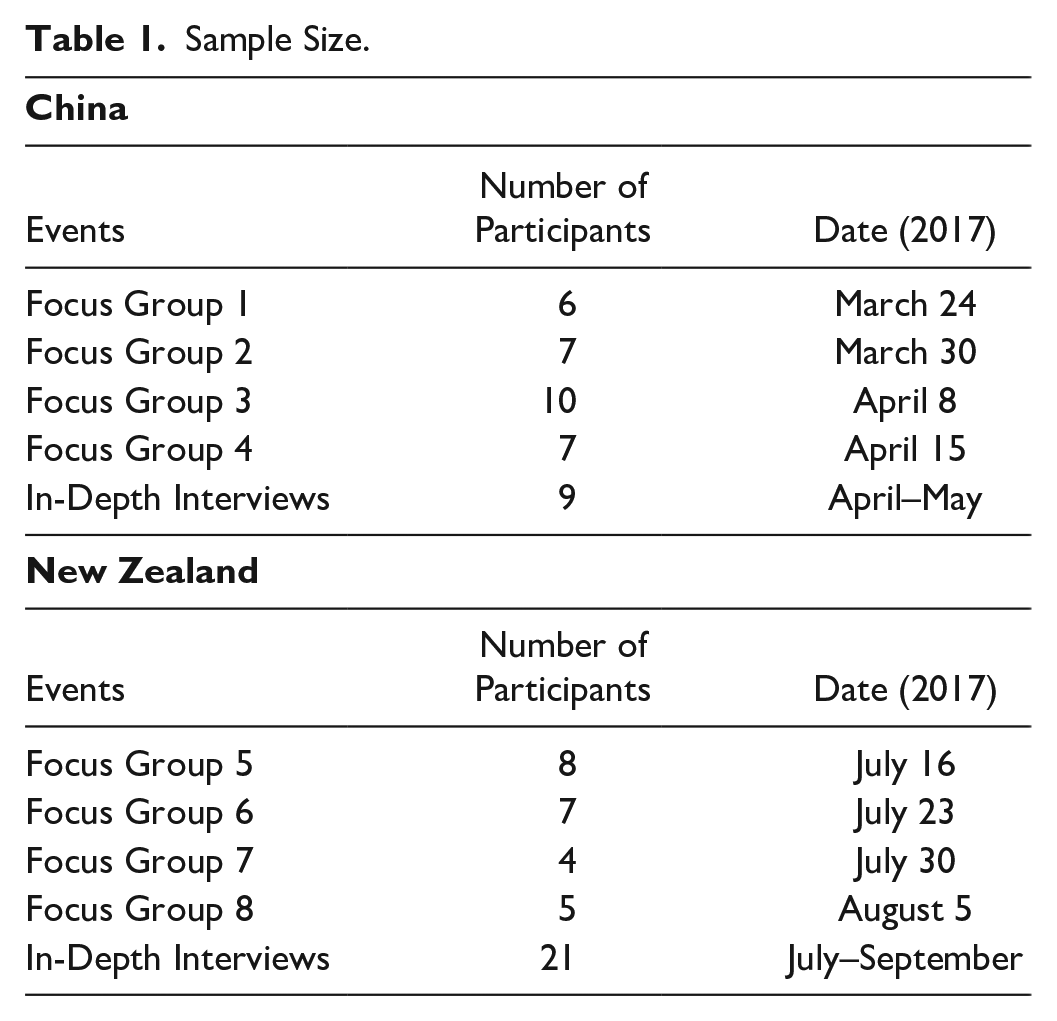
From March to May 2017, the researcher went to China to interview people whose relatives had resided in New Zealand for 3 years or longer. These stay-behinds had visited, or intended to visit, their migrant family members. During July to September 2017, the researcher returned to New Zealand and interviewed Chinese sojourners who had migrated more than 3 years ago. These sojourners had hosted, or intended to host, their stay-behind family members. The number of focus group discussions and in-depth interviews are shown in Table 1.
Sample Size.
Information sheets were provided beforehand, which clearly explained the sample criteria while answering the reason that the participants were approached. Data collection stopped when no new relevant themes were emerging and various meaningful themes had been identified (Cyr, 2019). Each focus group discussion (video-recorded with participants’ consent) lasted for 1.5 to 2 hours. Each in-depth interview (audio-recorded with participants’ consent) encompassed 1 to 2 hours. Five participants who attended focus group discussions also agreed to an individual interview, because the topics reminded them of their personal life experiences and evoked strong empathy. Table 2 shows the sociodemographic profiles of the participants.
Participants’ Profiles.
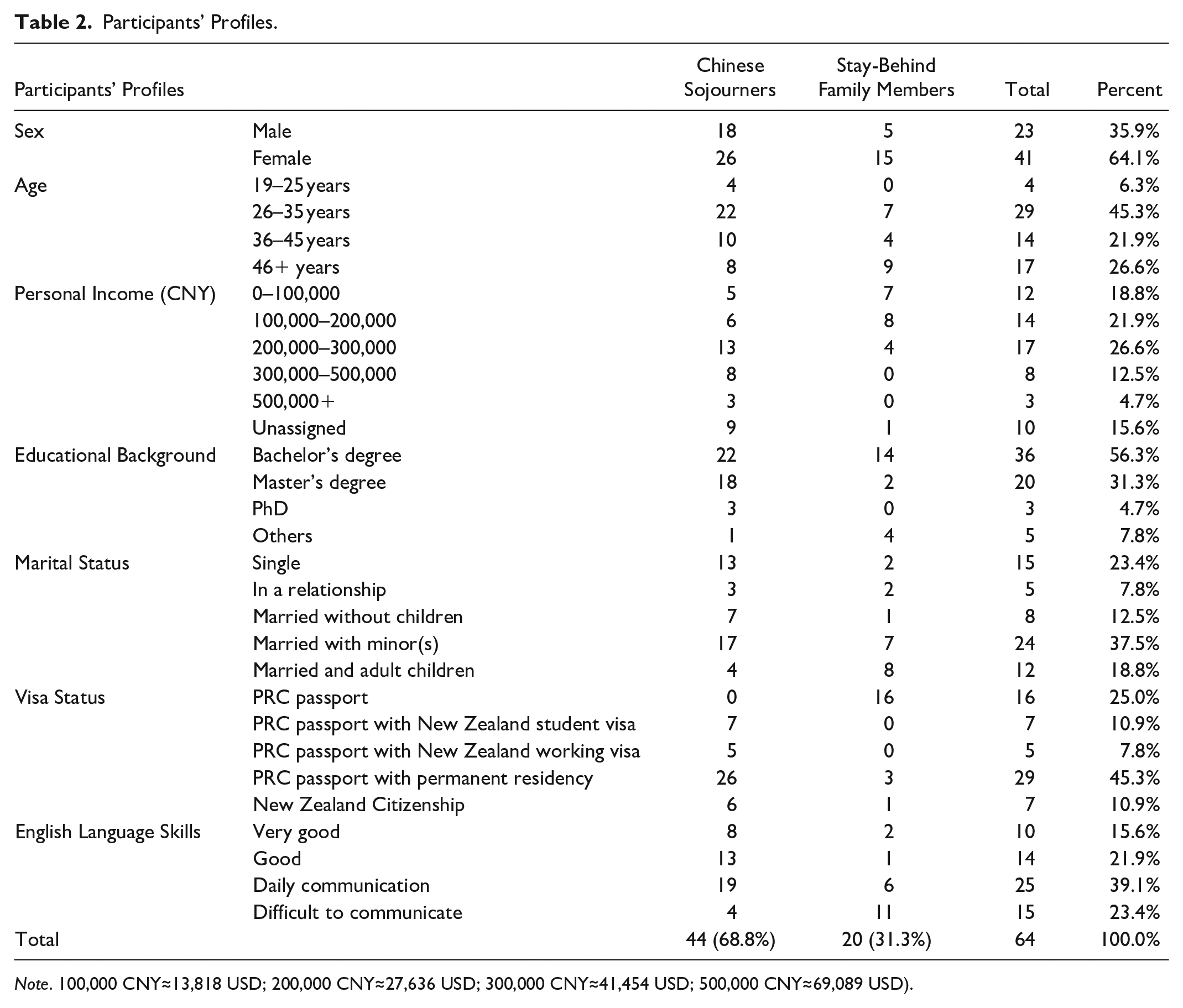
Note. 100,000 CNY≈13,818 USD; 200,000 CNY≈27,636 USD; 300,000 CNY≈41,454 USD; 500,000 CNY≈69,089 USD).
More female participants were represented in both the sojourner and stay-behind groups. More than half of the sojourners were between 19 and 35 years of age (26 of 44), implying earlier stages of family life cycle. Of the stay-behinds in China, most were older than 36 years of age (13 of 20), while there were no stay-behinds belonging to the 19 to 25 age group, suggesting that older stay-behinds were given stronger voices. Annual income between both sides differed considerably. More than half sojourners’ (24 of 44) income was higher than 200,000 CNY (35 of 44 provided this data), while most stay-behinds’ (15 of 20) income was lower than 200,000 CNY (19 of 20 provided this data) (200,000 CNY ≈ 27,636 USD). Most participants held a Bachelor’s degree, with many sojourners also reporting having a higher degree (21 of 44), because they initially moved to New Zealand as international students. Only a few stay-behinds had higher degrees, suggesting a difference in educational background.
The sojourners’ marital status confirms that most of them were in the early life stages. More than half of them did not have children (23 of 44). Although the rest of them reported having children, only four had adult children. Most stay-behinds had children (15 of 20) while eight stay-behinds had adult children, indicating later stages of life. With regard to visa status, all sojourners held long-term visas, or citizenship, while most stay-behinds did not have the right to freely travel to New Zealand (16 of 20), suggesting that the changing conditions and costs of applying for a visitor visa may be a barrier for visiting. Of note, four stay-behinds acquired a New Zealand passport or residency through different avenues, such as Parent and Partnership Resident Visa, but still lived in China. Compared to the stay-behinds, the sojourners had better English proficiency. Most of them could speak English in daily communications (40 of 44), while more than half of the stay-behinds could not speak English (11 of 20) and thus may have had a strong dependency on their hosts’ language skills during VR travel.
Data Collection
Focus group discussions and semi-structured in-depth interviews were arranged at the participants’ convenience. Integrating the two methods creates a complementary effect, which enlarges the depth and scope of the understanding of transnational phenomenon (Hesse-Biber, 2011). Focus group discussions produce more comprehensive information around interview questions, by allowing participants to control the direction of discussion, actively negotiate meanings, and collectively make sense of social phenomena (David, 2011). In-depth interviews enable researchers and participants to work together and dig deeper into interview questions, so that underlying dynamics behind life experiences can be better revealed (Bryman, 2015). Also, integrating the two methods reduces hesitation and refusals, and facilitates participation (Lambert & Loiselle, 2008). An in-depth interview was used as an alternative for the participants who were unwilling to express their views in a focus group discussion.
Data gathering centered on interrogating (1) the nature, meanings, and dynamics of VRs host-guest interactions, and (2) their perceptions of transnational family ties. Questions were designed to reveal the psychological processes of balancing the benefits and costs of (1) taking part in VRs visiting and hosting, and (2) preserving geographically stretched family ties. The questions were explained plainly, carefully, and sometimes repeatedly for participants, as needed. Mandarin was used as it was the participants’ preferred language. Participants briefly introduced themselves at the beginning, focusing on their transnational family ties, so that biographical sketches were created. After the discussions, the researcher collected their demographic profiles. The events were held in public places. To acknowledge their contribution, this study followed a culturally appropriate gift-giving protocol.
Data Analysis
The researcher transcribed the recorded data verbatim into Chinese transcripts, and then translated them verbatim into English transcripts for analysis. Using the researcher’s pre-understanding of the phenomenon, a set of predetermined themes was first created. The researcher then conducted open-coding to identify as many meaningful themes as possible (Creswell, 2018) with some quotations being assigned to the predetermined themes, and others to the emerging themes. Next, the researcher examined the completeness of theme construction, that is, their capacity in collectively demonstrating the transnational phenomenon (Harwood et al., 2015).
NVivo was used for closed-coding, which followed a constant comparative thematic analysis process. The researcher compared the quotations, by taking one quotation and examining it against other quotations both within and between the themes (Glaser & Strauss, 1967). This process largely revised the theme construction, as the researcher decided whether or not the quotations were theoretically the same (Corbin, 2015). The researcher continued reviewing the themes until no further changes could be made to the theme construction. This resulted in a set of meaningful and closely interrelated themes that collectively depict the transnational social phenomenon.
Discussion
This section addresses the research question: How does VRs travel shape the lives of sojourners abroad and their visiting family members? Social exchange and family life cycle are used as theoretical lenses to uncover the nature, meanings, and dynamics of VRs host–guest interactions while unveiling sociocultural nuances in the current research context. To produce a broader view of the role of VRs travel in shaping family wellbeing, this study not only explores parent–children ties, but also other family relationships. Participants’ paired roles are summarized in Table 3.
Summary of Participants’ Paired Roles.
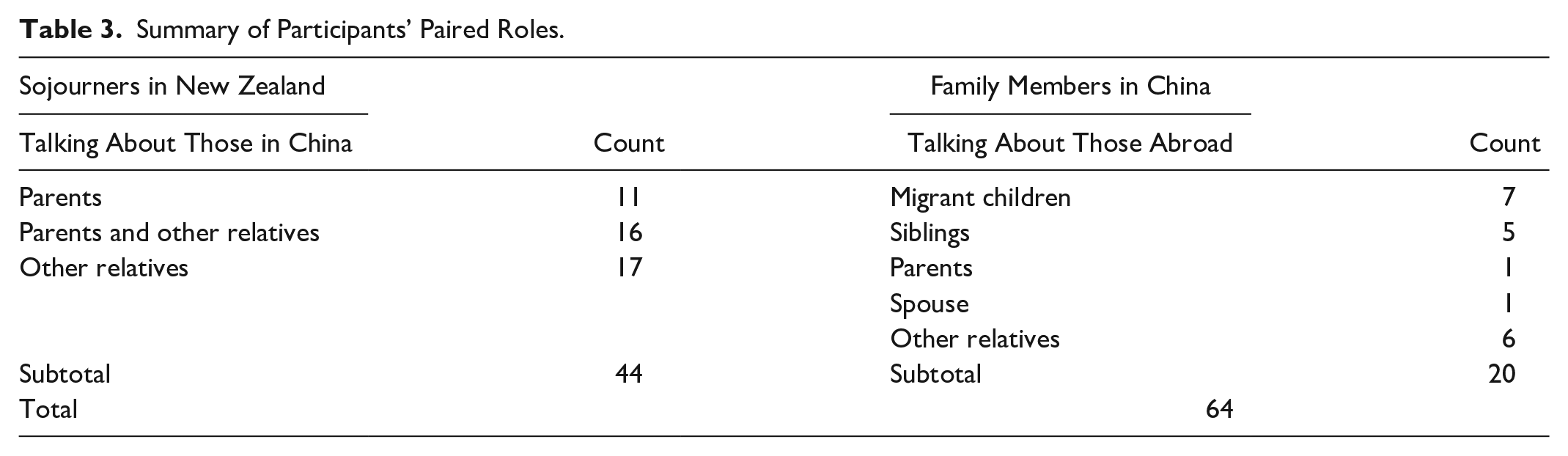
More than half of the sojourners talked about hosting their stay-behind parents (27 of 44), implying that parents are Chinese sojourners’ major concern. The rest of them mainly discussed hosting non-parent family members (17 of 44). Regarding the visiting side, the parents who talked about visiting migrant children represented the largest category (7 of 20). Some stay-behinds talked about visiting their siblings (5 of 20). The rest of the stay-behinds discussed their visiting experiences underpinned by other types of family ties (8 of 20). Pseudonyms are used to protect the participants’ anonymity.
Exchange of Emotional Support
VRs travel allows geographically scattered family members to enjoy seeing beloved ones for a short time, sharing the happiness and difficulties in their lives, and exchanging emotional support. Many participants shared this view.
Migrant hosts’ view
VRs travel can improve Chinese migrant hosts’ emotional wellbeing. About one-third of the sojourners said that they were keen to host family members. Sojourner-L had lived in New Zealand for 7 years with her husband and young children. Sometimes, they had a feeling of helplessness because they could not get help from their stay-behind family member when they encounter difficulties abroad. Therefore, they were always very excited about hosting family members, so that they could enjoy the feeling of being supported. This finding supports some prior research, which argued that Chinese sojourners need emotional support from far-away family members (Wang, 2016; Wang & Collins, 2015).
This study extends the literature, by indicating that Chinese sojourners have a much stronger desire to reunite with their parents, compared to hosting non-parent VR visitors, because stay-behind parents often provided them with a variety of assistance, such as reverse remittances or taking care of young children, out of a strong sense of family altruism (i.e., a nexus of family altruism and reciprocity). Sojourner-W had lived in New Zealand alone for more than nine years. His parents had lived in a very thrifty life in order to buy him a house abroad. Now, he misses them badly, especially the taste of meals that they cooked for him, while also realizing that they are aging and becoming increasingly dependent on him. His experience suggests that reuniting with elderly parents helps alleviate wistful longing and fulfills a sense of filial piety in Chinese migrant hosts’ hearts.
Similarly, Sojourner-J was a single mother of two young children. She felt deeply grateful to her elderly parents who provided her with significant financial support so that she could purchase two houses abroad. Also, the stay-behinds visited her almost every year to help look after her two young children, so she could spend more time on her work to make ends meet. Sojourner-J repeatedly expressed her willingness to spend more time with the elderly. She said remorsefully: “For now, I think what they really need is the time that we can stay together, rather than the money. I didn’t notice this in the past.”
Stay-behinds’ view
Most stay-behind parents in this study pointed out that the presence of migrant children evoked a feeling of happiness. Parent-1’s only-child daughter married a New Zealander. Since then, Parent-1 and her husband have been living in Beijing alone. Parent-1 visits her migrant daughter’s family every year, saying: “Happiness only exists when family members stay together, wherever we are. Anyway, it will be the best if they can come to Beijing, but I will have to go to New Zealand if they cannot” (female, aged 46+).
The way Parent-1 understands happiness suggests that Chinese parents tend to perceive family as the priority in their lives. Reuniting with migrant children is thus important for preserving their emotional wellbeing. Some prior studies noted the importance of maintaining a strong sense of familyhood in Chinese transnational families (J. Liu et al., 2018; Tu, 2016). This study extends prior research, by indicating that the emerging dilemma of Chinese transnational one-child families makes VRs travel even more important for maintaining elderly parents’ emotional wellbeing. Parent-1’s view was echoed by Sojourner-Q, who was the only-child from another transnational family. He indicated that elderly Chinese parents tend to devote themselves to their families, because “they believe in family, rather than any God.”
Therefore, Chinese parents consider VRs travel to be a means of family reunion and often do not have high expectations of tourism activities. Parent-3’s only-child daughter had been living in New Zealand for more than four years. Parent-3 shared: “I don’t even care where we are going, as long as I am traveling with my daughter. I always feel good when I am with her.” An only-child sojourner, Sojourner-AM, had hosted her stay-behind parents once. They spent most of the time at home during the visit, sharing life experiences and cooking, rather than traveling. Sojourner-AM shared that her understanding of her parents’ primary motive for visiting was for them to see “how I live in New Zealand, and what I usually eat, and the food prices here. That’s all my parents really care about. They are very concerned about whether I am living a happy life”.
Uncover hidden needs
The findings indicate that Chinese parents tend to deliberately hide their need for emotional support, and conceal the difficulties in their daily lives, such as physical and emotional sickness, from their migrant children, because they do not want to worry these sojourners. At the beginning of his settlement, Sojourner-Q had lived a very busy life and forgot to send greetings to his father one Father’s Day. His father was very upset but did not express his feelings. It was Sojourner-Q’s mother who asked him to send his greetings immediately, saying: “Your father thinks that you have abandoned him!” Sojourner-Q explained: “Yes, our parents care about these special days so much, but they simply choose not to tell us.” He shared another touching story:
My mom hurt her waist badly last year and had to lie on the bed for more than one week. However, she pretended that nothing [had] happened when I called her. I only got to know this thing after a long time. (Male, aged 26–35)
This finding contributes to new knowledge, by suggesting that VRs travel allows Chinese migrant children to better understand stay-behind parents’ needs and difficulties while providing them with emotional support during family reunions. Similarly, Chinese sojourners are often hesitant about telling their parents the unpleasant things they encounter abroad, for the same reason. For example, Sojourner-B maintained regular communication with her parents, but only told them the good things, rather than any trouble in her life: “No matter how heavy the pressure I may have had during that time,” she explained, “I don’t want them to be anxious and worry about me.” Sojourner-G was an only-child and had lived in New Zealand for more than six years. He shared:
I usually share this kind of unpleasant things with my friends, instead of my family members in China . . . [because] my family members will be very anxious and worry about me, if they know that I am in some kind of trouble and they are not able to help me out. (Male, aged 26–35)
Strengthen ties
VRs travel is an important means for preserving emotional closeness between far-away family members. Parent-7’s only daughter had lived in New Zealand for almost ten years. She shared: “The only reason I go to New Zealand is to see her . . . in case she may not want to talk to me when she stays there alone for a long time.” Parent-7’s view echoes some prior studies, which suggest that Chinese parents’ perceived closeness to migrant children shapes their emotional wellbeing (Xu et al., 2017). Such a desire to strengthen family bonds was also shared by non-parent visitors. For example, Relative-9 was planning to visit his migrant cousin, with whom he used to have a close relationship. He explained: “I want to live with them and be integrated into their lives during my stay in New Zealand. I just want to preserve our relationship, which is my primary purpose of visiting New Zealand”.
Chinese migrant hosts also consider hosting to be an opportunity to strengthen emotional closeness with stay-behinds. Sojourner-V is Parent-7’s migrant daughter. During hosting, she often takes Parent-7 to visit local cafés, restaurants, and enjoy natural scenery, because she considers that these activities potentially strengthen their bond, by creating a laid-back atmosphere for them to talk. Despite the development of means of communication, face-to-face interaction is still essential for strengthening geographically stretched family ties. Sojourner-AN had lived in New Zealand for almost nine years. She could always feel a sense of distance when she was chatting with her family members on WeChat. She explained: “Communicating face-to-face during the visits is a better way to open our hearts to each other, so that our emotional connections may be strengthened”.
This study extends the literature, by indicating that VRs travel improves mutual understanding by allowing stay-behinds to immerse themselves in migrant hosts’ lives abroad. Relative-2’s youngest sister left home when still in high school and lived in Japan for more than ten years before she married a New Zealander and finally settled down in Wellington. Relative-2 took her elderly mother and two other sisters to visit this migrant sister. She believed that their reunion was an opportunity for the stay-behinds to better understand the sojourner’s life choice, so that their bond could be strengthened. Relative-4’s older sister migrated to New Zealand in 2002. Since then, they had only had a few reunions in Beijing, and there were many conflicts. Talking about visiting the sister, Relative-4 shared:
I didn’t understand some of her thoughts and things she did before I went to New Zealand. Anyway, I understand her now, since I have been to New Zealand and seen how people drive there. I have understood her decisions now, because I had lived in the same environment and interacted with the same people. The more knowledge I have about New Zealand and the cultural environment she is living in, the better I can understand her. (Female, aged 26–35)
Exchange of Instrumental Support
Migrant hosts’ view
For Chinese sojourners, hosting VRs travel from their homeland broadens their sources of caregiving. Sojourner-F was a middle-aged sojourner who had a job in a pharmaceutical factory. Although he and his wife had a good household income, they still experienced difficulty in looking after their young daughter. Sojourner-F explained: “We have to leave our daughter in day-care for almost the whole daytime, nearly 11 hours, since we are too busy to take care of her by ourselves.” He therefore had to ask his stay-behind parents for childcare assistance. Sojourner-F explained that it is a time-honored tradition for elderly Chinese parents to take care of grandchildren.
For young sojourners who do not have children, their stay-behind parents often help them to do household chores during their visits, such as grocery shopping, cooking, housecleaning, and laundry, so they can enjoy the convenience during the short reunion. Sojourner-E was married without children and lived very busy life running his own businesses. According to him, helping with household chores was the main activity his parents did during their VRs travel.
Stay-behinds’ view
Chinese stay-behind parents often consider themselves to be a reliable source of support for their migrant children, so they tend to consider VRs travel as a means to provide the sojourners with childcare assistance and help with household chores. As Parent-1 happily shared, her migrant daughter was going to give birth to her first baby, so Parent-1 was going to become a “full-time nanny” for her grandchild, frequently traveling between New Zealand and China. This finding supports the literature (Horn, 2017).
This research extends prior studies, by uncovering the Chinese family values behind elderly parents’ dedication. Parent-1 believed that most Chinese parents have a sense of family (intergenerational) altruism, which gives rise to a strongly felt feeling of obligation. This view was evidenced in other parents’ experiences. For example, Parent-3 was an elderly mother who lived alone in China. Talking about her only-child migrant daughter, she said: “I told her that I will be there, 24 hours a day, no matter when she needs me.” Parent-7 had retired and visited her migrant daughter every year. During the visits, she did many household chores. She explained:
Her life should be different [easier] when she is living with her mom. I want to devote myself to provide her with all the support she may need in New Zealand. As a result, my daughter can enjoy the love from her mom in this short period. I want her to feel my love. This is the main motive for me to travel to New Zealand. (Female, aged 46+)
This study adds to new knowledge, by indicating that non-parent VRs visitors may also have a sense of family obligation toward their migrant hosts and provide their hosts with instrumental support. For example, during the visits to her migrant sister, Relative-4 played a role of caregiver, by babysitting her sister’s two young children and doing household chores. She shared: “It was my duty to take them to play outside. These kids would become extremely frustrated if I don’t take them to play outside at weekend.” Relative-2 had visited her migrant sister twice. She explained her main purpose of visiting, saying: “I just wanted to take care of my nieces and do the household chores during the time they [her sister and brother-in-law] are very busy.”
Hosts as a source of support
Chinese sojourners are a reliable source of support for their parents during visits. Sojourner-G, for example, was an only-child. He realized that his aging parents were increasingly in need of his presence. He thus considered himself responsible for hosting them well during their visits, so that his sense of filial piety could be fulfilled, his parents’ lifetime dedication to him be reciprocated, and, to some extent, his feelings of guilt lessened. Sojourner-AG and his wife had migrated to New Zealand some 20 years ago. They supported their parents from the very beginning of their visits, including visa application costs and airfare.
Non-parent visitors may also receive considerable support from their migrant family members. Relative-8’s oldest sister had moved to New Zealand more than 20 years previously. Relative-8 and her young child visited this migrant sister every year and stayed for about 3 months. Throughout her visits, Relative-8 received substantial support from almost all aspects. She proudly said: “I didn’t need to worry about anything, including money. She prepared everything for me, even for the flight ticket.”
This study extends the literature by indicating the difference in travel purpose between stay-behind parents and non-parent VRs visitors. Compared to parents, non-parent visitors are more interested in tourist activities and often have certain expectations of their travel, other than family reunion. For example, Relative-13’s older sister moved to New Zealand in 1996. Although Relative-13 said that reuniting with this migrant sister was his primary motive for travel, he also had other expectations:
I wish they can take us to travel around the country. I would like to see the beautiful environment they have told us about. They have a caravan, which I really want to try. I also want to try the spa there and touch the alpacas. It will be good if we can visit the indigenous Māori village, maybe spend one night there. (Male, aged 46+)
Chinese sojourners tend to provide non-parent visitors with useful tourism information. For example, Sojourner-L always felt excited knowing that her family members were going to visit her. She shared: “Depending on the length of time they can stay in New Zealand, I usually help them design their travel plans and tell them how they can enjoy a very good time in this country.” Relative-7 expected that her migrant niece could recommend some good attractions, as she did not trust tourism websites. She explained: “People cannot totally believe in the things on these websites, since they may find them to be very different from those descriptions when they are actually visiting the attractions”.
Of note, compared to tourism information, migrant hosts’ companionship was more valuable, substantially enhancing VRs’ travel experiences. Parent-4 had visited her only-child in Auckland twice and was planning to visit him again, saying: “I went to somewhere which is very beautiful. There were some special birds. I took a lot of good pictures. I think I would never have known the place if my son didn’t take me there.” Sojourners’ companionship also improved travel safety. Having lived in New Zealand for more than 16 years, Sojourner-C had hosted many family members and often acted as a driver, because Sojourner-C worried that her visitors might not be able to safely drive abroad. Similarly, Sojourner-U had lived in New Zealand for almost seven years. He said: “It is not safe for Chinese travelers to drive in New Zealand, since there were many accidents every year. We have very different traffic rules here. Anyway, it will be fine if I drive for them”.
Costs of Hosting and Visiting
Migrant hosts’ view
It was found that hosting family members could be a heavy financial burden, echoing some prior research (Backer et al., 2020; R. C. Capistrano & Weaver, 2017). Sojourner-T was a Chinese sojourner who had married a New Zealander and had lived in Hamilton for more than seven years. She emphasized the fundamental principle of hosting her stay-behind family members, saying:
[Visiting] family members should pay for themselves. I even told my own younger brother that I will host him if he is going to visit me in New Zealand, but I am definitely not going to pay for him. There is no way that I will accept any financial burden he brings to me. (Female, aged 26–35)
Also, hosting family members sometimes requires Chinese sojourners to spend excessive time and energy, potentially resulting in overpowering tiredness. Sojourner-C, for example, shared her traumatic experiences, which evoked similar memories shared by other sojourners in her focus group. During hosting, she had to repeatedly visit the same tourist attractions, just to accompanying her visitors, so that hosting had become a burden for her. She complained:
Last year, I drove my visiting relatives around the South Island. I drove 2400 km in 1 week. Anyway, I had to work right after the travel. I spent another half month recovering from exhaustion. I felt that I was dying when I was working after the trip. (Female, 36–45)
Chinese sojourners tend to avoid the costs of hosting family members, echoing a principle of social exchange theory, but challenging the Chinese tradition of family altruism. Sojourner-A had hosted his stay-behind family members several times. He gave an example of evaluating the costs in hosting, saying:
Your parents can help you financially if they are rich. If they are poor, you have to spend much money on them during their travel here, so that you may hesitate before inviting them to New Zealand. For example, their airfare will cost you so much money, right? (Male, aged 36–45)
This study extends prior research, indicating that the desire to save face shapes Chinese sojourners’ hosting behaviors. Although facing financial exigency, most Chinese migrant hosts still have a sense of obligation to meet their visitors’ expectations, because of Chinese traditions of hospitality and the desire of saving face, suggesting the opposite of the principles of social exchange theory. For Sojourner-L, for example, hosting was an inescapable financially burden. She shared: “My life will be negatively affected if my visitors are poor. However, I often cannot refuse their visits, but being morally forced to host them very well, because of the obligation I have”.
Similarly, having lived in New Zealand for more than 16 years, Sojourner-AR had hosted many family members and found that some visitors misunderstood the meaning of hospitality. However, Sojourner-AR had to host them to a very high standard and would keep doing so, because she considered saving face to be more important than saving money. She believed that most Chinese migrant hosts do the same.
Stay-behinds’ view
This study adds to new knowledge, by indicating the difficulties elderly visitors face during relatively long VRs visits. It is difficult for them to live an independent and fulfilled life, frequently raising a sense of loneliness and helplessness. Parent-1 used to be a volunteer in a non-profit institution in Auckland that focuses on improving elderly migrants’ emotional wellbeing. She noticed that many elderly Chinese parents visit New Zealand merely to look after their grandchildren, while suffering mental issues. As an elderly parent, Parent-3 experienced a strong sense of loneliness during her last visit to her daughter in Wellington. She said: “Old people cannot live there for a long time. It is very hard for us to live alone at home, when our children go to work every day. We suffer from that very much, feeling really bad”.
Similarly, Relative-2 had been retired for several years. Although her general visiting experiences were enjoyable, she still encountered some difficulties. She explained: “It is very hard for me to live in New Zealand, because I do not speak English. Actually, I cannot go out without my sister accompanying me.” These comments were echoed by a few sojourners. Sojourner-F was aware that his parents visited him just to look after their granddaughter. Otherwise, they would never want to visit. He elaborated on this idea, saying: “They feel like [they are] staying in a prison here. People in my parents’ age [bracket] have their own fixed living patterns in China that they don’t want to change at all.”
Elderly visitors may also face culture shock. For example, Relative-13’s elderly mother had visited his migrant sister once, but only stayed for a short time, before she strongly insisted on returning home. The elderly mother told Relative-13 that she would die if she stayed any longer. She lost face a great deal during the visit, as many embarrassing moments occurred. He shared:
During her visit, my mom was looking for some pork ribs in a supermarket, because she wanted to cook a good meal for her grandson. However, she felt really terrible when her grandson told her what she brought to the counter is only for feeding dogs. (Male, aged 46+)
A few young stay-behinds also mentioned the costs of visiting migrant family members. Relative-11’s cousin had lived in New Zealand for more than ten years, but Relative-11 always avoided visiting her. She explained: “More relatives mean [a] heavier burden for you. I think I may have to do something that I don’t want to do if I visit them in New Zealand, such as spending money for them.”
The Dynamics of Host–Guest Interactions
Reciprocity
In their interactions with non-parent visitors, Chinese migrant hosts greatly value reciprocity. This finding supports some prior VRs studies (R. C. Capistrano & Weaver, 2017; Xu et al., 2018). Sojourner-AL migrated to New Zealand with her husband and young child. She indicated that migrant hosts may feel exploited if non-parent visitors do not express gratefulness and reciprocate their efforts in hosting. Nevertheless, Sojourner-AL pointed out that hosting ungrateful visitors is a puzzle that many migrant hosts face.
As a middle-aged sojourner, Sojourner-Z had migrated to New Zealand more than ten years earlier. She strongly complained about some non-parent visitors’ behaviors, saying: “They thought that they deserve all the efforts we made for them, so that they didn’t feel grateful to us at all.” This study adds new knowledge, by indicating that Chinese sojourners consider that helping with household chores is an appropriate way to express gratitude, as Sojourner-AR shared: “The conflicts between [non-parent] visitors and their hosts may be eased to some extent if they [visitors] can help their hosts to do some household chores, when they are enjoying the free accommodation and food”.
Of note, only a few non-parent visitors mentioned the notion of reciprocity, implying that there may be considerable tensions between the visiting and hosting sides. Relative-2’s visiting experience was an exception, which clearly shows a mutually beneficial social exchange. During a three-month visit, her migrant sister treated her really well and paid for most costs while Relative-2 provided her host with childcare assistance, by looking after her young children.
Comfortable distance
Some non-parent visitors may have unrealistic expectations of hosting, which break the comfortable distance between both sides, potentially placing a heavy burden on migrant hosts. This finding supports some prior studies (Schänzel et al., 2014; Shani & Uriely, 2012). In the current study, more than half of the migrant hosts experienced exploitation during hosting. For example, Sojourner-AH, a middle-aged Chinese sojourner who had lived in New Zealand for more than ten years, shared:
Last time, my wife’s younger sister-in-law came here to visit us. She was very greedy at shopping. She spent thousands of dollars on her souvenirs. However, she doesn’t have a job in China, so I had to pay for everything she bought. My wife was very angry. Although I can pay for everything she bought because of this unpleasant kinship, this behavior definitely affected our relationship. (Male, 36–45)
Although Sojourner-AH had a good personal income, he still suffered from hosting the visitor. His experience shocked other members in his focus group discussion and stimulated a heated discussion around being exploited by non-parent visitors, resulting in a consensus that such behaviors cause financial hardship and largely weaken family bonds. Sojourner-A emphasized that non-parent visitors should not heavily rely on their migrant hosts, because hosting should not substantially reduce their hosts’ quality of life. He said: “We all have our own issues to worry about in our daily lives.”
This study extends prior research, indicating that Chinese sojourners tend to use some escape strategies to avoid making excessive efforts in hosting non-parent visitors, since directly refusing to host may cause them to lose face. A popular strategy was to suggest that visitors book a group tour, so that someone else could look after them, thus minimizing hosts’ efforts. Sojourner-P was middle-aged and very busy running her restaurant during the visit of her young nephew and his friend. She shared: “There were so many things I needed to deal with at that time. Therefore, I asked a tourism agency to help me take care of my visitors.”
Another approach for minimizing hosting efforts is effective communication that enables visitors to better understand the meaning of hospitality and build realistic expectations of hosting obligations, prior to visiting. Sojourner-C found that some relatives visited her just to exploit family ties, so that she intended to try her best to prevent future visits from happening. She shared: “I just told them that the weather will not be good during the time they are planning to visit New Zealand. Also, they need to pay for everything themselves.”
Hosting stay-behind parents may also raise some conflicts when the elderly ignore the generational gap and interfere in their migrant children’s lives. Both sides may enjoy each other’s company at the beginning, but may then feel frustrated because unbearable tensions and conflicts emerge. In this study, many young sojourners had such unpleasant experiences. Sojourner-E, for example, had lived in New Zealand with his wife for almost seven years, but still felt strongly controlled when he was hosting his parents. He explained: “We quarreled with each other at home very often, because our value systems are different.”
This finding echoes some previous research, which has indicated that different levels of tension may emerge from the interactions between Chinese sojourners and their visiting parents (J. Liu et al., 2017; Tu, 2016). For example, Sojourner-A’s mother-in-law visited them several times to help babysit their young child. He strongly complained about her interference in his child’s education during these visits, considering it completely unacceptable. He said: “She always spoils my son. I used to communicate with her about this, but she didn’t change. Sometimes, she even blamed me for my son’s faults. For now, to be honest, I don’t want her to visit us again”.
The above-mentioned findings contribute to new knowledge, suggesting that VRs travel not only provides both sides with an opportunity to strengthen emotional closeness and exchange support, but also potentially leads to tensions and frustrations that often cause reduced wellbeing and weakened family ties, especially when the rule of reciprocity is not respected or the comfortable distance is broken, conceptually denoting a dual effect.
Family life cycle
This study contributes to the literature by indicating that family life cycle shapes family members’ needs and felt obligations, resulting in their ever-changing practice of transnational social exchange, which is reflected in visiting and hosting behaviors. A few years ago, Sojourner-W’s parents had to look after their elders during Chinese New Year, as the primary meaning of the festival is family reunion. However, the elders are now deceased, so his parents can reunite with him during the festival while helping with household chores. As Sojourner-W shared: “We can then stay together as a family, no matter what.” For his parents, the death of the elders, a significant life event, means that their family members’ needs have undergone significant changes, which lead to the changes in their felt obligations, and visiting behaviors.
Another life event that signals major changes in family members’ needs and felt obligations is the birth of children. Parent-1 used to visit New Zealand mainly for family reunion and leisure purposes. During the visits, her migrant daughter’s father-in-law took her to travel around both the North and South Island and visit many tourism attractions. She proudly shared: “My in-laws are locals. They have a villa near the sea. So, I visited their villa quite frequently.” However, after her migrant daughter gave birth to her first child, Parent-1’s main purpose for visiting changed to providing her daughter with childcare assistance. For Parent-1, the new-born evoked a strong sense of obligation, which provided a stronger reason for her to visit her migrant daughter and changed her choice of activities during visits from leisure to caregiving.
Consequently, the interpretation of participants’ life experiences developed into a conceptual framework that demonstrates the nature, meanings, and dynamics of VRs host–guest interactions, uncovering the way VRs travel shapes the lives of Chinese sojourners abroad and their stay-behind family members (Figure 1). The next section discusses this study’s implications, limitations, and future directions for research.
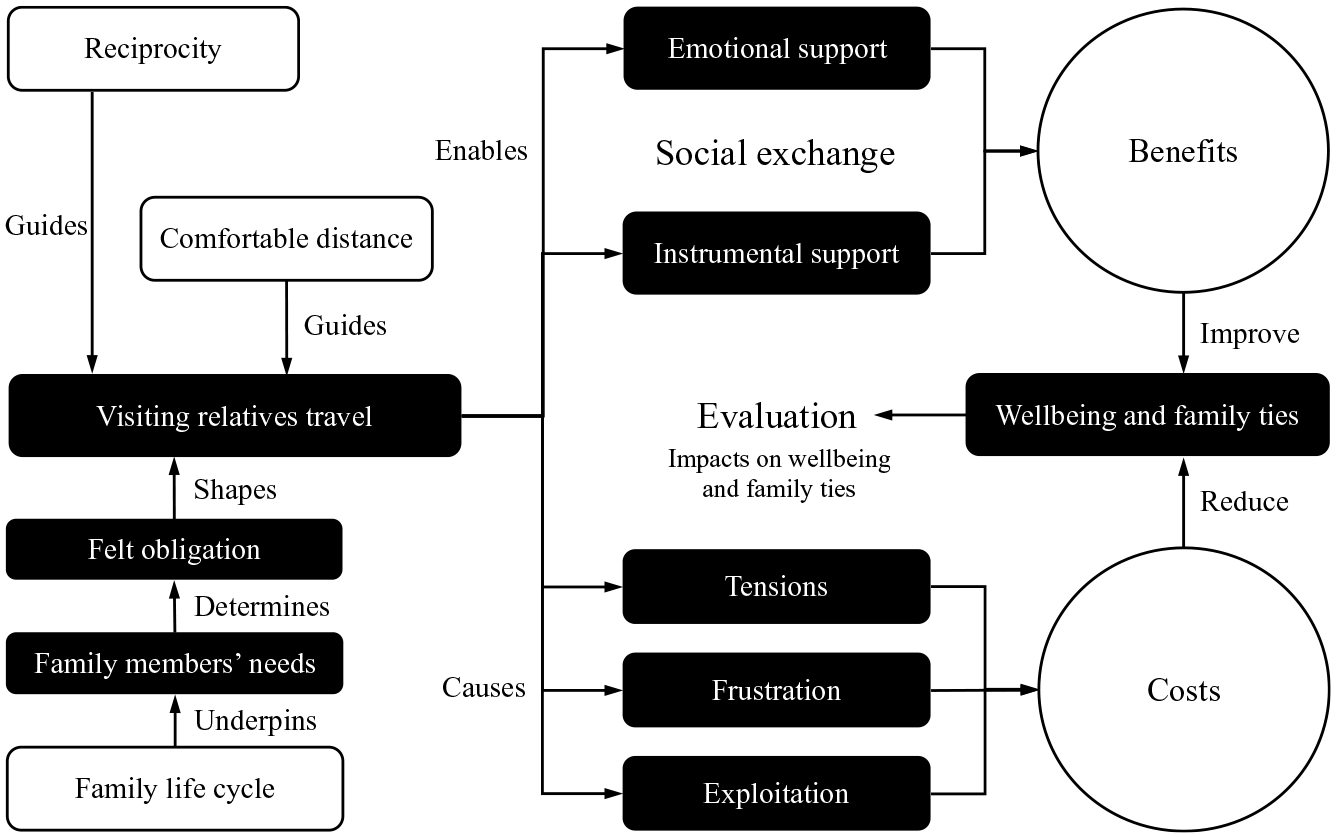
Conceptual Framework: The Nature, Meanings, and Dynamics of VRs Host–Guest Interactions.
Conclusion
This study is among the first to explore the role of VRs travel in enabling the interdependencies between geographically scattered family members from a non-Western perspective, contributing to the literature in terms of VRs travel, theory development, and understanding of practice.
VRs Travel
This study answers the call for more studies of the social aspects of VFR tourism (Backer, 2019). The findings add to new knowledge, by indicating that VRs travel has a dual and contradictory effect on the lives of both sides. On the one hand, it is an irreplaceable means for both sides to reunite for a short period, so that emotional and instrumental support can be exchanged, obligations fulfilled, and family bonds strengthened. On the other hand, VRs host–guest interactions may become a source of tension, frustration, and exploitation, when important social protocols are broken, potentially threatening family wellbeing, weakening emotional closeness, and inhibiting future visiting and hosting. Of note, elderly parents may find it difficult to live independent and fulfilled lives during VRs travel, and therefore suffer loneliness, helplessness, and depression.
This study extends the literature, by suggesting that the meanings of VRs travel in the Chinese context are different from those in Western families, because of the sociocultural and historical uniqueness of Chinese transnational families. The one-child policy led to an emerging puzzle of Chinese transnational one-child families, which increasingly threatens the wellbeing of Chinese sojourners and stay-behind parents. Therefore, VRs travel plays an important role in facilitating cross-border social exchange, enabling interdependencies between both sides, and greatly shaping family wellbeing, before and after the COVID19 pandemic.
Theory
This study develops theory by achieving an enhanced understanding of the dialogue between VRs host–guest interactions and social exchange theory. The emerging conceptual framework reflects the two major principles of the theory. Chinese sojourners and non-parent visitors tend to evaluate the benefits and costs of host–guest interactions. They are more likely to participate in hosting and visiting if the perceived benefits outweigh the costs. Also, when hosting non-parent visitors, Chinese sojourners strongly value the rule of reciprocity, which is considered a tacit understanding between both sides. However, the findings suggest that prior understanding of the theory does not adequately explain the dynamics of VRs’ travel, because a few previously unidentified factors act as new nuanced dimensions to the use of the theory in the current research context, sometimes overriding the two major principles.
First, Chinese sojourners have a felt obligation to have a welcoming attitude, and be generous to visiting family members, providing them with meals, accommodation, and transportation. Migrant hosts may lose face if they fail in following the Chinese tradition of hospitality. The interactions between Chinese sojourners and their stay-behind parents are underpinned by Chinese family values. The parents are motivated by intergenerational altruism to provide migrant children with childcare assistance and help with household chores, without evaluating benefits and costs or expecting commensurate return. Chinese sojourners are motivated by the moral value of filial piety to host their parents well.
Second, comfortable distance represents a highly desired social protocol that shapes host–guest interactions. Non-parent visitors may have false expectations of hosting, causing the sojourners to become emotionally and physically exhausted, and financially vulnerable. Stay-behind parents may interfere in migrant children’s lives, attempting to change their daily routines, consumption behaviors, and the way they educate young children, frequently raising tensions and conflicts. It was found that the generational gap greatly contributes to this puzzle, by causing difficulties in communication and giving rise to misunderstandings.
Third, family life cycle greatly shapes VRs travel, as it drives changes in family members’ needs and felt obligations, resulting in their ever-changing practice of transnational social exchange. This is reflected in VRs visiting and hosting behaviors. Of note, integrating the theoretical lens of family life cycle with social exchange theory contributes to theory development. In the interrogation of the social dynamics of VRs travel, it is essential to take into account the changes in family members’ needs and felt obligations, in addition to the principles of social exchange theory and other sociocultural nuances.
Consequently, the previously unidentified factors play an important role in shaping VRs travel and are therefore integrated in the conceptual framework (Figure 1), contributing to the use of social exchange theory in interrogating the dynamics behind VRs travel. Although a few ideas were mentioned in previous studies, it is this current study that has first integrated the factors into the use of social exchange theory in VR travel research, greatly improving the theory’s theoretical sophistication and contributing to an enhanced understanding of the sociocultural mechanisms that underpin the transnational phenomenon.
Practice
This study helps migrant hosts and visitors to build a clearer understanding of each other’s needs and respective roles in VRs travel, as well as important social protocols. Stay-behind parents should find ways of helping without being seen as interfering in sojourners’ lives. Non-parent visitors should build rational expectations of hosting obligations, consider their hosts’ difficulties, and show their hosts gratitude in one way or another. Migrant hosts can help non-parent visitors better understand the meaning of hospitality, prior to VRs visits, and use effective approaches to ease the burden of hosting.
Destination Marketing Organisations (DMOs) can identify important VRs visiting and hosting motivators (e.g., family reunion, providing and receiving childcare assistance) and understand the mechanisms behind visiting and hosting patterns (i.e., family life cycle), which is important for tourism planning and marketing. For instance, a few months before Chinese New Year, a commercial campaign could be launched which targets Chinese sojourners and stay-behind parents, encouraging both sides to plan a family reunion in New Zealand (e.g., grandparents meeting grandchildren in person for the first time), which is the traditional meaning of the festival.
In addition, this study indicates that VRs travel market is more diverse than it seems to be, while extant research tends to focus on the differences between VFs and VRs travel (Backer et al., 2017; Yousuf & Backer, 2017), treating VRs travel as one homogenous group. VRs visitors can be divided into parents and non-parent visitors. Sojourners should host these two groups of visitors differently, as they tend to have different purposes for traveling and different expectations of hosting. Stay-behind parents consider VRs travel to be a means of family reunion, and tend to stay at home and enjoy reuniting with their migrant children, so that emotional and instrumental support can be exchanged. Non-parent visitors consider VRs travel as an opportunity to reunite with migrant hosts and also enjoy participating in a range of tourism activities, and so they often expect the sojourners to act as tour guides.
DMOs can leverage this finding to design products tailored for stay-behind parents and non-parent family members. For stay-behind parents, future campaigns can convey the idea that visiting the sojourners is a means through which they can enjoy the presence of beloved ones for a valuable time, share happiness and difficulties in their lives, and provide migrant children with various supports. For non-parent stay-behinds, future campaigns may encourage them to discover the beautiful natural resorts in New Zealand, accompanied by their migrant hosts who have rich destination experience.
Limitations
This research has limitations. First, the research data was collected in 2017, reflecting the VRs travel phenomenon before the outbreak of COVID19. At the beginning of 2020, the global pandemic brought significant changes to human mobility worldwide (Miao et al., 2021). Nevertheless, the findings are relevant to today’s situation. Since early 2023, the world has experienced a rapid recovery of international travel and migration (A. T. Liu et al., 2023), including cross-border VFR travel (M. Li et al., 2024). The role of VRs travel in shaping the lives of transnational sojourners and stay-behinds has not changed over time, because the travel is motivated by the needs for family reunion, exchange of support, and, ultimately, love (Filep & Matteucci, 2020). This research should be repeated post-Covid19, because of the lack of research in the role of VRs travel in shaping the lives of transnational sojourners and stay-behind family members.
A second limitation is that most Chinese sojourners in New Zealand and stay-behinds in China are not matched based on family ties, but on their respective roles in host–guest interactions. This approach potentially limits the effectiveness of comparing and contrasting the views between both sides. Even so, the focus on visiting and hosting experiences, rather than exact matched relationships, offered a solid dataset. Also, catering for participants’ privacy concerns facilitates free expression (Joarder et al., 2017). A third limitation is the usage of a snowball recruiting method. A few stay-behind parents who participated were introduced by their migrant children (not participants). They may thus be reluctant to share their needs and the difficulties they encountered, to avoid allowing unpleasant experiences and negative feelings to become known by their migrant children.
Future Research
This study identified some possible directions for future research. First, most extant VFR travel research adopted quantitative methods while only a few studies used social exchange theory as a theoretical underpinning. Therefore, more qualitative studies are required to examine the social meanings of VFR travel and the role of social exchange theory in uncovering deeper social dynamics and cultural nuances behind VFR travel.
Second, future research should further examine the role of family life cycle as a theoretical lens in exploring the dynamics behind the transnational interactions between far-away family members. Third, more scholarly attention should be paid to the role of VRs travel in shaping the wellbeing of transnational sojourners and stay-behind parents, especially empty-nesters, who may intentionally conceal from their migrant children the needs they have and the difficulties they face, and therefore lack essential support.
Fourth, future research may explore the role of non-parent VRs visitors, such as siblings, in providing migrant hosts with essential support. Fifth, future research should further examine the differences between stay-behind parents and non-parent family members regarding their purposes for travel and expectations of hosting. Finally, future research could further examine the effectiveness of integrating in-depth interviews and focus group discussions in producing a more comprehensive view of this complex transnational social phenomenon.
Footnotes
Acknowledgements
Our gratitude goes to Monica van Oostrom, who efficiently proofread the original doctoral thesis and shared valuable suggestions. Also, our gratitude goes to Clive Wilkinson, who kindly provided helpful advice for formatting and referencing.
Declaration of Conflicting Interests
The authors declared no potential conflicts of interest with respect to the research, authorship, and/or publication of this article.
Funding
The authors received no financial support for the research, authorship, and/or publication of this article.
