




Abstract
Corporate charitable giving (CCG) is increasingly pervasive in the global hospitality industry. Among various subtypes of CCGs, many hospitality companies request donations from customers during the service delivery or payment process to encourage customer engagement and co-created social responsibility. Karma—the implicit belief that the universe rewards good deeds and punishes wrongdoings—resonates with consumers’ prosocial behaviors, yet little is known about how karma beliefs, along with various donation elements, affect donation likelihood. Study 1 demonstrates that karma believers are more likely to donate gifts-in-kind than money, as it signals altruism that engenders karmic rewards. Study 2 shows that consumers with weak (vs. strong) karma beliefs are more likely to donate in a public (vs. private) setting due to greater reputational benefits. This research enriches the literature on hospitality CCG marketing and provides insights to managers regarding how to effectively execute donation programs.
Keywords
Highlights
Karma beliefs moderate the effect of donation type (money vs. in-kind) on hospitality consumers’ donation likelihood via self-perceived altruism.
Karma beliefs attenuate the positive effect of publicizing donations on hospitality consumers’ donation likelihood via perceived reputational benefits.
Hospitality companies can effectively leverage customer engagement in charitable campaigns by reconciling karma beliefs, donation type, and donation setting.
Introduction
Instant karma’s gonna get you. Gonna knock you right on the head.
Corporate charitable giving (CCG), in which companies donate a portion of their profits or resources to social and charitable issues, is increasingly pervasive in the global hospitality industry (Chen & Lin, 2015; Chen et al., 2017; Zhang et al., 2019). Hospitality brands are pressured to be socially responsible and to contribute to charities (Choi & Seo, 2019 ). Among various subtypes of CCGs, many hospitality companies seek donations from customers during the service delivery or payment process to encourage customer engagement and co-created social responsibility (Loureiro & Lopes, 2019). For instance, many airlines and hotels such as Delta, Marriot, and IHG, let customers turn their loyalty reward points/miles into donations (Gao & Mattila, 2019; White, 2021). Disney, Universal, and Choice Hotels have expanded their charitable giving to include in-kind donations and public service. In 2014 the top 77 “checkout charities” collected $388 million from consumers (Sullivan, 2015). There is ample evidence to suggest that customer donations not only benefit society but also leverage business performance, customer evaluations, and brand-customer relationships (Choi & Seo, 2019; Huang & Liu, 2020; Levy & Park, 2011; Shafieizadeh & Tao, 2020).
Given the prevalence and benefits of soliciting customer donations in hospitality businesses, it is imperative to understand factors that increase donations. Consumers’ implicit, irrational beliefs have been shown to significantly influence their decision-making (Kramer & Block, 2011). This research focuses on karma beliefs. Karma is the “moral law of causation,” the belief that the universe bestows rewards for doing right and exacts punishments for doing wrong (Krishan, 1997). Although it originated in Eastern philosophy, the notion of karma is prevalent in the Western world. Examples range from daily colloquial expressions, entertainment industries, and marketing campaigns, to charitable practices (Kho, 2015; Kotlyarenko, 2021; Kulow & Kramer, 2016). Since karma beliefs emphasize “ethical causation,” one important way to earn karma points is via prosocial behaviors. Research linking karma beliefs with prosocial behaviors has emerged in recent years (e.g., Chairy & Syahrivar, 2020; Converse et al., 2012; Kulow & Kramer, 2016; Sharma, 2021). However, the studies have yielded mixed results. For instance, Kulow and Kramer (2016) found that karma believers favor charitable appeals highlighting other-benefits (vs. self-benefits) for donations of time. In the grocery checkout context, Sharma (2021) showed that charitable appeals with negative (vs. positive) karma-related messages led to lower purchase satisfaction and revisit intention, but did not influence donation likelihood. Previous research has largely ignored the psychological mechanism behind karma believers’ donation behaviors.
With findings from one pilot survey and two experiments, the current research extends prior research on karma beliefs and donations by considering two situational factors that can be easily managed by hospitality firms: donation type (money vs. in-kind) and donation setting (public vs. private). Moreover, we explored the motivations underlying karma believers’ charitable giving. Drawing on the self-perception theory and motivation theory, karma believers are more likely to donate when the charitable campaigns fulfill their self-perceived altruism (intrinsic motive), while they care less about reputational benefits (extrinsic motive). In particular, karma believers prefer prosocial behaviors that show altruistic, genuine concern, and emphasize personal connections (Kulow & Kramer, 2016; Palmer, 1997; White et al., 2019). In-kind (vs. money) donations have long been associated with greater psychic efforts and connections with the receiver (Ellingsen & Johannesson, 2011; Gino & Flynn, 2011; Robben & Verhallen, 1994). Thus, we predict that consumers with strong karma beliefs are more likely to donate in-kind gifts (vs. money) due to greater self-perceived altruism. Also, hospitality firms can decide the donation setting—whether the act of solicitation is public or private (Bereczkei et al., 2007). Public requests often encourage donations due to recognition and approval from social others (Bekkers & Wiepking, 2011; Wiepking, 2008). However, karma believers focus on accumulating karmic rewards, thus paying little heed to reputational benefits. We propose that the positive effect of publicizing donations on perceived reputational benefits is attenuated for consumers with strong karma beliefs.
The current research contributes new knowledge to the literature on karma beliefs and corporate charitable giving. We extend the literature on the moderating role of karma beliefs and reveal the psychological mechanisms behind karma believers’ donations. Our findings help hospitality companies effectively promote donation campaigns by reconciling three elements: karma beliefs, donation type (money or gifts/volunteers), and donation setting (public or private).
Literature Review
Karma
Karma, denoted as the “moral law of causation,” is a naturalistic principle that rules the universe in this life or the next (Krishan, 1997). Karma beliefs have two central tenets: (1) reincarnation, where an individual’s actions may bear fruit either in the current, later life, or the next; and (2) causation doctrine, suggesting that actions can be generally categorized into either good or bad. The universe aims to achieve an ultimate state of balance by rewarding good deeds and punishing wrongdoings (Kulow & Kramer, 2016).
Although karma originated from eastern religions such as Hinduism, Buddhism, and Taoism, many Westerners are quite familiar with the general concept that “you reap what you sow” (Lerner, 1980) and form the “good-behavior-good-outcome” association. While most research has treated karma as an explicit belief, rooted in specific cultures and religions (White et al., 2019), the activation of the karmic investment can be more of an automatic, implicit strategy for everyday decision-making (Converse et al., 2012). For instance, Banerjee and Bloom (2017) found that even 4-year-old children, before cultural learning, engage in karmic bargaining to secure an unrelated desired outcome.
Seemingly, karma beliefs fall into the spectrum of irrational beliefs (e.g., fatalism, magical thinking, and superstition), which focus on perceived (mis)attributions of causality to potential outcomes (Kulow & Kramer, 2016). However, karma beliefs differ in several ways: first, unlike fatalism in which whatever happens is predetermined, karma beliefs emphasize the ownership of a person’s actions. Second, the philosophy of karma is “ethical causation” (White et al., 2019). Conversely, individuals with magical thinking believe that associating themselves with lucky colors, numbers, or items leads to favorable states (Hamerman & Johar, 2013). The karmic investment suggests that accumulating moral energies via virtuous acts and transferring them to future, unrelated events, yields positive outcomes.
Prior research demonstrates the effects of karma beliefs on consumers’ brand/product evaluation (Kopalle et al., 2010; Sharma, 2021), word of mouth (Valenzuela et al., 2018), excessive consumption (Chen et al., 2019), green purchase (Chairy & Syahrivar, 2020), and prosocial behaviors (Converse et al., 2012; Kulow & Kramer, 2016). One important way to earn karma points is via prosocial behaviors, which refer to activities benefitting others and/or the greater good (Penner et al., 2005). For example, Converse and colleagues (2012) found that people are more likely to help others when uncertainty is high and personal control is lacking. Kulow and Kramer (2016) showed that karma believers react more favorably to charitable appeals signaling other-benefits than self-benefits. While prior research has examined the effects of karma beliefs on consumers’ decision-making processes, it has failed to investigate consumers’ psychological motivation for the karmic investment.
The karmic investment not only involves the valence of one’s actions (i.e., good or bad deeds) but also the individual’s motivations behind such actions (Ghose, 2007; Reichenbach, 1988). Prior research suggests that altruistic behaviors are, ultimately, selfishly motivated (Campbell, 1975; Rachlin, 2002). Similarly, it can be argued that karma believers engage in charitable giving out of egoistic motivation—to accumulate karmic rewards in the future. However, Kulow and Kramer (2016) found that consumers with strong karma beliefs favored charitable appeals associated with other-benefits over self-benefits. Such a paradox can be explained by the fact that karma believers prefer “incidentally” gaining karmas (intrinsic benefits) by helping others, rather than setting explicit objectives (extrinsic benefits). Since karmic consequences are delayed (“reincarnation”; Kopalle et al., 2010), the charitable appeal cueing current self-benefits represents selfishness, which will engender karmic punishments in the future.
Therefore, in the next section, we examine two situational factors—donation type and donation setting—that help karma believers “incidentally” accrue karmic rewards.
Monetary Donation Versus In-Kind Donation
Individuals can contribute to a charity either by donating money or donating time, services, and goods (i.e., in-kind donations). Previous research suggests that monetary and in-kind donations activate different mindsets, thus resulting in varying donor responses (Kulow & Kramer, 2016). Prior research shows that in-kind (vs. monetary) donations convey greater effort on the part of the donor (Hildebrand et al., 2017). Monetary donations, on the other hand, are relatively effortless (e.g., writing a check or clicking a button (Langan & Kumar, 2019). In-kind donations, which often involve substantial amounts of time and labor (e.g., picking and packing gifts, delivering meals), are associated with greater psychic costs, thoughtfulness, and respect to the receiver (Ellingsen & Johannesson, 2011; Gino & Flynn, 2011; Robben & Verhallen, 1994). For example, Jacobsson and colleagues (2007) found that donors overwhelmingly favored donating nicotine patches over money, aiming to truly improve the health of smoking diabetes patients. Reed and colleagues (2007) show that consumers perceive companies who donate time as more moral, caring, and socially responsible compared to those who donate money. Moreover, in-kind donations are associated with greater levels of empathy because time (or gifts) often convey emotional meaning (Liu & Aaker, 2008). Thus, in-kind donations provide heightened feelings of personal connections (Hildebrand et al., 2017; Mogilner & Aaker, 2009), which echo karma beliefs that “all actions and individuals are interconnected” (Kulow & Kramer, 2016, p.338; Palmer, 1997).
In this paper, we propose that differences in individual responses to monetary versus in-kind donations hinge on self-perceived altruism. Perceived altruism implies that the donor’s motive is to enhance the welfare of non-significant others even at the expense of his/her own benefits (Kerr et al., 2004; Rim et al., 2016). Previous research shows that individuals can infer altruistic motives based on various factors they observe, including donation amount (Folse et al., 2010), types of charity campaign (Groza et al., 2011), donation framing (Samu & Wymer, 2014), and firm size (De Vries & Duque, 2018). When individuals perceive greater levels of altruism in a firm’s motives, they are more likely to donate, volunteer, and purchase cause-related products (Barone et al., 2007; De Vries & Duque, 2018; Ogunfowora et al., 2018). Notably, such altruism perceptions can also be obtained from observing the self. The self-perception theory suggests individuals interpret their own actions by examining the reasons and motives for what they do (Bem, 1972). People want to view themselves as kind, caring, and altruistic to maintain a positive, well-protected self-concept (Sedikides & Strube, 1997). When individuals view themselves as altruistic, they tend to act in congruence with their self-perceptions (Lauren et al., 2017). Prior research suggests that self-perceived altruism is closely associated with prosocial behaviors (Batson et al., 1987; O’Malley & Andrews, 1983; Xiao et al., 2021). Becton and colleagues (2008) found that external rewards damage the donor’s positive self-concept, thus decreasing their motivation to engage in altruistic behaviors. Wang and Tong (2015) suggest that for individuals with high (vs. low) moral identity, introducing extrinsic benefits lowers the donor’s happiness and future donation intentions. External benefits make the donor doubt his/her intrinsic motivations, thus making them feel uncomfortable about his/her own behaviors.
Furthermore, we argue that karma believers, compared to non-karma believers, perceive altruism differently, which, in turn, influences their responses to monetary (vs. in-kind) donations. Karma rewards prosocial behaviors that are other-driven, showing true societal concerns and genuine intentions. Karma believers value personal connections (Palmer, 1997) and “incidental” karma accumulations (Kulow & Kramer, 2016). Therefore, individuals with strong karma beliefs are likely to favor in-kind donations that are more emotionally meaningful and psychologically effortful, leading to self-evaluated altruism that accrues karmic rewards. Conversely, the relatively effortless process of monetary donations may lead karma believers to perceive that they donate money out of convenience, making their actions appear to be “less pure and less altruistic.” Individuals with weak karma beliefs are less likely to believe in “moral causation” (White et al., 2019). They pay less attention to the psychic costs and moral efforts behind charitable giving and equate altruistic motives with the concrete benefits of their donations. Vohs and colleagues (2006) found that reminders of money shift individuals’ mindsets to value calculation and maximization. Therefore, individuals with weak karma beliefs believe that monetary donations are easy-to-evaluate, offer much-needed flexibility, and better meet the needs of the beneficiaries (Özpolat et al., 2015; Ülkü et al., 2015). In-kind donations with an equal value are often less impactful (e.g., fail to reach desired recipients and are eventually wasted) or culturally inappropriate showing a lack of concern regarding the beneficiaries (Davis et al., 2016). Accordingly, individuals with weak karma beliefs may favor money over in-kind donations as money brings substantial benefits to the recipients and can better help those in need. 1
Taken together, we propose the following:
H1: There is an interaction effect of karma beliefs and donation type on individuals’ self-perceived altruism. Specifically,
H1a: Individuals with weak karma beliefs will perceive their motives as more altruistic with monetary (vs. gifts-in-kind) donations.
H1b: Individuals with strong karma beliefs will perceive their motives as more altruistic with in-kind (vs. money) donations.
H2: Self-perceived altruism will have a positive impact on donation likelihood.
Public Donation Versus Private Donation
Another situational factor that hospitality firms can manipulate is the setting—whether the act of donating is public or private (Bereczkei et al., 2007). Giving, in general, is viewed as a virtuous act and, therefore, individuals who donate to charitable causes are held in admiration by peers. Donors can gain recognition and approval from social others with public donations (Bekkers & Wiepking, 2011; Wiepking, 2008). Prior research suggests that publicizing can reinforce altruistic behaviors. When given a choice, most people prefer their donations to be publicized as it signals generosity. People are more likely to donate through solicitations made face-to-face (vs. over the phone) (Brockner et al., 1984) and with the presence of ribbons and wristbands (a phenomenon named “conspicuous compassion”; Grace & Griffin, 2006). Publicizing also leads to a larger donation amount as it satisfies the donor’s extrinsic motivation—receiving reputational rewards (Hardy & Van Vugt, 2006).
However, we argue that the positive effect of public donations will diminish among individuals with strong karma beliefs. There is ample evidence to suggest that when individuals’ intrinsic motives for donations are high, the effect of extrinsic benefits will be attenuated (Frey & Jegen, 2001; Gneezy & Rustichini, 2000). For karma believers, the most important, intrinsic motive behind charitable giving is to accumulate karmic rewards (or avoid karmic punishments), thus reducing their desire for reputational benefits. As karma reflects a long-term orientation (i.e., an individual’s moral/immoral behaviors result in karmic rewards/punishments in the future; Nowak, 2006; Trivers, 1971), karma believers pay less attention to current extrinsic rewards such as reputational benefits. It is the act of donating rather than the donation setting that determines their karma credit. Therefore,
H3: There is an interaction effect of karma beliefs and donation setting on perceived reputational benefits. Specifically, individuals with weak karma beliefs will perceive greater reputational benefits from donating in a public (vs. private) setting. Such an effect will be attenuated among individuals with strong karma beliefs.
H4: Perceived reputational benefits will have a positive impact on donation likelihood.
Methodology
Study 1
In Study 1 we aim to examine the interplay of donation type and karma beliefs on self-perceived altruism, and the positive link between self-perceived altruism and donation likelihood. We expect that participants with strong karma beliefs perceive in-kind donations (vs. monetary donations) as more altruistic, thus leading to a greater donation likelihood. However, for participants with weak karma beliefs, monetary donations lead to greater self-perceived altruism.
Design and Participants
Study 1 adopted a two (donation type: money vs. gifts-in-kind) quasi-experimental design, with an individual difference measure of karma beliefs. Donation type was manipulated with two charitable appeals. A total of 161 U.S. participants, recruited from Amazon Mechanical Turk (MTurk), were randomly assigned to one of the two experimental conditions. 2 Two participants were filtered out due to failed attention checks, thus resulting in a final sample of 159 participants (68.60% male, Mage = 34.38 years, SD = 8.75).
Procedure and Measures
Numerous hospitality companies engage in cancer-related CCGs (Little, 2017). For instance, Hard Rock initiated the “PINKTOBER” campaign to support breast cancer research (https://www.hardrock.com/pinktober-2021.aspx). Extended Stay America collaborated with the American Cancer Society to provide 10,000 free rooms to cancer patients (Johnson, 2020). Therefore, Study 1 chose cancer research as the donation cause.
First, all participants were exposed to the following information: “1 in 3 people will be diagnosed with cancer in their lifetime. At the American Cancer Society, we’re on a mission to free the world from cancer. We aim to promote medical research, aid policymaking, share expert information, support patients, and spread the word about prevention. We couldn’t do what we do without our donors. Together, we’re making a difference—and you can, too.”
The design and layout of the donation appeal were identical in the two donation type conditions, except for the tagline: “Make a donation now to help us save lives,” or “Donate gifts-in-kind now to help us save lives (e.g., caps/hats, wigs, books, games, and toys).”
Next, participants indicated their likelihood to donate money (gifts) with two items, serving as a dependent variable (1 = not likely at all to 7 = very likely; r = 0.76; Kulow & Kramer, 2016). They then reported their self-perceived altruism with two items (e.g., “Donating money [gifts] shows that I have genuine concerns for the beneficiaries”; r = 0.81; Yoon et al., 2006). Karma beliefs were captured with seven items (e.g., “Good actions in the present lead to good outcomes in the future either in this life or in the hereafter” and “I believe in karma”; α = 0.79; Kopalle et al., 2010). For a manipulation check, participants answered whether the charitable appeal asked them to donate money or gifts. Next, participants were asked to indicate their issue involvement (“Whether promoting the effort of the American Cancer Society is unimportant/important to me”; α = 0.80; Maheswaran & Meyers-Levy, 1990) and donation history to the American Cancer Society ("Have you ever donated [e.g., money, gifts or time] to the American Cancer Society?”; Choi et al., 2019). Finally, participants provided their demographic information (see Appendices 1 and 2 for stimuli and full measures in the online supplemental material).
Results and Discussion
Manipulation check
Results of the Chi-square test showed that our donation type manipulation was effective, such that most participants successfully distinguished the monetary donation from the in-kind donation, χ2 (2, N = 159) = 83.55, p < .001.
Self-perceived altruism
We regressed self-perceived altruism on donation type, karma beliefs, and their interaction. We also included cause involvement, donation history, gender, and data collection period 2 as potential covariates. The analysis revealed a significant two-way interaction between donation type and karma beliefs, b = .55, SE = .15, t(3.7), p < .001. There were no significant main effects of either donation type (p = .22) or karma beliefs (p = .14). Results remained significant without control variables. Since the moderator—karma beliefs—was a continuous variable, we probed the interaction effect via the floodlight technique. The floodlight technique denotes distinct advantages from the traditional pick-a-point method, and is recommended by many social science scholars (Bauer & Curran, 2005; Hayes & Matthes, 2009; Jason et al., 2013; Preacher et al., 2006; Spiller et al., 2013). In our case, the plot illuminates the entire range of the karma beliefs to show where the donation type effect is significant (vs. not). The border between these regions is the Johnson-Neyman point. As visualized in Figure 1, the interaction effect was significant for values of karma beliefs below the Johnson-Neyman point of 4.18 and above 5.92: Participants with weaker karma beliefs perceived monetary donation (vs. gifts-in-kind donation) as more altruistic, thus leading to greater donation likelihood. In contrast, for participants with stronger karma beliefs, the in-kind donation was more altruistic and preferable. The area of significance covers 76.73% of the total participants. These results support both H1a and H1b and are summarized in Table 1 and Figure 1.
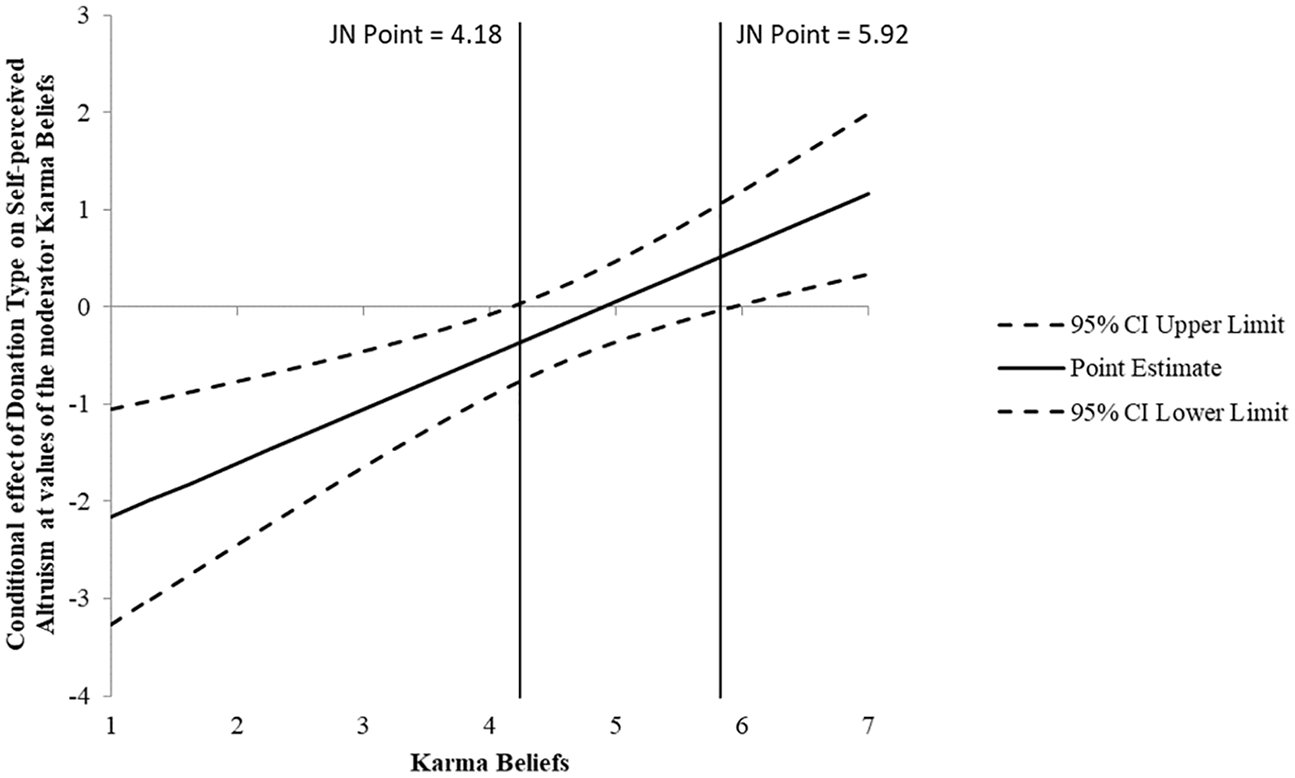
Interaction Plot of Floodlight Analysis.
Regression Analysis: The Joint Effect of Donation Type and Karma Beliefs on Self-Perceived Altruism.
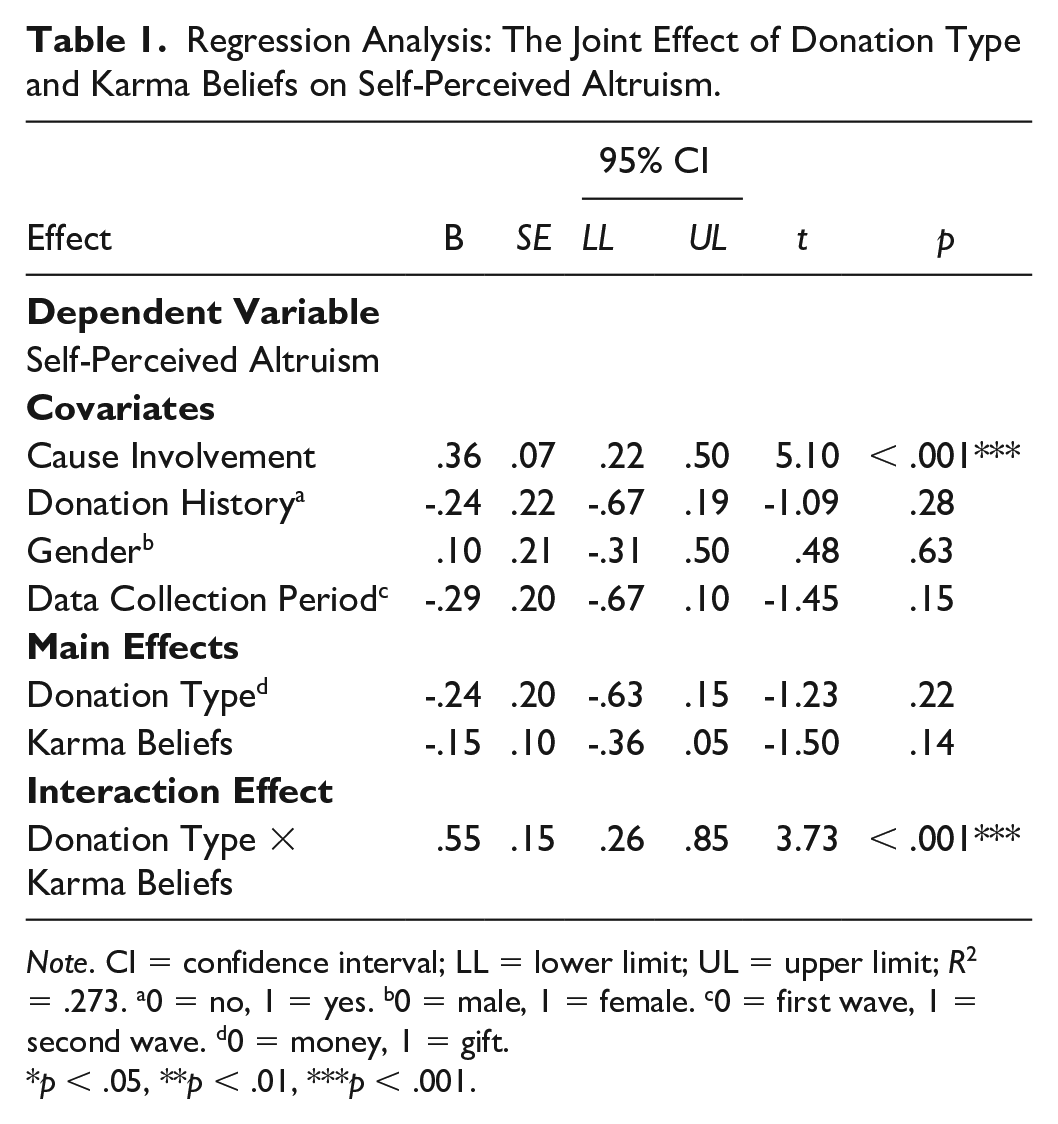
Note. CI = confidence interval; LL = lower limit; UL = upper limit; R2 = .273. a0 = no, 1 = yes. b0 = male, 1 = female. c0 = first wave, 1 = second wave. d0 = money, 1 = gift.
p < .05, **p < .01, ***p < .001.
Moderated mediation analysis
To exam the mediating effect of self-perceived altruism on donation likelihood, we conducted a moderated mediation analysis using PROCESS (Hayes, 2017; Model 7) with donation type as the independent variable (X), karma beliefs as the moderator variable (W), self-perceived altruism as the mediator variable (M) and donation likelihood as the outcome variable (Y). We included cause involvement, donation history, gender, and data collection period as covariates. An index of moderated mediation was significant (b = .21, SE = .09, 95% CI [.07, .40]). The results show that the interaction of donation type and karma beliefs did not directly influence donation likelihood, but had to go through self-perceived altruism. Specifically, the interplay significantly affected individuals’ self-perceived altruism, b = .55, SE = .15, t(3.73), p < .001, and self-perceived altruism positively influenced donation likelihood, b = .37, SE = .08, t(4.68), p < .001. These results provide support for H2: Consumers’ karma beliefs, together with donation type, influence donation likelihood via altering their perceived sincerity of motives. In the next study, we investigate another important contextual variable: donation setting.
Study 2
Design and Participants
Study 2 adopted a two (donation setting: public vs. private) quasi-experimental design, again, with an individual difference measure of karma beliefs. The donation setting was manipulated with two pre-tested scenarios. In total, 160 U.S. participants, recruited from Amazon Mechanical Turk (MTurk), were randomly assigned to one of the two experimental conditions. Four participants were filtered out due to failed attention checks resulting in a final sample of 156 participants (71.20% male, Mage = 35.90 years, SD = 10.43).
Pretest
Many hospitality firms implement fundraising programs (i.e., request donations from customers during the serving/payment process) to help others and strengthen customer-brand relationships (Huang & Liu, 2020). Therefore, the context for Study 2 was a fundraising program. Various dining scenarios were pretested to validate our manipulation. A total of 120 U.S. MTurkers were randomly assigned to one of the four imaginary dining experiences (dining with friends vs. dining with colleagues vs. solo dining vs. ordering food delivery alone). The results show that, compared to dining with friends, participants considered ordering food delivery alone as less public, Mfirends = 5.97 versus Mdelivery = 3.58, t(5.54), p < .001, and as equally realistic, Mfirends = 5.42 versus Mdelivery = 5.52, p > .05. Therefore, these two scenarios were chosen to represent a public and private donation setting, respectively.
Procedure and Measures
Participants were asked to imagine that they were either at a local café surrounded by their friends (public context) or were at home by themselves ordering food from a local café using its food delivery app (private context). After ordering, the server (or the app) states the following: “Our café is collaborating with the local food bank to help fight hunger. Would you like to make a donation to the food bank today?”
Next, participants reported their donation likelihood with four items (1 = not at all to 7 = very much; α = 0.91; adopted from Gao & Mattila, 2019; White & Peloza, 2009). They then indicated the extent to which they felt that this donation can enhance their social image (Owuamalam & Rubin, 2014) and karma beliefs (α = 0.78; Kopalle et al., 2010). Participants were asked whether they were surrounded by friends and whether the scenario was realistic. Next, participants indicated their issue involvement (α = 0.78; Maheswaran & Meyers-Levy, 1990) and donation history to the local food bank (Choi et al., 2019). Finally, participants provided their demographic information.
Results and Discussion
Manipulation check
Results of independent samples t tests showed that our manipulation was successful: participants considered ordering food delivery alone as less public than dining out with friends, Mfirends = 6.08 versus Mdelivery = 3.27, t(8.76), p < .001. Moreover, both scenarios were equally realistic, Mfirends = 5.91 versus Mdelivery = 5.84, p > .05.
Perceived reputational benefits
We regressed perceived reputational benefits on donation setting, karma beliefs, and their interaction. We included cause involvement, donation history, gender, and data collection period as potential covariates. The regression results indicate that the public (vs. private) setting increases donation likelihood, b = -.71, SE = .29, t(-2.42), p = .017, while karma beliefs have no main effect (p > .05). More importantly, the results revealed a significant two-way interaction between donation setting and karma beliefs, b = .54, SE = .25, t(2.18), p = .031. The floodlight analysis was again conducted to probe the interaction. As visualized in Figure 2, the interaction effect was significant for values of karma beliefs below the Johnson-Neyman point of 4.68: For participants with weaker karma beliefs, donating in the public context (vs. private context) enhanced their social image, thus leading to greater donation likelihood. Such an effect did not exist for participants with stronger karma beliefs. The area of significance covers 51.28% of the total participants. These results support both H3 and are summarized in Table 2 and Figure 2.
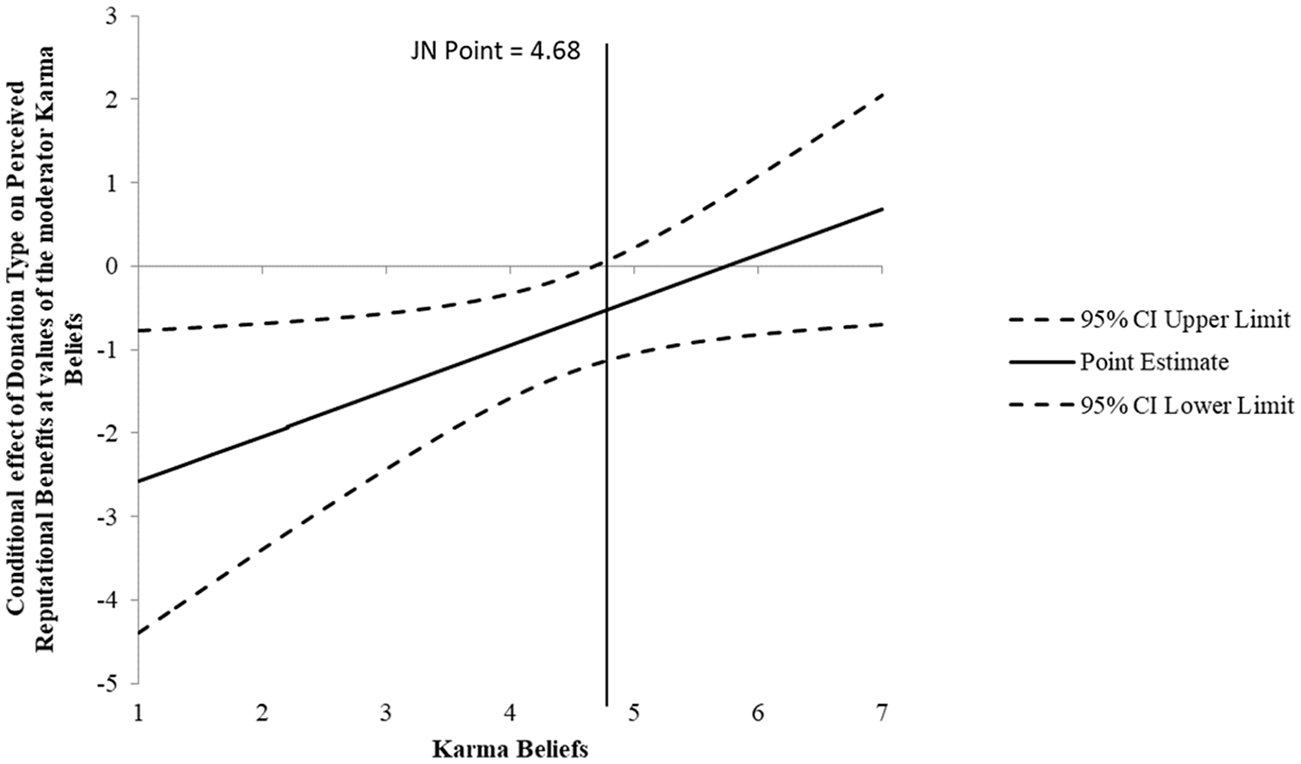
Interaction Plot of Floodlight Analysis.
Regression Analysis: The Joint Effect of Donation Type and Karma Beliefs on Perceived Reputational Benefits.
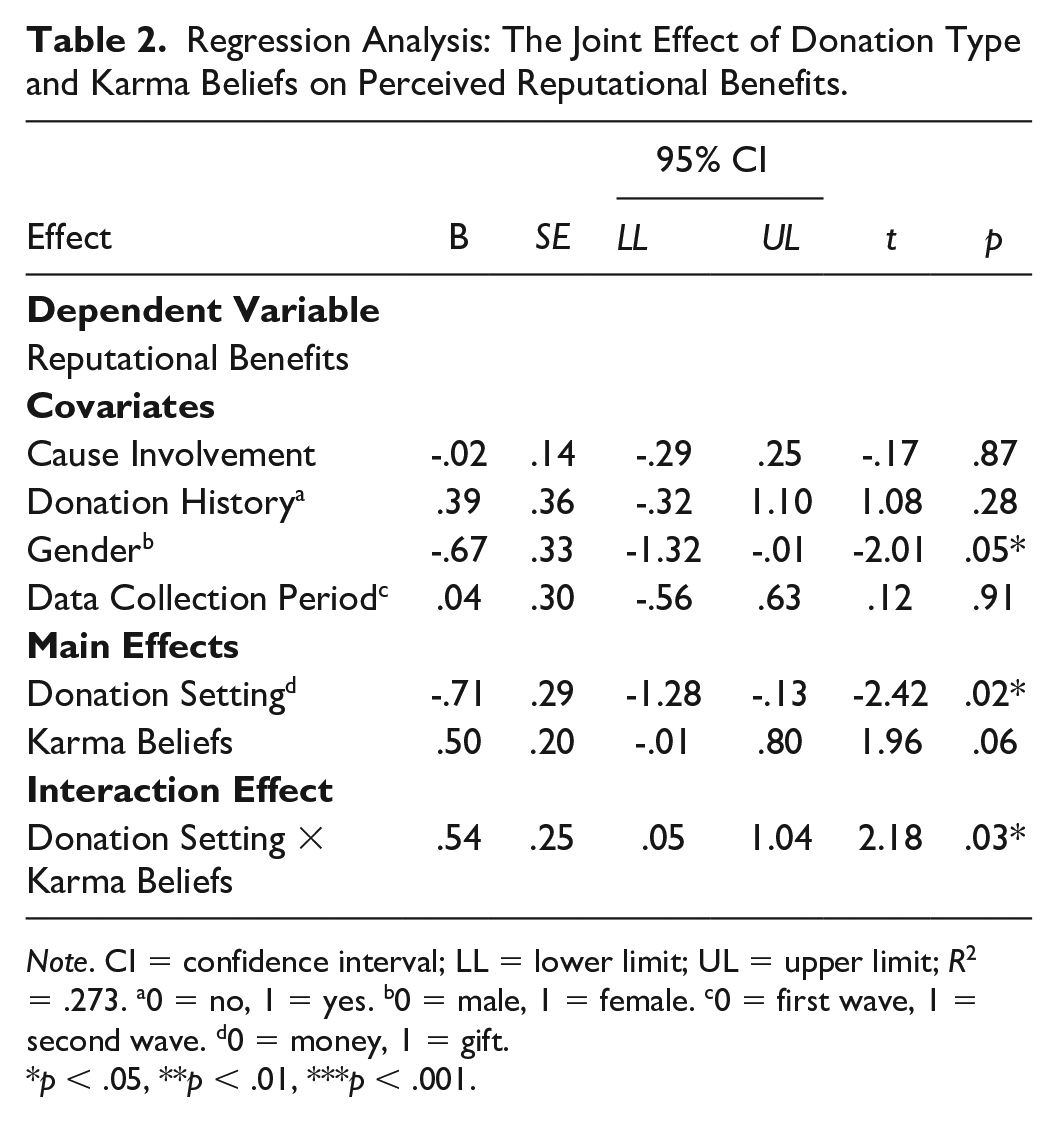
Note. CI = confidence interval; LL = lower limit; UL = upper limit; R2 = .273. a0 = no, 1 = yes. b0 = male, 1 = female. c0 = first wave, 1 = second wave. d0 = money, 1 = gift.
p < .05, **p < .01, ***p < .001.
Moderated mediation analysis
To test whether consumers’ perceived that reputational benefits mediate the interaction effect of donation setting and karma beliefs on donation likelihood, we conducted a moderated mediation analysis using PROCESS (Hayes, 2017; Model 7) with donation setting as the independent variable, karma beliefs as the moderator variable, perceived reputational benefits as the mediator variable, and donation likelihood as the outcome variable. Cause involvement, donation history, gender, and data collection period were included as covariates. An index of moderated mediation was significant (b = .19, SE = .09, 95% CI [.01, .39]). Specifically, the interplay significantly affected perceived reputational benefits, b = .54, SE = .25, t(2.18), p = .03, and perceived reputational benefits positively influenced donation likelihood, b = .35, SE = .05, t(6.61), p < .001. These results support H4.
Discussion
Theoretical Implications
This research contributes to the corporate charitable giving (CCG) literature in the hospitality field. Many hospitality companies solicit donations from consumers to enhance co-created experiences and customer engagement (Loureiro & Lopes, 2019; Gao et al., 2020). Accordingly, prior research has investigated the effectiveness of various donation components on such co-created CCG activities, including self- versus society-serving charitable appeals (Wu et al., 2017), effort-based versus surprise reward types (Gao & Mattila, 2019), nearby versus faraway donation proximity (Choi et al., 2019) and round-up versus flat-dollar donations (Hwang et al., 2021). This research enriches this stream of literature by considering two managerially important factors: money versus in-kind donations, and public versus private donation setting. We introduced a novel moderator, karma beliefs, to illustrate when and why such effects are magnified or attenuated.
Our research enriches the literature on karma beliefs. Prior research has long established that irrational beliefs, such as peculiar beliefs (Kramer & Block, 2011), magical thinking (St. James et al., 2011), superstition (Mowen et al., 2003), and fatalism (Kim et al., 2014) can influence consumers’ decision-making processes. Although karma is a subtype of irrational beliefs, research linking karma beliefs and prosocial behaviors has only recently emerged (Converse et al., 2012; Kulow & Kramer, 2016; Sharma, 2021). Moreover, the findings are mixed. Kulow and Kramer (2016) show that karma believers respond more favorably to other-serving charitable appeals, but they did not explain why the effect was limited to donations of time (vs. money). In a similar vein, Sharma (2021) proposed mood as a potential mediator, but the study findings failed to detect a significant effect of karma framing (positive vs. negative) on donation likelihood.
Although prior research has investigated consumers’ motivation for engaging in prosocial behaviors (Batson & Powell, 2003; Penner et al., 2005; Weinstein & Ryan, 2010), motivations behind karma believers lack empirical evidence. This research shows that the key to successfully soliciting donations among karma believers is to satisfy their intrinsic motive (i.e., self-perceived altruism; Study 1), while extrinsic rewards (i.e., reputational benefits; Study 2) are less impactful. When it comes to understanding customer engagement in corporate giving, many studies have examined the perceived altruism of the firm (De Vries & Duque, 2018; Hildebrand et al., 2017; Langan & Kumar, 2019). For instance, De Vries and Duque (2018) found that consumers who assessed the firm’s motive as more altruistic and sincere experienced stronger gratitude for the opportunity to donate and were more likely to purchase cause-related products. This research extends the notion of altruism to the donor’s self-perceptions. In Study 1, we not only incorporated a novel type of in-kind donation (gifts) but also demonstrate that individuals with strong karma beliefs perceive in-kind donations as more altruistic, thus leading to a greater donation likelihood. Conversely, individuals with weak karma beliefs are more likely to believe that monetary donations signal altruistic motives to help others in need. In terms of extrinsic benefits, Study 2 demonstrates that leveraging individuals’ reputational benefits via publicizing can increase donation likelihood, which is consistent with prior research (Alpizar et al., 2008; Reinstein & Riener, 2012; Hardy & Van Vugt, 2006; Milinski et al., 2002). However, such a positive effect is qualified by individuals’ karma beliefs. Karma believers seek internal karmic rewards, thus reducing the attractiveness of reputational benefits when donating in public.
The present research adds to a theoretical debate about whether and when donations should be publicized. Prior research shows that, compared to anonymous giving, making donations in public enhances extrinsic benefits (e.g., improved reputation) and voluntary contributions. For instance, Gao and Mattila (2019) suggest that the presence of other consumers increases hotel guests’ propensity to donate their loyalty rewards to charity. In a restaurant setting, Wu and colleagues (2017) found that the observability of the donation amplified the joint effect of fellow consumers’ presence and appeal type on donation intention. However, our research shows that this is not always the case. Study 2 investigated the interactive effect of donation setting and karma beliefs on consumers’ donation likelihood. Our findings indicate that the positive effect of public donations might be limited to consumers with weak karma beliefs. For strong karma believers, the donation setting had minimal effect. By documenting the null effect of publicizing and the key mediator (e.g., perceived reputational benefits), we shed light on public/private donations.
Practical Implications
Corporate charitable giving in the United States reached a record of $21.09 billion in 2019, accounting for 13.4% of total donations (Giving USA, 2020). CCG has also become a crucial part of strategic planning for many hospitality businesses (Giebelhausen et al., 2017). Hospitality companies are innovative in CCG practices, and the interactive nature of hospitality businesses makes many companies solicit donations from consumers during the service delivery/paying processes to enhance co-creation. Such fundraising programs have a positive impact on the company’s bottom line (Gao & Mattila, 2014). Moreover, prior research shows that consumer engagement in donation programs tends to “spill over” to their responses to the brand (e.g., product/service evaluation, brand attitude, purchase intention, revisit intention). Thus, it is imperative for hospitality marketers and CCG campaign managers to understand factors that boost customer engagement.
This research shows the importance of karma beliefs in understanding consumers’ donation likelihood and their motivations behind charitable giving. Therefore, hospitality companies can consider karma salience, either chronically or situationally induced, to promote charitable initiatives. Chronicle karma beliefs are more prominent in certain geographic locations and among some religions (e.g., Hinduism, Buddhism, and Taoism). Moreover, consumers are more likely to seek karmic rewards in conditions of high uncertainty and eagerness (e.g., living in the COVID-19 pandemic; looking for a job; Converse et al., 2012; Lerner, 1980). Therefore, when executing charitable programs, hospitality companies can (1) target consumers for whom karma beliefs are high via customer segmentation and targeting techniques; (2) solicit donations when karma beliefs are more salient (e.g., turbulent times, religious holidays); and (3) position themselves on karma-related values. Prior research suggests that karma beliefs can be temporarily activated via priming (Kopalle et al., 2010). Designing charitable appeals with karma-related information (e.g., incorporating karma references, symbols, or storytelling into the promotional mix) can evoke consumers’ karmic thinking, thus increasing their in-kind donations. For instance, the Wisconsin Donor Network used the charitable advertisement “improve your karma: transcend years of selfishness with our simple one-step program” to increase organ donations (Kulow & Kramer, 2016). Darvideo delivered a “good life, better karma” charitable advertisement, illustrating the charity service where people donate money to charity and in return can spend time with a celebrity (Keting, 2022).
Our findings further indicate that karma believers tend to favor in-kind donation over monetary donation due to self-perceived altruism. Charity campaigns seeking volunteers or in-kind donations should target people with strong karma beliefs, or use karma-related messages. For example, similar to “What Would Jesus Do?” bracelets and bumper stickers used previously (Hyodo & Bolton, 2021), firms can reward in-kind donors with gifts having “as you sow, so shall you reap” or “karma is real” quotes.
Among non-karma believers, making donations in public tends to induce donation likelihood due to reputational benefits. Therefore, hospitality companies should develop targeted strategies and offer such donors an option of being publicized. For instance, charities and hospitality companies can use public recognition (e.g., acknowledge the donor’s contribution on social media; Prior, 2014) and conspicuous cues (e.g., wear a ribbon or display a “twibbon” on a Twitter/Facebook profile after donations; Wallace et al., 2017) to enhance the observability of donations.
Limitations and Future Research
The limitations of the current study open up several avenues for future research. First, both studies used fictitious scenarios and hypothetical dollars, which might exaggerate participants’ donation intention (Li et al., 2019). Adopting laboratory and field studies involving real money can solve this problem and validate our findings in the real world. Second, our research only measured individuals’ chronic karma beliefs. Future research can adopt the priming method and momentarily activate participants’ karmic-investment mindset (e.g., design charitable appeals with karma-related quotes or images; Kopalle et al., 2010; Kulow & Kramer, 2016). Third, the outcome variable here was a one-time donation. Other types of prosocial behaviors can be considered in the future. For instance, are consumers with stronger karma beliefs more likely to use recyclable products or purchase products/services bundled with social issues? Finally, it will be interesting to explore other donation elements besides donation type and donation setting. For instance, will the source of income (earned vs. windfall) and karma beliefs jointly impact charitable behaviors? Karma believers may prefer to donate windfall money as such an effortless gain impairs their future karmic points.
Supplemental Material
sj-docx-1-jht-10.1177_10963480221137779 – Supplemental material for Instant Karma: How the Karmic-Investment Mindset Affects Customer Engagement With Corporate Charitable Giving Requests
Supplemental material, sj-docx-1-jht-10.1177_10963480221137779 for Instant Karma: How the Karmic-Investment Mindset Affects Customer Engagement With Corporate Charitable Giving Requests by Joanne (Xunyue) Xue and Anna S. Mattila in Journal of Hospitality & Tourism Research
Footnotes
Acknowledgements
The authors thank the Marriott Foundation for the funding of this research.
Declaration of Conflicting Interests
The authors declared no potential conflicts of interest with respect to the research, authorship, and/or publication of this article.
Funding
The author(s) disclosed receipt of the following financial support for the research, authorship, and/or publication of this article: The authors thank the Marriott Foundation for the financial support of the research.

Supplemental Material
Supplemental material for this article is available online.
Notes
Author Biographies
References
Supplementary Material
Please find the following supplemental material available below.
For Open Access articles published under a Creative Commons License, all supplemental material carries the same license as the article it is associated with.
For non-Open Access articles published, all supplemental material carries a non-exclusive license, and permission requests for re-use of supplemental material or any part of supplemental material shall be sent directly to the copyright owner as specified in the copyright notice associated with the article.
