



Abstract
This paper provides a critical review of studies using neurophysiological measures in tourism and hospitality. Among 145 articles covering 20 years of research, 16 studies applied either electroencephalography (EEG), functional magnetic resonance imaging (fMRI), or skin conductance (SC) measures in tourism and hospitality settings. Results show that, in general, (1) EEG studies investigated the relationships between EEG components and attention/emotion induced by destination advertisements; (2) fMRI studies examined the correlation between brain area activation and behavior (e.g., visit intention); and (3) SC studies focused on emotional responses to tourism stimuli. Neurophysiological techniques are theoretically and practically useful in tourism and hospitality: these tools uncover subjects’ objective, unbiased, and real-time responses to provide academic insight and guide industry practitioners’ decisions. Directions for future research are proposed along with solutions to address the current limitations of neuroscience measures in tourism and hospitality applications.
Keywords
Highlights
Critically reviews the use of EEG, fMRI, and SC neurophysiological measures in hospitality and tourism research.
Discusses how neurophysiological measures can address pertinent research issues in hospitality and tourism.
Analyzes key research findings and implications for practice.
Proposes three basic standards for research involving neurophysiological measures.
Introduction
Neurophysiological measures have been widely used in neuroscience and cognitive neuroscience research for more than 50 years (Sawyer, 2011). The past 2 decades have witnessed technological developments and the adaptation of neurophysiological measures in business studies. These advances have birthed interdisciplinary fields such as neuroeconomics (Rushworth & Walton, 2009), neuromarketing (for a review, see Plassmann et al., 2015), and neuromanagement (Opris et al., 2020), all of which have enriched the understanding of consumer/leader/employee behavior. For example, using functional magnetic resonance imaging (fMRI), Plassmann et al. (2007) reported that individuals’ willingness to pay for food involves the medial prefrontal cortex (PFC). Van Zessen et al. (2012) found that the ventral tegmental area is engaged in reward consumption. Neuroscientific techniques have elicited extensive attention from business scholars in the past 10 years. However, research in the neural underpinnings of hospitality and tourism is still relatively rare (Li et al., 2021; Van der Rest et al., 2020). Yet, technological innovations and a growing interest in understanding the underlying neural correlates of tourism and hospitality have popularized the application of neuroscientific techniques in this field.
Neurophysiological researchers in tourism and hospitality have unearthed intriguing results (Al-Kwifi, 2015; Bastiaansen et al, 2018, 2020; Hsu & Chen, 2020; Li et al., 2015; Scott et al., 2019; Walters & Li, 2022). For instance, electroencephalography (EEG) studies have revealed relationships between EEG components and attention/emotion induced by destination advertisements (Bastiaansen et al., 2018, 2020). fMRI research has shown that activation of the ventromedial PFC (vmPFC) is correlated with viewing attractive pictures and tourists’ intentions to visit a destination (Al-Kwifi, 2015). Despite the publication of several review articles on eye tracking (Liu & Li, 2021; Savin et al., 2021; Scott et al., 2019), skin conductance (SC; Li et al., 2015), and EEG (Li et al., 2021), an insightful analysis of all papers featuring these tools in tourism and hospitality settings is lacking. The current study seeks to provide a critical review of work involving neurophysiological measures such as EEG, fMRI, and SC in tourism and hospitality. Implications and future research directions are discussed accordingly.
To accomplish the above objective, this paper first describes how neurophysiological measures can address research issues in hospitality and tourism. The characteristics of different neurophysiological instruments are next identified. Then, findings from studies employing neurophysiological measures (EEG, fMRI, and SC) in tourism and hospitality are summarized. Finally, suitable research directions for applying neurophysiological measures in this field are proposed, and the limitations of such techniques are presented. This paper makes two notable contributions. First, it marks an early attempt to review the use of EEG, fMRI, and SC in tourism and hospitality and how to integrate these measures in subsequent work. Second, this paper can serve as a reference for experiments involving EEG, fMRI, and SC in academia and industry.
Neurophysiological Measures in Tourism and Hospitality
This section highlights several ways that neurophysiological measures can address pertinent issues in tourism and hospitality. Specifically, this section outlines (1) how neurophysiological measures can contribute to theory building, either through verifying or disconfirming current theories’ hypotheses or by refining existing theories; (2) how these measures can reveal individuals’ subliminal perceptions; and (3) how these measures can be used to gather objective and real-time responses from subjects.
Contributing to Theory Building
Neurophysiological measures can provide neural evidence essential for theory building in tourism and hospitality, either through verifying or disconfirming theoretical hypotheses or by refining current theories. For example, research has shown that tourism destinations featured in popular films subsequently enjoy greater visitation and economic impacts. Movies have therefore been widely adopted for destination marketing (Bolan & Williams, 2008). Bastiaansen et al. (2018) used EEG and discovered that, after watching a movie clip containing pictures of tourism destinations, the amplitude of event-related potential (ERP) components tied to attention increased when subjects saw the same picture again in the following task. ERP thus represents a helpful tool to validate existing theories of destination marketing.
In an fMRI study, Choi et al. (2021) recruited frontline hospitality workers (i.e., those in customer-facing positions) and non-hospitality workers (i.e., those with minimal or no customer interaction) and found that seeing angry faces was more closely associated with the deactivation (habituation) of brain regions in the hospitality group compared to the non-hospitality group. Meanwhile, survey data suggested no significant difference in life/occupational stress between the two groups. The authors argued that neurophysiological measures of burnout severity among hospitality employees could refine emotional dissonance theory (Choi et al., 2021). Put simply, neurophysiological tools can enrich tourism and hospitality research by providing complementary neural evidence to further validate theories.
Observing Subliminal Perception
Traditional research techniques measure experiences that can be expressed verbally. Yet many cognitive processes, such as attention (Scott et al., 2019) and emotion (Bastiaansen et al., 2018), are beyond conscious control. Neurophysiological measures can detect conscious and unconscious states. Based on EEG data, Hsu and Chen (2020) demonstrated that subliminal messaging in a hotel video influenced tourists’ hotel choices, as reflected by significant correlations between subliminal presentations of stimuli, theta bands of EEG, and behavioral data regarding hotel selection. Bastiaansen et al. (2020) pointed out that although subjects’ responses before and after watching TV commercials did not differ based on self-report data, an enhancement effect manifested in emotion-related ERP components in response to pictures of tourism destinations after watching the commercials. Neurophysiological measures can therefore clarify how unconsciousness affects cognition and emotion in tourism and hospitality research.
Collecting Objective and Real-Time Responses From Subjects
Neurophysiological measures are typically used to study the nervous system and understand the biological foundations of behavior. Compared with conventional behavioral measures, neurophysiological measures offer distinct advantages in tourism and hospitality settings. Traditional behavioral research using self-report methods relies on subjects’ verbal responses. Accompanying interpretations thus depend on subjects’ good-faith reporting when expressing sensations, perceptions, attitudes, and opinions (Sawyer, 2011; Scott et al., 2019). One benefit of neurophysiological measures lies in their ability to obtain objective and unbiased data. Neurophysiological tools can also track subjects’ physiological responses in real time, whereas self-report data are often gathered after subjects have processed stimuli (i.e., a time lag exists between when subjects respond to stimuli and when corresponding data are acquired). Neurophysiological measures can more precisely monitor individuals’ ever-changing cognitive processes such as attention, emotion, and decision making.
The merits of neurophysiological measures cover multiple aspects of research. Self-report studies primarily rely on respondents’ subjective self-assessment of emotions and attitudes, which can be distorted by cognitive bias or socially desirable responses. Neurophysiological measures effectively generate a record of subjects’ subliminal perceptions and enable researchers to collect objective and real-time responses, both of which facilitate an academic and practical understanding of consumers’ true thoughts. Neurophysiological measures hence serve to clarify consumer and employee behavior.
Basic Characteristics of Neurophysiological Measures
Biological Basis of Neurophysiological Measures
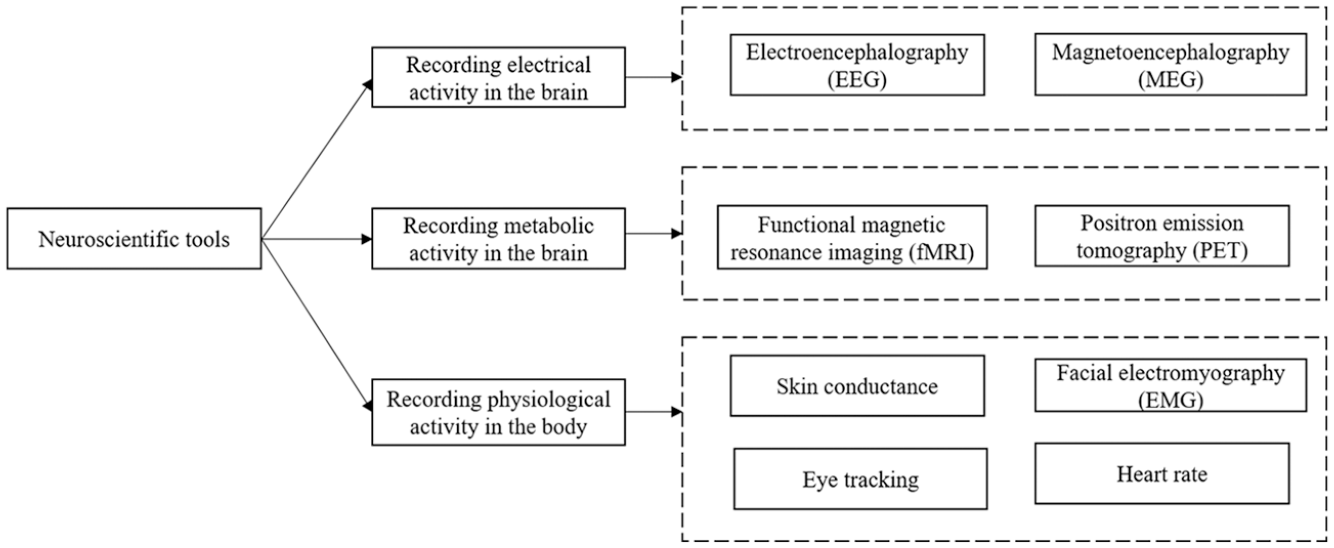
The brain comprises 100–150 billion neurons, with each neuron containing many short dendrites and one long axon. A neuron receives signals through short dendrites, sums those signals, and transmits them to its axon (Sawyer, 2011). Each neuron is linked with 1,000–10,000 neurons; these connections are called synapses. Synapses house neurotransmitters, such as serotonin, oxytocin, and dopamine (Koc & Boz, 2014), which are sent from one neuron’s axon across synapses to another neuron’s dendrites via the constant firing of neurons. EEG offers a means of recording this electrical activity in the brain (Telpaz et al., 2015). For example, when viewing a beautiful picture of a tourism destination, neurons involved in the visual system will fire more quickly. This rapid firing produces higher electrical voltages, which EEG can capture (Bastiaansen et al., 2018). Figure 1 illustrates that EEG is a neurophysiological measure of electrical potentials on the scalp surface (Minas et al., 2014).
Neuroscientific Tools in Neuroscience Research
In addition to electrical activity, neuroscientists are concerned with the thin layer of gray matter in the brain—also known as the neocortex, the brain’s outer layer—which is responsible for higher-level cognitive functions. The neocortex is about 5 mm thick (Huettel et al., 2009) and is made up of neuron cell bodies and blood vessels that supply blood to all neurons. When neurons in a particular region of the neocortex fire at an increasingly fast rate, that region becomes more active. Cognitive activities require high energy/oxygen consumption; therefore, neurons need more oxygen, and blood flow accelerates in regions featuring more intense cognitive activity (Boksem & Smidts, 2015; Lebreton et al., 2009). Positron emission tomography detects local changes in regional cerebral blood flow and measures neuronal activity. Similarly, fMRI detects the ratio of oxygenated to deoxygenated blood in the brain using a magnetic field. This ratio is referred to as the blood oxygen level-dependent (BOLD) signal. When activity heightens in a particular region, the BOLD signal is enhanced because neural activity induces an increase in local blood supply (Huettel et al., 2009). BOLD signal fluctuations can indicate correlations in regional brain activity. Positron emission tomography and fMRI scanners can assess metabolic activity in the brain.
Other measures, including SC, facial electromyography (EMG), eye tracking, and heart rate/respiratory rate, can be used to record psychophysiological activities in humans. SC, or electro-dermal activity (EDA), is an index of individuals’ emotional responses to stimuli (Li et al., 2015). As a person becomes emotionally aroused, the sympathetic nervous system activates and eccrine glands are innervated, resulting in stronger skin conductivity (Li et al., 2015). Facial EMG measures electrical activity induced by facial muscle movements. The muscles most often tested are related to emotional expressions, such as the zygomatic major muscles and supercilli muscles; positive emotions activate the former whereas negative emotions activate the latter (Wu et al., 2015). Eye-tracking devices are frequently used to detect the allocation of attentional resources in the visual system, as more than 80% of sensory input to the brain comes through this system (Scott et al., 2019). Heart rate and respiratory rate are usually taken as complementary measures to investigate emotion, stress, decision making, and attention (Li et al., 2015).
This paper focuses on a single typical neurophysiological measure from each of three types of tools (i.e., EEG, fMRI, and SC). The measures’ strengths and weaknesses are then compared to aid tourism and hospitality scholars in choosing a measure that suits their research design.
Comparison of Neurophysiological Measures
EEG
EEG uses sensors placed on the scalp to measure the electromagnetic fields generated by neural activity (Bastiaansen et al., 2018; Sawyer, 2011). Sensors/electrodes collect neurons’ overall synchronized activity relative to a reference electrode or a common average reference (re-reference). EEG is most sensitive to cortical activity (Ohme et al., 2009). Usually, a headset equipped with 32–128 electrodes is placed on the scalp at standard locations.
EEG data can be analyzed in two ways. The first is time domain analysis. EEG recorded immediately after a stimulus event is an ERP. Because all neurons in the brain are constantly firing, task-related EEG signals compared with background noise (i.e., the signal-to-noise ratio) are relatively low and the calculated ERP is of small amplitudes—often mere microvolts (Telpaz et al., 2015). Subjects view the same stimulus or task 30–100 times. The EEG waves are then averaged across all tasks, reducing the signal-to-noise ratio and revealing specific task-associated ERPs (Lopez-Calderon & Luck, 2014). EEG data can also be evaluated using frequency domain analysis (Harmon-Jones & Peterson, 2009). With this technique, different EEG frequency bands indicate different types of brain activity: delta band activity (5–4 Hz) occurs during deep sleep; theta band activity (4–8 Hz) is greater in childhood and is thought to be involved in information encoding and retrieval; alpha band activity (8–13 Hz) may be observed while one is awake or relaxed with their eyes closed; and beta band activity (13–30 Hz) accompanies increased alertness and focused attention. Gamma band activity (> 30 Hz) has yet to be fully understood but appears to be involved in perception (Luo et al., 2009).
One obstacle in EEG data analysis is that whenever a person moves their head or blinks, electrical frequencies are created within the same range as the task-related EEG signal. Signals unrelated to a task are called artifacts. Common artifacts include saccades, facial EMG, electrocardiography, skin potentials, and fatigue-induced alpha waves (Lopez-Calderon & Luck, 2014). It is therefore vital to remove artifacts unrelated to a task (i.e., artifact rejection) prior to data averaging.
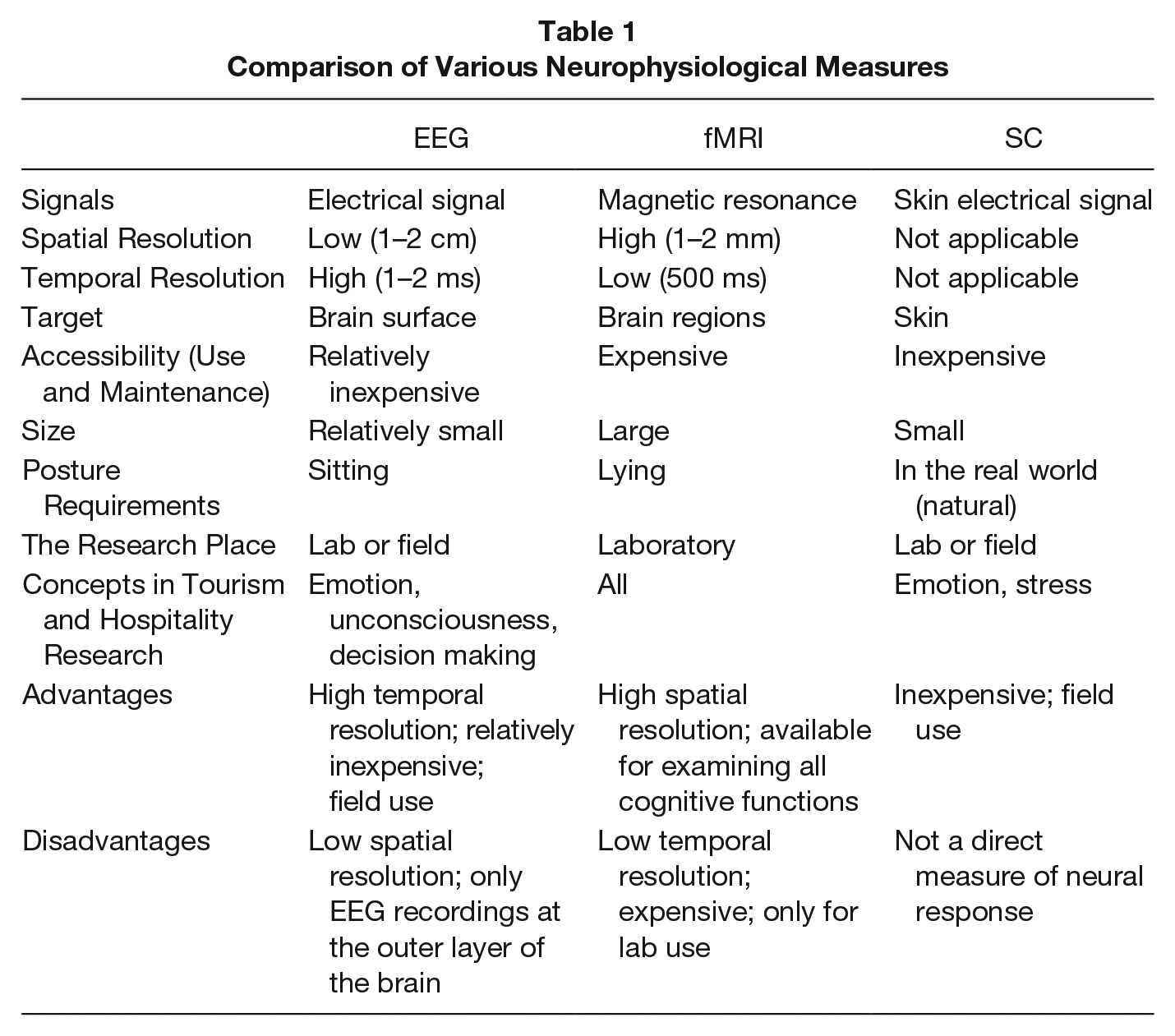
A major advantage of EEG is the ability to detect brain activity immediately (around 1–2 ms) after stimulus presentation, a characteristic known as high temporal resolution. EEG is also non-invasive and relatively inexpensive compared with fMRI. The disadvantage of EEG is its limited spatial resolution. Although as many as 128 electrodes can be used for recording, an ERP occurring at any particular electrode does not necessarily mean that the neurons beneath that electrode caused the ERP; electrical activity extends across the brain (Sawyer, 2011).
fMRI
As noted, an fMRI scanner uses a magnetic field to detect the ratio of oxygenated to deoxygenated blood (Huettel et al., 2009). When activation increases in a certain brain area, blood flow and the BOLD signal rise accordingly. fMRI technology has played a key role in neuroscience over the past 2 decades. Similar to EEG, neuronal changes associated with single trials are impossible to detect due to noise in the brain. Evoked hemodynamic brain activity is therefore usually estimated across multiple trials using a general linear model.
Two challenges apply to fMRI data analysis. First, as with EEG, various brain regions can be activated when a person moves their hand, bends their knee, or turns their head; these activations will interfere with normal scanning. Thus, individuals must remain completely still: the head is physically restrained, and only a single finger can be used to push a button in response to a trial. The second challenge in fMRI data analysis involves fitting each person’s brain onto a standard brain. Variation in brain size requires researchers to scale each person’s brain to a standard size. It is important to correct for head movement and to make necessary adjustments before fMRI data analysis (Huettel et al., 2009).
As an advantage, fMRI can accurately discern the brain regions related to certain tasks within 1–2 mm (i.e., at a high spatial resolution). This technique is also non-invasive and is becoming more readily available. However, fMRI suffers from a limited temporal resolution. BOLD signals do not increase immediately alongside growth in neuronal activity; the initial rise occurs several seconds after brain activity increases, peaking 4–6 s later before returning to baseline after 15–20 s (Sawyer, 2011).
SC
SC, also known as EDA, is a physiological indicator of emotion (Jacobs et al., 2012; Li et al., 2015). The automatic nervous system is activated when one’s body is stimulated by the outside world or when one’s emotional state changes. The automatic nervous system is composed of the sympathetic (activation) and parasympathetic nervous systems (relaxation). Stimulation activates the sympathetic nervous system and increases sweat gland secretion, leading to stronger skin conductivity (Jacobs et al., 2012). Phasic and tonic SC are collected via SC measurement (Li et al., 2015). Phasic data refer to individuals’ SC responses which last for several seconds; tonic data reflect longer-term reactions to stimuli and last for at least 30 s (Li et al., 2015).
A benefit of SC is its ability to measure physiological activities objectively without being influenced by socially desirable responses. SC is also useful for detecting unconscious physiological/emotional states. Finally, SC records real-time emotional responses to stimuli. Yet, as with EEG and fMRI, several issues hamper SC data analysis. First, both positive and negative stimuli can trigger SC responses, but SC cannot distinguish between these types. Researchers thus often combine SC with other approaches, such as self-report data, to collect information on emotional valence. Second, the external environment can influence SC data collection: Variables such as ambient temperature, electrode placement, hydration level of the tested hand, and individuals’ conversation must be well controlled during data collection (LaBarbera & Tucciarone, 1995). Approximately 10% of subjects are considered non-responders during SC recording (Li et al., 2015).
Combining methods
Given that the above-mentioned techniques possess complementary advantages (Table 1), they can be integrated to clarify how different brain areas are related to specific cognitive processes in tourism and hospitality research. One of the most common methods is to combine neuroscientific techniques (EEG, fMRI, or SC) with questionnaires to obtain a more complete picture of the behaviors involved in cognitive processes. Several tourism and hospitality scholars have performed multi-method studies. Li et al. (2018a) combined SC with questionnaires to investigate individuals’ emotional responses to promotional destination videos. EEG and SC have been used jointly to evaluate degrees of emotion (Valenzi et al., 2014). Relatedly, Hadinejad et al. (2019) employed EEG, eye tracking, and facial EMG to identify individuals’ emotional responses. fMRI has also been implemented with self-report surveys to examine tourists’ destination visit intentions (Al-Kwifi, 2015). However, thus far, no research appears to have employed both EEG and fMRI in tourism and hospitality. Future work can combine these methods to obtain intriguing results. For instance, researchers could use fMRI to determine which areas of the brain are activated by attractive pictures of tourism destinations. EEG could also be used to monitor transient changes in EEG components when individuals view pictures of destinations, thereby revealing temporal shifts in cognitive processes.
Comparison of Various Neurophysiological Measures
Methodology
Neurophysiological tools can be grouped into three main categories (Figure 1): tools that record electrical activity produced by the brain’s neurons; tools that use a magnetic field or a radioactive substance to track the brain’s metabolic activity; and tools that measure other physiological activities (Cherubino et al., 2019). Electrical activity in the brain is usually detected via EEG and magnetoencephalography. fMRI and positron emission tomography are typically used to measure the brain’s metabolic activity. Other physiological activities can be monitored based on SC, facial EMG, eye movement (eye tracking), and heart rate.
As indicated, this paper focuses on a typical measure from each of three categories of neurophysiological tools (i.e., EEG, fMRI, and SC) and comprehensively reviews studies adopting them in tourism and hospitality. Several recommendations for applying these measures in future work are also presented.
A systematic approach was employed to review neurophysiological measures in tourism and hospitality. Initially, a literature search was conducted to identify relevant studies in accordance with the procedure described below. In Step 1, the authors searched databases such as ScienceDirect, EBSCOhost, SAGE, Web of Science, Springer, and Google Scholar for all articles published between January 2001 and September 2021. Several keyword sets were used to locate articles mentioning the focal neurophysiological measures. EEG studies were gathered using various combinations of the keywords “EEG, electroencephalogram, tourism, tourist, hospitality, hotel”; “fMRI, functional magnetic resonance imaging, tourist, tourism, hotel, hospitality” were searched to identify fMRI studies; and SC studies were obtained with the keywords “skin conductance, electro-dermal activity, EDA, tourism, tourist, hotel.” To further ensure research quality, only academic articles published in peer-reviewed English-language journals were considered. The three topics yielded 145 articles: 19 on EEG, 48 on fMRI, and 78 on SC. The articles were then collected and recorded in a spreadsheet to facilitate subsequent categorization.
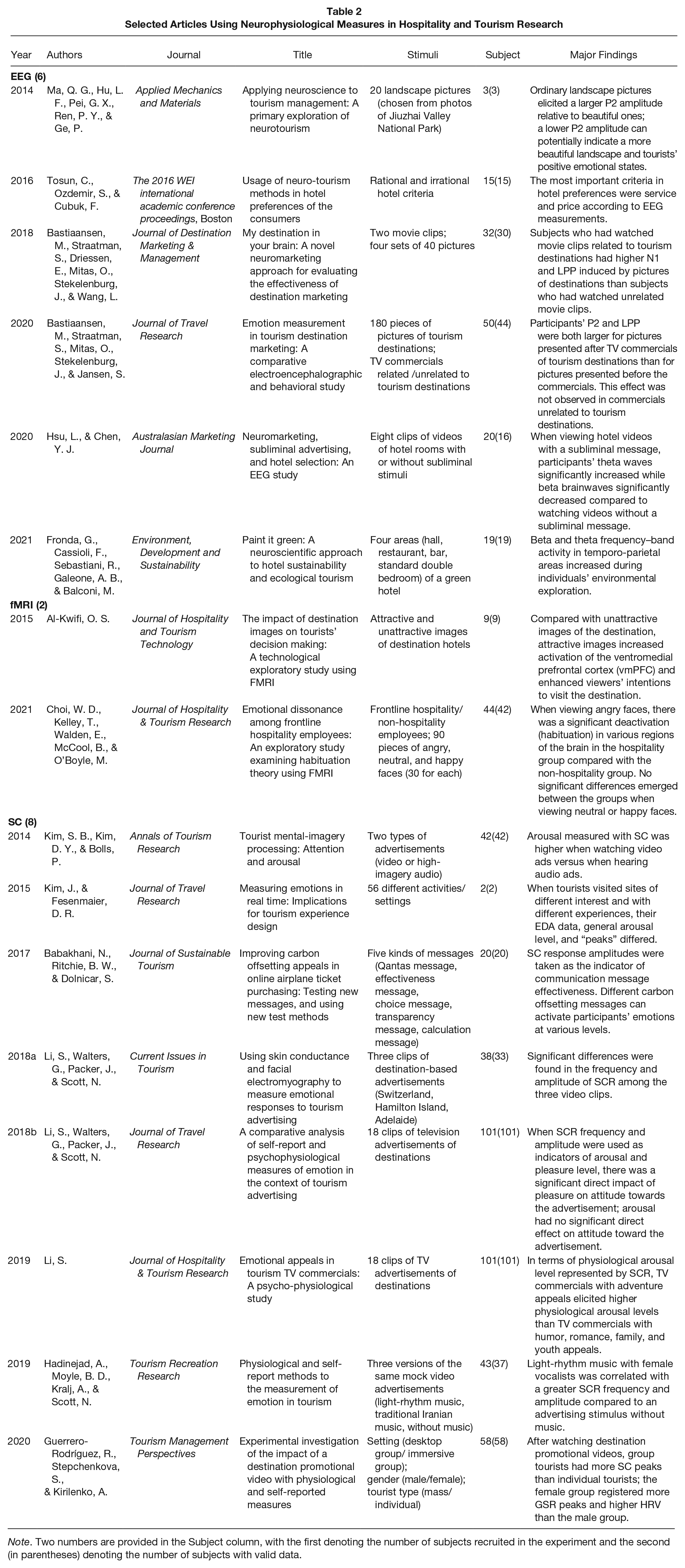
In Step 2, all sources were screened by examining each article’s abstract and evaluating the study context after a full read. This process indicated whether an article should be included in this review. Sixteen articles were ultimately retained: six on EEG, two on fMRI, and eight on SC (see Table 2 for details). This relatively small sample suggests that neurophysiological measures remain underutilized in tourism and hospitality research.
Selected Articles Using Neurophysiological Measures in Hospitality and Tourism Research
Note. Two numbers are provided in the Subject column, with the first denoting the number of subjects recruited in the experiment and the second (in parentheses) denoting the number of subjects with valid data.
Results of Neurophysiological Methods in Tourism and Hospitality
EEG in Tourism and Hospitality Research
EEG is widely considered a tool that can reflect emotional and cognitive brain activity (Li et al., 2021). Although EEG has been frequently applied in business and management research over the past 20 years, its adoption in tourism and hospitality is relatively rare. Only six sources used EEG in the current review—three in tourism and three in hospitality. As discussed, EEG data can be analyzed in either the time or frequency domain. Bastiaansen et al. (2018, 2020) and Ma et al. (2014) used time domain analysis whereas Tosun et al. (2016), Hsu and Chen (2020), and Fronda et al. (2021) used frequency domain analysis.
Ma et al. (2014) conducted a pilot study using brain ERPs to investigate neural activities underlying tourists’ perceptions and evaluations of two types of landscapes: Viewing ordinary landscape pictures elicited a larger P2 amplitude relative to viewing beautiful ones. A lower P2 amplitude potentially serves as an indicator of more beautiful landscapes and may represent a positive emotional state. Although the study only involved three subjects, a direct relationship was established between the P2 component of EEG and the sensations evoked when tourists viewed landscapes.
Bastiaansen et al. (2018) used ERPs to evaluate the impact of destination marketing. They chose the N1, P2, and late positive potential (LPP) components of ERP as dependent variables to reflect emotion and attention. The label “N” (as in N1) denotes a negative deflection peaking around 100 ms that can be observed on the scalp after stimulus presentation; P2 refers to a positive deflection peaking around 200 ms after stimulus presentation; and LPPs appear between 300–1000 ms. The authors adopted a between-subjects design. Findings revealed that subjects who had watched movies related to destination images displayed larger N1 and LPP amplitudes than subjects who had not, indicating positive emotional responses and heightened attention to destination images. Because Bastiaansen et al.’s (2018) study was solely based on EEG data, the relationships between each ERP component and subjects’ destination visit intentions were difficult to assess. Subsequent studies can combine EEG data with survey data to obtain more robust results.
In another article, Bastiaansen et al. (2020) explored the effect of watching TV commercials. Data were collected based on subjects’ self-reports and EEG responses after viewing destination advertisements. Although self-report data did not vary before and after seeing the commercials, subjects’ P2 and LPP amplitudes (i.e., emotion-related ERP components) grew in response to destination pictures presented after commercial viewing relative to the pictures presented before. This effect was not observed when subjects watched TV commercials unrelated to the tourism destination. EEG can therefore clarify how the unconscious influences individuals’ cognition and emotions in tourism and hospitality research.
Tosun et al. (2016) employed EEG to investigate which criteria were most impactful when subjects selected hotel enterprises. The most important criteria shaping subjects’ hotel preferences were service and price, echoing the subjects’ verbal responses on the matter.
Hsu and Chen (2020) explored the role of subliminal messaging in hotel selection. They used a within-subject design and analyzed different EEG frequency bands recorded while subjects viewed hotel videos with or without subliminal messaging (i.e., a smiling-face emoji). Compared with watching hotel videos without subliminal messaging, subjects exhibited higher theta band waves and lower beta band waves when watching videos containing subliminal messaging. The subliminal stimuli of a smiling-face emoji significantly affected hotel selection. These findings point to a relationship among subliminal presentation of a stimulus, changes in theta/beta bands, and hotel choice.
Finally, Fronda et al. (2021) used EEG to examine the neural correlates of consumers’ sustainable and ecological tourism in hotels. Subjects were invited to visit four areas (a hall, restaurant, bar, and standard double bedroom) of a green hotel. EEG findings showed an increase in beta and theta frequency–band activity in tempo-parietal areas during subjects’ visits. Stronger beta activity was attributed to an increase in subjects’ cognitive elaboration processes related to green products and to subjects’ attentional responses to these products. As such, EEG can unravel neural activity in response to hotels’ sustainability practices.
EEG has a millisecond-level temporal resolution, offering reliable and real-time data on individuals’ emotional and cognitive reactions. EEG is also useful for recording subliminal responses. Thus, this technology can be adopted more frequently in tourism and hospitality research related to emotion and attention. Also, the tool can help researchers gather real-time data that are objective, unconscious, and unbiased.
fMRI in Tourism and Hospitality Research
fMRI uses a magnetic field to measure changes in BOLD caused by neuronal activity (Huettel et al., 2009). Although this technique has occasionally been applied in business and management research, fMRI studies remain limited in tourism and hospitality. Only two articles using fMRI were identified in this review.
Al-Kwifi (2015) employed fMRI to record nine subjects’ brain activity when assessing the attractiveness of hotel pictures in a tourist destination. Subjects showed higher levels of brain activation in the vmPFC and greater willingness to visit the destination when evaluating attractive pictures versus unattractive ones. The vmPFC resides in the ventromedial part of the PFC and is involved in many higher-order cognitive functions such as evaluation (Plassmann et al., 2015) and decision making (Basten et al., 2010; Deppe et al., 2005).
More recently, Choi et al. (2021) recruited frontline hospitality workers (i.e., in customer-facing positions) and non-hospitality employees (i.e., with minimal or no customer interaction). Behavioral survey data suggested no significant differences between the groups in terms of life/occupational stress. However, fMRI analysis revealed more deactivation (habituation) of brain regions related to angry faces in the hospitality group versus the non-hospitality group: Hospitality subjects showed significant deactivation (habituation) in various brain regions upon viewing angry faces. These regions included the posterior cingulate cortex, middle frontal gyrus, middle temporal gyrus, and precuneus. No significant between-group differences were observed when subjects viewed neutral or happy faces. Therefore, fMRI can contribute to tourism and hospitality research by providing neural evidence complementary to behavioral data.
fMRI applications in tourism and hospitality are nascent. Meanwhile, fMRI has often been adopted in consumer behavior research to investigate the neural correlates underlying decision making and emotion. For instance, scholars have discovered that the PFC is related to individuals’ decision making and willingness to pay (Basten et al., 2010; Deppe et al., 2005; Plassmann et al., 2008). Brain regions such as the anterior cingulate cortex and the amygdala are related to emotion (for a review, see Lindquist et al., 2012), a core topic in tourism research. In the future, tourism and hospitality scholars can employ fMRI more frequently to explore tourists’ behavior in greater depth.
SC in Tourism and Hospitality Research
SC is usually considered a physiological indicator of emotion, demonstrating changes in the skin’s electrical conduction (LaBarbera & Tucciarone, 1995; Li et al., 2018a). The two-dimensional model posits that emotion includes two dimensions: valence and arousal (Lang et al., 1993). Valence refers to whether an emotion is positive or negative, and arousal reflects the level of emotion (e.g., moderately or highly excited; Lang et al., 1993). SC cannot distinguish between the valence of emotional responses; accordingly, this approach is often combined with other methods such as self-report measures.
Eight articles featured SC in this study’s sample. Authors took the frequency or amplitude of SC responses as the measurement index to objectively discern subjects’ physiological states. The following topics were most commonly addressed.
Emotions during travel
Kim and Fesenmaier (2015) conducted a preliminary study using SC to measure tourists’ emotional changes during travel. They invited two tourists in Philadelphia, PA, to participate in a 4-day trip, where the subjects were exposed to a range of experiences while SC data were gathered on a second-by-second basis. Results indicated substantial variation in the subjects’ SC recordings depending on where they visited, the activities in which they participated, and who they met (Kim & Fesenmaier, 2015). The study centered on a pair of tourists who encountered authentic stimuli in Philadelphia; the sample size was small, and the environmental stimuli could not be replicated in a lab. However, scholars can learn the prospect of replacing artificial stimuli in the lab with authentic stimuli in tourism destinations.
Emotions induced by destination marketing materials
Most SC studies in tourism and hospitality have focused on the emotions evoked by destination marketing materials. For instance, Kim et al. (2014) compared destination promotional videos and high-imagery audio, and measured subjects’ emotional responses to both types of stimuli using SC and facial EMG. Video ads elicited stronger arousal than high-imagery audio ads (Kim et al., 2014), indicating that SC could be used to distinguish the effectiveness of various promotions.
Li et al. (2018a) used SC and facial EMG to track subjects’ emotional responses to destination advertisements. They also collected self-report ratings and post-hoc interview data. Significant differences emerged in the frequency and amplitude of SC between emotional videos and non-emotional videos. Compared with traditional self-report measures, SC and facial EMG could more clearly differentiate between sets of destination advertisements and emotional dimensions (Li et al., 2018a). Later, Li et al. (2018b) further investigated advertising effectiveness via SC. They divided tourism advertisements into six types (family, adventure, romance, youth, humor, and rationality) and examined the effects of emotional responses evoked by destination TV advertisements on subjects’ attitudes toward the advertisements, post-exposure destination attitudes, and visit intentions. Pleasure, but not arousal, significantly influenced subjects’ attitudes towards TV ads when SCR frequency and amplitude were taken as indicators of arousal and pleasure levels (Li et al., 2018b). However, pleasure and arousal each exerted a significant impact on subjects’ attitudes towards tourism TV ads based on responses to self-report measures. These contradictory findings imply overestimation of the relationship between self-report measures of emotions and the effectiveness of promotional advertisements. This inconsistency also underscores the need to adopt more reliable physiological measures in emotion-related studies.
Li (2019) referred to the same six types of tourism advertisements to identify differences in subjects’ physiological arousal. Emotional appeals in tourism videos appeared distinguishable by their ability to evoke emotional responses. Yet two questions remain, based on such work. First, SC data and oral reports produced discordant results. Li et al. (2018b) reported that the effects of pleasure on tourism advertising effectiveness were much weaker when pleasure was measured physiologically than when self-report measures were used, and physiological arousal was not a significant indicator of advertising effectiveness. Objective measures such as SC data are thus essential to tourism and hospitality research; they can provide more reliable metrics of subjects’ actual emotional states. Second, as the authors mentioned, emotional appeals in tourism advertisements should not be treated as a homogeneous variable: each of the six advertisement types was related to a particular emotional arousal level. Researchers should attend to varying levels of emotions when using SC.
Hadinejad et al. (2019) explored the validity of different measures of emotions in a tourism context by comparing the SC technique with self-report surveys. Three versions of the same mock video advertisement were used—one with light-rhythm music, one with traditional Iranian music, and one with no music. Significant differences were identified among the three versions according to self-report surveys as well as SC frequency and amplitude. Physiological and self-report measures of emotional arousal were not necessarily consistent, but similar results were observed when assessing emotional valence with either technique. Combining physiological and self-report measures seems useful for understanding emotional experiences in tourism more fully (Hadinejad et al., 2019).
In Guerrero-Rodríguez et al.’s study (2020), after subjects viewed promotional destination videos, subjects in the mass tourism group displayed more SC peaks than those in the individual group. Additionally, women registered more GSR peaks and higher heart rate variability than men (Guerrero-Rodríguez et al., 2020). Social factors such as group division and gender may therefore influence tourists’ emotions and should be accounted for in destination marketing research.
Emotions and environmental protection behavior during tourism
Only one article in this study’s sample featured SC when evaluating environmental protection behavior during tourism. Babakhani et al. (2017) measured subjects’ SC responses and amplitude peaks when presented with five kinds of information about carbon offsetting (i.e., a Qantas message, effectiveness message, choice message, transparency message, and calculation message). The choice, calculation, and effectiveness messages elicited the most pronounced emotional activation. These outcomes exemplify the utility of psychophysiological measures for pretesting alternative social marketing messages intended to encourage environmentally sustainable tourist behavior across a range of applications (Babakhani et al., 2017).
In sum, SC is a reliable means of assessing emotional arousal from tourism-related stimuli. However, SC data and self-report data do not always align (Hadinejad et al., 2019); the SC technique records emotions in real time and objectively, whereas oral reports reflect emotions stored in memory and are susceptible to distortion. Self-report measures thus may not represent subjects’ actual emotional states (Bastiaansen et al., 2018). Both methods possess benefits and drawbacks when used to measure emotions: physiological techniques return objective evaluations, and self-report approaches explain the reasons behind emotional experiences. In light of this complementarity, scholars may wish to combine SC, oral reports, or other neurophysiological measures to gain a more holistic understanding of emotional responses (Hadinejad et al., 2019).
Discussion
This study has presented a systematic review of neurophysiological measures adopted in tourism and hospitality, focusing on EEG, fMRI, and SC. Sixteen papers applying EEG, fMRI, and SC were discussed. Additionally, the advantages and disadvantages of each method were highlighted. This section outlines directions for future work involving neurophysiological measures, including strategies and standards related to their application both in academia and industry. The measures’ limitations are detailed as well.
Suggestions for Future Research
This review unveiled three topics that are well suited to neurophysiological investigation: decision making, emotions, and cognition.
Decision making
Many neuromarketing researchers have employed neuroscientific measures to scrutinize consumers’ decision-making processes (for reviews, see Shiv et al., 2005 and Yoon, et al, 2012). For instance, fMRI studies have shown that the medial orbitofrontal cortex and dorsolateral PFC play key roles in encoding one’s willingness to pay (Plassmann et al., 2007). In using EEG, Fu et al. (2019) reported that deceptive pricing can be associated with an increase in cognitive conflict and a decrease in purchase intention as evidenced by differences in N2 and LPP amplitudes. A recent fMRI study by Hu et al. (2021) discussed the computational and neurobiological substrates of altruistic decision making regarding helping and demonstrated that the dorsal anterior cingulate cortex and insula are involved in selfish and altruistic behaviors, respectively.
In the early 1980s, Zeleny (1982) proposed two approaches to studying decision making: outcome-oriented and process-oriented. The first approach maintains that decisions are comprehended based on their outcomes, whereas the second posits that decisions are best understood by their process. Most tourism and hospitality studies have assumed the outcome-oriented approach (AI-Kwifi, 2015). Yet researchers should consider the stages before and after decision making. Neurophysiological measures can contribute in understanding the three stages of decision making: information search (pre–decision making), actual decision making, and post–decision making.
In the first stage, consumers search for information about alternative options (e.g., tourism products or services). Hospitality and tourism scholars have confirmed that consumers’ subliminal perceptions of information, attention to stimuli, and perceptions of information largely govern the information search process (Bastiaansen et al., 2018, 2020; Hsu & Chen, 2020; Scott et al., 2019). For example, tourists’ subliminal perceptions of a smiling-face emoji can influence hotel selection as indicated by EEG (Hsu & Chen, 2020). Attention to marketing advertisements or promotional materials can convey marketing effectiveness, and this attentional process has neural correlates (Bastiaansen et al., 2018, 2020). Tourists’ perceptions of destination pictures’ attractiveness are associated with vmPFC activation (AI-Kwifi, 2015). These findings demonstrate that neuroscientific techniques can illuminate various tourism and hospitality phenomena, such as subliminal product perceptions and objective evaluations of destination stimuli. Future objective assessment of multi-sensory stimuli can entail neuroscientific techniques. For example, researchers can consider subjects’ visual perceptions of hotel and tourism destination photos, virtual reality presentations of hotels for internet marketing purposes (Marchiori et al., 2017), auditory perceptions of music at theme parks (Carson et al., 2004), and olfactory perceptions at restaurants (Guéguen & Petr, 2006).
Consumers’ willingness to pay and willingness to visit are common foci in studies of the second stage of decision making. Plassmann et al. (2007) found that activation in the medial orbitofrontal cortex and dorsolateral PFC guides willingness to pay. Ramsøy et al. (2019) observed that brain activation varies significantly with willingness to pay. In tourism, AI-Kwifi (2015) noted that activation of the ventromedial PFC is positively correlated with one’s willingness to visit a destination. The literature has identified the PFC as the key brain region for decision making. Yet, it is unclear whether tourism and hospitality decisions—which are often tied to intangible products—involve the same PFC subregions as decisions about tangible products (e.g., as in Plassmann et al.’s [2007] food experiment).
The third decision-making stage has received little academic attention in terms of neuroscientific techniques. Nonetheless, the post-decision phase is crucial; consumers can experience emotional responses such as anxiety, regret, and pleasure (Hoyer et al., 2001). Service recovery, which has been intensely examined in tourism and hospitality, also occurs in this stage. Boshoff (2012) employed neurophysiological measures to evaluate consumers’ emotional responses to service recovery efforts, seeking to provide objective evidence of the impact of service recovery. The brain regions involved in post-decision emotional responses, as well as the neural correlates of service recovery, need additional exploration.
Emotion
Emotions can be assessed using neurophysiological measures. Emotions are crucial to decision making (Li et al., 2015), and neurophysiological instruments can directly discern subjects’ emotional responses (Li et al., 2021). Hospitality and tourism scholars continue to examine emotions closely, such as in terms of tourists’ emotional responses to marketing agents (i.e., via EEG; Bastiaansen et al., 2018, 2020), individuals’ emotional experiences during travel (i.e., via SC; Kim et al., 2014), and hotel employees’ emotional dissonance (i.e., via fMRI; Choi et al., 2021). Yet, most studies have tended to focus on tourists’ positive rather than negative emotions. However, negative emotions heavily mold consumers’ repurchase intentions and play key roles in service recovery. Brain regions associated with positive and negative emotions should thus be further explored in tourism and hospitality settings. For instance, the left PFC and regions involved in the reward system (e.g., the striatum) are activated with positive emotional reactions; the right PFC and the amygdala are activated with negative emotional reactions (Matukin et al., 2016). Researchers can hence adopt neuroscientific techniques to inspect brain activities correlated with different emotional responses.
Another topic worthy of greater attention entails social emotions such as nostalgia, guilt, and gratitude. Nostalgia is the core of memory tourism and heritage tourism (Bandyopadhyay, 2008). Guilt is known to influence environmentally friendly tourism (Bahja & Hancer, 2021). A relationship has also been confirmed between gratitude and tourism (Filep et al., 2017). Social neuroscience studies have demonstrated that brain areas responsible for guilt processing include the anterior middle cingulate cortex and the insula (Yu et al, 2014). The vmPFC contributes to gratitude processing (Yu et al., 2017), while nostalgia processing involves the insula and the midbrain (Barrett & Janata, 2016). Correspondingly, neurophysiological measures can be applied to study complex social emotions and the underlying neural underpinnings in tourism and hospitality contexts.
Other cognitive processes
Finally, neurophysiological measures are appropriate for studying other psychological cognitive processes in tourism and hospitality. Cognitive processes can be evaluated via surveys; many questionnaires have been developed to measure cognition, including motivation, memory, attention, perception, and attitude. Yet, self-report surveys are more likely than other instruments to produce biased results, especially when subjects are reluctant to or unable to express their true opinions (Bastiaansen et al., 2018; Scott et al., 2019). Neurophysiological measures can capture more objective and unconscious responses (Li et al., 2015, 2021). This review proposes that neurophysiological measures can address multiple types of cognitive processes in tourism and hospitality research. For instance, in fMRI studies, the vmPFC has been shown to be related to subjects’ judgements about the attractiveness of destination pictures and subsequent destination visit intentions (Al-Kwifi, 2015). The hippocampus is involved in memory encoding and retrieval (Van Petten, 2004). EEG studies suggest that ERP components are associated with attention (Bastiaansen et al., 2018), unconscious perception (Hsu & Chen, 2020), and experience-based preferences (Boksem & Smidts, 2015). The SC technique can be used to examine subjects’ emotional experiences (Hadinejad et al., 2019) and attitudes (Walla et al., 2011). Neurophysiological measures are thus suitable for investigating cognitive processes, including motivation, attention, perception, memory, and attitude (Li et al, 2021).
Applying Neurophysiological Measures in Tourism and Hospitality
The relative paucity of research involving neurophysiological measures in the business and tourism and hospitality fields is noteworthy. These techniques may be somewhat rare in the social sciences for several reasons. First, neurophysiological measurement systems are expensive and difficult for researchers to access. EEG equipment such as Neuroscan or BrainProduct can cost roughly US$100,000; SC systems like BioPac can be purchased for about US$40,000. However, once a laboratory is equipped with these systems, the operating and maintenance costs are comparatively low (see Table 1). An experiment using a single EEG or SC system typically costs US$1000–$2000 for consumables and subject compensation, depending on the country where the experiment is conducted. An fMRI machine (e.g., from Siemens or General Electric Company) is much more expensive—around US$3 million—and carries high operating and maintenance costs: such equipment costs approximately US$400/hr to run. One fMRI experiment may cost as much as US$10,000–$20,000 when considering data collection and subject compensation.
Second, tourism and hospitality generally has limited cooperation with other disciplines. Although many universities are equipped with EEG and/or SC systems, many tourism and hospitality researchers do not know how to use these devices. Collaboration with psychology or neuroscience faculty can rectify this problem. Typically, a month-long training or additional assistance can prepare researchers in outside disciplines to run EEG or SC systems. Three months of training on fMRI should prepare a researcher to conduct an fMRI experiment with the help of a machine operator. Hospitality and tourism scholars who wish to quickly familiarize themselves with neuroscientific techniques should collaborate with professionals who have been using these methods and focus on a topic suitable for neurophysiological instruments.
Certain standards are proposed for research involving neurophysiological measures in tourism and hospitality. First, because these measures record electrical/metabolic activities in the brain and physiological activity in the body, studies leveraging neurophysiological instruments should address human behavior (e.g., decision making, emotion, and other cognitive processes). Second, sample sizes (i.e., the number of subjects) should satisfy the requirements for statistical power; the number of experimental trials should adhere to the threshold required for each technique. Neuroscience studies using EEG, fMRI, or SC usually recruit at least 20 subjects. Because neuronal changes associated with a single trial in EEG and fMRI experiments are impossible to detect due to noise in the brain, researchers must average the stimulus-locked epoch (i.e., in EEG) or estimate the beta value (i.e., in fMRI) across multiple trials to obtain a satisfactory signal-to-noise ratio. More than 50 trials are typically required for each experimental condition. Finally, neurophysiological measures need to be combined with other techniques such as surveys. Every method offers advantages; as such, approaches can be used jointly to determine how different brain areas correlate with certain cognitive processes in tourism and hospitality settings. One of the most common methods involves combining neuroscientific techniques (EEG, fMRI, or SC) with questionnaires to derive a more complete picture of the behavior involved in specific cognitive processes.
Neurophysiological techniques hold particular promise for the tourism and hospitality industry. On one hand, consumers are not always honest, whether deliberately or unintentionally; oral responses can be distorted by memory or social desirability bias. By contrast, neurophysiological measures gather objective and real-time responses, which can enlighten researchers and practitioners about consumers’ true thoughts. These measures can therefore make unique contributions to this industry. On the other hand, neurophysiological measures can help with practitioners’ decisions: EEG research can guide hotel managers in selecting promotional materials; promotional videos embedded with subliminal imagery can increase consumers’ theta waves and purchase intentions (Hsu et al., 2020). EEG studies can also promote green practices in hotels—scholars have adopted EEG to investigate consumers’ exploration of hotel environments and identified neural activities correlated with green products (Fronda et al., 2021). Additional EEG and fMRI studies can be performed regarding consumer behavior, choices of promotional materials, and green hotel behavior. Put simply, hotel and tourism researchers should continue to adopt neurophysiological measures in their work.
Limitations of Neurophysiological Measures
Neurophysiological measures are not free from limitations. First, neuroscience studies using EEG, fMRI, or SC often have relatively small samples of 10–30 subjects. Small samples are partly due to the high costs and complexity of experiments. Additionally, neuronal changes associated with single trials in EEG and fMRI experiments are impossible to detect due to noise in the brain. Researchers thus need to average subjects’ responses to each stimulus over a large number of identical trials. Statistical analyses such as t tests and analysis of variance can be conducted when each condition involves more than 30 trials (Li et al., 2021). Scholars should employ within-subject designs when possible to acquire more data even when using relatively small samples.
Second, it is hard to make claims about causation with neurophysiological measures. Most studies instead investigate the correlation between brain activity and behavior. Yet, a brain area may be activated during a task without playing a prominent role in that task; rather, the area may be under the control of other more critical areas. Researchers can compensate for this constraint by integrating neurophysiological measures with other methods (e.g., transcranial magnetic stimulation) to test causal relationships.
Third, neurophysiological measures can reveal information in tourism and hospitality contexts that has been documented in other disciplines, such as neuromarketing. For instance, studies have repeatedly shown that the PFC is activated during decision making. It is therefore unsurprising that this region is activated when individuals judge destination pictures and form visit intentions (AI-Kwifi, 2015). Yet it remains unknown whether tourism and hospitality decisions, which revolve around largely intangible products and services, involve the same PFC sub-regions (e.g., ventral medial PFC or dorsal lateral PFC) as decisions about tangible products. Tourism and hospitality should consider what distinguishes their findings from those in different fields to ensure novel results.
In summary, this paper has probed three topics suitable for investigation with neurophysiological measures in tourism and hospitality: decision making, emotion, and cognition. Interdisciplinary cooperation is strongly recommended to promote the application of neurophysiological measures in this domain. Neurophysiological measures can uniquely contribute to the hospitality industry by providing real-time, objective consumer responses. This study is one of the first to offer a deeper understanding of the literature involving neurophysiological tools and sheds light on subsequent use of such measures for academic and industry purposes.
Footnotes
Authors’ Note:
This work was supported by the Research Project of China Disabled Persons’ Federation-on assistive technology (2021CDPFAT-39), Beijing Municipal Education Commission Project (SZ201910031017), and National Natural Science Foundation of China (31800923).
