




Abstract
The government-mandated closure of U.S. restaurants for in-restaurant dining during the early stages of the COVID-19 crisis cast a spotlight on operators’ ability to effectively innovate, and re-imagine their product offerings. In this context, this research draws on the resource-advantage theory of competitive advantage, proposing that (1) an adhocracy culture is a key internal resource that operators can leverage to drive rapid incremental product innovation under forced change, and (2) firm size is a contextual factor that moderates the degree of incremental product innovation-firm performance relationship. Findings from two empirical studies indicate that adhocracy culture positively and indirectly effects firm performance through degree of incremental product innovation, and that this effect is moderated by firm size. Larger firms yield superior performance effects due to access to a network of interconnected resources for rapid innovation diffusion in a crisis.
Highlights
An adhocracy culture drives rapid incremental product innovation during a crisis
Incremental product innovation mediates the adhocracy culture-firm performance relationship
Larger (vs. smaller) firms drive higher returns from incremental product innovation
Introduction
The COVID-19 pandemic created both a public health crisis, and an economic crisis, unprecedented in scale, in the United States. (Triggs & Kharas, 2020). The simultaneity of these crises has had devastating consequences for the U.S. restaurant industry, particularly early in the crisis when government mandates dictated that operators pivot to a restricted business model. 1 This unprecedented pivot forced operators to re-imagine, and refine their product offerings, bringing their ability to effectively innovate to the test. Crisis dynamics create a compressed time and space continuum (Bowers et al., 2017). In this context, innovation can enable a firm to regain competitive advantage and market leadership (Guellec & Wunsch-Vincent, 2009). Indeed, owing to its pivotal role in recovery, a number of researchers have emphasized the need to study innovation within a crisis setting (see e.g., Hausman & Johnston, 2014).
Hospitality research has examined innovation in response to the COVID-19 crisis from a number of perspectives, such as business model innovation (e.g., Harms et al., 2021), technology innovation (e.g., Shin & Kang, 2020), and determinants of innovation (e.g., social capital; Visentin et al., 2021). In this research, we seek to contribute to the literature in this domain by probing the mediating effect of degree of incremental product innovation (i.e., the volume of incremental product innovations that the firm creates and implements) on the adhocracy culture-firm performance relationship in the context of the U.S. restaurant industry’s rapid shift to a crisis-induced, restrictive business model. Furthermore, we examine the moderating effect of firm size in the indirect effect of adhocracy culture on firm performance through degree of incremental product innovation.
We use the resource-advantage (R-A) theory of competitive advantage as the theoretical framework for this research (Hunt & Morgan, 1995, 1996). According to R-A theory, innovation is central to gaining competitive advantage in a market. However, the degree to which a firm successfully engages in innovation activity is contingent on its ability to leverage its heterogeneous internal resources for innovation (Hunt, 1997). We propose that adhocracy culture (Cameron & Quinn, 1999) is one such internal resource that is critical to support innovation during a crisis. We assert that the characteristics of an adhocracy culture (i.e., flexibility, creativity, and an external focus) position it as a key resource that restaurant firms can leverage to drive rapid incremental product innovation under forced change.
Further, R-A theory suggests that any competitive advantage gained from incremental product innovation will lead to superior firm performance. However, prior research is inconclusive regarding the innovation-firm performance relationship (Szymanski et al., 2007). In this research, we propose firm size as a contextual factor that may moderate the degree of incremental product innovation-firm performance relationship. The monetization of innovation demands a complex set of interconnected resources for effective diffusion. Thus, under the time pressure associated with a rapid change in business model, we expect that the resource advantage that large (vs. small) firms have for innovation diffusion will garner them a greater return on their incremental product innovations during a crisis.
Across two empirical studies, one qualitative and the other quantitative in nature, we probe a moderated-mediation model, wherein (1) incremental product innovation mediates the adhocracy culture-firm performance relationship, and (2) the path from incremental product innovation to firm performance is moderated by firm size. Because our research focus is on rapid incremental product innovation in the context of restaurant operators’ response to the government-mandated shift to a restricted business model at the outset of the COVID-19 crisis, the timeframe of interest in this work was the first 8 weeks that restaurants were closed for dine-in business. Unfortunately, it is likely that the U.S. restaurant industry will encounter more crises in the future. Thus, we conclude with a discussion of the implications of our research findings for restaurant operators in terms of resourcing, and supporting incremental product innovation to meet future challenges.
Literature Review
Incremental Product Innovation
Innovation can broadly be defined as an idea, practice, behavior, or an artifact that is perceived as being new by the adopting unit (Tarafdar & Gordon, 2007). Innovation can be radical in nature (i.e., the development or application of significantly new technologies or ideas) or incremental (i.e., upgrades or revisions to products and services; Ettlie et al., 1984). Both types of innovation have been explored in the hospitality literature. For example, Chang et al. (2011) investigated how hospitality firms can promote incremental and radical innovation through human resource management practices, while Souto (2015) demonstrated the influence of business model innovation, and business concept innovation on successful incremental and radical innovation. More recently, García-Villaverde et al. (2017) examined the determinants of radical innovation in a hospitality and tourism context.
Hospitality innovation research specific to the COVID-19 crisis setting has primarily focused on incremental innovation. In their work on hotel innovation, Sharma et al. (2021) noted that radical innovation is rare within the hospitality industry, with most innovation incremental in nature, prompting them to focus primarily on incremental innovation in the crisis setting. Breier et al.’s (2021) qualitative data provides support for the dominance of incremental innovation during the COVID-19 crisis, finding that business model innovation was incremental in nature owing to the fact that it could be implemented quickly and spontaneously in a period of low liquidity. This finding is consistent with the notion that firms tend to favor incremental innovations when satisfying changing market needs in the short term (Ali, 1994), as they are generally easier to plan, and take less time and resources to implement, than radical innovations (Gilbert, 1994). In line with this stream of research, we focus on incremental innovation in our work.
In terms of innovation typology, hospitality researchers have explored several dimensions of innovation including product (e.g., Horng et al., 2013; Li et al., 2021), process (e.g., Khan, 2020), marketing (e.g., Hussain et al., 2020), and organizational innovation (e.g., Binder et al., 2016; Uen et al., 2018). Our research focuses specifically on product innovation as it is highly relevant to restaurant firms’ response to the restricted business model that the COVID-19 crisis induced.
Finally, innovation has been conceptualized and measured in a number of different ways in the literature, contributing to the lack of consensus regarding the role and impact of innovation within organizations (Camisón & Monfort-Mir, 2012). For example, some studies have framed innovation in terms of behavior or orientation (e.g., “creativity is encouraged here,” “openness to new ideas”; e.g., Kim et al., 2021; Senbeto et al., 2021; Xu & Wang, 2020), while others have focused on innovation capability (e.g., Kim et al, 2018; Teng & Chen, 2021) or competencies (Huang et al., 2021). Here, we focus specifically on degree of innovation, in other words the volume of incremental product innovations that the firm creates and implements.
Adhocracy Culture and Firm Performance
R-A theory classifies organizational culture as a potential resource that a firm can leverage for competitive advantage. Organizational culture is a combination of shared attributes within an organization, including values, beliefs, and norms (Khazanchi et al., 2007). The competing values model of organizational culture posits that a firm’s shared, or basic, values can take different forms as represented by four cultures: hierarchy, market, clan, and adhocracy (Cameron & Quinn, 1999; Quinn & Rohrbaugh, 1983; White et al., 2003). Both hierarchy and clan cultures are internally focused, with a hierarchy culture emphasizing control, efficiency, consistency, and uniformity, while a clan culture is oriented towards collaboration, commitment, and teamwork. Market and adhocracy cultures, on the other hand, are externally focused. A market culture has a competition orientation, emphasizing market share, goal achievement, and profitability, whereas an adhocracy culture has a creative orientation that stresses innovativeness, vision, and agility (Cameron & Quinn, 1999).
While all four cultures can coexist at both the firm and business unit levels (Cameron & Quinn, 2006; Moorman, 1995), one or more of these cultures may dominate within specific contexts. Furthermore, it has been suggested that firm performance is contingent on the fit of the dominant culture with the external environment (Wei et al., 2014). Within environments exhibiting high uncertainty and rapid change, traditional bureaucratic modes of control through market and hierarchy cultures are not effective because rational economic decision making and opportunistic behavior do not apply to such markets (Ouchi 1980). Conversely, an adhocracy culture can perform well because the entrepreneurial thinking and creativity inherent in the adhocracy culture is necessary to navigate the uncertain and unpredictable conditions (Alvesson & Lindkvist, 1993; Wei et al., 2014). Extending this line of reasoning to a crisis environment, it can be argued that an adhocracy culture that stresses innovation and agility can provide firms with the opportunity to gain a competitive advantage and drive firm performance in an environment that demands rapid change. Furthermore, we suggest that degree of incremental product innovation is the underlying mechanism explaining the adhocracy culture effect on firm performance in a crisis setting.
Adhocracy Culture and Degree of Incremental Product Innovation
Within R-A theory, innovation provides a means for firms to gain competitive advantage, and achieve superior performance (Hunt & Davis, 2008). However, the degree to which a firm successfully engages in innovation activity is contingent on its ability to leverage its heterogeneous internal resources for innovation (Hunt, 1997). In this research, we propose that adhocracy culture is one such internal resource.
Prior research has established a positive relationship between an adhocracy culture and innovation activity. For example, Naranjo-Valencia et al. (2017) found that an adhocracy culture was positively related to innovative behavior, and the degree of radical innovation that a firm engaged in. Similarly, Zeb et al. (2021) demonstrated a positive adhocracy culture-innovation activity relationship. Del Rosario and René (2017) focused specifically on incremental product innovation and found support for a positive adhocracy culture-incremental product/service innovation relationship in the context of eco-innovation in hotels.
To our knowledge, there has been little focus on the role of an adhocracy culture in a crisis setting with the exception of work such as that of Bowers et al. (2017) which examined the effects of an adhocracy culture on leadership style, or Sherman and Roberto (2020) who examined adhocracy culture in the context of constructing crisis management messages. Here, were suggest, in line with R-A theory, that the characteristics of an adhocracy culture (i.e., flexibility, spontaneity, individual initiative, and market responsiveness; White et al., 2003), position it as a key resource that firms can leverage to drive incremental product innovation under rapid, crisis-induced change. Because a firm with an adhocracy culture emphasizes innovation, experimentation, and risk taking, it can be expected that it will seek new solutions in response to changes in the external environment (Lumpkin & Dess, 1996). The more informal adhocracy culture encourages greater horizontal communication and cooperation among organizational members, allowing for collaborative communication (Brown & Starkey, 1994) and participation in decision-making (Ashmos et al., 1998), both of which are essential in an environment that demands rapid change. Further, because firms with an adhocracy culture tend to emphasize innovation and adaptation (Bluedorn & Lundgren 1993), they are more likely to provide adequate resources in the event of sudden change (White et al., 2003), and allow organizational members the latitude to make the changes necessary to facilitate rapid incremental product innovation.
Degree of Incremental Product Innovation and Firm Performance: Moderating Effect of Firm Size
While R-A theory suggests that innovation activity will drive firm performance, prior research regarding the innovation-firm performance relationship is inconclusive. A meta-analysis conducted by Szymanski et al. (2007) found only a small to moderate correlation between product innovativeness and firm performance, but they suggested that contextual factors could influence the innovativeness-performance relationship. In other words, the development of incremental product innovations, in of itself, will not drive superior performance (Farooq et al., 2021). Rather, contextual factors surrounding the diffusion of innovation will also determine its success.
Consumer- and firm-based influences can play a role in the marketplace performance of innovation offerings (Szymanski et al., 2007). For example, an innovation is likely to be more successful if it triggers consumers’ variety-seeking tendencies (Mukherjee & Hoyer, 2001), or if a patent precludes competitors from entering the marketplace with a new good of their own (Szymanski et al., 2007). Here, we argue that firm size represents a contextual factor that will moderate the degree of incremental product innovation-firm performance relationship in a crisis setting.
Consistent with R-A theory, the monetization of innovation demands a complex set of interconnected resources for effective diffusion. For example, in their study of environmental innovation, Andries and Stephan (2019) found that larger firms benefitted financially from environmental innovation driven by regulation or industry codes of conduct, attributing the superior performance to the lower marginal costs associated with scale economies and more resources to adapt to regulation. This finding is consistent with the thesis that economies of scale and scope in an organization can positively impact innovation outcomes (Moch & Morse, 1977). Here, we suggest that the resource advantage held by larger firms is fundamental to the rapid diffusion of incremental product innovation in a crisis setting. When innovation results in the development of a re-imagined product portfolio, the success of that portfolio rests on building consumer awareness of, and access to it. Given the scale of their activities, larger firms tend to have more sophisticated technology systems, distribution channels, and marketing tools to promote, and distribute their products to the consumer (Coviello et al., 2000; Rogers, 2004). Thus, we expect that, by virtue of comparative advantage in these inter-related resources, larger (vs. smaller) firms are able to more rapidly yield returns from incremental product innovation.
In sum, we propose that, under crisis conditions:
H1: Degree of incremental product innovation will mediate the adhocracy culture-firm performance relationship.
H2a: The effect of degree of incremental product innovation on firm performance will be moderated by firm size. The positive effects of degree of incremental product innovation on firm performance will be more pronounced for large (vs. small) firms.
H2b: Firm size will moderate the positive and indirect effect of adhocracy culture on firm performance through degree of incremental product innovation. Specifically, the mediating effect of incremental product innovation will be more pronounced for large (vs. small) firms.
See Figure 1 for our conceptual model.
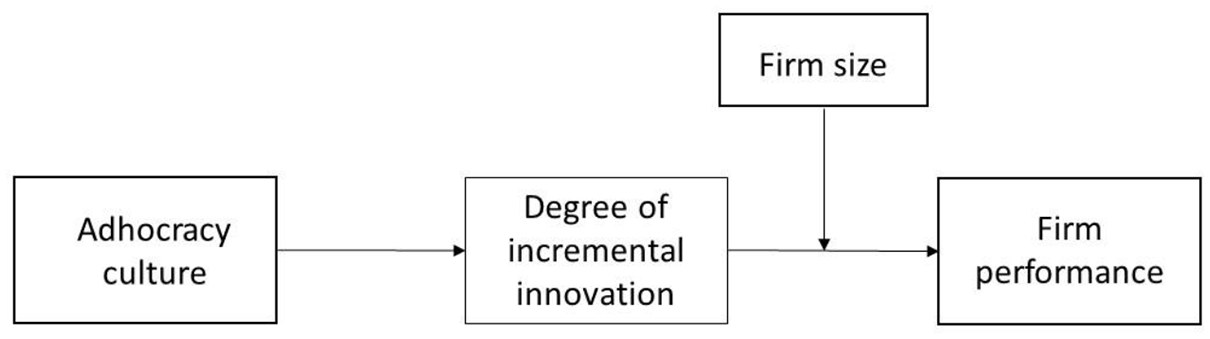
Conceptual Model
Method
We used a mixed method, sequential exploratory design in this research. We first conducted a qualitative study (Study 1) to validate the elements of our theoretical model, and then conducted a quantitative study (Study 2) to formally test our hypotheses. Given the unique characteristics of the COVID-19 crisis, Study 1 enabled us to elicit deeper insights from restaurant professionals than quantitative research permits, and, in doing so, allowed us to evaluate the elements of our conceptual model within the context of practitioners’ first-hand experiences. Specifically, in line with the work of Grayson and Martinec (2004), we conducted interviews with restaurant industry executives to hear, in their own words, their experience of the shift to a restricted business model, and to tap into the role, antecedents, and consequences of incremental product innovation in that context. This phase of our research also enabled us to (1) identify appropriate measures for firm performance, and firm size (i.e., measures that were compatible with the novel COVID-19 operating environment); and (2) generate lists of potential incremental innovation practices, and price discounting practices, for Study 2. In Study 2, we empirically tested our conceptual model using a sample of restaurant firms from across the continental United States.
Study 1 was conducted in May, 2020, and Study 2 in June–August, 2020. Given that the objective of this research was to examine firms’ ability to rapidly innovate during the earliest stages of a crisis, the timeframe of interest in this research was the first 8 weeks that a given restaurant was closed for in-restaurant dining. This time range, rather than a specific date range, was employed to accommodate the date differences in in-restaurant dining closures across individual states.
Study 1
Participants and Procedure
The likelihood of achieving the goal of gathering rich descriptions of lived experience can be enhanced by using a purposeful sample (Grossoehme, 2014). Thus, we used purposive sampling in this study, selecting participating restaurant firms to provide broad representation across major restaurant segments (i.e., fast/fast casual, casual, and upscale casual/fine dining), firm size (i.e., single versus multi-unit), and structure (e.g., franchise and non-franchise operations). All participants held an ownership/executive leadership position within their firm, enabling them to speak to its organizational culture, and the full scope of incremental product innovation-related actions undertaken in response to the COVID-19 outbreak. Two of the participants chose to remain anonymous. See Table 1.
Study 1: Participant Profiles
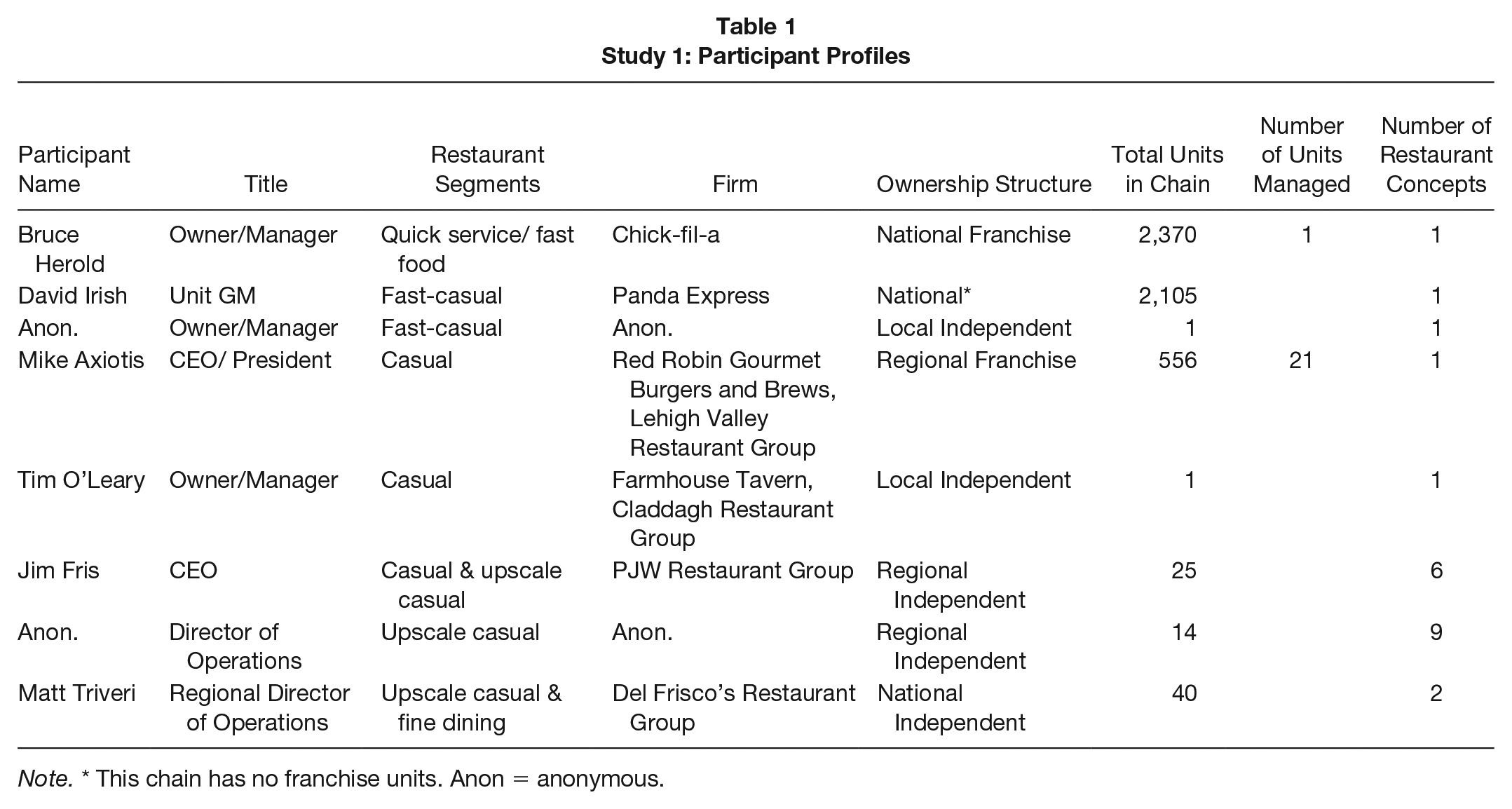
Note. * This chain has no franchise units. Anon = anonymous.
Sample size guides for phenomenological studies vary across authors: for example, at least six (Morse, 2000), and between five and 25 (Cresswell, 1998); with variability of sample size contingent on a number of factors including (1) the scope of the study (the narrower the scope, the smaller the sample size needed to reach saturation), (2) the nature of the topic (the less ambiguous the topic, the fewer the participants needed as information can be easily obtained in the interviews), (3) interviewee expertise (the more useable the data collected from each interviewee, the fewer participants are needed), and (4) data quality (the greater the amount of useful information obtained from each participant, the fewer needed) (Morse, 2000). After evaluating the characteristics of our qualitative study (i.e., relatively narrow in scope, unambiguous topic, and participants who, by virtue of their expertise, were expected to provide useful, high quality data), we set an initial target sample size of 10, with the goal of interviewing participants until saturation was reached. Consistent with Guest et al. (2006), we operationalized saturation as the point in data collection and analysis when new information produces little or no change to the codebook.
We conducted a semi-structured, in-depth interview with each participant via Zoom. Each interview lasted between 45 min and 1 hr and 10 min, with an average of 50 min. The set of interview questions that we used were designed to enable participants to talk broadly about their COVID-19 experiences, and provide the opportunity for the constructs of interest to emerge organically during the interview (see supplementary material: Study 1). All interviews were recorded in Zoom, and the automated transcripts generated by Zoom were reviewed and checked for accuracy. Given that the primary objective of this study was to validate our theoretical model, we used a directed approach to content analysis (Hsieh & Shannon, 2005). After each interview, the content was coded with pre-determined codes for categories (and sub-categories) that were dictated by our conceptual model (Potter & Levine-Donnerstein, 1999): Firm Performance (pre-COVID-19, post-pivot to a restricted business model); Incremental Product Innovations; Adhocracy Culture; and, Firm Size (Distribution; Customer Engagement). Interview data that could not be coded into these pre-defined categories and sub-categories were held out until all interviews were completed, and were analyzed to determine if they represented a new sub-category of an existing code, or a new category.
This resulted in the creation of a broad Product Portfolio category which encompassed Efficiencies and Incremental Product Innovations (formerly a category) as subcategories; a sub-category within Incremental Product Innovation: Community Orientation; and a sub-category within Adhocracy Culture: Clan culture. We used NVivo 12 to support data management, coding, and the aggregation of data into categories and sub-categories (Flick, 2004). Two independent raters reviewed and coded the data; interrater reliability was acceptable (Cohen’s k = .90).
The directed content analysis was ongoing throughout the data collection period, and a clear pattern in participants’ responses emerged within five interviews. Although the interview questions allowed participants to talk broadly about their lived experiences of the mandated restrictive business model, the variables of interest (i.e., adhocracy culture, incremental product innovation, and firm size) emerged organically as integral to driving firm performance under a restricted business model. Differences arose in terms of how the different restaurant concepts (e.g., the six concepts managed by the PJW Restaurant Group), and individual restaurant units represented in the sample managed their product portfolio during the early stage of the COVID-19 crisis (e.g., some of the specific menu items removed from, and added to, menus were a function of historical consumer preferences for a given brand or restaurant outlet), but the fundamental constructs of interest emerged from the interviews regardless of restaurant concept, or number of restaurant units managed. We continued with three additional interviews to ensure saturation had been reached, resulting in a final interview count of eight participants.
Results
Firm Performance
Prior to the COVID-19 crisis, all of the restaurant firms in the sample were performing strongly, with sales up year-on-year (YOY) as much as 20%. However, the pivot to the COVID-induced restricted business model had a significant impact on this upward trend. For casual and upscale casual/fine dining restaurants, where take-out pre-COVID-19 constituted as little as 5% of total sales mix, sales dropped as much as 95% YOY during Week 1 (of restaurant closure for in-restaurant dining). For fast/fast casual restaurants, with a high proportion of drive-thru/takeout business pre-COVID (i.e., 55% plus of total sales mix), the impact on sales was less severe, with some outlets even boosting as much as 15% YOY sales growth.
All firms grew sales volume during Weeks 2–8 (of restaurant closure for in-restaurant dining), with those negatively impacted by the crisis closing the gap on YOY overall sales as much as 50%. Firms that relied on in-restaurant dining pre-COVID-19 grew their take-out business as much as 350% YOY, but to do so were challenged with rethinking how to price, and drive customer spend under a take-out/delivery model. The need to actively drive customer spend was particularly pertinent for restaurants that traditionally relied on alcohol sales to boost average check. For example, one participant noted that, because alcohol sales for his firm constituted approximately 35% of the pre-COVID-19 sales mix, there was significant pressure to develop practices that would enable them to maximize the spend from food sales:
The to-go per person check average is always much lower than dine-in because it’s very hard to attach a beverage order to it. Most people have drinks in the refrigerator at home. . . . . So, what we found is, what we’re trying to do now is, because we’re only relying on takeout sales, we’re trying to figure out ways to get a higher attachment rate and get that check average up.
Within the fast/fast-casual segment, with less reliance on alcohol sales, and a stable pre-COVID-takeout business model, participants reported sales growth through increases in average spend per transaction of up to $6 during the timeframe under investigation.
Product Portfolio
The implementation of efficiencies, as well as incremental product innovations were central to participants’ strategies to change and adapt their product portfolios, and drive sales during the time period under investigation.
Efficiencies
Efficiencies primarily encompassed menu paring, and all but one firm engaged in this practice. For example, one firm reduced their menu by 50%, while another pared their menu down from 96 items to the top 25 based on sales volume. In addition to popularity, participants identified ease of preparation as a criterion for keeping a menu item. Additional practical considerations included, for example, the cost of raw ingredients, suitability of menu items for travel, and the amount of customer volume required to justify certain menu items (e.g., slow roasted prime rib). There was a flexible approach to streamlining across multi-unit firms. Units that were able to maintain, or increase, sales volume did not streamline their menus. Others removed complex items (e.g., fajitas) from their menus only during high demand periods. The notion of menu streamlining is not unique to this crisis. As one participant put it:
“Paring down the menu. . .that’s something that, if our sales dropped, we would naturally do.”
Accordingly, all participants reported that, as sales began to rebound after Week 2 and Week 3 of closure for in-restaurant dining, they began to bring back a number of menu items each week.
Incremental product innovations
While some degree of menu streamlining was viewed as a natural tactic that firms use to address a decline in demand, innovation and the ability to reinvent and change in response to the unique COVID-19 operating model was viewed as a critical means of survival for all firms. As one participant put it:
“We can’t—we just can’t keep operating how we traditionally do. . . . It’s a new marketplace.”
Another described the crisis as a catalyst for change:
“When you’re caught in a crisis, it sparks innovation. . . . Entrepreneurs figure out how to innovate their way through the crisis and come out stronger.”
There was a consensus across participants that incremental innovation was about rethinking what products to offer the consumer, with one participant describing incremental innovation in his firm’s context as follows:
Where you allow your team to bring forth outside-the-box ideas, that are non-traditional to your operating model. Innovation is not necessarily your own creative idea. It can be your own creative idea, but it could be a borrowed idea from someone else that you took and made it better.
In the pivot to a takeout/delivery business model, participants’ firms engaged in the development of various new product offerings, from meal kits (e.g., Mother’s Day brunch in a box) and do-it-yourself ingredient boxes (e.g., taco kits), through to pop-ups (e.g., Mexican Taqueria), and the sale of grocery items. The degree of incremental innovation was greatest for casual and upscale casual/ fine dining restaurants. For example, upscale casual/fine dining restaurants focused on creating new revenue streams by pivoting to alternative, cheaper options to existing menu items, introducing day of week specials, and promoting grocery items to increase spend per transaction. Participants reported grocery sales as high as 20% of their post-in-dining closure sales mix, with one describing it as a “shocking hit.” Casual and upscale casual/fine dining restaurants also experienced a boost in spend per transaction from selling high-end wine and cocktails to go, as well as do-it-yourself drink kits. Indeed, for one firm, the promotion of a to-go version of their signature drink, and $1 sodas yielded beverage sales from 5–6 out of 10 take-out orders, versus 1 out of 10 pre-COVID.
Community orientation: While incremental product innovation was viewed by participants as a means to stimulate average check, they all spoke to the impact of this innovation on restaurants’ ability to support, and connect with, the local community, something that participants valued highly. As one participant put it: “How can we keep our hearts full and feel like we’re helping?” A community orientation was reflected in the development of offerings such as groceries, as well as the charitable giving that restaurant firms linked to various product offerings (e.g., “buy one, and we’ll donate one” boxed meals for frontline workers).
Adhocracy Culture
The influence of an adhocracy culture on incremental product innovation was evident from the manner in which participants spoke about the role of culture in enabling incremental product innovation within their firms. All participants stressed the importance of a culture that values innovation and creativity, and the ability to enact change quickly. Two participants referred to the first week of the pandemic as the “wild west” stressing that the ability to dynamically respond and adapt was key to successful product innovation. Participants’ most used phrases included innovative, creativity, autonomy, and entrepreneurial. Participants from regional and national firms acknowledged the bureaucratic elements of their organizations (e.g., firm-wide policies and regulations to ensure brand consistency), but underscored their firms’ ability to emphasize innovation, and creativity during the crisis. One participant spoke to the role of culture in his firm’s success in growing their take-out business by 240% in the first 8 weeks post-COVID, moving from a $8.9 million run-rate in Week 1 to a $31 million run-rate in Week 8:
[There was] little micromanagement, a lot of autonomy, a lot of innovation, and we saw explosive growth. . . . As a company, we typically have a system for everything. . .but we’ve been coached in how to think, and we can move very quickly in what we want to do. . . . Our general managers had the autonomy to be creative, generate ideas, and then they are filtered up as best practices to be shared company-wide.
This sentiment was echoed by other participants:
We are a very big company but the thing that drew me to it in the beginning was that it was a big company that didn’t feel like a big company. It’s very entrepreneurial. I’ll definitely praise our senior leadership. . . . They did a lot of things at the start of the crisis to remove some of the bureaucracy that we’re used to as a big company, to allow us to move quickly. . . . It allowed for specific innovations at a local level as well as innovations at the national level.
It is about leading with positivity and fostering a culture that allows the team to work together, come together, and bring forth ideas that are not going to be criticized, critiqued. . . . We’ve been disciplined about that. . . . Because you know another thing that stifles creativity is when somebody brings forth an idea, and somebody shoots it down. . . . It’s really being disciplined to stay quiet as the leader, and not be the one that’s always coming up with ideas. This is how we have operated. . .people are not afraid to live outside-the-box a bit. . . . And I think that having a culture that allows people to be creative and bring forth ideas and work together as a team, has allowed us to do what we have done here. If it was a top-down directive style, it would not work.
Four of the participants also spoke specifically to the benefits of their firm’s innovation focus pre-COVID-19, and how it enabled them to pivot to a take-out/delivery business model. As one participant summed it up:
“We were prepared, had systems in place. We [had] thought creatively about how we distribute our product offerings, [and] enhance access, digital [and] mobile.”
Clan Culture: In the context of talking broadly about their COVID-19 experiences, participants also emphasized how characteristics of a clan culture shaped their firms’ approach to the crisis, with the most frequently-used words being family and loyalty. While this dimension of culture did not directly impact the degree of incremental product innovation that firms engaged in, it underpinned a priority on taking care of the team (e.g., retaining as many employees as financially viable, providing meals for furloughed employees and their families).
Firm Size
Participants emphasized the effects of firm size in bridging their incremental product innovations to customer spend. Comments across all participants focused primarily on firm size as an enabler of distribution, and customer engagement.
Distribution
In terms of distribution, participants spoke of access to technology by virtue of firm size for ordering (e.g., firm app, online ordering platforms) and delivery (e.g., national contracts with third party vendors), minimizing the effort, time, and any physical contact required for ordering and receiving orders. The latter was an important consideration for customers in light of the dearth of knowledge regarding virus transmission and its effects early in the pandemic.
Even for firms that did not have ordering technology in place pre-COVID-19, firm size, and the associated resources, enabled a quick pivot to a take-out/delivery business model. One participant described his firm’s experience:
NCR was able to work with us with a group out of India, and we were able to launch online ordering in four days. . . . So that was huge. I mean, it was a game changer for us. It got everybody off the phone constantly. But it also—it was a big sales increaser, because that’s, that’s what people want to do. They don’t want to talk to anybody, they just want to go in and click, click, click, pay. . . . It was all due to our IT team.
This idea of speed to market was echoed by another multi-unit participant when speaking about his firm’s pivot to new distribution platforms:
“We got ourselves on six [third party] platforms in half the time it should have taken.”
Customer Engagement
Participants spoke to the role of technology in facilitating communication and engagement with customers, in particular to raise awareness about new product offerings and availability. Participants from multi-unit operations, particularly those with a significant number of units spoke to the advantages they experienced by virtue of firm size. For example, when speaking about how he leveraged the digital capabilities of his national firm when his restaurants closed for in-restaurant dining, one participant noted:
With the mobile app I could go in and literally move a button to “okay curbside on.” The backend marketing tool is our primary communicator with our customers—it drives our messaging and communication. . . . For example, I changed my hours in my individual unit and used it to instantly to communicate with 8,000 customers via the app. It’s gone from just another marketing tool to really connecting with the guests. All offers/letters get routed that way to customers too. . .. It’s been a little humbling to see just how powerful it is. . . . I feel for these small mom and pops.
In contrast, a single-unit participant spoke to the challenges of educating the customer to engage with technology:
We already had online ordering in place, but people will still call so we are pushing them towards the online. . . . The hope is that will build awareness of the online. . . . [The] biggest challenge is how to get the right mix on your menu, and how to get the word out there.
The importance of access to marketing and public relations tools was underscored by another multi-unit participant when speaking about his firm’s COVID-19 experience:
In the beginning, the first thing we knew was that we had to create a presence that we didn’t have. We don’t have a presence in the to-go and delivery game, so it very much, first-off, becomes a marketing game.
Discussion
The primary goal of Study 1 was to validate our conceptual model within the context of restaurant professionals’ first-hand experiences during the shift from normal, pre-COVID-19 operations to a restricted, crisis-induced business model. The clear pattern in participants’ responses with regard to the variables of interest in this work provides initial support for our conceptual model, suggesting that an adhocracy culture is a driver of the degree to which firms engage in incremental product innovation, and that firm size may moderate the impact of incremental product innovation on firm performance. While beyond the scope of our conceptual model, the interview process also provided a deeper insight into how incremental product innovation activities fit within restaurants’ total response to COVID-19. Incremental product innovations were implemented alongside efficiencies in terms of menu paring, staff layoffs and furloughs. Participants also spoke, at length, to the very emotional and humane aspect of restaurants’ response to the crisis through actions to protect the welfare of employees, and contribute to the community, reflective of a clan culture within their organizations.
Participants’ responses also guided the development of measures for firm performance and firm size for Study 2. It was evident from participants’ responses that it was consumer spend, not volume, that restaurant operators were focused on in terms of a return on their incremental product innovations. This is because spend (vs. volume) was the metric that they had the greatest capacity to impact during the early stage of the COVID-19 crisis, with external factors including stay-at-home orders, and fear regarding the spread and effects of the virus negatively impacting customer volume. For this, and several additional reasons outlined in the Measures section for Study 2, average spend per transaction was used to measure firm performance in Study 2. The notion that firm size, by virtue of number of restaurant units, was a driver of the pace of innovation diffusion during the early stage of the COVID-19 crisis was apparent in the way that participants spoke about access to resources, particularly technology for distribution and customer engagement. The greater the number of restaurant units, the more likely the organization was to have access to the network of interconnected resources required to support rapid innovation diffusion (i.e., resources for distribution and customer engagement). For this reason, we used number of restaurant units to measure firm size in Study 2.
Study 2
Participants and Procedure
The target population for Study 2 was restaurant managers and owners across the continental United States. We sought a sample that would be representative of (1) major segments of the restaurant industry (i.e., fast/fast casual, casual, and upscale casual/fine dining), (2) single and multi-unit restaurants, (3) franchise and non-franchise outlets, and (4) restaurant operations across all U.S. states. To reach this population we employed the services of Dynata, a third-party data collection firm that specializes in the recruitment of professionals for research panels. 2 Their service allowed us access to their first party data (i.e., individual participants who could provide representation across the four criteria listed above). Only restaurants that had remained open since the beginning of the COVID-19 pandemic were included in the study. Participants were asked to complete an online, self-administered questionnaire to gather data relating to the variables of interest in this study. Because we were interested in the impact of degree of incremental product innovation on firm performance, participants were screened to ensure that they were familiar with the performance metrics for their restaurant(s): “I am familiar with the performance metrics for the restaurant(s) that I own/manage (e.g., year-on-year change in sales mix, average number of weekly transactions, average spend per transaction)” with a yes/no response.
Measures
Prior research in innovation in a non-crisis setting has examined firm performance from a number of perspectives such as measures of input, output, capacity, employees, and financial resources (Camisón-Zornoza et al., 2004). In this research, we assessed firm performance from a sales perspective but used average spend per transaction (on a sliding scale from $0 to $200), as opposed to sales performance, for a number of reasons. First, as indicated in the Discussion section for Study 1, it was consumer spend, not volume, that restaurant operators had a greater capacity to impact during the early stage of the COVID-19 crisis through incremental product innovation. Second, spend per transaction can account for the effects of differences in sales mixes across restaurant units on sales performance, independent of customer volume (Giménez-García et al., 2007). Third, average spend per transaction provides a better measure of tracking takeout and delivery sales wherein the concept of volume gets distorted.
We used a 4-item, 7-point Likert scale anchored by strongly disagree and strongly agree to measure adhocracy culture (Cronbach’s α = 0.87; Lukas et al., 2013). We adopted the approach of Sorescu and Spanjol (2008) to measure degree of incremental innovation, where we summed the number of incremental new product offerings that a restaurant introduced following the closure of their restaurant for in-restaurant dining (Yes/No response). To facilitate respondents’ capture of all of the incremental product innovations that they implemented, we provided them with a list of 11 incremental product offerings sourced from Study 1 data, and verified by a U.S. restaurant industry survey (Datassential, 2020). There was also an open-ended question that allowed participants to record any additional innovations that they had implemented but were not included on the list that we provided.
Firm size has been previously measured using total assets, market capitalization, or number of employees (Camisón-Zornoza et al., 2004; Jeng & Pak, 2016). As indicated in the Discussion section for Study 1, we used number of restaurant units within the firm as a measure of physical capacity (Camisón-Zornoza et al., 2004) to account for the access to the resources relevant to rapid innovation diffusion (i.e., distribution and customer engagement).
Given their potential effects on both degree of incremental product innovation and firm performance, we controlled for restaurant type, franchise status, and access to financial resources in our analyses. Franchise status was measured using a binary outcome (Yes/No). Access to financial resources was measured using a 2-item, 7-point scale anchored by strongly disagree and strongly agree adapted from Leonidou et al. (2013; r = 0.82; p < .0001). Also, based on prior evidence of the influence of firm size on innovation activity (Camisón-Zornoza et al., 2004), we controlled for firm size when testing the adhocracy culture-incremental product innovation relationship.
Finally, given their potential to influence consumer spending, we controlled for the effects of price discounting practices, and median household income in our test of the incremental innovation-firm performance relationship. Consistent with the approach of Sorescu and Spanjol (2008), we measured price discounting practices by summing the number of price discounting practices that a restaurant introduced following the closure of their restaurant for in-restaurant dining (Yes/No response). To facilitate respondents’ capture of all of the price discounting practices that they implemented, we provided them with a list of five discounting practices sourced from Study 1 data, and verified with a U.S. restaurant industry survey (Datassential, 2020). There was also an open-ended question that allowed participants to record any additional discounting practices that they had implemented but were not included on the list that we provided. Median household income by city and state was extracted from the United States Census Bureau (2020; see Supplementary material: Study 2).
Results
Descriptive Statistics
In total, 310 restaurant owners and managers across 38 states within the continental United States. were screened for participation in the study. Of those, 140 qualified to participate (i.e., they were familiar with, and were willing to share, the performance metrics for their restaurant[s]). Of the participants, 48.6% (n = 68) were owners, and the remainder were restaurant managers. The average age of the participants was 42.39 (SD = 11.33). The average number of years that participants had worked in their current position was 8.58 years (SD = 6.77), with an average of 16.44 years working in the restaurant industry (SD = 10.39). The split between single and multi-unit restaurant firms was relatively even, with 45.7% (n = 64) of the firms represented in the study comprising of a single unit, with the remaining 54.3% comprising of multiple units. The mean number of units per firm was 328.29 (SD = 1,635.45). In terms of restaurant type, 44.3% (n = 62) of the specific restaurant units described by participants were fast/fast casual, 31.4% (n = 44) were casual, and the remaining 24.35 (n = 34) were upscale casual/fine dining. In total, 33.6% (n = 47) of the restaurant units represented in the study were franchise units (see Supplementary material: Study 2).
The mean rating for adhocracy culture was relatively high among all of the firms surveyed (M = 5.28, SD = 1.23). The mean number of incremental product offerings introduced across restaurant units was 3.25 (SD = 2.59). The mean spend per customer transaction across the restaurants in the sample was $34.25 (SD = $22.19). Consistent with the typical differences in price points between fast/fast casual restaurants and those in the casual and upscale casual/fine dining tiers, the mean spend per transaction for fast/fast causal units (M = $24.05, SD = $16.79) was significantly lower than for casual (M = $40.99, SD = $21.64; p < .0001), and upscale casual/fine dining (M = $44.15, SD = $24.21; p < .0001) units.
Hypotheses Tests
We used PROCESS Model 14 in SPSS to test H1, H2a, and H2b regarding the hypothesized moderated mediation of the adhocracy culture-firm performance relationship (Hayes, 2017). This procedure used an ordinary-least-squares path analysis to estimate the coefficients in the model in order to determine the direct effect and indirect effects of adhocracy culture on firm performance. We modified the cmatrix within PROCESS to enable us to specify the covariates at the different stages of our analyses. Bootstrapping was implemented in these analyses to obtain bias-corrected 95% confidence intervals for making statistical inference about specific and total indirect effects (see Preacher & Hayes, 2008).
Due to the high standard deviations for firm performance, firm size, and median household income, we used the logarithm of these variables in the model to slow the fluctuation of the sample data, and encourage normal distribution of the error terms (Liang et al., 2020). The results of the moderated mediation analysis are presented in Table 2.
Study 2: Results of the Moderated Mediation Analysis
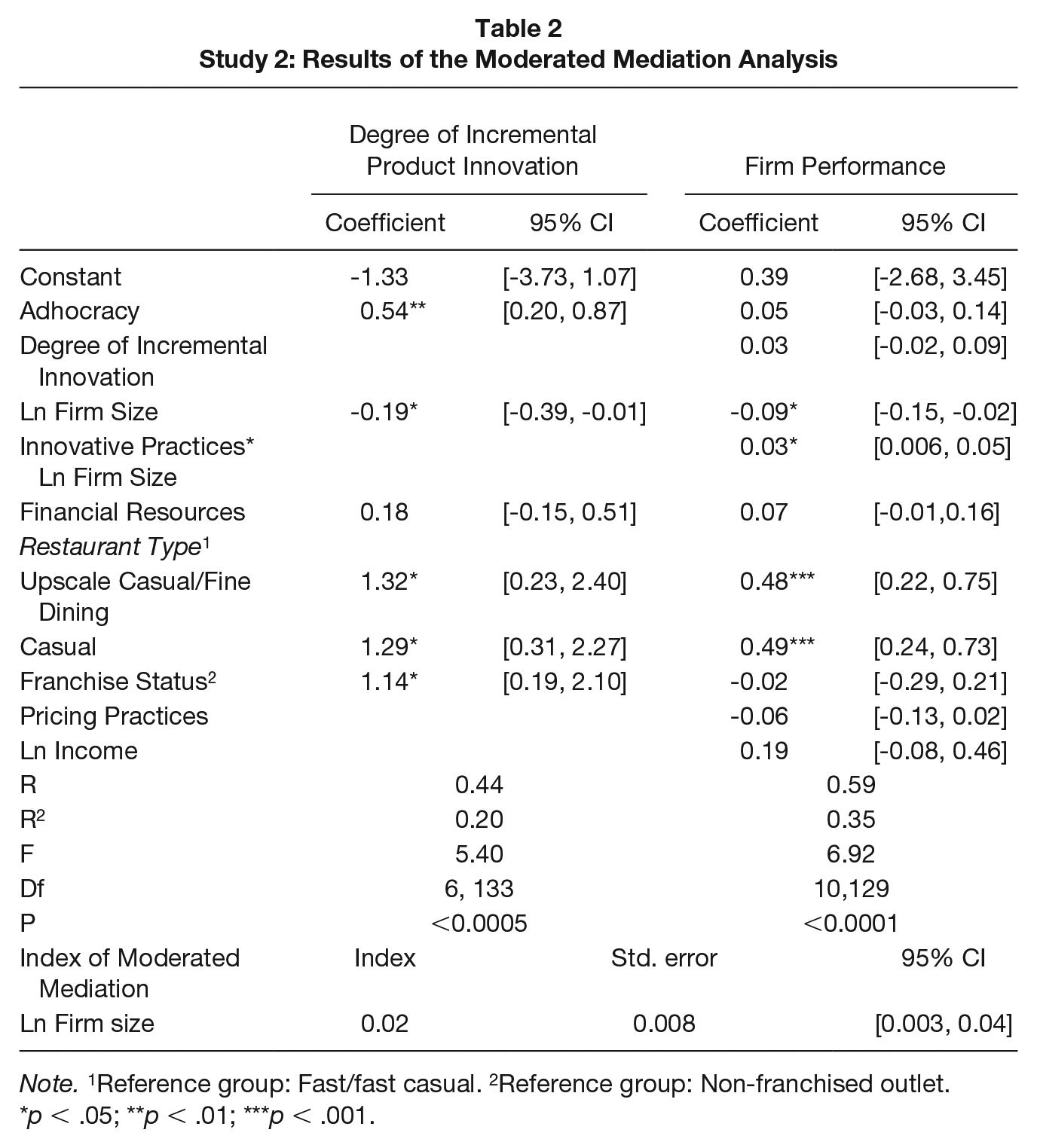
Note. 1Reference group: Fast/fast casual. 2Reference group: Non-franchised outlet.
p < .05; **p < .01; ***p < .001.
As hypothesized, there was a significant, positive effect of adhocracy culture on degree of incremental product innovation (β = 0.54, CI [0.20, 0.87]. With the exception of financial resources (β = 0.18, CI [-0.15, 0.51], all of the control variables had an effect on degree of incremental product innovation. Casual and upscale causal/ fine dining restaurants engaged in a significantly higher degree of incremental product innovation than fast/ fast casual restaurants (β = 1.29, CI [0.31, 2.27]; and, β = 1.32, CI [0.23, 2.40] respectively). Franchise units had a higher degree of incremental product innovation than non-franchised units (β = 1.14, CI [0.19, 2.10] and firm size had a significant, negative effect on degree of incremental product innovation (β = -0.19, CI [-0.39, -0.01].
The direct effects of adhocracy culture, and degree of incremental product innovation on firm performance were not significant (β = 0.05, CI [-0.03, 0.14]; β = 0.03, CI [-0.02, 0.09] respectively). However, the direct effect of firm size was significant (β = -0.09, CI [-0.15, -0.02], as was the interaction effect of degree of incremental product innovation and firm size (β = 0.03, CI [0.006, 0.05]). The Johnson-Neyman technique was used to probe the interaction effect (Hayes, 2017). Above the value of 0.5147, LnFirm size had a significant effect (p < .005) with 45.71% of observations falling below that value, and 54.28% falling above that value. Single unit restaurant firms represent the bottom 45.71% of the sample, indicating that, for single unit restaurants, degree of incremental product innovation did not have a significant effect on firm performance. However, for multi-unit firms, the slope of the relationship between degree of incremental product innovation and firm performance was relatively strong (and positive): firm size strengthened the positive relationship between degree of incremental product innovation and firm performance. These findings support H2a (moderating effect). This interaction effect is visualized in Figure 2. Furthermore, the index of moderated mediation was significant (Index = 0.02; CI [0.003, 0.04]). Together, these results provide support for H1 (mediating effect) and H2b (moderated mediation). For multi-unit firms, the positive and indirect effect of adhocracy culture through incremental product innovation on firm performance increased as the number of units increased. Single unit restaurant firms, on the other hand, experienced a positive effect of adhocracy culture on degree of incremental innovation, but the downstream effect of incremental product innovation on firm performance was not significant.
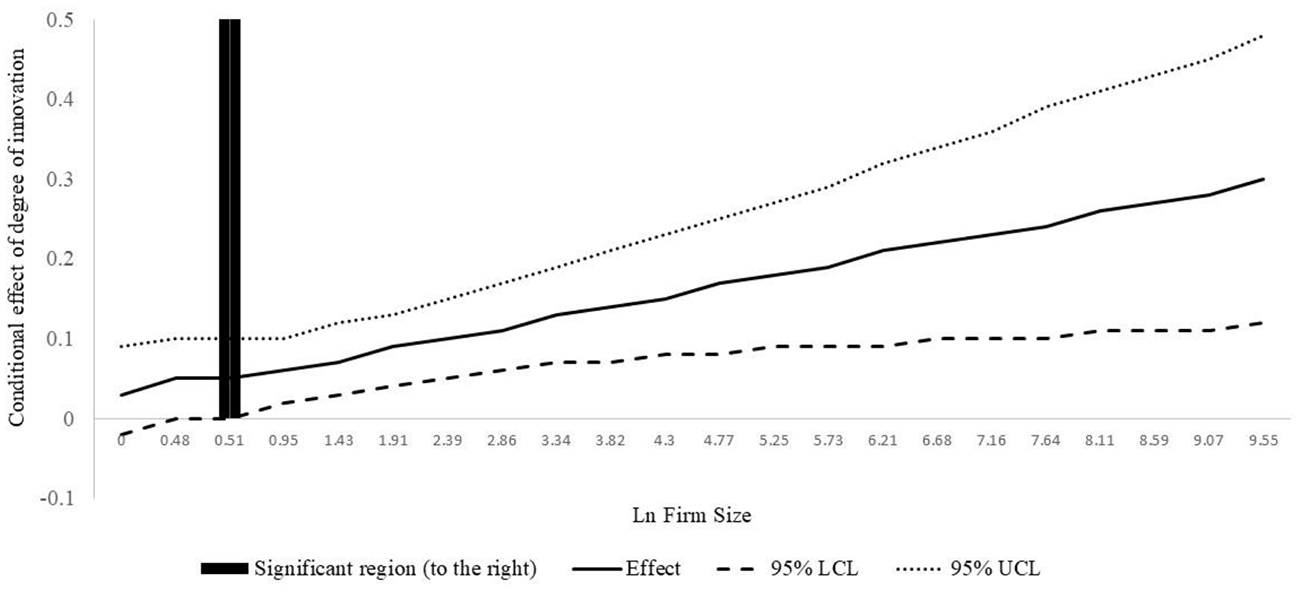
Study 2: Conditional Effect of Degree of Innovation on Firm Performance as a Function of Firm Size
Finally, in terms of control variables, restaurant type had a significant positive effect on firm performance, with casual and upscale causal/ fine dining restaurants garnering a higher spend per transaction than fast/ fast casual restaurants (β = 0.49, CI [0.24, 0.73]; and, β = 0.48, CI [0.22, 0.75] respectively). The remaining control variables, franchise status, price discounting practices, and median income, did not have a significant effect on firm performance (β = -0.02, CI [-0.29, 0.21]; β = -0.06, CI [-0.13, 0.02]; and, β = 0.19, CI [-0.08, 0.46] respectively).
Discussion
The purpose of Study 2 was to empirically examine our proposed model of moderated mediation within a crisis setting. Our findings suggest that an adhocracy culture positively, and indirectly, effects firm performance through degree of incremental product innovation, but the magnitude of that effect is dependent on firm size. Both single- and multi- unit restaurant firms experienced a positive effect of adhocracy culture on degree of incremental innovation. However, the downstream effects on firm performance was only significant for multi-unit firms.
General Discussion
There is a lack of consensus in the literature regarding the role and impact of innovation within organizations. Much of this disagreement has stemmed from the different ways in which innovation has been conceptualized and measured (Camisón & Monfort-Mir, 2012). In this research, our specific focus was degree of incremental product innovation, its role, and that of firm size, in the adhocracy culture-firm performance relationship during a crisis.
The findings of this research contribute to the literature in a number of ways. First, prior research in the domain of the competing values model of organizational culture suggests that one or more organizational cultures can dominate within a specific context (White et al., 2003). The findings of Study 1 extend this line of research to a crisis setting, suggesting that two cultures may dominate, adhocracy and clan, but serve different purposes. In line with the argument that the entrepreneurial thinking and creativity inherent in the adhocracy culture is necessary to navigate uncertain and unpredictable conditions (Alvesson & Lindkvist 1993; Wei et al., 2014), we found that the dominance of an adhocracy culture was strongly linked to rapid incremental product innovation in response to an unprecedented crisis situation. For example, a number of participants noted that, while their organizations gravitate towards a hierarchy culture under “normal” operating conditions that support an internal focus on efficiency and consistency (White et al., 2003), an adhocracy culture dominated during the crisis. This notion that leadership encouraged an adhocracy culture to dominate in this context (e.g., allowing teams the autonomy to be creative) reflects a recognition that an adhocracy culture is a key organizational resource that can be leveraged to support innovation. An emphasis on fostering an adhocracy culture allowed management, and their teams, to innovate, experiment, and take risks, and that positively impacted the types, and degree of incremental product innovation that participants’ firms engaged in. While not the focus of this research, the findings of Study 1 also provided evidence that, while a dominant adhocracy culture is essential to innovation activity within a crisis, it does not preclude the potential role of other types of culture in shaping a firm’s response to a crisis. As indicated by a number of participants, a clan culture strongly shaped their response to the crisis, not in terms of their innovation efforts, but rather with regard to how firms focused efforts towards taking care of employees, and supporting the community.
Second, prior research posits that firm performance is contingent on the fit of the dominant culture with the external environment (Wei et al., 2014). This suggests that, the better the fit of the dominant culture, the more positive the effect of culture on firm performance. However, the findings of Study 2 suggest that an adhocracy culture in of itself will not drive firm performance in a crisis setting. In line with R-A theory (Hunt & Morgan, 1995, 1996), we found that an adhocracy culture constitutes a key organizational resource that can facilitate, and drive rapid incremental product innovation, thus influencing firm performance indirectly through degree of incremental product innovation.
Third, we extend the work of Andries and Stephan (2019) regarding the effects of firm size on the innovation-firm performance relationship. In line with the notion that innovation, in of itself, will not drive superior performance (Farooq et al., 2021), our findings suggest a boundary condition on the nature of the indirect relationship between an adhocracy culture and firm performance. The positive, indirect effects of an adhocracy culture on firm performance through degree of incremental product innovation are moderated by firm size. Consistent with R-A theory, our findings from Study 1 suggest that the resource advantage of larger firms (i.e., access to better resources, particularly technology, for distribution and customer engagement; Coviello et al., 2000; Rogers, 2004) can yield advantages in the context of incremental product innovation in terms of building customer awareness of, and access to, a re-imagined product portfolio. Study 2 also provides empirical support for this influence of firm size, consistent with the thesis that economies of scale and scope in an organization can positively impact innovation outcomes (Moch & Morse, 1977). These findings add credence to the idea that, despite being innovative, firms may lose out on realizing the benefits of innovative practices if those practices are not implemented effectively (Klein & Knight, 2005).
Fourth, while not hypothesized, our findings in relation to the direct negative effect of firm size on degree of incremental product innovation contribute to the literature regarding the firm size-innovation adoption relationship. While some researchers have provided evidence that larger firms have a greater capacity to innovate (Minguela-Rata et al., 2014), others have suggested that smaller, more nimble firms are able to implement innovative practices more rapidly (Andries & Stephan, 2019). Our findings support the latter proposition, suggesting that, during a crisis, “smallness” and firm’s nimbleness are a better fit (vs. larger firms) with incremental product innovation. Arguably, incremental product innovation in the COVID-19 context was possible without major investment—barring investment in personal protective equipment, and packaging—thus offsetting the potential advantage that larger firms have in terms of access to resources for innovation. Our findings related to firm size are also consistent with the argument put forth by Knott and Vieregger (2020): Small firms appear to be better at generating innovations, whereas large firms appear to be better at appropriating returns from innovation.
Implications for Industry
In alignment with our main findings, the most crucial implication for industry is that an adhocracy culture can play a critical role in driving incremental product innovation during times of crisis when firms are in the greatest need to survive and stay competitive. It behooves restaurant industry professionals to invest in creating an adhocracy culture orientation in their firms given that the next crisis is always around the corner. This can be achieved by firms in at least two ways: first, by creating an environment that allows employees to share their ideas that propel the company forward; and second by hiring personnel that fit the characteristics of an adhocracy culture (i.e., innovative, creative, entrepreneurial thinkers). Providing onboarding programs that emphasize the firm’s adhocracy cultural orientation could ensure that employees understand the importance of their potential role in driving innovation. In order to reward successful ideas, firms could institute performance management programs that support the focus on adhocracy culture characteristics. Prior research suggests that top management leader benevolence (i.e., being humane, supportive, caring, and kind) can also result in employees becoming more creative (Karakas & Sarigollu, 2012; Lin et al., 2018). Thus, adopting a leadership style that fits an adhocracy culture is also key to fostering an innovative, think outside the box workplace.
Our findings with regard to firm size have implications for how firms approach the development and diffusion of incremental product innovations during a crisis. While larger firms have the advantage of resources to diffuse their innovations, they lack small firms’ ability to develop nimble responses during a crisis. Thus, larger firms need to foster an adhocracy culture to enable them to overcome barriers to innovating their product and service offerings, and quickly adapt to crisis-induced environmental change. In terms of incremental product innovation diffusion, smaller firms could, in the short-term, strategically partner with third party vendors for marketing and distribution. A longer-term consideration for small firms could be to consider franchising to harness the support and resources of a larger system such that returns on any crisis-induced investment in incremental product innovation are optimized.
Finally, our findings suggest that certain types of restaurants may be better positioned to drive innovation activity during a crisis. We found that casual and upscale causal/ fine dining restaurants engaged in a greater degree of incremental innovation than fast/fast casual restaurants. Arguably upscale casual, and fine dining restaurants, by virtue of offering greater personalization (vs. standardization) of products and services than fast food/fast casual restaurants, have a greater opportunity to leverage incremental product innovation practices in a crisis setting. Upscale casual/fine dining operators should capitalize on that advantage.
Limitations and Directions for Further Research
We chose the restaurant industry as the context for this study because the mandated shift to a restricted business model in the early days of the COVID-19 crisis provided the opportunity to examine the variables of interest within a crisis setting that was unprecedented in its magnitude and severity. Research is also needed to expand our understanding of the role of incremental product innovation across other hospitality sectors in response to severe market-led crises. We also limited the scope of our analyses to the first 8 weeks that restaurants were closed for dine-in business so that we could examine the immediate effects of an adhocracy culture, and rapid incremental product innovation on firm performance. That said, further research is needed to examine the longer-term effects of continued crisis-induced changes to restaurants’ operating models on firm performance (e.g., the re-introduction of “normal operating conditions” such as in-restaurant dining but with mandated, limited capacities). Such research would also facilitate the inclusion of volume-related metrics (e.g., total sales) to assess firm performance as demand begins to grow again following the initial crisis, and even during post-crisis recovery. Further, while the focus of this study was incremental product innovation, the role of other types of innovation, (e.g., technological innovation), and their antecedents and consequences, in a crisis setting merit examination. On a related note, the types of incremental product innovations explored in this research arguably do not demand as much financial/resource outlay as other types of innovation. Firm size could potentially have a positive effect on the degree to which firms can engage in those other types of innovation during a crisis. This aspect of firm size impact should be further explored.
Concluding Summary
This research proposed a moderated mediation model, wherein degree of incremental product innovation mediates the relationship between adhocracy culture and firm performance, and firm size moderates the degree of incremental innovation-firm performance relationship. Our goal was to understand the nature of the relationships between these variables within a crisis setting. We conducted two empirical studies, one qualitative and the other quantitative in nature, within the context of the U.S. restaurant industry’s COVID-19 crisis-induced shift to a restricted business model. Our findings underscore the need for a nimble adhocracy culture to drive rapid incremental product innovation, and the impact that firm size, both positive and negative, can have on degree of incremental product innovation, and incremental product innovation diffusion during a crisis.
Supplemental Material
sj-docx-1-jht-10.1177_10963480221086846 – Supplemental material for Firm Performance During a Crisis: Effects of Adhocracy Culture, Incremental Product Innovation, and Firm Size
Supplemental material, sj-docx-1-jht-10.1177_10963480221086846 for Firm Performance During a Crisis: Effects of Adhocracy Culture, Incremental Product Innovation, and Firm Size by Breffni M. Noone, Michael S. Lin and Amit Sharma in Journal of Hospitality & Tourism Research
Footnotes
Authors’ Note:
This study was supported by a grant from the Social Science Research Institute and the Huck Institutes of the Life Sciences at Penn State University

Supplemental material
Supplemental material for this article is available online.
Notes
References
Supplementary Material
Please find the following supplemental material available below.
For Open Access articles published under a Creative Commons License, all supplemental material carries the same license as the article it is associated with.
For non-Open Access articles published, all supplemental material carries a non-exclusive license, and permission requests for re-use of supplemental material or any part of supplemental material shall be sent directly to the copyright owner as specified in the copyright notice associated with the article.
